

Coping with Fear of and Exposure to Terrorism among Expatriates



Abstract
1. Introduction
2. What Is Terrorism?
- ◾
- Involve violent acts or acts dangerous to human life;
- ◾
- Appear to be intended to intimidate or coerce a civilian population; to influence the policy of a government by intimidation or coercion; or to affect the conduct of a government by mass destruction, assassination, or kidnapping; and
- ◾
- Transcend national boundaries in terms of the means by which they are accomplished, the persons they appear intended to intimidate or coerce, or the locale in which their perpetrators operate or seek asylum.
3. What Is an Expatriate?
legally working individuals who reside temporarily in a country of which they are not a citizen in order to accomplish a career-related goal, being relocated abroad either by an organization, by self-initiation or directly employed within the host-country (p. 20).
4. Coping with Exposure to Terrorism: Models and Research
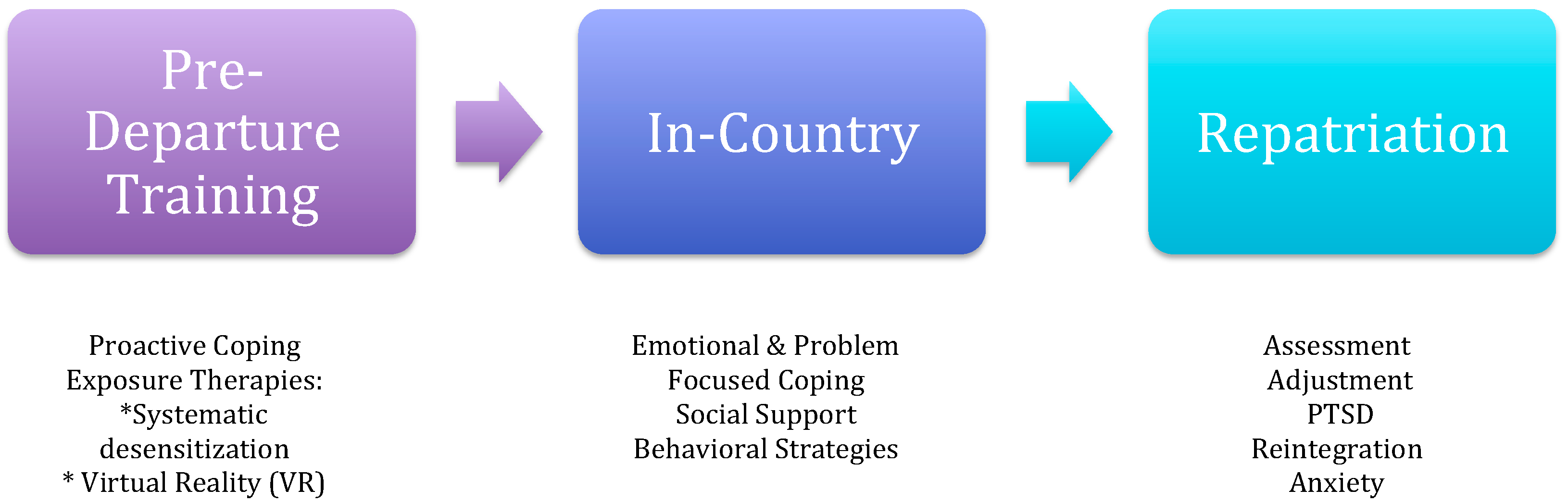
5. Coping during Different Stages of Expatriation
5.1. Pre-Departure Coping Strategies
First, we believe that the subjects in the process of leaving their own country should be mentally healthy and not feeling frightened by either the place of destination or the assigned tasks. According to Lazarus and Folkman (1984), if an expatriate is worried and anxious, it is less likely that he/she will ever adjust. Therefore, it is essential to help expatriates to prevent the development of any type of fear (p. 9).
Particularly during high impact, low probability events, appropriate personnel response relies upon the ability to perform their designated roles. Unforeseen psychological effects of stress brought about by unfamiliar environments or situations can impair decision-making and directly affect performance, leading to degradation of even routinely practiced skills. Disaster or public health emergency training scenarios incorporating real event elements (e.g., large crowds, damage to infrastructure, background noise, and visual and auditory cues) can better approximate real life conditions while retaining the advantages of a controlled environment. This increased practice realism enables responders to gauge their individual and/or team’s ability to execute tasks and decision-making under more closely representative conditions [44].
5.2. In-Country Strategies
5.3. Repatriation Strategies
6. Discussion
7. Contributions and Implications
8. Conclusions
Acknowledgments
Author Contributions
Conflicts of Interest
References
- Peel, M. Fear Stalks Expatriate Workers in Libya. Available online: https://www.ft.com/content/9011befa-7f16-11e0-b239-00144feabdc0?mhq5j=e1 (accessed on 2 June 2017).
- Kastenmüller, A.; Greitemeyer, T.; Aydin, N.; Tattersall, A.J.; Peus, C.; Bussmann, P.; Fischer, J.; Frey, D.; Fischer, P. Terrorism threat and networking: Evidence that terrorism salience decreases occupational networking. J. Organ. Behav. 2011, 32, 961–977. [Google Scholar] [CrossRef] [Scilit]
- Larobina, M.D.; Pate, R.L. The impact of terrorism on business. J. Glob. Bus. Issues 2009, 3, 147–156. [Google Scholar]
- Bader, B.; Berg, N. The influence of terrorism on expatriate performance: A conceptual approach. Int. J. Hum. Resour. Manag. 2014, 25, 539–557. [Google Scholar] [CrossRef] [Scilit]
- Mainiero, L.A.; Gibson, D.E. Managing employee trauma: Dealing with the emotional fallout from 9–11. Acad. Manag. Exec. 2003, 17, 130–143. [Google Scholar] [CrossRef] [Scilit]
- Bader, A.K.; Reade, C.; Froese, F.J. Terrorism and expatriate withdrawal cognitions: The differential role of perceived work and non-work constraints. Int. J. Hum. Resour. Manag. 2016. [Google Scholar] [CrossRef] [Scilit]
- Fee, A.; McGrath-Champ, S. The role of human resources in protecting expatriates: Insights from the international aid and development sector. Int. J. Hum. Resour. Manag. 2017, 28, 1960–1985. [Google Scholar] [CrossRef] [Scilit]
- Gannon, J.; Paraskevas, A. In the line of fire: Managing expatriates in hostile environments. Int. J. Hum. Resour. Manag. 2017. [Google Scholar] [CrossRef] [Scilit]
- Fee, A.; McGrath-Champ, S.; Berti, M. Protecting expatriates in hostile environments: Institutional forces influencing the safety and security practices of internationally active organisations. Int. J. Hum. Resour. Manag. 2017. [Google Scholar] [CrossRef] [Scilit]
- Miranda, J. Global Terrorism, Insurgency, and Guerilla Warfare in the 21st Century. Modern War: Military History in the Making 2017. Available online: http://shop.strategyandtacticspress.com/ProductDetails.asp?ProductCode=MW30M (accessed on 2 June 2017).
- Maguen, S.; Papa, A.; Litz, B.T. Coping with the threat of terrorism: A review. Anxiety Stress Coping 2008, 21, 15–35. [Google Scholar] [CrossRef] [Scilit] [PubMed]
- Silverman, A.L. Just war, jihad, and terrorism: A comparison of western and islamic norms for the use of political violence. J. Church State 2002, 44, 73–92. [Google Scholar] [CrossRef] [Scilit]
- Shah, Z. Jihad and terrorism: A comparative study. Dialogue 2009, 4, 526–554. [Google Scholar]
- Veness, S.D. Global Trends in Terrorism. Available online: http://georgetownsecuritystudiesreview.org/2017/02/24/gssr-special-issue-what-the-new-administration-needs-to-know-about-terrorism-and-counterterrorism/ (accessed on 2 June 2017).
- Harvey, M.; Dabic, M.; Kiessling, T.; Maley, J.; Moeller, M. Engaging in duty of care: Towards a terrorism preparedness plan. Int. J. Hum. Resour. Manag. 2017. [Google Scholar] [CrossRef] [Scilit]
- McNulty, Y.; Brewster, C. Theorizing the meaning(s) of ‘expatriate’: Establishing boundary conditions for business expatriates. Int. J. Hum. Resour. Manag. 2016. [Google Scholar] [CrossRef] [Scilit]
- Sims, R.H.; Schraeder, M. An examination of salient factors affecting expatriate culture shock. J. Bus. Manag. 2004, 10, 73–87. [Google Scholar]
- Feitosa, J.; Kreutzer, C.; Kramperth, A.; Kramer, W.S.; Salas, E. Expatriate adjustment: Considerations for selection and training. J. Glob. Mob. 2014, 2, 134. [Google Scholar] [CrossRef] [Scilit]
- Shaffer, M.A.; Harrison, D.A.; Gregersen, H.; Black, J.S.; Ferzandi, L.A. You can take it with you: Individual differences and expatriate effectiveness. J. Appl. Psychol. 2006, 91, 109–125. [Google Scholar] [CrossRef] [Scilit] [PubMed]
- Sanchez, J.I.; Spector, P.E.; Cooper, C.L. Adapting to a boundaryless world: A developmental expatriate model. Acad. Manag. Exec. 2000, 14, 96–106. [Google Scholar] [CrossRef] [Scilit]
- Giorgi, G.; Montani, F.; Fiz-Perez, J.; Arcangeli, G.; Mucci, N. Expatriates’ multiple fears from terrorism to working conditions: Development of a model. Front. Psychol. 2016, 7, 1571. [Google Scholar] [CrossRef] [Scilit] [PubMed]
- Lazarus, R.S.; Folkman, S. Stress, Appraisal, and Coping; Springer: New York, NY, USA, 1984. [Google Scholar]
- Stahl, G.K.; Caligiuri, P. The effectiveness of expatriate coping strategies: The moderating role of cultural distance, position level, and time on the international assignment. J. Appl. Psychol. 2005, 90, 603–615. [Google Scholar] [CrossRef] [Scilit] [PubMed]
- Selmer, J. Effects of coping strategies on sociocultural and psychological adjustment of western expatriate managers in the prc. J. World Bus. 1999, 34, 41–51. [Google Scholar] [CrossRef] [Scilit]
- Weiss, H.M.; Cropanzano, R. Affective events theory: A theoretical discussion of the structure, causes and consequences of affective experiences at work. In Research in Organizational Behavior: An Annual Series of Analytical Essays and Critical Reviews; Cummings, B.M.S.L.L., Ed.; Elsevier Science: Amsterdam, The Netherlands, 1996; pp. 1–74. [Google Scholar]
- Aspinwall, L.G.; Taylor, S.E. A stitch in time: Self-regulation and proactive coping. Psychol. Bull. 1997, 121, 417–436. [Google Scholar] [CrossRef] [PubMed]
- Hobfoll, S.E.; Canetti-Nisim, D.; Johnson, R.J. Exposure to terrorism, stress-related mental health symptoms, and defensive coping among Jews and Arabs in Israel. J. Consult. Clin. Psychol. 2006, 74, 207–218. [Google Scholar] [CrossRef] [Scilit] [PubMed]
- Folkman, S.; Lazarus, R.S. If it changes it must be a process: Study of emotion and coping during three stages of a college examination. J. Person. Soc. Psychol. 1985, 48, 150–170. [Google Scholar] [CrossRef]
- Brenitz, S. Anticipatory stress and denial. In The Denial of Stress; Brenitz, S., Ed.; International Universities Press: New York, NY, USA, 1983; pp. 225–255. [Google Scholar]
- Hobfoll, S.E. Conservation of resources: A new attempt at conceptualizing stress. Am. Psychol. 1989, 44, 513–524. [Google Scholar] [CrossRef] [PubMed]
- Benight, C.C.; Bandura, A. Social cognitive theory of post-traumatic recovery: The role of perceived self-efficacy. Behav. Res. Ther. 2004, 42, 1129–1148. [Google Scholar] [CrossRef] [Scilit] [PubMed]
- Baquatayan, S.M.S. Stress and coping mechanisms: A historical overview. Mediterr. J. Soc. Sci. 2015, 6. [Google Scholar] [CrossRef] [Scilit]
- Hall, D.T. A model of coping with role conflict: The role behavior of college educated women. Adm. Sci. Q. 1972, 17, 471–486. [Google Scholar] [CrossRef] [Scilit]
- Aldwin, C.M. Stress, Coping, and Development: An Integrative Perspective; The Guiford Press: New York, NY, USA, 1994. [Google Scholar]
- Herman, J.L.; Tetrick, L.E. Problem-focused versus emotion-focused coping strategies and repatriation adjustment. Hum. Resour. Manag. 2009, 48, 69–88. [Google Scholar] [CrossRef] [Scilit]
- Ryans, J.K.; Shanklin, W.L. How managers cope with terrorism. Calif. Manag. Rev. 1980, 23, 66–72. [Google Scholar] [CrossRef] [Scilit]
- Beale, D.; Hoel, H. Workplace bullying, industrial relations and the challenge for management in Britain and Sweden. Eur. J. Ind. Relat. 2010, 16, 101–118. [Google Scholar] [CrossRef] [Scilit]
- Giorgi, G.; Arcangeli, G.; Mucci, N.; Cupelli, V. Economic stress in the workplace: The impact of fear of the crisis on mental health. Work 2015, 51, 135–142. [Google Scholar] [CrossRef] [Scilit] [PubMed]
- Grove, C.; Hallowell, W. The Ideal Expatriate. Available online: https://www.grovewell.com/pub-expat-assess.html (accessed on 2 June 2017).
- Perry, R.W.; Lindell, M. Understanding human response to disasters with implications for terrorism. J. Conting. Crisis Manag. 2003, 11, 49–63. [Google Scholar] [CrossRef] [Scilit]
- Knowles, G. Bomb Security Guide; Security World Publishing: Los Angeles, CA, USA, 1976. [Google Scholar]
- Meichenbaum, D.H. Cognitive modification of test anxious college students. J. Consult. Clin. Psychol. 1972, 39, 370–380. [Google Scholar] [CrossRef] [Scilit] [PubMed]
- Meichenbaum, D.H. Principles and Practice of Stress Management, 3rd ed.; Guilford Press: New York, NY, USA, 2007; p. 734. [Google Scholar]
- Hsu, E.B.; Li, Y.; Bayram, J.D.; Levinson, D.; Yang, S.; Monahan, C. State of Virtual Reality Based Disaster Preparedness and Response Training. Available online: http://currents.plos.org/disasters/article/state-of-virtual-reality-vr-based-disaster-preparedness-and-response-training/ (accessed on 2 June 2017).
- Difede, J.; Hoffman, H.G. Virtual reality exposure therapy for world trade center posttraumatic stress disorder: A case report. Cyberpsychol. Behav. 2002, 5, 529–535. [Google Scholar] [CrossRef] [Scilit] [PubMed]
- Josman, N.; Garcia-Palacios, A.; Reisberg, A.; Somer, E.; Weiss, L.T.P.; Hoffman, H. Virtual reality in the treatment of survivors of terrorism in Israel. In Novel Approaches to the Diagnosis and Treatment of Posttraumatic Stress Disorders; Roy, E., Ed.; IOS: Amsterdam, The Netherlands, 2006; pp. 196–204. [Google Scholar]
- Bader, B.; Berg, N.; Holtbrügge, D. Expatriate performance in terrorism-endangered countries: The role of family and organizational support. Int. Bus. Rev. 2015, 24, 849–860. [Google Scholar] [CrossRef] [Scilit]
- Bader, B. The power of support in high-risk countries: Compensation and social support as antecedents of expatriate work attitudes. Int. J. Hum. Resour. Manag. 2015, 26, 1712–1736. [Google Scholar] [CrossRef] [Scilit]
- Seal, K.H.; Bertenthal, D.; Miner, C.R.; Sen, S.; Marmar, C. Bringing the war back home: Mental health disorders among 103,788 US veterans returning from Iraq and Afghanistan seen at department of veterans affairs facilities. Arch. Int. Med. 2007, 167, 476–482. [Google Scholar] [CrossRef] [Scilit] [PubMed]
- Seal, K.H.; Metzler, T.J.; Gima, K.S.; Bertenthal, D.; Maguen, S.; Marmar, C.R. Trends and risk factors for mental health diagnoses among Iraq and Afghanistan veterans using department of veterans affairs health care, 2002–2008. Am. J. Public Health 2009, 99, 1651–1658. [Google Scholar] [CrossRef] [Scilit] [PubMed]
- Harvey, A.G.; Bryant, R.A. The relationship between acute stress disorder and posttraumatic stress disorder: A 2-year prospective evaluation. J. Consul. Clin. Psychol. 1999, 67, 985–988. [Google Scholar] [CrossRef]
- Arman, G. Repatriation adjustment: Literature review. J. Eur. Psychol. Stud. 2009, 1. [Google Scholar] [CrossRef] [Scilit]
- Selmer, J. Coping strategies applied by western vs overseas Chinese business expatriates in China. Int. J. Hum. Resour. Manag. 2002, 13, 19–34. [Google Scholar] [CrossRef] [Scilit]
- Bleich, A.; Gelkopf, M.; Solomon, Z. Exposure to terrorism, stress-related mental health symptoms, and coping behaviors among a nationally representative sample in Israel. JAMA 2003, 290, 612–620. [Google Scholar] [CrossRef] [Scilit] [PubMed]
- Koveshnikov, A.; Wechtler, H.; Dejoux, C. Cross-cultural adjustment of expatriates: The role of emotional intelligence and gender. J. World Bus. 2014, 49, 362–371. [Google Scholar] [CrossRef] [Scilit]
- Bernin, P.; Theorell, T.; Cooper, C.L.; Sparks, K.; Spector, P.E.; Radhakrishnan, P.; Russinova, V. Coping strategies among Swedish female and male managers in an international context. Int. J. Stress Manag. 2003, 10, 376–391. [Google Scholar] [CrossRef] [Scilit]
- Schmid, A. Terrorism as psychological warfare. Democr. Sec. 2005, 1, 137–146. [Google Scholar] [CrossRef] [Scilit]
- Claus, L. Duty of Care of Employers for Protecting International Assigness, Their Dependends, and International Business Travelers; AEA International Pte. Ltd.: London, UK, 2009. [Google Scholar]
© 2017 by the authors. Licensee MDPI, Basel, Switzerland. This article is an open access article distributed under the terms and conditions of the Creative Commons Attribution (CC BY) license (http://creativecommons.org/licenses/by/4.0/).
Share and Cite
Beutell, N.J.; O’Hare, M.M.; Schneer, J.A.; Alstete, J.W. Coping with Fear of and Exposure to Terrorism among Expatriates. Int. J. Environ. Res. Public Health 2017, 14, 808. https://doi.org/10.3390/ijerph14070808
Beutell NJ, O’Hare MM, Schneer JA, Alstete JW. Coping with Fear of and Exposure to Terrorism among Expatriates. International Journal of Environmental Research and Public Health. 2017; 14(7):808. https://doi.org/10.3390/ijerph14070808
Chicago/Turabian StyleBeutell, Nicholas J., Marianne M. O’Hare, Joy A. Schneer, and Jeffrey W. Alstete. 2017. "Coping with Fear of and Exposure to Terrorism among Expatriates" International Journal of Environmental Research and Public Health 14, no. 7: 808. https://doi.org/10.3390/ijerph14070808
APA StyleBeutell, N. J., O’Hare, M. M., Schneer, J. A., & Alstete, J. W. (2017). Coping with Fear of and Exposure to Terrorism among Expatriates. International Journal of Environmental Research and Public Health, 14(7), 808. https://doi.org/10.3390/ijerph14070808

