Article

Seasonal Patterns of Japanese Encephalitis and Associated Meteorological Factors in Taiwan

1
Internal Medicine Chest Division, Chi-Mei Medical Center, Liouying, Tainan 736, Taiwan
2
Division of Infection Control and Biosafety, Centers for Disease Control, Ministry of Health and Welfare, Taipei 104, Taiwan
3
School of Public Health, National Defense Medical Center, National Defense University, Taipei 117, Taiwan
4
Research Center for Environmental Changes, Academia Sinica, 115, Taiwan
5
Department of Occupational Medicine, Tainan Municipal Hospital (Managed by Show Chwan Medical Care Corporation), Tainan 701, Taiwan
6
Department of Public Health, College of Medicine, National Cheng Kung University, Tainan 701, Taiwan
*
Author to whom correspondence should be addressed.
Int. J. Environ. Res. Public Health 2017, 14(11), 1317; https://doi.org/10.3390/ijerph14111317

Submission received: 22 September 2017 / Revised: 25 October 2017 / Accepted: 27 October 2017 / Published: 29 October 2017
(This article belongs to the Special Issue Environmental Determinants of Infectious Disease Transmission)

Abstract

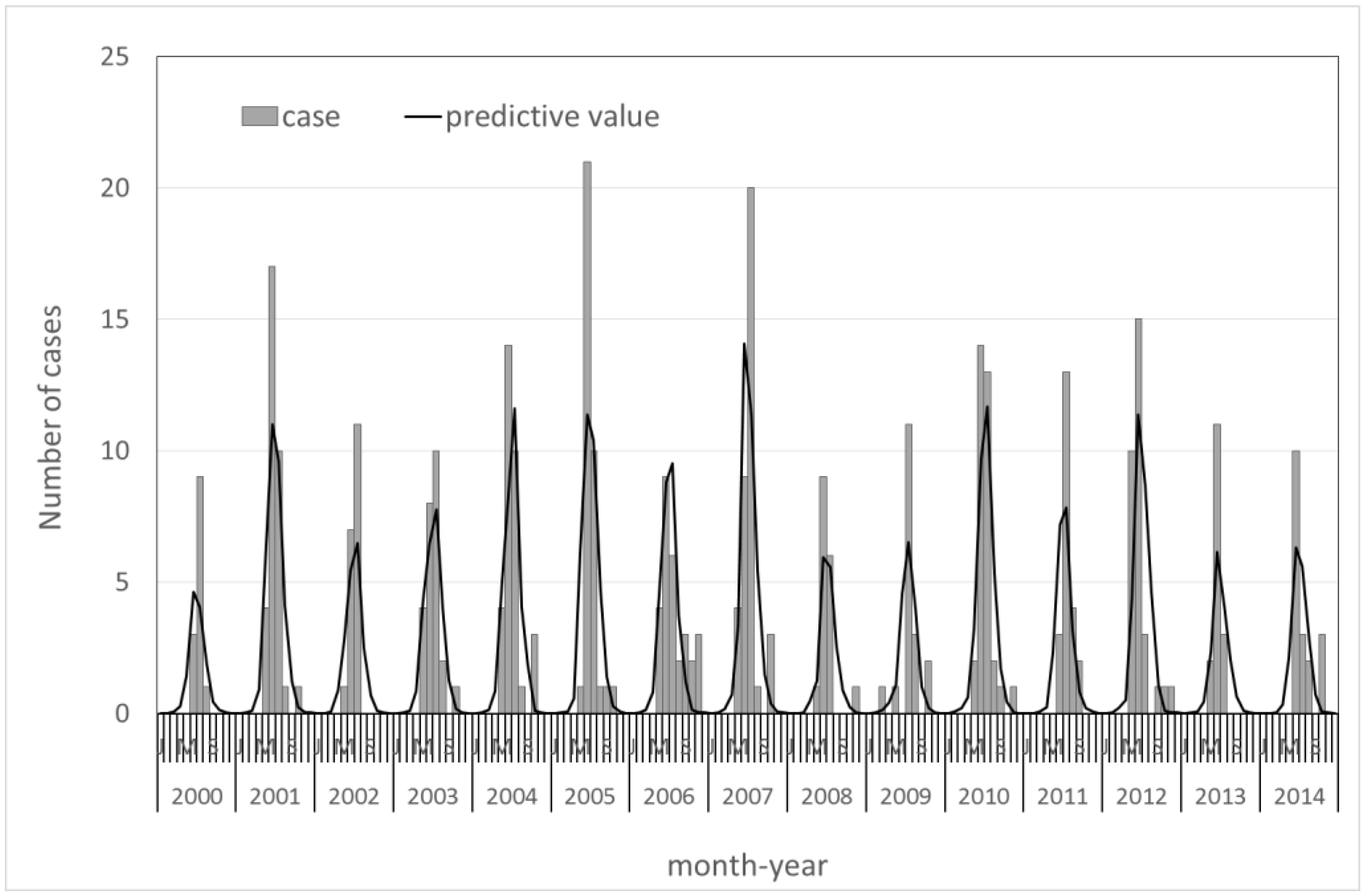
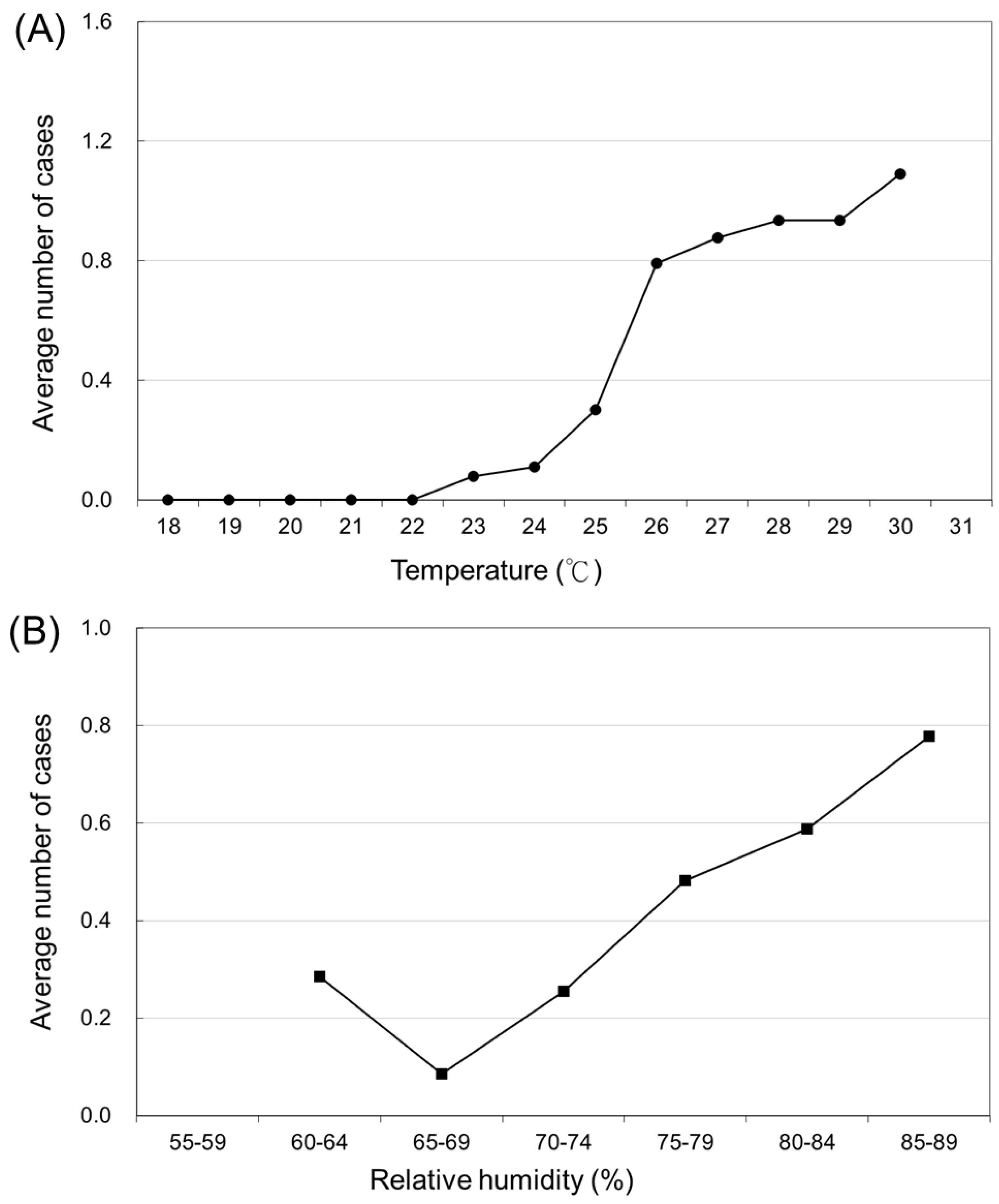
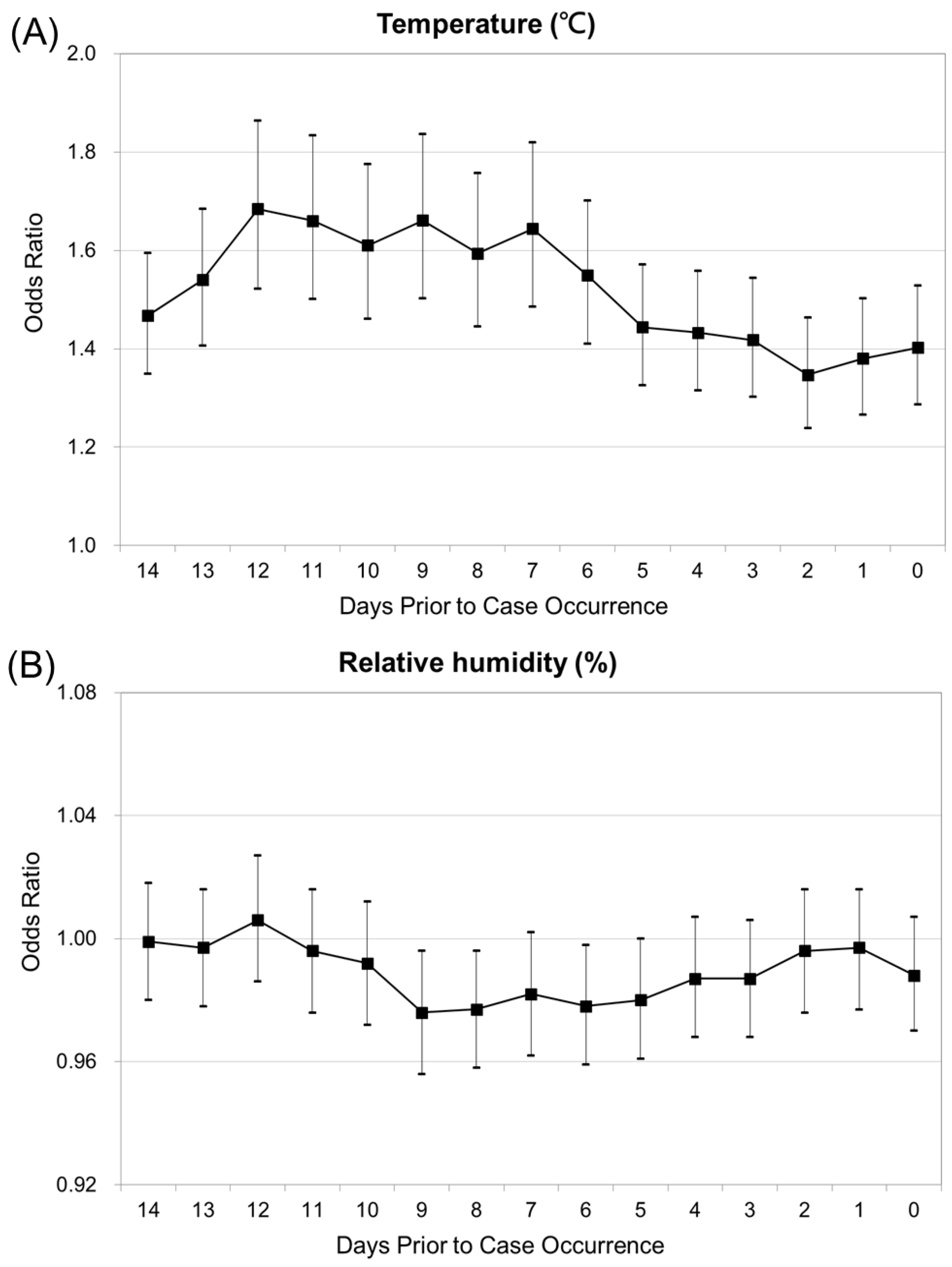
The persistent transmission of Japanese encephalitis virus (JEV) in Taiwan necessitates exploring the risk factors of occurrence of Japanese encephalitis (JE). The purpose of this study was to assess the relationship between meteorological factors and the incidence of JE in Taiwan. We collected data for cases of JE reported to the Taiwan Centers for Disease Control (Taiwan CDC) from 2000 to 2014. Meteorological data were obtained from the Taiwan Central Weather Bureau. The relationships between weather variability and the incidence of JE in Taiwan were determined via Poisson regression analysis and a case-crossover methodology. During the 15-year study period, a total of 379 cases of JE were reported. The incidence of JE showed significant seasonality, with the majority of cases occurring in summertime (for oscillation, p < 0.001). The number of JE cases started to increase at temperatures of 22 °C (r2 = 0.88, p < 0.001). Similarly, the number of JE cases began to increase at a relative humidity of 70–74% (r2 = 0.75, p < 0.005). The number of JE cases was positively associated with mean temperature and relative humidity in the period preceding the infection. In conclusion, the occurrence of JE is significantly associated with increasing temperature and relative humidity in Taiwan. Therefore, these factors could be regarded as warning signals indicating the need to implement preventive measures.
Keywords: infectious diseases; climate; modeling; mosquito infectious diseases; climate; modeling; mosquito