

Brown Seaweed Phlorotannins: Chemical Diversity, Sustainable Extraction, Selective Quantification, Ageing-Related Bioactivities, and Phlorotannin-First Biorefinery Potential


Abstract
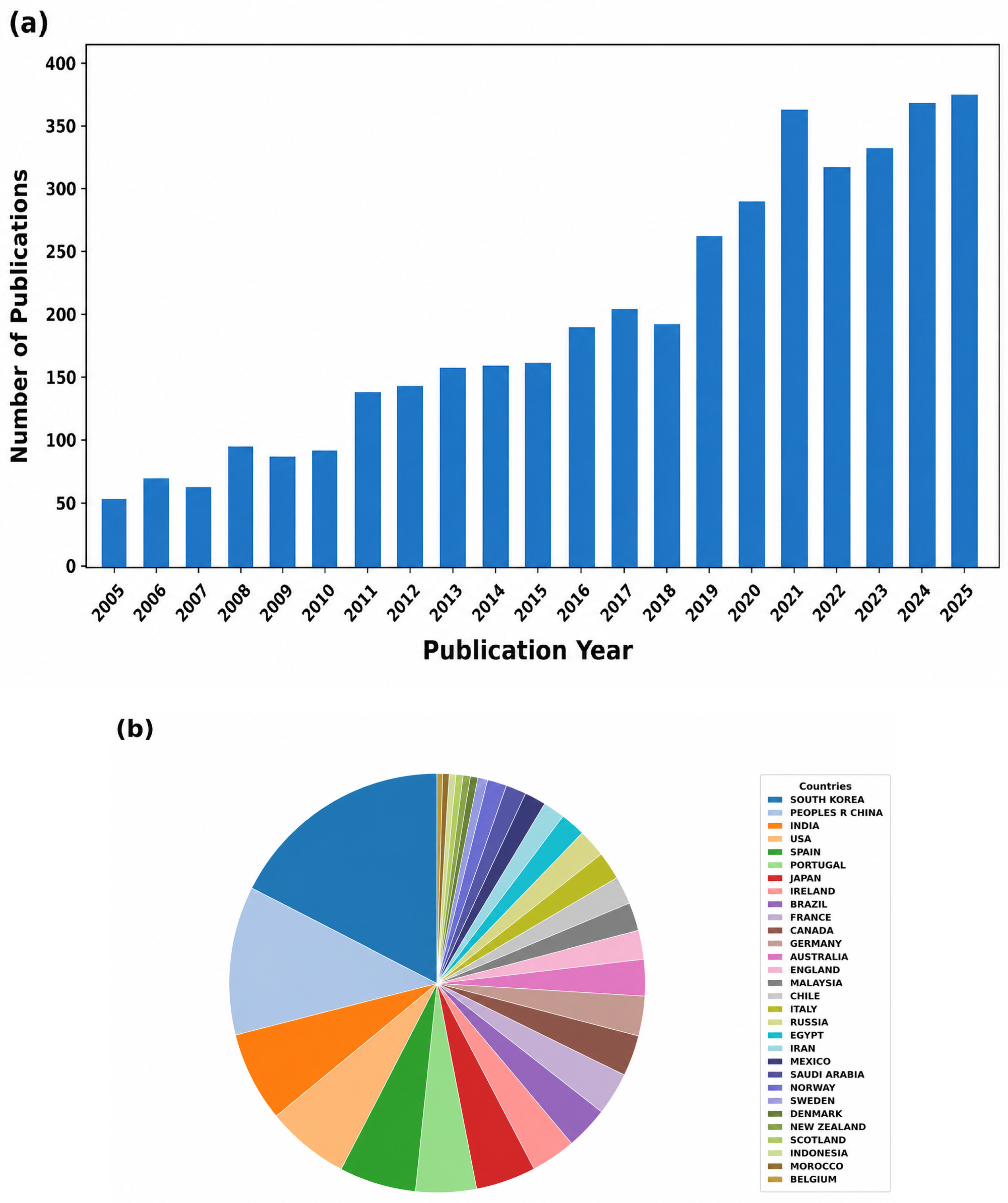
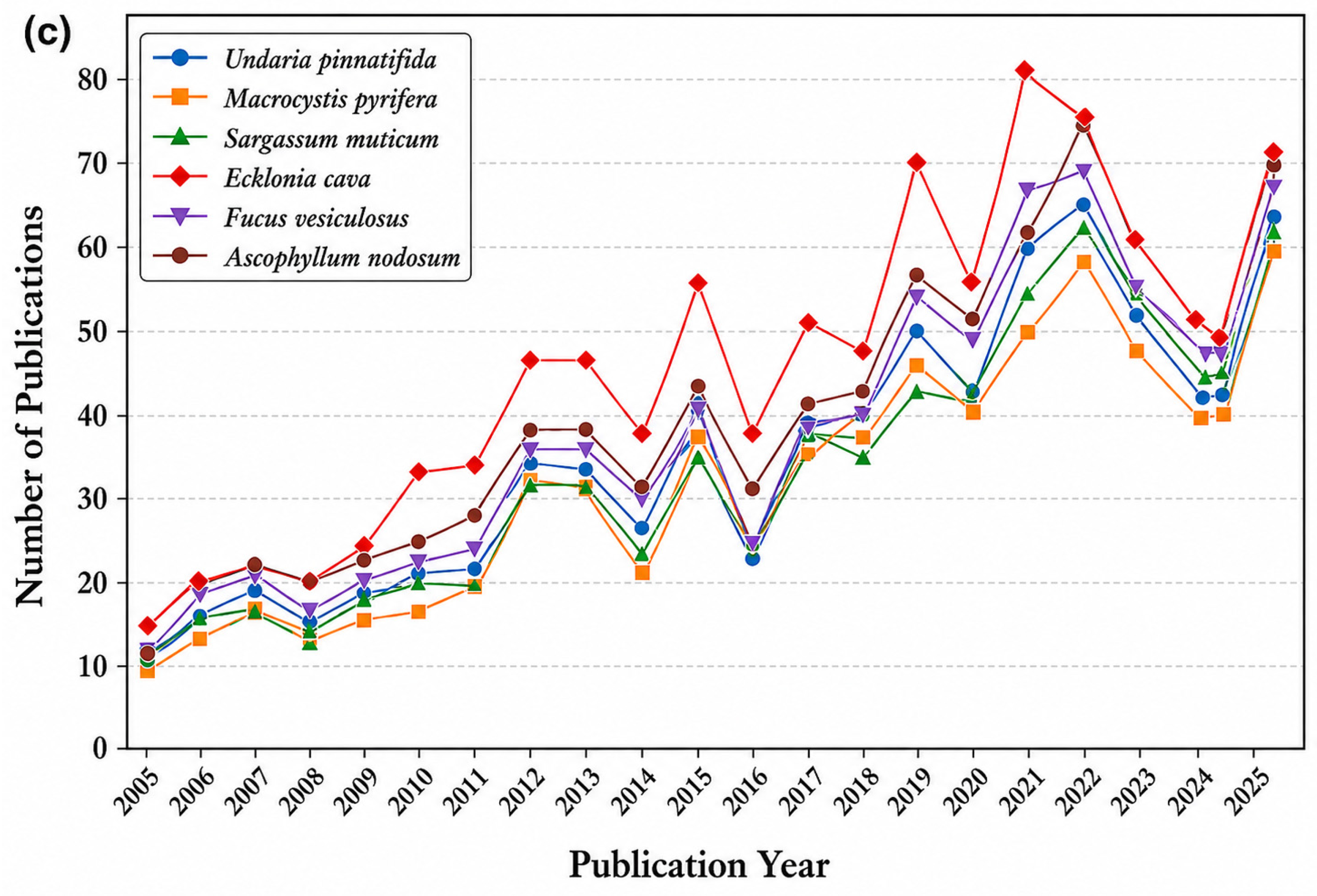
1. Introduction
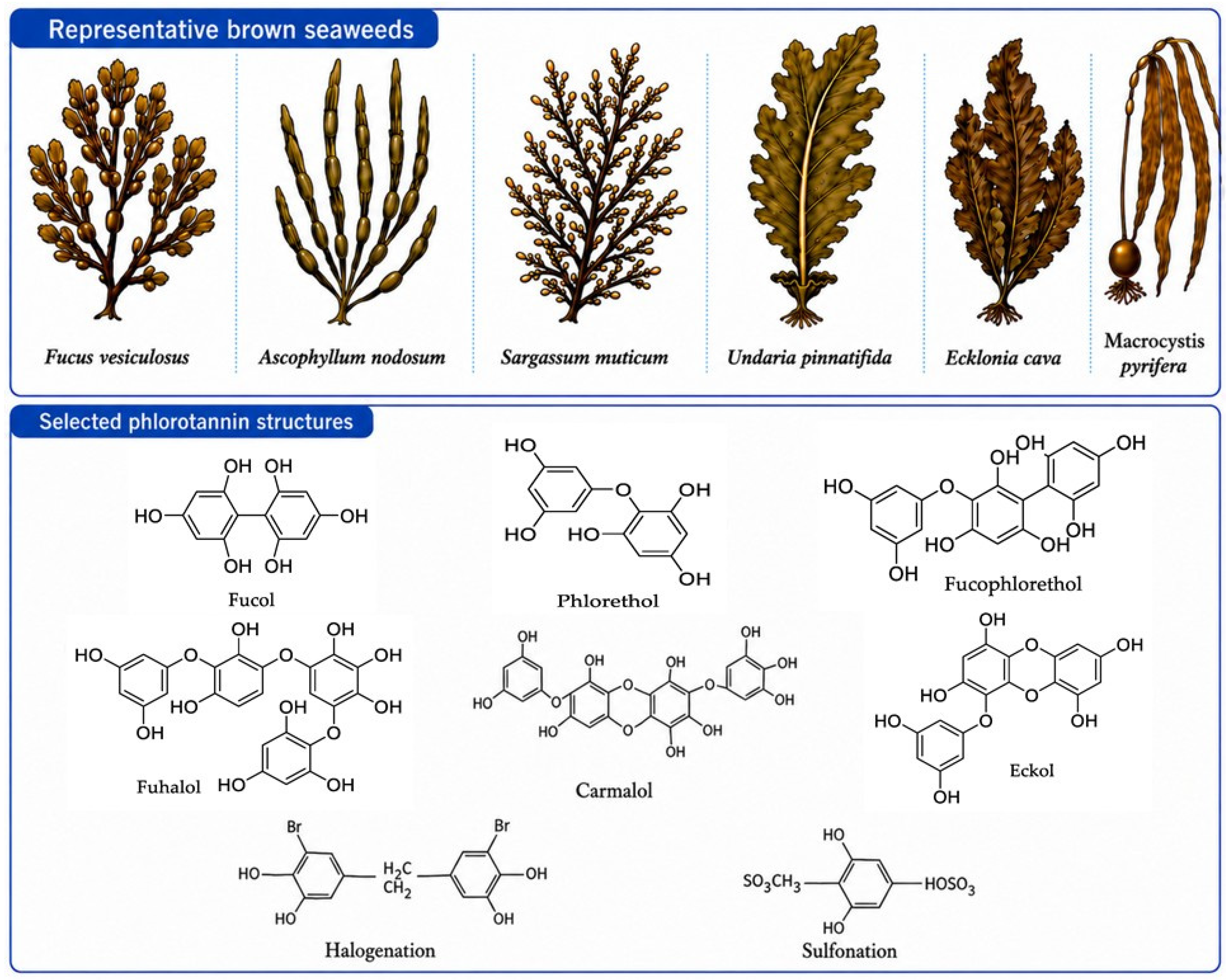
2. Chemical Foundation, Biosynthesis, and Comparative Species Availability of Phlorotannins

| Species | Reported Phlorotannin Oligomers/Compound Groups | References |
|---|---|---|
| Ascophyllum nodosum | Fucol/phlorethol/fucophlorethol | [23,26,27,33,40,45,46,60,75,76,78,130] |
| Bifurcaria bifurcata | Trihydroxyheptafuhalol | [131] |
| Carpophyllum flexuosum/Cystophora flexuosum | Hydroxyhexafuhalol; dihydroxyhexafuhalol; bifuhalol; hydroxytrifuhalol;tetrafuhalol | [68,106] |
| Cystoseira abies-marina | Fucol/phlorethol/fucophlorethol | [132] |
| Cystoseira barbata | Fucol/phlorethol/fucophlorethol | [133] |
| Durvillaea antarctica | Fucol/phlorethol/fucophlorethol | [134] |
| Fucus distichus | Fucol/phlorethol/fucophlorethol | [135] |
| Fucus spiralis | Fucol/phlorethol/fucophlorethol | [64,136,137,138] |
| Fucus vesiculosus | Fucol/phlorethol/fucophlorethol; hexafucol; tetrafucophlorethol; fucofuropentaphlorethol; heptafucol; trifucotriphlorethol; difucotetraphlorethol; pentafucodiphlorethol; hexafucophlorethol; tetrafucotetraphlorethol | [15,16,17,30,42,51,53,64,82,85,86,89,90,131,139] |
| Sargassum fusiforme | Fucol/phlorethol/fucophlorethol; tetraphlorethoxycarmalol; hexafuhalol; hydroxyhexafuhalol; dihydroxytetraphlorethoxycarmalol; dihydroxyhexafuhalol; pentaphlorethoxycarmalol; heptafuhalol; hydroxyheptafuhalol; dihydroxypentaphlorethoxycarmalol; dihydroxyheptafuhalol; hexaphlorethoxycarmalol; dihydroxynonafuhalol; trihydroxyhexaphlorethoxycarmalol; trihydroxyoctafuhalol; trihydroxynonafuhalol; trihydroxydecafuhalol; tetrahydroxydecafuhalol; tetrahydroxyfuhalol; pentahydroxyfuhalol | [35,69,70,78,116] |
| Sargassum muticum | Hexaphlorethol; hexafuhalol; hydroxyhexafuhalol; dihydroxyhexafuhalol; trihydroxyhexafuhalol; heptaphlorethol; hydroxyheptafuhalol; dihydroxyheptafuhalol; trihydroxyheptafuhalol; octafuhalol; dihydroxynonafuhalol; trihydroxyoctafuhalol; nonafuhalol; decafuhalol | [110,114,117,119,122] |
| Sargassum vulgare | Dibenzodioxine-1,3,6,8-tetraol; fuhalol; pentaphlorethol; fucopentaphlorethol; dihydroxypentafuhalol | [12] |
| Macrocystis pyrifera | Phloroeckol; tetrameric phlorofucofuroeckol; phloroethol o fucols | [124,125] |
| Laminaria digitata | Fuhalol; carmalol; phloroethol; fucophloroethol | [43,140,141] |
| Laminaria hyperborea | Phlorotannins trimer; tetramer; hexamer; sulfated dimer | [58,142] |
| Eisenia arborea | Eckol; phlorofucofuroeckol; phloroeckol; fucophloroethol; phloroethol o fucols | [143] |
| Ecklonia kurome | Eckol; phlorofucofuroeckol; dieckol; 8,8′-bieckol; phloroethol | [93,100] |
| Ecklonia stolonifera | Phlorofucofuroeckol A; dieckol; dioxinodehydroeckol | [20,47] |
| Ecklonia cava | Dieckol; 8,8′-bieckol; 7-phloroeckol; 2-O-(2,4,5-trihydroxyphenyl)-6,6′-bieckol; 6,6′-bieckol; phlorofucofuroeckol-A; eckol; 2-phloroeckol; fucofuroeckol | [22,29,41,47,92,94,95,96,97,101,104,105] |
| Ecklonia radiata | Fucol;fucodiphlorethol G; phloroeckol; eckol; phloroeckol isomer 2; dieckol; diphlorethohydroxycarmalol; 6,6’-bieckol; eckmaxol; eckmaxol isomer 1; dieckol isomer 1; dioxinodehydroeckol; phlorofucofuroeckol | [99,102,103] |
| Undaria pinnatifida | Bifuhol; trifuhalol; tetrafuhalol | [78,127,128,129] |
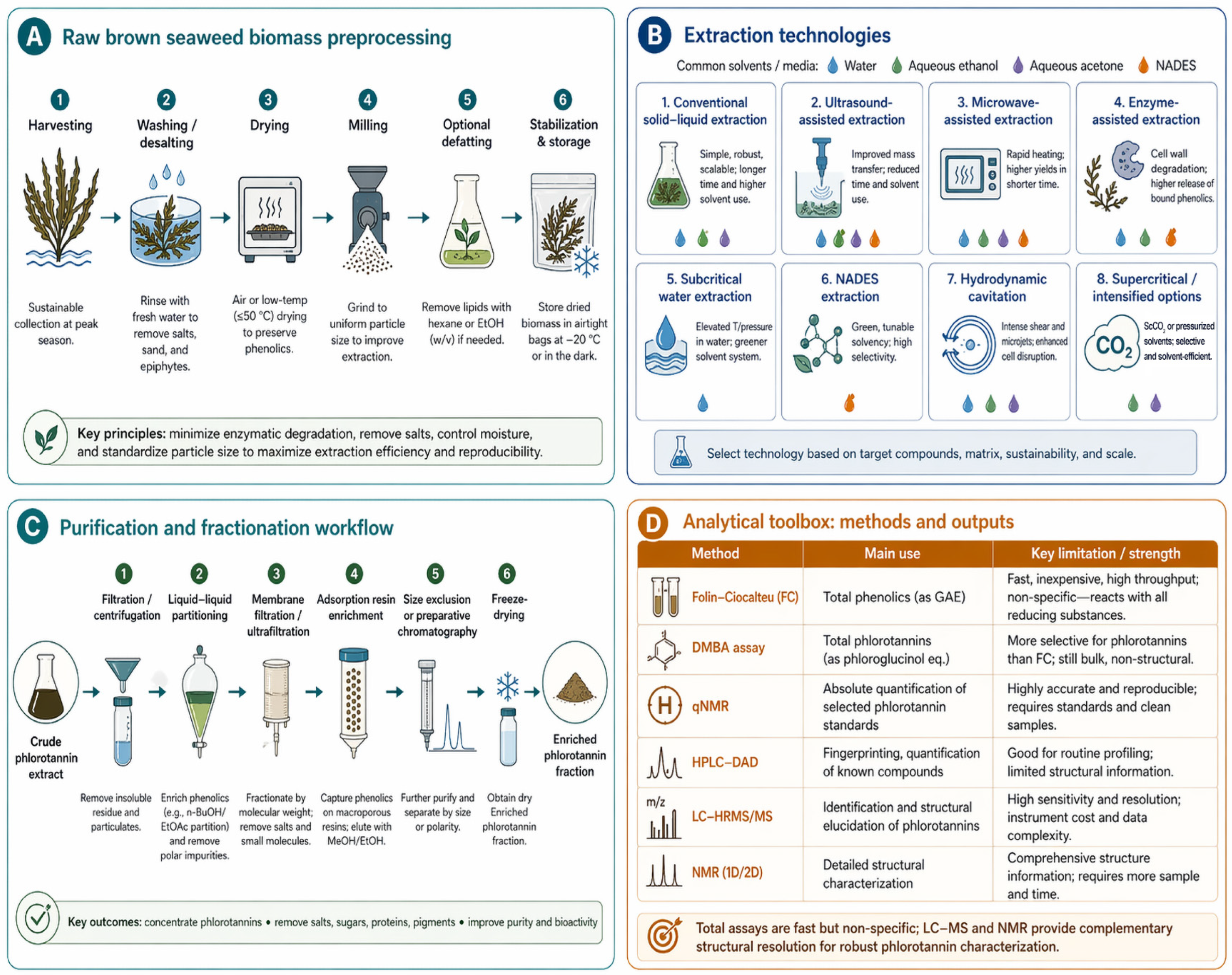
3. Extraction Methods and Sustainable Recovery of Phlorotannins
Advancement in the Sustainable Extraction of Phlorotannins from Brown Seaweed Using NADES
| Ref./Study | Species/Location | Extraction Method | Clean-Up Method | Separation/Characterization | Detection Technique | Quantification/Bioactivity |
|---|---|---|---|---|---|---|
| [57] | Residual Sargassum filipendula | DES extraction using N,N-dimethylamino-ethanol:benzyl alcohol 1.30:1 and N,N-dimethylamino-ethanol:1,3-propanediol 1.83:1; 68.4–74.4 °C selective, 120 °C maximum pigment/phlorotannin extraction | np | Optimization of the DES process | FC assay | TPC: F–C, UV-Vis DPPH, ABTS, FRAP |
| [51] | Fucus vesiculosus | NADES-UAE of phlorotannins. (lactic acid:choline chloride; 3:1) provides a high yield of phlorotannins under the following extraction conditions: extraction time 23 min, 30.0% water concentration and 1:12 sample to solvent ratio. | np | HPLC-HRMS and MS/MS technique | MS/MS | TPC: F–C, UV-Vis |
| [102] | Ecklonia radiata | NaDES-UAE solvents tested, choline chloride:lactic acid (molar ratio of 1:3) supplemented with 20% water, was the most effective for the extraction of phlorotannin. | np | UPLC-MS/MS | MS/MS | TPC: F–C, UV-Vis |
| [50] | Saccharina latissima | UAE-WRNADES betaine and 1,3-butanediol (1:1) 1:20 w/w biomass to solvent ratio and a 1 h extraction time at 50 °C. | XAD-07 with ethanol and water washing | qNMR | NMR | TPC: F–C, UV-Vis |
| [83] | Fucus vesiculosus | Frozen samples thawed for 2 h at room temperature, and then mixed at a ratio of 1:10 (w/v) with NADES Lactic acid:Choline chloride 3:1 and Lactic acid:Glucose:H2O 5:1:3. The UAE was performed for 20 and 60 min. | np | Optimization of UAE-DES process for antioxidant activity | FC assay | TPC: F–C, UV-Vis |
| [8] | Fucus vesiculosus L. and Ascophyllum nodosum (L.) | The extraction efficiency of polyphenols was evaluated using 10 NADES based on choline chloride, lactic acid, betaine, and glucose in various mole ratios. The effect of H2O on the extraction of phlorotannins from aqueous solutions of NADES was studied. | np | Optimization of the NADES process for extraction of phlorotannin | Folin–Ciocalteu | TPC: F–C, UV-Vis |
| [153] | Fresh and storm-cast Ascophyllum nodosum, White Sea, Russia | Freeze-dried, powdered algae (0.5 grams of sample) were suspended in 5 mL of 70% acetone and subjected to continuous shaking in a 360-degree rotating shaker (Bio RS-24 BioSan, Latvia) for one hour at 4–6 °C. | np | FTIR + UV/Vis method validation | FC assay at 750 nm, 45 min, phloroglucinol standard | FTIR and TPC: F–C, UV-Vis |
| [139] | Fucus vesiculosus, Iceland | SLE, 80% aqueous ethanol, 200 rpm, 24 h | Extraction with ethyl acetate | UHPLC; 3 μm ODS-3, 150 × 2 mm column | DAD-ECD- QTOFMS | — |
| [129] | Undaria pinnatifida, China | PLE (52% ethanol in water; 5.2 h heating at 170 °C) | np | UPLC | Triple-TOF/MS (TOF MS/MS) | TPC: F–C, UV-Vis |
| [154] | Undaria pinnatifida, Japan | SLE (distilled water; 10 min constant shaking in water bath at 80 °C) | np | HPLC; column (C18 Kinetex; 150 mm × 4.6 mm × i.d. 2.6 μm) Mobile phase; water-acetic acid (99:1, v/v) water-acetonitrile-acetic acid (67:32:1, v/v/v) | DAD | TPC: F–C, UV-Vis |
| [116] | Sargassum fusiforme, China | SLE, 52% ethanol/water, 50 °C, 3 h | Ethyl acetate extraction | UHPLC, Poroshell 120 EC-C18 | DAD-ESI-QTOF-MS | TPC: F–C, UV-Vis |
| [110] | Sargassum muticum (1) Norway (2) Portugal (3) Ireland (4) Spain (5) France | PLE (ethanol: water (95:5); 10.3 MPa for 20 min at 160 °C) | Multi-step purification; (1) PLE samples were re-dissolved in water then LL extraction with dichloromethane (2) acetone and ethanol extraction | LC × LC D1; Lichrospher diol-5 column (150 × 1.0 mm, 5 μm) D2; C18 (50 × 4.6 mm, 2.7 μm) Mobile phase | D1; DAD D2; Ion trap MS | TPC: F–C, DMBA (UV–Vis) |
| [141] | Laminaria digitata, Scotland | SLE (80% aqueous methanol; macroalgae were bead-milled for 1.5 h, then filtered over a cellulose filter) | Extraction with ethyl acetate and normal phase-flash chromatography using hexane, acetone and methanol as eluents | Reversed phase-UHPLC; C18 column (2.1 mm × 150 mm i.d., particle size 1.7 μm) Mobile phase; Acetonitrile and water containing 0.1% v/v formic acid | DAD-ESI-MS, MALDI TOF MS and NMR | TPC: DMBA and F–C (UV–Vis), NMR |
| [155] | Sargassum muticum, France | (1) EAE (0.1 M sodium acetate- acetic acid buffer; viscozyme; 2 h at 50 °C/pH 4.5). (2) PLE (ethanol: water (25:75, v/v) for 20 min at 120 °C). (3) EAE-PLE (0.1 M phosphate buffer; alcalase; 2 h at 50 °C/pH 7.0 +ethanol: water (25:75, v/v) at for 20 min at 120 °C) (4) EAE-PLE (0.1 M sodium acetate-acetic acid buffer; viscozyme; 2 h at 50 °C/pH 4.5+ethanol: water (25:75, v/v) for 20 min at 120 °C) | np | HPLC; XDB-C18 column (4.6 × 150 mm, 5 μm) Mobile phase; Water (0.1% formic acid) and acetonitrile | DAD-Ion trap MS | TPC: DMBA, F–C (UV–Vis) |
| [76] | Ascophyllum nodosum, Iceland | SLE (aqueous ethanol 30% (i); at 25 °C in 30 min, aqueous ethanol 80% (ii); 20 h at 25 °C +10 h at 65 °C) | Two-step purification by two SPE cartridges using 100% acetonitrile and 0.25% aqueous acetic acid | UHPLC; CSH Phenyl-hexyl UPLC column (2.1 mm × 100 mm, 1.7 μm, 130 Å) Mobile phase; water and acetonitrile/water (95/5, v/v) both containing 10 mM ammonium formate | DAD-ESI- Ion-trap MS | TPC: F–C, UV-Vis |
| [138] | Ascophyllum nodosum, Ireland | SLE, cold water; ethanol/water, shaking, room temperature | SPE and HPLC-grade water fractionation | UPLC-PFP and UPLC-C18 | TQD-MS | — |
| [68] | Carpophyllum flexuosum, New Zealand | (1) MAE (Milli-Q water; the dried and milled sample extracted in a focused microwave reactor at 160 °C for 3 min) (2) SLE (sequential solvent mixtures; methanol: water (1:1), acetone: water (7:3), both mixtures at pH 2 controlled by HCl | Dichloromethane partition, ethyl acetate extraction | HPLC-C18, 250 × 4.6 mm, 5 µm | DAD-ESI-MS, NMR | TPC: F–C, UV-Vis |
| [147] | Fucus vesiculosus Ireland | SLE (ethanol: water (80:20); shaking at 150 rmp and room temperature for 24 h) | Multi-step purification: (1) partitioned with HPLC-grade water (2) fractionated by Molecular Weight Cut-off Dialysis (3) fractionated using a two-step Reversed- Phase Flash Chromatography | UPLC-PFP, water/acetonitrile/formic acid | TQD-MS | TPC: F–C, UV-Vis |
| [107] | Saccharina latissima | PLE and MAE with GRAS solvents; MAE: 80 °C, 2% EtOH/water, 40 mL/g; PLE2: 80 °C water | np | Optimization of PLE and MAE for phlorotannin | FC assay | TPC: F–C, UV-Vis |
| [62] | Durvillaea incurvata | USAE with 32.5% ethanol–water | Diaion HP-20 resin purification | FTIR, HPLC-IR, UHPLC-QToF-MS/MS | Spectrophotometry and MS/MS | DMBA colorimetric method |
| [156] | Dictyopteris justii | UAE optimized by Box–Behnken: 70% ethanol, 1:10 solid/liquid, 25 °C, 20 min | np | Chromatographic indication of hydroxypentafuhalol-B | DMBA colorimetric method | DMBA colorimetric method |
4. Selective Quantification and Analytical Validation of Phlorotannins
4.1. Limitations of Folin–Ciocalteu and Bulk Colorimetric Assays
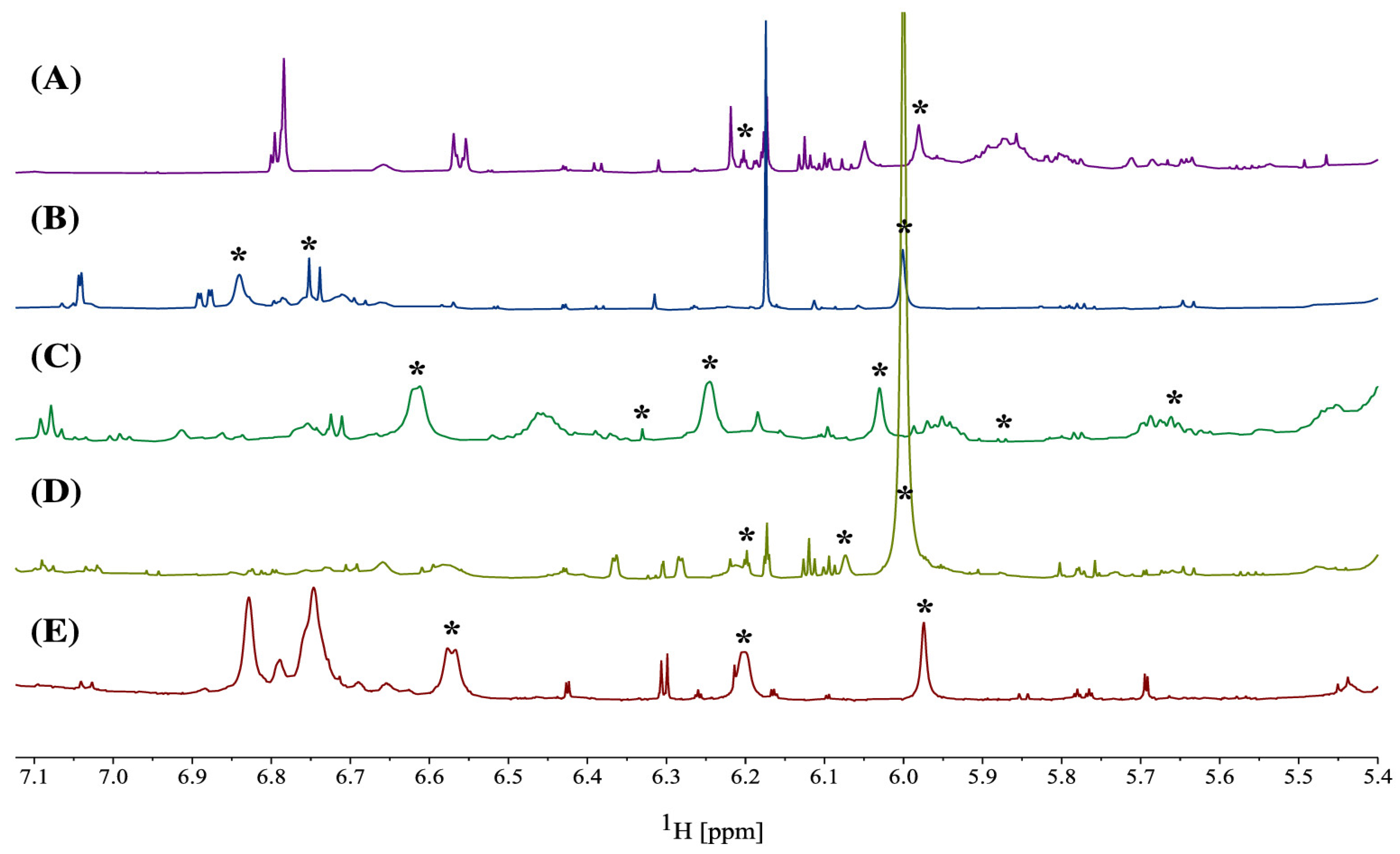
4.2. Why qNMR Matters for Phlorotannin Quantification
4.3. qNMR Versus Folin–Ciocalteu, and LC-HRMS/MS
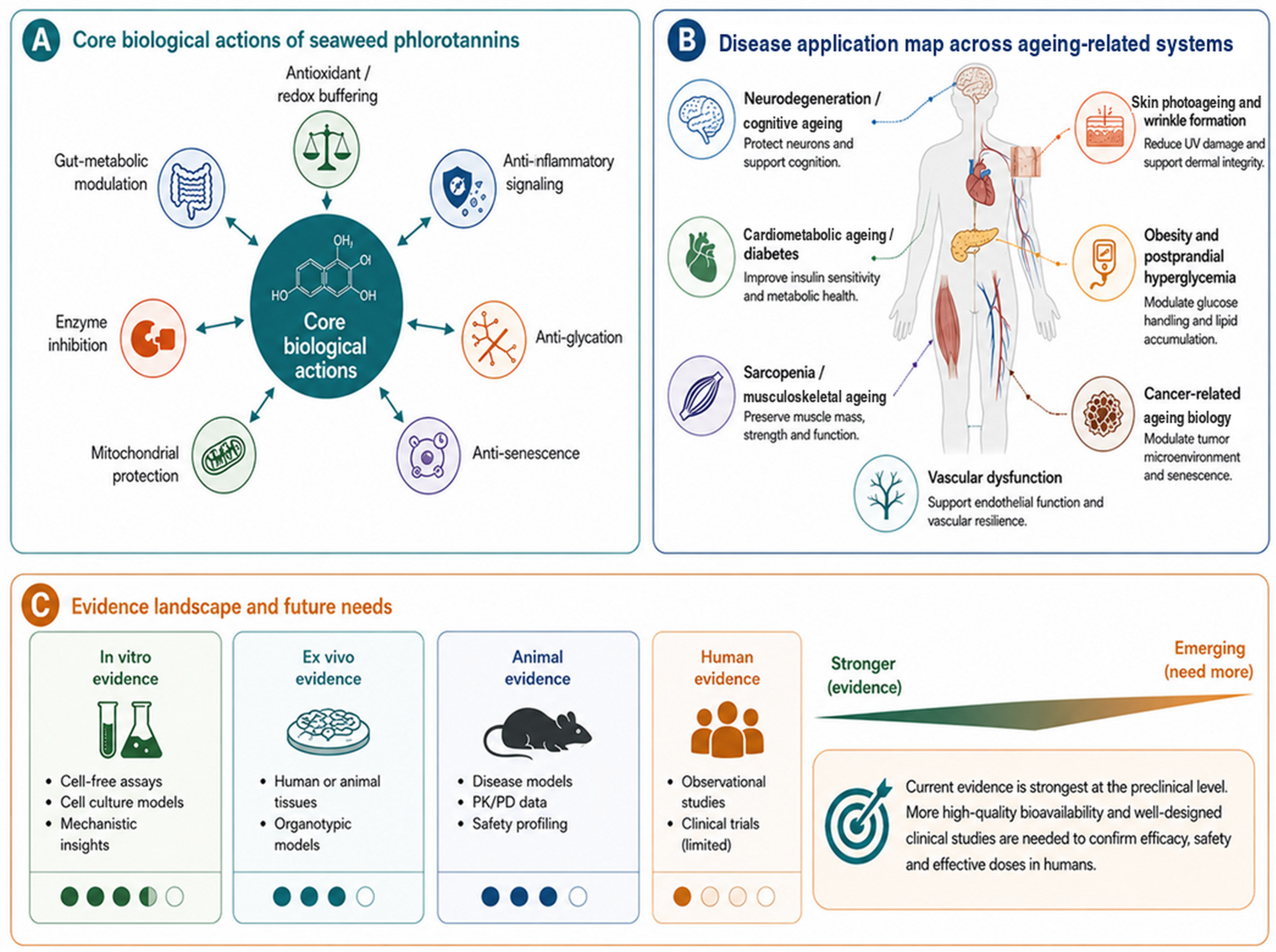
5. Biological Activities and Translational Roadmap for Ageing-Related Phlorotannin Applications
5.1. Bioavailability and Gastrointestinal Fate
5.2. Antioxidant and Redox-Buffering Functions
5.3. Antidiabetic and Metabolic-Ageing Applications
5.4. Anti-Inflammatory and Inflammaging Relevance
5.5. Anti-Glycation, Protein Carbonyl Stress, and Ageing
5.6. Neurocognitive Ageing and Skin-Ageing Products as Differentiated Development Tracks
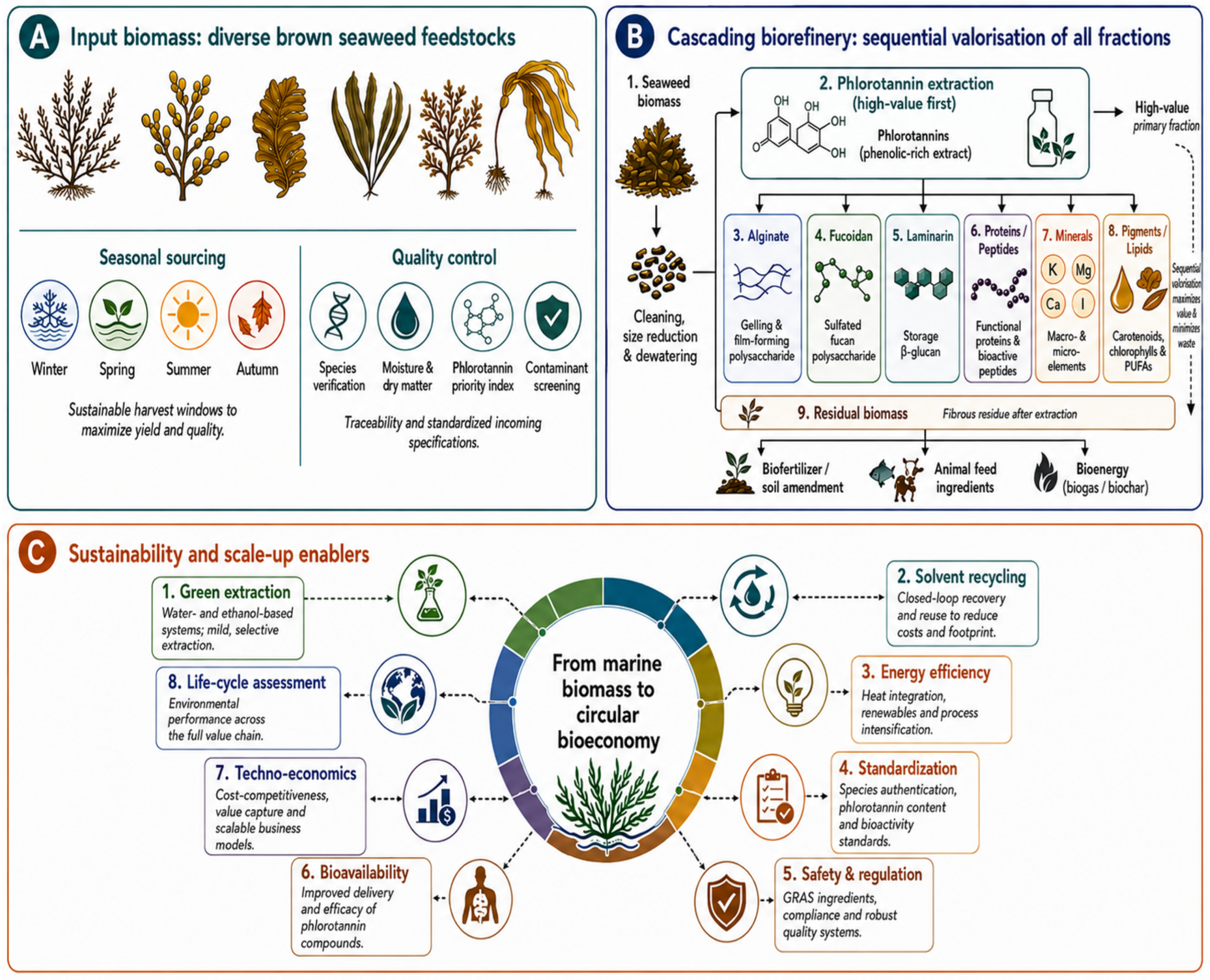
6. Phlorotannin-First Brown Seaweed Biorefinery Concept
7. Future Perspectives
8. Conclusions
Author Contributions
Funding
Institutional Review Board Statement
Data Availability Statement
Acknowledgments
Conflicts of Interest
Abbreviations
| Abbreviation | Full Term |
| ASE | Accelerated Solvent Extraction |
| DAD | Diode-Array Detection |
| DW | Dry Weight |
| EAE | Enzyme-Assisted Extraction |
| FC | Folin–Ciocalteu Assay |
| GAE | Gallic Acid Equivalents |
| HPLC | High-Performance Liquid Chromatography |
| LCA | Life-Cycle Assessment |
| LC-MS/MS | Liquid Chromatography–Tandem Mass Spectrometry |
| MAE | Microwave-Assisted Extraction |
| NADES | Natural Deep Eutectic Solvents |
| NMR | Nuclear Magnetic Resonance |
| ORAC | Oxygen Radical Absorbance Capacity |
| PGE | Phloroglucinol Equivalents |
| PLE | Pressurized Liquid Extraction |
| qNMR | Quantitative Nuclear Magnetic Resonance |
| RP-HPLC | Reversed-Phase High-Performance Liquid Chromatography |
| SPE | Solid-Phase Extraction |
| TPC | Total Phenolic Content |
| TEA | Techno-Economic Analysis |
| UAE | Ultrasound-Assisted Extraction |
| UHPLC-HRMS/MS | Ultra-High-Performance Liquid Chromatography–High-Resolution Tandem Mass Spectrometry |
| UV–Vis | Ultraviolet–Visible Spectroscopy |
| WR-NADES | Water-Rich Natural Deep Eutectic Solvents |
| XAD-7 | Amberlite XAD-7 Adsorption Resin |
References
- Catarino, M.D.; Pires, S.M.G.; Silva, S.; Costa, F.; Braga, S.S.; Pinto, D.C.G.A.; Silva, A.M.S.; Cardoso, S.M. Overview of Phlorotannins’ Constituents in Fucales. Mar. Drugs 2022, 20, 754. [Google Scholar] [CrossRef] [Scilit] [PubMed]
- Catarino, M.D.; Amarante, S.J.; Mateus, N.; Silva, A.M.S.; Cardoso, S.M. Brown Algae Phlorotannins: A Marine Alternative to Break the Oxidative Stress, Inflammation and Cancer Network. Foods 2021, 10, 1478. [Google Scholar] [CrossRef] [Scilit] [PubMed]
- Harasym, J.; Słota, P.; Pejcz, E. Phlorotannins from Phaeophyceae: Structural Diversity, Multi-Target Bioactivity, Pharmacokinetic Barriers, and Nanodelivery System Innovation. Molecules 2025, 30, 4733. [Google Scholar] [CrossRef] [Scilit] [PubMed]
- Khan, F.; Jeong, G.-J.; Khan, M.S.A.; Tabassum, N.; Kim, Y.-M. Seaweed-Derived Phlorotannins: A Review of Multiple Biological Roles and Action Mechanisms. Mar. Drugs 2022, 20, 384. [Google Scholar] [CrossRef] [Scilit] [PubMed]
- Li, Y.-X.; Wijesekara, I.; Li, Y.; Kim, S.-K. Phlorotannins as Bioactive Agents from Brown Algae. Process Biochem. 2011, 46, 2219–2224. [Google Scholar] [CrossRef] [Scilit]
- Venkatesan, J.; Keekan, K.K.; Anil, S.; Bhatnagar, I.; Kim, S.-K. Phlorotannins. In Encyclopedia of Food Chemistry; Academic Press: Cambridge, MA, USA, 2019; pp. 515–527. [Google Scholar] [CrossRef] [Scilit]
- Zheng, H.; Zhao, Y.; Guo, L. A Bioactive Substance Derived from Brown Seaweeds: Phlorotannins. Mar. Drugs 2022, 20, 742. [Google Scholar] [CrossRef] [Scilit] [PubMed]
- Obluchinskaya, E.D.; Daurtseva, A.V.; Pozharitskaya, O.N.; Flisyuk, E.V.; Shikov, A.N. Natural Deep Eutectic Solvents as Alternatives for Extracting Phlorotannins from Brown Algae. Pharm. Chem. J. 2019, 53, 243–247. [Google Scholar] [CrossRef] [Scilit]
- Abdelhamid, A.; Lajili, S.; Elkaibi, M.A.; Ben Salem, Y.; Abdelhamid, A.; Muller, C.D.; Majdoub, H.; Kraiem, J.; Bouraoui, A. Optimized Extraction, Preliminary Characterization and Evaluation of the in Vitro Anticancer Activity of Phlorotannin-Rich Fraction from the Brown Seaweed, Cystoseira sedoides. J. Aquat. Food Prod. Technol. 2019, 28, 892–909. [Google Scholar] [CrossRef] [Scilit]
- He, Z.; Chen, Y.; Chen, Y.; Liu, H.; Yuan, G.; Fan, Y.; Chen, K. Optimization of the Microwave-Assisted Extraction of Phlorotannins from Saccharina japonica Aresch and Evaluation of the Inhibitory Effects of Phlorotannin-Containing Extracts on HepG2 Cancer Cells. Chin. J. Oceanol. Limnol. 2013, 31, 1045–1054. [Google Scholar] [CrossRef] [Scilit]
- Zhang, R.; Khan, A.; Singh, J.; Kaur, L. Phlorotannins from New Zealand Brown Seaweeds: Extraction, Antioxidant Activity, and Food Applications. Food Chem. Adv. 2025, 9, 101144. [Google Scholar] [CrossRef] [Scilit]
- Chouh, A.; Nouadri, T.; Catarino, M.D.; Silva, A.M.S.; Cardoso, S.M. Phlorotannins of the Brown Algae Sargassum vulgare from the Mediterranean Sea Coast. Antioxidants 2022, 11, 1055. [Google Scholar] [CrossRef] [Scilit] [PubMed]
- Kumar, L.R.G.; Paul, P.T.; Anas, K.K.; Tejpal, C.S.; Chatterjee, N.S.; Anupama, T.K.; Mathew, S.; Ravishankar, C.N. Phlorotannins–Bioactivity and Extraction Perspectives. J. Appl. Phycol. 2022, 34, 2173–2185. [Google Scholar] [CrossRef] [Scilit] [PubMed]
- Shrestha, S.; Zhang, W.; Smid, S.D. Phlorotannins: A Review on Biosynthesis, Chemistry and Bioactivity. Food Biosci. 2021, 39, 100832. [Google Scholar] [CrossRef] [Scilit]
- Golshany, H.; Siddiquy, M.; Elbarbary, A.; Seddiek, A.S.; Kamal, A.; Yu, Q.; Fan, L. Exploring Fucus vesiculosus Phlorotannins: Insights into Chemistry, Extraction, Purification, Identification and Bioactivity. Food Biosci. 2024, 61, 104769. [Google Scholar] [CrossRef] [Scilit]
- Wang, T.; Jónsdóttir, R.; Liu, H.; Gu, L.; Kristinsson, H.G.; Raghavan, S.; Ólafsdóttir, G. Antioxidant Capacities of Phlorotannins Extracted from the Brown Algae Fucus vesiculosus. J. Agric. Food Chem. 2012, 60, 5874–5883. [Google Scholar] [CrossRef] [Scilit] [PubMed]
- Catarino, M.D.; Silva, A.M.S.; Mateus, N.; Cardoso, S.M. Optimization of Phlorotannins Extraction from Fucus vesiculosus and Evaluation of Their Potential to Prevent Metabolic Disorders. Mar. Drugs 2019, 17, 162. [Google Scholar] [CrossRef] [Scilit] [PubMed]
- Kawamura-Konishi, Y.; Watanabe, N.; Saito, M.; Nakajima, N.; Sakaki, T.; Katayama, T.; Enomoto, T. Isolation of a New Phlorotannin, a Potent Inhibitor of Carbohydrate-Hydrolyzing Enzymes, from the Brown Alga Sargassum patens. J. Agric. Food Chem. 2012, 60, 5565–5570. [Google Scholar] [CrossRef] [Scilit] [PubMed]
- Boi, V.N.; Cuong, D.X.; Vinh, P.T.K. Effects of Extraction Conditions over the Phlorotannin Content and Antioxidant Activity of Extract from Brown Algae Sargassum serratum (Nguyen Huu Dai 2004). Free Radic. Antioxid. 2016, 7, 115–122. [Google Scholar] [CrossRef] [Scilit]
- Kim, A.-R.; Shin, T.-S.; Lee, M.-S.; Park, J.-Y.; Park, K.-E.; Yoon, N.-Y.; Kim, J.-S.; Choi, J.-S.; Jang, B.-C.; Byun, D.-S.; et al. Isolation and Identification of Phlorotannins from Ecklonia stolonifera with Antioxidant and Anti-Inflammatory Properties. J. Agric. Food Chem. 2009, 57, 3483–3489. [Google Scholar] [CrossRef] [Scilit] [PubMed]
- Besednova, N.N.; Andryukov, B.G.; Zaporozhets, T.S.; Kryzhanovsky, S.P.; Fedyanina, L.N.; Kuznetsova, T.A.; Zvyagintseva, T.N.; Shchelkanov, M.Y. Antiviral Effects of Polyphenols from Marine Algae. Biomedicines 2021, 9, 200. [Google Scholar] [CrossRef] [Scilit] [PubMed]
- Cho, H.M.; Doan, T.P.; Ha, T.K.Q.; Kim, H.W.; Lee, B.W.; Pham, H.T.T.; Cho, T.O.; Oh, W.K. Dereplication by High-Performance Liquid Chromatography (HPLC) with Quadrupole-Time-of-Flight Mass Spectroscopy (qTOF-MS) and Antiviral Activities of Phlorotannins from Ecklonia cava. Mar. Drugs 2019, 17, 149. [Google Scholar] [CrossRef] [Scilit] [PubMed]
- Dutot, M.; Fagon, R.; Hemon, M.; Rat, P. Antioxidant, Anti-Inflammatory, and Anti-Senescence Activities of a Phlorotannin-Rich Natural Extract from Brown Seaweed Ascophyllum nodosum. Appl. Biochem. Biotechnol. 2012, 167, 2234–2240. [Google Scholar] [CrossRef] [Scilit] [PubMed]
- El-Bilawy, E.H.; Al-Mansori, A.-N.A.; Alotibi, F.O.; Al-Askar, A.A.; Arishi, A.A.; Teiba, I.I.; Sabry, A.E.-N.; Elsharkawy, M.M.; Heflish, A.A.; Behiry, S.I.; et al. Antiviral and Antifungal of Ulva fasciata Extract: HPLC Analysis of Polyphenolic Compounds. Sustainability 2022, 14, 12799. [Google Scholar] [CrossRef] [Scilit]
- Ford, L.; Stratakos, A.C.; Theodoridou, K.; Dick, J.T.A.; Sheldrake, G.N.; Linton, M.; Corcionivoschi, N.; Walsh, P.J. Polyphenols from Brown Seaweeds as a Potential Antimicrobial Agent in Animal Feeds. ACS Omega 2020, 5, 9093–9103. [Google Scholar] [CrossRef] [Scilit] [PubMed]
- Gisbert, M.; Sineiro, J.; Moreira, R. Influence of Oxidation and Dialysis of Phlorotannins on Bioactivity and Composition of Ultrasound-Assisted Extracts from Ascophyllum nodosum. Mar. Drugs 2022, 20, 706. [Google Scholar] [CrossRef] [Scilit] [PubMed]
- Gisbert, M.; Franco, D.; Sineiro, J.; Moreira, R. Antioxidant and Antidiabetic Properties of Phlorotannins from Ascophyllum nodosum Seaweed Extracts. Molecules 2023, 28, 4937. [Google Scholar] [CrossRef] [Scilit] [PubMed]
- Gunasekara, D.M.N.M.; Wang, L.; Herath, K.H.I.N.M.; Sanjeewa, K.K.A. Cosmeceutical Applications of Phlorotannins from Brown Seaweeds. Phycology 2025, 5, 15. [Google Scholar] [CrossRef] [Scilit]
- Kwon, H.-J.; Ryu, Y.B.; Kim, Y.-M.; Song, N.; Kim, C.Y.; Rho, M.-C.; Jeong, J.-H.; Cho, K.-O.; Lee, W.S.; Park, S.-J. In Vitro Antiviral Activity of Phlorotannins Isolated from Ecklonia cava against Porcine Epidemic Diarrhea Coronavirus Infection and Hemagglutination. Bioorg. Med. Chem. 2013, 21, 4706–4713. [Google Scholar] [CrossRef] [Scilit] [PubMed]
- Liu, H.; Gu, L. Phlorotannins from Brown Algae (Fucus vesiculosus) Inhibited the Formation of Advanced Glycation Endproducts by Scavenging Reactive Carbonyls. J. Agric. Food Chem. 2012, 60, 1326–1334. [Google Scholar] [CrossRef] [Scilit] [PubMed]
- Lomartire, S.; Gonçalves, A.M.M. Marine Macroalgae Polyphenols as Potential Neuroprotective Antioxidants in Neurodegenerative Diseases. Mar. Drugs 2023, 21, 261. [Google Scholar] [CrossRef] [Scilit] [PubMed]
- Cotas, J.; Lomartire, S.; Gonçalves, A.M.M.; Pereira, L. From Ocean to Medicine: Harnessing Seaweed’s Potential for Drug Development. Int. J. Mol. Sci. 2024, 25, 797. [Google Scholar] [CrossRef] [Scilit] [PubMed]
- Quéguineur, B.; Goya, L.; Ramos, S.; Martín, M.A.; Mateos, R.; Guiry, M.D.; Bravo, L. Effect of Phlorotannin-Rich Extracts of Ascophyllum nodosum and Himanthalia elongata (Phaeophyceae) on Cellular Oxidative Markers in Human HepG2 Cells. J. Appl. Phycol. 2013, 25, 1–11. [Google Scholar] [CrossRef] [Scilit]
- Nakai, M.; Kageyama, N.; Nakahara, K.; Miki, W. Phlorotannins as Radical Scavengers from the Extract of Sargassum ringgoldianum. Mar. Biotechnol. 2006, 8, 409–414. [Google Scholar] [CrossRef] [Scilit] [PubMed]
- Chen, B.; Chen, H.; Qiao, K.; Xu, M.; Wu, J.; Su, Y.; Shi, Y.; Ke, L.; Liu, Z.; Wang, Q. Anti-Melanogenic Activities of Sargassum fusiforme Polyphenol-Rich Extract on α-MSH-Stimulated B16F10 Cells via PI3K/Akt and MAPK/ERK Pathways. Foods 2024, 13, 3556. [Google Scholar] [CrossRef] [Scilit] [PubMed]
- Gheda, S.; Naby, M.A.; Mohamed, T.; Pereira, L.; Khamis, A. Antidiabetic and Antioxidant Activity of Phlorotannins Extracted from the Brown Seaweed Cystoseira compressa in Streptozotocin-Induced Diabetic Rats. Environ. Sci. Pollut. Res. 2021, 28, 22886–22901. [Google Scholar] [CrossRef] [Scilit] [PubMed]
- Frazzini, S.; Rizzi, N.; Fifi, A.P.; Fusi, E.; Pilu, S.R.; Rossi, L. Functional Evaluation of Fucus vesiculosus Extract: Bioactivity Retention After In Vitro Digestion and Anti-Inflammatory Effects on Murine Peritoneal Macrophages. Appl. Sci. 2025, 15, 7911. [Google Scholar] [CrossRef] [Scilit]
- O’Sullivan, A.M.; O’Callaghan, Y.C.; O’Grady, M.N.; Queguineur, B.; Hanniffy, D.; Troy, D.J.; Kerry, J.P.; O’Brien, N.M. In Vitro and Cellular Antioxidant Activities of Seaweed Extracts Prepared from Five Brown Seaweeds Harvested in Spring from the West Coast of Ireland. Food Chem. 2011, 126, 1064–1070. [Google Scholar] [CrossRef] [Scilit]
- Ouahabi, S.; Daoudi, N.E.; Loukili, E.H.; Asmae, H.; Merzouki, M.; Bnouham, M.; Challioui, A.; Hammouti, B.; Fauconnier, M.-L.; Rhazi, L.; et al. Investigation into the Phytochemical Composition, Antioxidant Properties, and In-Vitro Anti-Diabetic Efficacy of Ulva lactuca Extracts. Mar. Drugs 2024, 22, 240. [Google Scholar] [CrossRef] [Scilit] [PubMed]
- Meng, W.; Sun, H.; Mu, T.; Garcia-Vaquero, M. Extraction, Purification, Chemical Characterization and Antioxidant Properties in Vitro of Polyphenols from the Brown Macroalga Ascophyllum nodosum. Algal Res. 2023, 70, 102989. [Google Scholar] [CrossRef] [Scilit]
- Wijesekara, I.; Yoon, N.Y.; Kim, S.-K. Phlorotannins from Ecklonia cava (Phaeophyceae): Biological Activities and Potential Health Benefits. BioFactors 2010, 36, 408–414. [Google Scholar] [CrossRef] [Scilit] [PubMed]
- Koivikko, R.; Eränen, J.K.; Loponen, J.; Jormalainen, V. Variation of Phlorotannins Among Three Populations of Fucus vesiculosus as Revealed by HPLC and Colorimetric Quantification. J. Chem. Ecol. 2008, 34, 57–64. [Google Scholar] [CrossRef] [Scilit] [PubMed]
- Garcia-Vaquero, M.; Rajauria, G.; Miranda, M.; Sweeney, T.; Lopez-Alonso, M.; O’Doherty, J. Seasonal Variation of the Proximate Composition, Mineral Content, Fatty Acid Profiles and Other Phytochemical Constituents of Selected Brown Macroalgae. Mar. Drugs 2021, 19, 204. [Google Scholar] [CrossRef] [Scilit] [PubMed]
- Garcia-Vaquero, M.; Ummat, V.; Tiwari, B.; Rajauria, G. Exploring Ultrasound, Microwave and Ultrasound–Microwave Assisted Extraction Technologies to Increase the Extraction of Bioactive Compounds and Antioxidants from Brown Macroalgae. Mar. Drugs 2020, 18, 172. [Google Scholar] [CrossRef] [Scilit] [PubMed]
- Parys, S.; Kehraus, S.; Pete, R.; Küpper, F.C.; Glombitza, K.-W.; König, G.M. Seasonal Variation of Polyphenolics in Ascophyllum nodosum (Phaeophyceae). Eur. J. Phycol. 2009, 44, 331–338. [Google Scholar] [CrossRef] [Scilit]
- Pavia, H.; Toth, G.B.; Lindgren, A.; Åberg, P. Intraspecific Variation in the Phlorotannin Content of the Brown Alga Ascophyllum nodosum. Phycologia 2003, 42, 378–383. [Google Scholar] [CrossRef] [Scilit]
- Sugiura, Y.; Kinoshita, Y.; Misumi, S.; Yamatani, H.; Katsuzaki, H.; Hayashi, Y.; Murase, N. Correlation between the Seasonal Variations in Phlorotannin Content and the Antiallergic Effects of the Brown Alga Ecklonia cava subsp. stolonifera. Algal Res. 2021, 58, 102398. [Google Scholar] [CrossRef] [Scilit]
- Alara, O.R.; Abdurahman, N.H.; Ukaegbu, C.I. Extraction of Phenolic Compounds: A Review. Curr. Res. Food Sci. 2021, 4, 200–214. [Google Scholar] [CrossRef] [Scilit] [PubMed]
- Cotas, J.; Leandro, A.; Monteiro, P.; Pacheco, D.; Figueirinha, A.; Gonçalves, A.M.M.; da Silva, G.J.; Pereira, L. Seaweed Phenolics: From Extraction to Applications. Mar. Drugs 2020, 18, 384. [Google Scholar] [CrossRef] [Scilit] [PubMed]
- Zeb, L.; Gerhardt, A.S.; Johannesen, B.A.; Underhaug, J.; Jordheim, M. Ultrasonic-Assisted Water-Rich Natural Deep Eutectic Solvents for Sustainable Polyphenol Extraction from Seaweed: A Case Study on Cultivated Saccharina latissima. ACS Sustain. Chem. Eng. 2024, 12, 14921–14929. [Google Scholar] [CrossRef] [Scilit] [PubMed]
- Obluchinskaya, E.D.; Pozharitskaya, O.N.; Shevyrin, V.A.; Kovaleva, E.G.; Flisyuk, E.V.; Shikov, A.N. Optimization of Extraction of Phlorotannins from the Arctic Fucus vesiculosus Using Natural Deep Eutectic Solvents and Their HPLC Profiling with Tandem High-Resolution Mass Spectrometry. Mar. Drugs 2023, 21, 263. [Google Scholar] [CrossRef] [Scilit] [PubMed]
- Aktaş, H.; Kurek, M.A. Deep Eutectic Solvents for the Extraction of Polyphenols from Food Plants. Food Chem. 2024, 444, 138629. [Google Scholar] [CrossRef] [Scilit] [PubMed]
- Amarante, S.J.; Catarino, M.D.; Marçal, C.; Silva, A.M.S.; Ferreira, R.; Cardoso, S.M. Microwave-Assisted Extraction of Phlorotannins from Fucus vesiculosus. Mar. Drugs 2020, 18, 559. [Google Scholar] [CrossRef] [Scilit] [PubMed]
- Ummat, V.; Tiwari, B.K.; Jaiswal, A.K.; Condon, K.; Garcia-Vaquero, M.; O’Doherty, J.; O’Donnell, C.; Rajauria, G. Optimisation of Ultrasound Frequency, Extraction Time and Solvent for the Recovery of Polyphenols, Phlorotannins and Associated Antioxidant Activity from Brown Seaweeds. Mar. Drugs 2020, 18, 250. [Google Scholar] [CrossRef] [Scilit] [PubMed]
- Shafiq, M.; Ali, S.; Zeb, L. Recent Advances in NADES-Assisted Process Intensification Technologies for Sustainable Recovery of Microalgal Bioactives: Challenges and Future Prospectives. Mar. Drugs 2026, 24, 146. [Google Scholar] [CrossRef] [Scilit] [PubMed]
- Zeb, L.; Shafiq, M.; Jordheim, M. Advancements in Sustainable Extraction of Seaweed Phenolics: Integrating Extraction Technologies with Natural Deep Eutectic Solvents (NADES). Food Chem. 2025, 489, 144941. [Google Scholar] [CrossRef] [Scilit] [PubMed]
- Mello, P.A.V.P.; da Silva, C.N.; Ribeiro, B.D. Valorization of Residual Biomass from Sargassum filipendula for the Extraction of Phlorotannins and Pigments Using Eutectic Solvents. Processes 2025, 13, 1345. [Google Scholar] [CrossRef] [Scilit]
- Wekre, M.E.; Hellesen Brunvoll, S.; Jordheim, M. Advancing Quantification Methods for Polyphenols in Brown Seaweeds—Applying a Selective qNMR Method Compared with the TPC Assay. Phytochem. Anal. 2022, 33, 1099–1110. [Google Scholar] [CrossRef] [Scilit] [PubMed]
- Wekre, M.E.; Kåsin, K.; Underhaug, J.; Holmelid, B.; Jordheim, M. Quantification of Polyphenols in Seaweeds: A Case Study of Ulva intestinalis. Antioxidants 2019, 8, 612. [Google Scholar] [CrossRef] [Scilit] [PubMed]
- Allwood, J.W.; Evans, H.; Austin, C.; McDougall, G.J. Extraction, Enrichment, and LC-MSn-Based Characterization of Phlorotannins and Related Phenolics from the Brown Seaweed, Ascophyllum nodosum. Mar. Drugs 2020, 18, 448. [Google Scholar] [CrossRef] [Scilit] [PubMed]
- Gunathilaka, T.L.; Samarakoon, K.; Ranasinghe, P.; Peiris, L.D.C. Antidiabetic Potential of Marine Brown Algae—A Mini Review. J. Diabetes Res. 2020, 2020, 1230218. [Google Scholar] [CrossRef] [Scilit] [PubMed]
- Rivera-Tovar, P.R.; Contreras-Contreras, G.; Rivas-Reyes, P.I.; Pérez-Jiménez, J.; Martínez-Cifuentes, M.; Pérez-Correa, J.R.; Mariotti-Celis, M.S. Sustainable Recovery of Phlorotannins from Durvillaea incurvata: Integrated Extraction and Purification with Advanced Characterization. Antioxidants 2025, 14, 250. [Google Scholar] [CrossRef] [Scilit] [PubMed]
- Santos, S.A.O.; Félix, R.; Pais, A.C.S.; Rocha, S.M.; Silvestre, A.J.D. The Quest for Phenolic Compounds from Macroalgae: A Review of Extraction and Identification Methodologies. Biomolecules 2019, 9, 847. [Google Scholar] [CrossRef] [Scilit] [PubMed]
- Lopes, G.; Barbosa, M.; Vallejo, F.; Gil-Izquierdo, Á.; Andrade, P.B.; Valentão, P.; Pereira, D.M.; Ferreres, F. Profiling Phlorotannins from Fucus spp. of the Northern Portuguese Coastline: Chemical Approach by HPLC-DAD-ESI/MSn and UPLC-ESI-QTOF/MS. Algal Res. 2018, 29, 113–120. [Google Scholar] [CrossRef] [Scilit]
- Mahendran, S.; Sankaralingam, S.; Sethupathi, S.M.; Kathiresan, D.; Muthumani, M.; Kousalya, L.; Palpperumal, S.; Harinathan, B. Evaluation of Antioxidant and Cytotoxicity Activities of Polyphenol Extracted from Brown Seaweed Sargassum tenerrimum Biomass. Biomass Convers. Biorefinery 2024, 14, 2063–2069. [Google Scholar] [CrossRef] [Scilit]
- Ford, L.; Theodoridou, K.; Sheldrake, G.N.; Walsh, P.J. A Critical Review of Analytical Methods Used for the Chemical Characterisation and Quantification of Phlorotannin Compounds in Brown Seaweeds. Phytochem. Anal. 2019, 30, 587–599. [Google Scholar] [CrossRef] [Scilit] [PubMed]
- Magnusson, M.; Yuen, A.K.; Zhang, R.; Wright, J.T.; Taylor, R.B.; Maschmeyer, T.; de Nys, R. A Comparative Assessment of Microwave Assisted (MAE) and Conventional Solid-Liquid (SLE) Techniques for the Extraction of Phloroglucinol from Brown Seaweed. Algal Res. 2017, 23, 28–36. [Google Scholar] [CrossRef] [Scilit]
- Zhang, R.; Yuen, A.K.L.; Magnusson, M.; Wright, J.T.; de Nys, R.; Masters, A.F.; Maschmeyer, T. A Comparative Assessment of the Activity and Structure of Phlorotannins from the Brown Seaweed Carpophyllum flexuosum. Algal Res. 2018, 29, 130–141. [Google Scholar] [CrossRef] [Scilit]
- Lee, H.-H.; Kim, J.-S.; Jeong, J.-H.; Lee, S.-Y.; Kim, C.-S. Comparative Analysis of Biological Activities and Phenolic Content between Fresh and Steamed Sargassum fusiforme in Different Extraction Solvents. Appl. Sci. 2022, 12, 12161. [Google Scholar] [CrossRef] [Scilit]
- He, W.; Kong, Q.; Li, H.; Wu, Y.; Huang, R.; Yu, L.; Shen, S.; Xu, C.; Han, Y.; Ai, Y.; et al. Ultrasonic-Assisted Extraction, Purification, Identification, and Bioactivity Evaluation of Phlorotannins from Sargassum fusiforme: A Comparative Study of RSM and SVM–GA. Ultrason. Sonochem. 2026, 128, 107821. [Google Scholar] [CrossRef] [Scilit] [PubMed]
- Erpel, F.; Camilo, C.; Mateos, R.; Ricardo Pérez-Correa, J. A Macroporous Resin Purification Process to Obtain Food-Grade Phlorotannin-Rich Extracts with α-Glucosidase Inhibitory Activity from Chilean Brown Seaweeds: An UHPLC-MSn Profiling. Food Chem. 2023, 402, 134472. [Google Scholar] [CrossRef] [Scilit] [PubMed]
- Hodhodi, A.; Babakhani, A.; Rostamzad, H. Effect of Different Extraction Conditions on Phlorotannin Content and Antioxidant Activity of Extract from Brown Algae (Sargassum angustifolium). J. Food Process. Preserv. 2022, 46, e16307. [Google Scholar] [CrossRef] [Scilit]
- Gisbert, M.; Barcala, M.; Rosell, C.M.; Sineiro, J.; Moreira, R. Aqueous Extracts Characteristics Obtained by Ultrasound-Assisted Extraction from Ascophyllum nodosum Seaweeds: Effect of Operation Conditions. J. Appl. Phycol. 2021, 33, 3297–3308. [Google Scholar] [CrossRef] [Scilit]
- Bruno, A.; Velders, A.H.; Biasone, A.; Li Vigni, M.; Mondelli, D.; Miano, T. Chemical Composition, Biomolecular Analysis, and Nuclear Magnetic Resonance Spectroscopic Fingerprinting of Posidonia oceanica and Ascophyllum nodosum Extracts. Metabolites 2023, 13, 170. [Google Scholar] [CrossRef] [Scilit] [PubMed]
- Breton, F.; Cérantola, S.; Ar Gall, E. Distribution and Radical Scavenging Activity of Phenols in Ascophyllum nodosum (Phaeophyceae). J. Exp. Mar. Biol. Ecol. 2011, 399, 167–172. [Google Scholar] [CrossRef] [Scilit]
- Sardari, R.R.R.; Prothmann, J.; Gregersen, O.; Turner, C.; Nordberg Karlsson, E. Identification of Phlorotannins in the Brown Algae, Saccharina latissima and Ascophyllum nodosum by Ultra-High-Performance Liquid Chromatography Coupled to High-Resolution Tandem Mass Spectrometry. Molecules 2020, 26, 43. [Google Scholar] [CrossRef] [Scilit] [PubMed]
- Kadam, S.U.; O’Donnell, C.P.; Rai, D.K.; Hossain, M.B.; Burgess, C.M.; Walsh, D.; Tiwari, B.K. Laminarin from Irish Brown Seaweeds Ascophyllum nodosum and Laminaria hyperborea: Ultrasound Assisted Extraction, Characterization and Bioactivity. Mar. Drugs 2015, 13, 4270–4280. [Google Scholar] [CrossRef] [Scilit] [PubMed]
- Shen, P.; Gu, Y.; Zhang, C.; Sun, C.; Qin, L.; Yu, C.; Qi, H. Metabolomic Approach for Characterization of Polyphenolic Compounds in Laminaria japonica, Undaria pinnatifida, Sargassum fusiforme and Ascophyllum nodosum. Foods 2021, 10, 192. [Google Scholar] [CrossRef] [Scilit] [PubMed]
- Mega, D.F.; Sharma, P.; Kipar, A.; Hetzel, U.; Bramwell, C.; Merritt, A.; Wright, S.; Plummer, C.; Urbanowicz, R.A.; Stewart, J.P. Phlorotannin-Rich Ascophyllum nodosum Seaweed Extract Inhibits Influenza Infection. Viruses 2024, 16, 1919. [Google Scholar] [CrossRef] [Scilit] [PubMed]
- Blanc, N.; Hauchard, D.; Audibert, L.; Ar Gall, E. Radical-Scavenging Capacity of Phenol Fractions in the Brown Seaweed Ascophyllum nodosum: An Electrochemical Approach. Talanta 2011, 84, 513–518. [Google Scholar] [CrossRef] [Scilit] [PubMed]
- Bai, Y.; Li, X.; Xie, Y.; Wang, Y.; Dong, X.; Qi, H. Ultrasound Treatment Enhanced the Functional Properties of Phycocyanin with Phlorotannin from Ascophyllum nodosum. Front. Nutr. 2023, 10, 1181262. [Google Scholar] [CrossRef] [Scilit] [PubMed]
- Catarino, M.D.; Fernandes, I.; Oliveira, H.; Carrascal, M.; Ferreira, R.; Silva, A.M.S.; Cruz, M.T.; Mateus, N.; Cardoso, S.M. Antitumor Activity of Fucus vesiculosus-Derived Phlorotannins through Activation of Apoptotic Signals in Gastric and Colorectal Tumor Cell Lines. Int. J. Mol. Sci. 2021, 22, 7604. [Google Scholar] [CrossRef] [Scilit] [PubMed]
- Obluchinskaya, E.D.; Pozharitskaya, O.N.; Zakharova, L.V.; Daurtseva, A.V.; Flisyuk, E.V.; Shikov, A.N. Efficacy of Natural Deep Eutectic Solvents for Extraction of Hydrophilic and Lipophilic Compounds from Fucus vesiculosus. Molecules 2021, 26, 4198. [Google Scholar] [CrossRef] [Scilit] [PubMed]
- Karlsberger, L.; Sadova, N.; Heckmann, M.; Serenius, F.; Meinander, A.; Kirchsteiger, J.; König, A.; Schwarzinger, B.; Blank-Landeshammer, B.; Ladirat, S.; et al. From Sea to Cell: Ascophyllum nodosum and Fucus vesiculosus Extracts Attenuate NF-κB-Mediated Inflammation and Protect Intestinal Barrier Integrity—A Comprehensive Analysis Applying In Vitro and In Vivo Models. Mar. Drugs 2026, 24, 182. [Google Scholar] [CrossRef] [Scilit] [PubMed]
- Koivikko, R.; Loponen, J.; Pihlaja, K.; Jormalainen, V. High-Performance Liquid Chromatographic Analysis of Phlorotannins from the Brown Alga Fucus vesiculosus. Phytochem. Anal. 2007, 18, 326–332. [Google Scholar] [CrossRef] [Scilit] [PubMed]
- Catarino, M.D.; Marçal, C.; Bonifácio-Lopes, T.; Campos, D.; Mateus, N.; Silva, A.M.S.; Pintado, M.M.; Cardoso, S.M. Impact of Phlorotannin Extracts from Fucus vesiculosus on Human Gut Microbiota. Mar. Drugs 2021, 19, 375. [Google Scholar] [CrossRef] [Scilit] [PubMed]
- Reis, S.F.; Catarino, M.D.; Braga, S.S.; Coimbra, M.A.; Silva, A.M.S.; Cardoso, S.M. Improving in Vitro Gastrointestinal Stability of Phlorotannins From Food Grade Fucus vesiculosus Extracts Using Cyclodextrins. J. Food Sci. 2026, 91, e70830. [Google Scholar] [CrossRef] [Scilit] [PubMed]
- Gil-Martínez, L.; Santos-Mejías, A.; De la Torre-Ramírez, J.M.; Baños, A.; Verardo, V.; Gómez-Caravaca, A.M. Optimization of a Sonotrode Extraction Method and New Insight of Phenolic Composition of Fucus vesiculosus. Mar. Drugs 2025, 23, 40. [Google Scholar] [CrossRef] [Scilit] [PubMed]
- Sumampouw, G.A.; Jacobsen, C.; Getachew, A.T. Optimization of Phenolic Antioxidants Extraction from Fucus vesiculosus by Pressurized Liquid Extraction. J. Appl. Phycol. 2021, 33, 1195–1207. [Google Scholar] [CrossRef] [Scilit]
- Catarino, M.D.; Silva, A.; Cruz, M.T.; Mateus, N.; Silva, A.M.S.; Cardoso, S.M. Phlorotannins from Fucus vesiculosus: Modulation of Inflammatory Response by Blocking NF-κB Signaling Pathway. Int. J. Mol. Sci. 2020, 21, 6897. [Google Scholar] [CrossRef] [Scilit] [PubMed]
- Muñoz-Quintana, M.; Padrón-Sanz, C.; Dolbeth, M.; Arenas, F.; Vasconcelos, V.; Lopes, G. Revealing the Potential of Fucus vesiculosus Linnaeus for Cosmetic Purposes: Chemical Profile and Biological Activities of Commercial and Wild Samples. Mar. Drugs 2024, 22, 548. [Google Scholar] [CrossRef] [Scilit] [PubMed]
- Artan, M.; Li, Y.; Karadeniz, F.; Lee, S.-H.; Kim, M.-M.; Kim, S.-K. Anti-HIV-1 Activity of Phloroglucinol Derivative, 6,6′-Bieckol, from Ecklonia cava. Bioorg. Med. Chem. 2008, 16, 7921–7926. [Google Scholar] [CrossRef] [Scilit] [PubMed]
- Nagayama, K.; Iwamura, Y.; Shibata, T.; Hirayama, I.; Nakamura, T. Bactericidal Activity of Phlorotannins from the Brown Alga Ecklonia kurome. J. Antimicrob. Chemother. 2002, 50, 889–893. [Google Scholar] [CrossRef] [Scilit] [PubMed]
- Byun, K.-A.; Park, Y.; Oh, S.; Batsukh, S.; Son, K.H.; Byun, K. Co-Treatment with Phlorotannin and Extracellular Vesicles from Ecklonia cava Inhibits UV-Induced Melanogenesis. Antioxidants 2024, 13, 408. [Google Scholar] [CrossRef] [Scilit] [PubMed]
- Chakraborty, A.; Ghosh, R.; Barik, S.; Mohapatra, S.S.; Biswas, A.; Chowdhuri, S. Deciphering Inhibitory Activity of Marine Algae Ecklonia cava Phlorotannins against SARS CoV-2 Main Protease: A Coupled in-Silico Docking and Molecular Dynamics Simulation Study. Gene 2024, 926, 148620. [Google Scholar] [CrossRef] [Scilit] [PubMed]
- Lee, J.; Jun, M. Dual BACE1 and Cholinesterase Inhibitory Effects of Phlorotannins from Ecklonia cava—An In Vitro and in Silico Study. Mar. Drugs 2019, 17, 91. [Google Scholar] [CrossRef] [Scilit] [PubMed]
- Douglas, T.E.L.; Dokupil, A.; Reczyńska, K.; Brackman, G.; Krok-Borkowicz, M.; Keppler, J.K.; Božič, M.; Van Der Voort, P.; Pietryga, K.; Samal, S.K.; et al. Enrichment of Enzymatically Mineralized Gellan Gum Hydrogels with Phlorotannin-Rich Ecklonia cava Extract Seanol® to Endow Antibacterial Properties and Promote Mineralization. Biomed. Mater. 2016, 11, 045015. [Google Scholar] [CrossRef] [Scilit] [PubMed]
- Duan, X.; Subbiah, V.; Xie, C.; Agar, O.T.; Barrow, C.J.; Dunshea, F.R.; Suleria, H.A.R. Evaluation of the Antioxidant Potential of Brown Seaweeds Extracted by Different Solvents and Characterization of Their Phenolic Compounds by LC–ESI-QTOF–MS/MS. J. Food Sci. 2023, 88, 3737–3757. [Google Scholar] [CrossRef] [Scilit] [PubMed]
- Charoensiddhi, S.; Franco, C.; Su, P.; Zhang, W. Improved Antioxidant Activities of Brown Seaweed Ecklonia radiata Extracts Prepared by Microwave-Assisted Enzymatic Extraction. J. Appl. Phycol. 2015, 27, 2049–2058. [Google Scholar]
- Yotsu-Yamashita, M.; Kondo, S.; Segawa, S.; Lin, Y.-C.; Toyohara, H.; Ito, H.; Konoki, K.; Cho, Y.; Uchida, T. Isolation and Structural Determination of Two Novel Phlorotannins from the Brown Alga Ecklonia kurome Okamura, and Their Radical Scavenging Activities. Mar. Drugs 2013, 11, 165–183. [Google Scholar] [CrossRef] [Scilit] [PubMed]
- Kim, J.-E.; Choi, Y.-J.; Lee, S.-J.; Gong, J.-E.; Jin, Y.-J.; Park, S.-H.; Lee, H.-S.; Choi, Y.-W.; Hong, J.-T.; Hwang, D.-Y. Laxative Effects of Phlorotannins Derived from Ecklonia cava on Loperamide-Induced Constipation in SD Rats. Molecules 2021, 26, 7209. [Google Scholar] [CrossRef] [Scilit] [PubMed]
- Praveen, M.A.; Yu, L.; Selva, C.; Bulone, V. Optimization of Ultrasound-Assisted Natural Deep Eutectic Solvent Extraction for the Recovery of Bioactive Polysaccharides and Phlorotannins from the Brown Alga Ecklonia radiata. Int. J. Biol. Macromol. 2026, 338, 149744. [Google Scholar] [CrossRef] [Scilit] [PubMed]
- Duan, X.; Subbiah, V.; Agar, O.T.; Barrow, C.J.; Ashokkumar, M.; Dunshea, F.R.; Suleria, H.A. Optimizing Extraction Methods by a Comprehensive Experimental Approach and Characterizing Polyphenol Compositions of Ecklonia radiata. Food Chem. 2024, 455, 139926. [Google Scholar] [CrossRef] [Scilit] [PubMed]
- Lee, S.-H.; Kang, M.-C.; Moon, S.-H.; Jeon, B.-T.; Jeon, Y.-J. Potential Use of Ultrasound in Antioxidant Extraction from Ecklonia cava. Algae 2013, 28, 371–378. [Google Scholar] [CrossRef] [Scilit]
- EFSA Panel on Dietetic Products, Nutrition and Allergies (NDA); Turck, D.; Bresson, J.-L.; Burlingame, B.; Dean, T.; Fairweather-Tait, S.; Heinonen, M.; Hirsch-Ernst, K.I.; Mangelsdorf, I.; McArdle, H.J.; et al. Safety of Ecklonia cava Phlorotannins as a Novel Food Pursuant to Regulation (EC) No 258/97. EFSA J. 2017, 15, e05003. [Google Scholar] [CrossRef] [Scilit] [PubMed]
- Zhang, R.; Yuen, A.K.L.; de Nys, R.; Masters, A.F.; Maschmeyer, T. Step by Step Extraction of Bio-Actives from the Brown Seaweeds, Carpophyllum flexuosum, Carpophyllum plumosum, Ecklonia radiata and Undaria pinnatifida. Algal Res. 2020, 52, 102092. [Google Scholar] [CrossRef] [Scilit]
- da Silva, J.; dos Santos, L.C.; Ibañez, E.; Ferreira, S.R.S. Green Extraction Methods Applied to the Brown Macroalga Saccharina latissima: Assessing Yield, Total Phenolics, Phlorotannins and Antioxidant Capacity. Foods 2025, 14, 1017. [Google Scholar] [CrossRef] [Scilit] [PubMed]
- Sharma, S.; Neves, L.; Funderud, J.; Mydland, L.T.; Øverland, M.; Horn, S.J. Seasonal and Depth Variations in the Chemical Composition of Cultivated Saccharina latissima. Algal Res. 2018, 32, 107–112. [Google Scholar] [CrossRef] [Scilit]
- Catarino, M.D.; Silva-Reis, R.; Chouh, A.; Silva, S.; Braga, S.S.; Silva, A.M.S.; Cardoso, S.M. Applications of Antioxidant Secondary Metabolites of Sargassum spp. Mar. Drugs 2023, 21, 172. [Google Scholar] [CrossRef] [Scilit] [PubMed]
- Montero, L.; Sánchez-Camargo, A.P.; García-Cañas, V.; Tanniou, A.; Stiger-Pouvreau, V.; Russo, M.; Rastrelli, L.; Cifuentes, A.; Herrero, M.; Ibáñez, E. Anti-Proliferative Activity and Chemical Characterization by Comprehensive Two-Dimensional Liquid Chromatography Coupled to Mass Spectrometry of Phlorotannins from the Brown Macroalga Sargassum muticum Collected on North-Atlantic Coasts. J. Chromatogr. A 2016, 1428, 115–125. [Google Scholar] [CrossRef] [Scilit] [PubMed]
- Sheikhi, Z.; Kazemzadeh, P.; Mahmoudzadeh, L.; Sharifian, S.; Khorram, S.; Mohammadi, S.; Mahmoudzadeh, M. Atmospheric Cold Plasma Pretreatment for Enhanced Phlorotannin Extraction and Bioactivity from Sargassum tenerrimum. LWT 2025, 220, 117561. [Google Scholar] [CrossRef] [Scilit]
- Castillo, A.; Celeiro, M.; Lores, M.; Grgić, K.; Banožić, M.; Jerković, I.; Jokić, S. Bioprospecting of Targeted Phenolic Compounds of Dictyota dichotoma, Gongolaria barbata, Ericaria amentacea, Sargassum hornschuchii and Ellisolandia elongata from the Adriatic Sea Extracted by Two Green Methods. Mar. Drugs 2023, 21, 97. [Google Scholar] [CrossRef] [Scilit] [PubMed]
- Cunha dos Santos, T.; Pompermayer Machado, L.; Pimentel Santos, A.L.V.; Campos Martins, R.C.; Cavalcanti, D.N.; Wolff Bueno, G.; Madeira Sanches, A.L.; Concha Obando, J.M. Dermocosmetic Properties of Bioproducts from Sargassum Macroalgae: Chemical Aspects, Challenges, and Opportunities. Front. Mar. Sci. 2024, 11, 1500778. [Google Scholar] [CrossRef] [Scilit]
- Casas, M.P.; Conde, E.; Domínguez, H.; Moure, A. Ecofriendly Extraction of Bioactive Fractions from Sargassum muticum. Process Biochem. 2019, 79, 166–173. [Google Scholar] [CrossRef] [Scilit]
- Cuong, D.X.; Boi, V.N.; Van, T.T.T.; Hau, L.N. Effect of Storage Time on Phlorotannin Content and Antioxidant Activity of Six Sargassum Species from Nhatrang Bay, Vietnam. J. Appl. Phycol. 2016, 28, 567–572. [Google Scholar] [CrossRef] [Scilit]
- Li, Y.; Fu, X.; Duan, D.; Liu, X.; Xu, J.; Gao, X. Extraction and Identification of Phlorotannins from the Brown Alga, Sargassum fusiforme (Harvey) Setchell. Mar. Drugs 2017, 15, 49. [Google Scholar] [CrossRef] [Scilit] [PubMed]
- Anaëlle, T.; Leon, E.S.; Laurent, V.; Elena, I.; Mendiola, J.A.; Stéphane, C.; Nelly, K.; Stéphane, L.B.; Luc, M.; Valérie, S.-P. Green Improved Processes to Extract Bioactive Phenolic Compounds from Brown Macroalgae Using Sargassum muticum as Model. Talanta 2013, 104, 44–52. [Google Scholar] [CrossRef] [Scilit] [PubMed]
- Toan, T.Q.; Phong, T.D.; Tien, D.D.; Linh, N.M.; Mai Anh, N.T.; Hong Minh, P.T.; Duy, L.X.; Nghi, D.H.; Pham Thi, H.H.; Nhut, P.T.; et al. Optimization of Microwave-Assisted Extraction of Phlorotannin from Sargassum swartzii (Turn.) C. Ag. with Ethanol/Water. Nat. Prod. Commun. 2021, 16, 1934578X21996184. [Google Scholar] [CrossRef] [Scilit]
- Zheng, H.; Du, H.; Ye, E.; Xu, X.; Wang, X.; Jiang, X.; Min, Z.; Zhuang, L.; Li, S.; Guo, L. Optimized Extraction of Polyphenols with Antioxidant and Anti-Biofilm Activities and LC-MS/MS-Based Characterization of Phlorotannins from Sargassum muticum. LWT 2024, 198, 116069. [Google Scholar] [CrossRef] [Scilit]
- Dang, T.T.; Bowyer, M.C.; Van Altena, I.A.; Scarlett, C.J. Optimum Conditions of Microwave-Assisted Extraction for Phenolic Compounds and Antioxidant Capacity of the Brown Alga Sargassum vestitum. Sep. Sci. Technol. 2018, 53, 1711–1723. [Google Scholar] [CrossRef] [Scilit]
- Lee, M.-K.; Ryu, H.; Lee, J.Y.; Jeong, H.H.; Baek, J.; Van, J.Y.; Kim, M.-J.; Jung, W.-K.; Lee, B. Potential Beneficial Effects of Sargassum spp. in Skin Aging. Mar. Drugs 2022, 20, 540. [Google Scholar] [CrossRef] [Scilit] [PubMed]
- Conde, E.; Moure, A.; Domínguez, H. Supercritical CO2 Extraction of Fatty Acids, Phenolics and Fucoxanthin from Freeze-Dried Sargassum muticum. J. Appl. Phycol. 2015, 27, 957–964. [Google Scholar] [CrossRef] [Scilit]
- Landa-Cansigno, C.; Serviere-Zaragoza, E.; Morales-Martínez, T.K.; Ascacio-Valdes, J.A.; Morreeuw, Z.P.; Gauyat, C.; Stiger-Pouvreau, V.; Reyes, A.G. The Antioxidant and Anti-Elastase Activity of the Brown Seaweed Sargassum horridum (Fucales, Phaeophyceae) and Their Early Phenolics and Saponins Profiling for Green Cosmetic Applications. Algal Res. 2023, 75, 103271. [Google Scholar] [CrossRef] [Scilit]
- Leyton, A.; Pezoa-Conte, R.; Barriga, A.; Buschmann, A.H.; Mäki-Arvela, P.; Mikkola, J.-P.; Lienqueo, M.E. Identification and Efficient Extraction Method of Phlorotannins from the Brown Seaweed Macrocystis pyrifera Using an Orthogonal Experimental Design. Algal Res. 2016, 16, 201–208. [Google Scholar] [CrossRef] [Scilit]
- Leyton, A.; Pezoa-Conte, R.; Mäki-Arvela, P.; Mikkola, J.-P.; Lienqueo, M.E. Improvement in Carbohydrate and Phlorotannin Extraction from Macrocystis pyrifera Using Carbohydrate Active Enzyme from Marine Alternaria sp. as Pretreatment. J. Appl. Phycol. 2017, 29, 2039–2048. [Google Scholar] [CrossRef] [Scilit]
- Steevensz, A.J.; MacKinnon, S.L.; Hankinson, R.; Craft, C.; Connan, S.; Stengel, D.B.; Melanson, J.E. Profiling Phlorotannins in Brown Macroalgae by Liquid Chromatography–High Resolution Mass Spectrometry. Phytochem. Anal. 2012, 23, 547–553. [Google Scholar] [CrossRef] [Scilit] [PubMed]
- Ferreira, C.A.M.; Félix, R.; Félix, C.; Januário, A.P.; Alves, N.; Novais, S.C.; Dias, J.R.; Lemos, M.F.L. A Biorefinery Approach to the Biomass of the Seaweed Undaria pinnatifida (Harvey Suringar, 1873): Obtaining Phlorotannins-Enriched Extracts for Wound Healing. Biomolecules 2021, 11, 461. [Google Scholar] [CrossRef] [Scilit] [PubMed]
- Roh, M.-K.; Uddin, M.S.; Chun, B.-S. Extraction of Fucoxanthin and Polyphenol from Undaria pinnatifida Using Supercritical Carbon Dioxide with Co-Solvent. Biotechnol. Bioprocess Eng. 2008, 13, 724–729. [Google Scholar] [CrossRef] [Scilit]
- Dong, X.; Bai, Y.; Xu, Z.; Shi, Y.; Sun, Y.; Janaswamy, S.; Yu, C.; Qi, H. Phlorotannins from Undaria pinnatifida Sporophyll: Extraction, Antioxidant, and Anti-Inflammatory Activities. Mar. Drugs 2019, 17, 434. [Google Scholar] [CrossRef] [Scilit] [PubMed]
- Wang, Y.; Alexander, T.W.; McAllister, T.A. In Vitro Effects of Phlorotannins from Ascophyllum nodosum (Brown Seaweed) on Rumen Bacterial Populations and Fermentation. J. Sci. Food Agric. 2009, 89, 2252–2260. [Google Scholar] [CrossRef] [Scilit]
- Agregán, R.; Munekata, P.E.S.; Franco, D.; Dominguez, R.; Carballo, J.; Lorenzo, J.M. Phenolic Compounds from Three Brown Seaweed Species Using LC-DAD–ESI-MS/MS. Food Res. Int. 2017, 99, 979–985. [Google Scholar] [CrossRef] [Scilit] [PubMed]
- Montero, L.; Herrero, M.; Ibáñez, E.; Cifuentes, A. Separation and Characterization of Phlorotannins from Brown Algae Cystoseira abies-marina by Comprehensive Two-Dimensional Liquid Chromatography. ELECTROPHORESIS 2014, 35, 1644–1651. [Google Scholar] [CrossRef] [Scilit] [PubMed]
- Trifan, A.; Vasincu, A.; Luca, S.V.; Neophytou, C.; Wolfram, E.; Opitz, S.E.W.; Sava, D.; Bucur, L.; Cioroiu, B.I.; Miron, A.; et al. Unravelling the Potential of Seaweeds from the Black Sea Coast of Romania as Bioactive Compounds Sources. Part I: Cystoseira barbata (Stackhouse) C. Agardh. Food Chem. Toxicol. 2019, 134, 110820. [Google Scholar] [CrossRef] [Scilit] [PubMed]
- Olate-Gallegos, C.; Barriga, A.; Vergara, C.; Fredes, C.; García, P.; Giménez, B.; Robert, P. Identification of Polyphenols from Chilean Brown Seaweeds Extracts by LC-DAD-ESI-MS/MS. J. Aquat. Food Prod. Technol. 2019, 28, 375–391. [Google Scholar] [CrossRef] [Scilit]
- Obluchinskaya, E.D.; Pozharitskaya, O.N.; Gorshenina, E.V.; Zakharov, D.V.; Flisyuk, E.V.; Terninko, I.I.; Generalova, Y.E.; Shikov, A.N. Arctic Edible Brown Alga Fucus distichus L.: Biochemical Composition, Antiradical Potential and Human Health Risk. Plants 2023, 12, 2380. [Google Scholar] [CrossRef] [Scilit] [PubMed]
- Almeida, B.; Barroso, S.; Ferreira, A.S.D.; Adão, P.; Mendes, S.; Gil, M.M. Seasonal Evaluation of Phlorotannin-Enriched Extracts from Brown Macroalgae Fucus spiralis. Molecules 2021, 26, 4287. [Google Scholar] [CrossRef] [Scilit] [PubMed]
- Obluchinskaya, E.D.; Pozharitskaya, O.N.; Zakharov, D.V.; Flisyuk, E.V.; Terninko, I.I.; Generalova, Y.E.; Shikov, A.N. Biochemical Composition, Antiradical Potential and Human Health Risk of the Arctic Edible Brown Seaweed Fucus spiralis L. J. Appl. Phycol. 2023, 35, 365–380. [Google Scholar] [CrossRef] [Scilit]
- Tierney, M.S.; Soler-Vila, A.; Rai, D.K.; Croft, A.K.; Brunton, N.P.; Smyth, T.J. UPLC-MS Profiling of Low Molecular Weight Phlorotannin Polymers in Ascophyllum nodosum, Pelvetia canaliculata and Fucus spiralis. Metabolomics 2014, 10, 524–535. [Google Scholar] [CrossRef] [Scilit]
- Hermund, D.B.; Plaza, M.; Turner, C.; Jónsdóttir, R.; Kristinsson, H.G.; Jacobsen, C.; Nielsen, K.F. Structure Dependent Antioxidant Capacity of Phlorotannins from Icelandic Fucus vesiculosus by UHPLC-DAD-ECD-QTOFMS. Food Chem. 2018, 240, 904–909. [Google Scholar] [CrossRef] [Scilit] [PubMed]
- Catarino, M.D.; García, C.J.; García-Villalba, R.; Silva, A.M.S.; Campos, D.A.; Manuela Pintado, M.; Neves, B.; Cardoso, S.M.; Tomás-Barberán, F.A. Exploring the Fate of Phlorotannins from Laminaria digitata across the Gastrointestinal Tract: Insights into Susceptibility and Bioactivity Prior and Post Gastrointestinal Digestion. Food Res. Int. 2024, 191, 114641. [Google Scholar] [CrossRef] [Scilit] [PubMed]
- Vissers, A.M.; Caligiani, A.; Sforza, S.; Vincken, J.-P.; Gruppen, H. Phlorotannin Composition of Laminaria digitata. Phytochem. Anal. 2017, 28, 487–495. [Google Scholar] [CrossRef] [Scilit] [PubMed]
- Wekre, M.E.; Holmelid, B.; Underhaug, J.; Pedersen, B.; Kopplin, G.; Jordheim, M. Characterization of High Value Products in the Side-Stream of Laminaria hyperborea Alginate Production—Targeting the Phenolic Content. Algal Res. 2023, 72, 103109. [Google Scholar] [CrossRef] [Scilit]
- Tenorio-Rodríguez, P.A.; Esquivel-Solis, H.; Murillo-Álvarez, J.I.; Ascencio, F.; Campa-Córdova, Á.I.; Angulo, C. Biosprospecting Potential of Kelp (Laminariales, Phaeophyceae) from Baja California Peninsula: Phenolic Content, Antioxidant Properties, Anti-Inflammatory, and Cell Viability. J. Appl. Phycol. 2019, 31, 3115–3129. [Google Scholar] [CrossRef] [Scilit]
- Fonseca-Barahona, I.; Shahbaz, K.; Baroutian, S. Emerging Methods to Extract Bioactive Compounds from Brown Algae: A Comprehensive Review of Performance, Readiness, and Sustainability. Sep. Purif. Technol. 2026, 395, 137731. [Google Scholar] [CrossRef] [Scilit]
- Getachew, A.T.; Jacobsen, C.; Holdt, S.L. Emerging Technologies for the Extraction of Marine Phenolics: Opportunities and Challenges. Mar. Drugs 2020, 18, 389. [Google Scholar] [CrossRef] [Scilit] [PubMed]
- Generalić Mekinić, I.; Skroza, D.; Šimat, V.; Hamed, I.; Čagalj, M.; Popović Perković, Z. Phenolic Content of Brown Algae (Pheophyceae) Species: Extraction, Identification, and Quantification. Biomolecules 2019, 9, 244. [Google Scholar] [CrossRef] [Scilit] [PubMed]
- Heffernan, N.; Smyth, T.J.; FitzGerald, R.J.; Soler-Vila, A.; Brunton, N. Antioxidant Activity and Phenolic Content of Pressurised Liquid and Solid–Liquid Extracts from Four Irish Origin Macroalgae. Int. J. Food Sci. Technol. 2014, 49, 1765–1772. [Google Scholar] [CrossRef] [Scilit]
- Ihua, M.W.; Guihéneuf, F.; Mohammed, H.; Margassery, L.M.; Jackson, S.A.; Stengel, D.B.; Clarke, D.J.; Dobson, A.D.W. Microbial Population Changes in Decaying Ascophyllum nodosum Result in Macroalgal-Polysaccharide-Degrading Bacteria with Potential Applicability in Enzyme-Assisted Extraction Technologies. Mar. Drugs 2019, 17, 200. [Google Scholar] [CrossRef] [Scilit] [PubMed]
- Otero, P.; López-Martínez, M.I.; García-Risco, M.R. Application of Pressurized Liquid Extraction (PLE) to Obtain Bioactive Fatty Acids and Phenols from Laminaria ochroleuca Collected in Galicia (NW Spain). J. Pharm. Biomed. Anal. 2019, 164, 86–92. [Google Scholar] [CrossRef] [Scilit] [PubMed]
- Tian, Y.; Deng, D.; Luo, H.; He, M.; Wang, S. Ultrasonic Assisted Enzymatic Extraction, Structural Characterization, and Tyrosinase Inhibition Mechanism of Phlorotannins from Sargassum horneri. Algal Res. 2025, 88, 104038. [Google Scholar] [CrossRef] [Scilit]
- Saravana, P.S.; Getachew, A.T.; Cho, Y.-J.; Choi, J.H.; Park, Y.B.; Woo, H.C.; Chun, B.S. Influence of Co-Solvents on Fucoxanthin and Phlorotannin Recovery from Brown Seaweed Using Supercritical CO2. J. Supercrit. Fluids 2017, 120, 295–303. [Google Scholar] [CrossRef] [Scilit]
- Amador, S.; Martins, A.; Matias, M.; Pedrosa, R.; Pinteus, S. Deep Eutectic Systems: A Game Changer for Marine Bioactives Recovery. Mar. Drugs 2025, 23, 211. [Google Scholar] [CrossRef] [Scilit] [PubMed]
- Obluchinskaya, E.D.; Pozharitskaya, O.N.; Daurtseva, A.V.; Shikov, A.N. Validation of Folin–Ciocalteu Assay for Phlorotannins Analysis in Fresh and Storm-Cast Brown Algae Ascophyllum nodosum (Phaeophyceae). Drug Dev. Regist. 2026, 15, 135–144. [Google Scholar] [CrossRef] [Scilit]
- Machu, L.; Misurcova, L.; Vavra Ambrozova, J.; Orsavova, J.; Mlcek, J.; Sochor, J.; Jurikova, T. Phenolic Content and Antioxidant Capacity in Algal Food Products. Molecules 2015, 20, 1118–1133. [Google Scholar] [CrossRef] [Scilit] [PubMed]
- del Pilar Sánchez-Camargo, A.; Montero, L.; Stiger-Pouvreau, V.; Tanniou, A.; Cifuentes, A.; Herrero, M.; Ibáñez, E. Considerations on the Use of Enzyme-Assisted Extraction in Combination with Pressurized Liquids to Recover Bioactive Compounds from Algae. Food Chem. 2016, 192, 67–74. [Google Scholar] [CrossRef] [Scilit]
- Hernández, A.C.; Costa, G.M.; Aragón, M. Optimization of Ultrasound Extraction of Phlorotannin Rich Extract from Dictyopteris justii with Tyrosinase Inhibition. Sci. Rep. 2026, 16, 7229. [Google Scholar] [CrossRef] [Scilit] [PubMed]
- Jégou, C.; Kervarec, N.; Cérantola, S.; Bihannic, I.; Stiger-Pouvreau, V. NMR Use to Quantify Phlorotannins: The Case of Cystoseira tamariscifolia, a Phloroglucinol-Producing Brown Macroalga in Brittany (France). Talanta 2015, 135, 1–6. [Google Scholar] [CrossRef] [Scilit] [PubMed]
- Parys, S.; Rosenbaum, A.; Kehraus, S.; Reher, G.; Glombitza, K.-W.; König, G.M. Evaluation of Quantitative Methods for the Determination of Polyphenols in Algal Extracts. J. Nat. Prod. 2007, 70, 1865–1870. [Google Scholar] [CrossRef] [Scilit] [PubMed]
- Nour, M.; Stiger-Pouvreau, V.; Guenneguez, A.; Meslet-Cladière, L.; Cérantola, S.; Ali, A.; Simon, G.; Daher, A.; Petek, S. Eco-Friendly Extraction of Phlorotannins from Padina pavonica: Identification Related to Purification Methods Towards Innovative Cosmetic Applications. Mar. Drugs 2025, 23, 15. [Google Scholar] [CrossRef] [Scilit] [PubMed]
- Hardouin, K.; Bedoux, G.; Burlot, A.-S.; Donnay-Moreno, C.; Bergé, J.-P.; Nyvall-Collén, P.; Bourgougnon, N. Enzyme-Assisted Extraction (EAE) for the Production of Antiviral and Antioxidant Extracts from the Green Seaweed Ulva armoricana (Ulvales, Ulvophyceae). Algal Res. 2016, 16, 233–239. [Google Scholar] [CrossRef] [Scilit]
- Karuppan Perumal, M.K.; Renuka, R.R.; Subbiah, S.K. Enhancing Biomedical Applications of Phlorotannins through Advanced Extraction, Characterization, and Formulation Strategies. J. Appl. Phycol. 2025, 37, 4543–4562. [Google Scholar] [CrossRef] [Scilit]
- Catarino, M.D.; Circuncisão, A.R.; Neves, B.; Marçal, C.; Silva, A.M.S.; Cruz, M.T.; Cardoso, S.M. Impact of Gastrointestinal Digestion on the Anti-Inflammatory Properties of Phlorotannins from Himanthalia elongata. Antioxidants 2022, 11, 1518. [Google Scholar] [CrossRef] [Scilit] [PubMed]
- Heleno, S.A.; Martins, A.; Queiroz, M.J.R.; Ferreira, I.C. Bioactivity of Phenolic Acids: Metabolites versus Parent Compounds: A Review. Food Chem. 2015, 173, 501–513. [Google Scholar] [CrossRef] [Scilit] [PubMed]
- Sugiura, Y.; Katsuzaki, H.; Imai, K.; Amano, H. The Anti-Allergic and Anti-Inflammatory Effects of Phlorotannins from the Edible Brown Algae, Ecklonia sp. and Eisenia sp. Nat. Prod. Commun. 2021, 16, 1934578X211060924. [Google Scholar] [CrossRef] [Scilit]
- Gager, L.; Connan, S.; Cérantola, S.; Petek, S.; Couteau, C.; Coiffard, L.; Stiger-Pouvreau, V. An Eco-Friendly Extraction and Purification Approach for Obtaining Active Ingredients for Cosmetics from Two Marine Brown Seaweeds. Mar. Drugs 2024, 22, 112. [Google Scholar] [CrossRef] [Scilit] [PubMed]
- Jang, B.; Chung, H.; Jung, H.; Song, H.-K.; Park, E.; Choi, H.S.; Jung, K.; Choe, H.; Yang, S.; Oh, E.-S. Extracellular Vesicles from Korean Codium fragile and Sargassum fusiforme Negatively Regulate Melanin Synthesis. Mol. Cells 2021, 44, 736–745. [Google Scholar] [CrossRef] [Scilit] [PubMed]
- Sharma, G.; John, J. Identification of Polyphenols Using UPLC-QTOF MS/MS, in-Vitro Photoprotective and Antiaging Activities of Brown Macroalga Padina tetrastromatica. Algal Res. 2023, 75, 103255. [Google Scholar] [CrossRef] [Scilit]
- Kim, K.; Huh, Y.; Lim, K.-M. Anti-Pigmentary Natural Compounds and Their Mode of Action. Int. J. Mol. Sci. 2021, 22, 6206. [Google Scholar] [CrossRef] [Scilit] [PubMed]
- Kim, S.-Y.; Lee, J.-H.; Kang, N.; Kim, K.-N.; Jeon, Y.-J. The Effects of Marine Algal Polyphenols, Phlorotannins, on Skeletal Muscle Growth in C2C12 Muscle Cells via Smad and IGF-1 Signaling Pathways. Mar. Drugs 2021, 19, 266. [Google Scholar] [CrossRef] [Scilit] [PubMed]
- Fernando, I.P.S.; Lee, W.; Ahn, G. Marine Algal Flavonoids and Phlorotannins; an Intriguing Frontier of Biofunctional Secondary Metabolites. Crit. Rev. Biotechnol. 2022, 42, 23–45. [Google Scholar] [CrossRef] [Scilit] [PubMed]
- Ryu, J.-W.; Yim, M.-J.; Kim, J.-Y.; Lee, J.M.; Lee, M.S.; Lee, D.-S.; Hwang, J.-Y.; Kim, K.T.; Kim, Y.-M.; Eom, S.-H. Tyrosinase Inhibition Effects of Korean Edible Brown, Green, and Red Seaweed Extracts. Fish. Aquat. Sci. 2024, 27, 468–473. [Google Scholar] [CrossRef] [Scilit]
- Wang, L.; Kim, H.-S.; Je, J.-G.; Fu, X.; Huang, C.; Ahn, G.; Oh, J.-Y.; Sanjeewa, K.K.A.; Xu, J.; Gao, X.; et al. In Vitro and In Vivo Photoprotective Effects of (-)-Loliode Isolated from the Brown Seaweed, Sargassum horneri. Molecules 2021, 26, 6898. [Google Scholar] [CrossRef] [Scilit] [PubMed]
- Subbiah, V.; Xie, C.; Dunshea, F.R.; Barrow, C.J.; Suleria, H.A.R. The Quest for Phenolic Compounds from Seaweed: Nutrition, Biological Activities and Applications. Food Rev. Int. 2023, 39, 5786–5813. [Google Scholar] [CrossRef] [Scilit]
- Cho, S.; Yoon, M.; Pae, A.N.; Jin, Y.-H.; Cho, N.-C.; Takata, Y.; Urade, Y.; Kim, S.; Kim, J.-S.; Yang, H.; et al. Marine Polyphenol Phlorotannins Promote Non-Rapid Eye Movement Sleep in Mice via the Benzodiazepine Site of the GABAA Receptor. Psychopharmacology 2014, 231, 2825–2837. [Google Scholar] [CrossRef] [Scilit] [PubMed]
- Abraham, R.E.; Su, P.; Puri, M.; Raston, C.L.; Zhang, W. Optimisation of Biorefinery Production of Alginate, Fucoidan and Laminarin from Brown Seaweed Durvillaea potatorum. Algal Res. 2019, 38, 101389. [Google Scholar] [CrossRef] [Scilit]
- Chaurasiya, S.; Preuss, N.; You, F. Life Cycle Assessment of Seaweed-Based Biorefineries: Environmental Impacts, Hotspots, and Pathways for a Circular Bioeconomy. RSC Sustain. 2026, 4, 2011–2041. [Google Scholar] [CrossRef] [Scilit]
- Ummat, V.; Sivagnanam, S.P.; Rameshkumar, S.; Pednekar, M.; Fitzpatrick, S.; Rai, D.K.; Padamati, R.B.; O’Donnell, C.; Tiwari, B.K. Sequential Extraction of Fucoidan, Laminarin, Mannitol, Alginate and Protein from Brown Macroalgae Ascophyllum nodosum and Fucus vesiculosus. Int. J. Biol. Macromol. 2024, 256, 128195. [Google Scholar] [CrossRef] [Scilit] [PubMed]
- Quitério, E.; Grosso, C.; Ferraz, R.; Delerue-Matos, C.; Soares, C. A Critical Comparison of the Advanced Extraction Techniques Applied to Obtain Health-Promoting Compounds from Seaweeds. Mar. Drugs 2022, 20, 677. [Google Scholar] [CrossRef] [Scilit] [PubMed]
- Sadeghi, A.; Rajabiyan, A.; Nabizade, N.; Nezhad, N.M.; Zarei-Ahmady, A. Seaweed-Derived Phenolic Compounds as Diverse Bioactive Molecules: A Review on Identification, Application, Extraction and Purification Strategies. Int. J. Biol. Macromol. 2024, 266, 131147. [Google Scholar] [CrossRef] [Scilit] [PubMed]
- Charoensiddhi, S.; Lorbeer, A.J.; Franco, C.M.M.; Su, P.; Conlon, M.A.; Zhang, W. Process and Economic Feasibility for the Production of Functional Food from the Brown Alga Ecklonia radiata. Algal Res. 2018, 29, 80–91. [Google Scholar] [CrossRef] [Scilit]


| Evaluation Criterion | qNMR Approach | TPC Assay |
|---|---|---|
| Sample preparation | Dry-weight-based dilution, commonly in DMSO; the sample is recovered after analysis | Dry-weight-based dilution, commonly in MeOH; no sample recovery after reaction |
| Detection principle | Direct structural measurement of proton resonances | Colorimetric, reaction-dependent measurement |
| Calibrant/reference | Certified reference material, such as TMS; internal or external standard | Structurally identical or equivalent phenolic reference compound |
| Quantification basis | Signal integration relative to the standard | Calibration curve generated from the reference standard |
| Main assumption | The number of protons per aromatic ring in the sample is known or estimated. | Polyphenol concentration is proportional to color development. |
| Selectivity/specificity | More structurally informative; affected by resonance overlap, improved by 13C and 2D NMR optimization | “All-in-one” assay; non-selective toward phlorotannins because other reducing compounds may contribute |
| Reproducibility | Instrument-dependent but less affected by chemical reaction variability | Work-up- and reaction-dependent |
| Main strength | Direct, structure-oriented quantification | Simple, rapid, inexpensive screening method |
| Main limitation | Requires NMR instrumentation and careful spectral interpretation | Indirect and non-specific for phlorotannins |
| Name of Brown Seaweed | Activities | References |
|---|---|---|
| Fucus vesiculosus | A prebiotic effect contributes to the maintenance of healthy gastrointestinal conditions. | [86] |
| Cystoseira compressa | Anti-diabetic activity | [36] |
| Ecklonia cava | Anti-melanogenesis | [28,41,94] |
| Ecklonia cava subsp. stolonifera | Anti-allergic effects | [47] |
| Sargassum horridum | Antioxidant | [123,168] |
| Sargassum siliquastrum | Photoprotective effect | [113,121] |
| Ecklonia cava | Laxative effect of phlorotannin | [101] |
| Ecklonia cava | Potential natural muscle-building supplements | [169] |
| Ishige okamurae | Tyrosinase inhibition | [28,170,171] |
| Fucus vesiculosus | Antitumor activity of phlorotannin | [82] |
| Sargassum horneri | Antioxidant | [28,113,172] |
| Himanthalia elongata | Anti-inflammatory properties of phlorotannins | [162] |
| Ecklonia cava | Antiviral activity of phlorotannin | [22] |
| Ecklonia stolonifera Okamura | Tyrosinase inhibition | [7,168] |
| Sargassum tenerrimum | Antibacterial, antioxidant, and anti-inflammatory activities post-treatment. | [111] |
| Sargassum fusiforme | Anti-melanogenesis, downregulated the expression of tyrosinase-1 (TRP-1) | [35,69,113,166] |
| Ecklonia cava | Neuro-protective effects | [3,96] |
| Ecklonia bicyclis | Tyrosinase inhibition | [7,13,28,49,173] |
| Ecklonia cava | Sedative-hypnotics | [174] |
| Padina tetrastromatica | Photoprotective effect | [49,167] |
Disclaimer/Publisher’s Note: The statements, opinions and data contained in all publications are solely those of the individual author(s) and contributor(s) and not of MDPI and/or the editor(s). MDPI and/or the editor(s) disclaim responsibility for any injury to people or property resulting from any ideas, methods, instructions or products referred to in the content. |
© 2026 by the authors. Licensee MDPI, Basel, Switzerland. This article is an open access article distributed under the terms and conditions of the Creative Commons Attribution (CC BY) license.
Share and Cite
Zeb, L.; Jordheim, M. Brown Seaweed Phlorotannins: Chemical Diversity, Sustainable Extraction, Selective Quantification, Ageing-Related Bioactivities, and Phlorotannin-First Biorefinery Potential. Mar. Drugs 2026, 24, 259. https://doi.org/10.3390/md24080259
Zeb L, Jordheim M. Brown Seaweed Phlorotannins: Chemical Diversity, Sustainable Extraction, Selective Quantification, Ageing-Related Bioactivities, and Phlorotannin-First Biorefinery Potential. Marine Drugs. 2026; 24(8):259. https://doi.org/10.3390/md24080259
Chicago/Turabian StyleZeb, Liaqat, and Monica Jordheim. 2026. "Brown Seaweed Phlorotannins: Chemical Diversity, Sustainable Extraction, Selective Quantification, Ageing-Related Bioactivities, and Phlorotannin-First Biorefinery Potential" Marine Drugs 24, no. 8: 259. https://doi.org/10.3390/md24080259
APA StyleZeb, L., & Jordheim, M. (2026). Brown Seaweed Phlorotannins: Chemical Diversity, Sustainable Extraction, Selective Quantification, Ageing-Related Bioactivities, and Phlorotannin-First Biorefinery Potential. Marine Drugs, 24(8), 259. https://doi.org/10.3390/md24080259