


Marine Bioactive Peptides for Colorectal Cancer Therapy: Mechanisms, Therapeutic Potential, and Translational Challenges


Abstract
1. Introduction
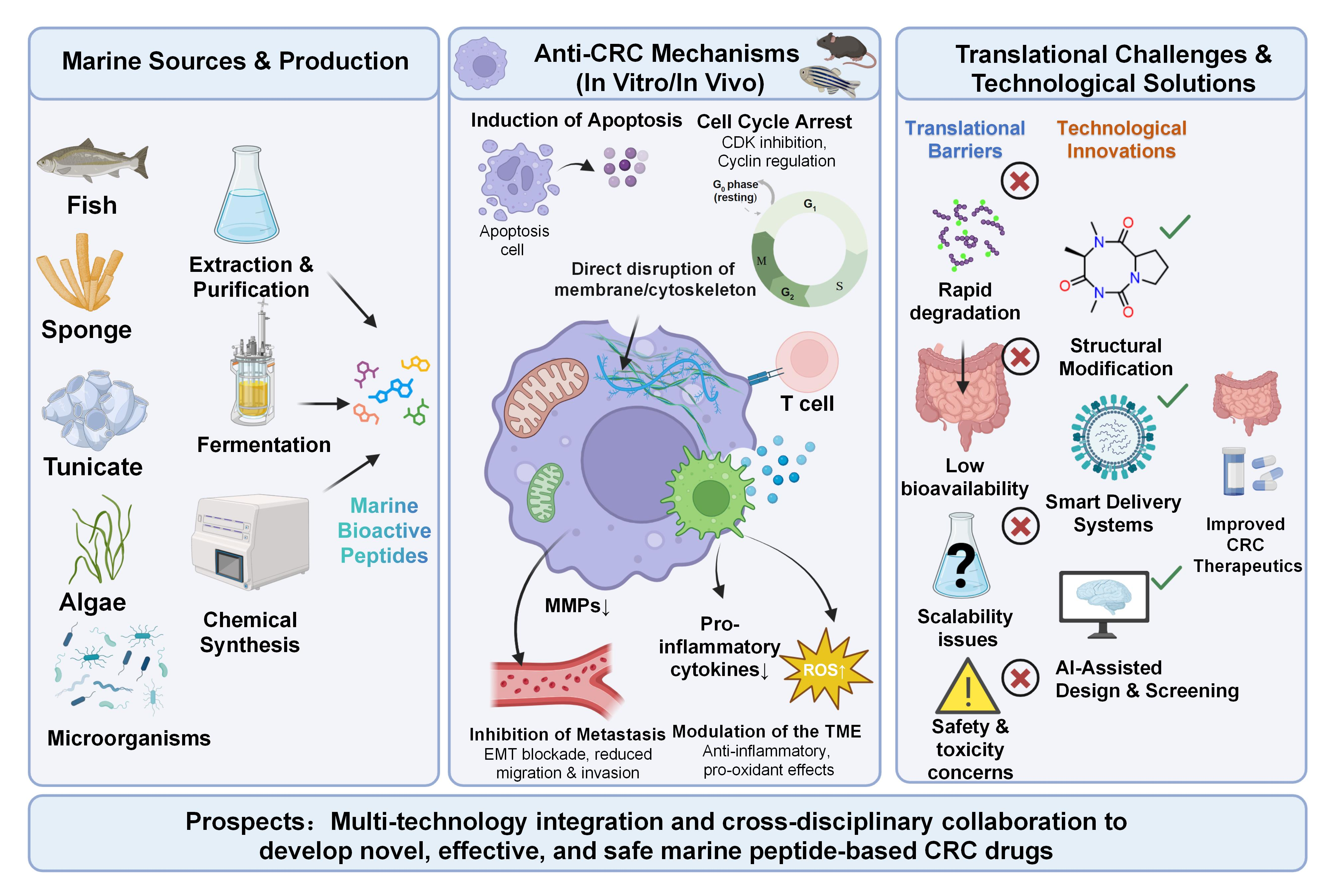
2. Source and Structural Characteristics of Marine Peptides
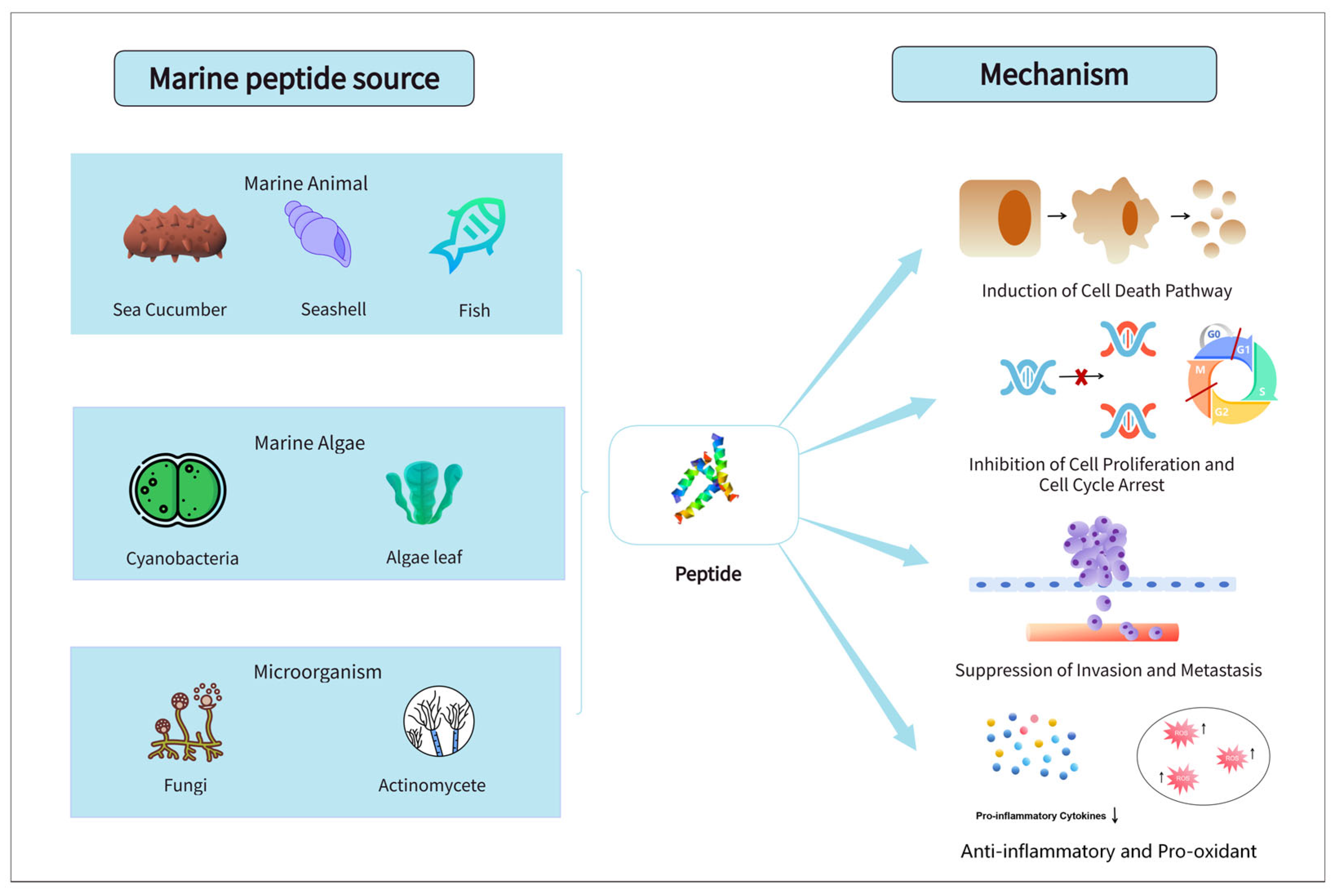
2.1. Sources of Marine Peptides
2.2. Structural Characteristics of Marine Peptides
3. Methods for Obtaining and Isolating Marine Peptides
3.1. Enzymatic Hydrolysis
3.2. Direct Extraction and Purification
3.3. Fermentation
3.4. Structural Optimization
4. Mechanistic Analysis of Marine Peptides
4.1. Induction of Cell Death Pathways
4.2. Inhibition of Cell Proliferation and Cell Cycle Arrest
4.3. Suppression of Invasion and Metastasis
4.4. Anti-Inflammatory and Pro-Oxidant Properties
5. In Vivo and In Vitro Anti-Colorectal Cancer Efficacy of Marine Peptides
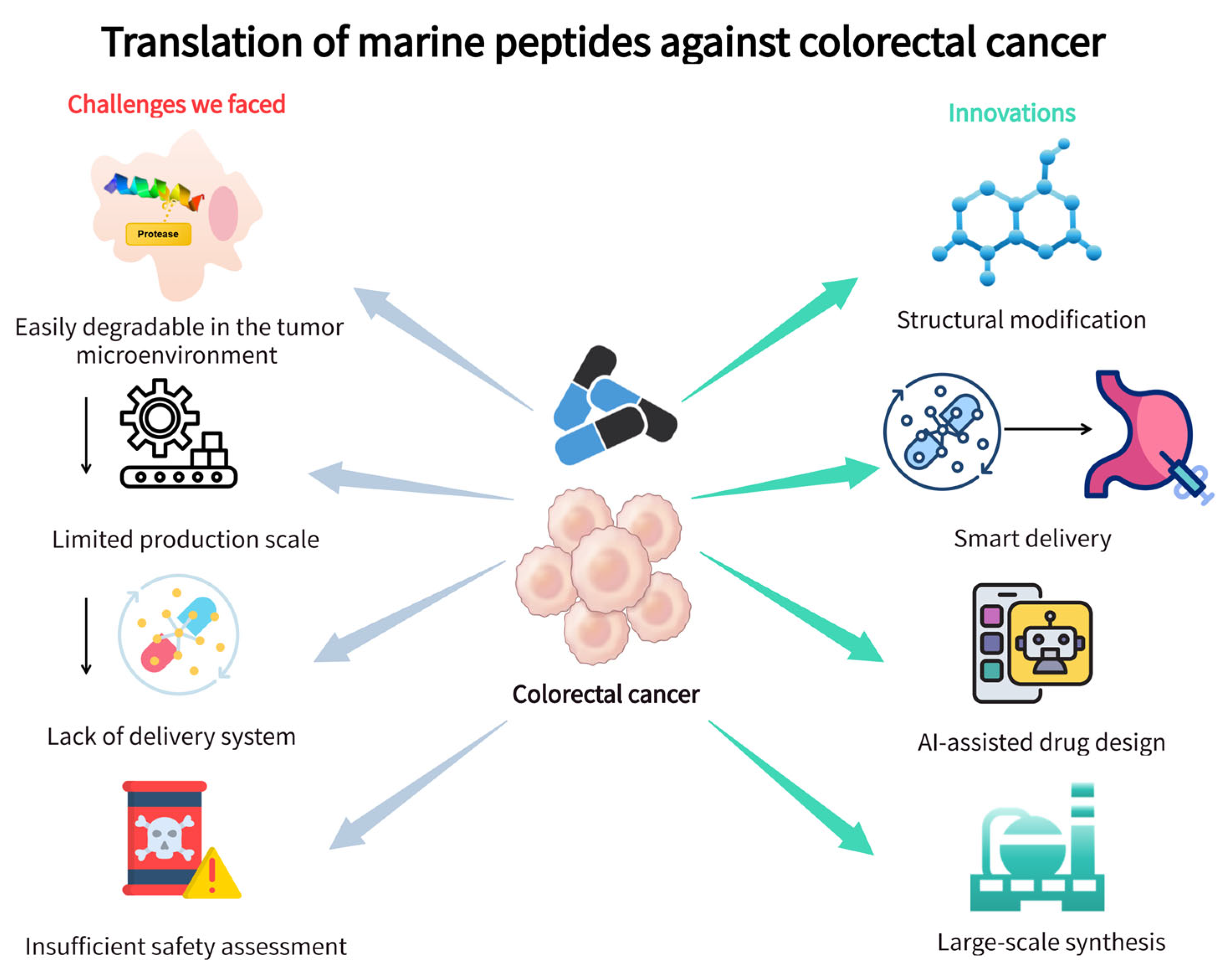
6. Application of Marine Peptides in the Treatment of Colorectal Cancer: Breakthroughs and Technological Innovations
6.1. Translation Challenges: Key Constraints for Application of Marine Peptides
6.2. Technological Innovations: Tailored Strategies to Improve Translational Efficacy
6.2.1. Optimization of Drug-like Properties for CRC
6.2.2. Scalable Production of CRC-Specific Marine Peptides
6.2.3. AI-Driven Acceleration of CRC-Targeted Translational Research
7. Conclusions
Supplementary Materials
Author Contributions
Funding
Institutional Review Board Statement
Data Availability Statement
Acknowledgments
Conflicts of Interest
References
- Fadlallah, H.; El Masri, J.; Fakhereddine, H.; Youssef, J.; Chemaly, C.; Doughan, S.; Abou-Kheir, W. Colorectal cancer: Recent advances in management and treatment. World J. Clin. Oncol. 2024, 15, 1136–1156. [Google Scholar] [CrossRef]
- Morgan, E.; Arnold, M.; Gini, A.; Lorenzoni, V.; Cabasag, C.J.; Laversanne, M.; Vignat, J.; Ferlay, J.; Murphy, N.; Bray, F. Global burden of colorectal cancer in 2020 and 2040: Incidence and mortality estimates from GLOBOCAN. Gut 2023, 72, 338–344. [Google Scholar] [CrossRef]
- Zhou, J.; Yang, Q.; Zhao, S.; Sun, L.; Li, R.; Wang, J.; Wang, L.; Wang, D. Evolving landscape of colorectal cancer: Global and regional burden, risk factor dynamics, and future scenarios (the Global Burden of Disease 1990–2050). Ageing Res. Rev. 2025, 104, 102666. [Google Scholar] [CrossRef]
- Kumar, A.; Gautam, V.; Sandhu, A.; Rawat, K.; Sharma, A.; Saha, L. Current and emerging therapeutic approaches for colorectal cancer: A comprehensive review. World J. Gastrointest. Surg. 2023, 15, 495–519. [Google Scholar] [CrossRef]
- Vodenkova, S.; Buchler, T.; Cervena, K.; Veskrnova, V.; Vodicka, P.; Vymetalkova, V. 5-fluorouracil and other fluoropyrimidines in colorectal cancer: Past, present and future. Pharmacol. Ther. 2020, 206, 107447. [Google Scholar] [CrossRef] [PubMed]
- Overman, M.J.; McDermott, R.; Leach, J.L.; Lonardi, S.; Lenz, H.-J.; Morse, M.A.; Desai, J.; Hill, A.; Axelson, M.; Moss, R.A.; et al. Nivolumab in patients with metastatic DNA mismatch repair-deficient or microsatellite instability-high colorectal cancer (CheckMate 142): An open-label, multicentre, phase 2 study. Lancet Oncol. 2017, 18, 1182–1191. [Google Scholar] [CrossRef]
- Kopetz, S.; Grothey, A.; Yaeger, R.; Van Cutsem, E.; Desai, J.; Yoshino, T.; Wasan, H.; Ciardiello, F.; Loupakis, F.; Hong, Y.S.; et al. Encorafenib, Binimetinib, and Cetuximab in BRAF V600E-Mutated Colorectal Cancer. N. Engl. J. Med. 2019, 381, 1632–1643. [Google Scholar] [CrossRef] [PubMed]
- Cunha, S.A.; Pintado, M.E. Bioactive peptides derived from marine sources: Biological and functional properties. Trends Food Sci. Technol. 2022, 119, 348–370. [Google Scholar] [CrossRef]
- Karthikeyan, A.; Joseph, A.; Nair, B.G. Promising bioactive compounds from the marine environment and their potential effects on various diseases. J. Genet. Eng. Biotechnol. 2022, 20, 14. [Google Scholar] [CrossRef]
- Macedo, M.W.F.S.; Cunha, N.B.d.; Carneiro, J.A.; Costa, R.A.d.; Alencar, S.A.d.; Cardoso, M.H.; Franco, O.L.; Dias, S.C. Marine Organisms as a Rich Source of Biologically Active Peptides. Front. Mar. Sci. 2021, 8, 667764. [Google Scholar] [CrossRef]
- Bandaru, N.; Patil, Y.P.; Ekghara, S.D.; Patil, K.S.; Bonthu, M.G. Exploring Marine-Derived Compounds as Potential Anti-Cancer Agents: Mechanisms and Therapeutic Implications. Cancer Pathog. Ther. 2025, 4, 192–207. [Google Scholar] [CrossRef]
- Bowling, J.J.; Kochanowska, A.J.; Kasanah, N.; Hamann, M.T. Nature’s bounty—Drug discovery from the sea. Expert Opin. Drug Discov. 2007, 2, 1505–1522. [Google Scholar] [CrossRef]
- Lin, J.; Chen, S.; Butt, U.D.; Yan, M.; Wu, B. A comprehensive review on ziconotide. Heliyon 2024, 10, e31105. [Google Scholar] [CrossRef] [PubMed]
- Gao, G.; Wang, Y.; Hua, H.; Li, D.; Tang, C. Marine Antitumor Peptide Dolastatin 10: Biological Activity, Structural Modification and Synthetic Chemistry. Mar. Drugs 2021, 19, 363. [Google Scholar] [CrossRef] [PubMed]
- Kim, J.L.; Park, S.H.; Jeong, S.; Kim, B.R.; Na, Y.J.; Jo, M.J.; Jeong, Y.A.; Yun, H.K.; Kim, D.Y.; Kim, B.G.; et al. Sea Cucumber (Stichopus japonicas) F2 Enhanced TRAIL-Induced Apoptosis via XIAP Ubiquitination and ER Stress in Colorectal Cancer Cells. Nutrients 2019, 11, 1061. [Google Scholar] [CrossRef] [PubMed]
- Zhang, Y.; Gao, S.; Mao, J.; Song, Y.; Wang, X.; Jiang, J.; Lv, L.; Zhou, Z.; Wang, J. The Inhibitory Effect and Mechanism of the Histidine-Rich Peptide rAj-HRP from Apostichopus japonicus on Human Colon Cancer HCT116 Cells. Molecules 2024, 29, 5214. [Google Scholar] [CrossRef]
- Loganzo, F.; Discafani, C.M.; Annable, T.; Beyer, C.; Musto, S.; Hari, M.; Tan, X.; Hardy, C.; Hernandez, R.; Baxter, M.; et al. HTI-286, a synthetic analogue of the tripeptide hemiasterlin, is a potent antimicrotubule agent that circumvents P-glycoprotein-mediated resistance in vitro and in vivo. Cancer Res. 2003, 63, 1838–1845. [Google Scholar]
- Shahidi, F.; Saeid, A. Bioactivity of Marine-Derived Peptides and Proteins: A Review. Mar. Drugs 2025, 23, 157. [Google Scholar] [CrossRef]
- Ahmed, S.; Alam, W.; Alsharif, K.; Aschner, M.; Akkol, E.K.; Allahyani, M.; Alhuthali, H.; Saso, L.; Türkcanoğlu, E.G.; Khan, H. Unveiling the potential of marine peptides in leukemia: Mechanistic insights and future horizon in peptide research. Turk. J. Med. Sci. 2025, 55, 1063–1076. [Google Scholar] [CrossRef]
- Zheng, K.; Yang, Z.; Ba, T. Marine bioactive peptides as potential therapeutic agents for wound healing—A review. Ann. Med. 2025, 57, 2530693. [Google Scholar] [CrossRef]
- Visuddho, V.; Halim, P.; Helen, H.; Muhar, A.M.; Iqhrammullah, M.; Mayulu, N.; Surya, R.; Tjandrawinata, R.R.; Ribeiro, R.; Tallei, T.E.; et al. Modulation of Apoptotic, Cell Cycle, DNA Repair, and Senescence Pathways by Marine Algae Peptides in Cancer Therapy. Mar. Drugs 2024, 22, 338. [Google Scholar] [CrossRef]
- Jaret, A.; Baghel, V.; Bisht, G.S. Anticancer Peptides: Unveiling the Next Frontier in Cancer Treatment. Int. J. Pept. Res. Ther. 2025, 31, 64. [Google Scholar] [CrossRef]
- Banday, A.H.; Azha, N.u.; Farooq, R.; Sheikh, S.A.; Ganie, M.A.; Parray, M.N.; Mushtaq, H.; Hameed, I.; Lone, M.A. Exploring the potential of marine natural products in drug development: A comprehensive review. Phytochem. Lett. 2024, 59, 124–135. [Google Scholar] [CrossRef]
- Wang, S.; Fan, L.; Pan, H.; Li, Y.; Qiu, Y.; Lu, Y. Antimicrobial peptides from marine animals: Sources, structures, mechanisms and the potential for drug development. Front. Mar. Sci. 2023, 9, 1112595. [Google Scholar] [CrossRef]
- Carroll, A.R.; Copp, B.R.; Grkovic, T.; Keyzers, R.A.; Prinsep, M.R. Marine natural products. Nat. Prod. Rep. 2026, 43, 89–131. [Google Scholar] [CrossRef] [PubMed]
- Shilabin, A.G.; Kasanah, N.; Wedge, D.E.; Hamann, M.T. Lysosome and HER3 (ErbB3) selective anticancer agent kahalalide F: Semisynthetic modifications and antifungal lead-exploration studies. J. Med. Chem. 2007, 50, 4340–4350. [Google Scholar] [CrossRef]
- Hussein, A.A.A.; Salem, M.B.; ElZallat, M.; Ghoname, S.I.; Habib, M.R.; Hammam, O.A.; El-Dabaa, E.; Okasha, H. Novel peptides from the edible bivalve Ruditapes decussatus target apoptosis, autophagy, and FGF19-FGFR4 signaling in human cancer cell lines. Sci. Rep. 2025, 15, 34283. [Google Scholar] [CrossRef] [PubMed]
- Varijakzhan, D.; Loh, J.Y.; Yap, W.S.; Yusoff, K.; Seboussi, R.; Lim, S.E.; Lai, K.S.; Chong, C.M. Bioactive Compounds from Marine Sponges: Fundamentals and Applications. Mar. Drugs 2021, 19, 246. [Google Scholar] [CrossRef] [PubMed]
- Librizzi, M.; Martino, C.; Mauro, M.; Abruscato, G.; Arizza, V.; Vazzana, M.; Luparello, C. Natural Anticancer Peptides from Marine Animal Species: Evidence from In Vitro Cell Model Systems. Cancers 2023, 16, 36. [Google Scholar] [CrossRef]
- Dağ, H.E.; Atalay, B.R.; Ayaz, F.; Ayaz, E.A.; Deviren, A. The investigation of immunomodulatory effects of didemnin B in macrophage cells. Immunol. Res. 2026, 74, 25. [Google Scholar] [CrossRef]
- Ru, R.; Guo, Y.; Mao, J.; Yu, Z.; Huang, W.; Cao, X.; Hu, H.; Meng, M.; Yuan, L. Cancer Cell Inhibiting Sea Cucumber (Holothuria leucospilota) Protein as a Novel Anti-Cancer Drug. Nutrients 2022, 14, 786. [Google Scholar] [CrossRef] [PubMed]
- Tejuca, M.; Anderluh, G.; Serra, M.D. Sea anemone cytolysins as toxic components of immunotoxins. Toxicon 2009, 54, 1206–1214. [Google Scholar] [CrossRef]
- Tejuca, M.; Anderluh, G.; Serra, M.D. Construction of an immunotoxin with the pore forming protein StI and ior C5, a monoclonal antibody against a colon cancer cell line. Int. Immunopharmacol. 2004, 4, 731–744. [Google Scholar] [CrossRef] [PubMed]
- Jeong, K.-Y. Recent Understanding of Colorectal Cancer Treatment; IntechOpen: London, UK, 2022. [Google Scholar]
- Hamann, M.T.; Otto, C.S.; Scheuer, P.J.; Dunbar, D.C. Kahalalides: Bioactive Peptides from a Marine Mollusk Elysia rufescens and Its Algal Diet Bryopsis sp. J. Org. Chem. 1996, 61, 6594–6600. [Google Scholar] [CrossRef]
- Singh, R.S.; Walia, A.K. Lectins from red algae and their biomedical potential. J. Appl. Phycol. 2018, 30, 1833–1858. [Google Scholar] [CrossRef]
- Pradhan, B.; Nayak, R.; Patra, S.; Jit, B.P.; Ragusa, A.; Jena, M. Bioactive Metabolites from Marine Algae as Potent Pharmacophores against Oxidative Stress-Associated Human Diseases: A Comprehensive Review. Molecules 2021, 26, 37. [Google Scholar] [CrossRef] [PubMed]
- Chen, N.; Huang, R.; Lan, H.; Jokela, J.; Wei, H.; Zhi, S.; Liu, L. Cyclic peptides from cyanobacteria: Structural insights, biological functions, and mechanisms of cyclization. Algal Res. 2025, 86, 103925. [Google Scholar] [CrossRef]
- Ibrahim, J.A.A.; Botcha, S.; Prattipati, S.D. Marine actinomycetes: A promising source of novel therapeutics and pharmaceutical bioactive compounds—A review. Microbe 2025, 7, 100383. [Google Scholar] [CrossRef]
- Hafez Ghoran, S.; Taktaz, F.; Sousa, E.; Fernandes, C.; Kijjoa, A. Peptides from Marine-Derived Fungi: Chemistry and Biological Activities. Mar. Drugs 2023, 21, 510. [Google Scholar] [CrossRef]
- Ashaolu, T.J.; Pham, B.P.; Molnár, Z.; Varga, L.; Greff, B. The structure–activity relationship of marine peptides: A review. Int. J. Food Sci. Technol. 2024, 59, 4437–4445. [Google Scholar] [CrossRef]
- Li, Q.; Vlachos, E.N.; Bryant, P. Design of linear and cyclic peptide binders from protein sequence information. Commun. Chem. 2025, 8, 211. [Google Scholar] [CrossRef]
- Panja, A.; Sharma, V.; Mitra, P.; Bazylevich, A.; Drori, C.; Kayet, A.; Tobi, D.; Patsenker, L.; Firer, M.; Gellerman, G. Synthesis and anticancer properties of novel dolastatin 10 analogs featuring five-membered heterocyclic rings with a linkable group at the C-terminus. Bioorg. Med. Chem. 2024, 109, 117794. [Google Scholar] [CrossRef]
- Li, C.; Zhang, S.; Zhu, J.; Huang, W.; Luo, Y.; Shi, H.; Yu, D.; Chen, L.; Song, L.; Yu, R. A Novel Peptide Derived from Arca inflata Induces Apoptosis in Colorectal Cancer Cells through Mitochondria and the p38 MAPK Pathway. Mar. Drugs 2022, 20, 110. [Google Scholar] [CrossRef]
- Bauer, M.; Glowacka, M.; Kamysz, W.; Kleczkowska, P. Marine Peptides: Potential Basic Structures for the Development of Hybrid Compounds as Multitarget Therapeutics for the Treatment of Multifactorial Diseases. Int. J. Mol. Sci. 2024, 25, 12601. [Google Scholar] [CrossRef] [PubMed]
- Wyer, S.; Townsend, D.M.; Ye, Z.; Kourtidis, A.; Choo, Y.-M.; de Barros, A.L.B.; Donia, M.S.; Hamann, M.T. Recent advances and limitations in the application of kahalalides for the control of cancer. Biomed. Pharmacother. 2022, 148, 112676. [Google Scholar] [CrossRef] [PubMed]
- Lee, H.; Nihan, K.; Kwon, Y.R. Cyanobacterial Peptides in Anticancer Therapy: A Comprehensive Review of Mechanisms, Clinical Advances, and Biotechnological Innovation. Mar. Drugs 2025, 23, 233. [Google Scholar] [CrossRef] [PubMed]
- Cui, Y.; Li, X.; Sun, Y.; Liu, Y.; Zhang, W.; Jiang, Y.; Zhou, Y.; Liu, J.; Gong, B.; Wu, Y.; et al. Separation, characterization, AI screening, and bioactivities of marine bioactive peptides: A review. Food Chem. 2025, 495, 146312. [Google Scholar] [CrossRef]
- Du, J.; Xiao, M.; Sudo, N.; Liu, Q. Bioactive peptides of marine organisms: Roles in the reduction and control of cardiovascular diseases. Food Sci. Nutr. 2024, 12, 5271–5284. [Google Scholar] [CrossRef]
- Wang, X.; Yu, H.; Xing, R.; Liu, S.; Chen, X.; Li, P. Optimization of Oyster (Crassostrea talienwhanensis) Protein Hydrolysates Using Response Surface Methodology. Molecules 2020, 25, 2844. [Google Scholar] [CrossRef]
- Vu, D.T.; Falch, E.; Elvevoll, E.O.; Jensen, I.J. Enzymatic Hydrolysis of Orange-Footed Sea Cucumber (Cucumaria frondosa)-Effect of Different Enzymes on Protein Yield and Bioactivity. Foods 2023, 12, 3685. [Google Scholar] [CrossRef]
- Pezeshk, S.; Abdollahi, M. Ultrasound technology in fish proteins processing: Innovations in extraction and structure–function dynamics. Ultrason. Sonochem. 2025, 120, 107503. [Google Scholar] [CrossRef] [PubMed]
- Tacias-Pascacio, V.G.; Castañeda-Valbuena, D.; Morellon-Sterling, R.; Tavano, O.; Berenguer-Murcia, Á.; Vela-Gutiérrez, G.; Rather, I.A.; Fernandez-Lafuente, R. Bioactive peptides from fisheries residues: A review of use of papain in proteolysis reactions. Int. J. Biol. Macromol. 2021, 184, 415–428. [Google Scholar] [CrossRef]
- Trigueros, E.; Oliveira, A.P.; Andrade, P.B.; Videira, R.A.; de Pinho, P.G.; Sanz, M.T.; Beltrán, S. Exploring the bioactive potential of algae residue extract via subcritical water extraction: Insights into chemical composition and biological activity. Food Chem. 2024, 458, 140310. [Google Scholar] [CrossRef]
- Contreras-Angulo, L.A.; Leyva-López, N.; Rodríguez-Miranda, E.S.; Germán-Soto, B.G.; González-Gómez, J.P.; Trujillo-Peregrina, A.E. Bioactive Compounds Extraction from Marine Microorganisms by Fermentation. In Bioactive Compounds Extraction from Marine Resources and Wastes; Heredia, J.B., Gutiérrez-Grijalva, E.P., Cabanillas-Bojórquez, L.A., Eds.; Springer Nature: Singapore, 2025; pp. 151–174. [Google Scholar] [CrossRef]
- Daletos, G.; Kalscheuer, R.; Koliwer-Brandl, H.; Hartmann, R.; de Voogd, N.J.; Wray, V.; Lin, W.; Proksch, P. Callyaerins from the Marine Sponge Callyspongia aerizusa: Cyclic Peptides with Antitubercular Activity. J. Nat. Prod. 2015, 78, 1910–1925. [Google Scholar] [CrossRef] [PubMed]
- Dincturk, H.C.; Bilgin, A.B.; Köroğlu, D.G.; Gozukirmizi, C.K.; Ozkan, G.; Capanoglu, E.; Setzer, W.N.; Büsselberg, D.; Calina, D.; Sharifi-Rad, J. Symplocamide A as marine-derived proteasome inhibitor: A promising scaffold for targeted cancer therapy. Med. Oncol. 2025, 42, 351. [Google Scholar] [CrossRef] [PubMed]
- Liu, C.; Masuno, M.N.; Macmillan, J.B.; Molinski, T.F. Enantioselective total synthesis of (+)-milnamide A and evidence of its autoxidation to (+)-milnamide D. Angew. Chem. Int. Ed. Engl. 2004, 43, 5951–5954. (In English) [Google Scholar] [CrossRef]
- Perez, L.J.; Faulkner, D.J. Bistratamides E−J, Modified Cyclic Hexapeptides from the Philippines Ascidian Lissoclinum bistratum. J. Nat. Prod. 2003, 66, 247–250. [Google Scholar] [CrossRef]
- Aspevik, T.; Oterhals, Å.; Rønning, S.B.; Altintzoglou, T.; Wubshet, S.G.; Gildberg, A.; Afseth, N.K.; Whitaker, R.D.; Lindberg, D. Valorization of Proteins from Co- and By-Products from the Fish and Meat Industry. Top. Curr. Chem. 2017, 375, 53. [Google Scholar] [CrossRef]
- Hayes, M.; Tiwari, B.K. Bioactive Carbohydrates and Peptides in Foods: An Overview of Sources, Downstream Processing Steps and Associated Bioactivities. Int. J. Mol. Sci. 2015, 16, 22485–22508. [Google Scholar] [CrossRef]
- Cuesta-Ramos, L.; Sánchez-Moreno, N.; Salgado-Ramos, M.; Castagnini, J.M.; Martí-Quijal, F.J.; Ferrer, E.; Barba, F.J.; Pallarés, N. LC-QTOF-MS/MS for tentative identification of antioxidant peptides in defatted Spirulina platensis cakes obtained by supercritical CO2 extraction. Anal. Bioanal. Chem. 2025, 418, 1645–1657. [Google Scholar] [CrossRef]
- Karabulut, G.; Purkiewicz, A.; Goksen, G. Recent developments and challenges in algal protein and peptide extraction strategies, functional and technological properties, bioaccessibility, and commercial applications. Compr. Rev. Food Sci. Food Saf. 2024, 23, e13372. [Google Scholar] [CrossRef]
- Sila, A.; Bougatef, A. Antioxidant peptides from marine by-products: Isolation, identification and application in food systems. A review. J. Funct. Foods 2016, 21, 10–26. [Google Scholar] [CrossRef]
- Luo, J.; Ye, C.; Wen, Y.; Bao, Y.; Quek, S.Y. Investigation of solid-state fermentation of red seaweed (Pyropia spp.) with lactic acid Bacteria: Effects on protein profile and in vitro digestibility. Food Chem. 2025, 469, 142667. [Google Scholar] [CrossRef]
- Zhong, L.; Wu, Y.; Guan, X.; Xu, M.; Huang, J.; Zheng, Y.; Wang, Q. Oyster Peptides Prepared by Lactobacillus casei Fermentation Enhance Immune Activity in RAW264.7 Cells via Activation of the MAPK Pathway. Mar. Drugs 2025, 23, 484. [Google Scholar] [CrossRef]
- Zhao, Q.; Jiang, X.; Mao, Z.; Zhang, J.; Sun, J.; Mao, X. Exploration, sequence optimization and mechanism analysis of novel xanthine oxidase inhibitory peptide from Ostrea rivularis Gould. Food Chem. 2023, 404, 134537. [Google Scholar] [CrossRef] [PubMed]
- Ullah, A.; Shaheen, F.; Salar, U.; Tzakos, A.G.; Gerothanassis, I.P. Therapeutic Potential of Stylissatin A and Related Cyclic Peptides From Marine Sponges. J. Pept. Sci. 2025, 31, e70045. [Google Scholar] [CrossRef]
- Chen, C.; Xia, P.; Gan, Y.; Zheng, X.; Yang, P.; Shi, A.; Liu, X.; Zhang, J.; Yu, P.; Zhang, D. Food-derived bioactive peptides as emerging therapeutic agents: Unlocking novel strategies for colorectal cancer treatment. Pharmacol. Res. 2025, 217, 107819. [Google Scholar] [CrossRef] [PubMed]
- Jiang, S.; Zhang, E.; Ruan, H.; Ma, J.; Zhao, X.; Zhu, Y.; Xie, X.; Han, N.; Li, J.; Zhang, H.; et al. Actinomycin V Induces Apoptosis Associated with Mitochondrial and PI3K/AKT Pathways in Human CRC Cells. Mar. Drugs 2021, 19, 599. [Google Scholar] [CrossRef]
- Nandi, S.; Khatua, S.; Nag, A.; Sen, S.; Chakraborty, N.; Naskar, A.; Acharya, K.; Mekky, R.H.; Contreras, M.d.M.; Calina, D.; et al. Dolastatins and their analogues present a compelling landscape of potential natural and synthetic anticancer drug candidates. Curr. Res. Biotechnol. 2024, 7, 100167. [Google Scholar] [CrossRef]
- Ahmad, I.Z.; Parvez, S.; Tabassum, H. Chapter 10—Cyanobacterial peptides with respect to anticancer activity: Structural and functional perspective. In Studies in Natural Products Chemistry; Attaur, R., Ed.; Elsevier: Amsterdam, The Netherlands, 2020; Volume 67, pp. 345–388. [Google Scholar]
- Asghar, A.; Chohan, T.A.; Khurshid, U.; Saleem, H.; Mustafa, M.W.; Khursheed, A.; Alafnan, A.; Batul, R.; Bin Break, M.K.; Almansour, K.; et al. A systematic review on understanding the mechanistic pathways and clinical aspects of natural CDK inhibitors on cancer progression.: Unlocking cellular and biochemical mechanisms. Chem. Biol. Interact. 2024, 393, 110940. [Google Scholar] [CrossRef] [PubMed]
- Eghtedari, M.; Jafari Porzani, S.; Nowruzi, B. Anticancer potential of natural peptides from terrestrial and marine environments: A review. Phytochem. Lett. 2021, 42, 87–103. [Google Scholar] [CrossRef]
- Byun, W.S.; Kim, S.; Shin, Y.-H.; Kim, W.K.; Oh, D.-C.; Lee, S.K. Antitumor Activity of Ohmyungsamycin A through the Regulation of the Skp2-p27 Axis and MCM4 in Human Colorectal Cancer Cells. J. Nat. Prod. 2020, 83, 118–126. [Google Scholar] [CrossRef]
- Wei, J.; Gou, Z.; Wen, Y.; Luo, Q.; Huang, Z. Marine compounds targeting the PI3K/Akt signaling pathway in cancer therapy. Biomed. Pharmacother. 2020, 129, 110484. [Google Scholar] [CrossRef]
- Bhardwaj, N.; Goel, B.; Tripathi, N.; Sahu, B.; Jain, S.K. A comprehensive review on chemistry and pharmacology of marine bioactives as antimetastatic agents. Eur. J. Med. Chem. Rep. 2022, 4, 100023. [Google Scholar] [CrossRef]
- Le, T.C.; Pulat, S.; Lee, J.; Kim, G.J.; Kim, H.; Lee, E.Y.; Hillman, P.F.; Choi, H.; Yang, I.; Oh, D.C.; et al. Marine Depsipeptide Nobilamide I Inhibits Cancer Cell Motility and Tumorigenicity via Suppressing Epithelial-Mesenchymal Transition and MMP2/9 Expression. ACS Omega 2022, 7, 1722–1732. [Google Scholar] [CrossRef]
- Lee, J.; Gamage, C.D.B.; Kim, G.J.; Hillman, P.F.; Lee, C.; Lee, E.Y.; Choi, H.; Kim, H.; Nam, S.-J.; Fenical, W. Androsamide, a Cyclic Tetrapeptide from a Marine Nocardiopsis sp., Suppresses Motility of Colorectal Cancer Cells. J. Nat. Prod. 2020, 83, 3166–3172. [Google Scholar] [CrossRef] [PubMed]
- He, X.; Lee, B.; Jiang, Y. Extracellular matrix in cancer progression and therapy. Med. Rev. 2022, 2, 125–139. [Google Scholar] [CrossRef] [PubMed]
- Li, Z.; Bao, K.; Xu, H.; Wu, P.; Li, W.; Liu, J.; Zhang, W. Design, synthesis, and bioactivities of tasiamide B derivatives as cathepsin D inhibitors. J. Pept. Sci. Off. Publ. Eur. Pept. Soc. 2019, 25, e3154. [Google Scholar] [CrossRef]
- Cheng, L.; Wang, C.; Liu, H.; Wang, F.; Zheng, L.; Zhao, J.; Chu, E.; Lin, X. A novel polypeptide extracted from Ciona savignyi induces apoptosis through a mitochondrial-mediated pathway in human colorectal carcinoma cells. Clin. Color. Cancer 2012, 11, 207–214. [Google Scholar] [CrossRef] [PubMed]
- Jegani, K.T.; Balde, A.; Nazeer, R.A. A review on anti-inflammatory and antioxidant peptides derived from marine organisms: Mechanism of action and therapeutic applications. Food Biosci. 2025, 63, 105745. [Google Scholar] [CrossRef]
- Florean, C.; Dicato, M.; Diederich, M. Immune-modulating and anti-inflammatory marine compounds against cancer. Semin. Cancer Biol. 2022, 80, 58–72. [Google Scholar] [CrossRef] [PubMed]
- Kwan, J.C.; Liu, Y.; Ratnayake, R.; Hatano, R.; Kuribara, A.; Morimoto, C.; Ohnuma, K.; Paul, V.J.; Ye, T.; Luesch, H. Grassypeptolides as natural inhibitors of dipeptidyl peptidase 8 and T-cell activation. ChemBioChem 2014, 15, 799–804. [Google Scholar] [CrossRef]
- Huang, T.C.; Lee, J.F.; Chen, J.Y. Pardaxin, an antimicrobial peptide, triggers caspase-dependent and ROS-mediated apoptosis in HT-1080 cells. Mar. Drugs 2011, 9, 1995–2009. [Google Scholar] [CrossRef]
- Kılınç, S.; Karaoğlan, M.; Kuzucu, M. Analysis of possible effects of recombinant antimicrobial peptide TP4 on colon cancer line HT-29. Med. Oncol. 2025, 42, 356. [Google Scholar] [CrossRef]
- Avilés-Gaxiola, S.; Gutiérrez-Grijalva, E.P.; León-Felix, J.; Angulo-Escalante, M.A.; Heredia, J.B. Peptides in Colorectal Cancer: Current State of Knowledge. Plant Foods Hum. Nutr. 2020, 75, 467–476. [Google Scholar] [CrossRef] [PubMed]
- Zhang, J.-N.; Xia, Y.-X.; Zhang, H.-J. Natural Cyclopeptides as Anticancer Agents in the Last 20 Years. Int. J. Mol. Sci. 2021, 22, 3973. [Google Scholar] [CrossRef]
- Hong, J.; Luesch, H. Largazole: From discovery to broad-spectrum therapy. Nat. Prod. Rep. 2012, 29, 449–456. [Google Scholar] [CrossRef] [PubMed]
- Kitani, S.; Ueguchi, T.; Igarashi, Y.; Leetanasaksakul, K.; Thamchaipenet, A.; Nihira, T. Rakicidin F, a new antibacterial cyclic depsipeptide from a marine sponge-derived Streptomyces sp. J. Antibiot. 2018, 71, 139–141. [Google Scholar] [CrossRef]
- Yaghoubzadeh, Z.; Peyravii Ghadikolaii, F.; Kaboosi, H.; Safari, R.; Fattahi, E. Antioxidant Activity and Anticancer Effect of Bioactive Peptides from Rainbow Trout (Oncorhynchus mykiss) Skin Hydrolysate. Int. J. Pept. Res. Ther. 2020, 26, 625–632. [Google Scholar] [CrossRef]
- Nurdiani, R.; Vasiljevic, T.; Yeager, T.; Singh, T.K.; Donkor, O.N. Bioactive peptides with radical scavenging and cancer cell cytotoxic activities derived from Flathead (Platycephalus fuscus) by-products. Eur. Food Res. Technol. 2017, 243, 627–637. [Google Scholar] [CrossRef]
- Vazquez, J.M.; Khudyakov, J.I.; Madelaire, C.B.; Godard-Codding, C.A.; Routti, H.; Lam, E.K.; Piotrowski, E.R.; Merrill, G.B.; Wisse, J.H.; Allen, K.N.; et al. Ex vivo and in vitro methods as a platform for studying anthropogenic effects on marine mammals: Four challenges and how to meet them. Front. Mar. Sci. 2024, 11, 1466968. [Google Scholar] [CrossRef]
- Fontana, C.M.; Van Doan, H. Zebrafish xenograft as a tool for the study of colorectal cancer: A review. Cell Death Dis. 2024, 15, 23. [Google Scholar] [CrossRef]
- Jinendiran, S.; Teng, W.; Dahms, H.-U.; Liu, W.; Ponnusamy, V.K.; Chiu, C.C.-C.; Kumar, B.S.D.; Sivakumar, N. Induction of mitochondria-mediated apoptosis and suppression of tumor growth in zebrafish xenograft model by cyclic dipeptides identified from Exiguobacterium acetylicum. Sci. Rep. 2020, 10, 13721. [Google Scholar] [CrossRef]
- Yang, Y.; Liu, P.; Zhou, M.; Yin, L.; Wang, M.; Liu, T.; Jiang, X.; Gao, H. Small-molecule drugs of colorectal cancer: Current status and future directions. Biochim. Biophys. Acta (BBA) -Mol. Basis Dis. 2024, 1870, 166880. [Google Scholar] [CrossRef] [PubMed]
- Meyiah, A.; Khan, F.I.; Alfaki, D.A.; Murshed, K.; Raza, A.; Elkord, E. The colorectal cancer microenvironment: Preclinical progress in identifying targets for cancer therapy. Transl. Oncol. 2025, 53, 102307. [Google Scholar] [CrossRef]
- Sukumaran, S.; Nadarajan, S. Marine Peptides and Their Bioactive Potentials: New Horizon for Biotherapeutics. In Drugs from Nature: Targets, Assay Systems and Leads; Haridas, M., Abdulhameed, S., Francis, D., Kumar, S.S., Eds.; Springer Nature: Singapore, 2024; pp. 153–178. [Google Scholar] [CrossRef]
- Tang, C.-d.; Cheng, J.-H.; Sun, D.-W. Structure-activity relationships and activity enhancement techniques of marine bioactive peptides (MBPs). Crit. Rev. Food Sci. Nutr. 2025, 65, 4941–4963. [Google Scholar] [CrossRef] [PubMed]
- Fosgerau, K.; Hoffmann, T. Peptide therapeutics: Current status and future directions. Drug Discov. Today 2015, 20, 122–128. [Google Scholar] [CrossRef]
- Lau, J.L.; Dunn, M.K. Therapeutic peptides: Historical perspectives, current development trends, and future directions. Bioorg. Med. Chem. 2018, 26, 2700–2707.103. [Google Scholar] [CrossRef] [PubMed]
- Xu, C.; Liu, Y.; Li, K.; Zhang, J.; Wei, B.; Wang, H. Absorption of food-derived peptides: Mechanisms, influencing factors, and enhancement strategies. Food Res. Int. 2024, 197, 115190. [Google Scholar] [CrossRef]
- Guidotti, G.; Brambilla, L.; Rossi, D. Cell-Penetrating Peptides: From Basic Research to Clinics. Trends Pharmacol. Sci. 2017, 38, 406–424. [Google Scholar] [CrossRef]
- Staff, N.P.; Grisold, A.; Grisold, W.; Windebank, A.J. Chemotherapy-induced peripheral neuropathy: A current review. Ann. Neurol. 2017, 81, 772–781. [Google Scholar] [CrossRef]
- Öngoren, B.; Kara, A.; Serrano, D.R.; Lalatsa, A. Novel enabling strategies for oral peptide delivery. Int. J. Pharm. 2025, 681, 125888. [Google Scholar] [CrossRef] [PubMed]
- Zhang, Y.; Zhang, M.; Song, H.; Dai, Q.; Liu, C. Tumor Microenvironment-Responsive Polymer-Based RNA Delivery Systems for Cancer Treatment. Small Methods 2025, 9, e2400278. [Google Scholar] [CrossRef]
- Fu, C.; Yu, L.; Miao, Y.; Liu, X.; Yu, Z.; Wei, M. Peptide-drug conjugates (PDCs): A novel trend of research and development on targeted therapy, hype or hope? Acta Pharm. Sin. B 2023, 13, 498–516. [Google Scholar] [CrossRef]
- Alonso, D.; Reguera, L.; Rennert, R.; Morgan, I.; Saoud, M.; Ricardo, M.G.; Valdés, L.; Coro-Bermello, J.; Wessjohann, L.A.; Rivera, D.G. Exploration of the Tertiary Amide Chemical Space of Dolastatin 15 Analogs Reveals New Insights into the Structure–Anticancer Activity Relationship. ChemMedChem 2025, 20, e202500580. [Google Scholar] [CrossRef]
- Cai, Z.; Liu, L.; Zou, C.; Jiang, X.; Wang, G.; He, X.; Zhuang, W.; Yang, C.; Yao, Y.; Sun, X.; et al. Peptide synthesis: A review of classical and emerging methods. Biofabrication 2025, 18, 012001. [Google Scholar] [CrossRef] [PubMed]
- Wang, L.; Wang, N.; Zhang, W.; Cheng, X.; Yan, Z.; Shao, G.; Wang, X.; Wang, R.; Fu, C. Therapeutic peptides: Current applications and future directions. Signal Transduct. Target. Ther. 2022, 7, 48. [Google Scholar] [CrossRef] [PubMed]
- Bose, D.; Roy, L.; Chatterjee, S. Peptide therapeutics in the management of metastatic cancers. RSC Adv. 2022, 12, 21353–21373. [Google Scholar] [CrossRef]
- Gunasekara, D.M.N.M.; Wijerathne, H.D.T.U.; Wang, L.; Kim, H.-S.; Sanjeewa, K.K.A. Marine Bioactive Peptides in the Regulation of Inflammatory Responses: Current Trends and Future Directions. Proteomes 2025, 13, 53. [Google Scholar] [CrossRef]
- Okeke, E.S.; Okagu, I.U.; Chukwudozie, K.; Ezike, T.C.; Ezeorba, T.P.C. Marine-Derived Bioactive Proteins and Peptides: A Review of Current Knowledge on Anticancer Potentials, Clinical Trials, and Future Prospects. Nat. Prod. Commun. 2024, 19, 1934578X241239825. [Google Scholar] [CrossRef]
- Rafieezadeh, D.; Esfandyari, G. Marine bioactive peptides with anticancer potential, a narrative review. Int. J. Biochem. Mol. Biol. 2024, 15, 118–126. [Google Scholar] [CrossRef]
- Puig, M.; Shubow, S. Immunogenicity of therapeutic peptide products: Bridging the gaps regarding the role of product-related risk factors. Front. Immunol. 2025, 16, 1608401. [Google Scholar] [CrossRef]
- Achilleos, K.; Petrou, C.; Nicolaidou, V.; Sarigiannis, Y. Beyond Efficacy: Ensuring Safety in Peptide Therapeutics through Immunogenicity Assessment. J. Pept. Sci. 2025, 31, e70016. [Google Scholar] [CrossRef]
- Zhao, H.; Ming, T.; Tang, S.; Ren, S.; Yang, H.; Liu, M.; Tao, Q.; Xu, H. Wnt signaling in colorectal cancer: Pathogenic role and therapeutic target. Mol. Cancer 2022, 21, 144. [Google Scholar] [CrossRef]
- Dunne, P.D.; Arends, M.J. Molecular pathological classification of colorectal cancer—An update. Virchows Arch. 2024, 484, 273–285. [Google Scholar] [CrossRef]
- Sharma, K.; Sharma, K.K.; Sharma, A.; Jain, R. Peptide-based drug discovery: Current status and recent advances. Drug Discov. Today 2023, 28, 103464. [Google Scholar] [CrossRef] [PubMed]
- Ye, Z.; Xu, Z.; Ouyang, J.; Shi, W.; Li, S.; Wang, X.; Lu, B.; Wang, K.; Wang, Y. Improving the Stability and Anti-Infective Activity of Sea Turtle AMPs Using Multiple Structural Modification Strategies. J. Med. Chem. 2024, 67, 22104–22123. [Google Scholar] [CrossRef] [PubMed]
- Lee, Y.; Oh, B.; Kang, S.; Kim, S.; Kim, Y.-P. Engineering cyclized biomolecules for advanced diagnostic and therapeutic applications. Biotechnol. Adv. 2025, 84, 108694. [Google Scholar] [CrossRef]
- Polli, J.R.; Balthasar, J.P. Cell Penetrating Peptides Conjugated to Anti-Carcinoembryonic Antigen “Catch-and-Release” Monoclonal Antibodies Alter Plasma and Tissue Pharmacokinetics in Colorectal Cancer Xenograft Mice. Bioconjug. Chem. 2022, 33, 1456–1466. [Google Scholar] [CrossRef] [PubMed]
- Jayapriya, P.; Pardhi, E.; Vasave, R.; Guru, S.K.; Madan, J.; Mehra, N.K. A review on Stimuli-pH responsive liposomal formulation in cancer therapy. J. Drug Deliv. Sci. Technol. 2023, 90, 105172. [Google Scholar] [CrossRef]
- Xiao, W.; Jiang, W.; Chen, Z.; Huang, Y.; Mao, J.; Zheng, W.; Hu, Y.; Shi, J. Advance in peptide-based drug development: Delivery platforms, therapeutics and vaccines. Signal Transduct. Target. Ther. 2025, 10, 74. [Google Scholar] [CrossRef]
- Wang, Y.; Yin, Z.; Gao, L.; Ma, B.; Shi, J.; Chen, H. Lipid Nanoparticles-Based Therapy in Liver Metastasis Management: From Tumor Cell-Directed Strategy to Liver Microenvironment-Directed Strategy. Int. J. Nanomed. 2023, 18, 2939–2954. [Google Scholar] [CrossRef]
- Sabatino, G.; D’Ercole, A.; Pacini, L.; Zini, M.; Ribecai, A.; Paio, A.; Rovero, P.; Papini, A.M. An Optimized Scalable Fully Automated Solid-Phase Microwave-Assisted cGMP-Ready Process for the Preparation of Eptifibatide. Org. Process Res. Dev. 2021, 25, 552–563. [Google Scholar] [CrossRef]
- Zheng, B.; Wang, X.; Guo, M.; Tzeng, C.M. Therapeutic Peptides: Recent Advances in Discovery, Synthesis, and Clinical Translation. Int. J. Mol. Sci. 2025, 26, 5131. [Google Scholar] [CrossRef]
- Fernando, I.P.S.; Jayawardena, T.U.; Wu, J. Marine proteins and peptides: Production, biological activities, and potential applications. Food Innov. Adv. 2023, 2, 69–84. [Google Scholar] [CrossRef]
- Alavi, F.; Ciftci, O.N. Purification and fractionation of bioactive peptides through membrane filtration: A critical and application review. Trends Food Sci. Technol. 2023, 131, 118–128. [Google Scholar] [CrossRef]
- Deo, S.; Turton, K.L.; Kainth, T.; Kumar, A.; Wieden, H.-J. Strategies for improving antimicrobial peptide production. Biotechnol. Adv. 2022, 59, 107968. [Google Scholar] [CrossRef]
- Singh, S.K.; Collins, J.M. Ultra-Efficient Solid-Phase Peptide Synthesis. In Peptide Synthesis: Methods and Protocols; Hussein, W.M., Skwarczynski, M., Eds.; Springer: New York, NY, USA, 2025; pp. 327–342. [Google Scholar] [CrossRef]
- Liu, Y.; Lu, X.; Chen, M.; Wei, Z.; Peng, G.; Yang, J.; Tang, C.; Yu, P. Advances in screening, synthesis, modification, and biomedical applications of peptides and peptide aptamers. BioFactors 2024, 50, 33–57. [Google Scholar] [CrossRef]
- Akhavan-Bahabadi, M.; Paknejad, H.; Hedayati, A.; Habibi-Rezaei, M. Fractionation of the Caspian sand goby epidermal exudates using membrane ultrafiltration and reversed-phase chromatography: An investigation on bioactivities. Sci. Rep. 2024, 14, 1716. [Google Scholar] [CrossRef] [PubMed]
- Lu, Z.; Sun, N.; Dong, L.; Gao, Y.; Lin, S. Production of Bioactive Peptides from Sea Cucumber and Its Potential Health Benefits: A Comprehensive Review. J. Agric. Food Chem. 2022, 70, 7607–7625. [Google Scholar] [CrossRef]
- Yang, C.; Brown, Z.Z.; Meng, T.; Frost, J.R.; Rao, A.; Zhu, X.; Pissarnitski, N.; Jian, T.; Pan, J.; Liu, M. Enabling faster and greener peptide purification in discovery chemistry. J. Chromatogr. B 2025, 1267, 124795. [Google Scholar] [CrossRef]
- Isidro-Llobet, A.; Kenworthy, M.N.; Mukherjee, S.; Kopach, M.E.; Wegner, K.; Gallou, F.; Smith, A.G.; Roschangar, F. Sustainability Challenges in Peptide Synthesis and Purification: From R&D to Production. J. Org. Chem. 2019, 84, 4615–4628. [Google Scholar] [CrossRef]
- Rezaee, K.; Eslami, H. Bridging machine learning and peptide design for cancer treatment: A comprehensive review. Artif. Intell. Rev. 2025, 58, 156. [Google Scholar] [CrossRef]
- Harmalkar, A.; Lyskov, S.; Gray, J.J. Reliable Protein-Protein Docking with AlphaFold, Rosetta, and Replica-Exchange; eLife Sciences Publications, Ltd.: Cambridge, UK, 2025. [Google Scholar] [CrossRef]
- Wu, X.; Lin, H.; Bai, R.; Duan, H. Deep learning for advancing peptide drug development: Tools and methods in structure prediction and design. Eur. J. Med. Chem. 2024, 268, 116262. [Google Scholar] [CrossRef] [PubMed]
- Bhattarai, S.; Chong, K.T.; Tayara, H. GAN-ML: Advancing anticancer peptide prediction through innovative Deep Convolution Generative Adversarial Network data augmentation technique. Chemom. Intell. Lab. Syst. 2025, 262, 105390. [Google Scholar] [CrossRef]
- Wu, J.; Ji, S.; Sahibzada, K.I.; Lou, M.; An, F.; Li, W.; Guo, J.; Zhang, T.; Zhang, X.; Chou, Y.; et al. Artificial intelligence-driven anticancer peptide discovery. iMetaOmics 2025, 2, e70063. [Google Scholar] [CrossRef]



| Biological Source | Peptide | Species | Structure | Efficacy Against Colorectal Cancer (CRC) | Anti-CRC Mechanism |
|---|---|---|---|---|---|
| Marine Animals | rAj-HRP | Apostichopus japonicus | Linear peptide | HCT116 IC50 5.21 μM | Upregulate BAX and PARP degradation; suppress EGFR/PI3K/AKT and Ras/MAPK signalling |
| P6 | Arca inflata | Linear peptide | HT-29 IC50 4.43 μM and DLD-1 IC50 2.14 μM; 72.66% tumour inhibition in vivo at 30 mg/kg | Induce ROS burst and calcium influx; activate p38 MAPK and mitochondrial apoptosis pathway | |
| Dolastatin 10 | Dolabella auricularia | Linear pentapeptide | Potent cytotoxicity at sub-nanomolar concentrations against multiple CRC lines | Bind tubulin at the vinca domain and inhibit microtubule polymerization | |
| CS5931 | Ciona savignyi | Linear peptide | High toxicity against HCT-8 and HCT116 cells | Induce G2/M phase arrest; mitochondrial pathway apoptosis; destruction of cell membrane morphology | |
| Halipeptin D | Leiosella cf. arenifibrosa | Cyclic peptide | HCT116 IC50 7 nM | Unreported | |
| HVLSRAPR | Spirulina platensis | Linear octapeptide | HT-29 IC50 99.88 μg/mL | Unreported | |
| Didemnin B | Trididemnum solidum | Cyclic depsipeptide | Inhibit colorectal cancer cells at 10 nM; completed phase II clinical trials | Inhibit protein synthesis; induce mitochondrial apoptosis; interfere with the G1/G2 phase of the cell cycle | |
| Plitidepsin | Aplidium albicans | Cyclic peptide | Completely inhibit colorectal cancer cells at 10 nM; already entered phase III clinical trials | Target eEF1A2; induce apoptosis; inhibit cell cycle progression | |
| Kahalalide F | Elysia rufescens | Cyclic depsipeptide | IC50 0.16–0.29 µM for colorectal cancer cells; has entered phase I clinical trials | Cytoplasmic swelling and vacuolization; damage to mitochondria and lysosomal functions; inducing cell necrosis | |
| Rainbow trout skin hydrolysates | Oncorhynchus mykiss | Peptide segment | HCT116116: <3 kDa peptide IC50 = 249.5 μg/mL; <3 kDa peptide IC50 = 727.4 μg/mL; >30 kDa peptide IC50 = 1446.0 μg/mL | Antioxidant activity and cytotoxicity; inducing apoptosis through high mobility | |
| Flathead fish by-products peptides | Platycephalus fuscus | Linear peptide | Inhibit 91.04% HT-29 at 0.005 mg/mL | Non-selective cytotoxicity; reducing oxidative stress by clearing free radicals | |
| Marine Microorganisms | Actinomycin V | Streptomyces sp. | Cyclic peptide | HCT116 IC50 2.85 ± 0.10 nM; HT-29 IC50 6.38 ± 0.46 nM; SW620 IC50 6.43 ± 0.16 nM; SW480 IC50 8.65 ± 0.31 nM | Disrupt mitochondrial membrane potential and activate caspase-9/3; inhibit PI3K/AKT signalling pathway |
| Ohmyungsamycin A | Streptomyces sp. SNJ042 | Cyclic peptide | HCT116 IC50 7.61 μM; 52.1% tumour suppression in vivo | Regulate the Skp2-p27 axis to induce G0/G1 arrest; downregulate MCM4 to disrupt DNA replication; activate caspase-3/7/8 and PARP cleavage to induce apoptosis | |
| Thiocoraline | Micromonospora marina | Cyclic thiodepsipeptide | LoVo IC50 500 nM; SW620 IC50 15 nM | Combine with inhibition of primer extension at the DNA polymerase α active site to block DNA replication | |
| Nobilamide I | Saccharomonospora sp. CNQ-490 | Cyclic depsipeptide | 60% migration inhibition in Caco2 cells | Downregulate Snail/Slug; inhibit MMP-2/9; upregulate TIMP2 | |
| Androsamide | Nocardiopsis sp.CNT-189 | Cyclotetrapeptide | Caco2 IC50 13 μM. Migration inhibition at 1.3 μM | Inhibit EMT by downregulating Snail, Slug, and N-cadherin; reduce the expression of genes related to cell motility | |
| Rakicidin C | Streptomyces sp. | Cyclic depsipeptide | Inhibit invasion of 26-L5 colon cells at 1.25 μM | Anti-tumour invasion | |
| Trichodermamide B | Penicillium janthinellum SH0301 | Cyclic peptide | HCT116 IC50 0.12 μM, 65% tumour inhibition rate at 20 mg/kg | Inhibit STAT3 phosphorylation at Y705 and block JAK/STAT3 pathway | |
| Asperphenin A | Aspergillus sp. | Lipopeptide benzophenone | Block RKO cells in the G2/M phase (increase the proportion of cells in this phase to 43.94% at 1.25 μM); inhibit tumour growth by 38.9%/68.7% at 4/8 mg/kg | Inhibit microtubule polymerization; promote ROS production; affect the function of mitosis-related proteins | |
| Cyclo(L-Pro-L-Phe) (DKP-3) | Exiguobacterium acetylicum S01 | Cyclodipeptide | HT-29 IC50 85.19 μM, 68% tumour inhibition in vivo | Activate mitochondria-mediated apoptotic pathway | |
| Marine Algae and Cyanobacteria | Desmethoxymajusculamide C (DMMC) | Lyngbya majuscula | Cyclic depsipeptide | HCT116 IC50 20 nM; administration at 0.62 mg/kg results in 60% tumour proliferation in vivo | Disrupt actin microfilament network; induce changes in cell morphology and formation of binucleated cells |
| Grassypeptolides A–C | Lyngbya confervoides | Cyclic depsipeptide | HT29 IC50: A 1.22 μM, B 4.97 μM, C 76.7 nM | Inhibit DPP8; regulate T-cell activation-related inflammation; induce G1/G2/M phase arrest | |
| Tasiamide | Symploca sp. NIH304 | Acyclic peptide | LoVo IC50 3.47 μg/mL | Cathepsin D as a potential anti-cancer target | |
| Largazole | Symploca sp. | Cyclic depsipeptide | HCT116 apoptosis: ≥10 nM induces cell cycle arrest and apoptosis; inhibits tumour growth at 5 mg/kg in vivo | Bind HDAC1 catalytic domain and inhibit histone deacetylase; regulate the cell cycle; induce apoptosis | |
| Cryptophycins | Nostoc sp. strain ATCC 53789 | Macrolactone peptide | High anti-tumour activity in preclinical trials | Interfere with microtubule dynamic; inhibit vinblastine binding; prevent mitotic spindle formation; lead to cell cycle arrest and apoptosis | |
| Tilapia piscidin 4 (TP4) | Oreochromis niloticus | Linear peptide | HT-29 IC50 15 μg/mL | Elevate intracellular ROS leading to mitochondrial dysfunction and apoptosis |
| Method | Representative Peptide | Source Organism | Key Procedure | Advantages |
|---|---|---|---|---|
| Enzymatic hydrolysis | Antioxidant peptides | Strongylocentrotus nudus | Papain hydrolysis (48.83 °C, pH 6.92, enzyme/substrate 3143 U/g, substrate 83.5 g/L, 3 h); then, inactivate the enzyme at 100 °C for 10 min, and finally, separate it using 10 kDa ultrafiltration | High specificity; gentle conditions preserve nutrients; products contain all essential amino acids, with no side effects |
| Ultrasound-assisted Enzymatic hydrolysis | Acid-soluble collagen | Lateolabrax japonicus | 20 kHz ultrasound treatment (80% amplitude, 20/20 s pulse, 4 °C) followed by 0.5 M acetic acid extraction, centrifugation to separate the supernatant, and SDS-PAGE analysis | Reduce processing time to 1.5 h; improve extraction rate; maintain the integrity of α1/α2/β chain structures |
| Direct extraction and chromatographic purification | Callyaerins A | Callyspongia aerizusa | Organic solvent extraction followed by multi-stage HPLC | High-purity isolates suitable for structural elucidation |
| Supercritical fluid extraction (Indirect) | Fourteen peptides | Spirulina platensis | Use Jasco supercritical fluid equipment; extract with supercritical CO2 containing 10% ethanol as a co-solvent; perform LC-QTOF-MS/MS analysis on the extracted solid residue cake | Defatting rate is 86.75%, higher than that of the Soxhlet method (9.18%); the residual cake protein content increased to 74.4 g/100 g (68.4 g/100 g for the Soxhlet method) |
| Microwave-assisted extraction (Indirect) | Protein fragments and peptides generated by subsequent enzymatic digestion | Chlorella vulgaris | Prepare sample suspension and heat via microwave treatment until the suspension boils, followed by enzymatic hydrolysis | Increase the release of 32–40 kDa proteins; enhance peptide yield; promote subsequent enzymatic hydrolysis and peptide generation as a preprocessing method |
| Microbial fermentation | SGAVGEGAGGAGHPFFAPPQGW, PAEHPIL and seven other bioactive peptides | Pyropia spp. | Lactic acid bacteria consortium fermented in solid state at 37 °C, ultrasonically lysed and analyzed by LC-MS/MS; bioinformatic screening | Produce 58 diverse bioactive peptides (environmentally sustainable); improve protein solubility; optimize amino acid composition |
| Chemical synthesis (SPPS) | Aplidine analogue 4a, Tamandarin A analogue 5a | Synthetic | Synthesis of side-chain pseudo-dipeptides, cyclopeptide coupling, HPLC purification | Flexible structural modification; conformational restriction studies; preparation of high-purity products; scalability to support large-scale production |
| Structural optimization | WGWGW | Ostrea rivularis Gould | Molecular docking-guided amino acid substitution | Enhance xanthine oxidase inhibition over parent peptide |
Disclaimer/Publisher’s Note: The statements, opinions and data contained in all publications are solely those of the individual author(s) and contributor(s) and not of MDPI and/or the editor(s). MDPI and/or the editor(s) disclaim responsibility for any injury to people or property resulting from any ideas, methods, instructions or products referred to in the content. |
© 2026 by the authors. Licensee MDPI, Basel, Switzerland. This article is an open access article distributed under the terms and conditions of the Creative Commons Attribution (CC BY) license.
Share and Cite
Lu, Y.; Wang, G.; Zhou, M.; Chen, T.; Fan, Z. Marine Bioactive Peptides for Colorectal Cancer Therapy: Mechanisms, Therapeutic Potential, and Translational Challenges. Mar. Drugs 2026, 24, 170. https://doi.org/10.3390/md24050170
Lu Y, Wang G, Zhou M, Chen T, Fan Z. Marine Bioactive Peptides for Colorectal Cancer Therapy: Mechanisms, Therapeutic Potential, and Translational Challenges. Marine Drugs. 2026; 24(5):170. https://doi.org/10.3390/md24050170
Chicago/Turabian StyleLu, Yueyang, Guixiao Wang, Mei Zhou, Tianbao Chen, and Zhimin Fan. 2026. "Marine Bioactive Peptides for Colorectal Cancer Therapy: Mechanisms, Therapeutic Potential, and Translational Challenges" Marine Drugs 24, no. 5: 170. https://doi.org/10.3390/md24050170
APA StyleLu, Y., Wang, G., Zhou, M., Chen, T., & Fan, Z. (2026). Marine Bioactive Peptides for Colorectal Cancer Therapy: Mechanisms, Therapeutic Potential, and Translational Challenges. Marine Drugs, 24(5), 170. https://doi.org/10.3390/md24050170