Article

Screening and Evaluation of Chassis Cells for Heterologous Biosynthesis of Gas Vesicles as Ultrasound Contrast Agents


1
Department of Biomedical Engineering, Shenyang Pharmaceutical University, Shenyang 110016, China
2
State Key Laboratory of Quantitative Synthetic Biology, Shenzhen Institute of Synthetic Biology, Shenzhen Institutes of Advanced Technology, Chinese Academy of Sciences, Shenzhen 518055, China
3
Department of Ultrasound, Fifth Affiliated Hospital of Sun Yat-sen University, Zhuhai 519000, China
*
Authors to whom correspondence should be addressed.
These authors equally contributed to this work.
Mar. Drugs 2026, 24(3), 106; https://doi.org/10.3390/md24030106
Submission received: 31 January 2026 / Revised: 2 March 2026 / Accepted: 9 March 2026 / Published: 11 March 2026
(This article belongs to the Section Marine Biotechnology Related to Drug Discovery or Production)

Abstract

Gas vesicles (GVs) are hollow protein nanostructures derived from microorganisms and show significant potential for ultrasound imaging applications. However, the direct production of gas vesicles (GVs) from their native hosts faces several limitations: poor contrast imaging performance, insufficient yield, and high costs associated with extraction and purification. These challenges heavily hinder their clinical translation and application. The heterologous expression of GV genes varies significantly among different chassis strains due to their distinct intracellular environments, which ultimately affects GV performance and yield. Therefore, it is crucial to select an appropriate chassis cell that can produce GVs with excellent imaging performance. In this study, the GV gene cluster from Serratia sp. ATCC 39006 was heterologously expressed in five different bacterial chassis strains: Escherichia coli BL21 (AI), Escherichia coli K-12 MG1655, Escherichia coli Nissle 1917, Salmonella YB1, and Vibrio natriegens. By systematically comparing the yield, particle morphology, and ultrasound imaging performance of GVs produced by these strains, we elucidated the impact of chassis cells on GV synthesis and function. This work provides experimental evidence and theoretical support for screening robust GV-producing strains and facilitates future biomedical applications of GVs.

1. Introduction

Ultrasound imaging is widely used in clinical diagnosis due to its non-ionizing, non-invasive, and real-time capabilities, along with low cost and ease of operation [1,2,3]. Ultrasound contrast agents can significantly enhance tissue echo signals, improving imaging sensitivity and contrast [4,5]. However, conventional microbubble-based agents (1–10 µm in diameter) are confined to the vascular lumen due to their microscale size and suffer from a short half-life in circulation [6,7]. Moreover, chemically synthesized nanoscale contrast agents often encounter challenges such as complex preparation processes, suboptimal biocompatibility, and heterogeneous particle size distribution [8,9]. In recent years, nanoscale ultrasound contrast agents have attracted increasing attention for overcoming these shortcomings.
Gas vesicles (GVs) are hollow protein nanostructures naturally produced by microorganisms such as cyanobacteria and halophilic archaea [10,11,12]. Studies have shown that GVs possess favorable acoustic scattering properties, excellent biocompatibility, low toxicity, and uniform structure, making them promising candidates as novel acoustic contrast agents [13,14,15]. Their contrast imaging effectiveness has been validated in various animal models [16,17,18]. Nonetheless, direct production of GVs from native hosts is hampered by their suboptimal imaging contrast, low yield, and high purification costs [19,20,21]. Genetically engineered technology provides an ideal platform for constructing microbial cell factories for heterologous GV production, thanks to their well-characterized genetic backgrounds and mature genetic toolkits [22,23,24].
It should be noted that heterologous gene expression can significantly vary among different chassis strains due to their distinct intracellular environments, which may in turn affect both the yield and properties of GVs. Therefore, it is crucial to select an appropriate chassis cell that can produce GVs with excellent imaging performance. In this study, the five typical chassis strains were selected on the basis on the following considerations: Escherichia coli BL21 (AI) is a well-established standard industrial strain for high-level recombinant protein expression [25,26]; Escherichia coli K-12 MG1655 is a prototypic laboratory strain with a well-defined genetic background [27]; Escherichia coli Nissle 1917 (EcN) is a probiotic strain with demonstrated safety and therapeutic potential [28,29]; Salmonella YB1 is an attenuated tumor-targeting strain [30,31]; and Vibrio natriegens is a fast-growing marine bacterium with high protein synthesis capacity [32,33]. The objective of this study is to systematically evaluate the influence of chassis cells on the synthesis of GVs from Serratia sp. ATCC 39006 in five chassis strains, including E. coli BL21 (AI), E. coli K-12 MG1655, E. coli Nissle 1917, Salmonella YB1, and Vibrio natriegens, followed by comprehensive comparisons of their yield, morphology, and ultrasound imaging performance of these heterologously synthesized GVs from these different chassis cells.
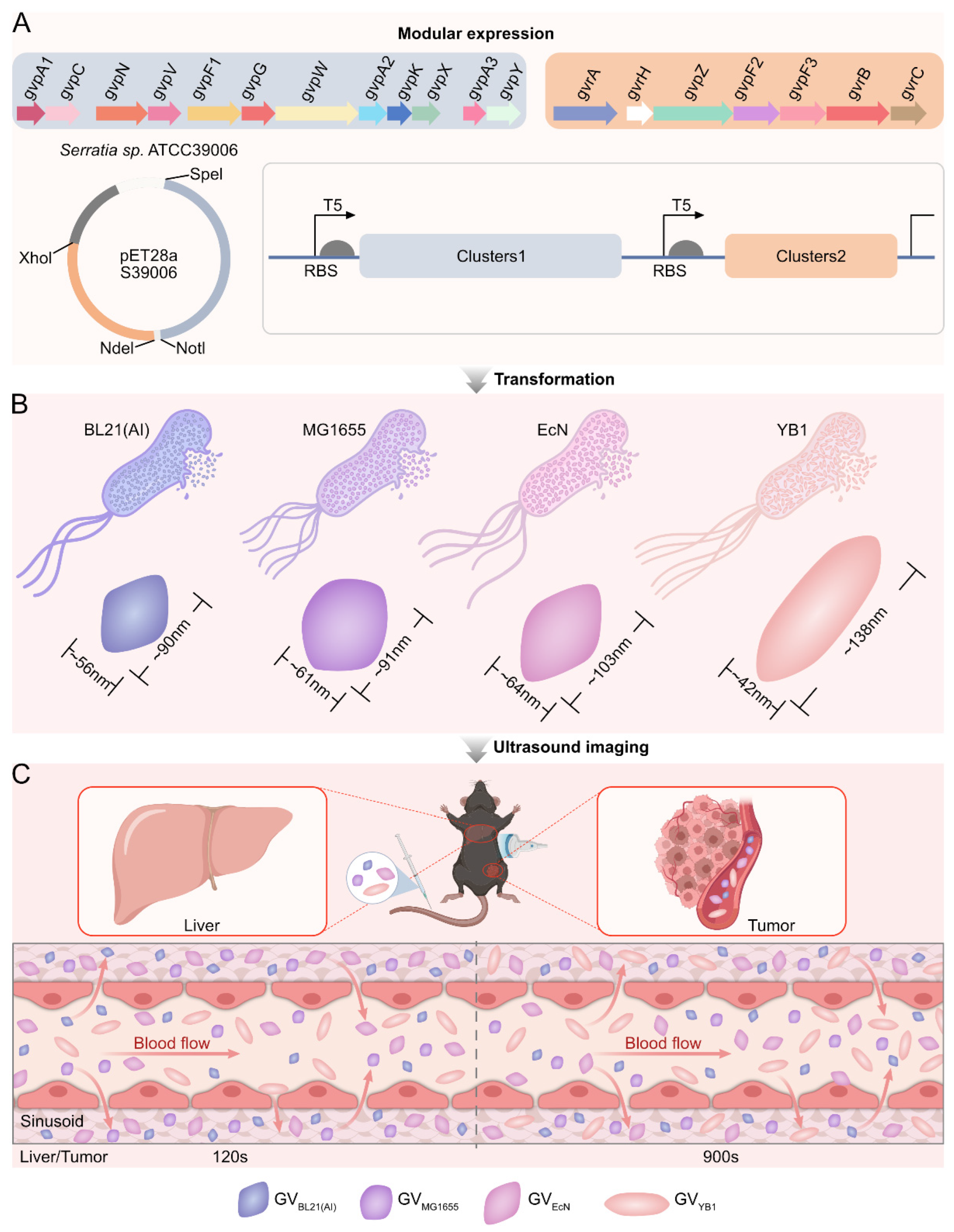
In this study, the GV gene cluster from Serratia sp. ATCC 39006 was split into two subclusters and cloned into the pET28a vector to generate a complete functional unit for heterologous expression (Figure 1A). The verified recombinant plasmid was then transformed into five different chassis strains for heterologous expression of GVs (Figure 1B). Subsequently, purified GVs were systemically administered to both healthy mice and tumor-bearing mice, with subsequent imaging of the liver and tumor to assess their ultrasound imaging performance (Figure 1C).

2. Results

2.1. Synthesis of GVs in Different Chassis Cells

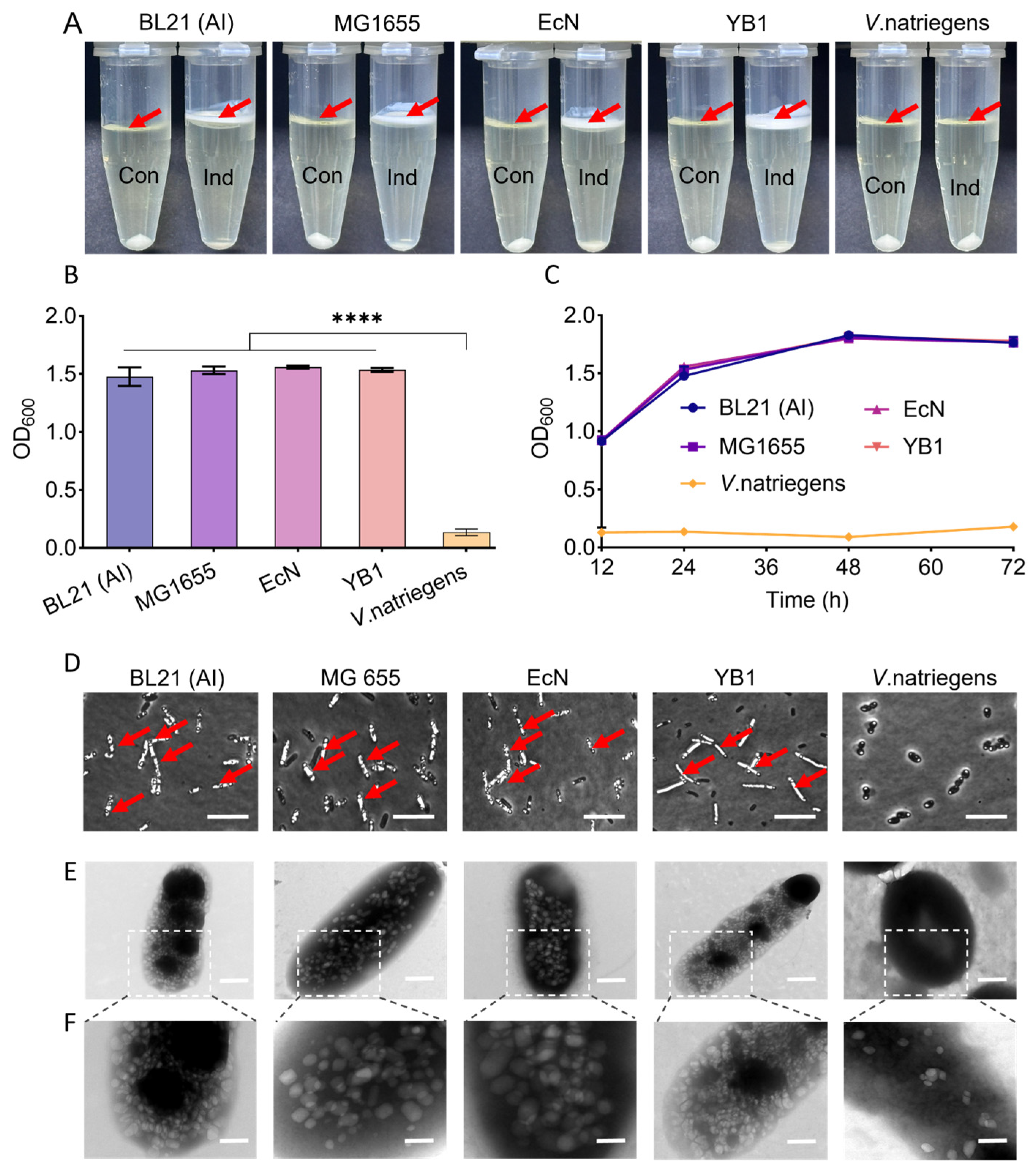
The modular engineering plasmid was successfully constructed and transformed into different chassis cells, including E. coli BL21 (AI), E. coli K-12 MG1655, E. coli Nissle 1917 (EcN), Salmonella YB1, and Vibrio natriegens. The yield of GVs was initially assessed by measuring the volume of floating bacterial cells after centrifugation. As shown in Figure 2A, except for Vibrio natriegens, which did not show obvious floating bacterial cells, all four other floating cells could be seen on the top of the media, indicative of significant GVs synthesis. Moreover, the addition of IPTG further significantly increased the yield of GVs. Subsequently, we systematically evaluated the GV synthesis dynamics in different chassis cells through quantitative measurement of the floating bacterial amount. As shown in Figure 2B, all four kinds of chassis cells except for Vibrio natriegens demonstrated effective GV synthesis with comparable production efficiency after 24 h of IPTG induction (p < 0.05). Furthermore, we conducted quantitative tracking of the GV production process across all five chassis cells at different time points. Figure 2C showed that GV yield progressively increased over time in E. coli, BL21 (AI), MG1655, EcN, and Salmonella YB1 within 48 h after inducer addition. Phase-contrast microscopy clearly revealed that GVs appeared within E. coli BL21 (AI), MG1655, EcN, and Salmonella YB1, but not in Vibrio natriegens (Figure 2D and Figure S1). Transmission electron microscopy (TEM) further confirmed the presence of GVs in the four kinds of strains, while Vibrio natriegens produced significantly fewer GVs (Figure 2E,F). Collectively, these results demonstrate that E. coli BL21 (AI), MG1655, EcN, and Salmonella YB1 effectively produced GVs and are suitable chassis cells for heterologous synthesis of GVs.

2.2. Extraction and Characterization of GVs

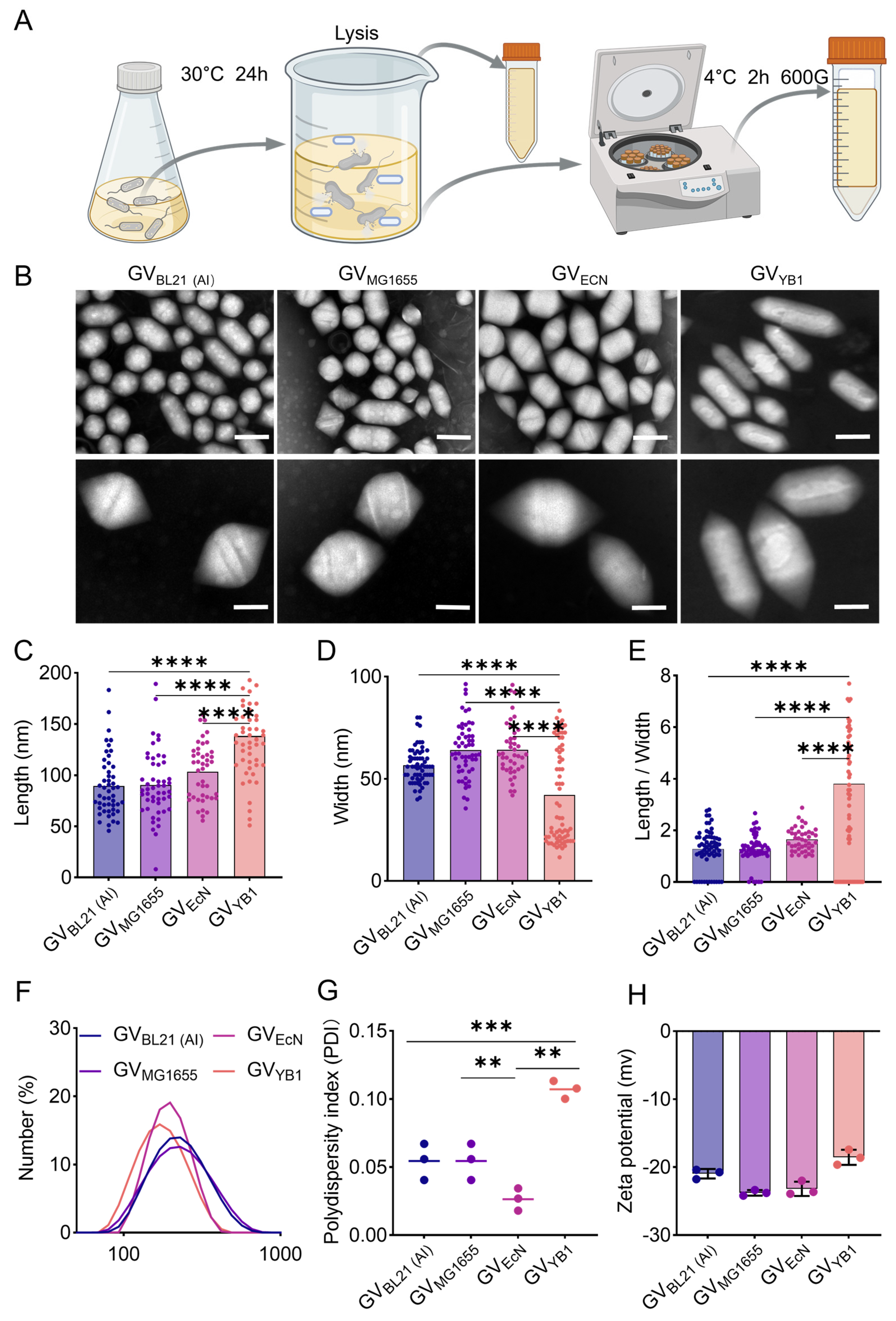
The GVs were extracted and purified from E. coli BL21 (AI), MG1655, EcN, as well as Salmonella YB1 according to a previously established protocol (Figure 3A) [34]. TEM imaging revealed that the purified gas vesicles from BL21 (AI) and MG1655 strains exhibited a consistent cylindrical morphology, whereas those from the EcN strain presented a distinct, elongated rod-shaped structure (Figure 3B). Next, we measured the dimensions under TEM, which showed that the mean length of GVBL21 (AI), GVMG1655, GV EcN1917 and GVYB1 were 89.54 ± 29.7 nm, 90.61 ± 32.51 nm, 103.60 ± 27.69 nm, and 138.2 ± 44.8 nm, respectively (Figure 3C), and the width of GVBL21 (AI), GVMG1655, GV EcN, and GVYB1 were 56.77 ± 8.83 nm, 64.23 ± 13.34 nm, 64.27 ± 12.99 nm, and 42.24 ± 23.25 nm, respectively (Figure 3D). The length/width ratios of GVs varied across different chassis cells, as shown in Figure 3E. Briefly, the aspect ratios for GVBL21 (AI), GVMG1655, GVEcN, and GVYB1 were 1.27 ± 0.79, 1.27 ± 0.58, 1.64 ± 0.44, and 3.80 ± 3.31, respectively.
Also, we measured their hydrodynamic diameter in hydration using dynamic light scattering (DLS). The results showed that the hydrodynamic diameter of GVBL21 (AI), GVMG1655, GVEcN, and GVYB1 were 184.2 ± 3.12 nm, 151.4 ± 2.61 nm, 147.3 ± 1.62 nm, and 217.7 ± 11.59 nm, respectively (Figure 3F). The polydispersity index (PDI) measurements indicated good homogeneity across all four kinds of GVs, with the values of 0.05 ± 0.01, 0.05 ± 0.01, 0.03 ± 0.01, and 0.11 ± 0.01 for GVBL21 (AI), GVMG1655, GVEcN, and GVYB1, respectively (Figure 3G). Furthermore, the zeta potentials of GVBL21 (AI), GVMG1655, GVEcN, and GVYB1 were measured at −20.96 ± 0.71 mV, −23.77 ± 0.41 mV, 23.18 ± 1.04 mV, and −18.55 ± 1.12 mV, respectively (Figure 3H). Thus, these results demonstrate that GVs had a uniform nanoscale particle size.

2.3. In Vitro Ultrasound Imaging and Stability Assessment of GVs

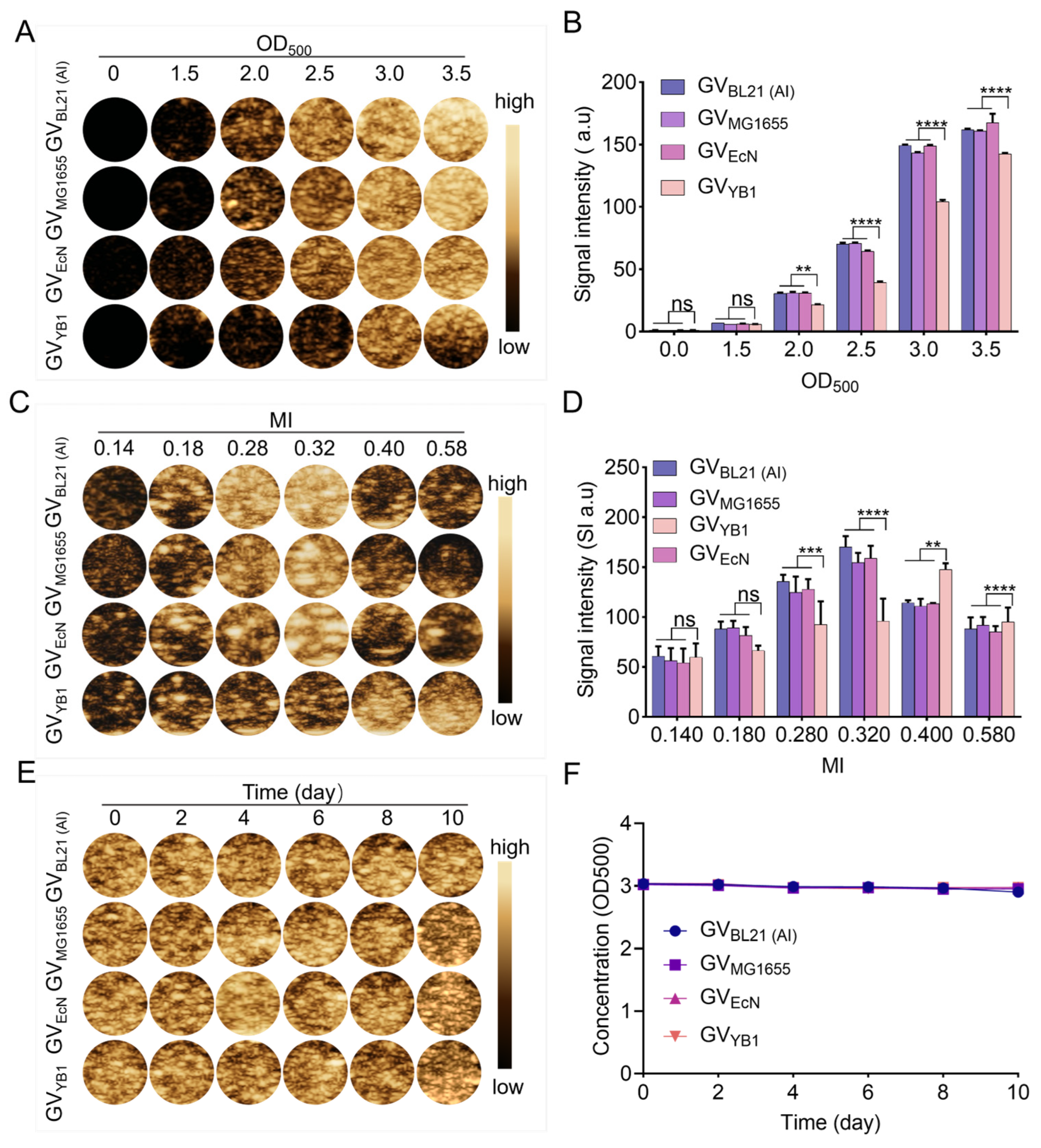
Next, we assessed the ultrasound contrast imaging performance of GVs in agar phantoms using a clinical ultrasound system equipped with a 7.1 MHz linear array transducer in vitro. The imaging signal intensity showed a positive correlation with GV concentrations across an OD500 range of 0 to 3.5 (Figure 4A,B). Notably, for GVYB1 at OD500 3.5, significant acoustic attenuation occurred, resulting in a diminished signal in the bottom region of the gel well (Figure 4A). Based on these results, we set the experimental concentration at OD500 = 3.3. At this concentration, all four kinds of GVs exhibited favorable ultrasound imaging signal intensities and effectively avoided the signal attenuation observed at the highest concentration (OD500 = 3.5) (Figure S2).
Subsequently, at this experimental concentration, we investigated the ultrasound imaging performance of GVs under various mechanical indices (MI). As shown in Figure 4C,D, the average ultrasound signal intensities within the region of interest (ROI) for all four kinds of GVs increased with the mechanical index (MI) until reaching their respective optima. Specifically, GVBL21 (AI), GVMG1655, and GVEcN1917 peaked at MI = 0.32, with signal intensities of 170.3 ± 10.82 a.u., 154.6 ± 9.65 a.u., and 159.0 ± 12.50 a.u., respectively. In contrast, GVYB1 achieved its optimal imaging at a higher MI of 0.40, with an intensity of 147.8 ± 6.12 a.u. Beyond these optimal MI values, further increases in acoustic power led to a decline in signal intensity for all GVs. This phenomenon is likely due to the acoustic collapse of GVs when the acoustic power exceeds their optimal imaging threshold.
To further assess their imaging stability, the four kinds of GVs (OD500 = 3.3) were stored at 4 °C and imaged at regular intervals over 10 days. The results showed no significant decrease in contrast signal intensity throughout the observation period (Figure 4E,F). These results demonstrate that GVs produced from these four different chassis cells exhibit favorable imaging stability, establishing a foundation for their further biomedical applications.

2.4. In Vivo Ultrasound Imaging of GVs in Normal Liver Tissue

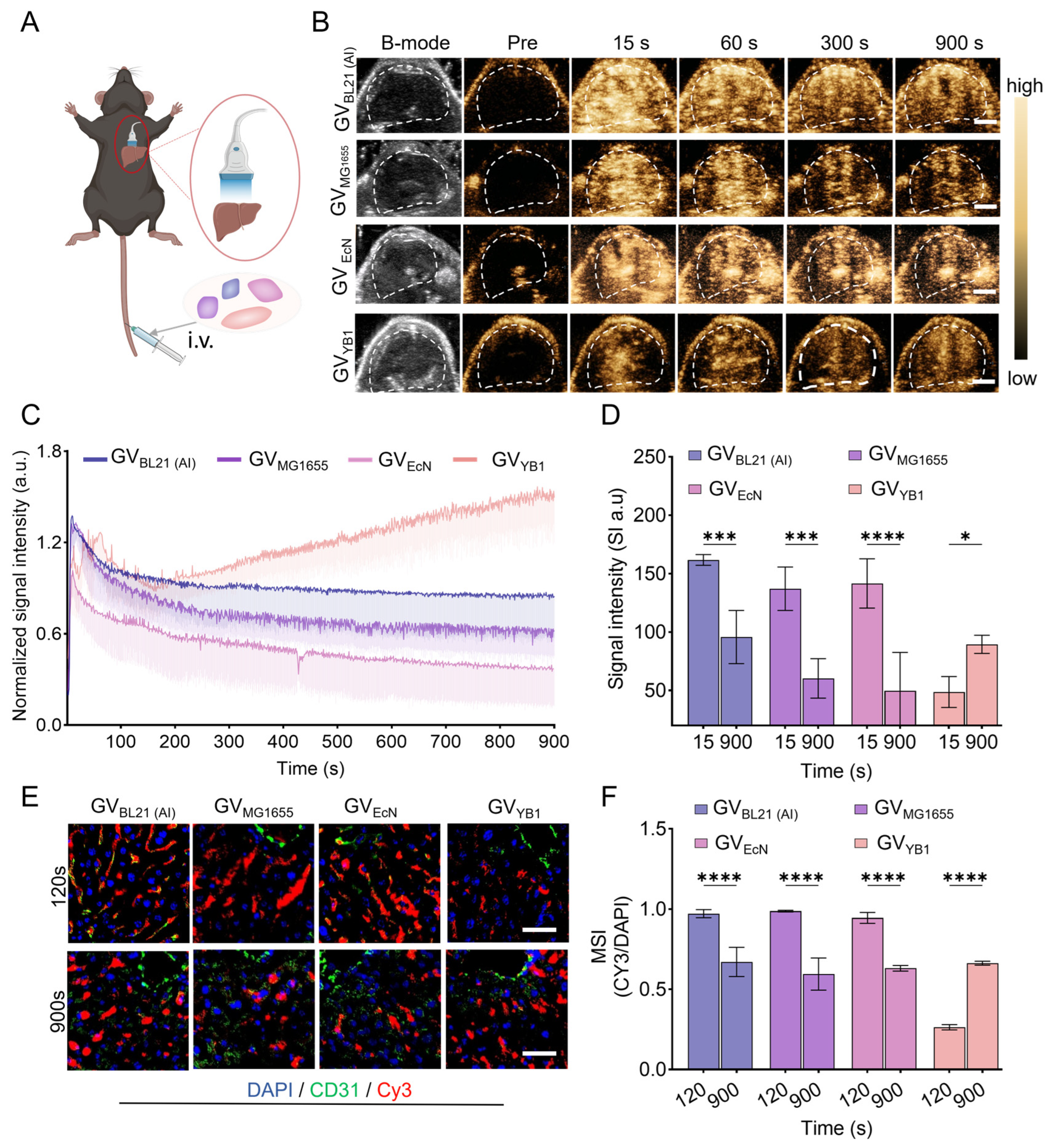
Given their outstanding stability and imaging performance in vitro, the four kinds of GVs produced from distinct chassis cells were further compared for their liver imaging capability in healthy C57BL/6J mice. The experimental procedure was illustrated in Figure 5A. Following standardization to OD500 = 3.3, each of the four kinds of GVs was systemically injected into mice at a dose of 200 µL. Figure 5B,C showed that the kinetics of contrast-enhanced ultrasound (CEUS) imaging varied significantly across the different GV types. Specifically, GVBL21 (AI), GVMG1655, and GVEcN showed similar kinetics, exhibiting rapid contrast enhancement that peaked at approximately 15 s post-injection, followed by a gradual signal decline over 900 s. In contrast, GVYB1 displayed a unique pharmacokinetic profile characterized by progressive signal accumulation, reaching its peak at the 900 s. Quantitative analysis detailed the signal attenuation dynamics over a 900 s period (Figure 5D). Specifically, the ultrasound signal intensity from the peak (approximately 15 s) to 900 s changed as follows: GVBL21 (AI) decreased from 161.70 ± 4.55 a.u. to 95.79 ± 22.75 a.u. (with a reduction of about 15%); GVMG1655 decreased from 137.20 ± 21.08 a.u. to 60.35 ± 16.91 a.u. (with a reduction of about 38%); and GVEcN decreased from 141.60 ± 21.08 a.u. to 49.76 ± 32.89 a.u. (with a reduction of about 34%). In contrast, the signal intensity of GVYB1 increased from 48.65 ± 13.23 a.u. to 89.48 ± 7.71 a.u., representing an increase of 34% by 900 s. The distinct perfusion imaging performance of GVYB1 may be attributed to its elongated rod-shaped structure, which affects its extravasation kinetics in the hepatic sinusoids, leading to prolonged imaging duration and delayed time to peak. The hepatic sinusoids are characterized by endothelial fenestrae and a discontinuous basement membrane, providing the primary pathway for nanoparticle extravasation from the vasculature into the liver tissue. Compared with the more oval-shaped structures of the other three GV variants, the elongated rod-like morphology of GVYB1 likely encounters greater steric hindrance and orientational constraints when passing through the sinusoidal fenestrae, thereby significantly reducing its passive extravasation efficiency. This morphological restriction not only delays its effective penetration from the vessels into the interstitial space (resulting in a delayed time to peak), but also makes it less susceptible to rapid washout by sinusoidal blood flow, thus prolonging its imaging persistence in the liver. Therefore, the morphological characteristics of GVYB1 may explain both its lower extravasation efficiency and its prolonged imaging kinetics.
To elucidate the differences in time-to-peak imaging among the various GVs, we performed immunofluorescence staining using Cy3-labeled GVs. Analysis of liver sections showed that a substantial amount of Cy3-labeled GVBL21 (AI), GVMG1655, and GVEcN extravasated from the vasculature by 120 s post-injection, with a visible decrease in signal by 900 s. In contrast, Cy3-labeled GVYB1 showed minimal vascular infiltration at 120 s post-injection. Notably, it exhibited progressive accumulation within the liver by 900 s (Figure 5E). At 120 s, the mean fluorescence intensities (Cy3/DAPI) for GVBL21 (AI), GVMG1655, GVEcN, and GVYB1 were 0.97 ± 0.03, 0.99 ± 0.01, 0.95 ± 0.03, and 0.26 ± 0.02, respectively. By 900 s, the signals for GVBL21 (AI), GVMG1655, and GVEcN had declined to 0.67 ± 0.09, 0.59 ± 0.10, and 0.63 ± 0.02, respectively, while that of GVYB1 increased to 0.66 ± 0.01. Quantitative immunofluorescence proved our hypothesis: GVBL21 (AI), GVMG1655, and GVEcN showed rapid extravasation within the hepatic vasculature after systemic administration, achieving a fast ultrasound contrast peak, and subsequently being cleared from the tissue. In contrast, GVYB1 exhibited a progressive accumulation in the liver over time, with slower extravasation and delayed clearance from the bloodstream. Collectively, our data demonstrate that GVs generated from the selected chassis cells all produce strong ultrasound contrast signals in the liver. Importantly, their hepatic perfusion and retention kinetics vary with GV particle shape. This shape-dependent characteristic, particularly the distinct elongated rod-shaped structure of GVYB1, enriches in vivo GV dynamics that differ from those of conventional ultrasound contrast agents. This feature may offer great potential for application in the diagnosis of liver diseases.

2.5. In Vivo CEUS Imaging of GVs in Tumor

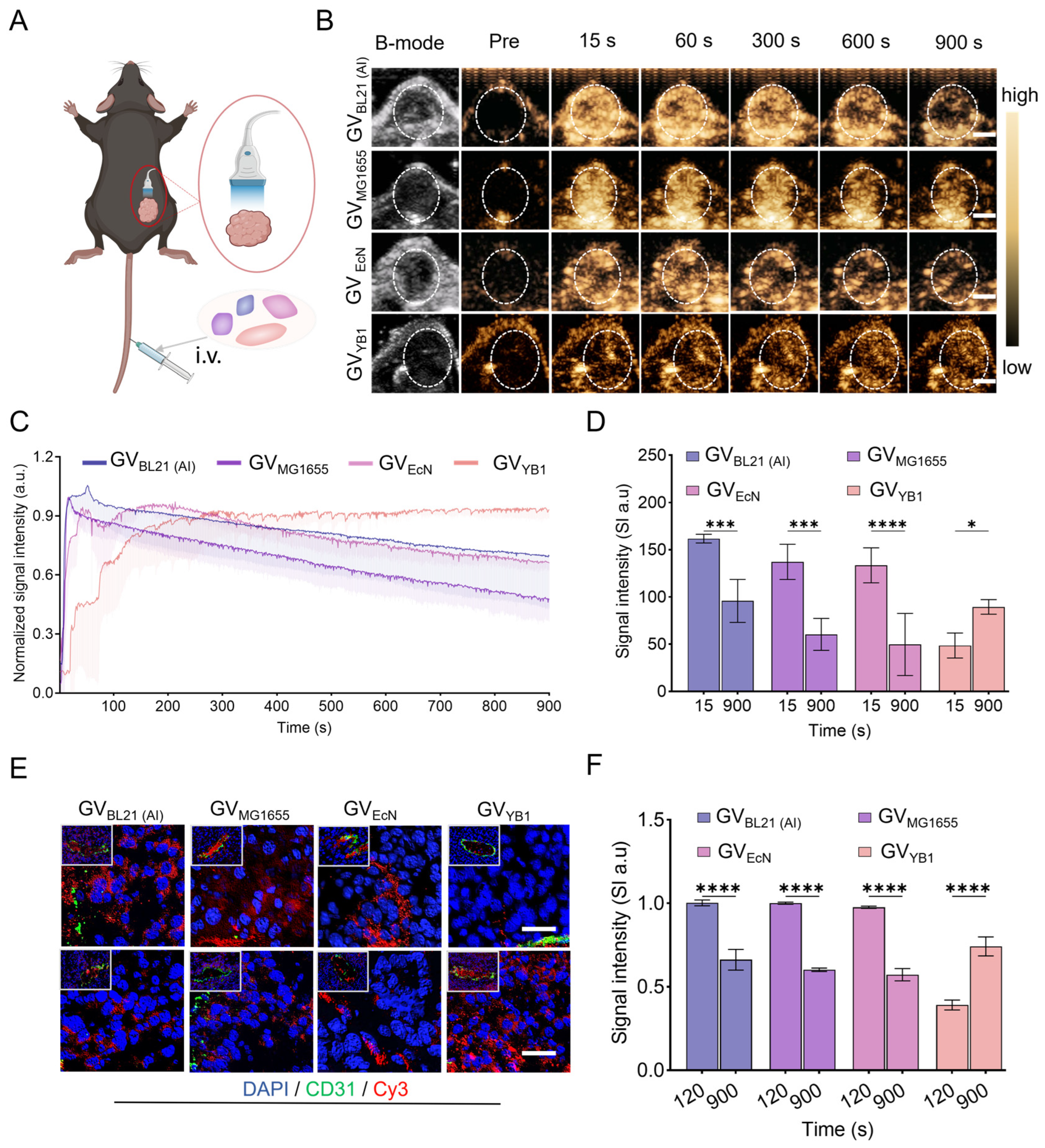
To explore the tumor imaging capability of GVs, we intravenously administered GVBL21 (AI), GVMG1655, GVEcN, and GVYB1 at equal concentrations into the tumor-bearing mice, as shown in Figure 6A. From Figure 6B,C, we can see that GVBL21 (AI), GVMG1655, GVEcN, and GVYB1 effectively perfused into the tumors. Consistent with the phenomenon in normal liver, GVBL21 (AI), GVMG1655, and GVEcN also exhibited rapid contrast enhancement within tumors, peaking at approximately 15 s post-systemic injection, followed by a gradual signal decay over time. In contrast, GVYB1 showed markedly delayed kinetics, with its intratumoral signal progressively increasing after administration. Quantitative analysis of signal intensity (Figure 6D) showed that at 15 s, GVBL21 (AI), GVMG1655, and GVEcN reached peak values of 161.7 ± 4.54, 136.9 ± 19.03, and 133.5 ± 18.5 a.u., respectively, whereas GVYB1 was significantly lower (55.31 ± 20.93 a.u.). By 900 s, signals from the GVBL21 (AI), GVMG1655, and GVEcN declined to 95.79 ± 22.75, 60.35 ± 16.91, and 49.76 ± 49.76 a.u., respectively. In contrast, GVYB1 increased substantially to 89.48 ± 7.72 a.u., representing a 45.7% rise from its 15 s baseline.
To elucidate the underlying differential intratumoral perfusion of the various GVs, we performed immunofluorescence staining on tumor tissues. After systemic injection of Cy3-labeled GVs, mice were sacrificed at 120 s and 900 s, and tumors were harvested for analysis. The results demonstrated that all four kinds of GVs could effectively extravasate through tumor vascular gaps and reach the peritumoral cellular area. Notably, a substantial amount of GVBL21 (AI), GVMG1655, and GVEcN had penetrated the tumor vessel walls and reached tumor cells at the early time point (120 s). In contrast, only a minimal amount of GVYB1 extravasating the vasculature was observed. By 900 s, the fluorescence signals from GVBL21 (AI), GVMG1655, and GVEcN had decreased markedly in comparison to their levels at 120 s, whereas the signal from GVYB1 progressively increased. Quantitative analysis of the mean fluorescence intensity confirmed this trend: the signals for GVBL21 (AI), GVMG1655, and GVEcN dropped from 0.99 ± 0.02, 0.99 ± 0.01, and 0.97 ± 0.01 a.u. at 120 s to 0.68 ± 0.07, 0.60 ± 0.01, and 0.58 ± 0.01 a.u. at 900 s, corresponding to an average reduction of ~36.9%. In contrast, the signal for GVYB1 rose from 0.39 ± 0.03 a.u. to 0.74 ± 0.05 a.u. over the 900 s period, with an increase of ~34.8%. These findings further support our hypothesis that the elongated, rod-shaped GVYB1 impedes its extravasation across tumor vascular gaps. This not only delays the time to peak imaging enhancement but also results in slower clearance by blood flow, leading to prolonged intratumoral imaging duration. Consequently, the choice of chassis cell determines the GV morphology, which in turn dictates different intratumoral imaging characteristics. In addition, the biocompatibility of GVs produced by the four kinds of chassis strains was evaluated through blood biochemistry, complete blood count, and H&E staining of major organs, which confirmed their favorable safety profile in vivo (Figures S3 and S4).

3. Conclusions

In summary, this study successfully produced gas vesicles (GVs) with distinct morphologies and imaging kinetics through genetically engineering of multiple chassis cells. The results demonstrate that Escherichia coli BL21 (AI), MG1655, EcN, and Salmonella YB1 can serve as efficient chassis strains, stably producing GVs with high yield and excellent imaging performance. Furthermore, this work clarifies that the rational selection and engineering of chassis cells can modulate GV morphology, thereby directly influencing their imaging performance. These findings not only establish a clear “chassis-GV morphology-imaging performance” relationship but also provide a solid theoretical and experimental foundation for screening and constructing high-efficiency GV-producing strains. Compared with traditional microbubble-based contrast agents, the nanoscale biosynthesized GVs may offer unique advantages such as extravasation from blood vessels, making it possible to achieve molecularly targeted imaging of tumor cells.

4. Materials and Methods

4.1. Plasmid Construction

The Serratia sp. ATCC 39006 strain used in this study was purchased from the American Type Culture Collection (ATCC). Its wild-type genome has a 19-gene gas vesicle (GV) cluster. In this study, the complete 19-gene cluster was divided into two sub-clusters (cluster 1, gvpA-gvpY and cluster 2, gvrA-gvrC) [35,36]. Each sub-cluster was cloned into the downstream of a constitutive T5 promoter for expression by restriction enzyme and ligation. After sequencing verification, the correct assembly of the recombinant plasmid was transformed into different chassis cells for further functional assays. The sequences of primers used in this article are listed in Supplementary Table S1.

4.2. Cultivation of GV-Producing Bacteria

The recombinant plasmid encoding gas vesicles (GVs) was transformed into five chassis strains: Escherichia coli BL21 (AI), MG1655, EcN, Salmonella YB1, and Vibrio natriegens. Positive single colonies were selected and inoculated into 5 mL of LB liquid medium supplemented with 50 μg/mL kanamycin and 0.2% glucose, followed by incubation at 37 °C with shaking for 16 h to prepare seed cultures. Subsequently, the seed cultures at a 1:100 ratios, were transferred into fresh LB medium containing the same concentrations of antibiotic and glucose for continued shaking cultivation. When the cultures’ optical density at 600 nm (OD600) reached 0.6–0.7, isopropylβ-D-1-thiogalactopyranoside (IPTG) was added, and the temperature was shifted to 30 °C for 24 h to induce GV synthesis. After induction, to visually assess GV formation, aliquots of culture (1 mL) of each culture were centrifuged at 600× g for 10 min. A white suspended layer appeared in the upper phase, indicating the presence of GV-containing bacteria [19,37,38].

4.3. Extraction and Purification of GVs

After cultivation of the GV-containing bacteria, the culture was centrifuged at 600× g and 4 °C for 2 h to collect the GV-containing bacteria from the upper layer. The harvested cells were gently resuspended in a bacterial active protein extraction reagent (L200500, Galantis, Shenzhen, China) supplemented with lysozyme (L8120, Soleibao, Beijing, China), followed by incubation with gentle stirring at room temperature for 2 h. DNase I (9003-98-9, GLPBIO, Shanghai, China) was then added, and the mixture was incubated for an additional 2 h. After enzymatic digestion, the sample was centrifuged again under the same conditions (600× g, 4 °C, 2 h) to obtain a crude GVs [34]. The pellet was subsequently washed three to four times with PBS buffer (2.0 mM KH2PO4, 137 mM NaCL, 10.0 mM NaHPO4, 2.7 mM KCI) (G4202-500ML) (Servicebio, Wuhan, China) to yield purified GVs.

4.4. Characterization of GVs

The morphology of GVs was examined by a transmission electron microscope (Hitachi H-7650, Tokyo, Japan) and phase-contrast microscopy (Olympus IX83 inverted microscope, Tokyo, Japan). The particle size and zeta potential of GVs were measured using a particle size analyzer (Malvern Panalytical ZS XPLORER, Malvern, UK).

4.5. In Vitro Imaging and Stability Test

In this study, we first explored the effect of GV concentration on ultrasound contrast enhancement. GV solutions with optical densities at OD500: 0–3.5 were loaded into pre-fabricated agarose phantom wells. Ultrasound imaging was conducted using a clinical scanner (Resona 9, Mindray, Shenzhen, China) equipped with a linear array probe (L11-3U) [17]. Contrast-enhanced images were acquired at each concentration, followed by quantitative analysis of the signal intensity. The imaging parameters were set as follows: frequency 7.1 MHz, frame rate 10 Hz, dynamic range 115 dB. Following determination of the optimal GV concentration (OD500 = 3.3), the mechanical index (MI) was subsequently optimized. Keeping all other imaging parameters constant, the MI was systematically varied from 0.145 to 0.581 to evaluate its effect on GV-mediated contrast enhancement and to identify the optimal imaging conditions [34]. To assess the stability of GVs, samples (OD500 = 3.3) were stored at 4 °C, and in vitro images were obtained every other day for 10 days [39]. The contrast signal intensities were quantified at each time point.

4.6. Cell Culture

B16F10 cells (TCM36, Cell Bank of the Chinese Academy of Sciences, Shanghai, China) were cultured in RPMI-1640 medium (G4535) (Servicebio, Wuhan, China) supplemented with 100 U/mL penicillin, 100 µg/mL streptomycin (G4003) (Servicebio, Wuhan, China), and 10% heat-inactivated fetal bovine serum (G8003) (Servicebio, Wuhan, China).

4.7. Establishment of Animal Models

B16F10 cells were cultured to the logarithmic growth phase. When the cell confluence reached 80%, cells were detached with 0.25% trypsin, centrifuged, and resuspended in PBS to prepare a single-cell suspension at 2.0 × 10⁵ cells/mL. Subsequently, 0.1 mL of the cell suspension was subcutaneously inoculated into the flank of C57BL/6 mice. Tumor growth was monitored using an ultrasound imaging system (Resona 9, Mindray, Shenzhen, China), and the contrast imaging experiments were initiated when the tumor diameter reached 5–8 mm [40,41].

4.8. In Vivo Ultrasound Imaging of GVs

The tumor-bearing mice were anesthetized, fixed in a supine position on a heated pad (37 °C), and an optimal ultrasound view was obtained. To avoid potential cross-interference, each mouse received an injection of a single type of GV. The injection volume was 200 μL at an OD500 of 3.3 [17].

4.9. Tissue Immunofluorescence Analysis

Briefly, Cy3-labeled GVs (100 µL, OD500 = 3.3) were intravenously injected into tumor-bearing or healthy control mice. At designated time points, mice were euthanized, and tumors were excised, cryosectioned, and immunostained with an anti-CD31 antibody (GB113151, Servicebio, China) to label blood vessels [18]. Sections were then imaged using a confocal laser scanning microscope (Nikon A1R, Tokyo, Japan).

4.10. Statistical Analyses

Statistical analyses were performed using GraphPad Prism 9.0. Data normality was assessed with the Shapiro–Wilk test. Data are expressed as mean ± standard deviation (SD). Differences between the two groups were evaluated using a two-tailed Student’s t-test or the Mann–Whitney test. Comparisons among multiple groups were conducted by one-way analysis of variance (ANOVA). A p-value < 0.05 was considered statistically significant.

Supplementary Materials

The following supporting information can be downloaded at: https://www.mdpi.com/article/10.3390/md24030106/s1, Figure S1: Five chassis cell strains biosynthesized gas vesicles (GVs) without the inducer. scale bars: 10 µm; Figure S2: In vitro ultrasound contrast imaging of GVs at a concentration of OD500 = 3.3; Figure S3: Biosafety assessment in mice. Representative H&E-stained sections of major organs (heart, liver, spleen, lung, and kidney) collected 7 days post-administration of PBS or GVs. scale bars: 50 µm; Figure S4: (A–K) Hematological detection of liver function (A,B), kidney function (C,D), and blood count (E–H) 3 days after intravenous injection of PBS or GVs in mice. (n = 3); Table S1: Primers used in this study.

Author Contributions

Conceptualization, Funding acquisition, Supervision, Methodology, F.Y. and W.S.; Data curation, Investigation, Visualization, Resources, Validation, Q.F., K.Y., Y.W., C.L. and W.O.; Formal analysis, Software, Q.F., K.Y. and W.L.; Writing—Original Draft, K.Y.; Writing—Review and Editing, F.Y., K.Y. and Q.F. All authors have read and agreed to the published version of the manuscript.

Funding

The authors gratefully acknowledge the support of the National Key R&D Program of China (2025YFA0922100), the Shenzhen Medical Research Fund (B2402006), the Leading Talents of the Guangdong Special Support Program (2024TX08A098), the Shenzhen Synthetic Bio-Manufacturing Pilot-scale Base Project (ZXSJD20240708092506009), and the Natural Science Foundation of Guangdong Province in China (2023B1515120007).

Institutional Review Board Statement

Ethical clearance was granted by the Animal Experiment Ethics Committee of the Shenzhen Institute of Advanced Technology, Chinese Academy of Sciences (Protocol No. SIAT-IACUC-231114-HCS-YF-A2377; approved on 14 September 2023).

Data Availability Statement

The original data presented in the study are included in the article and the Supplementary Material; further inquiries can be directed to the corresponding author.

Conflicts of Interest

The authors declare no conflicts of interest.

References

  1. Aziz, M.U.; Eisenbrey, J.R.; Deganello, A. Microvascular Flow Imaging: A State-of-the-Art Review of Clinical Use and Promise. Radiology 2022, 305, 250–264. [Google Scholar] [CrossRef]
  2. Pirmoazen, A.M.; Khurana, A.; El Kaffas, A.; Kamaya, A. Quantitative ultrasound approaches for diagnosis and monitoring hepatic steatosis in nonalcoholic fatty liver disease. Theranostics 2020, 10, 4277–4289. [Google Scholar] [CrossRef]
  3. Shekhar, S.; Chauhan, M.; Sonali. Enhanced permeability and retention effect-focused tumor-targeted nanomedicines: Latest trends, obstacles and future perspective. Nanomedicine 2022, 17, 1213–1216. [Google Scholar] [CrossRef]
  4. Kang, H.J.; Lee, J.M.; Yoon, J.H.; Lee, K.; Kim, H.; Han, J.K. Contrast-enhanced US with Sulfur Hexafluoride and Perfluorobutane for the Diagnosis of Hepatocellular Carcinoma in Individuals with High Risk. Radiology 2020, 297, E241. [Google Scholar] [CrossRef]
  5. Ren, E.; Liu, C.; Lv, P.; Wang, J.; Liu, G. Genetically Engineered Cellular Membrane Vesicles as Tailorable Shells for Therapeutics. Adv. Sci. 2021, 8, e2100460. [Google Scholar] [CrossRef]
  6. Bodard, S.; Denis, L.; Chabouh, G. First clinical utility of sensing Ultrasound Localization Microscopy (sULM): Identifying renal pseudotumors. Theranostics 2025, 15, 233–244. [Google Scholar] [CrossRef] [PubMed]
  7. Wei, L.; Kang, H.J.; Huang, Y.L. Perfluorobutane-Enhanced CEUS in Intrahepatic Cholangiocarcinoma: Correlating Imaging Features With Liver Backgrounds and Tumor Sizes. Ultrasound Med. Biol. 2025, 51, 70–76. [Google Scholar] [CrossRef] [PubMed]
  8. Zhang, X.H.; Maeda, N.; Craig, V.S. Physical properties of nanobubbles on hydrophobic surfaces in water and aqueous solutions. Langmuir 2006, 22, 5025–5035. [Google Scholar] [CrossRef] [PubMed]
  9. Jafari, S.A.; de Leon, A.C.; Lee, R. Toward Precisely Controllable Acoustic Response of Shell-Stabilized Nanobubbles: High Yield and Narrow Dispersity. ACS Nano 2021, 15, 4901–4915. [Google Scholar] [CrossRef]
  10. Ling, B.; Gungoren, B.; Yao, Y. Truly Tiny Acoustic Biomolecules for Ultrasound Imaging and Therapy. Adv. Mater. 2024, 36, e2307106. [Google Scholar] [CrossRef]
  11. Dutka, P.; Metskas, L.A.; Hurt, R.C. Structure of Anabaena flos-aquae gas vesicles revealed by cryo-ET. Structure 2023, 31, 518–528.e6. [Google Scholar] [CrossRef]
  12. Lakshmanan, A.; Lu, G.J.; Farhadi, A. Preparation of biogenic gas vesicle nanostructures for use as contrast agents for ultrasound and MRI. Nat. Protoc. 2017, 12, 2050–2080. [Google Scholar] [CrossRef] [PubMed]
  13. Lakshmanan, A.; Farhadi, A.; Nety, S.P. Molecular Engineering of Acoustic Protein Nanostructures. ACS Nano 2016, 10, 7314–7322. [Google Scholar] [CrossRef] [PubMed]
  14. Wang, Y.; Fu, M.; Yang, Y. Modification of PEG reduces the immunogenicity of biosynthetic gas vesicles. Front. Bioeng. Biotechnol. 2023, 11, 1128268. [Google Scholar] [CrossRef] [PubMed]
  15. Pfeifer, F. Distribution, formation and regulation of gas vesicles. Nat. Rev. Microbiol. 2012, 10, 705–715. [Google Scholar] [CrossRef]
  16. Gong, Z.; He, Y.; Zhou, M. Ultrasound imaging tracking of mesenchymal stem cells intracellularly labeled with biosynthetic gas vesicles for treatment of rheumatoid arthritis. Theranostics 2022, 12, 2370–2382. [Google Scholar] [CrossRef]
  17. Yu, K.; Huang, Y.; Wang, Y. PEGylated gas vesicles: A promising novel ultrasound contrast agent for diagnosis and guiding radiofrequency ablation of liver tumor. J. Nanobiotechnol. 2025, 23, 344. [Google Scholar] [CrossRef]
  18. Wang, Z.; Yibulayin, M.; Yu, K. Biosynthetic gas vesicles as a novel ultrasound contrast agent for diagnosing and treating myocardial infarction. Theranostics 2025, 15, 8553–8568. [Google Scholar] [CrossRef]
  19. Hurt, R.C.; Buss, M.T.; Duan, M. Genomically mined acoustic reporter genes for real-time in vivo monitoring of tumors and tumor-homing bacteria. Nat. Biotechnol. 2023, 41, 919–931. [Google Scholar] [CrossRef]
  20. Bourdeau, R.W.; Lee-Gosselin, A.; Lakshmanan, A. Acoustic reporter genes for noninvasive imaging of microorganisms in mammalian hosts. Nature 2018, 553, 86–90. [Google Scholar] [CrossRef]
  21. Kim, J.M.; Kim, Y.S.; Kim, Y.R.; Choi, M.J.; DasSarma, P.; DasSarma, S. Bioengineering of Halobacterium sp. NRC-1 gas vesicle nanoparticles with GvpC fusion protein produced in E. coli. Appl. Microbiol. Biotechnol. 2022, 106, 2043–2052. [Google Scholar] [CrossRef]
  22. Yu, M.; Hu, S.; Tang, B.; Yang, H.; Sun, D. Engineering Escherichia coli Nissle 1917 as a microbial chassis for therapeutic and industrial applications. Biotechnol. Adv. 2023, 67, 108202. [Google Scholar] [CrossRef]
  23. Ba, F.; Zhang, Y.; Ji, X.; Liu, W.Q.; Ling, S.; Li, J. Expanding the toolbox of probiotic Escherichia coli Nissle 1917 for synthetic biology. Biotechnol. J. 2024, 19, e2300327. [Google Scholar] [CrossRef]
  24. Abedi, M.H.; Yao, M.S.; Mittelstein, D.R. Ultrasound-controllable engineered bacteria for cancer immunotherapy. Nat. Commun. 2022, 13, 1585. [Google Scholar] [CrossRef]
  25. Du, M.; Hou, Z.; Liu, L. Progress, applications, challenges and prospects of protein purification technology. Front. Bioeng. Biotechnol. 2022, 10, 1028691. [Google Scholar] [CrossRef] [PubMed]
  26. Vyas, V.V.; Esposito, D.; Zhu, J. Clinical manufacturing of recombinant human interleukin 15. I. Production cell line development and protein expression in E. coli with stop codon optimization. Biotechnol. Prog. 2012, 28, 497–507. [Google Scholar] [CrossRef] [PubMed]
  27. Monk, J.M.; Koza, A.; Campodonico, M.A. Multi-omics Quantification of Species Variation of Escherichia coli Links Molecular Features with Strain Phenotypes. Cell Syst. 2016, 3, 238–251.e12. [Google Scholar] [CrossRef]
  28. Falzone, L.; Lavoro, A.; Candido, S.; Salmeri, M.; Zanghì, A.; Libra, M. Benefits and concerns of probiotics: An overview of the potential genotoxicity of the colibactin-producing Escherichia coli Nissle 1917 strain. Gut Microbes 2024, 16, 2397874. [Google Scholar] [CrossRef]
  29. Gurbatri, C.R.; Radford, G.A.; Vrbanac, L. Engineering tumor-colonizing E. coli Nissle 1917 for detection and treatment of colorectal neoplasia. Nat. Commun. 2024, 15, 646. [Google Scholar] [CrossRef]
  30. Yu, B.; Yang, M.; Shi, L. Explicit hypoxia targeting with tumor suppression by creating an “obligate” anaerobic Salmonella Typhimurium strain. Sci. Rep. 2012, 2, 436. [Google Scholar] [CrossRef] [PubMed]
  31. Zahedifard, Z.; Mahmoodi, S.; Ghasemian, A. Genetically Engineered Bacteria as a Promising Therapeutic Strategy Against Cancer: A Comprehensive Review. Biotechnol. Appl. Biochem. 2025, 72, 1458–1476. [Google Scholar] [CrossRef] [PubMed]
  32. Sun, Y.; Wang, Y.; Li, X.; Zhang, J.; Liu, C. Recombinant Protein Expression Chassis Library of Vibrio natriegens by Fine-Tuning the Expression of T7 RNA Polymerase. ACS Synth. Biol. 2023, 12, 555–564. [Google Scholar] [CrossRef] [PubMed]
  33. Kormanová, Ľ.; Rybecká, S.; Turňa, J.; Čelešník, H. Comparison of simple expression procedures in novel expression host Vibrio natriegens and established Escherichia coli system. J. Biotechnol. 2020, 321, 57–67. [Google Scholar] [CrossRef]
  34. Liu, T.; Wang, J.Q.; Liu, C.X.; Wang, Y.; Li, Z.; Yan, F. Characterization and Comparison of Contrast Imaging Properties of Naturally Isolated and Heterologously Expressed Gas Vesicles. Pharmaceuticals 2024, 17, 755. [Google Scholar] [CrossRef]
  35. Tashiro, Y.; Monson, R.E.; Ramsay, J.P.; Salmond, G.P. Molecular genetic and physical analysis of gas vesicles in buoyant enterobacteria. Environ. Microbiol. 2016, 18, 1264–1276. [Google Scholar] [CrossRef] [PubMed]
  36. Hill, A.M.; Salmond, G.P.C. Microbial gas vesicles as nanotechnology tools: Exploiting intracellular organelles for translational utility in biotechnology, medicine and the environment. Microbiology 2020, 166, 501–509. [Google Scholar] [CrossRef]
  37. Fu, M.J.; Wang, Y.; Wang, J.Q. Genetic Modulation of Biosynthetic Gas Vesicles for Ultrasound Imaging. Small 2024, 20, e2310008. [Google Scholar] [CrossRef]
  38. Yang, Z.; Wang, Y.; Zeng, F.Y.; Chen, Z.; Yan, F. Ultrasound-visible engineered bacteria for tumor chemo-immunotherapy. Cell Rep. Med. 2024, 5, 101512. [Google Scholar] [CrossRef]
  39. Wang, G.; Kang, X.; Liu, W. iRGD-Targeted Biosynthetic Nanobubbles for Ultrasound Molecular Imaging of Osteosarcoma. Int. J. Nanomed. 2025, 20, 791–805. [Google Scholar]
  40. Wang, G.; Kang, X.; Chen, K.S. An engineered oncolytic virus expressing PD-L1 inhibitors activates tumor neoantigen-specific T cell responses. Nat. Commun. 2020, 11, 1395. [Google Scholar] [CrossRef]
  41. Shi, C.; Zhang, Q.; Yao, Y. Targeting the activity of T cells by membrane surface redox regulation for cancer theranostics. Nat. Nanotechnol. 2023, 18, 86–97. [Google Scholar] [CrossRef] [PubMed]
Figure 1. Heterologous expression and in vivo imaging of GVs. (A) Schematic of GV expression plasmid construction. The GV gene cluster from Serratia sp. ATCC 39006 was split into two subclusters and cloned into the pET28a vector to generate a complete functional unit for heterologous expression. (B) Expression of GVs in different chassis cells. The verified recombinant plasmid was transformed into five different strains for heterologous expression of GVs. (C) In vivo ultrasound imaging of GVs. Purified GVs were systemically administered to both healthy mice and tumor-bearing mice, with subsequent imaging of the liver and tumor to assess their ultrasound imaging performance.
Marinedrugs 24 00106 g001
Figure 2. Bacterial synthesis and characterization of GVs. (A) Five engineered chassis strains after centrifugation. Arrows point to buoyant, GV-containing cells. (B) OD600 measurement of buoyant fractions after 24 h of enrichment culture. (C) OD600 dynamics of buoyant fractions over a 12–72 h culture period. (D) Phase-contrast microscopy (PCM) images showing GV synthesis. Arrows indicate intracellular GVs. Scale bar: 10 µm; (E,F) Scanning electron microscopy (SEM) images of five chassis strains producing GVs (E) and magnified view of the boxed area in E (F); scale bars: 400 nm (E) and 200 nm (F); **** p < 0.0001.
Marinedrugs 24 00106 g002
Figure 3. Extraction and characterization of GVs. (A) Schematic of the biosynthetic GV production. (B) TEM images of GVs isolated from four chassis strains: BL21 (AI), MG1655, EcN1917, and YB1. Scale bars: 200 nm (top row) and 100 nm (bottom row). (CE) Quantification of GV dimensions: Length (C), width (D), and length/width ratio (E) derived from the four kinds of strains (n = 50 GVs per strain). (FH) Hydrodynamic size distribution (F), polydispersity index (PDI, (G)), and zeta potential (H) of the four kinds of GVs. Data are presented as mean ± SD. ** p < 0.01, *** p < 0.001 and **** p < 0.0001.
Marinedrugs 24 00106 g003
Figure 4. Ultrasound contrast imaging of GVs in vitro. (A,B) In vitro ultrasound contrast imaging of GVs at equivalent concentrations (OD500 0–3.5) and their quantification analysis (B); (C,D) representative contrast images (C) and the corresponding quantitative analysis of signal intensity (D) for GVs at OD500 = 3.3 under different mechanical index (MI) conditions; (E,F) representative contrast images (E) and quantitative analysis of signal intensity (F) of GVs at OD500 = 3.3 at the indicated time points. Data represent the mean ± SD, ** p < 0.01, *** p < 0.001, and **** p < 0.0001, ns, not significant.
Marinedrugs 24 00106 g004
Figure 5. In vivo imaging performance of GVs in the liver. (A) Schematic of liver imaging in healthy mice for GVBL21 (AI), GVMG1655, GVEcN, and GVYB1; (B) in vivo hepatic contrast-enhanced ultrasound images at different time points after systemic injection of the four kinds of GVs (n = 3). Scale bar: 5 µm; (C) normalized time-signal intensity curve for contrast enhancement in (B); (D) quantitative analysis of liver imaging signal intensity for the four kinds of GVs at 15 s and 900 s; (E) immunofluorescence images of the mouse liver at 120 s and 900 s. Cy3-labeled GVs (red); CD31-stained vessels (green); DAPI-stained nuclei (blue). n = 3 and scale bar: 40 nm; (F) quantitative analysis of average immunofluorescence intensity (CY3/DAPI) in (E). Data in (E,F) are represented as mean ± SD. * p < 0.05; *** p < 0.001; and **** p < 0.0001.
Marinedrugs 24 00106 g005
Figure 6. Imaging performance of GVs in tumors. (A) Schematic diagram of intratumoral imaging for the four kinds of GVs in mice; (B) contrast-enhanced ultrasound images of intratumoral regions at different time points following systemic injection of the four kinds of GVs (n = 3). Scale bar: 5 µm; (C) normalized time–signal intensity curve for contrast enhancement in (B); (D) quantitative analysis of tumor imaging signal intensity for the four kinds of GVs at 15 s and 900 s; (E) immunofluorescence images of the tumor at 120 s and 900 s. Cy3-labeled GVs (red); CD31-stained vessels (green); DAPI-stained nuclei (blue). n = 3, scale bar: 40 nm; (F) quantitative analysis of average immunofluorescence intensity (CY3/DAPI) in (F). * p < 0.05; *** p < 0.001; and **** p < 0.0001.
Marinedrugs 24 00106 g006
Disclaimer/Publisher’s Note: The statements, opinions and data contained in all publications are solely those of the individual author(s) and contributor(s) and not of MDPI and/or the editor(s). MDPI and/or the editor(s) disclaim responsibility for any injury to people or property resulting from any ideas, methods, instructions or products referred to in the content.