Targeting the Cardiovascular-Alzheimer’s Disease Axis: The Promise of Marine Bioactive Peptides


Abstract
1. Introduction
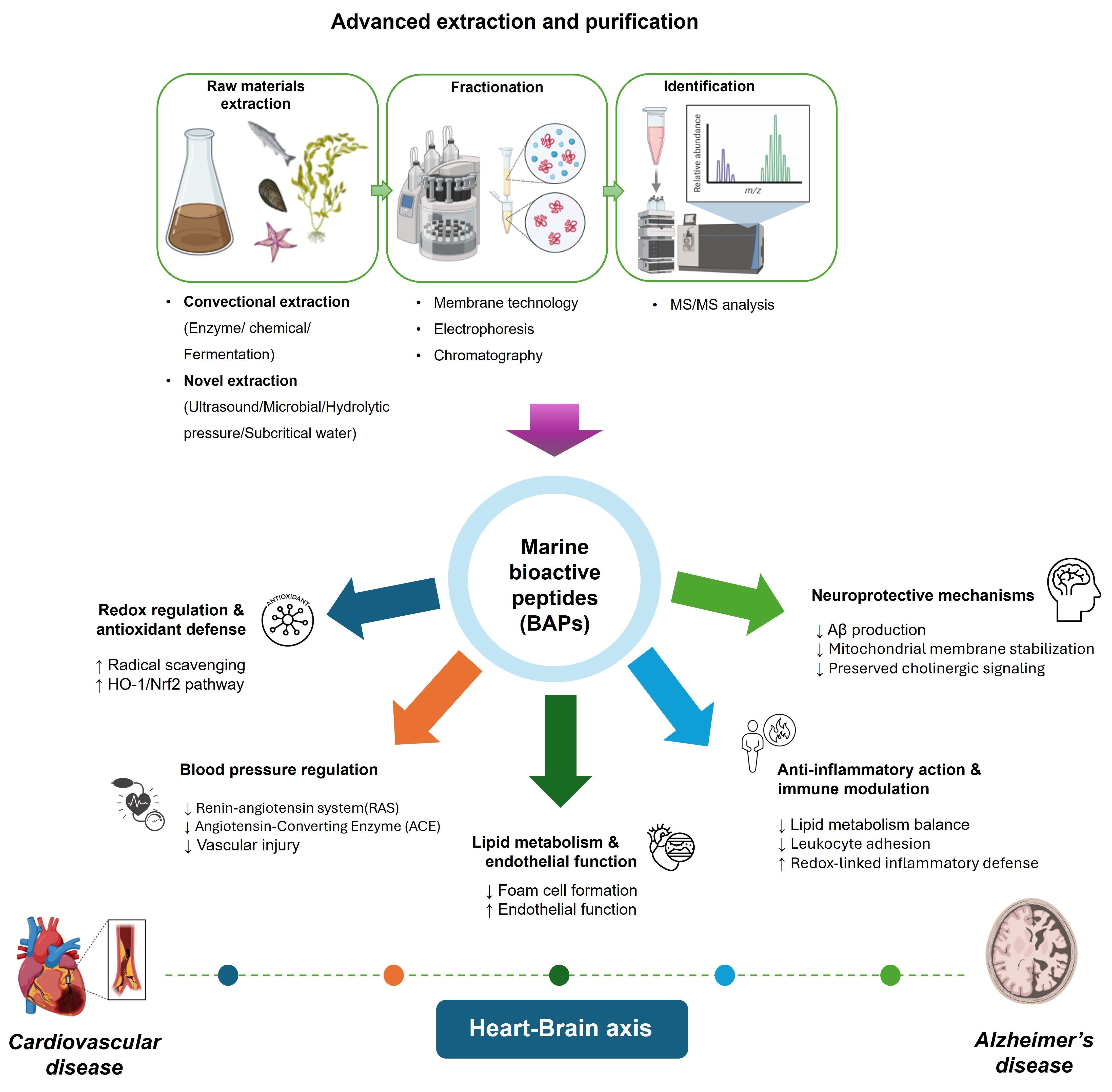
2. Exploring Marine BAPs as Promising Preventive Resource Against CVD and AD
3. Biodiversity of Marine BAPs Sources: From Microbes to Vertebrates
3.1. Major BAP-Producing Organisms
3.1.1. Marine Microorganisms and Algae
3.1.2. Marine Invertebrates
3.1.3. Marine Vertebrates
3.2. Major BAP-Producing Technologies
3.2.1. Extraction Methods

| Extraction | Principle | Advantages | Limitations | Refs |
|---|---|---|---|---|
| Enzymatic hydrolysis | Proteolytic enzymes cleave peptide bonds | Specificity, mild conditions, high bioactivity | Enzyme cost, requires optimization | [39,40] |
| Microbial fermentation | Proteolytic microbes secrete enzymes to break down proteins | Natural process, multifunctional bioactivity | Sensitive to pH/temp, strain selection critical | [44,45] |
| Chemical hydrolysis | Acidic or alkaline conditions break peptide bonds | Fast, useful for large-scale processing | Low selectivity, possible peptide degradation | [38] |
| Ultrasound-assisted | Ultrasonic waves disrupt protein structures | Accelerates hydrolysis, eco-friendly | Equipment cost, potential overheating | [46] |
| Microwave-assisted | Electromagnetic waves induce rapid protein breakdown | Energy-efficient, timesaving | May denature sensitive peptides | [46] |
| High hydrostatic pressure | Intense pressure alters protein conformation | Enhances enzyme accessibility | High equipment cost, limited industrial use | [47] |
| Subcritical water processing | Uses pressurized hot water as a solvent | Eco-friendly, improves hydrolysis efficiency | Requires specialized reactors | [48] |
| Pulsed electric field (PEF) | High-voltage pulses disrupt cell membranes | Improves peptide release, minimal heat | Still under development for peptides | [49] |
3.2.2. Purification and Identification of BAPs
| Peptide | Species | Extraction | Purification and Identification | Basic Characteristics | Ref. | |
|---|---|---|---|---|---|---|
| Micro organisms (Fungus) | Cyclic tetrapeptide, Aspochracin-type cyclic tripeptide, Sclerotiotide L, Diketopiperazine dimer  | Aspergillus violaceofuscus | Microbial fermentation, Ethyl acetate extraction | Vacuum liquid chromatography, MPLC, RP-HPLC | Microbial fermentation (80 g rice, 120 mL H2O, 0.3% peptone), Vacuum chromatography (silica gel 200–300 mesh, CH2Cl2/MeOH gradient 500:1–0:1), Sephadex LH-20 (MeOH), MPLC on ODS (10–100% MeCN/H2O gradient), RP-HPLC (55% MeOH, 2.0 mL/min) | [67] |
| Algae | * Tyr-Ile-Gly-Asn-Asn-Pro-Ala-Lys-Gly-Gly-Leu-Phe (MW: <3 kDa)  * Ile-Gly-Asn-Asn-Pro-Ala-Lys-Gly-Gly-Leu-Phe (MW: <3 kDa) * Ile-Gly-Asn-Asn-Pro-Ala-Lys-Gly-Gly-Leu-Phe (MW: <3 kDa) | Laminaria digitata | Chemical synthesis | MS spectroscopy | MWCO filtration, Peptide clean-up (Phoenix kit), LC-MS/MS (nanoESI qQTOF, 6600 plus TripleTOF), RP-HPLC-MS (purity verification) | [68] |
* Leu-Asp-Ala-Val-Asn-Arg (MW: 686 Da) | Spirulina maxima | Enzymatic hydrolysis | Ultrafiltration, Anion-exchange chromatography, Gel filtration, RP-HPLC, LC-MS/MS | Trypsin (pH 8, 37 °C), α-Chymotrypsin (pH 8, 37 °C), Pepsin (pH 2, 37 °C), Ultrafiltration (10, 5, 3 kDa membranes), Anion-exchange chromatography (DEAE FF, 2 mL/min), Gel filtration (Superdex Peptide 10/300 GL), RP-HPLC (C18, 1 mL/min), LC-MS/MS (Q-TOF, ESI source) | [53] | |
* Val-Glu-Cys-Tyr-Gly-Pro-Asn-Arg-Pro-Gln-Phe (MW: 1309 Da) | Chlorella pyrenoidosa | Enzymatic hydrolysis | Ultrafiltration, Gel filtration, RP-HPLC, LC-MS/MS | Pepsin (pH 2, 37 °C), Flavourzyme (pH 7, 50 °C), Alcalase (conditions per manufacturer), Papain (conditions per manufacturer), Sephacryl S-100 column (2.6 × 70 cm), Q-Sepharose Fast Flow column (2.6 × 40 cm,), Superdex Peptide HR 10/30 column (0.5 mL/min), RP-HPLC (C18, gradient not specified), Agilent 6510 Q-TOF MS | [54] | |
| MW < 1kDa, 1–3 kDa, 3–10 kDa, >10 kDa peptides | Enzymatic hydrolysis | Ultrafiltration | Pepsin (1 mg/mL), centrifuged (1.2× g rpm, 10 min), Ultrafiltration (Molecular weight cutoff: <1 kDa, 1–3 kDa, 3–10 kDa, >10 kDa) | [55] | ||
* Ile-Ile-Ala-Val-Glu-Ala-Gly-Cys (MW: 774.92 Da) | Isochrysis zhanjiangensis | Enzymatic hydrolysis | RP-HPLC, LC-MS/MS | Chymotrypsin (pH 7.8, 37 °C), Trypsin (pH 7.5, 37 °C), Pepsin (pH 2, 37 °C), RP-HPLC (Synchropak RPP-100, 4.6 × 250 mm, 60 mL/h), LC-MS/MS (ESI-QTOF) | [69] | |
* Ile-Asp-His-Tyr (MW: 546.2 Da) | Gracilariopsis chorda | Enzymatic hydrolysis | Ultrafiltration, Gel filtration, RP-HPLC, LC-MS/MS | Pepsin (pH 2, 37 °C), Papain (pH 6, 37 °C), Flavourzyme (pH 7, 50 °C), Kojizyme (pH 6, 40 °C), Protamex (pH 6, 40 °C) Gel filtration: Sephadex G-25 column (2.5 × 75 cm, 1.5 mL/min) RP-HPLC: C18 ODS, 0–30% ACN, 0.8 mL/min | [56] | |
* Ile-Arg-Leu-Ile-Ile-Val-Leu-Met-Pro-Ile-Leu-Met-Ala (MW: 1494.93) | Palmaria palmata | Enzymatic hydrolysis | RP-HPLC, LC-MS/MS, MW-SPPS | Papain (pH 6, 60 °C, 24 h), RP-HPLC (C18, 100 × 21.2 mm, 1.0 mL/min), LC-MS/MS (nano-UPLC BEH130 C18, 100 × 0.1 mm, 250 nL/min), MW-SPPS (Liberty CEM synthesizer, H-Ala/Ile-HMPB-ChemMatrix resin), RP-HPLC (C18), MALDI-TOF MS, Lyophilization (Genevac HT 4X) | [57,70] | |
| <3 kDa, 3–10 kDa, >10 kDa peptides | Ulva prolifera | Enzymatic hydrolysis | Sephadex G-100 gel filtration, Ultrafiltration, Nano-LC-MS/MS | Neutral protease (pH 7.4, 47 °C), Ultrafiltration (<3 kDa, 3–10 kDa, >10 kDa), Sephadex G-100 column (2.5 × 70 cm, 1.0 mL/min), Nano-LC-MS/MS (online nano-flow) | [71] | |
* Glu-Thr-Thr (MW: 998.02 Da) | Isochrysis zhanjiangensis | Gastrointestinal digestion | Simulated GI digestion: Pepsin (pH 2, 37 °C, 2.5 h), Trypsin + Chymotrypsin (1:100 w/w, 37 °C, 2.5 h) | [72] | ||
| Invertebrates (Echinoderm) | * Phe-Tyr-Asp-Trp-Pro-Lys (MW: 854.4 Da) | Stichopus japonicas | Chemically synthesized | [59] | ||
* Asp-Asp-Gln-Ile-His-Ile-Phe (MW: 886.4 Da) * His-Asp-Trp-Trp-Lys-Glu-Arg (MW: 1055.5 Da) * His-Asp-Trp-Trp-Lys-Glu-Arg (MW: 1055.5 Da) * Thr-His-Asp-Trp-Trp-Lys-Glu-Arg (MW: 1156.5 Da) * Thr-His-Asp-Trp-Trp-Lys-Glu-Arg (MW: 1156.5 Da) | Apostichopus japonicus | Vacuum freeze-drying, Enzymatic hydrolysis | Ceramic membrane filtration, Ultrafiltration, Targeted affinity purification, RP-HPLC, LC-MS/MS | Pepsin (pH 2, 37 °C), Papain (pH 6, 37 °C), Flavourzyme (pH 7, 50 °C), Kojizyme (pH 6, 40 °C), Protamex (pH 6, 40 °C), Cyanogen bromide-activated agarose 4B column (pH 4.0–8.0), Sephadex G-15 column (3.6 × 150 cm, 1.0 mL/min), RP-HPLC (C18, 0.5 mL/min), LC-MS/MS (Q-Exactive, m/z 200–2000) | [58] | |
* Met-Glu-Gly-Ala-Gln-Glu-Ala-Gln-Gly-Asp (MW: 1034.4 Da) | Acaudina molpadioidea | Enzymatic hydrolysis and Solid-phase peptide synthesis | Ultrafiltration Gel filtration, RP-HPLC, Mass spectrometry, HPLC, ODS column. | Alcalase (pH 7.5, 55 °C), Ultrafiltration (2 kDa cutoff), Sephadex G-25 column (1.6 × 30 cm, 0.6 mL/min), SP Sephadex C-25 column (2.6 × 30 cm, 0.6 mL/min), RP-HPLC (Zorbax C18, 0.8 mL/min), nanoESI-MS/MS, Solid-phase peptide synthesis | [73] | |
| * Phe-Leu-Ala-Pro (MW < 1 kDa)  | Microwave-assisted enzymatic hydrolysis | Ultrafiltration, Gel filtration, RP-HPLC | Papain (pH 6.5, 37 °C), Pepsin (pH 2, 37 °C), Trypsin (pH 8.5, 45 °C), Ultrafiltration (<1 kDa, 1–5 kDa, >5 kDa), Sephadex G-15 column, RP-HPLC (0–75% ACN, 45 min) | [74] | ||
* Gly-Val-Ser-Gly-Leu-His-Ile-Asp (MW: 797 Da) | Actinopyga lecanora | Enzymatic hydrolysis | Ultrafiltration, SDS-PAGE, RP-HPLC, UHPLC-Q-TOF-MS/MS, Peptide synthesis | Alcalase hydrolysis (pH 7.9, 55 °C), Ultrafiltration (10, 5, 2 kDa MWCO), SDS-PAGE (15% acrylamide), Sephadex G-25 column (2.5 × 75 cm, 1 mL/min), RP-HPLC (C18, 4 mL/min), UHPLC-Q-TOF-MS/MS (positive ESI) | [75] | |
Asn-Asp-Glu-Glu-Leu-Asn-Lys (MW: 860.4) | Stichopus japonicus | Commercial peptide | 98% purity | [76] | ||
| Invertebrates (Annelida) | * Asn-Cys-Trp-Pro-Phe-Gln-Gly-Val-Pro-Leu-Gly-Phe-Gln-Ala-Pro-Pro (MW: 1757.86 Da) | Marphysa sanguinea | Acetic acid extraction, | Sep-Pak C18 concentration, RP-HPLC, UPLC-Q-TOF MS/MS | Acetic acid extraction (1%, 100 °C, 5 min), Sep-Pak C18 cartridge, RP-HPLC (Delta Pak C18, 1 mL/min), UPLC-Q-TOF MS/MS (C18, 0.1 mL/min) | [60] |
| Invertebrates (Mollusk) | Leu-Leu-Arg-Leu-Thr-Asp-Leu (MW: 842.5 Da)  Gly-Tyr-Ala-Leu-Pro-Cys-Asp-Cys-Leu (MW: 953.4 Da) Gly-Tyr-Ala-Leu-Pro-Cys-Asp-Cys-Leu (MW: 953.4 Da) Ala-Trp-Leu-Asn-His (MW: 639.3 Da) Ala-Trp-Leu-Asn-His (MW: 639.3 Da) Pro-His-Asp-Leu (MW: 480.2 Da) Pro-His-Asp-Leu (MW: 480.2 Da) | Scapharca subcrenata | Chemically synthesized | Synthesized peptides with >96% purity confirmed by LC-MS/MS | [77,78] | |
Pro-Ile-Ile-Ser-Val-Tyr-Trp-Lys (MW: 1005.2 Da) Phe-Ser-Val-Val-Pro-Ser-Pro-Lys (MW: 860.05 Da) Phe-Ser-Val-Val-Pro-Ser-Pro-Lys (MW: 860.05 Da) | Mytilus edulis | Chemically synthesized | Purity >96% (LC-MS/MS) | [79] | ||
| Pro-Ile-Ile-Ser-Val-Tyr-Trp-Lys (MW: 1004.6 Da), Phe-Ser-Val-Val-Pro-Ser-Pro-Lys (MW: 859.5 Da) | Chemically synthesized (Peptron Inc. Daejeon, Korea) | purity > 96% by LC-MS/MS | Synthesized peptides with >96% purity confirmed by LC-MS/MS | [80] | ||
* Glu-Pro-Thr-Phe (MW: 493 Da) * Phe-Thr-Val-Asn (MW: 480 Da) * Phe-Thr-Val-Asn (MW: 480 Da) | Enzymatic hydrolysis | Gel filtration, RP-HPLC, LC-MS/MS | α-Chymotrypsin (pH 8, 37 °C), Sephadex G-25 column (3.0 × 90 cm, 1.0 mL/min), RP-HPLC (C18 column, 2.0 mL/min, ACN gradient), LC-MS/MS (Q-TOF, ESI source) | [81] | ||
* Ile-Lys (MW: 259.33 Da) * Tyr-Glu-Gly-Asp-Pro (MW: 579.56 Da) * Tyr-Glu-Gly-Asp-Pro (MW: 579.56 Da) * Trp-Phe(MW: 351.41 Da) * Trp-Phe(MW: 351.41 Da) * Ser-Trp-Ile-Ser-Ser (MW: 578.62Da) * Ser-Trp-Ile-Ser-Ser (MW: 578.62Da) | Enzymatic hydrolysis | Ultrafiltration, Ion exchange chromatography, Gel filtration, RP-HPLC | Pepsin (pH 1.5, 37 °C), Trypsin (pH 7.0, 37 °C), Ultrafiltration membranes (1, 3.5, 5, 10 kDa), QFF anion exchange column (3.8 × 150 cm, 2.5 mL/min), Sephadex G-15 column (3.6 × 150 cm, 1.0 mL/min), RP-HPLC (Zorbax C18, 4.6 × 250 mm, 5 µm, 10–60% ACN gradient) | [82] | ||
* Phe-Gly-His-Pro-Tyr (MW: 620 Da) | Spontaneous fermentation | 25% NaCl (w/w), 20 °C, 12 months | [83] | |||
| Peptide fraction (<1 kDa) | Mytilus coruscus | Enzymatic hydrolysis | Ultrafiltration | Trypsin (pH 8.0, 37 °C), Pepsin (pH 2.0, 37 °C), Papain (pH 6.0, 60 °C), Alcalase (pH 10.0, 45 °C), Neutrase (pH 7.0, 45 °C), Cogent μScale TFF ultrafiltration system, Spectra/Por dialysis tubing (MW cutoff 150 Da) | [84] | |
| Hydrolyzed collagen | L. smithi + black jelly mushroom extract | Enzymatic hydrolysis | Gel filtration chromatography, UV detection | Papain (pH 7, 40 °C, 150 min), Alcalase (pH 8, 50 °C, 120 min), Sephadex G-25 column (size not specified, absorbance at 280 nm), MW markers for molecular weight estimation | [85] | |
* Gly-Val-Gly-Ser-Pro-Tyr (MW: 578.7 Da) | Pinctada fucata | Enzymatic hydrolysis | Gel filtration chromatography, RP-HPLC | Nucleicin (pH 7.0, 50 °C), Orientase 22BF (pH 9.2, 60 °C), Sephadex G-25 column (2.2 × 70 cm, 0.8 mL/min), RP-HPLC (COSMOSIL 5C18-AR-II, 0.8 mL/min) | [86] | |
* Ala-Gly-Phe-Ala-Gly-Asp-Asp-Ala-Pro-Arg (MW: 975.4 Da)  * Cys-Asp-Val-Asp-Ile-Arg (MW: 719.3 Da) * Cys-Asp-Val-Asp-Ile-Arg (MW: 719.3 Da) | Chlamys farreri | Microorganism fermentation | Ultrafiltration, RP-HPLC, LC-MS/MS | Bacillus natto (optimized: 38.4 h, 39.9 °C, 6.0% inoculum), fermented Chlamys farreri skirt, Ultrafiltration: 10 and 3 kDa membranes (Pellicon XL, Millipore), fractions: <3, 3–10, and >10 kDa, Gel filtration: Sephadex G-15 column (1.6 × 40 cm, 3 mL/min), RP-HPLC: SunFire™ Prep C18 OBD™ (19 × 150 mm, 10 µm), LC-MS/MS (Mascot 2.2) | [87] | |
* Asp-Leu-Thr-Asp-Tyr (MW: 625.3 Da) | Crassostrea gigas | Protease hydrolysis | RP-HPLC, Amino acid sequence | Trypsin hydrolysis (0.5%, pH 7, 25 °C, 24 h), RP-HPLC (ODS-AM120-S50, 2 × 50 cm, 5 mL/min), JAI-ODS-S343-15 column (2.5 × 25 cm), FinePak-SiL-C18-5 column (0.46 × 25 cm) | [88] | |
| GPH-IV-P2 (MW ≈ 5 kDa) | Perna canaliculus | Enzymatic hydrolysis | Gel-filtration, RP-HPLC, LC-MS/MS | Mussel flesh boiled (10 min), homogenized (1500 rpm, 5 min), protein extracted, fractionated, freeze-dried | [89] | |
| Invertebrates (Arthropoda) | * Asn-Gly-Val-Ala-Ala (MW: 431 Da) | Oratosquilla woodmasoni | Enzymatic hydrolysis | Ultrafiltration, Ion exchange chromatography, Gel filtration chromatography | Thermolysin (70 °C, pH 8) Pepsin (37 °C, pH 2), Ultrafiltration (Amicon 3 & 10 kDa MWCO), DEAE anion exchange chromatography, Sephadex G-25 gel filtration | [90] |
| Invertebrates (Tunicate) | * Leu-Trp-His-Thr-His (MW: 692.2 Da) | Styela clava | Enzymatic hydrolysis | Gel filtration, RP-HPLC, QTOF ESI-MS | Pepsin (pH 2, 37 °C), Papain (pH 6, 37 °C), Flavourzyme (pH 7, 50 °C), Kojizyme (pH 6, 40 °C), Protamex (pH 6, 40 °C), Sephadex G-25 column (2.5 × 75 cm, 1.5 mL/min), RP-HPLC (C18 ODS, 0–30% ACN, 0.8 mL/min) | [91] |
| Vertebrates (Fish) | Gly-Thr-Glu-Asp-Glu-Leu-Asp-Lys (MW: 906.4 Da) | Hippocampus trimaculatus | Enzymatic hydrolysis | Ion exchange chromatography, RP-HPLC | Trypsin, a-chymotrypsin, papain, and pronase E), Enzyme inactivation (100 °C, 10 min), Lyophilization (−80 °C storage) Ion exchange chromatography (FPLC, DEAE FF, 4 mL/min,), RP-HPLC (Nucleosil C18, 10 × 250 mm) | [92] |
| Marine collagen peptides (MCPs) | Chum salmon skin | Enzymatic hydrolysis | HPLC, MALDI-TOF MS | Alcalase (pH 8, 40 °C, 3 h), Protamex (pH 8, 40 °C, 3 h), HPLC (Waters Corporation), MALDI-TOF MS (LDI-1700), Amino acid analyzer (H835-50) | [93] | |
* His-Gly-Ser-His (MW: 436.43 Da) * Lys-Gly-Pro-Ser-Trp (MW: 573.65 Da) * Lys-Gly-Pro-Ser-Trp (MW: 573.65 Da) | Hippocampus abdominalis | Enzymatic hydrolysis | Ultrafiltration, Gel filtration, RP-HPLC, LC-MS/MS | Enzymatic hydrolysis: Pepsin (pH 2, 37 °C), Papain (pH 6, 37 °C), Flavourzyme (pH 7, 50 °C), Kojizyme (pH 6, 40 °C), Protamex (pH 6, 40 °C), Gel filtration: Sephadex G-25 column (2.5 × 75 cm, 1.5 mL/min), RP-HPLC: C18 ODS, 0–30% ACN, 0.8 mL/min | [94] | |
* Ser-Pro (MW: 202.3 Da)  * Val-Asp-Arg-Tyr-Phe (MW: 698.9 Da) * Val-Asp-Arg-Tyr-Phe (MW: 698.9 Da) | Katsuwonus pelamis | Enzymatic hydrolysis | Ultrafiltration, Gel filtration, RP-HPLC, LC-MS/MS | Pepsin (pH 2, 37 °C), Papain (pH 6, 37 °C), Flavourzyme (pH 7, 50 °C), Kojizyme (pH 6, 40 °C), Protamex (pH 6, 40 °C). Gel filtration: Sephadex G-25 column (2.5 × 75 cm, 1.5 mL/min). RP-HPLC: C18 ODS column, 0.8 mL/min. | [95] | |
* Pro-Pro-Leu-Leu-Phe-Ala-Ala-Leu (MW: 841.05 Da) | Takifugu flavidus | Enzymatic hydrolysis | Ultrafiltration, Gel filtration, RP-HPLC (semi-prep), RP-HPLC (analytical), LC-MS/MS | Alcalase (pH 8.0, 55 °C), Pepsin (pH 2.0, 37 °C), Neutral protease (pH 7.0, 55 °C), Ultrafiltration: MWCO membranes (1, 3, 10, 30, 50 kDa), Gel filtration: Sephadex G-15 column (0.5 × 100 cm, 5 mL/min), RP-HPLC (semi-prep): ODS-BP column (50 × 400 mm, 1 mL/min), RP-HPLC (analytical): C18 column (4.6 × 250 mm, 1 mL/min) | [61] | |
* Asp-Pro-Ala-Leu-Ala-Thr-Glu-Pro-Asp-Pro-Met-Pro-Phe (MW: 1382 Da) | Oreochromis niloticus | Enzymatic hydrolysis | Ion exchange chromatography, HPLC | Alcalase, Pronase E, pepsin, and trypsin, Ion Exchange Chromatography (2 mL/min flow rate), RP-HPLC (2 mL/min flow rate) | [96] | |
* Phe-Ala-Gly-Pro-Pro-Gly-Gly-Asp-Gly-Gln-Pro-Gly-Ala-Lys (MW: 1255.33 Da) * Ile-Ala–Gly-Pro-Ala-Gly-Pro-Arg-Gly-Pro-Ser-Gly-Pro-Ala (MW: 1204.33 Da) * Ile-Ala–Gly-Pro-Ala-Gly-Pro-Arg-Gly-Pro-Ser-Gly-Pro-Ala (MW: 1204.33 Da) | Salmo salar | Alkaline treatment, Gelatin extraction | Enzymatic hydrolysis, Enzyme inactivation, Ultrafiltration, RP-HPLC, nano-LC-MS/MS, HPLC analysis | Alkaline protease (pH 7.5, 55 °C), Ultrafiltration membrane (1 kDa), YMC ODS-A C18 column (1.0 cm × 10 cm, 1 mL/min), nano-LC-MS/MS (Hypersil Gold C18, 150 μm × 15 cm, 600 nL/min), SB-C18 column (4.6 mm × 250 mm, 1 mL/min) | [97] | |
| SWP-I (MW: 4976 Da), SWP-II (MW: 1960 Da) | Gadus morhua | Alkaline treatment, Enzymatic hydrolysis | Gel filtration, chromatography, UV-Vis spectroscopy, FT-IR spectroscopy | Protamex (pH 7.5, 55 °C), Heat inactivation (100 °C, 5 min), Sephadex G-15 column (2.6 × 60 cm, 1.5 mL/min), RP-HPLC (C18, 1.0 mL/min), GPC (SRT SEC-300 column, 0.5 mL/min) | [98] | |
* His-Asn-Leu-Gly-Leu-Leu-His-Gly-Asp-Met-Leu (MW: 1105.52 Da) * Asp-Ala-Pro-Ser-Met-Asn-Asp (MW: 748.25 Da) * Asp-Ala-Pro-Ser-Met-Asn-Asp (MW: 748.25 Da) | Piaractus brachypomus | Fermentative hydrolysis | Ultrafiltration, Gel filtration, RP-HPLC, LC-MS/MS | Bacillus fermentation (37 °C, 50 rpm), ultrafiltration (3 kDa MWCO), Sephadex G-25 column (2.6 × 60 cm, 0.5 mL/min), RP-HPLC (C18, 1.0 mL/min), LC-MS/MS (positive ion mode, 100–3000 m/z) | [29] | |
* Asn-His-Arg-Tyr-Asp-Arg (MW: 856 Da)  * Gly-Asn-Arg-Gly-Phe-Ala-Cys-Arg-His-Ala * Gly-Asn-Arg-Gly-Phe-Ala-Cys-Arg-His-Ala (MW: 1101.5 Da)  | Magalaspis cordyla,
Otolithes ruber | In vitro digestion | Ion exchange chromatography, Gel filtration, ESI-MS/MS | Pepsin (pH 2.5, 37 °C, 2 h), Trypsin + α-chymotrypsin (pH 8, 37 °C, 2.5 h), Ion exchange chromatography (DEAE column, 1 mL/min), Gel filtration (Sephadex G-25 column, 2.5 × 75 cm, 1 mL/min), ESI-MS/MS (FIA 3200 QTRAP, positive ion mode) | [99] | |
* Lys-Ala-Pro-Asp-Pro-Gly-Pro-Gly-Pro-Met (MW: 966.1 Da) | Oreochromis niloticus | Enzymatic hydrolysis | Ultrafiltration, RP-HPLC, LC-MS/MS, Solid-phase peptide synthesis (SPPS) | Alkaline protease (pH 10, 51 °C, 9 h), Ultrafiltration membranes (5 kDa, 3.5 kDa, 1 kDa MWCO), PREP-ODS column (20 × 250 mm, 7 mL/min), LC-MS/MS (RP C18 column, 600 nL/min) | [62] | |
| Low MW peptides (MW < 600 Da) | Bigeye tuna | Subcritical water hydrolysis | 150–300 °C, 50–100 bar, 5 min | [100] | ||
* Gly-Ile-Ile-Gly-Pro-Ser-Gly-Ser-Pro (MW: 784 Da) * Ile-Gly-Thr-Gly-Ile-Pro-Gly-Ile-Trp (MW: 913 Da) * Ile-Gly-Thr-Gly-Ile-Pro-Gly-Ile-Trp (MW: 913 Da) * Gln-Ile-Gly-Phe-Ile-Trp (MW: 763 Da) * Gln-Ile-Gly-Phe-Ile-Trp (MW: 763 Da) | Hippocampus abdominalis | Enzymatic hydrolysis | Ultrafiltration, Gel filtration, RP-HPLC, LC-MS/MS | Alcalase (0.01% w/w, 24 h, 50 °C, pH 8), Ultrafiltration (5, 10 kDa), Gel filtration, RP-HPLC (T3 column) | [101] | |
* Leu-Leu-Asp-Phe (MW: 506.3 Da) | yellowfin tuna | Ultrasonic-assisted enzymatic hydrolysis | RP-HPLC, LC-MS/MS | Trypsin (pH 8.1, 37 °C), Neutral enzyme (pH 7, 50 °C), Papain (pH 6.5, 55 °C), Pepsin (pH 3, 37 °C), Alkaline enzyme (pH 9, 50 °C), 1:25 (w/v), Ultrasonication (200 W, 55 °C, 25 kHz) | [42] | |
* Ser-Leu-Ala-Phe-Val-AspAsp-Val-Leu-Asn (MW: 1091.5 Da) | Merluccius productus | Enzymatic hydrolysis | Sephadex G-25 gel filtration, Preparative RP-HPLC, Analytical RP-HPLC, MS/MS | Umamizyme K hydrolysis (pH 6.6–6.9, 50 °C, 1 h), Sephadex G-25 gel filtration (25 × 750 mm), Preparative RP-HPLC (Grom-sil 120 ODS-5ST, 10 × 250 mm), Analytical RP-HPLC (C18, 4.6 × 250 mm) MS/MS (Q-TOF, nano-ESI, Capcell Pak C18 UG120 V, MeOH/H2O 1:1, [M+2H]2+ ion selection) | [102] |
4. Shared Biological Processes Linking Cardiovascular (CVD) and Alzheimer’s Diseases (AD)
4.1. Molecular Mechanism of CVD Progression
4.2. Neurodegenerative Cascades in AD
4.3. The CVD-AD Axis: Shared Pathophysiological Mechanisms
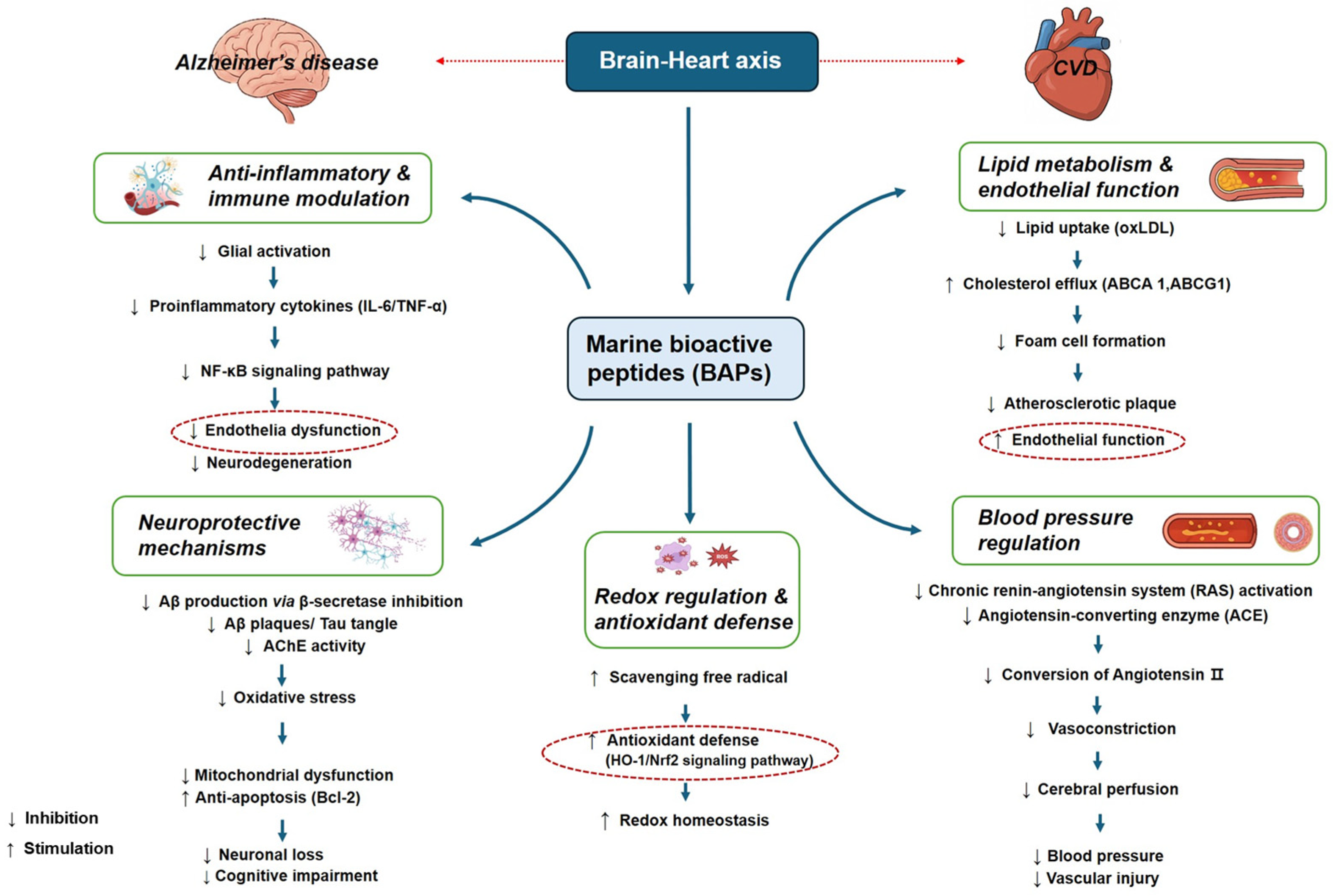
5. Multifunctional Preventive Roles of Marine BAPs Targeting the CVD-AD Axis
5.1. Marine-Derived BAPs in Redox Regulation and Antioxidant Defense
5.2. Blood Pressure Regulation via Inhibiting Renin–Angiotensin System (RAS)
5.3. Regulation of Lipid Metabolism and Endothelial Function
5.4. Anti-Inflammatory Actions and Immune Modulation by BAPs
5.5. Integrated Neuroprotective Mechanisms of Marine BAPs
6. Structure–Activity Relationship (SAR) and Advantages of BAPs in CVD-AD Axis
7. Current Challenges and Future Perspectives
8. Conclusions
Author Contributions
Funding
Institutional Review Board Statement
Informed Consent Statement
Data Availability Statement
Conflicts of Interest
Abbreviations
| CVD | Cardiovascular diseases |
| AD | Alzheimer’s diseases |
| BAPs | Bio-active peptides |
| PUFAs | Linear dichroism |
| HPLC | High-performance liquid chromatography |
| FPLC | Fast protein liquid chromatography |
| SPPS | Solid-phase peptide synthesis |
| QSAR | Quantitative structure-activity relationship |
| Bead-GPS | Bead-based global proteomic screening |
| NO | Nitric oxide |
| ROS | Reactive oxygen species |
| LDL | Low-density lipoproteins |
| oxLDL | Oxidized low-density lipoproteins |
| VCAM-1 | Adhesion molecule-1 |
| ICAM-1 | Intercellular adhesion molecule-1 |
| VSMCs | Vascular smooth muscle cells |
| RAAS | Renin–angiotensin–aldosterone system |
| GPX4 | Glutathione peroxidase 4 |
| BACE1 | Amyloid precursor protein (APP) by β-secretase |
| PrPC | Prion protein |
| LTP | Impair long-term potentiation |
| LTD | Promote long-term depression |
| GSK-3β | Glycogen synthase kinase-3β |
| CDK5 | Cyclin-dependent kinase 5 |
| MDA | Malondialdehyde |
| AChE | Acetylcholinesterase |
| ACh | Acetylcholine |
| MOMP | Mitochondrial outer membrane permeabilization |
| CNS | Central nervous system |
| HIFs | Hypoxia-inducible factors |
| ACE | Angiotensin-converting enzyme |
| hASMCs | Human aortic smooth muscle cells |
| BBB | Blood–brain barrier |
References
- World Health Organization. Cardiovascular Diseases (CVDs); World Health Organization: Geneva, Switzerland, 2021. Available online: https://www.who.int/news-room/fact-sheets/detail/cardiovascular-diseases-(cvds) (accessed on 17 June 2025).
- Chong, B.; Jayabaskaran, J.; Jauhari, S.M.; Chan, S.P.; Goh, R.; Kueh, M.T.W.; Li, H.; Chin, Y.H.; Kong, G.; Anand, V.V.; et al. Global Burden of Cardiovascular Diseases: Projections from 2025 to 2050. Eur. J. Prev. Cardiol. 2024, 32, 1001–1015. [Google Scholar] [CrossRef]
- Kazi, D.S.; Elkind, M.S.; Deutsch, A.; Dowd, W.N.; Heidenreich, P.; Khavjou, O.; Mark, D.; Mussolino, M.E.; Ovbiagele, B.; Patel, S.S.; et al. Forecasting the Economic Burden of Cardiovascular Disease and Stroke in the United States through 2050: A Presidential Advisory from the American Heart Association. Circulation 2024, 150, e89–e101. [Google Scholar] [CrossRef]
- Luengo-Fernandez, R.; Walli-Attaei, M.; Gray, A.; Torbica, A.; Maggioni, A.P.; Huculeci, R.; Bairami, F.; Aboyans, V.; Timmis, A.D.; Vardas, P.; et al. Economic Burden of Cardiovascular Diseases in the European Union: A Population-Based Cost Study. Eur. Heart J. 2023, 44, 4752–4767. [Google Scholar] [CrossRef] [PubMed]
- Alzheimer’s Association. Alzheimer’s Disease Facts and Figures. Alzheimers Dement. 2019, 15, 321–387. [Google Scholar] [CrossRef]
- Pradeepkiran, J.A.; Baig, J.; Islam, A.; Kshirsagar, S.; Reddy, P.H. Amyloid-β and Phosphorylated Tau Are the Key Biomarkers and Predictors of Alzheimer’s Disease. Aging Dis. 2025, 16, 658. [Google Scholar] [CrossRef] [PubMed]
- Giordano, D. Bioactive Molecules from Extreme Environments. Mar. Drugs 2020, 18, 640. [Google Scholar] [CrossRef]
- Karami, Z.; Akbari-Adergani, B. Bioactive Food-Derived Peptides: A Review on Correlation between Structure of Bioactive Peptides and Their Functional Properties. J. Food Sci. Technol. 2019, 56, 535–547. [Google Scholar] [CrossRef]
- Blunt, J.W.; Copp, B.R.; Keyzers, R.A.; Munro, M.H.G.; Prinsep, M.R. Marine Natural Products. Nat. Prod. Rep. 2013, 30, 237–323. [Google Scholar] [CrossRef]
- Lotze, H.K. Marine Biodiversity Conservation. Curr. Biol. 2021, 31, R1190–R1195. [Google Scholar] [CrossRef]
- WoRMS Editorial Board. World Register of Marine Species. Available online: http://www.marinespecies.org/ (accessed on 1 April 2025).
- Senadheera, T.R.L.; Hossain, A.; Shahidi, F. Marine Bioactives and Their Application in the Food Industry: A Review. Appl. Sci. 2023, 13, 12088. [Google Scholar] [CrossRef]
- Cermeño, M.; Kleekayai, T.; Amigo-Benavent, M.; Harnedy-Rothwell, P.; FitzGerald, R.J. Current Knowledge on the Extraction, Purification, Identification, and Validation of Bioactive Peptides from Seaweed. Electrophoresis 2020, 41, 1694–1717. [Google Scholar] [CrossRef] [PubMed]
- Okeke, E.S.; Okagu, I.U.; Chukwudozie, K.; Ezike, T.C.; Ezeorba, T.P.C. Marine-Derived Bioactive Proteins and Peptides: A Review of Current Knowledge on Anticancer Potentials, Clinical Trials, and Future Prospects. Nat. Prod. Commun. 2024, 19, 1934578X241239825. [Google Scholar] [CrossRef]
- Zhong, L.; Tan, X.; Yang, W.; Li, P.; Ye, L.; Luo, Q.; Hou, H. Bioactive Matters Based on Natural Product for Cardiovascular Diseases. Smart Mater. Med. 2024, 5, 542–565. [Google Scholar] [CrossRef]
- Harirforoosh, S.; Asghar, W.; Jamali, F. Adverse Effects of Nonsteroidal Antiinflammatory Drugs: An Update of Gastrointestinal, Cardiovascular and Renal Complications. J. Pharm. Pharm. Sci. 2014, 16, 821–847. [Google Scholar] [CrossRef]
- Ramkumar, S.; Raghunath, A.; Raghunath, S. Statin Therapy: Review of Safety and Potential Side Effects. Acta Cardiol. Sin. 2016, 32, 631–639. [Google Scholar] [CrossRef]
- Akbarian, M.; Khani, A.; Eghbalpour, S.; Uversky, V.N. Bioactive Peptides: Synthesis, Sources, Applications, and Proposed Mechanisms of Action. Int. J. Mol. Sci. 2022, 23, 1445. [Google Scholar] [CrossRef]
- Koushki, K.; Shahbaz, S.K.; Mashayekhi, K.; Sadeghi, M.; Zayeri, Z.D.; Taba, M.Y.; Banach, M.; Al-Rasadi, K.; Johnston, T.P.; Sahebkar, A. Anti-Inflammatory Action of Statins in Cardiovascular Disease: The Role of Inflammasome and Toll-Like Receptor Pathways. Clin. Rev. Allergy Immunol. 2021, 60, 175–199. [Google Scholar] [CrossRef]
- Jegani, K.T.; Balde, A.; Nazeer, R.A. A Review on Anti-Inflammatory and Antioxidant Peptides Derived from Marine Organisms: Mechanism of Action and Therapeutic Applications. Food Biosci. 2025, 63, 105745. [Google Scholar] [CrossRef]
- Li, C.-Q.; Ma, Q.-Y.; Gao, X.-Z.; Wang, X.; Zhang, B.-L. Research Progress in Anti-Inflammatory Bioactive Substances Derived from Marine Microorganisms, Sponges, Algae, and Corals. Mar. Drugs 2021, 19, 572. [Google Scholar] [CrossRef]
- Srinivasan, R.; Kannappan, A.; Shi, C.; Lin, X. Marine Bacterial Secondary Metabolites: A Treasure House for Structurally Unique and Effective Antimicrobial Compounds. Mar. Drugs 2021, 19, 530. [Google Scholar] [CrossRef]
- Sánchez, A.; Vázquez, A. Bioactive Peptides: A Review. Food Qual. Saf. 2017, 1, 29–46. [Google Scholar] [CrossRef]
- Pimentel, F.B.; Alves, R.C.; Harnedy, P.A.; FitzGerald, R.J.; Oliveira, M.B.P. Macroalgal-Derived Protein Hydrolysates and Bioactive Peptides: Enzymatic Release and Potential Health-Enhancing Properties. Trends Food Sci. Technol. 2019, 93, 106–124. [Google Scholar] [CrossRef]
- Fleurence, J.; Morançais, M.; Dumay, J. Seaweed Proteins. In Proteins in Food Processing; Elsevier: Sawston, UK, 2018; pp. 245–262. [Google Scholar] [CrossRef]
- Abreu, M.H.; Pereira, R.; Yarish, C.; Buschmann, A.H.; Sousa-Pinto, I. IMTA with Gracilaria vermiculophylla: Productivity and Nutrient Removal Performance of the Seaweed in a Land-Based Pilot Scale System. Aquaculture 2011, 321, 77–87. [Google Scholar] [CrossRef]
- Lewbart, G.A.; Zachariah, T.T. Aquatic and Terrestrial Invertebrate Welfare. Animals 2023, 13, 3375. [Google Scholar] [CrossRef] [PubMed]
- Ganesan, A.R.; Mohanram, M.S.G.; Balasubramanian, B.; Kim, I.H.; Seedevi, P.; Mohan, K.; Kanagasabai, S.; Arasu, M.V.; Al-Dhabi, N.A.; Ignacimuthu, S. Marine Invertebrates’ Proteins: A Recent Update on Functional Property. J. King Saud Univ. Sci. 2020, 32, 1496–1502. [Google Scholar] [CrossRef]
- Diniz, G.S.; Barbarino, E.; Neto, J.O.; Pacheco, S.; Lourenço, S.O. Proximate Composition of Marine Invertebrates from Tropical Coastal Waters, with Emphasis on the Relationship between Nitrogen and Protein Contents. Lat. Am. J. Aquat. Res. 2014, 42, 332–352. [Google Scholar] [CrossRef]
- Harnedy, P.A.; FitzGerald, R.J. Bioactive Peptides from Marine Processing Waste and Shellfish: A Review. J. Funct. Foods 2012, 4, 6–24. [Google Scholar] [CrossRef]
- Hashem, A.M.A.; Venmarath, A.; Kudre, T.G. Preparation, Purification, and Identification of Novel Antioxidant Peptides from Red-Bellied Pacu (Piaractus brachypomus) Fish Meat Protein Hydrolysate. Food Sci. Biotechnol. 2023, 32, 2057–2068. [Google Scholar] [CrossRef]
- Jafari, S.M.; Rashidinejad, A.; Simal-Gandara, J. Handbook of Food Bioactive Ingredients; Springer: Cham, Switzerland, 2023. [Google Scholar] [CrossRef]
- Guryanova, S.V.; Balandin, S.V.; Belogurova-Ovchinnikova, O.Y.; Ovchinnikova, T.V. Marine Invertebrate Antimicrobial Peptides and Their Potential as Novel Peptide Antibiotics. Mar. Drugs 2023, 21, 503. [Google Scholar] [CrossRef]
- Walquist, M.J.; Eilertsen, K.-E.; Elvevoll, E.O.; Jensen, I.-J. Marine-Derived Peptides with Anti-Hypertensive Properties: Prospects for Pharmaceuticals, Supplements, and Functional Food. Mar. Drugs 2024, 22, 140. [Google Scholar] [CrossRef]
- Kundam, D.N.; Acham, I.O.; Girgih, A.T. Bioactive Compounds in Fish and Their Health Benefits. Asian Food Sci. J. 2018, 4, 1–14. [Google Scholar] [CrossRef]
- Kurnianto, M.A.; Defri, I.; Syahbanu, F.; Aulia, S.S. Fish-Derived Bioactive Peptide: Bioactivity Potency, Structural Characteristics, and Conventional and Bioinformatics Approaches for Identification. Future Foods 2024, 9, 100386. [Google Scholar] [CrossRef]
- Nirmal, N.P.; Santivarangkna, C.; Rajput, M.S.; Benjakul, S.; Maqsood, S. Valorization of Fish Byproducts: Sources to End-Product Applications of Bioactive Protein Hydrolysate. Compr. Rev. Food Sci. Food Saf. 2022, 21, 1803–1842. [Google Scholar] [CrossRef] [PubMed]
- Nong, N.T.P.; Hsu, J.L. Bioactive Peptides: An Understanding from Current Screening Methodology. Processes 2022, 10, 1114. [Google Scholar] [CrossRef]
- Cruz-Casas, D.E.; Aguilar, C.N.; Ascacio-Valdés, J.A.; Rodríguez-Herrera, R.; Chávez-González, M.L.; Flores-Gallegos, A.C. Enzymatic Hydrolysis and Microbial Fermentation: The Most Favorable Biotechnological Methods for the Release of Bioactive Peptides. Food Chem. Mol. Sci. 2021, 3, 100047. [Google Scholar] [CrossRef] [PubMed]
- Zambrowicz, A.; Timmer, M.; Polanowski, A.; Lubec, G.; Trziszka, T. Manufacturing of Peptides Exhibiting Biological Activity. Amino Acids 2013, 44, 315–320. [Google Scholar] [CrossRef]
- Chen, G.W.; Yang, M.H. Production and Purification of Novel Hypocholesterolemic Peptides from Lactic Fermented Spirulina platensis through High Hydrostatic Pressure-Assisted Protease Hydrolysis. Catalysts 2021, 11, 873. [Google Scholar] [CrossRef]
- Peng, P.; Yu, H.; Xian, M.; Qu, C.; Guo, Z.; Li, S.; Zhu, Z.; Xiao, J. Preparation of Acetylcholinesterase Inhibitory Peptides from Yellowfin Tuna Pancreas Using Moderate Ultrasound-Assisted Enzymatic Hydrolysis. Mar. Drugs 2025, 23, 75. [Google Scholar] [CrossRef]
- Queffelec, J.; Flórez-Fernández, N.; Domínguez, H.; Torres, M.D. Microwave Hydrothermal Processing of Undaria pinnatifida for Bioactive Peptides. Bioresour. Technol. 2021, 342, 125882. [Google Scholar] [CrossRef]
- Gobbetti, M.; Minervini, F.; Rizzello, C.G. Bioactive Peptides in Dairy Products. In Handbook of Food Products Manufacturing; Hui, Y.H., Ed.; Wiley: Hoboken, NJ, USA, 2007; pp. 489–517. [Google Scholar] [CrossRef]
- Onuh, J.O.; Girgih, A.T.; Aluko, R.E.; Aliani, M. In Vitro Antioxidant Properties of Chicken Skin Enzymatic Protein Hydrolysates and Membrane Fractions. Food Chem. 2014, 150, 366–373. [Google Scholar] [CrossRef]
- Wang, X.; Yu, H.; Xing, R.; Li, P. Characterization, Preparation, and Purification of Marine Bioactive Peptides. Biomed. Res. Int. 2017, 2017, 9746720. [Google Scholar] [CrossRef] [PubMed]
- Marciniak, A.; Suwal, S.; Naderi, N.; Pouliot, Y.; Doyen, A. Enhancing Enzymatic Hydrolysis of Food Proteins and Production of Bioactive Peptides Using High Hydrostatic Pressure Technology. Trends Food Sci. Technol. 2018, 80, 187–198. [Google Scholar] [CrossRef]
- Chian, F.M.; Kaur, L.; Oey, I.; Astruc, T.; Hodgkinson, S.; Boland, M. Effect of Pulsed Electric Fields (PEF) on the Ultrastructure and In Vitro Protein Digestibility of Bovine Longissimus thoracis. LWT 2019, 110, 253–259. [Google Scholar] [CrossRef]
- Cheng, Y.; Xue, F.; Yu, S.; Du, S.; Yang, Y. Subcritical Water Extraction of Natural Products. Molecules 2021, 26, 4004. [Google Scholar] [CrossRef] [PubMed]
- Arumugam, V.; Venkatesan, M.; Ramachandran, S.; Sundaresan, U. Bioactive Peptides from Marine Ascidians and Future Drug Development—A Review. Int. J. Pept. Res. Ther. 2018, 24, 13–18. [Google Scholar] [CrossRef]
- Okoye, C.O.; Ezeorba, T.P.; Okeke, E.S.; Okagu, I.U. Recent Findings on the Isolation, Identification and Quantification of Bioactive Peptides. Appl. Food Res. 2022, 2, 100065. [Google Scholar] [CrossRef]
- Ryan, J.T.; Ross, R.P.; Bolton, D.; Fitzgerald, G.F.; Stanton, C. Bioactive Peptides from Muscle Sources: Meat and Fish. Nutrients 2011, 3, 765–791. [Google Scholar] [CrossRef]
- Vo, T.S.; Ryu, B.; Kim, S.K. Purification of Novel Anti-Inflammatory Peptides from Enzymatic Hydrolysate of the Edible Microalgal Spirulina maxima. J. Funct. Foods 2013, 5, 1336–1346. [Google Scholar] [CrossRef]
- Shih, M.; Chen, L.; Cherng, J. Chlorella 11-Peptide Inhibits the Production of Macrophage-Induced Adhesion Molecules and Reduces Endothelin-1 Expression and Endothelial Permeability. Mar. Drugs 2013, 11, 3861–3874. [Google Scholar] [CrossRef]
- Wang, S.-M.; Chuu, J.-J.; Lee, C.-K.; Chang, C.-Y. Exploring the Therapeutic Efficacy of Chlorella pyrenoidosa Peptides in Ameliorating Alzheimer’s Disease. Heliyon 2023, 9, e15406. [Google Scholar] [CrossRef]
- Mune, M.A.M.; Miyabe, Y.; Shimizu, T.; Matsui, W.; Kumagai, Y.; Kishimura, H. Characterisation of Bioactive Peptides from Red Alga Gracilariopsis chorda. Mar. Drugs 2023, 21, 49. [Google Scholar] [CrossRef]
- Fitzgerald, C.; Mora-Soler, L.; Gallagher, E.; O’connor, P.; Prieto, J.; Soler-Vila, A.; Hayes, M. Isolation and Characterization of Bioactive Pro-Peptides with In Vitro Renin Inhibitory Activities from the Macroalga Palmaria palmata. J. Agric. Food Chem. 2012, 60, 7421–7427. [Google Scholar] [CrossRef] [PubMed]
- Wang, Y.; Chen, S.; Shi, W.; Liu, S.; Chen, X.; Pan, N.; Wang, X.; Su, Y.; Liu, Z. Targeted Affinity Purification and Mechanism of Action of Angiotensin-Converting Enzyme (ACE) Inhibitory Peptides from Sea Cucumber Gonads. Mar. Drugs 2024, 22, 90. [Google Scholar] [CrossRef] [PubMed]
- Zhao, Y.; Lu, Z.; Xu, X.; Sun, N.; Lin, S. Sea Cucumber-Derived Peptide Attenuates Scopolamine-Induced Cognitive Impairment by Preventing Hippocampal Cholinergic Dysfunction and Neuronal Cell Death. J. Agric. Food Chem. 2022, 70, 567–576. [Google Scholar] [CrossRef] [PubMed]
- Park, Y.R.; Park, C.I.; Soh, Y. Antioxidant and Anti-Inflammatory Effects of NCW Peptide from Clam Worm (Marphysa sanguinea). J. Microbiol. Biotechnol. 2020, 30, 1387–1394. [Google Scholar] [CrossRef]
- Su, Y.; Chen, S.; Cai, S.; Liu, S.; Pan, N.; Su, J.; Qiao, K.; Xu, M.; Chen, B.; Yang, S.; et al. A Novel Angiotensin-I-Converting Enzyme (ACE) Inhibitory Peptide from Takifugu flavidus. Mar. Drugs 2021, 19, 651. [Google Scholar] [CrossRef]
- Ma, Y.; Zhang, D.; Liu, M.; Li, Y.; Lv, R.; Li, X.; Wang, Q.; Ren, D.; Wu, L.; Zhou, H. Identification of Antioxidant Peptides Derived from Tilapia (Oreochromis niloticus) Skin and Their Mechanism of Action by Molecular Docking. Foods 2022, 11, 2576. [Google Scholar] [CrossRef]
- Dziuba, M.; Dziuba, B. In Silico Analysis of Bioactive Peptides. In Bioactive Proteins and Peptides as Functional Foods and Nutraceuticals; Wiley: Hoboken, NJ, USA, 2010; pp. 325–340. [Google Scholar]
- Kang, N.J.; Jin, H.-S.; Lee, S.-E.; Kim, H.J.; Koh, H.; Lee, D.-W. New Approaches towards the Discovery and Evaluation of Bioactive Peptides from Natural Resources. Crit. Rev. Environ. Sci. Technol. 2020, 50, 72–103. [Google Scholar] [CrossRef]
- Liu, K.; Pang, C.; Li, Q.; Li, J.; Du, G.; Zhang, G. Step Enzymatic Hydrolysis and In Silico Screening-Assisted Preparation of Bioactive Peptides from Abalone. Foods 2025, 14, 1209. [Google Scholar] [CrossRef]
- Kose, A. In Silico Bioactive Peptide Prediction from The Enzymatic Hydrolysates of Edible Seaweed Rubisco Large Chain. Turk. J. Fish. Aquat. Sci. 2021, 21, 615–625. [Google Scholar] [CrossRef]
- Liu, J.; Gu, B.; Yang, L.; Yang, F.; Lin, H. New Anti-Inflammatory Cyclopeptides from a Sponge-Derived Fungus Aspergillus violaceofuscus. Front. Chem. 2018, 6, 226. [Google Scholar] [CrossRef] [PubMed]
- Purcell, D.; Packer, M.A.; Hayes, M. Identification of Bioactive Peptides from a Laminaria digitata Protein Hydrolysate Using In Silico and In Vitro Methods to Identify Angiotensin-1-Converting Enzyme (ACE-1) Inhibitory Peptides. Mar. Drugs 2023, 21, 90. [Google Scholar] [CrossRef] [PubMed]
- Lin, L.; He, Y.-L.; Tang, Y.; Hong, P.; Zhou, C.; Sun, S.; Qian, Z.-J. Mechanism Analysis of Octapeptide from Microalgae Isochrysis zhanjiangensis for Suppressing Vascular Injury and Angiogenesis in Human Umbilical Vein Endothelial Cells. Int. Immunopharmacol. 2022, 111, 109149. [Google Scholar] [CrossRef] [PubMed]
- Fitzgerald, C.; Aluko, R.E.; Hossain, M.; Rai, D.K.; Hayes, M. Potential of a Renin Inhibitory Peptide from the Red Seaweed Palmaria palmata as a Functional Food Ingredient Following Confirmation and Characterization of a Hypotensive Effect in Spontaneously Hypertensive Rats. J. Agric. Food Chem. 2014, 62, 8352–8356. [Google Scholar] [CrossRef]
- Li, Z.; He, H.; Liu, J.; Gu, H.; Fu, C.; Zeb, A.; Che, T. Preparation and Vasodilation Mechanism of Angiotensin-I-Converting Enzyme Inhibitory Peptide from Ulva prolifera Protein. Mar. Drugs 2024, 22, 398. [Google Scholar] [CrossRef]
- Pei, Y.; Cai, S.; Ryu, B.; Zhou, C.; Hong, P.; Qian, Z.-J. An ACE Inhibitory Peptide from Isochrysis zhanjiangensis Exhibits Antihypertensive Effect via Anti-Inflammation and Anti-Apoptosis in HUVEC and Hypertensive Rats. J. Funct. Foods 2022, 92, 105061. [Google Scholar] [CrossRef]
- Zhao, Y.; Li, B.; Dong, S.; Liu, Z.; Zhao, X.; Wang, J.; Zeng, M. A Novel ACE Inhibitory Peptide Isolated from Acaudina molpadioidea Hydrolysate. Peptides 2009, 30, 1028–1033. [Google Scholar] [CrossRef]
- Jin, H.-X.; Xu, H.-P.; Li, Y.; Zhang, Q.-W.; Xie, H. Preparation and Evaluation of Peptides with Potential Antioxidant Activity by Microwave-Assisted Enzymatic Hydrolysis of Collagen from Sea Cucumber Acaudina molpadioides Obtained from Zhejiang Province in China. Mar. Drugs 2019, 17, 169. [Google Scholar] [CrossRef]
- Bordbar, S.; Ebrahimpour, A.; Zarei, M.; Hamid, A.A.; Saari, N. Alcalase-Generated Proteolysates of Stone Fish (Actinopyga lecanora) Flesh as a New Source of Antioxidant Peptides. Int. J. Food Prop. 2018, 21, 1541–1559. [Google Scholar] [CrossRef]
- Zhao, Y.; Dong, Y.; Ge, Q.; Cui, P.; Sun, N.; Lin, S. Neuroprotective Effects of NDEELNK from Sea Cucumber Ovum against Scopolamine-Induced PC12 Cell Damage through Enhancing Energy Metabolism and Upregulation of the PKA/BDNF/NGF Signaling Pathway. Food Funct. 2021, 12, 7676–7687. [Google Scholar] [CrossRef]
- Marasinghe, C.K.; Je, J.Y. Ark Shell-Derived Peptides AWLNH (P3) and PHDL (P4) Mitigate Foam Cell Formation by Modulating Cholesterol Metabolism and HO-1/Nrf2-Mediated Oxidative Stress in Atherosclerosis. Mar. Drugs 2025, 23, 111. [Google Scholar] [CrossRef]
- Marasinghe, C.K.; Yoon, S.; Je, J.Y. Two Peptides LLRLTDL and GYALPCDCL Inhibit Foam Cell Formation through Activating PPAR-γ/LXR-α Signaling Pathway in oxLDL-Treated RAW264.7 Macrophages. BioFactors 2024, 50, 1161–1175. [Google Scholar] [CrossRef] [PubMed]
- Marasinghe, C.K.; Je, J.Y. Blue Mussel-Derived Bioactive Peptides PIISVYWK (P1) and FSVVPSPK (P2): Promising Agents for Inhibiting Foam Cell Formation and Inflammation in Cardiovascular Diseases. Mar. Drugs 2024, 22, 466. [Google Scholar] [CrossRef] [PubMed]
- Oh, Y.; Jung, W.K.; Je, J.Y. Protective Effect of Multifunctional Peptides PIISVYWK and FSVVPSPK on Oxidative Stress-Mediated HUVEC Injury through Antioxidant and Anti-Apoptotic Action. Process Biochem. 2023, 125, 121–129. [Google Scholar] [CrossRef]
- Suryaningtyas, I.T.; Ahn, C.B.; Je, J.Y. Cytoprotective peptides from blue mussel protein hydrolysates: Identification and mechanism investigation in human umbilical vein endothelial cells injury. Mar. Drugs 2021, 19, 609. [Google Scholar] [CrossRef]
- Suo, S.-K.; Zhao, Y.-Q.; Wang, Y.-M.; Pan, X.-Y.; Chi, C.-F.; Wang, B. Seventeen Novel Angiotensin-Converting Enzyme (ACE) Inhibitory Peptides from the Protein Hydrolysate of Mytilus edulis: Isolation, Identification, Molecular Docking Study, and Protective Function on HUVECs. Food Funct. 2022, 13, 7831–7846. [Google Scholar] [CrossRef]
- Jung, W.K.; Rajapakse, N.; Kim, S.K. Antioxidative Activity of a Low Molecular Weight Peptide Derived from the Sauce of Fermented Blue Mussel, Mytilus edulis. Eur. Food Res. Technol. 2005, 220, 535–539. [Google Scholar] [CrossRef]
- Zhang, Z.; Jiang, S.; Zeng, Y.; He, K.; Luo, Y.; Yu, F. Antioxidant Peptides from Mytilus coruscus on H2O2-Induced Human Umbilical Vein Endothelial Cell Stress. Food Biosci. 2020, 38, 100762. [Google Scholar] [CrossRef]
- Binlateh, T.; Hutamekalin, P.; Benjakul, S.; Chotphruethipong, L. Antioxidant and Anti-Atherosclerosis Activities of Hydrolyzed Jellyfish Collagen and Its Conjugate with Black Jelly Mushroom Extract. Foods 2024, 13, 2463. [Google Scholar] [CrossRef]
- Sasaki, C.; Tamura, S.; Tohse, R.; Fujita, S.; Kikuchi, M.; Asada, C.; Nakamura, Y. Isolation and Identification of an Angiotensin I-Converting Enzyme Inhibitory Peptide from Pearl Oyster (Pinctada fucata) Shell Protein Hydrolysate. Process Biochem. 2019, 77, 137–142. [Google Scholar] [CrossRef]
- Gao, J.; Liu, Q.; Zhao, L.; Yu, J.; Wang, S.; Cao, T.; Gao, X.; Wei, Y. Identification and Antihypertension Study of Novel Angiotensin I-Converting Enzyme Inhibitory Peptides from the Skirt of Chlamys farreri Fermented with Bacillus natto. J. Agric. Food Chem. 2021, 69, 146–158. [Google Scholar] [CrossRef] [PubMed]
- Shiozaki, K.; Shiozaki, M.; Masuda, J.; Yamauchi, A.; Ohwada, S.; Nakano, T.; Yamaguchi, T.; Saito, T.; Muramoto, K.; Sato, M. Identification of Oyster-Derived Hypotensive Peptide Acting as Angiotensin-I-Converting Enzyme Inhibitor. Fish. Sci. 2010, 76, 865–872. [Google Scholar] [CrossRef]
- Jayaprakash, R.; Perera, C.O. Partial Purification and Characterization of Bioactive Peptides from Cooked New Zealand Green-Lipped Mussel (Perna canaliculus) Protein Hydrolysates. Foods 2020, 9, 879. [Google Scholar] [CrossRef] [PubMed]
- Joshi, I.K.J.; Noorani, K.P.M.; Nazeer, R.A. Isolation and Characterization of Angiotensin I-Converting Enzyme (ACE-I) Inhibition and Antioxidant Peptide from By-Catch Shrimp (Oratosquilla woodmasoni) Waste. Biocatal. Agric. Biotechnol. 2020, 29, 101770. [Google Scholar] [CrossRef]
- Kang, N.; Ko, S.-C.; Samarakoon, K.; Kim, E.-A.; Kang, M.-C.; Lee, S.-C.; Kim, J.; Kim, Y.-T.; Kim, J.-S.; Kim, H.; et al. Purification of Antioxidative Peptide from Peptic Hydrolysates of Mideodeok (Styela clava) Flesh Tissue. Food Sci. Biotechnol. 2013, 22, 541–547. [Google Scholar] [CrossRef]
- Pangestuti, R.; Ryu, B.; Himaya, S.; Kim, S.-K. Optimization of Hydrolysis Conditions, Isolation, and Identification of Neuroprotective Peptides Derived from Seahorse Hippocampus trimaculatus. Amino Acids 2013, 45, 369–381. [Google Scholar] [CrossRef]
- Zhu, C.; Zhang, W.; Liu, J.; Mu, B.; Zhang, F.; Lai, N.; Zhou, J.; Xu, A.; Li, Y. Marine Collagen Peptides Reduce Endothelial Cell Injury in Diabetic Rats by Inhibiting Apoptosis and the Expression of Coupling Factor 6 and Microparticles. Mol. Med. Rep. 2017, 16, 3947–3957. [Google Scholar] [CrossRef]
- Oh, Y.; Ahn, C.B.; Je, J.Y. Cytoprotective Role of Edible Seahorse (Hippocampus abdominalis)-Derived Peptides in H2O2-Induced Oxidative Stress in Human Umbilical Vein Endothelial Cells. Mar. Drugs 2021, 19, 86. [Google Scholar] [CrossRef]
- Zheng, S.-L.; Luo, Q.-B.; Suo, S.-K.; Zhao, Y.-Q.; Chi, C.-F.; Wang, B. Preparation, Identification, Molecular Docking Study, and Protective Function on HUVECs of Novel ACE Inhibitory Peptides from Protein Hydrolysate of Skipjack Tuna Muscle. Mar. Drugs 2022, 20, 176. [Google Scholar] [CrossRef]
- Vo, T.-S.; Ngo, D.-H.; Kim, J.-A.; Ryu, B.; Kim, S.-K. An Antihypertensive Peptide from Tilapia Gelatin Diminishes Free Radical Formation in Murine Microglial Cells. J. Agric. Food Chem. 2011, 59, 12193–12197. [Google Scholar] [CrossRef]
- Liu, H.; Yang, Y.; Liu, Y.; Cui, L.; Fu, L.; Li, B. Various Bioactive Peptides in Collagen Hydrolysate from Salmo salar Skin and the Combined Inhibitory Effects on Atherosclerosis In Vitro and In Vivo. Food Res. Int. 2022, 157, 111281. [Google Scholar] [CrossRef] [PubMed]
- Li, N.; Lv, S.; Ma, Y.; Liu, N.; Wang, S.; Zhou, D.; Zhou, S. In Vitro Antioxidant and Anti-Aging Properties of Swim Bladder Peptides from Atlantic Cod (Gadus morhua). Int. J. Food Prop. 2020, 23, 1416–1429. [Google Scholar] [CrossRef]
- Sampath Kumar, N.S.; Nazeer, R.A.; Jaiganesh, R. Purification and Identification of Antioxidant Peptides from the Skin Protein Hydrolysate of Two Marine Fishes, Horse Mackerel (Megalaspis cordyla) and Croaker (Otolithes ruber). Amino Acids 2012, 42, 1641–1649. [Google Scholar] [CrossRef] [PubMed]
- Ahmed, R.; Chun, B.S. Subcritical Water Hydrolysis for the Production of Bioactive Peptides from Tuna Skin Collagen. J. Supercrit. Fluids 2018, 141, 88–96. [Google Scholar] [CrossRef]
- Kim, H.-S.; Je, J.-G.; Ryu, B.; Kang, N.; Fernando, I.P.S.; Jayawardena, T.U.; Sanjeewa, K.K.A.; Oh, J.-Y.; Lee, T.-G.; Jeon, Y.-J. Antioxidant and Angiotensin-I-Converting Enzyme Inhibitory Peptides from Hippocampus abdominalis. Eur. Food Res. Technol. 2019, 245, 479–487. [Google Scholar] [CrossRef]
- Lee, J.K.; Li-Chan, E.C.Y.; Cheung, I.W.; Jeon, Y.-J.; Ko, J.-Y.; Byun, H.-G. Neuroprotective Effect of β-Secretase Inhibitory Peptide from Pacific Hake (Merluccius productus) Fish Protein Hydrolysate. Curr. Alzheimer Res. 2019, 16, 1028–1038. [Google Scholar] [CrossRef]
- Raddino, R.; Carretta, G.; Teli, M.; Bonadei, I.; Robba, D.; Zanini, G.; Madureri, A.; Nodari, S.; Cas, L.D. Nitric Oxide and Cardiovascular Risk Factors. Heart Int. 2007, 3, 18. [Google Scholar] [CrossRef]
- Petrie, J.R.; Guzik, T.J.; Touyz, R.M. Diabetes, Hypertension, and Cardiovascular Disease: Clinical Insights and Vascular Mechanisms. Can. J. Cardiol. 2018, 34, 575–584. [Google Scholar] [CrossRef]
- Zhang, X.-X.; Tian, Y.; Wang, Z.-T.; Ma, Y.-H.; Tan, L.; Yu, J.-T. The Epidemiology of Alzheimer’s Disease: Modifiable Risk Factors and Prevention. J. Prev. Alzheimers Dis. 2021, 8, 313–321. [Google Scholar] [CrossRef]
- Westhorpe, C.L.; Dufour, E.M.; Maisa, A.; Jaworowski, A.; Crowe, S.M.; Muller, W.A. Endothelial Cell Activation Promotes Foam Cell Formation by Monocytes Following Transendothelial Migration in an In Vitro Model. Exp. Mol. Pathol. 2012, 93, 220–226. [Google Scholar] [CrossRef]
- Maguire, E.M.; Pearce, S.W.A.; Xiao, Q. Foam Cell Formation: A New Target for Fighting Atherosclerosis and Cardiovascular Disease. Vasc. Pharmacol. 2019, 112, 54–71. [Google Scholar] [CrossRef] [PubMed]
- Jebari-Benslaiman, S.; Galicia-García, U.; Larrea-Sebal, A.; Olaetxea, J.R.; Alloza, I.; Vandenbroeck, K.; Benito-Vicente, A.; Martín, C. Pathophysiology of Atherosclerosis. Int. J. Mol. Sci. 2022, 23, 3346. [Google Scholar] [CrossRef] [PubMed]
- Farahi, L.; Sinha, S.K.; Lusis, A.J. Roles of Macrophages in Atherogenesis. Front. Pharmacol. 2021, 12, 785220. [Google Scholar] [CrossRef] [PubMed]
- Bobryshev, Y.V.; Ivanova, E.A.; Chistiakov, D.A.; Nikiforov, N.G.; Orekhov, A.N. Macrophages and Their Role in Atherosclerosis: Pathophysiology and Transcriptome Analysis. Biomed. Res. Int. 2016, 2016, 9582430. [Google Scholar] [CrossRef]
- Chen, S.; Saeed, A.F.; Liu, Q.; Jiang, Q.; Xu, H.; Xiao, G.G.; Rao, L.; Duo, Y. Macrophages in Immunoregulation and Therapeutics. Signal Transduct. Target Ther. 2023, 8, 207. [Google Scholar] [CrossRef]
- Ziegler-Heitbrock, L. The CD14+ CD16+ Blood Monocytes: Their Role in Infection and Inflammation. J. Leukoc. Biol. 2007, 81, 584–592. [Google Scholar] [CrossRef]
- Low, E.L.; Baker, A.H.; Bradshaw, A.C. TGFβ, Smooth Muscle Cells and Coronary Artery Disease: A Review. Cell. Signal. 2019, 53, 90–101. [Google Scholar] [CrossRef]
- Pacurari, M.; Kafoury, R.; Tchounwou, P.B.; Ndebele, K. The Renin–Angiotensin–Aldosterone System in Vascular Inflammation and Remodeling. Int. J. Inflamm. 2014, 2014, 689360. [Google Scholar] [CrossRef]
- Liu, D.; Qin, H.; Gao, Y.; Sun, M.; Wang, M. Cardiovascular Disease: Mitochondrial Dynamics and Mitophagy Crosstalk Mechanisms with Novel Programmed Cell Death and Macrophage Polarisation. Pharmacol. Res. 2024, 206, 107258. [Google Scholar] [CrossRef]
- Zhaolin, Z.; Guohua, L.; Shiyuan, W.; Zuo, W. Role of Pyroptosis in Cardiovascular Disease. Cell Prolif. 2019, 52, e12563. [Google Scholar] [CrossRef]
- Chen, C.; Wang, J.; Zhang, S.; Zhu, X.; Hu, J.; Liu, C.; Liu, L. Epigenetic Regulation of Diverse Regulated Cell Death Modalities in Cardiovascular Disease: Insights into Necroptosis, Pyroptosis, Ferroptosis, and Cuproptosis. Redox Biol. 2024, 76, 103321. [Google Scholar] [CrossRef]
- Yang, M.; Wang, T.; Shao, J.; Ran, X.; Xiao, R.; Zhao, R.; Wu, C.; Ji, M.; Tian, W.; Sun, H.; et al. (+)-JQ-1 Alleviates Cardiac Injury in Myocardial Infarction by Inhibiting Ferroptosis through the NAMPT/SIRT1 Pathway. Cell Death Dis. 2025, 16, 548. [Google Scholar] [CrossRef]
- Gulisano, W.; Maugeri, D.; Baltrons, M.A.; Fà, M.; Amato, A.; Palmeri, A.; D’aDamio, L.; Grassi, C.; Devanand, D.; Honig, L.S.; et al. Role of Amyloid-β and Tau Proteins in Alzheimer’s Disease: Confuting the Amyloid Cascade. J. Alzheimers Dis. 2019, 68, 415. [Google Scholar] [CrossRef] [PubMed]
- Hampel, H.; Hardy, J.; Blennow, K.; Chen, C.; Perry, G.; Kim, S.H.; Villemagne, V.L.; Aisen, P.; Vendruscolo, M.; Iwatsubo, T.; et al. The Amyloid-β Pathway in Alzheimer’s Disease. Mol. Psychiatry 2021, 26, 5481–5503. [Google Scholar] [CrossRef] [PubMed]
- Ferreira, S.T.; Lourenco, M.V.; Oliveira, M.M.; De Felice, F.G. Soluble Amyloid-β Oligomers as Synaptotoxins Leading to Cognitive Impairment in Alzheimer’s Disease. Front. Cell. Neurosci. 2015, 9, 191. [Google Scholar] [CrossRef] [PubMed]
- Zhang, H.; Jiang, X.; Ma, L.; Wei, W.; Li, Z.; Chang, S.; Wen, J.; Sun, J.; Li, H. Role of Aβ in Alzheimer’s-Related Synaptic Dysfunction. Front. Cell Dev. Biol. 2022, 10, 964075. [Google Scholar] [CrossRef]
- Valiukas, Z.; Tangalakis, K.; Apostolopoulos, V.; Feehan, J. Microglial Activation States and Their Implications for Alzheimer’s Disease. J. Prev. Alzheimers Dis. 2025, 12, 100013. [Google Scholar] [CrossRef]
- Zheng, W.-H.; Bastianetto, S.; Mennicken, F.; Ma, W.; Kar, S. Amyloid β Peptide Induces Tau Phosphorylation and Loss of Cholinergic Neurons in Rat Primary Septal Cultures. Neuroscience 2002, 115, 201–211. [Google Scholar] [CrossRef]
- Renner, M.; Lacor, P.N.; Velasco, P.T.; Xu, J.; Contractor, A.; Klein, W.L.; Triller, A. Deleterious Effects of Amyloid β Oligomers Acting as an Extracellular Scaffold for mGluR5. Neuron 2010, 66, 739–754. [Google Scholar] [CrossRef]
- Chen, Z.-R.; Huang, J.-B.; Yang, S.-L.; Hong, F.-F. Role of Cholinergic Signaling in Alzheimer’s Disease. Molecules 2022, 27, 1816. [Google Scholar] [CrossRef]
- Ferreira-Vieira, T.H.; Guimaraes, I.M.; Silva, F.R.; Ribeiro, F.M. Alzheimer’s Disease: Targeting the Cholinergic System. Curr. Neuropharmacol. 2016, 14, 101–115. [Google Scholar] [CrossRef] [PubMed]
- Carvajal, F.J.; Inestrosa, N.C. Interactions of AChE with Aβ Aggregates in Alzheimer’s Brain: Therapeutic Relevance of IDN 5706. Front. Mol. Neurosci. 2011, 4, 19. [Google Scholar] [CrossRef]
- Gajendra, K.; Pratap, G.; Poornima, D.; Shantaram, M.; Ranjita, G. Natural Acetylcholinesterase Inhibitors: A Multi-Targeted Therapeutic Potential in Alzheimer’s Disease. Eur. J. Med. Chem. Rep. 2024, 11, 100154. [Google Scholar] [CrossRef]
- Gomez-Arboledas, A.; Acharya, M.M.; Tenner, A.J. The Role of Complement in Synaptic Pruning and Neurodegeneration. ImmunoTargets Ther. 2021, 10, 373–386. [Google Scholar] [CrossRef]
- Dejanovic, B.; Wu, T.; Tsai, M.C.; Graykowski, D.; Gandham, V.D.; Rose, C.M.; Bakalarski, C.E.; Ngu, H.; Wang, Y.; Pandey, S.; et al. Complement C1q-Dependent Excitatory and Inhibitory Synapse Elimination by Astrocytes and Microglia in Alzheimer’s Disease Mouse Models. Nat. Aging 2022, 2, 837–850. [Google Scholar] [CrossRef]
- Gu, X.; Chen, A.; Su, Y.; You, M.; Guo, H.; Tan, S.; He, Q.; Hu, B. Extracellular Vesicles: A New Communication Paradigm of Complement in Neurological Diseases. Brain Res. Bull. 2023, 199, 110667. [Google Scholar] [CrossRef]
- Kinney, J.W.; Bemiller, S.M.; Murtishaw, A.S.; Leisgang, A.M.; Salazar, A.M.; Lamb, B.T. Inflammation as a Central Mechanism in Alzheimer’s Disease. Alzheimers Dement. Transl. Res. Clin. Interv. 2018, 4, 575–590. [Google Scholar] [CrossRef]
- Andreone, B.J.; Larhammar, M.; Lewcock, J.W. Cell Death and Neurodegeneration. Cold Spring Harb. Perspect. Biol. 2020, 12, a036434. [Google Scholar] [CrossRef]
- Tsuchiya, K. Inflammasome-Associated Cell Death: Pyroptosis, Apoptosis, and Physiological Implications. Microbiol. Immunol. 2020, 64, 252–269. [Google Scholar] [CrossRef]
- Feng, L.; Sun, J.; Xia, L.; Shi, Q.; Hou, Y.; Zhang, L.; Li, M.; Fan, C.; Sun, B. Ferroptosis Mechanism and Alzheimer’s Disease. Neural Regen. Res. 2024, 19, 1741–1750. [Google Scholar] [CrossRef]
- Leszek, J.; Mikhaylenko, E.V.; Belousov, D.M.; Koutsouraki, E.; Szczechowiak, K.; Kobusiak-Prokopowicz, M.; Mysiak, A.; Diniz, B.S.; Somasundaram, S.G.; Kirkland, C.E.; et al. The Links between Cardiovascular Diseases and Alzheimer’s Disease. Curr. Neuropharmacol. 2020, 19, 152–169. [Google Scholar] [CrossRef]
- Saeed, A.; Lopez, O.; Cohen, A.; Reis, S.E. Cardiovascular Disease and Alzheimer’s Disease: The Heart–Brain Axis. J. Am. Heart Assoc. 2023, 12, e030780. [Google Scholar] [CrossRef] [PubMed]
- Alexander, C.; Li, T.; Hattori, Y.; Chiu, D.; Frost, G.R.; Jonas, L.; Liu, C.; Anderson, C.J.; Wong, E.; Park, L.; et al. Hypoxia-Inducible Factor-1α Binds and Activates γ-Secretase for Aβ Production under Hypoxia and Cerebral Hypoperfusion. Mol. Psychiatry 2022, 27, 4264–4273. [Google Scholar] [CrossRef] [PubMed]
- Zhang, F.; Zhang, J.; Wang, X.; Han, M.; Fei, Y.; Wang, J. Blood–Brain Barrier Disruption in Schizophrenia: Insights, Mechanisms, and Future Directions. Int. J. Mol. Sci. 2025, 26, 873. [Google Scholar] [CrossRef] [PubMed]
- Ungvari, Z.; Toth, P.; Tarantini, S.; Prodan, C.I.; Sorond, F.; Merkely, B.; Csiszar, A. Hypertension-Induced Cognitive Impairment: From Pathophysiology to Public Health. Nat. Rev. Nephrol. 2021, 17, 639–654. [Google Scholar] [CrossRef]
- Drożdż, D.; Drożdż, M.; Wójcik, M. Endothelial Dysfunction as a Factor Leading to Arterial Hypertension. Pediatr. Nephrol. 2023, 38, 2973–2985. [Google Scholar] [CrossRef]
- Ma, Z.-G.; Yuan, Y.-P.; Fan, D.; Zhang, X.; Teng, T.; Song, P.; Kong, C.-Y.; Hu, C.; Wei, W.-Y.; Tang, Q.-Z. IRX2 Regulates Angiotensin II–Induced Cardiac Fibrosis by Transcriptionally Activating EGR1 in Male Mice. Nat. Commun. 2023, 14, 4967. [Google Scholar] [CrossRef]
- Fouda, A.Y.; Fagan, S.C.; Ergul, A. Brain Vasculature and Cognition. Arterioscler. Thromb. Vasc. Biol. 2019, 39, 593–602. [Google Scholar] [CrossRef]
- Gomez-Arboledas, A.; Hirbec, H.E. Editorial: Expert Opinions on the Relationship between Microglia, Glia, and Alzheimer’s Disease: 2022. Front. Aging Neurosci. 2023, 15, 1278808. [Google Scholar] [CrossRef]
- Gu, S.; Li, Y.; Jiang, Y.; Huang, J.H.; Wang, F. Glymphatic Dysfunction Induced Oxidative Stress and Neuroinflammation in Major Depressive Disorders. Antioxidants 2022, 11, 2296. [Google Scholar] [CrossRef]
- Steven, S.; Frenis, K.; Oelze, M.; Kalinovic, S.; Kuntic, M.; Bayo Jimenez, M.T.; Vujacic-Mirski, K.; Helmstädter, J.; Kröller-Schön, S.; Münzel, T.; et al. Vascular Inflammation and Oxidative Stress: Major Triggers for Cardiovascular Disease. Oxid. Med. Cell. Longev. 2019, 2019, 7092151. [Google Scholar] [CrossRef] [PubMed]
- Burtenshaw, D.; Hakimjavadi, R.; Redmond, E.M.; Cahill, P.A. Nox, Reactive Oxygen Species and Regulation of Vascular Cell Fate. Antioxidants 2017, 6, 90. [Google Scholar] [CrossRef]
- Elahi, M.M.; Kong, Y.X.; Matata, B.M. Oxidative Stress as a Mediator of Cardiovascular Disease. Oxid. Med. Cell. Longev. 2009, 2, 259–269. [Google Scholar] [CrossRef] [PubMed]
- Stanaway, J.D.; Afshin, A.; Gakidou, E.; Lim, S.S.; Abate, D.; Abate, K.H.; Abbafati, C.; Avvasi, N.; Abbastabar, H.; Allah, A.A.; et al. Global, Regional, and National Comparative Risk Assessment of 84 Behavioural, Environmental and Occupational, and Metabolic Risks or Clusters of Risks for 195 Countries and Territories, 1990–2017: A Systematic Analysis for the Global Burden of Disease Study 2017. Lancet 2018, 392, 1923–1994. [Google Scholar] [CrossRef] [PubMed]
- Bundy, J.D.; Li, C.; Stuchlik, P.; Bu, X.; Kelly, T.N.; Mills, K.T.; He, H.; Chen, J.; Whelton, P.K.; He, J. Systolic Blood Pressure Reduction and Risk of Cardiovascular Disease and Mortality. JAMA Cardiol. 2017, 2, 775–781. [Google Scholar] [CrossRef]
- Ettehad, D.; Emdin, C.A.; Kiran, A.; Anderson, S.G.; Callender, T.; Emberson, J.; Chalmers, J.; Rodgers, A.; Rahimi, K. Blood Pressure Lowering for Prevention of Cardiovascular Disease and Death: A Systematic Review and Meta-Analysis. Lancet 2016, 387, 957–967. [Google Scholar] [CrossRef]
- Zeng, X.; Yang, Y. Molecular Mechanisms Underlying Vascular Remodeling in Hypertension. Rev. Cardiovasc. Med. 2024, 25, 2072. [Google Scholar] [CrossRef]
- Xu, S.; Ilyas, I.; Little, P.J.; Li, H.; Kamato, D.; Zheng, X.; Luo, S.; Li, Z.; Liu, P.; Han, J.; et al. Endothelial Dysfunction in Atherosclerotic Cardiovascular Diseases and Beyond: From Mechanism to Pharmacotherapies. Pharmacol. Rev. 2021, 73, 924–967. [Google Scholar] [CrossRef]
- Koutsaliaris, I.K.; Moschonas, I.C.; Pechlivani, L.M.; Tsouka, A.N.; Tselepis, A.D. Inflammation, Oxidative Stress, Vascular Aging and Atherosclerotic Ischemic Stroke. Curr. Med. Chem. 2022, 29, 5496–5509. [Google Scholar] [CrossRef]
- Wang, H.; Jing, Z. Inflammation and Cardiovascular Diseases. Chronic Dis. Transl. Med. 2020, 6, 215–218. [Google Scholar] [CrossRef]
- Hansson, G.K. Inflammation, Atherosclerosis, and Coronary Artery Disease. N. Engl. J. Med. 2005, 352, 1685–1695. [Google Scholar] [CrossRef]
- Lee, W.S.; Jeon, J.L.; Byun, H.G. Characterization of a novel antioxidative peptide from the sand eel Hypoptychus dybowskii. Process Biochem. 2011, 46, 1207–1211. [Google Scholar] [CrossRef]
- Manzoor, M.; Singh, J.; Gani, A. Exploration of bioactive peptides from various origin as promising nutraceutical treasures: In vitro, in silico and in vivo studies. Food Chem. 2022, 373, 131395. [Google Scholar] [CrossRef] [PubMed]
- Chourasia, R.; Abedin, M.; Phukon, L.C.; Sahoo, D.; Singh, S.P.; Rai, A.K. Biotechnological approaches for the production of designer cheese with improved functionality. Compr. Rev. Food Sci. Food Saf. 2020, 20, 960–979. [Google Scholar] [CrossRef] [PubMed]
- Sun, L.; Wu, S.; Zhou, L.; Wang, F.; Lan, X.; Sun, J.; Tong, Z.; Liao, D. Separation and Characterization of Angiotensin I Converting Enzyme (ACE) Inhibitory Peptides from Saurida elongata Proteins Hydrolysate by IMAC-Ni2+. Mar. Drugs 2017, 15, 29. [Google Scholar] [CrossRef]
- Matsui, R.; Honda, R.; Kanome, M.; Hagiwara, A.; Matsuda, Y.; Togitani, T.; Ikemoto, N.; Terashima, M. Designing antioxidant peptides based on the antioxidant properties of the amino acid side-chains. Food Chem. 2018, 245, 750–755. [Google Scholar] [CrossRef]
- Haque, E.; Chand, R.; Kapila, S. Biofunctional Properties of Bioactive Peptides of Milk Origin. Food Rev. Int. 2008, 25, 28–43. [Google Scholar] [CrossRef]
- Lin, L.; Li, C.; Li, T.; Zheng, J.; Shu, Y.; Zhang, J.; Shen, Y.; Ren, D. Plant-derived peptides for the improvement of Alzheimer’s disease: Production, functions, and mechanisms. Food Front. 2023, 4, 677–699. [Google Scholar] [CrossRef]
- Shahidi, F.; Saeid, A. Bioactivity of Marine-Derived Peptides and Proteins: A Review. Mar. Drugs 2025, 23, 157. [Google Scholar] [CrossRef]
- Ribeiro, R.; Costa, L.; Pinto, E.; Sousa, E.; Fernandes, C. Therapeutic Potential of Marine-Derived Cyclic Peptides as Antiparasitic Agents. Mar. Drugs 2023, 21, 609. [Google Scholar] [CrossRef]
- Macedo, M.W.F.S.; da Cunha, N.B.; Carneiro, J.A.; da Costa, R.A.; de Alencar, S.A.; Cardoso, M.H.; Franco, O.L.; Dias, S.C. Marine Organisms as a Rich Source of Biologically Active Peptides. Front. Mar. Sci. 2021, 8, 667764. [Google Scholar] [CrossRef]
- Wang, B.; Xie, N.; Lihttps, B. Influence of peptide characteristics on their stability, intestinal transport, and in vitro bioavailability: A review. J. Food Biochem. 2018, 43, e12571. [Google Scholar] [CrossRef] [PubMed]
- Li, J.; Chen, Y.; Yuan, N.; Zeng, M.; Zhao, Y.; Yu, R.; Liu, Z.; Wu, H.; Dong, S. A Novel Natural Influenza A H1N1 Virus Neuraminidase Inhibitory Peptide Derived from Cod Skin Hydrolysates and Its Antiviral Mechanism. Mar. Drugs 2018, 16, 377. [Google Scholar] [CrossRef] [PubMed]
- Mitragotri, S.; Burke, P.; Langer, R. Overcoming the challenges in administering biopharmaceuticals: Formulation and delivery strategies. Nat. Rev. Drug Discov. 2014, 13, 655–672. [Google Scholar] [CrossRef]
- Ministrini, S.; Carbone, F.; Montecucco, F. Updating Concepts on Atherosclerotic Inflammation: From Pathophysiology to Treatment. Eur. J. Clin. Investig. 2021, 51, e13467. [Google Scholar] [CrossRef]
- Ding, L.; Kshirsagar, P.; Agrawal, P.; Murry, D.J. Crossing the Blood–Brain Barrier: Innovations in Receptor- and Transporter-Mediated Transcytosis Strategies. Pharmaceutics 2025, 17, 706. [Google Scholar] [CrossRef]
- Fernandes, L.F.; Bruch, G.E.; Massensini, A.R.; Frézard, F. Recent Advances in the Therapeutic and Diagnostic Use of Liposomes and Carbon Nanomaterials in Ischemic Stroke. Front. Neurosci. 2018, 12, 453. [Google Scholar] [CrossRef]
- Boado, R. Brain delivery of biotherapeutics via receptor-mediated transcytosis across the blood–brain barrie. RSC Pharm. 2025, 6, 1349–1375. [Google Scholar] [CrossRef]
- Virginia, A.; Rachmawati, H.; Riani, C.; Retnoningrum, D.S. Study of HMG-CoA Reductase Inhibition Activity of the Hydrolyzed Product of Snakehead Fish (Channa striata) Skin Collagen with 50 kDa Collagenase from Bacillus licheniformis F11.4. Sci. Pharm. 2016, 84, 81–88. [Google Scholar] [CrossRef]
- Crespo, J.F.; Cabanillas, B. Recent advances in cellular and molecular mechanisms of IgE-mediated food allergy. Food Chem. 2023, 411, 135500. [Google Scholar] [CrossRef]
- Yang, Y.; Zhang, Y.; He, X.; Huan, F.; Chen, J.; Liu, M.; He, S.; Gu, S.; Liu, G. An Overview of Seafood Allergens: Structure–Allergenicity Relationship and Allergenicity Elimination Processing Techniques. Foods 2025, 14, 2241. [Google Scholar] [CrossRef]
- Cheng, S.; Yuan, L.; Li-Gao, R.; Chen, S.; Li, H.; Du, M. Nutrition and Cardiovascular Disease: The Potential Role of Marine Bioactive Proteins and Peptides in Thrombosis Prevention. J. Agric. Food Chem. 2024, 72, 6815–6832. [Google Scholar] [CrossRef]

| Bioactivity | Peptide (Sequence) | Source | Experimental Model | Mechanism of Action | Ref. |
|---|---|---|---|---|---|
| Redox regulation and antioxidant defense | His-Asn-Leu-Gly-Leu-Leu-His-Gly-Asp-Met, Asp-Ala-Pro-Ser-Met-Asn-Asp | Piaractus brachypomus | DPPH, ABTS, FRAP | Exhibits strong antioxidant properties. | [31] |
| Asn-His-Arg-Tyr-Asp-Dr, Gly-Asn-Arg-Gly-Phe-Ala-Cys-Arg-His-Ala | Horse mackerel, Croaker | DPPH, hydroxyl radical scavenging | Demonstrates potent free radical scavenging and lipid peroxidation inhibition activities. | [99] | |
| Gly-Val-Ser-Gly-Leu-His-Ile-Asp | Actinopyga lecanora | DPPH, ABTS, FRAP | Exhibits strong radical scavenging capacity. | [75] | |
| Lys-Ala-Pro-Asp-Pro-Gly-Pro-Gly-Pro-Met | Oreochromis niloticus | DPPH, ABTS | Shows significant radical scavenging activity, attributed to hydrogen bonding and hydrophobic interactions with radical species. | [62] | |
| Low MW peptides (<600 Da) | Bigeye tuna | DPPH, ABTS, FRAP | Exerts antioxidant effects through scavenger receptor pathways. | [100] | |
| GPH-IV-P2 | Perna canaliculus | DPPH, ABTS | Demonstrates radical scavenging ability. | [89] | |
| Gly-Ile-Ile-Gly-Pro-Ser-Gly-Ser-Pro, Ile-Gly-Thr-Gly-Ile-Pro-Gly-Ile-Trp, Gln-Ile-Gly-Phe-Ile-Trp | Hippocampus abdominalis | Alkyl radical scavenging | Exhibits alkyl radical scavenging activities. | [101] | |
| Asn-Gly-Val-Ala-Ala | Oratosquilla woodmasoni | DPPH, ABTS, super oxide radical scavenging | Displays dual ACE-inhibitory and antioxidant activity. | [90] | |
| Phe-Leu-Ala-Pro (FLAP) | Acaudina molpadioides | DPPH, ABTS | Shows strong DPPH and ABTS radical scavenging activity. | [74] | |
| Leu-Trp-His-Thr-His | Styela clava | Peroxyl radical scavenging | Effectively scavenges peroxyl radicals. | [91] | |
| Phe-Gly-His-Pro-Tyr | Mytilus edulis | Hydroxyl radical scavenging | Exhibits radical scavenging activity. | [83] | |
| Pro-Ile-Ile-Ser-Val-Tyr-Trp-Lys, Phe-Ser-Val-Val-Pro-Ser-Pro-Lys | Mytilus edulis | HUVECs | Activates HO-1/Nrf2 signaling cascade, enhances endogenous antioxidant defense, and reduces pro-apoptotic markers under oxidative stress. | [80] | |
| Glu-Pro-Thr-Phe, Phe-Thr-Val-Asn | Mytilus edulis | HUVECs | Protects HUVECs from H2O2-induced oxidative stress by enhancing the HO-1 antioxidant pathway and downregulating pro-apoptotic markers. | [81] | |
| <1 kDa peptide fraction | Mytilus coruscus | HUVECs | Restores redox homeostasis by reducing ROS/MDA, modulating apoptotic signaling, inhibiting NF-κB, and activating Nrf2 antioxidant pathway. | [84] | |
| His-Gly-Ser-His, Lys-Gly-Pro-Ser-Trp | Hippocampus abdominalis | HUVECs | Reduces apoptosis through inhibition of Bax, cytochrome c, and caspase-3, alongside HO-1/Nrf2 signaling pathway activation. | [94] | |
| Tyr-Glu-Gly-Asp-Pro, Trp-Phe | Mytilus edulis | HUVECs | Protects HUVECs from oxidative stress by enhancing NO production, reducing ET-1 secretion, and increasing antioxidase activities. | [82] | |
| Asp-Pro-Ala-Leu-Ala-Thr-Glu-Pro-Asp-Pro-Met-Pro-Phe | Oreochromis niloticus | BV-2 cells | Displays antioxidant activity by scavenging free radicals. | [96] | |
| Asn-Cys-Trp-Pro-Phe-Gln-Gly-Val-Pro-Leu-Gly-Phe-Gln-Ala-Pro-Pro | Marphysa sanguinea | RAW264.7 | Increases the activity of key antioxidant enzymes (CAT, SOD, GSH-Px) and reduces malondialdehyde (MDA) levels. | [60] | |
| SWP-I, SWP-II | Gadus morhua | 2BS cells | Exhibits free radical scavenging activity, reduces senescence-associated β-galactosidase (SA-β-gal) activity, and inhibits apoptosis. | [98] | |
| Blood pressure regulation (RAS Inhibition) | Ile-Asp-His-Tyr | Gracilariopsis chorda | Human ACE, molecular docking | Strong human ACE inhibition via high binding affinity in molecular docking analyses. | [56] |
| Tyr-Ile-Gly-Asn-Asn-Pro-Ala-Lys-Gly-Gly-Leu-Phe, Ile-Gly-Asn-Asn-Pro-Ala-Lys-Gly-Gly-Leu-Phe | Laminaria digitata | ACE-1 enzyme, DPP-IV enzyme | Exhibits significant ACE-1 inhibitory activities and shows DPP-IV inhibitory properties. | [68] | |
| Gly-Val-Gly-Ser-Pro-Tyr | Pinctada fucata | ACE | Acts as a potent competitive inhibitor of ACE. | [86] | |
| Lys-Ala-Phe | Ulva prolifera | ACE, molecular docking | Strong ACE inhibition, stability of KAF-ACE complex is mediated by hydrogen bonds with critical residues (Ala354, Asp415). | [71] | |
| Ile-Lys, Tyr-Glu-Gly-Asp-Pro, Trp-Phe, Ser-Trp-Ile-Ser-Ser | Mytilus edulis | ACE, HUVECs | Interacts strongly with ACE active site via hydrogen bonds, electrostatic forces, and hydrophobic contacts, YEGDP and WF enhance NO production and antioxidase activities. | [83] | |
| Asp-Asp-Gln-Ile-His-Ile-Phe, His-Asp-Trp-Trp-Lys-Glu-Arg, Thr-His-Asp-Trp-Trp-Lys-Glu-Arg | Apostichopus japonicus | ACE, SHRs | Inhibits ACE by deep embedding in its binding pocket, stabilizing the complex. In vivo, HDWWKER significantly lowers systolic BP. | [58] | |
| Ser-Pro, Val-Asp-Arg-Tyr-Phe | Katsuwonus pelamis | ACE | Binds effectively to ACE via hydrogen bonding, electrostatic, and hydrophobic interactions, enhances NO production and decreases ET-1 secretion. | [95] | |
| Pro-Pro-Leu-Leu-Phe-Ala-Ala-Leu | Takifugu flavidus | ACE, SHRs | Inhibits ACE via multiple hydrogen bonds, hydrophobic contacts, and coordination with the ACE zinc ion. In vivo, reduces BP. | [61] | |
| Ala-Gly-Phe-Ala-Gly-Asp-Asp-Ala-Pro-Arg, Cys-Asp-Val-Asp-Ile-Arg (and others) | Chlamys farreri | ACE | Contains N-terminal Ile, Ala, Met, Leu, basic Arg, Lys, His, and C-terminal aromatic Tyr, Phe, Trp residues, associated with potent ACE inhibition. | [87] | |
| Asp-Leu-Thr-Asp-Tyr | Crassostrea gigas | SHRs | Significantly reduces systolic BP and ACE activity in SHRs in vivo. | [88] | |
| Met-Glu-Gly-Ala-Gln-Glu-Ala-Gln-Gly-Asp | Acaudina molpadioidea | SHRs | Shows strong antihypertensive effects in SHRs, implying ACE inhibition. | [73] | |
| Asp-Pro-Ala-Leu-Ala-Thr-Glu-Pro-Asp-Pro-Met-Pro-Phe | Oreochromis niloticus | BV-2 cells | Exhibits potent ACE inhibition and antioxidant activity by scavenging free radicals. | [96] | |
| Ile-Arg-Leu-Ile-Ile-Val-Leu-Met-Pro-Ile-Leu-Met-Ala | Palmaria palmata | Renin enzyme, SHRs | Inhibits renin. In vivo, leads to a significant reduction in systolic BP. | [57,70] | |
| GPH-IV-P2 | Perna canaliculus | ACE | Demonstrates radical scavenging ability and inhibits ACE activity. | [89] | |
| Gly-Ile-Ile-Gly-Pro-Ser-Gly-Ser-Pro, Ile-Gly-Thr-Gly-Ile-Pro-Gly-Ile-Trp, Gln-Ile-Gly-Phe-Ile-Trp | Hippocampus abdominalis | ACE | Potent ACE inhibitory activity through hydrogen bonding and active site interactions, also exhibits antioxidant properties. | [101] | |
| Asn-Gly-Val-Ala-Ala | Oratosquilla woodmasoni | ACE | Displays dual ACE-inhibitory and antioxidant activity. | [90] | |
| Regulation of lipid metabolism and endothelial function | Pro-Ile-Ile-Ser-Val-Tyr-Trp-Lys, Phe-Ser-Val-Val-Pro-Ser-Pro-Lys | Mytilus edulis | RAW264.7 macrophages, hASMCs | Inhibits foam cell formation and suppresses lipid accumulation via cholesterol efflux pathways. | [79] |
| Leu-Leu-Arg-Leu-Thr-Asp-Leu, Gly-Tyr-Ala-Leu-Pro-Cys-Asp-Cys-Leu, Ala-Trp-Leu-Asn-His, Pro-His-Asp-Leu | Scapharca subcrenata | RAW264.7 macrophages | Reduces intracellular lipid accumulation and modulates cholesterol metabolism. | [77,78] | |
| Hydrolyzed collagen | L. smithi + black jelly mushroom extract | EA.hy926 cells | Preserves viability, reduces apoptosis, enhances VE-cadherin expression, improving endothelial junction integrity. | [85] | |
| Val-Glu-Cys-Tyr-Gly-Pro-Asn-Arg-Pro-Gln-Phe | Chlorella pyrenoidosa | RAW264.7 macrophages and SVEC4-10 cells co-culture | Suppresses adhesion molecules (E-selectin, ICAM-1, VCAM-1) and MCP-1 expression while maintaining endothelial barrier function. | [54] | |
| Marine collagen peptides (MCPs) | Chum salmon skin | HUVECs, diabetic Wistar rats | Improves endothelial function by decreasing circulating/arterial CF6 and MP, inhibits endothelial apoptosis and increases PPARγ expression. | [93] | |
| Glu-Pro-Thr-Phe, Phe-Thr-Val-Asn | Mytilus edulis | HUVECs | Protects against H2O2-induced oxidative stress by enhancing the HO-1 antioxidant pathway and downregulating pro-apoptotic markers. | [81] | |
| <1 kDa peptide fraction | Mytilus coruscus | HUVECs | Restores redox homeostasis by reducing ROS/MDA, modulating apoptotic signaling, inhibiting NF-κB, and activating Nrf2 antioxidant pathway. | [84] | |
| His-Gly—Ser-His, Lys-Gly-Pro-Ser-Trp | Hippocampus abdominalis | HUVECs | Reduces apoptosis by inhibiting Bax, cytochrome c, and caspase-3, alongside HO-1/Nrf2 pathway activation. | [94] | |
| Anti-Inflammatory actions and immune modulation by BAPs | Pro-Ile-Ile-Ser-Val-Tyr-Trp-Lys, Phe-Ser-Val-Val-Pro-Ser-Pro-Lys | Mytilus edulis | RAW264.7 macrophages | Suppresses NF-κB pathway activation, reducing expression of proinflammatory cytokines and iNOS/COX-2. | [79] |
| Leu-Leu-Arg-Leu-Thr-Asp-Leu, Gly-Tyr-Ala-Leu-Pro-Cys-Asp-Cys-Leu, Ala-Trp-Leu-Asn-His, Pro-His-Asp-Leu | Scapharca subcrenata | RAW264.7 macrophages | Suppresses proinflammatory cytokines (e.g., TNF-α, IL-6) and reduces NO production via NF-κB signaling inhibition | [77,78] | |
| Leu-Asp-Ala-Val-Asn-Arg, Met-Met-Leu-Asp-Phe | Spirulina maxima | RBL-2H3 mast cells | Reduces IL-8, IL-6, MCP-1, adhesion molecules, and ROS by downregulating Egr-1 via histamine receptor- and PKCδ-dependent MAPK pathways. | [53] | |
| Glu-Thr-Thr | Isochrysis zhanjiangensis | HUVECs | Decreases proinflammatory cytokines (IL-1β, IL-8, TNF-α), iNOS, COX-2, ET-1, and AT-1 levels by inhibiting MAPK, NF-κB, and Akt signaling. | [72] | |
| Ile-Ile-Ala-Val-Glu-Ala-Gly-Cys | Isochrysis zhanjiangensis | HUVECs | Downregulates inflammatory mediators (ICAM-1, VCAM-1, TLR-4, NOS-2, COX-2, IL-6, TNF-α), inhibits ROS via Nrf2/SOD/HO-1 and NF-κB pathways. | [71] | |
| Phe-Ala-Gly-Pro-Pro-Gly-Gly-Asp-Gly-Gln-Pro-Gly-Ala-Lys, Ile-Ala-Gly-Pro-Ala-Gly-Pro-Arg-Gly-Pro-Ser-Gly-Pro-Ala | Salmo salar | RAW264.7 macrophages | Strongly suppresses the production of key inflammatory mediators (NO, IL-6, IL-1β, TNF-α) in LPS-stimulated RAW264.7 macrophages. | [97] | |
| Cyclic tetrapeptide, Aspochracin-type cyclic tripeptide, Sclerotiotide L, Diketopiperazine dimer | Aspergillus violaceofuscus | THP-1 cells | Suppresses IL-10 production in LPS-induced THP-1 cells. | [67] | |
| Asn-Cys-Trp-Pro-Phe-Gln-Gly-Val-Pro-Leu-Gly-Phe-Gln-Ala-Pro-Pro | Marphysa sanguinea | RAW264.7 macrophages | Downregulates NO, iNOS, COX-2, IL-1β, and TNF-α. | [60] | |
| Integrated neuroprotective mechanisms of marine BAPs | Leu-Leu-Asp-Phe | Yellowfin tuna | AChE enzyme, molecular docking | Exhibits notable AChE inhibitory activity by strongly binding to its active site via hydrogen bonding. | [42] |
| CPPs (<1 kDa to >10 kDa fractions) | Chlorella pyrenoidosa | Neuronal cells, AD mouse model | Enhances neuronal viability, reduces Aβ plaques and tau tangles, and reduces neuroinflammation via downregulation of IL-6, TNF-α, COX-2, and NF-κB. In vivo, improves cognitive function. | [55] | |
| Asn-Asp-Glu-Glu-Leu-Asn-Lys | Stichopus japonicus | PC12 cells | Elevates acetylcholine, reduces AChE activity, enhances SOD/lowers ROS (antioxidant), suppresses mitochondrial dysfunction, acts via PKA/BDNF/NGF pathway. | [76] | |
| HTP-1 | Hippocampus trimaculatus | PC12 cells | Protects PC12 cells from Aβ42-induced neuronal death by upregulating anti-apoptotic gene Bcl-2, inhibiting apoptosis. | [92] | |
| Ser-Leu-Ala-Phe-Val-Leu-Asn | Merluccius productus | β-secretase enzyme, SH-SY5Y cells | Potent β-secretase inhibitory activity confirmed by high binding affinity in molecular docking, neuroprotective in SH-SY5Y cells. | [102] | |
| Phe-Tyr-Asp-Trp-Pro-Lys | Stichopus japonicas | Male Kunming mice | Counters scopolamine-induced cognitive impairment by enhancing SOD, reducing MDA, and reducing neuronal loss, acts via antioxidant, anti-cholinergic, and anti-inflammatory pathways. | [59] |
Disclaimer/Publisher’s Note: The statements, opinions and data contained in all publications are solely those of the individual author(s) and contributor(s) and not of MDPI and/or the editor(s). MDPI and/or the editor(s) disclaim responsibility for any injury to people or property resulting from any ideas, methods, instructions or products referred to in the content. |
© 2026 by the authors. Licensee MDPI, Basel, Switzerland. This article is an open access article distributed under the terms and conditions of the Creative Commons Attribution (CC BY) license.
Share and Cite
Marasinghe, C.K.; Youn, K.; Ho, C.-T.; Jun, M. Targeting the Cardiovascular-Alzheimer’s Disease Axis: The Promise of Marine Bioactive Peptides. Mar. Drugs 2026, 24, 56. https://doi.org/10.3390/md24020056
Marasinghe CK, Youn K, Ho C-T, Jun M. Targeting the Cardiovascular-Alzheimer’s Disease Axis: The Promise of Marine Bioactive Peptides. Marine Drugs. 2026; 24(2):56. https://doi.org/10.3390/md24020056
Chicago/Turabian StyleMarasinghe, Chathuri Kaushalya, Kumju Youn, Chi-Tang Ho, and Mira Jun. 2026. "Targeting the Cardiovascular-Alzheimer’s Disease Axis: The Promise of Marine Bioactive Peptides" Marine Drugs 24, no. 2: 56. https://doi.org/10.3390/md24020056
APA StyleMarasinghe, C. K., Youn, K., Ho, C.-T., & Jun, M. (2026). Targeting the Cardiovascular-Alzheimer’s Disease Axis: The Promise of Marine Bioactive Peptides. Marine Drugs, 24(2), 56. https://doi.org/10.3390/md24020056