
Installing a Ketocarotenoid Branch in Phaeodactylum tricornutum via Functional Activation of Chlamydomonas reinhardtii β-Carotene Ketolase



Abstract
1. Introduction
2. Results
2.1. Rational Construct Design and Multi-Level Molecular Validation of Functional CrBKT
2.2. Quantitative Analysis of the Engineered Ketocarotenoid Pathway Reveals a Hydroxylation Bottleneck
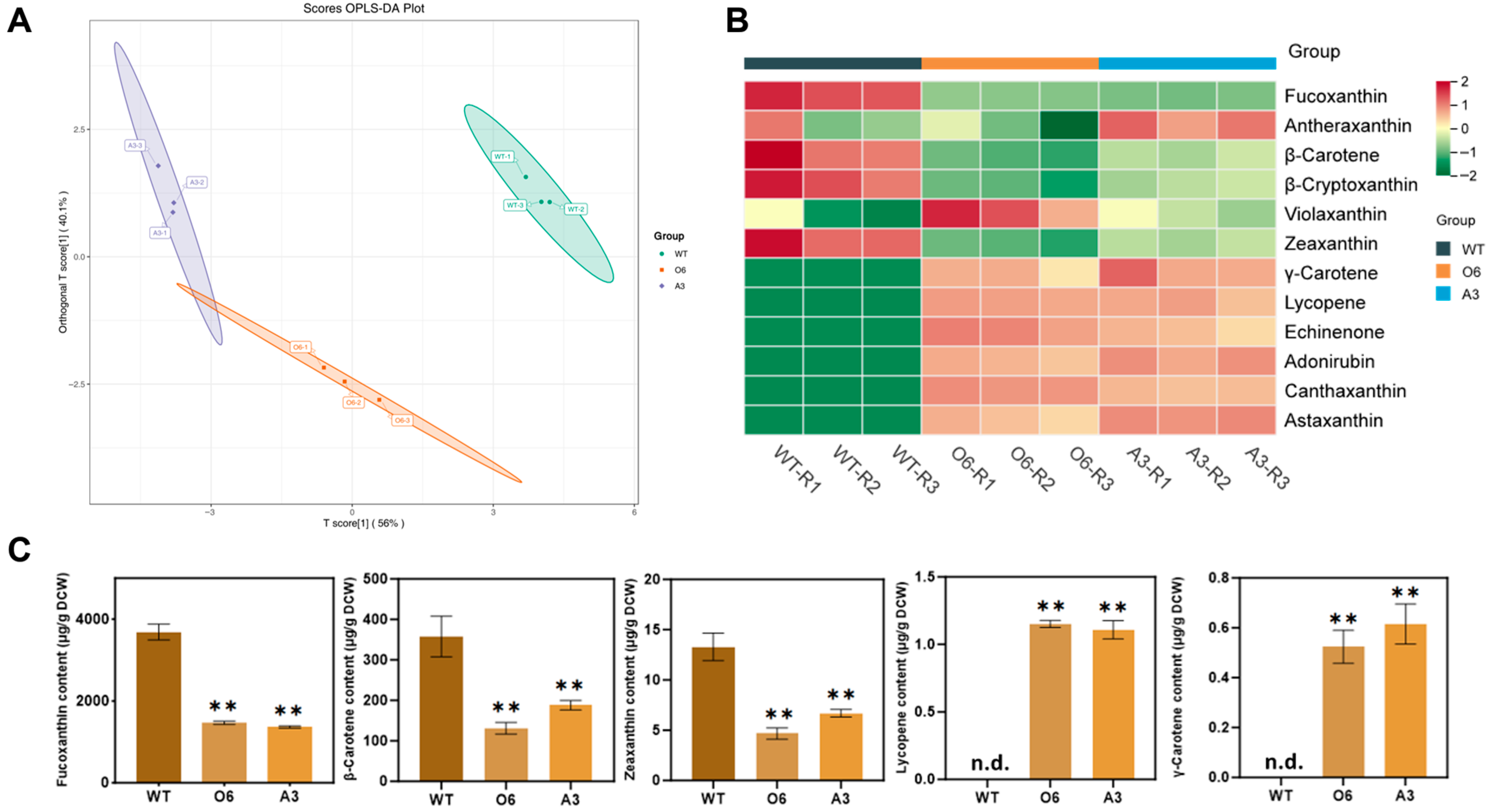
2.3. Metabolomic Analysis Reveals Significant Metabolic Flux Redirection from the Native Fucoxanthin Pathway
3. Discussion
4. Materials and Methods
4.1. Strains and Growth Conditions
4.2. Plasmid Design and Assembly
4.3. Nuclear Transformation and Transformants Identification
4.4. Western Blot Analysis
4.5. Chromatographic Mass Spectrometric Analysis of Carotenoids in Transgenic Algae
4.6. Qualitative and Quantitative Analysis of Carotenoid Compounds
4.7. Statistical Analysis
5. Conclusions
Supplementary Materials
Author Contributions
Funding
Institutional Review Board Statement
Data Availability Statement
Acknowledgments
Conflicts of Interest
Abbreviations
| BKT | β-carotene ketolase |
| CHY | β-carotene hydroxylase |
| LCYB | lycopene β-cyclase |
| WT | Wild Type |
| DCW | Dry Cell Weight |
| qPCR | Quantitative Polymerase Chain Reaction |
| RT-qPCR | Reverse Transcription Quantitative Polymerase Chain Reaction |
| TBS | TATA box binding protein |
| HA | Hemagglutinin (epitope tag) |
| GFP | Green Fluorescent Protein |
| ER | Endoplasmic Reticulum |
| SDS-PAGE | Sodium Dodecyl Sulfate–Polyacrylamide Gel Electrophoresis |
| PCA | Principal Component Analysis |
| ECL | Enhanced Chemiluminescence |
| FC | Fold Change |
| FDR | False Discovery Rate |
| BHT | Butylated Hydroxytoluene |
| APCI | Atmospheric Pressure Chemical Ionization |
References
- Ambati, R.R.; Moi, P.S.; Ravi, S.; Aswathanarayana, R.G. Astaxanthin: Sources, Extraction, Stability, Biological Activities and Its Commercial Applications—A Review. Mar. Drugs 2014, 12, 128–152. [Google Scholar] [CrossRef]
- Youssef, F.M.; Ateyya, H.; Hanna Samy, A.E.; Elmokadem, E.M. The Anti-Inflammatory and Antioxidant Effects of Astaxanthin as an Adjunctive Therapy in Community-Acquired Pneumonia: A Randomized Controlled Trial. Front. Pharmacol. 2025, 16, 1621308. [Google Scholar] [CrossRef]
- Solovchenko, A.E. Recent Breakthroughs in the Biology of Astaxanthin Accumulation by Microalgal Cell. Photosynth. Res. 2015, 125, 437–449. [Google Scholar] [CrossRef] [PubMed]
- Do, T.T.; Ong, B.N.; Tran, M.L.N.; Nguyen, D.; Melkonian, M.; Tran, H.D. Biomass and Astaxanthin Productivities of Haematococcus pluvialis in an Angled Twin-Layer Porous Substrate Photobioreactor: Effect of Inoculum Density and Storage Time. Biology 2019, 8, 68. [Google Scholar] [CrossRef] [PubMed]
- Rizzo, A.; Ross, M.E.; Norici, A.; Jesus, B. A Two-Step Process for Improved Biomass Production and Non-Destructive Astaxanthin and Carotenoids Accumulation in Haematococcus pluvialis. Appl. Sci. 2022, 12, 1261. [Google Scholar] [CrossRef]
- Shah, M.M.R.; Liang, Y.; Cheng, J.J.; Daroch, M. Astaxanthin-Producing Green Microalga Haematococcus pluvialis: From Single Cell to High Value Commercial Products. Front. Plant Sci. 2016, 7, 531. [Google Scholar] [CrossRef]
- Debnath, T.; Bandyopadhyay, T.K.; Vanitha, K.; Bobby, M.N.; Nath Tiwari, O.; Bhunia, B.; Muthuraj, M. Astaxanthin from Microalgae: A Review on Structure, Biosynthesis, Production Strategies and Application. Food Res. Int. 2024, 176, 113841. [Google Scholar] [CrossRef]
- Butler, T.; Kapoore, R.V.; Vaidyanathan, S. Phaeodactylum tricornutum: A Diatom Cell Factory. Trends Biotechnol. 2020, 38, 606–622. [Google Scholar] [CrossRef]
- Wang, S.; Hu, Z. The Marine Diatom Phaeodactylum tricornutum as a Versatile Bioproduction Chassis: Current Progress, Challenges and Perspectives. Plant Commun. 2025, 6, 101519. [Google Scholar] [CrossRef]
- Yang, R.; Wei, D. Improving Fucoxanthin Production in Mixotrophic Culture of Marine Diatom Phaeodactylum tricornutum by LED Light Shift and Nitrogen Supplementation. Front. Bioeng. Biotechnol. 2020, 8, 820. [Google Scholar] [CrossRef]
- Elshobary, M.E.; Abo-Shanab, W.A.; Ende, S.S.W.; Alquraishi, M.; El-Shenody, R.A. Optimizing Phaeodactylum tricornutum Cultivation: Integrated Strategies for Enhancing Biomass, Lipid, and Fucoxanthin Production. Biotechnol. Biofuels Bioprod. 2025, 18, 7. [Google Scholar] [CrossRef]
- Tanaka, K.; Lan, J.C.W.; Kondo, A.; Hasunuma, T. Metabolic Engineering and Cultivation Strategies for Efficient Production of Fucoxanthin and Related Carotenoids. Appl. Microbiol. Biotechnol. 2025, 109, 57. [Google Scholar] [CrossRef]
- Kadono, T.; Kira, N.; Suzuki, K.; Iwata, O.; Ohama, T.; Okada, S.; Nishimura, T.; Akakabe, M.; Tsuda, M.; Adachi, M. Effect of an Introduced Phytoene Synthase Gene Expression on Carotenoid Biosynthesis in the Marine Diatom Phaeodactylum tricornutum. Mar. Drugs 2015, 13, 5334–5357. [Google Scholar] [CrossRef]
- Manfellotto, F.; Stella, G.R.; Ferrante, M.I.; Falciatore, A.; Brunet, C. Engineering the Unicellular Alga Phaeodactylum tricornutum for Enhancing Carotenoid Production. Antioxidants 2020, 9, 757. [Google Scholar] [CrossRef]
- Græsholt, C.; Brembu, T.; Volpe, C.; Bartosova, Z.; Serif, M.; Winge, P.; Nymark, M. Zeaxanthin Epoxidase 3 Knockout Mutants of the Model Diatom Phaeodactylum tricornutum Enable Commercial Production of the Bioactive Carotenoid Diatoxanthin. Mar. Drugs 2024, 22, 185. [Google Scholar] [CrossRef]
- Athanasakoglou, A.; Kampranis, S.C. Diatom Isoprenoids: Advances and Biotechnological Potential. Biotechnol. Adv. 2019, 37, 107417. [Google Scholar] [CrossRef] [PubMed]
- Zhong, Y.J.; Huang, J.C.; Liu, J.; Li, Y.; Jiang, Y.; Xu, Z.F.; Sandmann, G.; Chen, F. Functional Characterization of Various Algal Carotenoid Ketolases Reveals That Ketolating Zeaxanthin Efficiently Is Essential for High Production of Astaxanthin in Transgenic Arabidopsis. J. Exp. Bot. 2011, 62, 3659–3669. [Google Scholar] [CrossRef] [PubMed]
- He, J.; Li, P.; Huo, H.; Liu, L.; Tang, T.; He, M.; Huang, J.; Liu, L. Heterologous Expression of HpBHY and CrBKT Increases Heat Tolerance in Physcomitrella Patens. Plant Divers. 2019, 41, 266–274. [Google Scholar] [CrossRef] [PubMed]
- Bernaudat, F.; Frelet-Barrand, A.; Pochon, N.; Dementin, S.; Hivin, P.; Boutigny, S.; Rioux, J.B.; Salvi, D.; Seigneurin-Berny, D.; Richaud, P.; et al. Heterologous Expression of Membrane Proteins: Choosing the Appropriate Host. PLoS ONE 2011, 6, e29191. [Google Scholar] [CrossRef]
- Maier, U.G.; Zauner, S.; Hempel, F. Protein Import into Complex Plastids: Cellular Organization of Higher Complexity. Eur. J. Cell Biol. 2015, 94, 340–348. [Google Scholar] [CrossRef]
- Gruber, A.; Vugrinec, S.; Hempel, F.; Gould, S.B.; Maier, U.G.; Kroth, P.G. Protein Targeting into Complex Diatom Plastids: Functional Characterisation of a Specific Targeting Motif. Plant Mol. Biol. 2007, 64, 519–530. [Google Scholar] [CrossRef]
- Perozeni, F.; Cazzaniga, S.; Baier, T.; Zanoni, F.; Zoccatelli, G.; Lauersen, K.J.; Wobbe, L.; Ballottari, M. Turning a Green Alga Red: Engineering Astaxanthin Biosynthesis by Intragenic Pseudogene Revival in Chlamydomonas reinhardtii. Plant Biotechnol. J. 2020, 18, 2053–2067. [Google Scholar] [CrossRef]
- Diaz-Garza, A.M.; Lavoie-Marchand, F.; Merindol, N.; Diamond, A.; Desgagné-Penix, I. What Is True for Plants May Not Be True for Phaeodactylum: The Case of Vanilla planifolia Vanillin Synthase (VpVAN) Targeted to Four Subcellular Compartments of the Diatom. bioRxiv 2024. [Google Scholar] [CrossRef]
- Zou, L.G.; Balamurugan, S.; Zhou, T.B.; Chen, J.W.; Li, D.W.; Yang, W.D.; Liu, J.S.; Li, H.Y. Potentiation of Concurrent Expression of Lipogenic Genes by Novel Strong Promoters in the Oleaginous Microalga Phaeodactylum tricornutum. Biotechnol. Bioeng. 2019, 116, 3006–3015. [Google Scholar] [CrossRef] [PubMed]
- Ye, L.; Zhu, X.; Wu, T.; Wang, W.; Zhao, D.; Bi, C.; Zhang, X. Optimizing the Localization of Astaxanthin Enzymes for Improved Productivity. Biotechnol. Biofuels 2018, 11, 278. [Google Scholar] [CrossRef] [PubMed]
- Zhou, Q.; Huang, D.; Yang, H.; Hong, Z.; Wang, C. Improvement of Carotenoids’ Production by Increasing the Activity of Beta-Carotene Ketolase with Different Strategies. Microorganisms 2024, 12, 377. [Google Scholar] [CrossRef]
- Bai, C.; Berman, J.; Farre, G.; Capell, T.; Sandmann, G.; Christou, P.; Zhu, C. Reconstruction of the Astaxanthin Biosynthesis Pathway in Rice Endosperm Reveals a Metabolic Bottleneck at the Level of Endogenous β-Carotene Hydroxylase Activity. Transgenic Res. 2017, 26, 13–23. [Google Scholar] [CrossRef]
- Dambek, M.; Eilers, U.; Breitenbach, J.; Steiger, S.; Büchel, C.; Sandmann, G. Biosynthesis of Fucoxanthin and Diadinoxanthin and Function of Initial Pathway Genes in Phaeodactylum tricornutum. J. Exp. Bot. 2012, 63, 5607–5612. [Google Scholar] [CrossRef]
- Bai, Y.; Cao, T.; Dautermann, O.; Buschbeck, P.; Cantrell, M.B.; Chen, Y.; Lein, C.D.; Shi, X.; Ware, M.A.; Yang, F.; et al. Green Diatom Mutants Reveal an Intricate Biosynthetic Pathway of Fucoxanthin. Proc Natl Acad Sci. USA 2022, 119, e2203708119. [Google Scholar] [CrossRef] [PubMed]
- Oslan, S.N.H.; Shoparwe, N.F.; Yusoff, A.H.; Rahim, A.A.; Chang, C.S.; Tan, J.S.; Oslan, S.N.; Arumugam, K.; Bin Ariff, A.; Sulaiman, A.Z.; et al. A Review on Haematococcus pluvialis Bioprocess Optimization of Green and Red Stage Culture Conditions for the Production of Natural Astaxanthin. Biomolecules 2021, 11, 256. [Google Scholar] [CrossRef]
- Gherabli, A.; Grimi, N.; Lemaire, J.; Vorobiev, E.; Lebovka, N. Extraction of Valuable Biomolecules from the Microalga Haematococcus pluvialis Assisted by Electrotechnologies. Molecules 2023, 28, 2089. [Google Scholar] [CrossRef]
- Delgado-Ramallo, J.F.; Álvarez-Gil, M.; Casado-Bañares, V.; Suárez-Montes, D.; Sanjurjo-Muñíz, C. Phaeodactylum tricornutum as a Stable Platform for Pilot Scale Production and Investigation of the Viability of Spirulina Fucoxanthin as a Commercial Lipolysis Active Novel Compound. Front. Mar. Sci. 2024, 11, 1325159. [Google Scholar] [CrossRef]
- Fang, H.; Liu, J.; Ma, R.; Zou, Y.; Ho, S.H.; Chen, J.; Xie, Y. Functional Characterization of Lycopene β- and ε-Cyclases from a Lutein-Enriched Green Microalga Chlorella Sorokiniana FZU60. Mar. Drugs 2023, 21, 418. [Google Scholar] [CrossRef]
- Cen, S.Y.; Li, D.W.; Huang, X.L.; Huang, D.; Balamurugan, S.; Liu, W.J.; Zheng, J.W.; Yang, W.D.; Li, H.Y. Crucial Carotenogenic Genes Elevate Hyperaccumulation of Both Fucoxanthin and β-Carotene in Phaeodactylum tricornutum. Algal Res. 2022, 64, 102691. [Google Scholar] [CrossRef]
- Henke, N.A.; Heider, S.A.E.; Peters-Wendisch, P.; Wendisch, V.F. Production of the Marine Carotenoid Astaxanthin by Metabolically Engineered Corynebacterium Glutamicum. Mar. Drugs 2016, 14, 124. [Google Scholar] [CrossRef]
- Wu, Y.; Yan, P.; Liu, X.; Wang, Z.; Tang, Y.J.; Chen, T.; Zhao, X. Combinatorial Expression of Different β-Carotene Hydroxylases and Ketolases in Escherichia Coli for Increased Astaxanthin Production. J. Ind. Microbiol. Biotechnol. 2019, 46, 1505–1516. [Google Scholar] [CrossRef]
- Menin, B.; Lami, A.; Musazzi, S.; Petrova, A.A.; Santabarbara, S.; Casazza, A.P. A Comparison of Constitutive and Inducible Non-Endogenous Keto-Carotenoids Biosynthesis in Synechocystis sp. PCC 6803. Microorganisms 2019, 7, 501. [Google Scholar] [CrossRef] [PubMed]
- Vidhyavathi, R.; Venkatachalam, L.; Sarada, R.; Ravishankar, G.A. Regulation of Carotenoid Biosynthetic Genes Expression and Carotenoid Accumulation in the Green Alga Haematococcus pluvialis under Nutrient Stress Conditions. J. Exp. Bot. 2008, 59, 1409–1418. [Google Scholar] [CrossRef] [PubMed]
- Chen, Q.; Chen, Y.; Xu, Q.; Jin, H.; Hu, Q.; Han, D. Effective Two-Stage Heterotrophic Cultivation of the Unicellular Green Microalga Chromochloris Zofingiensis Enabled Ultrahigh Biomass and Astaxanthin Production. Front. Bioeng. Biotechnol. 2022, 10, 834230. [Google Scholar] [CrossRef]
- Lyu, X.; Lyu, Y.; Yu, H.; Chen, W.N.; Ye, L.; Yang, R. Biotechnological Advances for Improving Natural Pigment Production: A State-of-the-Art Review. Bioresour. Bioprocess. 2022, 9, 8. [Google Scholar] [CrossRef] [PubMed]
- Giossi, C.E.; Kroth, P.G.; Lepetit, B. Xanthophyll Cycling and Fucoxanthin Biosynthesis in the Model Diatom Phaeodactylum tricornutum: Recent Advances and New Gene Functions. Front. Photobiol. 2025, 3, 1680034. [Google Scholar] [CrossRef]
- Cao, T.; Bai, Y.; Buschbeck, P.; Tan, Q.; Cantrell, M.B.; Chen, Y.; Jiang, Y.; Liu, R.Z.; Ries, N.K.; Shi, X.; et al. An Unexpected Hydratase Synthesizes the Green Light-Absorbing Pigment Fucoxanthin. Plant Cell 2023, 35, 3053–3072. [Google Scholar] [CrossRef]
- Cerón-García, M.C.; Fernández-Sevilla, J.M.; Sánchez-Mirón, A.; García-Camacho, F.; Contreras-Gómez, A.; Molina-Grima, E. Mixotrophic Growth of Phaeodactylum tricornutum on Fructose and Glycerol in Fed-Batch and Semi-Continuous Modes. Bioresour. Technol. 2013, 147, 569–576. [Google Scholar] [CrossRef]
- Zaslavskaia, L.A.; Lippmeier, J.C.; Shih, C.; Ehrhardt, D.; Grossman, A.R.; Apt, K.E. Trophic Conversion of an Obligate Photoautotrophic Organism Through Metabolic Engineering. Science 2001, 292, 2073–2075. [Google Scholar] [CrossRef]
- Guillard, R.R.L. Culture of Phytoplankton for Feeding Marine Invertebrates. In Culture of Marine Invertebrate Animals; Smith, W.L., Chanley, M.H., Eds.; Plenum Press: New York, NY, USA, 1975; pp. 29–60. [Google Scholar]
- Zaslavskaia, L.A.; Casey Lippmeier, J.; Kroth, P.G.; Grossman, A.R.; Apt, K.E. Transformation of the Diatom Phaeodactylum tricornutum (Bacillariophyceae) with a Variety of Selectable Marker and Reporter Genes. J. Phycol. 2000, 36, 379–386. [Google Scholar] [CrossRef]
- Apt, K.E.; Kroth-Pancic Arthur R Grossman, P.G. Stable Nuclear Transformation of the Diatom Phaeodactylum tricornutum. Mol. Gen. Genet. 1996, 252, 572–579. [Google Scholar] [CrossRef]
- Sachse, M.; Sturm, S.; Gruber, A.; Kroth, P.G. Identification and evaluation of endogenous reference genes for steady state transcript quantification by qPCR in the diatom Phaeodactylum tricornutum with constitutive expression independent from time and light. Endocytobiosis Cell Res. 2013, 24, 1–7. [Google Scholar]
- Geyer, R.; Peacock, A.D.; White, D.C.; Lytle, C.; Van Berkel, G.J. Atmospheric Pressure Chemical Ionization and Atmospheric Pressure Photoionization for Simultaneous Mass Spectrometric Analysis of Microbial Respiratory Ubiquinones and Menaquinones. J. Mass Spectrom. 2004, 39, 922–929. [Google Scholar] [CrossRef] [PubMed]



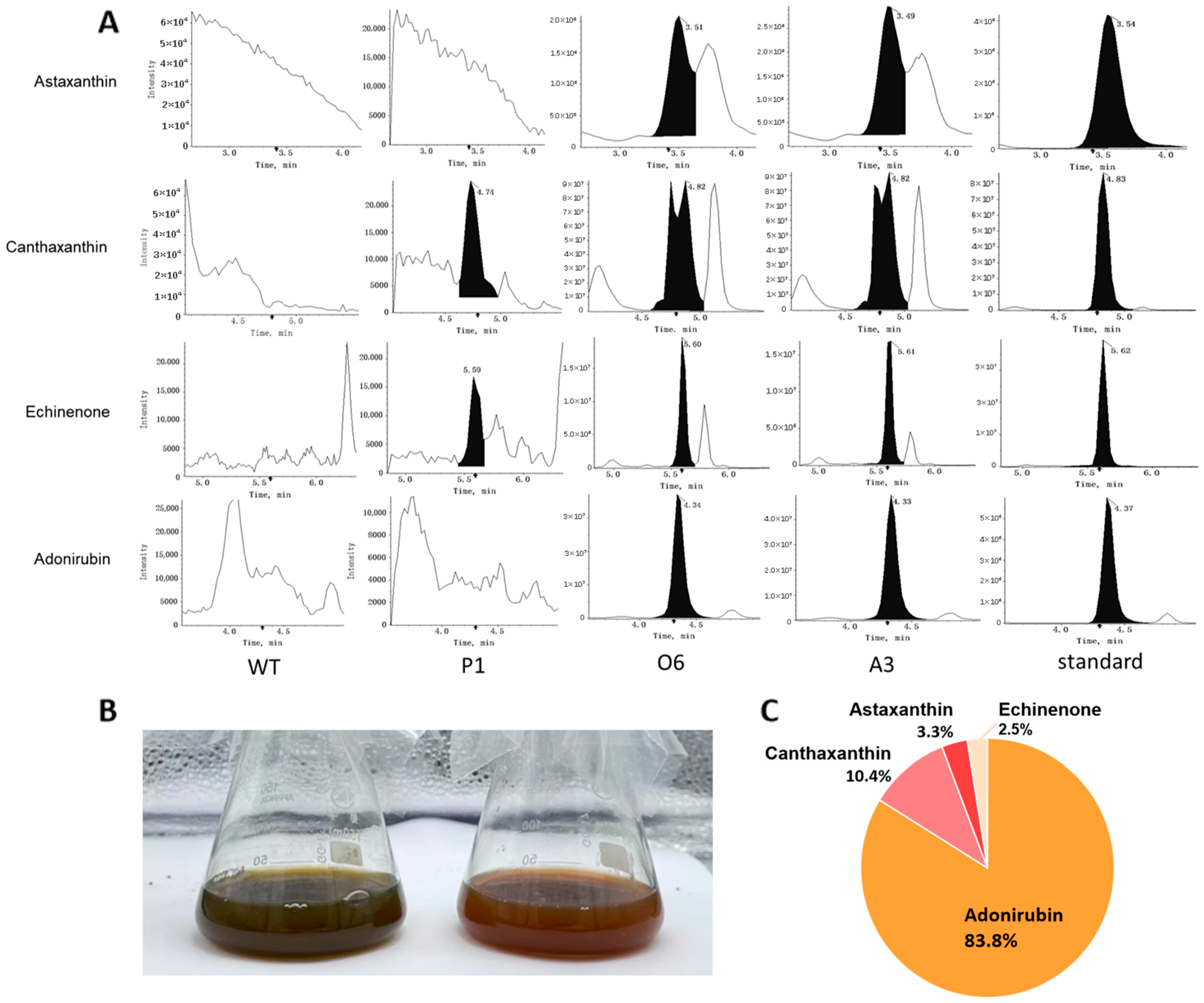
| Compound | WT | P1 | O6 | A3 |
|---|---|---|---|---|
| Echinenone | 0 | 0.020 ± 0.003 | 10.831 ± 0.626 | 8.920 ± 0.700 |
| Adonirubin | 0 | 0 | 353.348 ± 18.118 | 391.852 ± 17.847 |
| Canthaxanthin | 0 | 0.028 ± 0.004 | 44.846 ± 0.731 | 39.027 ± 0.758 |
| Astaxanthin | 0 | 0 | 13.381 ± 1.070 | 16.045 ± 0.286 |
Disclaimer/Publisher’s Note: The statements, opinions and data contained in all publications are solely those of the individual author(s) and contributor(s) and not of MDPI and/or the editor(s). MDPI and/or the editor(s) disclaim responsibility for any injury to people or property resulting from any ideas, methods, instructions or products referred to in the content. |
© 2025 by the authors. Licensee MDPI, Basel, Switzerland. This article is an open access article distributed under the terms and conditions of the Creative Commons Attribution (CC BY) license (https://creativecommons.org/licenses/by/4.0/).
Share and Cite
Chao, H.; Kamal, R.; Wu, Y.; Huang, D.; Wang, C. Installing a Ketocarotenoid Branch in Phaeodactylum tricornutum via Functional Activation of Chlamydomonas reinhardtii β-Carotene Ketolase. Mar. Drugs 2025, 23, 470. https://doi.org/10.3390/md23120470
Chao H, Kamal R, Wu Y, Huang D, Wang C. Installing a Ketocarotenoid Branch in Phaeodactylum tricornutum via Functional Activation of Chlamydomonas reinhardtii β-Carotene Ketolase. Marine Drugs. 2025; 23(12):470. https://doi.org/10.3390/md23120470
Chicago/Turabian StyleChao, Hengshen, Rasool Kamal, Yan Wu, Danqiong Huang, and Chaogang Wang. 2025. "Installing a Ketocarotenoid Branch in Phaeodactylum tricornutum via Functional Activation of Chlamydomonas reinhardtii β-Carotene Ketolase" Marine Drugs 23, no. 12: 470. https://doi.org/10.3390/md23120470
APA StyleChao, H., Kamal, R., Wu, Y., Huang, D., & Wang, C. (2025). Installing a Ketocarotenoid Branch in Phaeodactylum tricornutum via Functional Activation of Chlamydomonas reinhardtii β-Carotene Ketolase. Marine Drugs, 23(12), 470. https://doi.org/10.3390/md23120470