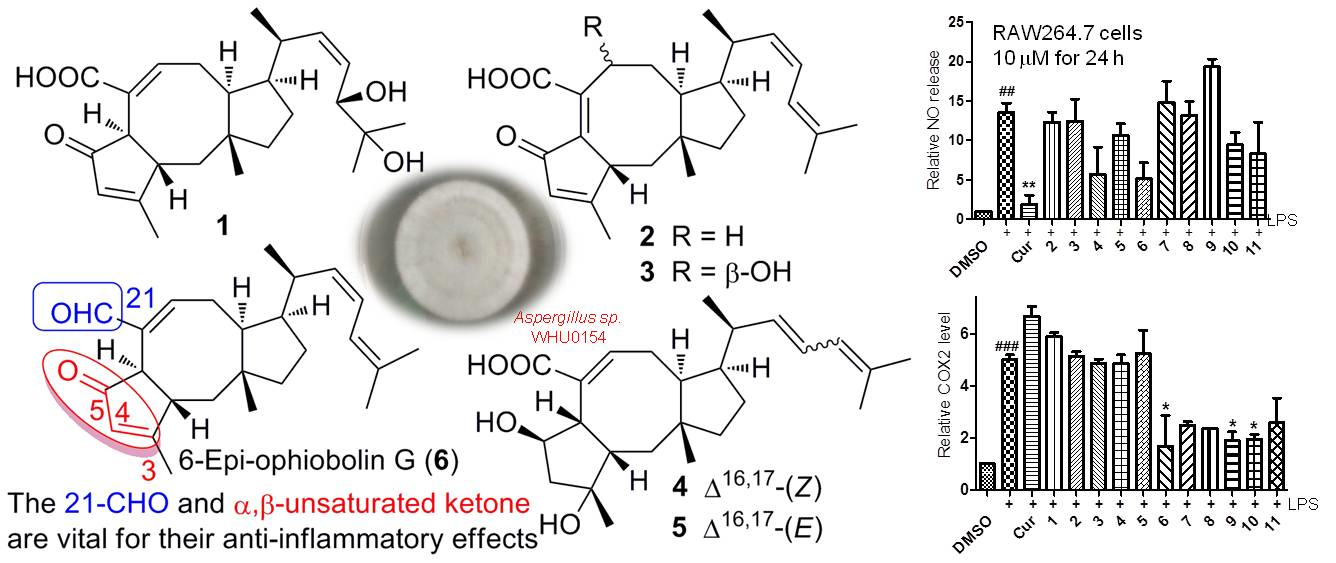
New Ophiobolins from the Deep-Sea Derived Fungus Aspergillus sp. WHU0154 and Their Anti-Inflammatory Effects


Abstract
Share and Cite
Ding, W.; Uvarani, C.; Wang, F.; Xue, Y.; Wu, N.; He, L.; Tian, D.; Chen, M.; Zhang, Y.; Hong, K.; et al. New Ophiobolins from the Deep-Sea Derived Fungus Aspergillus sp. WHU0154 and Their Anti-Inflammatory Effects. Mar. Drugs 2020, 18, 575. https://doi.org/10.3390/md18110575
Ding W, Uvarani C, Wang F, Xue Y, Wu N, He L, Tian D, Chen M, Zhang Y, Hong K, et al. New Ophiobolins from the Deep-Sea Derived Fungus Aspergillus sp. WHU0154 and Their Anti-Inflammatory Effects. Marine Drugs. 2020; 18(11):575. https://doi.org/10.3390/md18110575
Chicago/Turabian StyleDing, Wenjuan, Chokkalingam Uvarani, Fangfang Wang, Yaxin Xue, Ning Wu, Liming He, Danmei Tian, Mei Chen, Youwei Zhang, Kui Hong, and et al. 2020. "New Ophiobolins from the Deep-Sea Derived Fungus Aspergillus sp. WHU0154 and Their Anti-Inflammatory Effects" Marine Drugs 18, no. 11: 575. https://doi.org/10.3390/md18110575
APA StyleDing, W., Uvarani, C., Wang, F., Xue, Y., Wu, N., He, L., Tian, D., Chen, M., Zhang, Y., Hong, K., & Tang, J. (2020). New Ophiobolins from the Deep-Sea Derived Fungus Aspergillus sp. WHU0154 and Their Anti-Inflammatory Effects. Marine Drugs, 18(11), 575. https://doi.org/10.3390/md18110575