Beyond Sequencing: Integrating MLPA Reveals Hidden Structural PKD2 Variants and Enhances Mutation Detection in a Highly Selected ADPKD Greek Cohort

 ,
,  ,
, 
Abstract
1. Introduction
2. Materials and Methods
2.1. Study Design and Population
2.2. DNA Isolation–DNA Sequencing
2.3. Multiplex Ligation-Dependent Probe Amplification (MLPA)
2.4. Statistics
3. Results
4. Discussion
5. Conclusions
Supplementary Materials
Author Contributions
Funding
Institutional Review Board Statement
Informed Consent Statement
Data Availability Statement
Conflicts of Interest
References
- Bergmann, C.; Guay-Woodford, L.M.; Harris, P.C.; Horie, S.; Peters, D.J.M.; Torres, V.E. Polycystic kidney disease. Nat. Rev. Dis. Primers 2018, 4, 50. [Google Scholar] [CrossRef] [Scilit] [PubMed]
- Harris, P.C.; Torres, V.E. Polycystic kidney disease, autosomal dominant. In GeneReviews®; Adam, M.P., Feldman, J., Mirzaa, G.M., Pagon, R.A., Wallace, S.E., Bean, L.J.H., Gripp, K.W., Amemiya, A., Eds.; University of Washington: Seattle, WA, USA, 2002. [Google Scholar]
- Martinez, J.R.; Grantham, J.J. Polycystic kidney disease: Etiology, pathogenesis, and treatment. Dis. Mon. 1995, 41, 693–765. [Google Scholar] [CrossRef] [Scilit] [PubMed]
- Grantham, J.J. Clinical practice. Autosomal dominant polycystic kidney disease. N. Engl. J. Med. 2008, 359, 1477–1485. [Google Scholar] [CrossRef] [Scilit] [PubMed]
- Lanktree, M.B.; Haghighi, A.; Guiard, E.; Iliuta, I.A.; Song, X.; Harris, P.C.; Paterson, A.D.; Pei, Y. Prevalence estimates of polycystic kidney and liver disease by population sequencing. J. Am. Soc. Nephrol. 2018, 29, 2593–2600. [Google Scholar] [CrossRef] [Scilit] [PubMed]
- Harris, P.C.; Torres, V.E. Genetic mechanisms and signaling pathways in autosomal dominant polycystic kidney disease. J. Clin. Investig. 2014, 124, 2315–2324. [Google Scholar] [CrossRef] [Scilit] [PubMed]
- Grantham, J.J.; Torres, V.E.; Chapman, A.B.; Guay-Woodford, L.M.; Bae, K.T.; King, B.F., Jr.; Wetzel, L.H.; Baumgarten, D.A.; Kenney, P.J.; Harris, P.C.; et al. Volume progression in polycystic kidney disease. N. Engl. J. Med. 2006, 354, 2122–2130. [Google Scholar] [CrossRef] [Scilit] [PubMed]
- Chebib, F.T.; Hanna, C.; Harris, P.C.; Torres, V.E.; Dahl, N.K. Autosomal dominant polycystic kidney disease: A review. JAMA 2025, 333, 1708–1719. [Google Scholar] [CrossRef] [Scilit] [PubMed]
- Gansevoort, R.T.; Arici, M.; Benzing, T.; Birn, H.; Capasso, G.; Covic, A.; Devuyst, O.; Drechsler, C.; Eckardt, K.U.; Emma, F.; et al. Recommendations for the use of tolvaptan in autosomal dominant polycystic kidney disease: A position statement on behalf of the ERA-EDTA Working Groups on Inherited Kidney Disorders and European Renal Best Practice. Nephrol. Dial. Transplant. 2016, 31, 337–348. [Google Scholar] [CrossRef] [Scilit] [PubMed]
- Vias, P.; Goyal, S.; Madan, R.; Kakkar, N.; Sood, R.; Periasamy, K.; Kumar, R. Renal cell carcinoma in the background of autosomal dominant polycystic kidney disease: Report of two cases and review of literature. Indian J. Med. Paediatr. Oncol. 2024, 45, 188–193. [Google Scholar] [CrossRef] [Scilit]
- Drake, A.M.; Paynter, J.A.; Yim, A.; Tempo, J.A.; Manning, T.G.; Brennan, J.; Qin, K.R. Prevalence of renal neoplasia in autosomal dominant polycystic kidney disease: Systematic review and meta-analysis. Nephron 2024, 148, 457–467. [Google Scholar] [CrossRef] [Scilit] [PubMed]
- Rowe, I.; Boletta, A. Defective metabolism in polycystic kidney disease: Potential for therapy and open questions. Nephrol. Dial. Transplant. 2014, 29, 1480–1486. [Google Scholar] [CrossRef] [Scilit] [PubMed][Green Version]
- Harris, P.C.; Bae, K.T.; Rossetti, S.; Torres, V.E.; Grantham, J.J.; Chapman, A.B.; Guay-Woodford, L.M.; King, B.F.; Wetzel, L.H.; Baumgarten, D.A.; et al. Cyst number but not the rate of cystic growth is associated with the mutated gene in autosomal dominant polycystic kidney disease. J. Am. Soc. Nephrol. 2006, 17, 3013–3019. [Google Scholar] [CrossRef] [Scilit] [PubMed]
- Ta, C.M.; Vien, T.N.; Ng, L.C.T.; DeCaen, P.G. Structure and function of polycystin channels in primary cilia. Cell. Signal. 2020, 72, 109626. [Google Scholar] [CrossRef] [Scilit] [PubMed]
- Su, Q.; Hu, F.; Ge, X.; Lei, J.; Yu, S.; Wang, T.; Zhou, Q.; Mei, C.; Shi, Y. Structure of the human PKD1-PKD2 complex. Science 2018, 361, eaat9819. [Google Scholar] [CrossRef] [Scilit] [PubMed]
- Kidney Disease: Improving Global Outcomes (KDIGO) ADPKD Work Group. KDIGO 2025 clinical practice guideline for the evaluation, management, and treatment of autosomal dominant polycystic kidney disease (ADPKD). Kidney Int. 2025, 107, S1–S239. [CrossRef] [Scilit] [PubMed]
- Cornec-Le Gall, E.; Ong, A.C.M. Genetic testing in autosomal dominant polycystic kidney disease: Why it matters in 2025. Clin. Kidney J. 2025, 18, ii17–ii25. [Google Scholar] [CrossRef] [Scilit] [PubMed]
- Cornec-Le Gall, E.; Torres, V.E.; Harris, P.C. Genetic complexity of autosomal dominant polycystic kidney and liver diseases. J. Am. Soc. Nephrol. 2018, 29, 13–23. [Google Scholar] [CrossRef] [Scilit] [PubMed]
- Shukoor, S.S.; Vaughan, L.E.; Edwards, M.E.; Lavu, S.; Kline, T.L.; Senum, S.R.; Mkhaimer, Y.; Zaatari, G.; Irazabal, M.V.; Neal, R.; et al. Characteristics of patients with end-stage kidney disease in ADPKD. Kidney Int. Rep. 2021, 6, 755–767. [Google Scholar] [CrossRef] [Scilit] [PubMed]
- Heyer, C.M.; Sundsbak, J.L.; Abebe, K.Z.; Chapman, A.B.; Torres, V.E.; Grantham, J.J.; Bae, K.T.; Schrier, R.W.; Perrone, R.D.; Braun, W.E.; et al. Predicted mutation strength of nontruncating PKD1 mutations aids genotype-phenotype correlations in autosomal dominant polycystic kidney disease. J. Am. Soc. Nephrol. 2016, 27, 2872–2884. [Google Scholar] [CrossRef] [Scilit] [PubMed]
- Lavu, S.; Vaughan, L.E.; Senum, S.R.; Kline, T.L.; Chapman, A.B.; Perrone, R.D.; Mrug, M.; Braun, W.E.; Steinman, T.I.; Rahbari-Oskoui, F.F.; et al. The value of genotypic and imaging information to predict functional and structural outcomes in ADPKD. JCI Insight 2020, 5, e138724. [Google Scholar] [CrossRef] [Scilit] [PubMed]
- Hateboer, N.; van Dijk, M.A.; Bogdanova, N.; Coto, E.; Saggar-Malik, A.K.; San Millan, J.L.; Torra, R.; Breuning, M.; Ravine, D.; European PKD1-PKD2 Study Group. Comparison of phenotypes of polycystic kidney disease types 1 and 2. Lancet 1999, 353, 103–107. [Google Scholar] [CrossRef] [Scilit] [PubMed]
- Ghanem, A.; Borghol, A.H.; Munairdjy Debeh, F.G.; Paul, S.; AlKhatib, B.; Harris, P.C.; Garimella, P.S.; Hanna, C.; Kline, T.L.; Dahl, N.K.; et al. Biomarkers of kidney disease progression in ADPKD. Kidney Int. Rep. 2024, 9, 2860–2882. [Google Scholar] [CrossRef] [Scilit] [PubMed]
- Deltas, C.C. Mutations of the human polycystic kidney disease 2 (PKD2) gene. Hum. Mutat. 2001, 18, 13–24. [Google Scholar] [CrossRef] [Scilit] [PubMed]
- Hayashi, T.; Mochizuki, T.; Reynolds, D.M.; Wu, G.; Cai, Y.; Somlo, S. Characterization of the exon structure of the polycystic kidney disease 2 gene (PKD2). Genomics 1997, 44, 131–136. [Google Scholar] [CrossRef] [Scilit] [PubMed]
- Weckx, S.; Del-Favero, J.; Rademakers, R.; Claes, L.; Cruts, M.; De Jonghe, P.; Van Broeckhoven, C.; De Rijk, P. novoSNP, a novel computational tool for sequence variation discovery. Genome Res. 2005, 15, 436–442. [Google Scholar] [CrossRef] [Scilit] [PubMed]
- Márquez-Nogueras, K.M.; Kuo, I.Y.; Chapman, A.B. Future needs for clinical trials in autosomal dominant polycystic kidney disease. Nat. Rev. Nephrol. 2026, 22, 379–380. [Google Scholar] [CrossRef] [Scilit] [PubMed]
- Chen, C.Y.; Hadla, M.; Khambati, I.; Kashyap, S.; Westerfield, V.; Fedeles, S.; Besse, W.; Hopp, K.; Harris, P.C.; Patel, V.; et al. Emerging therapies in autosomal dominant polycystic kidney disease. Kidney360 2025, 7, 1662–1676. [Google Scholar] [CrossRef] [Scilit] [PubMed]
- Xue, C.; Lv, J.; Yang, B.; Mei, S.; Xu, J.; Li, X.; Zhang, L.; Mao, Z. Gene therapy in polycystic kidney disease: A promising future. J. Transl. Int. Med. 2024, 12, 543–552. [Google Scholar] [CrossRef] [Scilit] [PubMed]
- Chakraborty, A.; Yu, A.S.L. Prospects for gene therapy in polycystic kidney disease. Curr. Opin. Nephrol. Hypertens. 2025, 34, 121–127. [Google Scholar] [CrossRef] [Scilit] [PubMed]
- Ibel, A.; Bhardwaj, R.; Yilmaz, D.E.; Kong, S.; Wendlinger, S.; Cordero, C.; Papaioannou, D.; Papazian, M.; Schönauer, R.; Meng, Q.; et al. In vivo base editing reduces liver cysts in autosomal dominant polycystic kidney disease. Mol. Ther. 2025, 33, 5373–5382. [Google Scholar] [CrossRef] [Scilit] [PubMed]
- Puri, B.; Kulkarni, Y.A.; Gaikwad, A.B. Advances in CRISPR-Cas systems for kidney diseases. Prog. Mol. Biol. Transl. Sci. 2025, 210, 149–162. [Google Scholar] [CrossRef] [Scilit] [PubMed]
- Cao, M.L.; Han, R.Y.; Chen, S.D.; Zhao, D.Y.; Shi, M.Y.; Zou, J.H.; Li, L.; Jiang, H.K. Gene editing: An effective tool for the future treatment of kidney disease. J. Inflamm. Res. 2025, 18, 4001–4018. [Google Scholar] [CrossRef] [Scilit] [PubMed]



| Patient ID | Alteration | Alteration Type | Liver Cysts | Aneurysms | Family History (Ages of PKD Patients) |
|---|---|---|---|---|---|
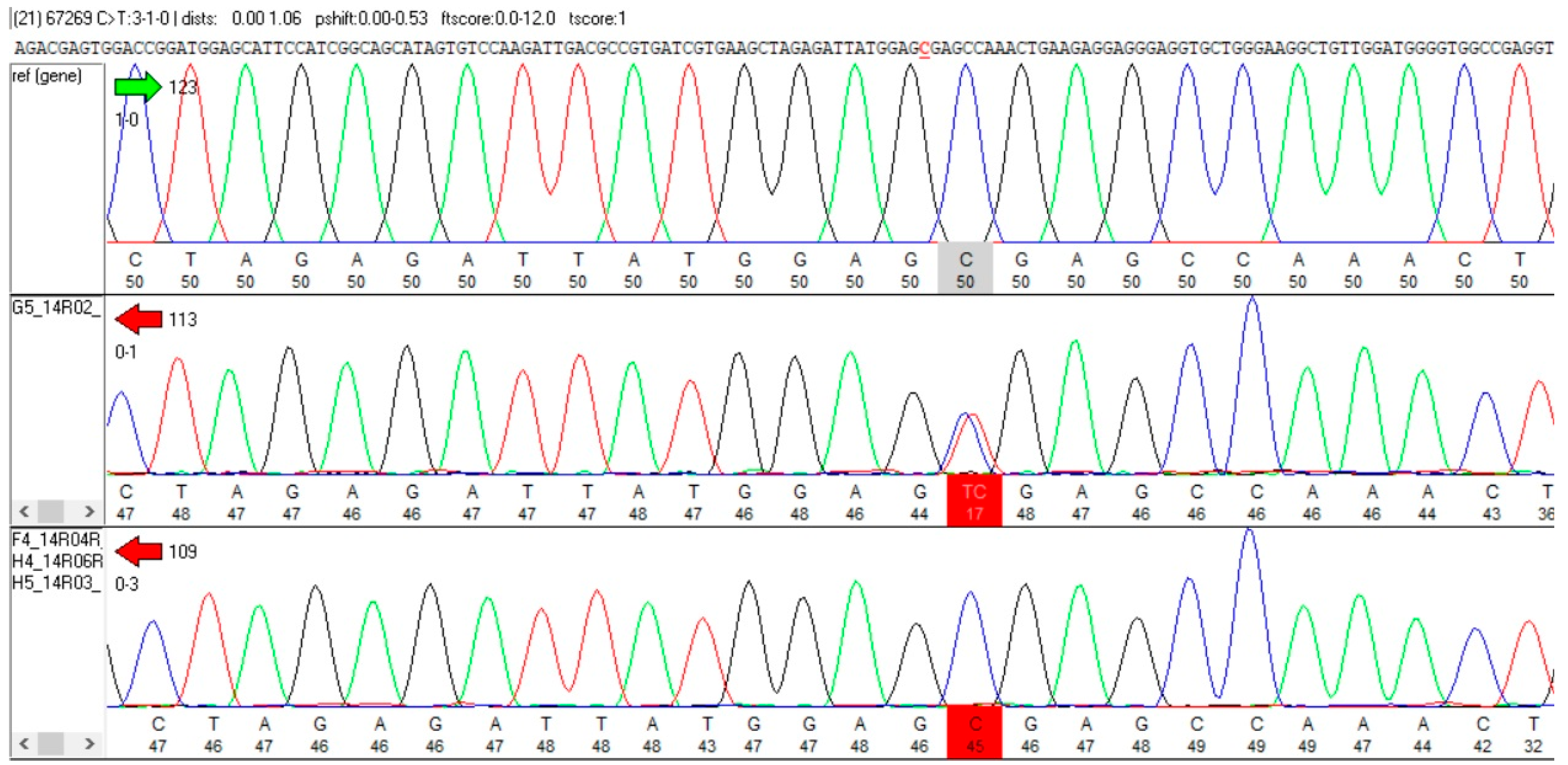
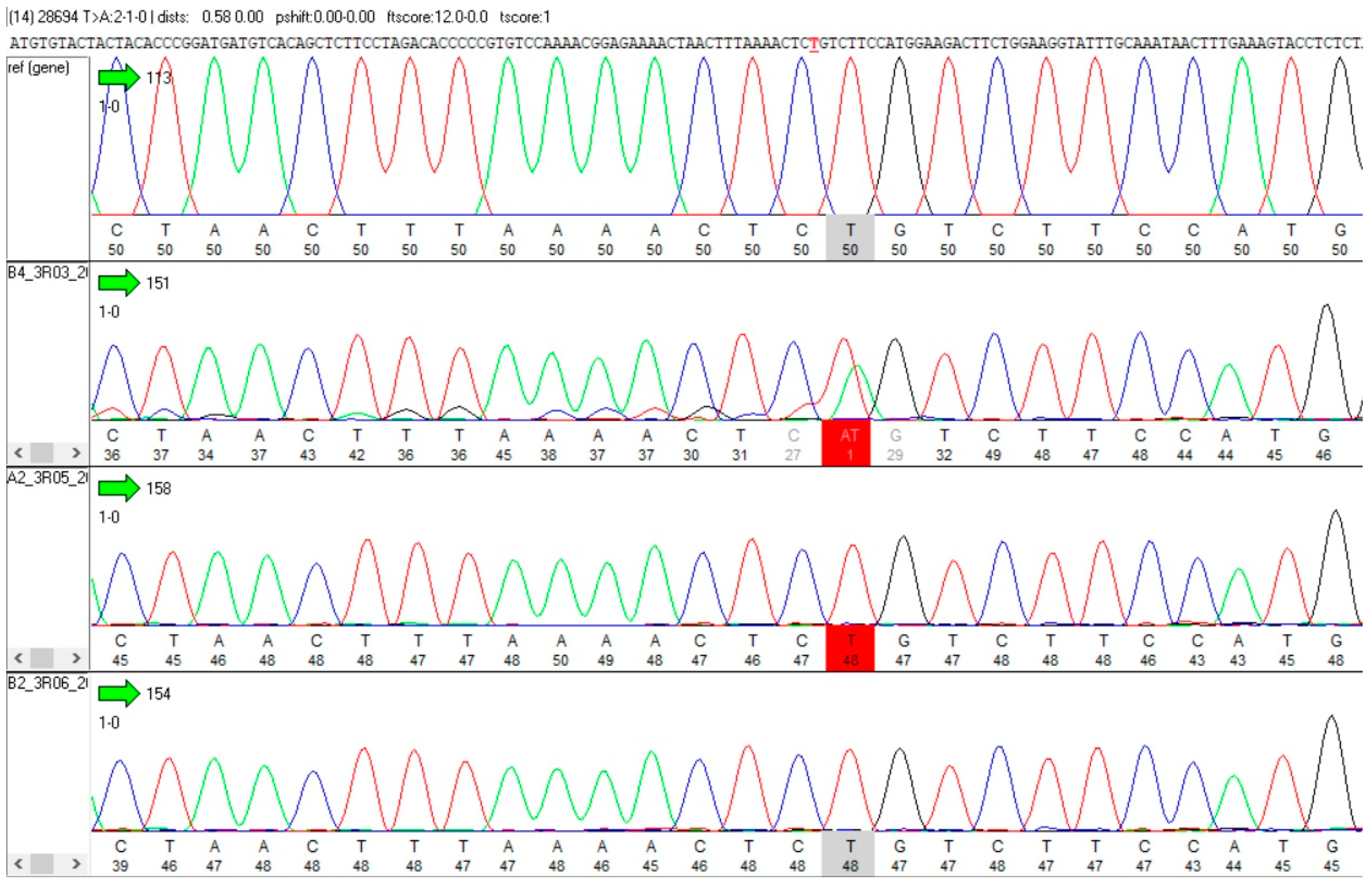
| R02 | p.Arg872Ter | Single base | Yes | No | Mother (78 y, KRT), son (58 y), granddaughter (40 y) |
| R03 | p.L273Q | Single base | Yes | No | Father (75 y, KRT), daughter (50 y), grandson (35 y) |
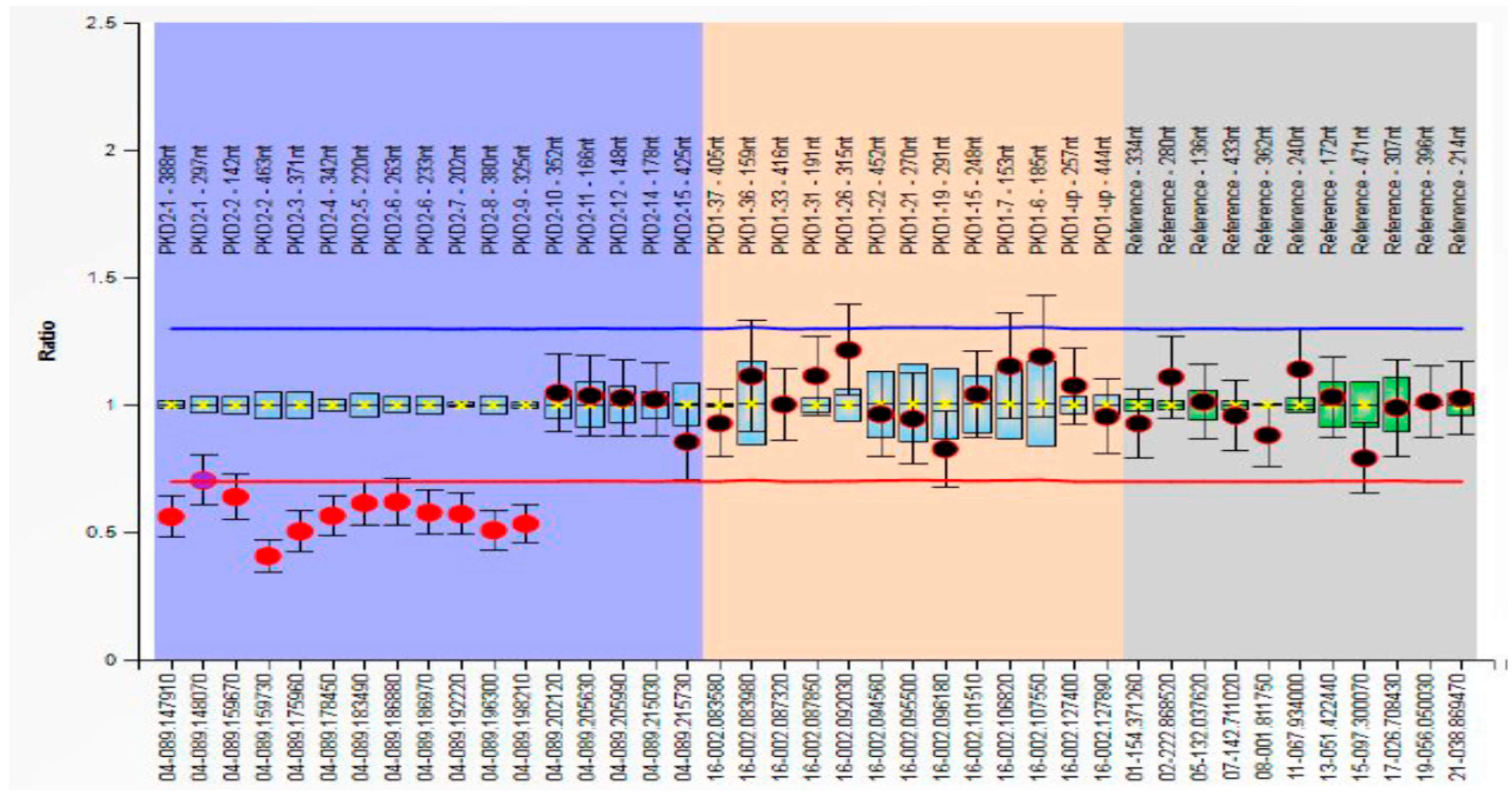
| R06 | Del.exons1–9 | Large deletion | Yes | No | Great maternal grandmother (77 y, died), mother (82 y, KRT), son (56 y), granddaughter (21 y) |
Disclaimer/Publisher’s Note: The statements, opinions and data contained in all publications are solely those of the individual author(s) and contributor(s) and not of MDPI and/or the editor(s). MDPI and/or the editor(s) disclaim responsibility for any injury to people or property resulting from any ideas, methods, instructions or products referred to in the content. |
© 2026 by the authors. Published by MDPI on behalf of the Lithuanian University of Health Sciences. Licensee MDPI, Basel, Switzerland. This article is an open access article distributed under the terms and conditions of the Creative Commons Attribution (CC BY) license.
Share and Cite
Papachristopoulou, A.; Margoni, A.; Simoudis, A.C.; Mylona, A.; Kroupi, O.-I.; Nikolopoulos, P.; Papavassiliou, A.G.; Vlahakos, D.V.; Kroupis, C. Beyond Sequencing: Integrating MLPA Reveals Hidden Structural PKD2 Variants and Enhances Mutation Detection in a Highly Selected ADPKD Greek Cohort. Medicina 2026, 62, 1771. https://doi.org/10.3390/medicina62091771
Papachristopoulou A, Margoni A, Simoudis AC, Mylona A, Kroupi O-I, Nikolopoulos P, Papavassiliou AG, Vlahakos DV, Kroupis C. Beyond Sequencing: Integrating MLPA Reveals Hidden Structural PKD2 Variants and Enhances Mutation Detection in a Highly Selected ADPKD Greek Cohort. Medicina. 2026; 62(9):1771. https://doi.org/10.3390/medicina62091771
Chicago/Turabian StylePapachristopoulou, Akrivi, Angeliki Margoni, Aimilios Christos Simoudis, Aristea Mylona, Olga-Irini Kroupi, Petros Nikolopoulos, Athanasios G. Papavassiliou, Demetrios V. Vlahakos, and Christos Kroupis. 2026. "Beyond Sequencing: Integrating MLPA Reveals Hidden Structural PKD2 Variants and Enhances Mutation Detection in a Highly Selected ADPKD Greek Cohort" Medicina 62, no. 9: 1771. https://doi.org/10.3390/medicina62091771
APA StylePapachristopoulou, A., Margoni, A., Simoudis, A. C., Mylona, A., Kroupi, O.-I., Nikolopoulos, P., Papavassiliou, A. G., Vlahakos, D. V., & Kroupis, C. (2026). Beyond Sequencing: Integrating MLPA Reveals Hidden Structural PKD2 Variants and Enhances Mutation Detection in a Highly Selected ADPKD Greek Cohort. Medicina, 62(9), 1771. https://doi.org/10.3390/medicina62091771