Thoracic Epidural Analgesia in Major Cancer Surgery: An Update


Abstract
1. Introduction
2. Postoperative Pain and Cancer Surgery
3. Local Anesthetics, Neuraxial Analgesia and Cancer
3.1. Experimental and Preclinical Evidence
3.2. Observational Clinical Evidence
3.3. Randomized Clinical Evidence
4. Epidural Analgesia Principles and Practical Management
4.1. Epidural Catheter Placement and Management
4.2. Management of Epidural Failure and Rescue Analgesia
4.3. Removal of Epidural Catheter
5. Benefits and Limitations of TEA
5.1. Analgesic Efficacy and Impact on Postoperative Recovery
5.2. Other Potential Systemic and Physiological Effects
5.3. Patient Selection and Surgical Context
5.4. Limitations and Risks of TEA
6. Indications of TEA in Different Major Surgical Cancer Patients
7. Alternatives to TEA in Major Cancer Surgery
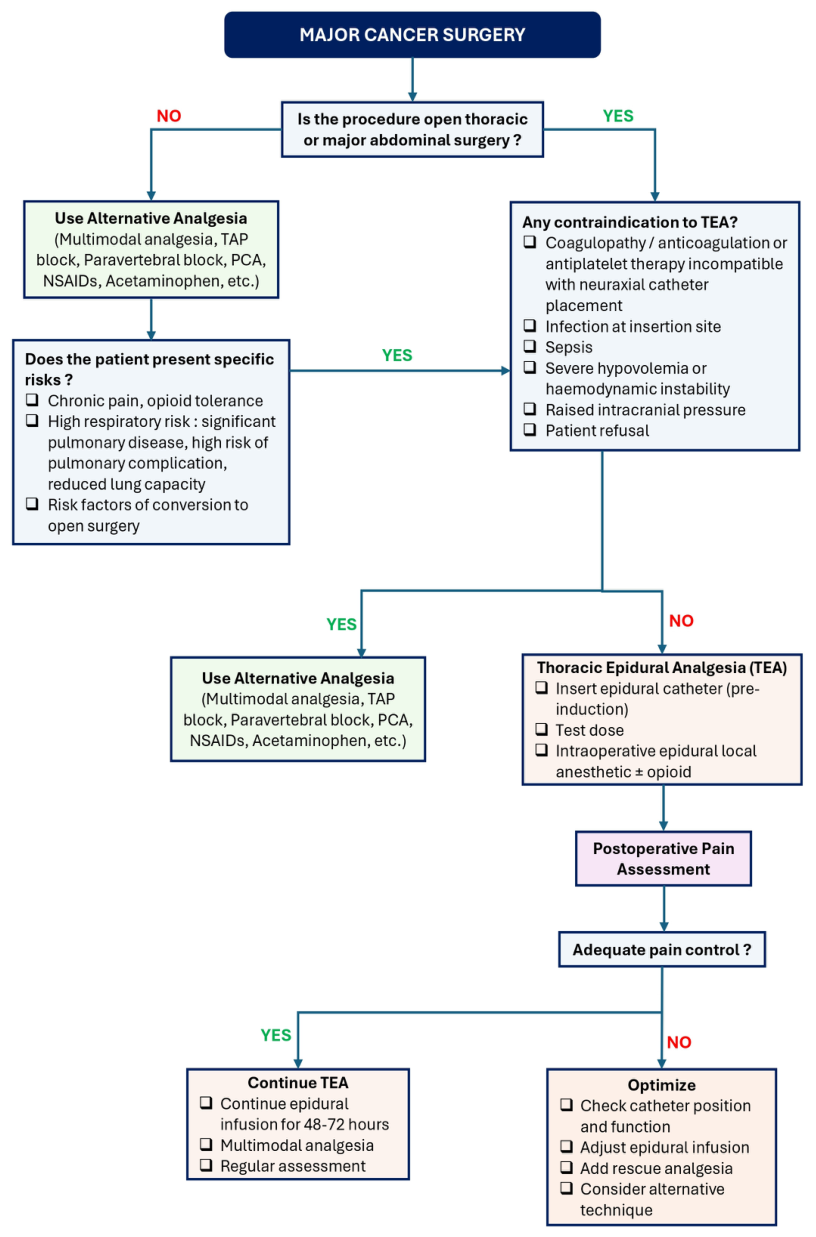
8. Clinical Decision Algorithm for Epidural Analgesia
9. Conclusions
Author Contributions
Funding
Data Availability Statement
Conflicts of Interest
Abbreviations
| TEA | Thoracic Epidural Analgesia |
| PCA | Patient-Controlled Analgesia |
| TAP block | Transversus Abdominis Plane Block |
| NSAIDs | Non-Steroidal Anti-Inflammatory Drugs |
| ERAS | Enhanced Recovery After Surgery |
| ESP block | Erector Spinae Plane Block |
| TPVB | Thoracic Paravertebral Block |
References
- Gao, L.; Mu, H.; Lin, Y.; Wen, Q.; Gao, P. Review of the Current Situation of Postoperative Pain and Causes of Inadequate Pain Management in Africa. J. Pain Res. 2023, 16, 1767–1778. [Google Scholar] [CrossRef] [Scilit]
- Sobol-Kwapinska, M.; Babel, P.; Plotek, W.; Stelcer, B. Psychological correlates of acute postsurgical pain: A systematic review and meta-analysis. Eur. J. Pain 2016, 20, 1573–1586. [Google Scholar] [CrossRef] [Scilit]
- Ledowski, T.; Reimer, M.; Chavez, V.; Kapoor, V.; Wenk, M. Effects of acute postoperative pain on catecholamine plasma levels, hemodynamic parameters, and cardiac autonomic control. Pain 2012, 153, 759–764. [Google Scholar] [CrossRef] [Scilit]
- Chen, D.X.; Zhang, Y.Y.; Liu, J.; Chen, Y. Postoperative acute pain trajectory and chronic postsurgical pain after abdominal surgery: A prospective cohort study and mediation analysis. Int. J. Surg. 2025, 111, 1968–1976. [Google Scholar] [CrossRef] [Scilit]
- Chiu, S.; Staley, H.; Zhang, X.; Mitra, A.; Sorbi, F.; Smith, J.R.; Yazbek, J.; Ghaem-Maghami, S.; Soni, S.; Fotopoulou, C.; et al. Postoperative Pain Following Gynecology Oncological Surgery: A Systematic Review by Tumor Site. Cancers 2025, 17, 2718. [Google Scholar] [CrossRef] [Scilit]
- Bates, K.R.; Jones, W.; Liggett, M.R.; Zaza, N.N.; Vitello, D.J.; Bentrem, D.J. Complications Following Open Versus Minimally Invasive Resection of Gastric Adenocarcinoma. J. Surg. Oncol. 2025, 131, 1302–1312. [Google Scholar] [CrossRef] [Scilit]
- Kincaid, S.; How, J.; Agrawal, D.K. Multimodal Analgesia in the Perioperative Period of Major Surgeries: An In-depth Analysis. Anesth. Crit. Care 2025, 7, 68–76. [Google Scholar] [CrossRef] [Scilit]
- Wick, E.C.; Grant, M.C.; Wu, C.L. Postoperative Multimodal Analgesia Pain Management With Nonopioid Analgesics and Techniques: A Review. JAMA Surg. 2017, 152, 691–697. [Google Scholar] [CrossRef] [Scilit] [PubMed]
- Amirkhosravi, F.; Allenson, K.C.; Moore, L.W.; Kolman, J.M.; Foster, M.; Hsu, E.; Sasangohar, F.; Dhala, A. Multimodal prehabilitation and postoperative outcomes in upper abdominal surgery: Systematic review and meta-analysis. Sci. Rep. 2024, 14, 16012. [Google Scholar] [CrossRef] [Scilit]
- Garg, S.; Govindaraj, V.; Dwivedi, D.P.; Raja, K.; Theerthar, E.P. Postoperative pulmonary complications in patients undergoing upper abdominal surgery: Risk factors and predictive models. Monaldi Arch. Chest Dis. 2025, 95. [Google Scholar] [CrossRef] [Scilit]
- Tassou, A.; Richebe, P.; Rivat, C. Mechanisms of chronic postsurgical pain. Reg. Anesth. Pain Med. 2025, 50, 77–85. [Google Scholar] [CrossRef] [Scilit]
- Swarm, R.A.; Paice, J.A.; Anghelescu, D.L.; Are, M.; Bruce, J.Y.; Buga, S.; Chwistek, M.; Cleeland, C.; Craig, D.; Gafford, E.; et al. Adult Cancer Pain, Version 3.2019, NCCN Clinical Practice Guidelines in Oncology. J. Natl. Compr. Canc Netw. 2019, 17, 977–1007. [Google Scholar] [CrossRef] [Scilit]
- Wilson, S.H.; Hellman, K.M.; James, D.; Adler, A.C.; Chandrakantan, A. Mechanisms, diagnosis, prevention and management of perioperative opioid-induced hyperalgesia. Pain Manag. 2021, 11, 405–417. [Google Scholar] [CrossRef] [Scilit]
- Guay, J.; Nishimori, M.; Kopp, S.L. Epidural local anesthetics Versus Opioid Based Regimens for Postoperarive Gastrointestinal Paralysis, Vomiting and pain after Abdominal Surgery: A Cochrane review. Anesth. Analg. 2016, 123, 1591–1602. [Google Scholar] [CrossRef] [Scilit]
- Sarridou, D.G.; Mouratoglou, S.A.; Mitchell, J.B.; Cox, F.; Boutou, A.; Braoudaki, M.; Lambrou, G.I.; Konstantinidou, M.; Argiriadou, H.; Walker, C.P.R. Post-Operative Thoracic Epidural Analgesia and Incidence of Major Complications according to Specific Safety Standardized Documentation: A Large Retrospective Dual Center Experience. J. Pers. Med. 2023, 13, 1672. [Google Scholar] [CrossRef] [Scilit]
- Macrosson, D.; Beebeejaun, A.; Odor, P.M. A systematic review and meta-analysis of thoracic epidural analgesia versus other analgesic techniques in patients post-oesophagectomy. Perioper. Med. 2024, 13, 80. [Google Scholar] [CrossRef] [Scilit]
- Motamed, C.; Spencer, A.; Farhat, F.; Bourgain, J.L.; Lasser, P.; Jayr, C. Postoperative hypoxaemia: Continuous extradural infusion of bupivacaine and morphine vs patient-controlled analgesia with intravenous morphine. Br. J. Anaesth. 1998, 80, 742–747. [Google Scholar] [CrossRef] [Scilit][Green Version]
- Guay, J.; Nishimori, M.; Kopp, S. Epidural local anaesthetics versus opioid-based analgesic regimens for postoperative gastrointestinal paralysis, vomiting and pain after abdominal surgery. Cochrane Database Syst. Rev. 2016, 7, CD001893. [Google Scholar] [CrossRef] [Scilit]
- Holm, J.H.; Bak, M.; Brochner, A.C. Epidural Analgesia Versus Systemic Opioids for Postoperative Pain Management After VATS: A Systematic Review and Meta-Analysis. Acta Anaesthesiol. Scand. 2025, 69, e70122. [Google Scholar] [CrossRef] [Scilit]
- Li, K.; Yang, J.; Han, X. Lidocaine sensitizes the cytotoxicity of cisplatin in breast cancer cells via up-regulation of RARbeta2 and RASSF1A demethylation. Int. J. Mol. Sci. 2014, 15, 23519–23536. [Google Scholar] [CrossRef] [Scilit]
- Chida, K.; Kanazawa, H.; Kinoshita, H.; Roy, A.M.; Hakamada, K.; Takabe, K. The role of lidocaine in cancer progression and patient survival. Pharmacol. Ther. 2024, 259, 108654. [Google Scholar] [CrossRef] [Scilit]
- Abdelaatti, A.; Buggy, D.J.; Wall, T.P. Local anaesthetics and chemotherapeutic agents: A systematic review of preclinical evidence of interactions and cancer biology. BJA Open 2024, 10, 100284. [Google Scholar] [CrossRef] [Scilit]
- Azizi, E.; Okumura, Y.; Sunde, B.; Lindblad, M.; Nilsson, M.; Rouvelas, I.; Grip, J.; Klevebro, F. Pain management after minimally invasive gastrectomy: Do we need epidural analgesia? Eur. J. Surg. Oncol. 2025, 51, 110232. [Google Scholar] [CrossRef] [Scilit]
- Xie, S.; Li, L.; Meng, F.; Wang, H. Regional anesthesia might reduce recurrence and metastasis rates in adult patients with cancers after surgery: A meta-analysis. BMC Anesthesiol. 2024, 24, 19. [Google Scholar] [CrossRef] [Scilit]
- Cata, J.P.; Sood, A.K.; Eltzschig, H.K. Anesthetic Drugs and Cancer Progression. Anesthesiology 2020, 133, 698–699. [Google Scholar] [CrossRef] [Scilit]
- Teng, Y.; Yin, Y.; Shi, Y.; Zhao, J.; Sun, M.; Zhao, X. The impact of perioperative anesthesia management-induced immunosuppression on postoperative cancer recurrence and metastasis: A narrative review. Front. Oncol. 2025, 15, 1558652. [Google Scholar] [CrossRef] [Scilit]
- Kun, L.; Tang, L.; Wang, J.; Yang, H.; Ren, J. Effect of Combined General/Epidural Anesthesia on Postoperative NK Cell Activity and Cytokine Response in Gastric Cancer Patients Undergoing Radical Resection. Hepatogastroenterology 2014, 61, 1142–1147. [Google Scholar]
- Bhuyan, S.; Bhuyan, D.; Rahane, S. Optimizing Regional Anesthesia for Cancer Patients: A Comprehensive Review of Current Practices and Future Directions. Cureus 2024, 16, e69315. [Google Scholar] [CrossRef] [Scilit]
- Xu, Z.Z.; Li, H.J.; Li, M.H.; Huang, S.M.; Li, X.; Liu, Q.H.; Li, J.; Li, X.-Y.; Wang, D.-X.; Sessler, D.I. Epidural Anesthesia-Analgesia and Recurrence-free Survival after Lung Cancer Surgery: A Randomized Trial. Anesthesiology 2021, 135, 419–432. [Google Scholar] [CrossRef] [Scilit]
- Sessler, D.I.; Riedel, B. Anesthesia and Cancer Recurrence: Context for Divergent Study Outcomes. Anesthesiology 2019, 130, 3–5. [Google Scholar]
- Falk, W.; Magnuson, A.; Eintrei, C.; Henningsson, R.; Myrelid, P.; Matthiessen, P.; Gupta, A. Comparison between epidural and intravenous analgesia effects on disease-free survival after colorectal cancer surgery: A randomised multicentre controlled trial. Br. J. Anaesth. 2021, 127, 65–74. [Google Scholar] [CrossRef] [Scilit]
- Zhou, Y.; Li, W.; Chen, Y.; Hu, X.; Miao, C. Research progress on the impact of opioids on the tumor immune microenvironment [Review]. Mol. Clin. Oncol. 2025, 22, 53. [Google Scholar] [CrossRef] [Scilit]
- Dhondt, L.A.; Vereen, M.S.; van de Laar, R.L.O.; Stolker, R.J.; Dirckx, M.; van Beekhuizen, H.J. Efficacy of locoregional analgesic techniques after laparotomy for gynecologic cancer: A systematic review. Int. J. Gynecol. Cancer 2024, 34, 1423–1430. [Google Scholar] [CrossRef] [Scilit]
- Eaves, G.K.; Ware, E.E.; Touchet, D.R.; Hamilton, W.K.; Netterville, S.S.; Stevens, J.R.; Ahmadzadeh, S.; Shekoohi, S.; Kaye, A.D. Efficacy and Safety of Thoracic Epidural vs. Paravertebral Block for Analgesia in Thoracotomy: A Systematic Review of Randomized Controlled Trials. Curr. Pain Headache Rep. 2025, 29, 69. [Google Scholar] [CrossRef] [Scilit]
- Ng Cheong Chung, J.; Kamarajah, S.K.; Mohammed, A.A.; Sinclair, R.C.F.; Saunders, D.; Navidi, M.; Immanuel, A.; Phillips, A.W. Comparison of multimodal analgesia with thoracic epidural after transthoracic oesophagectomy. Br. J. Surg. 2021, 108, 58–65. [Google Scholar] [CrossRef] [Scilit]
- Popping, D.M.; Gogarten, W. Epidural anesthesia in thoracic and abdominal surgery: Current perspectives and practical implications. Anaesthesiologie 2025, 74, 411–420. [Google Scholar]
- Spaans, L.N.; Dijkgraaf, M.G.W.; Susa, D.; de Loos, E.R.; Mourisse, J.M.J.; Bouwman, R.A.; Noyez, V.; Hendriks, J.M.H.; Yogeswaran, S.K.; Dickhoff, C.; et al. Intercostal or Paravertebral Block vs Thoracic Epidural in Lung Surgery: A Randomized Noninferiority Trial. JAMA Surg. 2025, 160, 855–864. [Google Scholar]
- Xu, M.; Hu, J.; Yan, J.; Yan, H.; Zhang, C. Paravertebral Block versus Thoracic Epidural Analgesia for Postthoracotomy Pain Relief: A Meta-Analysis of Randomized Trials. Thorac. Cardiovasc. Surg. 2022, 70, 413–421. [Google Scholar] [CrossRef] [Scilit]
- Weil, G.; Motamed, C.; Biau, D.J.; Guye, M.L. Learning curves for three specific procedures by anesthesiology residents using the learning curve cumulative sum [LC-CUSUM] test. Korean J. Anesthesiol. 2017, 70, 196–202. [Google Scholar] [CrossRef] [Scilit]
- Motamed, C.; Farhat, F.; Remerand, F.; Stephanazzi, J.; Laplanche, A.; Jayr, C. An analysis of postoperative epidural analgesia failure by computed tomography epidurography. Anesth. Analg. 2006, 103, 1026–1032. [Google Scholar] [CrossRef] [Scilit]
- Motamed, C.; Chedevergne, K.; Deschamps, F.; Tselikas, L.; Jayr, C. Contribution of Low-Dose Computerized Tomography With Digital Multiplanar Reconstructions in Thoracic Epidurography and Correlation With Sensory Block in Postoperative Analgesia. Anesth. Pain Med. 2016, 6, e37577. [Google Scholar] [CrossRef] [Scilit]
- Sutthibenjakul, K.; Pakpirom, J.; Siripruekpong, S.; Boonchuduang, S. Real-time ultrasound-guided thoracic epidural placement: Illustrating the techniques and reporting on prospective observational study. J. Perioper. Pract. 2025, 35, 560–567. [Google Scholar] [CrossRef] [Scilit]
- Kamimura, Y.; Yamamoto, N.; Shiroshita, A.; Miura, T.; Tsuji, T.; Someko, H.; Imai, E.; Kimura, R.; Sobue, K. Comparative efficacy of ultrasound guidance or conventional anatomical landmarks for neuraxial puncture in adult patients: A systematic review and network meta-analysis. Br. J. Anaesth. 2024, 132, 1097–1111. [Google Scholar] [CrossRef] [Scilit]
- Erturk, E.; Aydogdu Kaya, F.; Kutanis, D.; Besir, A.; Akdogan, A.; Geze, S.; Tugcugil, E. The effectiveness of preemptive thoracic epidural analgesia in thoracic surgery. Biomed. Res. Int. 2014, 2014, 673682. [Google Scholar] [CrossRef] [Scilit]
- Yegin, A.; Erdogan, A.; Kayacan, N.; Karsli, B. Early postoperative pain management after thoracic surgery; pre- and postoperative versus postoperative epidural analgesia: A randomised study. Eur. J. Cardiothorac. Surg. 2003, 24, 420–424. [Google Scholar] [CrossRef] [Scilit]
- Guay, J.; Kopp, S. Epidural pain relief versus systemic opioid-based pain relief for abdominal aortic surgery. Cochrane Database Syst. Rev. 2016, 2016, CD005059. [Google Scholar] [CrossRef] [Scilit]
- Kanani, F.; Nugzar, R.; Shimonov, M.; Akar, F.A. Comparative Analysis of Perioperative Analgesia Methods in Thoracic Surgery: A Literature Systemic Review. J. Clin. Med. 2025, 14, 2484. [Google Scholar] [CrossRef] [Scilit]
- Tran, D.Q.; Van Zundert, T.C.; Aliste, J.; Engsusophon, P.; Finlayson, R.J. Primary Failure of Thoracic Epidural Analgesia in Training Centers: The Invisible Elephant? Reg. Anesth. Pain Med. 2016, 41, 309–313. [Google Scholar] [CrossRef] [Scilit]
- Motamed, C.; Weil, G.; Deschamps, F.; Billard, V. Remifentanil target-controlled infusion: A safe rescue protocol for unexpected severe postoperative pain. J. Opioid Manag. 2014, 10, 284–288. [Google Scholar] [CrossRef] [Scilit]
- van den Broek, R.J.C.; Postema, J.M.C.; Koopman, J.; van Rossem, C.C.; Olsthoorn, J.R.; van Brakel, T.J.; Houterman, S.; Bouwman, R.A.; Versyck, B. Continuous erector spinae plane block versus thoracic epidural analgesia in video-assisted thoracoscopic surgery: A prospective randomized open-label non-inferiority trial. Reg. Anesth. Pain Med. 2025, 50, 11–19. [Google Scholar] [CrossRef] [Scilit]
- El-Tallawy, S.N.; Ahmed, R.S.; Salem, G.I.; Alzahrani, T.A.; Haddara, M.M.; Ahmed, R.H.; Nagiub, M.S.; Alsubaie, A.T.; Ali, M.M.; Elbasha, M.M.; et al. Neurological Deficits Following Regional Anesthesia and Pain Interventions: Reviewing Current Standards of Care. Pain Ther. 2025, 14, 817–839. [Google Scholar] [CrossRef] [Scilit]
- Fonseca, N.M.; Pontes, J.P.J.; Perez, M.V.; Alves, R.R.; Fonseca, G.G. SBA 2020: Regional anesthesia guideline for using anticoagulants update. Braz. J. Anesthesiol. 2020, 70, 364–387. [Google Scholar] [CrossRef] [Scilit]
- Corr, F.; Almealawy, Y.F.; Heinig, S.; Battig, L.; Schulz, E.; Hejrati, N.; Bertulli, L.; Heisinger, S.; Bozinov, O.; Stienen, M.N.; et al. Management of Retained Epidural Catheter Fragments: A Narrative Review of Individual Patient Data. J. Clin. Med. 2025, 14, 4265. [Google Scholar] [CrossRef] [Scilit]
- Schyns-van den Berg, A.; Lucas, D.N.; Leffert, L.R. Postdural puncture headache: Beyond the evidence. Best Pr. Res. Clin. Anaesthesiol. 2024, 38, 267–277. [Google Scholar] [CrossRef] [Scilit]
- Uppal, V.; Russell, R.; Sondekoppam, R.; Ansari, J.; Baber, Z.; Chen, Y.; DelPizzo, K.; Dîrzu, D.S.; Kalagara, H.; Kissoon, N.R.; et al. Consensus Practice Guidelines on Postdural Puncture Headache From a Multisociety, International Working Group: A Summary Report. JAMA Netw. Open 2023, 6, e2325387. [Google Scholar] [CrossRef] [Scilit] [PubMed]
- Bishop, R.; Chen, A.; Yates, W.D.; Fowler, J.; Macres, S. Update and Advances on Post-dural Puncture Headache. Adv. Anesth. 2023, 41, 71–85. [Google Scholar] [CrossRef] [Scilit]
- Pirie, K.; Traer, E.; Finniss, D.; Myles, P.S.; Riedel, B. Current approaches to acute postoperative pain management after major abdominal surgery: A narrative review and future directions. Br. J. Anaesth. 2022, 129, 378–393. [Google Scholar] [CrossRef] [Scilit]
- Elhadidi, A.; Fawzy, A. Laparoscopic Abdominal Surgery Under Thoracic Epidural Anesthesia in Patients with Interstitial Lung Disease: Retrospective Observational Cohort Study. Surg. Laparosc. Endosc. Percutan Tech. 2023, 33, 543–546. [Google Scholar] [CrossRef] [Scilit]
- Karakosta, A.; Kaminioti, E.; Riga, M.; Briassoulis, P.; Pantazi, A.; Sidiropoulou, T.; Tzimas, P.; Kostopanagiotou, G.G. Goal-Directed Fluid Therapy and Perioperative Epidural Analgesia in Low-Risk Patients Undergoing Elective Colorectal Surgery: Short-Term Clinical Outcomes From a Retrospective-Prospective Cohort Study. Cureus 2025, 17, e99819. [Google Scholar] [CrossRef] [Scilit]
- Naim, N.; Reza, M.S.; Umar, A. Comparative Effectiveness of Transversus Abdominis Plane [TAP] Block and Epidural Analgesia in Abdominal Surgery: A Meta-Analysis of Randomized Controlled Trials. Cureus 2025, 17, e87167. [Google Scholar] [CrossRef] [Scilit]
- Hiremath, S.C.; Karru, V.R. MCN Regional Anesthetic Techniques in Chronic Obstructive Pulmonary Disease Patients. A&A Pract. 2025, 19, e02006. [Google Scholar] [CrossRef] [Scilit]
- Ashcroft, J.; Singh, A.A.; Ramachandran, B.; Habeeb, A.; Hudson, V.; Meyer, J.; Simillis, C.; Davies, R.J. Reducing ileus after colorectal surgery: A network meta-analysis of therapeutic interventions. Clin. Nutr. 2021, 40, 4772–4782. [Google Scholar] [CrossRef] [Scilit]
- Wang, Z.; Peng, W.; Zhang, J. The Effect of Early Enteral Nutrition under the ERAS Model on Gastrointestinal and Immune Function Recovery in Patients Undergoing Gastric Tumor Surgery. Ann. Ital. Chir. 2024, 95, 1147–1154. [Google Scholar] [CrossRef] [Scilit]
- Tazreean, R.; Nelson, G.; Twomey, R. Early mobilization in enhanced recovery after surgery pathways: Current evidence and recent advancements. J. Comp. Eff. Res. 2022, 11, 121–129. [Google Scholar] [CrossRef] [Scilit]
- Powers, B.K.; Ponder, H.L.; Findley, R.; Wolfe, R.; Patel, G.P.; Parrish, R.H., 2nd; Enhanced Recovery Comparative Pharmacotherapy Collaborative. Enhanced recovery after surgery (ERAS®) Society abdominal and thoracic surgery recommendations: A systematic review and comparison of guidelines for perioperative and pharmacotherapy core items. World J. Surg. 2024, 48, 509–523. [Google Scholar] [CrossRef] [Scilit]
- Nelson, G.; Altman, A.D.; Nick, A.; Meyer, L.A.; Ramirez, P.T.; Achtari, C.; Antrobus, J.; Huang, J.; Scott, M.; Wijk, L.; et al. Guidelines for pre- and intra-operative care in gynecologic/oncology surgery: Enhanced Recovery After Surgery (ERAS®) Society recommendations--Part I. Gynecol. Oncol. 2016, 140, 313–322. [Google Scholar] [CrossRef] [Scilit]
- Goldblatt, J.G.; Bibo, L.; Crawford, L. Does Enhanced Recovery After Surgery Protocols Reduce Complications and Length of Stay After Thoracic Surgery: A Systematic Review of the Literature. Cureus 2024, 16, e59918. [Google Scholar] [CrossRef] [Scilit]
- Hewson, D.W.; Tedore, T.R.; Hardman, J.G. Impact of spinal or epidural anaesthesia on perioperative outcomes in adult noncardiac surgery: A narrative review of recent evidence. Br. J. Anaesth. 2024, 133, 380–399. [Google Scholar] [CrossRef] [Scilit]
- Fanelli, A.; Balzani, E.; Memtsoudis, S.; Abdallah, F.W.; Mariano, E.R. Regional anesthesia techniques and postoperative delirium: Systematic review and meta-analysis. Minerva Anestesiol. 2022, 88, 499–507. [Google Scholar] [CrossRef] [Scilit]
- Li, Y.W.; Li, H.J.; Li, H.J.; Zhao, B.J.; Guo, X.Y.; Feng, Y.; Zuo, M.Z.; Yu, Y.P.; Kong, H.; Zhao, Y.; et al. Delirium in Older Patients after Combined Epidural-General Anesthesia or General Anesthesia for Major Surgery: A Randomized Trial. Anesthesiology 2021, 135, 218–232. [Google Scholar] [CrossRef] [Scilit]
- Motamed, S.; Klubien, K.; Edwardes, M.; Mazza, L.; Carli, F. Metabolic changes during recovery in normothermic versus hypothermic patients undergoing surgery and receiving general anesthesia and epidural local anesthetic agents. Anesthesiology 1998, 88, 1211–1218. [Google Scholar] [CrossRef] [Scilit]
- Kim, J.S.; Ikeda, T.; Sessler, D.I.; Turakhia, M.; Jeffrey, R. Epidural anesthesia reduces the gain and maximum intensity of shivering. Anesthesiology 1998, 88, 851–857. [Google Scholar] [CrossRef] [Scilit]
- Ljungqvist, O.; Young-Fadok, T.; Demartines, N. The History of Enhanced Recovery After Surgery and the ERAS Society. J. Laparoendosc. Adv. Surg. Tech. A 2017, 27, 860–862. [Google Scholar] [CrossRef] [Scilit]
- Irani, J.L.; Hedrick, T.L.; Miller, T.E.; Lee, L.; Steinhagen, E.; Shogan, B.D.; Goldberg, J.E.; Feingold, D.L.; Lightner, A.L.; Paquette, I.M. Clinical Practice Guidelines for Enhanced Recovery After Colon and Rectal Surgery From the American Society of Colon and Rectal Surgeons and the Society of American Gastrointestinal and Endoscopic Surgeons. Dis. Colon Rectum 2023, 66, 15–40. [Google Scholar] [CrossRef] [Scilit]
- Li, X.; Yang, Y.; Zhang, Q.; Zhu, Y.; Xu, W.; Zhao, Y.; Liu, Y.; Xue, W.; Yan, P.; Li, S.; et al. Association between thoracic epidural anesthesia and driving pressure in adult patients undergoing elective major upper abdominal surgery: A randomized controlled trial. BMC Anesthesiol. 2024, 24, 434. [Google Scholar] [CrossRef] [Scilit]
- Guerra-Londono, C.E.; Vasquez, E.T.; Riveros, E.; Noori, E.; Greiver, D.; Pillai, S.; Schiff, T.; Soetedjo, J.; Wu, M.; Serrano, J.G. Development and validation of a prognostic model for postoperative hypotension in patients receiving epidural analgesia. J. Anaesthesiol. Clin. Pharmacol. 2025, 41, 286–291. [Google Scholar] [CrossRef] [Scilit]
- Holtz, M.; Liao, N.; Lin, J.H.; Asche, C.V. Economic Outcomes and Incidence of Postsurgical Hypotension With Liposomal Bupivacaine vs Epidural Analgesia in Abdominal Surgeries. J. Health Econ. Outcomes Res. 2022, 9, 86–94. [Google Scholar] [CrossRef] [Scilit]
- Pandraklakis, A.; Haidopoulos, D.; Lappas, T.; Stamatakis, E.; Oikonomou, M.D.; Valsamidis, D.; Rodolakis, A.; Thomakos, N. Enhanced Recovery After Surgery Protocols in Obese Gynecological Oncology Patients: A Single-Center Experience. Cureus 2023, 15, e40453. [Google Scholar] [CrossRef] [Scilit]
- Pandraklakis, A.; Haidopoulos, D.; Lappas, T.; Stamatakis, E.; Valsamidis, D.; Oikonomou, M.D.; Loutradis, D.; Rodolakis, A.; Bisch, S.P.; Nelson, G.; et al. Thoracic epidural analgesia as part of an enhanced recovery program in gynecologic oncology: A prospective cohort study. Int. J. Gynecol. Cancer 2023, 33, 1794–1799. [Google Scholar] [CrossRef] [Scilit]
- Wang, J.; Yin, Y.; Zhu, Y.; Xu, P.; Sun, Z.; Miao, C.; Zhong, J. Thoracic epidural anaesthesia and analgesia ameliorates surgery-induced stress response and postoperative pain in patients undergoing radical oesophagectomy. J. Int. Med. Res. 2019, 47, 6160–6170. [Google Scholar] [CrossRef] [Scilit]


| Level of Evidence | Main Findings | Limitations |
|---|---|---|
| Preclinical studies | Lidocaine, ropivacaine, and bupivacaine demonstrate anti-proliferative, anti-migratory, and immunomodulatory effects | Many effects occur at supraclinical concentrations or under experimental conditions |
| Mechanistic clinical studies | TEA may preserve NK cell function, reduce stress hormones, and attenuate inflammatory responses | Surrogate biological endpoints, uncertain translation into survival benefit |
| Observational studies and meta-analyses | Some studies report reduced recurrence or improved survival | Susceptible to selection bias and confounding |
| Randomized lung cancer trial | No significant recurrence-free survival benefit | Single disease setting |
| Randomized colorectal cancer trial | No improvement in disease-free survival | Limited generalizability |
| Overall interpretation | Biological plausibility exists, but no proven oncologic benefit | Additional high-quality randomized studies are required |
| Clinical scenario | Role of TEA | Rationale |
|---|---|---|
| Open thoracotomy | Strong indication | Superior dynamic analgesia, improved respiratory mechanics, reduced pulmonary complications |
| Esophagectomy | Strong indication | Severe postoperative pain, facilitation of pulmonary recovery and ERAS pathways |
| Major hepatobiliary or pancreatic surgery | Selective indication | Effective analgesia, opioid sparing, enhancement of gastrointestinal recovery |
| Major upper abdominal laparotomy | Strong indication | Significant postoperative pain burden and stress response |
| Radical cystectomy and major urologic oncology surgery | Selective indication | May reduce opioid requirements and improve postoperative recovery |
| Severe COPD or high pulmonary risk | Selective indication | Potential reduction in opioid-induced respiratory impairment |
| Frailty, sarcopenia, opioid tolerance, chronic pain | Selective indication | Facilitates mobilization and opioid-sparing analgesia |
| Video-assisted thoracoscopic surgery [VATS] | Alternative techniques often preferred | PVB or ESP block may provide comparable analgesia with fewer hemodynamic effects |
| Robotic abdominal surgery | Usually not routine | Lower pain burden and effective multimodal analgesic alternatives |
| Low-risk laparoscopic procedures | Generally, not indicated routinely | Limited incremental benefit compared with multimodal analgesia |
| Technique | Main Advantages | Principal Limitations | Preferred Indications |
|---|---|---|---|
| TEA | Excellent somatic and visceral analgesia; opioid sparing; improved pulmonary function and gastrointestinal recovery | Hypotension, urinary retention, technical failure, neuraxial complications | Open thoracic surgery, esophagectomy, major upper abdominal surgery |
| TPVB | Comparable analgesia for thoracic surgery; lower incidence of hypotension and urinary retention | Usually unilateral block; limited visceral analgesia | Thoracotomy, breast surgery, selected VATS procedures |
| ESP block | Technical simplicity; favorable safety profile; minimal hemodynamic effects | Limited high-quality comparative evidence | VATS, minimally invasive thoracic surgery, selected upper abdominal procedures |
| QL block | Useful abdominal wall analgesia; ERAS compatible | Less reliable visceral analgesia | Major abdominal and gynecologic surgery |
| TAP block | Easy to perform; reduced opioid consumption | Primarily somatic analgesia; limited visceral coverage | Lower abdominal surgery and ERAS pathways |
| Multimodal analgesia | Opioid sparing; flexibility; ERAS integration | Variable efficacy depending on procedure | Minimally invasive surgery and combination strategies |
Disclaimer/Publisher’s Note: The statements, opinions and data contained in all publications are solely those of the individual author(s) and contributor(s) and not of MDPI and/or the editor(s). MDPI and/or the editor(s) disclaim responsibility for any injury to people or property resulting from any ideas, methods, instructions or products referred to in the content. |
© 2026 by the authors. Published by MDPI on behalf of the Lithuanian University of Health Sciences. Licensee MDPI, Basel, Switzerland. This article is an open access article distributed under the terms and conditions of the Creative Commons Attribution (CC BY) license.
Share and Cite
Motamed, C.; Caballero, M.J. Thoracic Epidural Analgesia in Major Cancer Surgery: An Update. Medicina 2026, 62, 1637. https://doi.org/10.3390/medicina62091637
Motamed C, Caballero MJ. Thoracic Epidural Analgesia in Major Cancer Surgery: An Update. Medicina. 2026; 62(9):1637. https://doi.org/10.3390/medicina62091637
Chicago/Turabian StyleMotamed, Cyrus, and Marie Josée Caballero. 2026. "Thoracic Epidural Analgesia in Major Cancer Surgery: An Update" Medicina 62, no. 9: 1637. https://doi.org/10.3390/medicina62091637
APA StyleMotamed, C., & Caballero, M. J. (2026). Thoracic Epidural Analgesia in Major Cancer Surgery: An Update. Medicina, 62(9), 1637. https://doi.org/10.3390/medicina62091637