Psychiatric Symptoms and Impulsivity in Patients with Substance Use Disorders: Associations with an Aggregate ASI Interviewer Severity Score

 ,
,  , ,
, ,
Abstract
1. Introduction
2. Materials and Methods
2.1. Study Design and Setting
2.2. Participants, Diagnostic Ascertainment, and Recruitment
2.3. Sample Size
2.4. Data Collection and Quality Assurance
2.5. Measures
2.6. Statistical Analysis
2.7. Ethical Considerations
3. Results
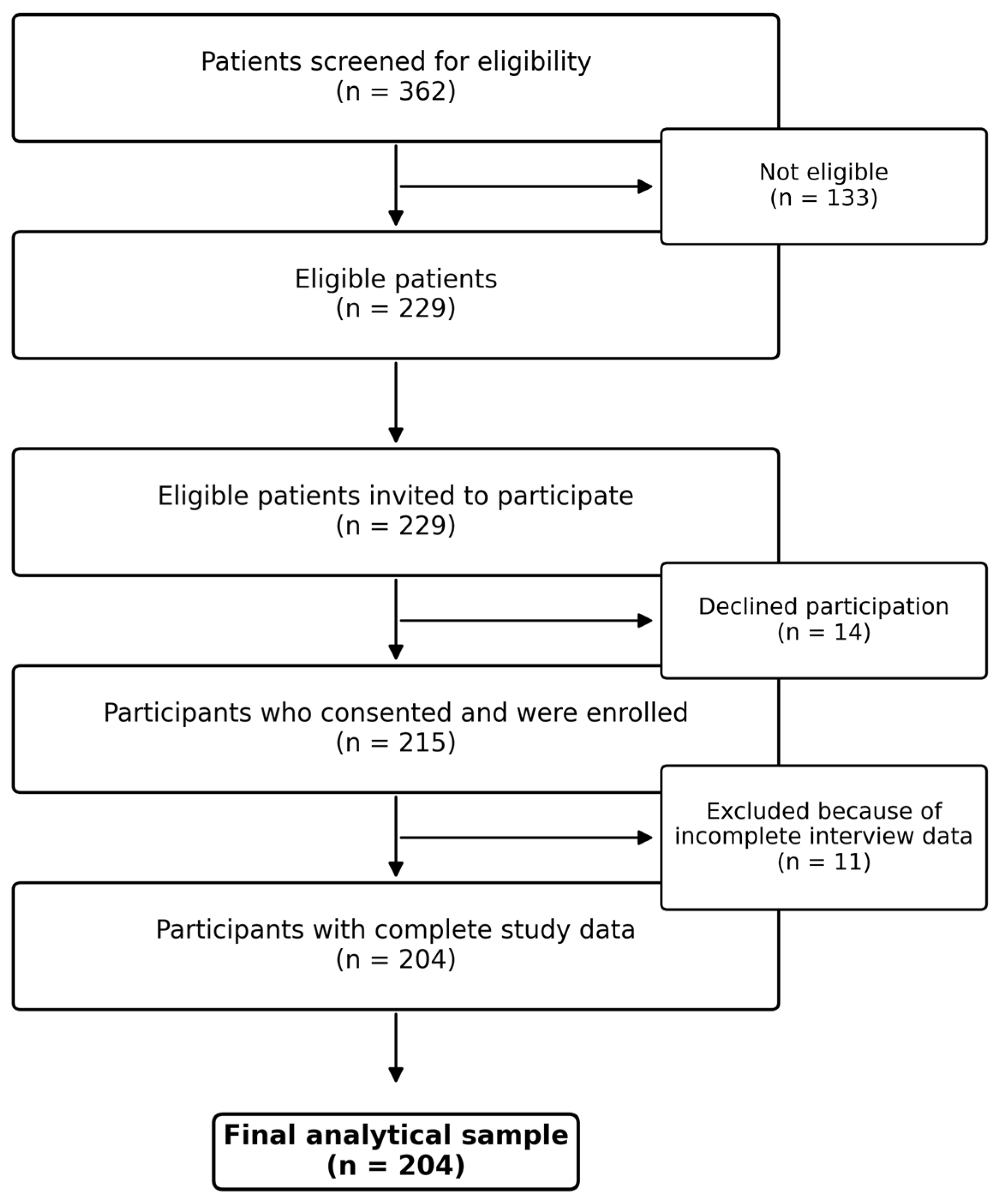
3.1. Participant Flow and Characteristics
3.2. Scale Scores
3.3. Age- and Sex-Adjusted Analyses
3.4. Correlation Analysis
3.5. Multivariable Analysis and Diagnostics
3.6. Sensitivity Analyses
4. Discussion
5. Conclusions
Supplementary Materials
Author Contributions
Funding
Institutional Review Board Statement
Informed Consent Statement
Data Availability Statement
Conflicts of Interest
Abbreviations
| SUD | Substance Use Disorders |
| ASI | Addiction Severity Index |
| BPRS | Brief Psychiatric Rating Scale |
| BIS-11 | Barratt Impulsiveness Scale-11 |
| CI | Confidence interval |
| FDR | False discovery rate |
| HC3 | Heteroskedasticity-consistent covariance estimator |
| VIF | Variance inflation factor |
References
- World Health Organization. Global Status Report on Alcohol and Health and Treatment of Substance Use Disorders; World Health Organization: Geneva, Switzerland, 2024; ISBN 978-92-4-009674-5. [Google Scholar]
- Saquib, N.; Rajab, A.M.; Saquib, J.; AlMazrou, A. Substance use disorders in Saudi Arabia: A scoping review. Subst. Abus. Treat. Prev. Policy 2020, 15, 41. [Google Scholar] [CrossRef] [Scilit] [PubMed]
- Altwaijri, Y.; Benjet, C.; Akkad, M.; Bilal, L.; Naseem, M.T.; Al-Habeeb, A.; Al-Subaie, A.S.; Al-Saud, N.K. The epidemiology of substance use disorders in Saudi Arabia: Findings from the Saudi National Mental Health Survey. BMC Public Health 2025, 25, 86. [Google Scholar] [CrossRef] [Scilit] [PubMed]
- Marquez-Arrico, J.E.; Rio-Martinez, L.; Navarro, J.F.; Prat, G.; Adan, A. Personality profile and clinical correlates of patients with substance use disorder with and without comorbid depression under treatment. Front Psychiatry 2019, 9, 764. [Google Scholar] [CrossRef] [Scilit] [PubMed]
- McKetin, R.; McLaren, J.; Lubman, D.I.; Hides, L. The prevalence of psychotic symptoms among methamphetamine users. Addiction 2006, 101, 1473–1478. [Google Scholar] [CrossRef] [Scilit] [PubMed]
- Verdejo-Garcia, A.; Lawrence, A.J.; Clark, L. Impulsivity as a vulnerability marker for substance-use disorders. Neurosci. Biobehav Rev. 2008, 32, 777–810. [Google Scholar] [CrossRef] [Scilit] [PubMed]
- Dalley, J.W.; Robbins, T.W. Fractionating impulsivity: Neuropsychiatric implications. Nat. Rev. Neurosci. 2017, 18, 158–171. [Google Scholar] [CrossRef] [Scilit] [PubMed]
- Moeller, F.G.; Barratt, E.S.; Dougherty, D.M.; Schmitz, J.M.; Swann, A.C. Psychiatric aspects of impulsivity. Am. J. Psychiatry 2001, 158, 1783–1793. [Google Scholar] [CrossRef] [Scilit] [PubMed]
- Makarenko, I.; Mahroug, A.; Jutras-Aswad, D.; Larney, S.; Martel-Laferriere, V.; Bruneau, J. Measurement of impulsivity and its role in drug use behaviours and related health, harm and treatment outcomes among people who use illicit drugs: A scoping review. Int. J. Ment. Health Addict 2025. [Google Scholar] [CrossRef] [Scilit]
- Patton, J.H.; Stanford, M.S.; Barratt, E.S. Factor structure of the Barratt Impulsiveness Scale. J. Clin. Psychol. 1995, 51, 768–774. [Google Scholar] [CrossRef] [Scilit]
- Stanford, M.S.; Mathias, C.W.; Dougherty, D.M.; Lake, S.L.; Anderson, N.E.; Patton, J.H. Fifty years of the Barratt Impulsiveness Scale: An update and review. Pers. Individ Dif. 2009, 47, 385–395. [Google Scholar] [CrossRef] [Scilit]
- Cyders, M.A.; Coskunpinar, A. Measurement of constructs using self-report and behavioral lab tasks: Is there overlap in nomothetic span and construct representation for impulsivity? Clin. Psychol. Rev. 2011, 31, 965–982. [Google Scholar] [CrossRef] [Scilit] [PubMed]
- Reise, S.P.; Moore, T.M.; Sabb, F.W.; Brown, A.K.; London, E.D. The Barratt Impulsiveness Scale-11: Reassessment of its structure in a community sample. Psychol. Assess. 2013, 25, 631–642. [Google Scholar] [CrossRef] [Scilit] [PubMed]
- Sharma, L.; Markon, K.E.; Clark, L.A. Toward a theory of distinct types of impulsive behaviors: A meta-analysis of self-report and behavioral measures. Psychol. Bull. 2014, 140, 374–408. [Google Scholar] [CrossRef] [Scilit] [PubMed]
- Rodriguez-Cintas, L.; Daigre, C.; Grau-Lopez, L.; Barral, C.; Perez-Pazos, J.; Voltes, N.; Ros-Cucurull, E.; Roncero, C.; Casas, M.; Palma-Álvarez, R.F. Impulsivity and addiction severity in cocaine and opioid dependent patients. Addict Behav. 2016, 58, 104–109. [Google Scholar] [CrossRef] [Scilit] [PubMed]
- Winhusen, T.; Lewis, D.; Adinoff, B.; Brigham, G.; Kropp, F.; Donovan, D.M.; Hodgkins, C.; Dempsey, C.; Obert, J.; Franken, I.H.A.; et al. Impulsivity is associated with treatment non-completion in cocaine- and methamphetamine-dependent patients. J. Subst. Abus. Treat. 2013, 44, 541–547. [Google Scholar] [CrossRef] [Scilit] [PubMed]
- Evren, C.; Durkaya, M.; Evren, B.; Dalbudak, E.; Cetin, R. Relationship of relapse with impulsivity, novelty seeking and craving in male alcohol-dependent inpatients. Drug Alcohol Rev. 2012, 31, 81–90. [Google Scholar] [CrossRef] [Scilit] [PubMed]
- Su, H.; Li, Z.; Du, J.; Jiang, H.; Chen, Z.; Sun, H.; Zhao, M. Predictors of heroin relapse: Personality traits, impulsivity, COMT Val158Met polymorphism in a 5-year prospective study. Am. J. Med. Genet. B Neuropsychiatr. Genet. 2015, 168, 712–719. [Google Scholar] [CrossRef] [Scilit] [PubMed]
- Cservenka, A.; Ray, L.A. Self-reported attentional and motor impulsivity are related to age at first methamphetamine use. Addict Behav. 2017, 65, 7–12. [Google Scholar] [CrossRef] [Scilit] [PubMed]
- Chen, T.; Zhong, N.; Du, J.; Li, Z.; Zhao, Y.; Sun, H.; Wang, J.; Hao, W.; Liu, Y.; Zhao, M. Polydrug use patterns and their impact on relapse among heroin-dependent patients in Shanghai, China. Addiction 2019, 114, 259–267. [Google Scholar] [CrossRef] [Scilit] [PubMed]
- Luo, D.; Tan, L.; Shen, D.; Gao, Z.; Yu, L.; Lai, M.; Chen, H.; Wang, X.; Huang, C. Characteristics of depression, anxiety, impulsivity, and aggression among various types of drug users. BMC Psychiatry 2022, 22, 274. [Google Scholar] [CrossRef] [Scilit] [PubMed]
- DeVito, E.E.; Weinberger, A.H.; Pang, R.D.; Petersen, N.; Allen, A.M.; Valentine, G. Impulsivity across substance use categories: Consideration of sex/gender. Curr. Behav. Neurosci. Rep. 2020, 7, 109–127. [Google Scholar] [CrossRef] [Scilit] [PubMed]
- McLellan, A.T.; Luborsky, L.; Woody, G.E.; O’Brien, C.P. An improved diagnostic evaluation instrument for substance abuse patients: The Addiction Severity Index. J. Nerv. Ment. Dis. 1980, 168, 26–33. [Google Scholar] [CrossRef] [Scilit] [PubMed]
- McLellan, A.T.; Kushner, H.; Metzger, D.; Peters, R.; Smith, I.; Grissom, G.; Pettinati, H.; Argeriou, M. The fifth edition of the Addiction Severity Index. J. Subst. Abus. Treat. 1992, 9, 199–213. [Google Scholar] [CrossRef] [Scilit] [PubMed]
- Alterman, A.I.; Brown, L.S.; Zaballero, A.; McKay, J.R. Interviewer severity ratings and composite scores of the ASI: A further look. Drug Alcohol Depend. 1994, 34, 201–209. [Google Scholar] [CrossRef] [Scilit] [PubMed]
- Alterman, A.I.; Mulvaney, F.D.; Cacciola, J.S.; Cnaan, A.; McDermott, P.A.; Brown, L.S., Jr. The validity of the interviewer severity ratings in groups of ASI interviewers with varying training. Addiction 2001, 96, 1297–1305. [Google Scholar] [CrossRef] [Scilit] [PubMed]
- Makela, K. Studies of the reliability and validity of the Addiction Severity Index. Addiction 2004, 99, 398–410. [Google Scholar] [CrossRef] [Scilit] [PubMed]
- American Psychiatric Association. Diagnostic and Statistical Manual of Mental Disorders, 5th ed.; American Psychiatric Association: Arlington, VA, USA, 2013. [Google Scholar] [CrossRef] [Scilit]
- Abouzed, M.; Aljadani, A.; Gabr, A.; Elsheikh, M.; Almuqahwi, M.S.; Alrashidy, M.F.; Alrashidi, G.K.; Soliman, M.F.; Altamimi, A.N.; Alenze, N.S.; et al. Psychometric properties of the Arabic version of the Addiction Severity Index (ASI-5): A cross-cultural validation study in Egypt and Saudi Arabia. Subst. Abus. Rehabil. 2025, 16, 129–136. [Google Scholar] [CrossRef] [Scilit] [PubMed]
- von Elm, E.; Altman, D.G.; Egger, M.; Pocock, S.J.; Gotzsche, P.C.; Vandenbroucke, J.P. STROBE Initiative. The Strengthening the Reporting of Observational Studies in Epidemiology statement. PLoS Med. 2007, 4, e296. [Google Scholar] [CrossRef] [Scilit] [PubMed]
- Overall, J.E.; Gorham, D.R. The Brief Psychiatric Rating Scale. Psychol. Rep. 1962, 10, 799–812. [Google Scholar] [CrossRef]
- Shafer, A. Meta-analysis of the Brief Psychiatric Rating Scale factor structure. Psychol. Assess. 2005, 17, 324–335. [Google Scholar] [CrossRef] [Scilit] [PubMed]
- Al-Hammouri, M.M.; Rababah, J.; Ta’an, W. Psychometric properties of the Arabic version of Barratt Impulsiveness Scale 11: The development of short form. Arch. Psychiatr. Nurs. 2023, 43, 1–8. [Google Scholar] [CrossRef] [Scilit] [PubMed]
- Greenland, S.; Senn, S.J.; Rothman, K.J.; Carlin, J.B.; Poole, C.; Goodman, S.N.; Altman, D.G. Statistical tests, P values, confidence intervals, and power: A guide to misinterpretations. Eur. J. Epidemiol. 2016, 31, 337–350. [Google Scholar] [CrossRef] [Scilit] [PubMed]
- Benjamini, Y.; Hochberg, Y. Controlling the false discovery rate: A practical and powerful approach to multiple testing. J. R Stat. Soc. Ser. B 1995, 57, 289–300. [Google Scholar] [CrossRef] [Scilit]
- Babyak, M.A. What you see may not be what you get: A brief, nontechnical introduction to overfitting in regression-type models. Psychosom. Med. 2004, 66, 411–421. [Google Scholar] [CrossRef] [Scilit] [PubMed]
- Long, J.S.; Ervin, L.H. Using heteroscedasticity consistent standard errors in the linear regression model. Am. Stat. 2000, 54, 217–224. [Google Scholar] [CrossRef] [Scilit]
- Papke, L.E.; Wooldridge, J.M. Econometric methods for fractional response variables with an application to 401(k) plan participation rates. J. Appl. Econom. 1996, 11, 619–632. [Google Scholar] [CrossRef] [Scilit]
- Wang, X.; Cheng, Z. Cross-sectional studies: Strengths, weaknesses, and recommendations. Chest 2020, 158, S65–S71. [Google Scholar] [CrossRef] [Scilit] [PubMed]
- World Medical Association. WMA Declaration of Helsinki: Ethical Principles for Medical Research Involving Human Participants; World Medical Association: Ferney-Voltaire, France, 2024. [Google Scholar]
- Polcin, D.L.; Korcha, R.; Bond, J.; Galloway, G.; Nayak, M.B. Changes in psychiatric symptoms among persons with methamphetamine dependence predict changes in severity of drug problems but not frequency of use. Subst. Abus. 2016, 37, 209–214. [Google Scholar] [CrossRef] [Scilit] [PubMed]
- Baginski, B.N.; Byrne, K.A.; Demosthenes, L.; Roth, P.J. Examining internalizing mental health correlates of addiction severity in patients hospitalized with medical complications from substance use disorder. Subst. Abus. 2022, 16, 11782218221115583. [Google Scholar] [CrossRef] [Scilit] [PubMed]
- Cavicchioli, M.; Movalli, M.; Bruni, A.; Terragni, R.; Bellintani, S.; Ricchiuti, A.; Ricchiuti, A.; Maffei, C.; Fossati, A.; Zogmaister, C.; et al. The complexity of impulsivity dimensions among abstinent individuals with substance use disorders. J. Psychoact. Drugs 2023, 55, 471–482. [Google Scholar] [CrossRef] [Scilit] [PubMed]
- Moniz-Lewis, D.I.K.; Carlon, H.A.; Hebden, H.; Tuchman, F.R.; Votaw, V.R.; Stein, E.R.; Witkiewitz, K. Third-wave treatments for impulsivity in addictive disorders: A narrative review of the active ingredients and overall efficacy. Curr. Addict Rep. 2023, 10, 131–139. [Google Scholar] [CrossRef] [Scilit] [PubMed]
- Bahji, A. Navigating the complex intersection of substance use and psychiatric disorders: A comprehensive review. J. Clin. Med. 2024, 13, 999. [Google Scholar] [CrossRef] [Scilit] [PubMed]
- Miller, S.C.; Rosenthal, R.N.; Levy, S.; Saxon, A.J.; Tetrault, J.M.; Wakeman, S.E. (Eds.) The ASAM Principles of Addiction Medicine, 7th ed.; Wolters Kluwer: Philadelphia, PA, USA, 2024. [Google Scholar]
- Loree, A.M.; Lundahl, L.H.; Ledgerwood, D.M. Impulsivity as a predictor of treatment outcome in substance use disorders: Review and synthesis. Drug Alcohol Rev. 2015, 34, 119–134. [Google Scholar] [CrossRef] [Scilit] [PubMed]


| Variable | Category/Summary | Value |
|---|---|---|
| Age, years | Mean ± SD | 34.4 ± 7.3 |
| Sex | Male | 161 (78.9) |
| Female | 43 (21.1) | |
| Marital status | Single | 144 (70.6) |
| Married | 60 (29.4) | |
| Education | Secondary education | 149 (73.0) |
| Higher education | 55 (27.0) | |
| Employment | Employed | 51 (25.0) |
| Unemployed | 153 (75.0) | |
| Family history of SUD | Positive | 32 (15.7) |
| Negative | 172 (84.3) | |
| Primary substance | Cannabis | 71 (34.8) |
| Alcohol | 40 (19.6) | |
| Tramadol | 35 (17.2) | |
| Pregabalin | 34 (16.7) | |
| Stimulants | 24 (11.8) | |
| Duration of SUD | <10 years | 111 (54.4) |
| ≥10 years | 93 (45.6) | |
| Age at onset | <20 years | 99 (48.5) |
| ≥20 years | 105 (51.5) | |
| Polysubstance use | Yes | 78 (38.2) |
| No | 126 (61.8) |
| Scale | Domain/Score | Mean ± SD | Range |
|---|---|---|---|
| ASI | Medical | 1.45 ± 1.22 | 0–4 |
| Employment/support | 4.37 ± 1.79 | 1–7 | |
| Alcohol-use | 4.47 ± 2.47 | 0–8 | |
| Drug-use | 3.07 ± 1.93 | 0–6 | |
| Legal | 2.01 ± 0.65 | 1–4 | |
| Family/social | 4.40 ± 1.61 | 2–8 | |
| Psychiatric | 6.55 ± 1.52 | 4–9 | |
| Aggregate Score | 26.33 ± 4.15 | 15–41 | |
| BPRS | Positive symptoms | 12.61 ± 4.61 | 5–20 |
| Negative symptoms | 6.33 ± 1.18 | 4–8 | |
| Affective symptoms | 11.93 ± 3.72 | 5–18 | |
| Activation | 5.13 ± 0.89 | 3–7 | |
| Resistance | 6.03 ± 1.20 | 3–9 | |
| Total | 42.04 ± 8.45 | 26–57 | |
| BIS-11 | Attentional | 16.96 ± 2.72 | 13–24 |
| Motor | 21.87 ± 6.10 | 13–33 | |
| Non-planning | 24.46 ± 5.80 | 16–35 | |
| Total | 63.28 ± 13.57 | 43–91 |
| Characteristic | ASI Aggregate Burden | BPRS | BIS-11 | ||||||
|---|---|---|---|---|---|---|---|---|---|
| F | FDR p | Partial η2 | F | FDR p | Partial η2 | F | FDR p | Partial η2 | |
| Age | 23.07 | <0.001 | 0.103 | 11.90 | 0.001 | 0.056 | 16.26 | <0.001 | 0.075 |
| Sex | 0.21 | 0.722 | 0.001 | 1.58 | 0.211 | 0.008 | 60.01 | <0.001 | 0.230 |
| Marital status | 12.61 | 0.001 | 0.059 | 4.04 | 0.065 | 0.020 | 78.14 | <0.001 | 0.281 |
| Education level | 1.20 | 0.343 | 0.006 | 19.10 | <0.001 | 0.087 | 3.03 | 0.104 | 0.015 |
| Employment status | 92.74 | <0.001 | 0.317 | 25.66 | <0.001 | 0.114 | 89.61 | <0.001 | 0.309 |
| Family history of SUD | 0.02 | 0.887 | 0.000 | 1.90 | 0.196 | 0.009 | 1.84 | 0.196 | 0.009 |
| Primary substance | 29.74 | <0.001 | 0.376 | 101.01 | <0.001 | 0.672 | 18.97 | <0.001 | 0.278 |
| Duration of SUD | 3.02 | 0.120 | 0.015 | 1.84 | 0.196 | 0.009 | 0.16 | 0.688 | 0.001 |
| Age at onset | 20.70 | <0.001 | 0.094 | 61.76 | <0.001 | 0.236 | 3.05 | 0.104 | 0.015 |
| Polysubstance use | 314.81 | <0.001 | 0.612 | 303.48 | <0.001 | 0.603 | 248.70 | <0.001 | 0.554 |
| Measure | Spearman ρ | Bootstrap 95% CI | FDR-Adjusted p |
|---|---|---|---|
| BPRS positive | 0.757 | 0.691–0.807 | <0.001 |
| BPRS negative | 0.592 | 0.481–0.686 | <0.001 |
| BPRS affective | 0.662 | 0.561–0.744 | <0.001 |
| BPRS activation | 0.497 | 0.366–0.607 | <0.001 |
| BPRS resistance | 0.333 | 0.196–0.457 | <0.001 |
| BPRS total | 0.874 | 0.827–0.908 | <0.001 |
| BIS-11 attentional | 0.721 | 0.651–0.781 | <0.001 |
| BIS-11 motor | 0.564 | 0.474–0.646 | <0.001 |
| BIS-11 non-planning | 0.469 | 0.349–0.577 | <0.001 |
| BIS-11 total | 0.590 | 0.494–0.669 | <0.001 |
| Variable | B | HC3 SE | Standardized Beta | HC3 95% CI | p | VIF |
|---|---|---|---|---|---|---|
| Intercept | 3.275 | 1.387 | - | 0.540 to 6.010 | 0.019 | - |
| Age, years | 0.186 | 0.022 | 0.329 | 0.143 to 0.230 | <0.001 | 1.79 |
| Male sex | −2.673 | 0.356 | −0.263 | −3.376 to −1.970 | <0.001 | 2.14 |
| Polysubstance use | 0.534 | 0.387 | 0.063 | −0.230 to 1.298 | 0.169 | 4.09 |
| BPRS total | 0.243 | 0.022 | 0.495 | 0.199 to 0.287 | <0.001 | 3.11 |
| BIS-11 motor | 0.222 | 0.041 | 0.327 | 0.141 to 0.303 | <0.001 | 6.75 |
| BIS-11 non-planning | 0.142 | 0.028 | 0.198 | 0.087 to 0.197 | <0.001 | 4.11 |
Disclaimer/Publisher’s Note: The statements, opinions and data contained in all publications are solely those of the individual author(s) and contributor(s) and not of MDPI and/or the editor(s). MDPI and/or the editor(s) disclaim responsibility for any injury to people or property resulting from any ideas, methods, instructions or products referred to in the content. |
© 2026 by the authors. Published by MDPI on behalf of the Lithuanian University of Health Sciences. Licensee MDPI, Basel, Switzerland. This article is an open access article distributed under the terms and conditions of the Creative Commons Attribution (CC BY) license.
Share and Cite
Eldeeb, S.M.; Shahtou, A.E.; Abobaker, M.N.; Elsaber, M.A.; Alrefaey, H.M.; Fadl, A.F.; Ahmed Alblowi, E.; Habil, M.H. Psychiatric Symptoms and Impulsivity in Patients with Substance Use Disorders: Associations with an Aggregate ASI Interviewer Severity Score. Medicina 2026, 62, 1504. https://doi.org/10.3390/medicina62081504
Eldeeb SM, Shahtou AE, Abobaker MN, Elsaber MA, Alrefaey HM, Fadl AF, Ahmed Alblowi E, Habil MH. Psychiatric Symptoms and Impulsivity in Patients with Substance Use Disorders: Associations with an Aggregate ASI Interviewer Severity Score. Medicina. 2026; 62(8):1504. https://doi.org/10.3390/medicina62081504
Chicago/Turabian StyleEldeeb, Seham Mahmoud, Ammar Elsayed Shahtou, Maha Nabil Abobaker, Magdy Abdelhamid Elsaber, Hesham Mohamed Alrefaey, Ahmed Fathy Fadl, Eman Ahmed Alblowi, and Mohamad Hussain Habil. 2026. "Psychiatric Symptoms and Impulsivity in Patients with Substance Use Disorders: Associations with an Aggregate ASI Interviewer Severity Score" Medicina 62, no. 8: 1504. https://doi.org/10.3390/medicina62081504
APA StyleEldeeb, S. M., Shahtou, A. E., Abobaker, M. N., Elsaber, M. A., Alrefaey, H. M., Fadl, A. F., Ahmed Alblowi, E., & Habil, M. H. (2026). Psychiatric Symptoms and Impulsivity in Patients with Substance Use Disorders: Associations with an Aggregate ASI Interviewer Severity Score. Medicina, 62(8), 1504. https://doi.org/10.3390/medicina62081504