Effects of Continuous Positive Airway Pressure on Surrogate, Intermediate, and Functional Cardiovascular Outcomes in Obstructive Sleep Apnea: An Umbrella Review of Systematic Reviews and Meta-Analyses


Abstract
1. Introduction
2. Materials and Methods
2.1. Protocol and Reporting Guidelines
2.2. Literature Search
2.3. Eligibility Criteria
2.4. Study Selection and Data Extraction
2.4.1. Classification of Cardiovascular Outcome Domains
2.4.2. Outcome-Level Evidence Synthesis
2.5. Methodological Quality and Certainty of Evidence
2.6. Overlap of Primary Studies
2.7. Data Synthesis
3. Results
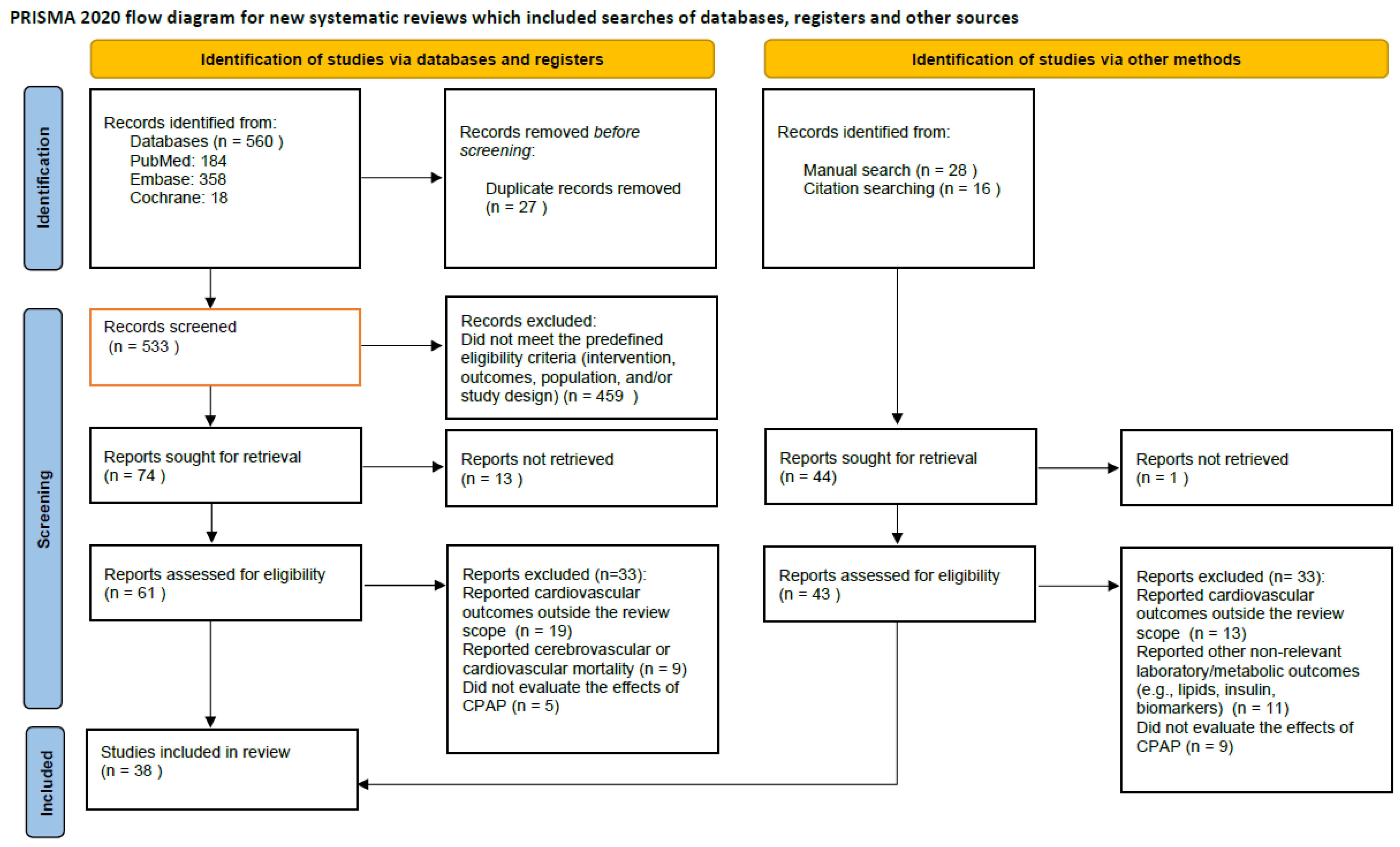
3.1. Study Selection
3.2. Characteristics of Included Reviews
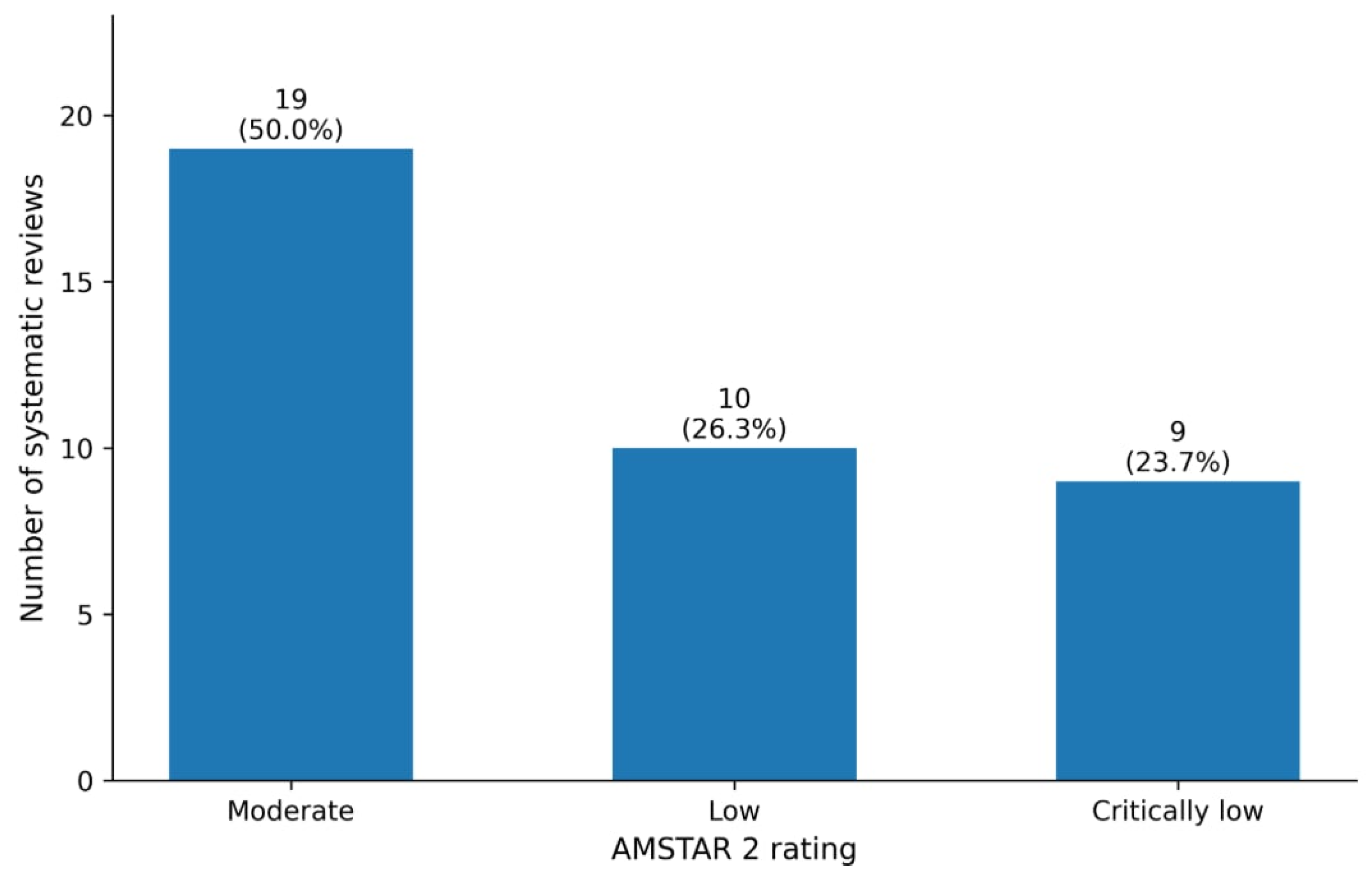
3.3. Methodological Quality
3.4. Effects of CPAP on Cardiovascular Outcomes
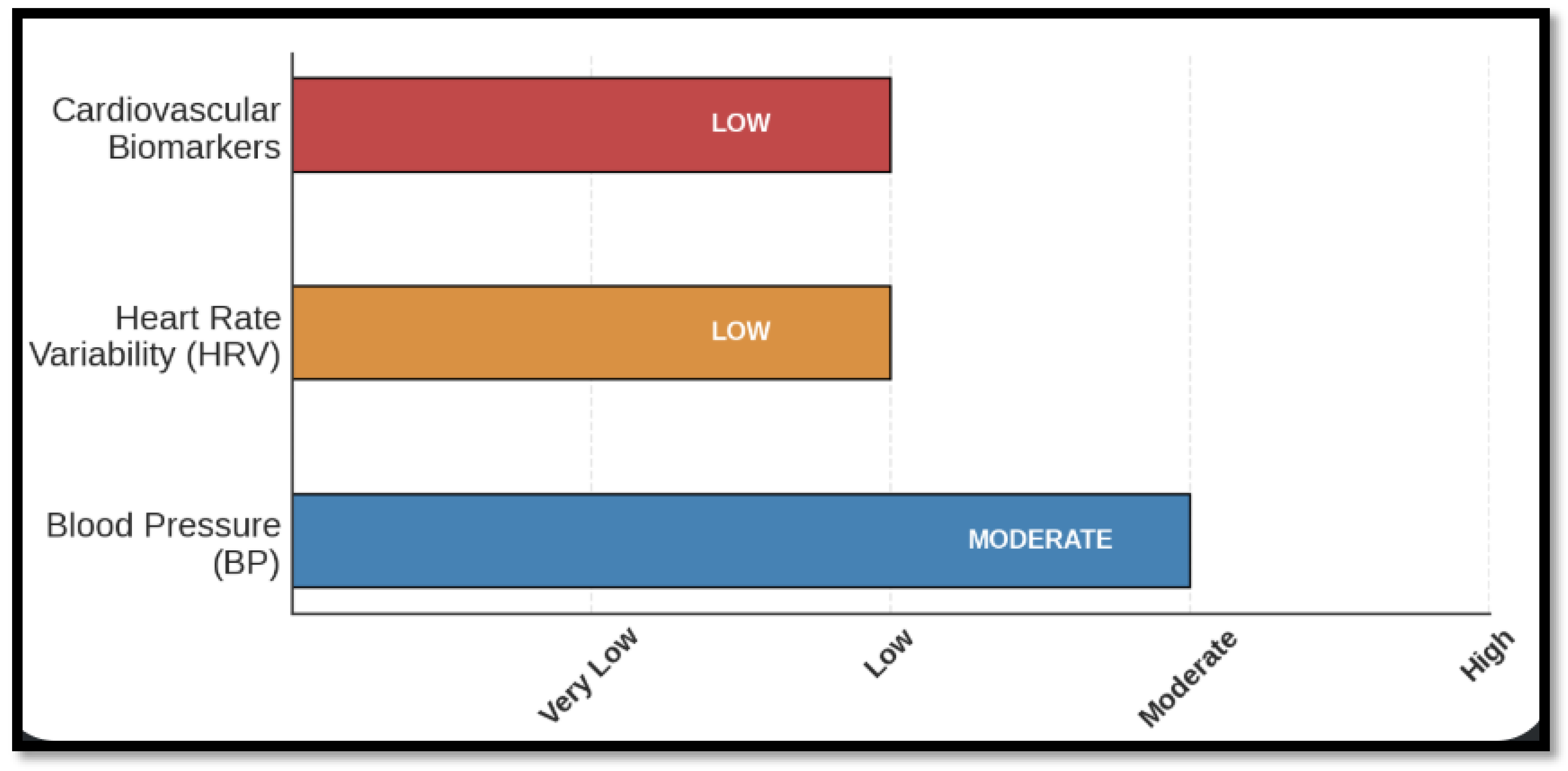
3.5. Certainty of Evidence
4. Discussion
Strengths and Limitations
5. Conclusions
Supplementary Materials
Author Contributions
Funding
Institutional Review Board Statement
Informed Consent Statement
Data Availability Statement
Acknowledgments
Conflicts of Interest
References
- Malhotra, A.; White, D.P. Obstructive sleep apnoea. Lancet 2002, 360, 237–245. [Google Scholar] [CrossRef] [Scilit] [PubMed]
- Redline, S.; Yenokyan, G.; Gottlieb, D.J.; Shahar, E.; O’Connor, G.T.; Resnick, H.E.; Diener-West, M.; Sanders, M.H.; Wolf, P.A.; Geraghty, E.M.; et al. Obstructive sleep apnea–hypopnea and incident stroke: The Sleep Heart Health Study. Am. J. Respir. Crit. Care Med. 2010, 182, 269–277. [Google Scholar] [CrossRef] [Scilit] [PubMed]
- Platon, A.L.; Stelea, C.G.; Boișteanu, O.; Patrascanu, E.; Zetu, I.N.; Roșu, S.N.; Trifan, V.; Palade, D.O. An update on obstructive sleep apnea syndrome—A literature review. Medicina 2023, 59, 1459. [Google Scholar] [CrossRef] [Scilit] [PubMed]
- de Araujo Dantas, A.B.; Goncalves, F.M.; Martins, A.A.; Alves, G.Â.; Stechman-Neto, J.; Corrêa, C.D.C.; Santos, R.S.; Nascimento, W.V.; de Araujo, C.M.; Taveira, K.V.M. Worldwide prevalence and associated risk factors of obstructive sleep apnea: A meta-analysis and meta-regression. Sleep Breath 2023, 27, 2083–2109. [Google Scholar] [CrossRef] [Scilit] [PubMed]
- Marshall, N.S.; Wong, K.K.; Liu, P.Y.; Cullen, S.R.; Knuiman, M.W.; Grunstein, R.R. Sleep apnea as an independent risk factor for all-cause mortality: The Busselton Health Study. Sleep 2008, 31, 1079–1085. [Google Scholar] [CrossRef] [Scilit]
- Benjafield, A.V.; Ayas, N.T.; Eastwood, P.R.; Heinzer, R.; Ip, M.S.M.; Morrell, M.J.; Nunez, C.M.; Patel, S.R.; Penzel, T.; Pépin, J.-L.; et al. Estimation of the global prevalence and burden of obstructive sleep apnoea: A literature-based analysis. Lancet Respir. Med. 2019, 7, 687–698. [Google Scholar] [CrossRef] [Scilit] [PubMed]
- Senaratna, C.V.; Perret, J.L.; Lodge, C.J.; Lowe, A.J.; Campbell, B.E.; Matheson, M.C.; Hamilton, G.S.; Dharmage, S.C. Prevalence of obstructive sleep apnea in the general population: A systematic review. Sleep Med. Rev. 2017, 34, 70–81. [Google Scholar] [CrossRef] [Scilit] [PubMed]
- Somers, V.K.; White, D.P.; Amin, R.; Abraham, W.T.; Costa, F.; Culebras, A.; Daniels, S.; Floras, J.S.; Hunt, C.E.; Olson, L.J.; et al. Sleep apnea and cardiovascular disease: An American Heart Association/American College of Cardiology Foundation Scientific Statement From the American Heart Association Council for High Blood Pressure Research Professional Education Committee, Council on Clinical Cardiology, Stroke Council, and Council on Cardiovascular Nursing In Collaboration With the National Heart, Lung, and Blood Institute National Center on Sleep Disorders Research (National Institutes of Health). Circulation 2008, 118, 1080–1111. [Google Scholar] [CrossRef] [Scilit]
- Mitra, A.K.; Bhuiyan, A.R.; Jones, E.A. Association and risk factors for obstructive sleep apnea and cardiovascular diseases: A systematic review. Diseases 2021, 9, 88. [Google Scholar] [CrossRef] [Scilit] [PubMed]
- Ahmed, A.M.; Nur, S.M.; Xiaochen, Y. Association between obstructive sleep apnea and resistant hypertension: Systematic review and meta-analysis. Front. Med. 2023, 10, 1200952. [Google Scholar] [CrossRef] [Scilit] [PubMed]
- Hou, H.; Zhao, Y.; Yu, W.; Dong, H.; Xue, X.; Ding, J.; Xing, W.; Wang, W. Association of obstructive sleep apnea with hypertension: A systematic review and meta-analysis. J. Glob. Health 2018, 8, 010405. [Google Scholar] [CrossRef] [Scilit] [PubMed]
- Polecka, A.; Olszewska, N.; Danielski, Ł.; Olszewska, E. Association between obstructive sleep apnea and heart failure in adults—A systematic review. J. Clin. Med. 2023, 12, 6139. [Google Scholar] [CrossRef] [Scilit] [PubMed]
- Prechaporn, W.; Hantrakul, P.; Ngamjarus, C.; Sukeepaisarnjaroen, W.; Sawanyawisuth, K.; Khamsai, S. Pooled prevalences of obstructive sleep apnea and heart failure: A systematic review and meta-analysis. Heart Fail. Rev. 2024, 29, 811–826. [Google Scholar] [CrossRef] [Scilit] [PubMed]
- Patel, N.; Donahue, C.; Shenoy, A.; Patel, A.; El-Sherif, N. Obstructive sleep apnea and arrhythmia: A systemic review. Int. J. Cardiol. 2017, 228, 967–970. [Google Scholar] [CrossRef] [Scilit] [PubMed]
- Mahajan, S.K.; Mahajan, K.; Sharma, S. Obstructive sleep apnea and coronary artery disease: An unholy nexus or a holy alliance? Lung India 2022, 39, 460–465. [Google Scholar] [CrossRef] [Scilit] [PubMed]
- Ooi, E.L.; Rajendran, S. Obstructive sleep apnea in coronary artery disease. Curr. Probl. Cardiol. 2023, 48, 101178. [Google Scholar] [CrossRef] [Scilit] [PubMed]
- Almeneessier, A.S.; Alasousi, N.; Sharif, M.M.; Pandi-Perumal, S.R.; Hersi, A.S.; BaHammam, A.S. Prevalence and predictors of arrhythmia in patients with obstructive sleep apnea. Sleep Sci. 2017, 10, 142–146. [Google Scholar] [CrossRef] [Scilit] [PubMed]
- Hersi, A.S. Obstructive sleep apnea and cardiac arrhythmias. Ann. Thorac. Med. 2010, 5, 10–17. [Google Scholar] [CrossRef] [Scilit] [PubMed]
- May, A.M.; Van Wagoner, D.R.; Mehra, R. OSA and cardiac arrhythmogenesis: Mechanistic insights. Chest 2017, 151, 225–241. [Google Scholar] [CrossRef] [Scilit] [PubMed]
- Zhang, D.; Ma, Y.; Xu, J.; Yi, F. Association between obstructive sleep apnea (OSA) and atrial fibrillation (AF): A dose-response meta-analysis. Medicine 2022, 101, e29443. [Google Scholar] [CrossRef] [Scilit] [PubMed]
- Polotsky, V.Y.; Patil, S.P.; Savransky, V.; Laffan, A.; Fonti, S.; Frame, L.A.; Steele, K.E.; Schweizter, M.A.; Clark, J.M.; Torbenson, M.S.; et al. Obstructive sleep apnea, insulin resistance, and steatohepatitis in severe obesity. Am. J. Respir. Crit. Care Med. 2009, 179, 228–234. [Google Scholar] [CrossRef] [Scilit] [PubMed]
- Fiedorczuk, P.; Stróżyński, A.; Olszewska, E. Is the oxidative stress in obstructive sleep apnea associated with cardiovascular complications?—Systematic review. J. Clin. Med. 2020, 9, 3734. [Google Scholar] [CrossRef] [Scilit] [PubMed]
- Cammaroto, G.; Costa, F.; Ruiz, M.V.G.; Andò, G.; Vicini, C.; Montevecchi, F.; Galletti, C.; Galletti, F.; Valgimigli, M. Obstructive sleep apnoea syndrome and endothelial function: Potential impact of different treatment strategies—Meta-analysis of prospective studies. Eur. Arch. Otorhinolaryngol. 2019, 276, 2331–2338. [Google Scholar] [CrossRef] [Scilit] [PubMed]
- Schwab, R.J.; Badr, S.M.; Epstein, L.J.; Gay, P.C.; Gozal, D.; Kohler, M.; Lévy, P.; Malhotra, A.; Phillips, B.A.; Rosen, I.M.; et al. An official American Thoracic Society statement: Continuous positive airway pressure adherence tracking systems. The optimal monitoring strategies and outcome measures in adults. Am. J. Respir. Crit. Care Med. 2013, 188, 613–620. [Google Scholar] [CrossRef] [Scilit] [PubMed]
- Cheng, Y.; Ou, Q.; Chen, B.; Loffler, K.A.; McEvoy, R.D.; Xu, Y.; Wang, Q.; Lao, M. The changes of AHI after long-term CPAP in patients with comorbid OSA and cardiovascular disease. Sleep Breath 2023, 27, 511–518. [Google Scholar] [CrossRef] [Scilit] [PubMed]
- Sánchez-de-la-Torre, M.; Gracia-Lavedan, E.; Benítez, I.D.; Sánchez-de-la-Torre, A.; Moncusí-Moix, A.; Torres, G.; Loffler, K.; Woodman, R.; Adams, R.; Labarca, G.; et al. Adherence to CPAP treatment and the risk of recurrent cardiovascular events: A meta-analysis. JAMA 2023, 330, 1255–1265. [Google Scholar] [CrossRef] [Scilit] [PubMed]
- Guo, J.; Sun, Y.; Xue, L.J.; Huang, Z.Y.; Wang, Y.S.; Zhang, L.; Zhou, G.-H.; Yuan, L.-X. Effect of CPAP therapy on cardiovascular events and mortality in patients with obstructive sleep apnea: A meta-analysis. Sleep Breath 2016, 20, 965–974. [Google Scholar] [CrossRef] [Scilit] [PubMed]
- Pengo, M.F.; Schwarz, E.I.; Barbé, F.; Cistulli, P.A.; Drager, L.F.; Fava, C.; Fuchs, F.D.; Ip, M.S.; Loffler, K.A.; Lui, M.M.; et al. Effect of CPAP therapy on blood pressure in patients with obstructive sleep apnoea: A worldwide individual patient data meta-analysis. Eur. Respir. J. 2025, 65, 2400837. [Google Scholar] [CrossRef] [Scilit] [PubMed]
- Javaid, S.S.; Obaid, M.A.; Noor, T.; Kaleem, M.; Shakil, A.; Haque, S.U.; Abbasi, N.M.; Saeed, E.M.; Manan, S.M.; Alam, K.M.; et al. Impact of continuous positive airway pressure on cardiovascular health in patients with obstructive sleep apnea: A systematic review and meta-analysis. Cardiol. Rev. 2025. Online ahead of print. [Google Scholar] [CrossRef] [Scilit] [PubMed]
- McEvoy, R.D.; Antic, N.A.; Heeley, E.; Luo, Y.; Ou, Q.; Zhang, X.; Mediano, O.; Chen, R.; Drager, L.F.; Liu, Z.; et al. CPAP for prevention of cardiovascular events in obstructive sleep apnea. N. Engl. J. Med. 2016, 375, 919–931. [Google Scholar] [CrossRef] [Scilit] [PubMed]
- Drager, L.F.; McEvoy, R.D.; Barbe, F.; Lorenzi-Filho, G.; Redline, S. Sleep apnea and cardiovascular disease: Lessons from recent trials and need for team science. Circulation 2017, 136, 1840–1850. [Google Scholar] [CrossRef] [Scilit] [PubMed]
- Page, M.J.; McKenzie, J.E.; Bossuyt, P.M.; Boutron, I.; Hoffmann, T.C.; Mulrow, C.D.; Shamseer, L.; Tetzlaff, J.M.; Akl, E.A.; Brennan, S.E.; et al. The PRISMA 2020 statement: An updated guideline for reporting systematic reviews. BMJ 2021, 372, n71. [Google Scholar] [CrossRef] [Scilit] [PubMed]
- Aromataris, E.; Fernandez, R.; Godfrey, C.M.; Holly, C.; Khalil, H.; Tungpunkom, P. Summarizing systematic reviews: Methodological development, conduct and reporting of an umbrella review approach. Int. J. Evid. Based Healthc. 2015, 13, 132–140. [Google Scholar] [CrossRef] [Scilit] [PubMed]
- Shea, B.J.; Reeves, B.C.; Wells, G.; Thuku, M.; Hamel, C.; Moran, J.; Moher, D.; Tugwell, P.; Welch, V.; Kristjansson, E.; et al. AMSTAR 2: A critical appraisal tool for systematic reviews that include randomised or non-randomised studies of healthcare interventions, or both. BMJ 2017, 358, j4008. [Google Scholar] [CrossRef] [Scilit] [PubMed]
- Guyatt, G.H.; Oxman, A.D.; Vist, G.E.; Kunz, R.; Falck-Ytter, Y.; Alonso-Coello, P.; Schünemann, H.J. GRADE: An emerging consensus on rating quality of evidence and strength of recommendations. BMJ 2008, 336, 924–926. [Google Scholar] [CrossRef] [Scilit] [PubMed]
- Feng, J.; Li, K.; Luo, W.; Xie, F.; Li, M.; Wu, Y. Effect of continuous positive pressure ventilation on left ventricular diastolic function E/A ratio in patients with obstructive sleep apnea: A meta-analysis. Sleep Breath 2023, 27, 2333–2340. [Google Scholar] [CrossRef] [Scilit] [PubMed]
- Green, M.; Ken-Dror, G.; Fluck, D.; Sada, C.; Sharma, P.; Fry, C.H.; Han, T.S. Meta-analysis of changes in the levels of catecholamines and blood pressure with continuous positive airway pressure therapy in obstructive sleep apnea. J. Clin. Hypertens. 2021, 23, 12–20. [Google Scholar] [CrossRef] [Scilit] [PubMed]
- Guo, W.; Lv, T.; She, F.; Miao, G.; Liu, Y.; He, R.; Xue, Y.; Nu, N.K.; Yang, J.; Li, K.; et al. The impact of continuous positive airway pressure on heart rate variability in obstructive sleep apnea patients during sleep: A meta-analysis. Heart Lung 2018, 47, 516–524. [Google Scholar] [CrossRef] [Scilit] [PubMed]
- Han, Y.-C.; Shen, Z.-J.; Zhang, S.-Y.; Gao, P.; Xiang, R.-L.; Qian, H.; Xie, H.-Z. Efficacy of adaptive servo-ventilation and continuous positive airway pressure treatment in chronic heart failure with sleep-disordered breathing: A systematic review and meta-analysis. Heart Fail. Rev. 2021, 26, 521–529. [Google Scholar] [CrossRef] [Scilit] [PubMed]
- Itaya, E.D.; Ternes, C.M.P.; Maher, T.; Fernandes, A.A.D.; Rocha, A.V.; Wippel, C.; Rivera, A.; Locke, A.H.; d’Avila, A. Efficacy of continuous positive airway pressure on atrial fibrillation recurrence after catheter ablation in patients with obstructive sleep apnea: A systematic review and meta-analysis. J. Interv. Card. Electrophysiol. 2025, 68, 1749–1759. [Google Scholar] [CrossRef] [Scilit] [PubMed]
- Khan, S.U.; Duran, C.A.; Rahman, H.; Lekkala, M.; Saleem, M.A.; Kaluski, E. A meta-analysis of continuous positive airway pressure therapy in prevention of cardiovascular events in patients with obstructive sleep apnoea. Eur. Heart J. 2018, 39, 2291–2297. [Google Scholar] [CrossRef] [Scilit] [PubMed]
- Kou, C.; Zhao, X.; Lin, X.; Fan, X.; Wang, Q.; Yu, J. Effect of different treatments for obstructive sleep apnoea on blood pressure. J. Hypertens. 2022, 40, 1071–1084. [Google Scholar] [CrossRef] [Scilit] [PubMed]
- Labarca, G.; Schmidt, A.; Dreyse, J.; Jorquera, J.; Enos, D.; Torres, G.; Barbé, F. Efficacy of continuous positive airway pressure (CPAP) in patients with obstructive sleep apnea (OSA) and resistant hypertension (RH): Systematic review and meta-analysis. Sleep Med. Rev. 2021, 58, 101446. [Google Scholar] [CrossRef] [Scilit] [PubMed]
- Lei, Q.; Lv, Y.; Li, K.; Ma, L.; Du, G.; Xiang, Y.; Li, X. Effects of continuous positive airway pressure on blood pressure in patients with resistant hypertension and obstructive sleep apnea: A systematic review and meta-analysis of six randomized controlled trials. J. Bras. Pneumol. 2017, 43, 373–379. [Google Scholar] [CrossRef] [Scilit] [PubMed]
- Li, F.; He, C.-J.; Ding, C.-H.; Wang, R.-X.; Li, H. Continuous positive airway pressure therapy might be an effective strategy on reduction of atrial fibrillation recurrence after ablation in patients with obstructive sleep apnea: Insights from the pooled studies. Front. Neurol. 2023, 14, 1269945. [Google Scholar] [CrossRef] [Scilit] [PubMed]
- Montesi, S.B.; Edwards, B.A.; Malhotra, A.; Bakker, J.P. The effect of continuous positive airway pressure treatment on blood pressure: A systematic review and meta-analysis of randomized controlled trials. J. Clin. Sleep Med. 2012, 8, 587–596. [Google Scholar] [CrossRef] [Scilit] [PubMed]
- Pengo, M.F.; Soranna, D.; Giontella, A.; Perger, E.; Mattaliano, P.; Schwarz, E.I.; Lombardi, C.; Bilo, G.; Zambon, A.; Steier, J.; et al. Obstructive sleep apnoea treatment and blood pressure: Which phenotypes predict a response? A systematic review and meta-analysis. Eur. Respir. J. 2020, 55, 1901945. [Google Scholar] [CrossRef] [Scilit] [PubMed]
- Sabry, M.; Gundala, C.; Hamad, M.; Tummala, N.; Hamid, A.A.; Mohamed, A.E.; Zia, U.; Hassan, A.M.; Essani, B.; Abid, M.; et al. Impact of sleep apnea treatment with continuous positive airway pressure (CPAP) on blood pressure control in resistant hypertension: A systematic review and meta-analysis. Cureus 2025, 17, e97569. [Google Scholar] [CrossRef] [Scilit] [PubMed]
- Hu, X.; Fan, J.; Chen, S.; Yin, Y.; Zrenner, B. The role of continuous positive airway pressure in blood pressure control for patients with obstructive sleep apnea and hypertension: A meta-analysis of randomized controlled trials. J. Clin. Hypertens. 2015, 17, 215–222. [Google Scholar] [CrossRef] [Scilit] [PubMed]
- Sarvananda, S.; Earnshaw, S.; Hughes, I.; Sivakumaran, P.; Sriram, K.B. Effect of positive airway pressure treatment on pulmonary artery pressure in obstructive sleep apnoea and/or obesity hypoventilation syndrome with pulmonary hypertension: A systematic review and meta-analysis. Intern. Med. J. 2025, 55, 1281–1292. [Google Scholar] [CrossRef] [Scilit] [PubMed]
- Schein, A.S.; Kerkhoff, A.C.; Coronel, C.C.; Plentz, R.D.M.; Sbruzzi, G. Continuous positive airway pressure reduces blood pressure in patients with obstructive sleep apnea; A systematic review and meta-analysis with 1000 patients. J. Hypertens. 2014, 32, 1762–1773. [Google Scholar] [CrossRef] [Scilit] [PubMed]
- Shang, W.; Zhang, Y.; Liu, L.; Chen, F.; Wang, G.; Han, D. Benefits of continuous positive airway pressure on blood pressure in patients with hypertension and obstructive sleep apnea: A meta-analysis. Hypertens. Res. 2022, 45, 1802–1813. [Google Scholar] [CrossRef] [Scilit] [PubMed]
- Sun, X.; Luo, J.; Xiao, Y. Continuous positive airway pressure is associated with a decrease in pulmonary artery pressure in patients with obstructive sleep apnoea: A meta-analysis. Respirology 2014, 19, 670–674. [Google Scholar] [CrossRef] [Scilit] [PubMed]
- Sun, Y.; Huang, Z.Y.; Sun, Q.R.; Qiu, L.P.; Zhou, T.T.; Zhou, G.H. CPAP therapy reduces blood pressure for patients with obstructive sleep apnoea: An update meta-analysis of randomized clinical trials. Acta Cardiol. 2016, 71, 275–280. [Google Scholar] [CrossRef]
- Sun, L.; Chang, Y.F.; Wang, Y.F.; Xie, Q.X.; Ran, X.Z.; Hu, C.Y.; Luo, B.; Ning, B. Effect of Continuous Positive Airway Pressure on Blood Pressure in Patients with Resistant Hypertension and Obstructive Sleep Apnea: An Updated Meta-analysis. Curr. Hypertens. Rep. 2024, 26, 201–211. [Google Scholar] [CrossRef] [Scilit] [PubMed]
- Tadic, M.; Gherbesi, E.; Faggiano, A.; Sala, C.; Carugo, S.; Cuspidi, C. The impact of continuous positive airway pressure on cardiac mechanics: Findings from a meta-analysis of echocardiographic studies. J. Clin. Hypertens. 2022, 24, 795–803. [Google Scholar] [CrossRef] [Scilit] [PubMed]
- Teo, Y.H.; Han, R.; Leong, S.; Teo, Y.N.; Syn, N.L.; Wee, C.F.; Tan, B.K.J.; Wong, R.C.C.; Chai, P.; Kojodjojo, P.; et al. Prevalence, types and treatment of bradycardia in obstructive sleep apnea—A systematic review and meta-analysis. Sleep Med. 2022, 89, 104–113. [Google Scholar] [CrossRef] [Scilit] [PubMed]
- Varounis, C.; Katsi, V.; Kallikazaros, I.E.; Tousoulis, D.; Stefanadis, C.; Parissis, J.; Lekakis, J.; Siristatidis, C.; Manolis, A.J.; Makris, T. Effect of CPAP on blood pressure in patients with obstructive sleep apnea and resistant hypertension: A systematic review and meta-analysis. Int. J. Cardiol. 2014, 175, 195–198. [Google Scholar] [CrossRef] [Scilit] [PubMed]
- Vlachantoni, I.-T.; Dikaiakou, E.; Antonopoulos, C.N.; Stefanadis, C.; Daskalopoulou, S.S.; Petridou, E.T. Effects of continuous positive airway pressure (CPAP) treatment for obstructive sleep apnea in arterial stiffness: A meta-analysis. Sleep Med. Rev. 2013, 17, 19–28. [Google Scholar] [CrossRef] [Scilit] [PubMed]
- Xu, H.; Wang, Y.; Guan, J.; Yi, H.; Yin, S. Effect of CPAP on endothelial function in subjects with obstructive sleep apnea: A meta-analysis. Respir. Care 2015, 60, 749–755. [Google Scholar] [CrossRef] [Scilit] [PubMed]
- Yang, D.; Li, L.; Dong, J.; Yang, W.; Liu, Z. Effects of continuous positive airway pressure on cardiac events and metabolic components in patients with moderate to severe obstructive sleep apnea and coronary artery disease: A meta-analysis. J. Clin. Sleep Med. 2023, 19, 2015–2025. [Google Scholar] [CrossRef] [Scilit] [PubMed]
- Chen, L.D.; Lin, L.; Lin, X.J.; Ou, Y.W.; Wu, Z.; Ye, Y.M.; Xu, Q.-Z.; Huang, Y.-P.; Cai, Z.-M. Effect of continuous positive airway pressure on carotid intima-media thickness in patients with obstructive sleep apnea: A meta-analysis. PLoS ONE 2017, 12, e0184293. [Google Scholar] [CrossRef] [Scilit] [PubMed]
- Aslan, G.; Afsar, B.; Siriopol, D.; Kanbay, A.; Sal, O.; Benli, C.; Okcuoglu, J.; Covic, A.; Kanbay, M. Cardiovascular effects of continuous positive airway pressure treatment in patients with obstructive sleep apnea: A meta-analysis. Angiology 2018, 69, 195–204. [Google Scholar] [CrossRef] [Scilit] [PubMed]
- Deng, F.; Raza, A.; Guo, J. Treating obstructive sleep apnea with continuous positive airway pressure reduces risk of recurrent atrial fibrillation after catheter ablation: A meta-analysis. Sleep Med. 2018, 46, 5–11. [Google Scholar] [CrossRef] [Scilit] [PubMed]
- Benning, L.; Herzig, J.J.; Mollet, M.S.; Bradicich, M.; Pengo, M.F.; Ulrich, S.; Schwarz, E.I. Effects of CPAP on blood pressure parameter across different severities of obstructive sleep apnoea: A meta-analysis. J. Sleep Res. 2025, 34, e70072. [Google Scholar] [CrossRef] [Scilit] [PubMed]
- de Coelho Castro, P.; Prizão, V.M.; Erzinger, G.; Leite, F.V.L.; Barbosa, L.M.; de Lucena, L.A.; Castro, R.S.A.; Girardi, A.C.C.; Reichert, C.O.; Drager, L.F. Efficacy of continuous positive airway pressure on cardiac remodeling and ventricular function in obstructive sleep apnea: A systematic review and updated meta-analysis of speckle-tracking echocardiography. J. Hypertens. 2026, 44, 16–27. [Google Scholar] [CrossRef] [Scilit] [PubMed]
- Bratton, D.J.; Gaisl, T.; Wons, A.M.; Kohler, M. CPAP vs mandibular advancement devices and blood pressure in patients with obstructive sleep apnea: A systematic review and meta-analysis. JAMA 2015, 314, 2280–2293. [Google Scholar] [CrossRef] [Scilit] [PubMed]
- Bratton, D.J.; Stradling, J.R.; Barbé, F.; Kohler, M. Effect of CPAP on blood pressure in patients with minimally symptomatic obstructive sleep apnoea: A meta-analysis using individual patient data from four randomised controlled trials. Thorax 2014, 69, 1128–1135. [Google Scholar] [CrossRef] [Scilit] [PubMed]
- da Silva Paulitsch, F.; Zhang, L. Continuous positive airway pressure for adults with obstructive sleep apnea and cardiovascular disease: A meta-analysis of randomized trials. Sleep Med. 2019, 54, 28–34. [Google Scholar] [CrossRef] [Scilit] [PubMed]
- Fava, C.; Dorigoni, S.; Dalle Vedove, F.; Danese, E.; Montagnana, M.; Guidi, G.C.; Narkiewicz, K.; Minuz, P. Effect of CPAP on blood pressure in patients with OSA/hypopnea: A systematic review and meta-analysis. Chest 2014, 145, 762–771. [Google Scholar] [CrossRef] [Scilit] [PubMed]
- Lv, M.; Mao, J.; Wang, S.; Zhang, C.; Qian, C.; Zhu, R.; Xiong, S.; Zhang, Y.; Guo, L. Effect of continuous positive airway pressure on cardiometabolic risk factors in patients with obstructive sleep apnea: A systematic review and meta-analysis. Respir. Med. 2024, 235, 107852. [Google Scholar] [CrossRef] [Scilit] [PubMed]
- Sun, H.; Shi, J.; Li, M.; Chen, X. Impact of continuous positive airway pressure treatment on left ventricular ejection fraction in patients with obstructive sleep apnea: A meta-analysis of randomized controlled trials. PLoS ONE 2013, 8, e62298. [Google Scholar] [CrossRef] [Scilit] [PubMed]
- Peker, Y.; Glantz, H.; Eulenburg, C.; Wegscheider, K.; Herlitz, J.; Thunström, E. Effect of positive airway pressure on cardiovascular outcomes in coronary artery disease patients with nonsleepy obstructive sleep apnea: The RICCADSA randomized controlled trial. Am. J. Respir. Crit. Care Med. 2016, 194, 613–620. [Google Scholar] [CrossRef] [Scilit] [PubMed]



| Author | Year | Design | Studies | Sample | Main Outcomes |
|---|---|---|---|---|---|
| Feng et al. [36] | 2023 | Systematic review and meta-analysis | n = 7 (RCT = 2; prospective = 5) | 473 | Left ventricular diastolic function |
| Green et al. [37] | 2021 | Meta-analysis | n = 38 (RCT = 14; cohort = 24) | 1123 | 24 h urinary Noradrenaline |
| Guo et al. [27] | 2016 | Meta-analysis | n = 18 (RCTs) | 4146 | 24 h Systolic BP |
| Guo et al. [38] | 2018 | Meta-analysis | n = 11 (cohort) | 260 | Apnea–Hypopnea Index (AHI) |
| Han et al. [39] | 2021 | Systematic review and meta-analysis | n = 11 | 392 | Left Ventricular Ejection Fraction (LVEF) |
| Itaya et al. [40] | 2025 | Systematic review and meta-analysis | n = 11 | 1536 | Atrial fibrillation recurrence (overall) |
| Khan et al. [41] | 2017 | Meta-analysis | n = 7 | 4268 | SBP |
| Kou et al. [42] | 2022 | Meta-analysis | n = 10 | 606 | Office SBP |
| Labarca et al. [43] | 2021 | Systematic review | n = 6 | 479 | 24 h SBP |
| Lei et al. [44] | 2017 | Meta-analysis | n = 8 | 1231 | Mean 24 h SBP (ABPM) |
| Li et al. [45] | 2023 | Meta-analysis | n = 28 | 1948 | Atrial fibrillation (AF) |
| Montesi et al. [46] | 2012 | Systematic review | n = 10 | 1148 | Diurnal SBP |
| Pengo et al. [47] | 2020 | Meta-analysis | n = 7 | 794 | SBP |
| Hu et al. [49] | 2015 | Meta-analysis | n = 16 | 1166 | 24 h SBP change |
| Schein et al. [51] | 2014 | Meta-analysis | n = 19 | 1904 | Office SBP |
| Sun et al. [72] | 2013 | Meta-analysis | n = 6 | 181 | LVEF (overall) |
| Sun et al. [53] | 2014 | Meta-analysis | n = 12 | 1720 | Pulmonary arterial pressure (PAP: mPAP/PASP) |
| Tadic et al. [56] | 2022 | Meta-analysis | n = 12 | 718 | Left ventricular global longitudinal strain (LV GLS) |
| Teo et al. [57] | 2021 | Meta-analysis | n = 9 | 337 | Daytime bradycardia in OSA |
| Varounis et al. [58] | 2014 | Meta-analysis | n = 34 | 4852 | 24 h SBP |
| Vlachantoni et al. [59] | 2013 | Meta-analysis | n = 5 | 359 | All arterial stiffness indices (pooled) |
| Xu et al. [60] | 2015 | Meta-analysis | n = 15 | 615 | Flow-mediated dilation (FMD) |
| Yang et al. [61] | 2023 | Meta-analysis | n = 11 | 199 | SBP change |
| Chen et al. [62] | 2017 | Systematic review | n = 29 | 1820 | Change in carotid IMT |
| Aslan et al. [63] | 2018 | Meta-analysis | n = 14 | 5410 | LVEF |
| Deng et al. [64] | 2018 | Systematic review | n = 9 | 3314 | AF recurrence after catheter ablation |
| Benning et al. [65] | 2025 | Meta-analysis | n = 7 | 167 | Office SBP |
| de Coelho Castro et al. [66] | 2026 | Meta-analysis | n = 9 (RCT = 5; observational = 4) | 9610 | LV GLS |
| Bratton et al. [67] | 2015 | Meta-analysis | n = 10 (RCT = 3; cohort = 7) | 1217 | SBP |
| Bratton et al. [68] | 2014 | Systematic review | n = NR | NR | SBP |
| da Silva Paulitsch et al. [69] | 2019 | Meta-analysis | n = 10 | 385 | SBP |
| Fava et al. [70] | 2014 | Meta-analysis | n = 51 | 4888 | SBP (Office/ABPM) |
| Lv et al. [71] | 2024 | Meta-analysis | n = 4 | 1219 | SBP |
| Sun et al. [55] | 2024 | Meta-analysis | n = 52 | 10,104 | 24 h SBP |
| Sabry et al. [48] | 2025 | Systematic review | n = NR | NR | Blood pressure reduction (overall BP) |
| Shang et al. [52] | 2022 | Meta-analysis | n = NR | NR | 24 h SBP |
| Sarvananda et al. [50] | 2025 | Systematic review | n = 8 | 731 | Blood pressure reduction (overall BP) |
| Sun et al. [54] | 2016 | Meta-analysis | n = 12 | 1720 | 24 h SBP |
| Study | Year | AMSTAR 2 Rating |
|---|---|---|
| Feng et al. [36] | 2023 | Low |
| Green et al. [37] | 2021 | Low |
| Guo et al. [27] | 2016 | Moderate |
| Guo et al. [38] | 2018 | Low |
| Han et al. [39] | 2021 | Critically low |
| Itaya et al. [40] | 2025 | Moderate |
| Khan et al. [41] | 2017 | Moderate |
| Kou et al. [42] | 2022 | Moderate |
| Labarca et al. [43] | 2021 | Critically low |
| Lei et al. [44] | 2017 | Moderate |
| Li et al. [45] | 2023 | Critically low |
| Montesi et al. [46] | 2012 | Low |
| Pengo et al. [47] | 2020 | Moderate |
| Sabry et al. [48] | 2025 | Critically low |
| Hu et al. [49] | 2015 | Moderate |
| Sarvananda et al. [50] | 2025 | Critically low |
| Schein et al. [51] | 2014 | Low |
| Shang et al. [52] | 2022 | Moderate |
| Sun et al. [72] | 2013 | Moderate |
| Sun et al. [53] | 2014 | Low |
| Sun et al. [54] | 2016 | Critically low |
| Sun et al. [55] | 2024 | Moderate |
| Tadic et al. [56] | 2022 | Moderate |
| Teo et al. [57] | 2021 | Moderate |
| Varounis et al. [58] | 2014 | Low |
| Vlachantoni et al. [59] | 2013 | Low |
| Xu et al. [60] | 2015 | Moderate |
| Yang et al. [61] | 2023 | Moderate |
| Chen et al. [62] | 2017 | Critically low |
| Aslan et al. [63] | 2018 | Low |
| Deng et al. [64] | 2018 | Critically low |
| Benning et al. [65] | 2025 | Moderate |
| de Coelho Castro et al. [66] | 2026 | Low |
| Bratton et al. [67] | 2015 | Moderate |
| Bratton et al. [68] | 2014 | Critically low |
| da Silva Paulitsch et al. [69] | 2019 | Moderate |
| Fava et al. [70] | 2014 | Moderate |
| Lv et al. [71] | 2024 | Moderate |
| Outcome | Study | Effect Measure | Effect Size | 95% CI | p-Value | Heterogeneity (I2) |
|---|---|---|---|---|---|---|
| Systolic blood pressure (RCT) | Green et al., 2021 [37] | MD | −4.8 | −7.7 to −2.0 | NR | 84% |
| Diastolic blood pressure (RCT) | Green et al., 2021 [37] | MD | −3.0 | −4.6 to −1.4 | NR | 62% |
| Systolic blood pressure (cohort) | Green et al., 2021 [37] | MD | −7.5 | −11.7 to −3.3 | NR | 71% |
| Diastolic blood pressure (cohort) | Green et al., 2021 [37] | MD | −5.1 | −8.0 to −2.3 | NR | 64% |
| 24 h systolic blood pressure | Guo et al., 2016 [27] | MD | −2.03 | −3.64 to −0.42 | 0.01 | 0% |
| 24 h diastolic blood pressure | Guo et al., 2016 [27] | MD | −1.79 | −2.89 to −0.68 | 0.001 | 0% |
| Nocturnal systolic blood pressure | Guo et al., 2016 [27] | MD | −4.39 | −6.85 to −1.93 | 0.0005 | 34% |
| Nocturnal diastolic blood pressure | Guo et al., 2016 [27] | MD | −1.64 | −2.88 to −0.40 | 0.009 | 0% |
| Daytime diastolic blood pressure | Guo et al., 2016 [27] | MD | −1.43 | −2.67 to −0.19 | 0.02 | 0% |
| Left ventricular diastolic function (E/A ratio) | Feng et al., 2023 [36] | WMD | 0.22 | 0.06 to 0.38 | 0.007 | 89.8% |
| Left ventricular ejection fraction (LVEF) | Han et al., 2021 [39] | MD | 3.27 | 1.88 to 4.65 | <0.00001 | 39% |
| Noradrenaline (RCT) | Green et al., 2021 [37] | SMD | −1.10 | −1.53 to −0.56 | NR | 81% |
| Noradrenaline (cohort) | Green et al., 2021 [37] | SMD | −0.38 | −0.53 to −0.24 | NR | 0% |
| Heart rate variability (LF) | Guo et al., 2018 [38] | SMD | −0.32 | −0.62 to −0.01 | 0.043 | 49.6% |
| Heart rate variability (HF) | Guo et al., 2018 [38] | SMD | −0.08 | −0.41 to 0.25 | 0.632 | 62.6% |
| LF/HF ratio | Guo et al., 2018 [38] | SMD | −0.30 | −0.57 to −0.03 | 0.031 | 56.5% |
| BNP/NT-proBNP | Han et al., 2021 [39] | SMD | −0.60 | −1.00 to −0.20 | NR | NR |
| NYHA functional class | Han et al., 2021 [39] | MD | −0.71 | −1.04 to −0.37 | NR | NR |
| Body mass index (BMI) | Guo et al., 2016 [27] | MD | 0.41 | −0.11 to 0.93 | 0.12 | 0% |
| Outcome | Evidence Source | Risk of Bias | Inconsistency | Indirectness | Imprecision | GRADE Certainty | Interpretation |
|---|---|---|---|---|---|---|---|
| Blood pressure (BP) | Meta-analyses of randomized and observational studies. | Not serious | Serious (I2 > 60%) | Not serious | Not serious | Moderate | Moderate-certainty evidence indicates that CPAP probably reduces systolic and diastolic blood pressure despite substantial statistical heterogeneity. |
| Heart rate variability (HRV) | Meta-analyses evaluating autonomic function. | Not serious | Serious | Not serious | Serious (small sample sizes) | Low | Low-certainty evidence suggests that CPAP may improve selected measures of heart rate variability; however, confidence in the estimate is limited because of heterogeneity and small sample sizes. Additional well-designed randomized trials are likely to influence the estimated effect. |
| Cardiovascular biomarkers | Meta-analyses reporting cardiovascular biomarkers. | Not serious | Serious | Not serious | Serious (limited reporting and small evidence base) | Low | Low-certainty evidence suggests that CPAP may improve selected cardiovascular biomarkers; however, confidence in the estimate is limited because of incomplete reporting and the small number of available studies. |
Disclaimer/Publisher’s Note: The statements, opinions and data contained in all publications are solely those of the individual author(s) and contributor(s) and not of MDPI and/or the editor(s). MDPI and/or the editor(s) disclaim responsibility for any injury to people or property resulting from any ideas, methods, instructions or products referred to in the content. |
© 2026 by the authors. Published by MDPI on behalf of the Lithuanian University of Health Sciences. Licensee MDPI, Basel, Switzerland. This article is an open access article distributed under the terms and conditions of the Creative Commons Attribution (CC BY) license.
Share and Cite
Bunjaku, J.; Rashiti, P.; Lama, A.; Bunjaku, G.; Koliqi, R. Effects of Continuous Positive Airway Pressure on Surrogate, Intermediate, and Functional Cardiovascular Outcomes in Obstructive Sleep Apnea: An Umbrella Review of Systematic Reviews and Meta-Analyses. Medicina 2026, 62, 1456. https://doi.org/10.3390/medicina62081456
Bunjaku J, Rashiti P, Lama A, Bunjaku G, Koliqi R. Effects of Continuous Positive Airway Pressure on Surrogate, Intermediate, and Functional Cardiovascular Outcomes in Obstructive Sleep Apnea: An Umbrella Review of Systematic Reviews and Meta-Analyses. Medicina. 2026; 62(8):1456. https://doi.org/10.3390/medicina62081456
Chicago/Turabian StyleBunjaku, Jeta, Premtim Rashiti, Arber Lama, Genta Bunjaku, and Rozafa Koliqi. 2026. "Effects of Continuous Positive Airway Pressure on Surrogate, Intermediate, and Functional Cardiovascular Outcomes in Obstructive Sleep Apnea: An Umbrella Review of Systematic Reviews and Meta-Analyses" Medicina 62, no. 8: 1456. https://doi.org/10.3390/medicina62081456
APA StyleBunjaku, J., Rashiti, P., Lama, A., Bunjaku, G., & Koliqi, R. (2026). Effects of Continuous Positive Airway Pressure on Surrogate, Intermediate, and Functional Cardiovascular Outcomes in Obstructive Sleep Apnea: An Umbrella Review of Systematic Reviews and Meta-Analyses. Medicina, 62(8), 1456. https://doi.org/10.3390/medicina62081456