Surgical Procedures Used in the Treatment of Postoperative Acute Pancreatitis Grade C After Pancreatoduodenectomy—A Narrative Review



Abstract
1. Introduction
2. Pancreatic Parenchyma Preserving Methods (PPPM)
2.1. Simple Drainage of the Peripancreatic Region (SD)
2.2. Pancreatojejunostomy (PJ) Separation with Closure of the Main Pancreatic Duct (MPD), Without Anastomosis Reconstruction
2.3. Sealing the PJ—Pancreatojejunostomy Repair (PJR)
2.4. Re-Pancreatojejunostomy (Re-PJ)
2.5. Drainage of the MPD
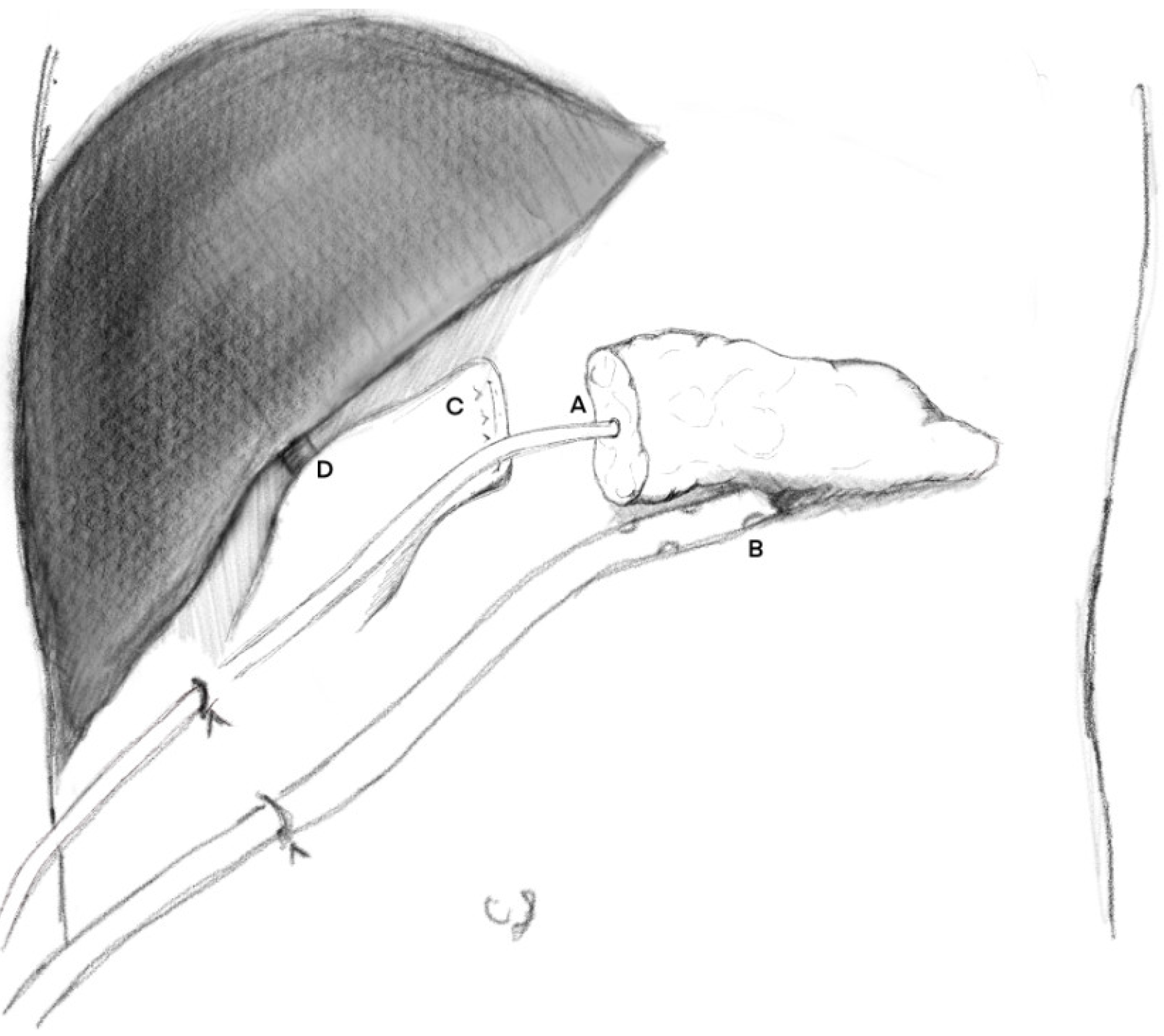
2.5.1. External Drainage of the MPD—External Wirsungostomy (EW)
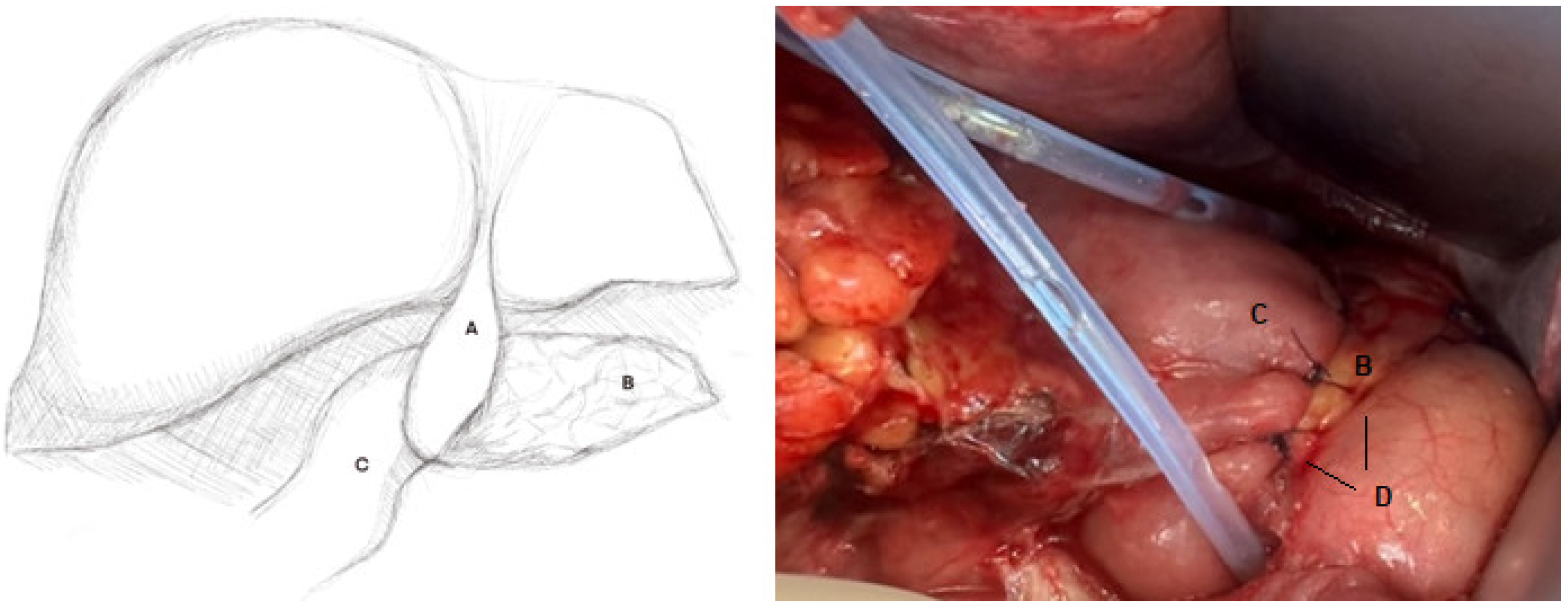
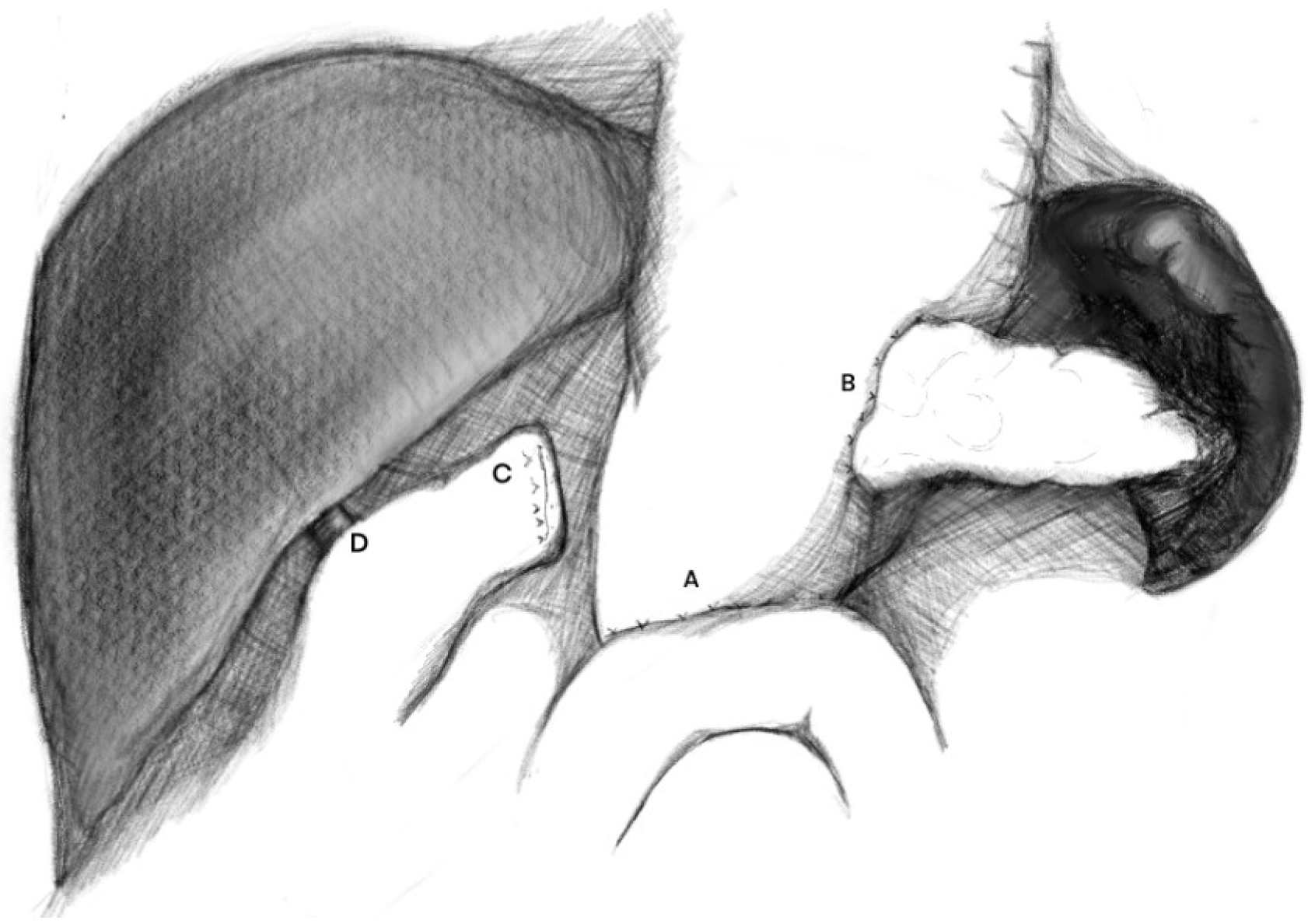
2.5.2. Internal Drainage of the MPD—Bridge Anastomosis
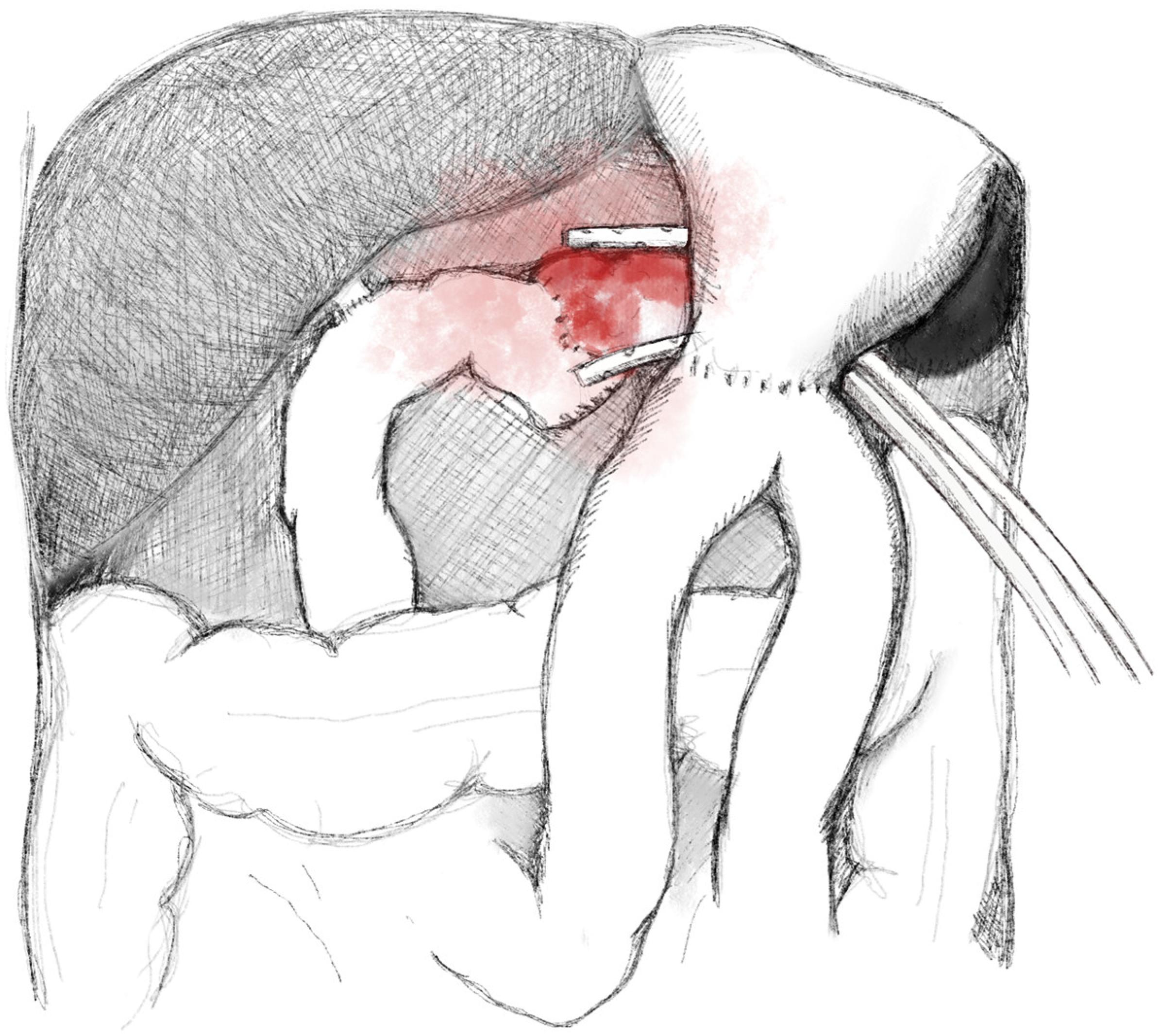
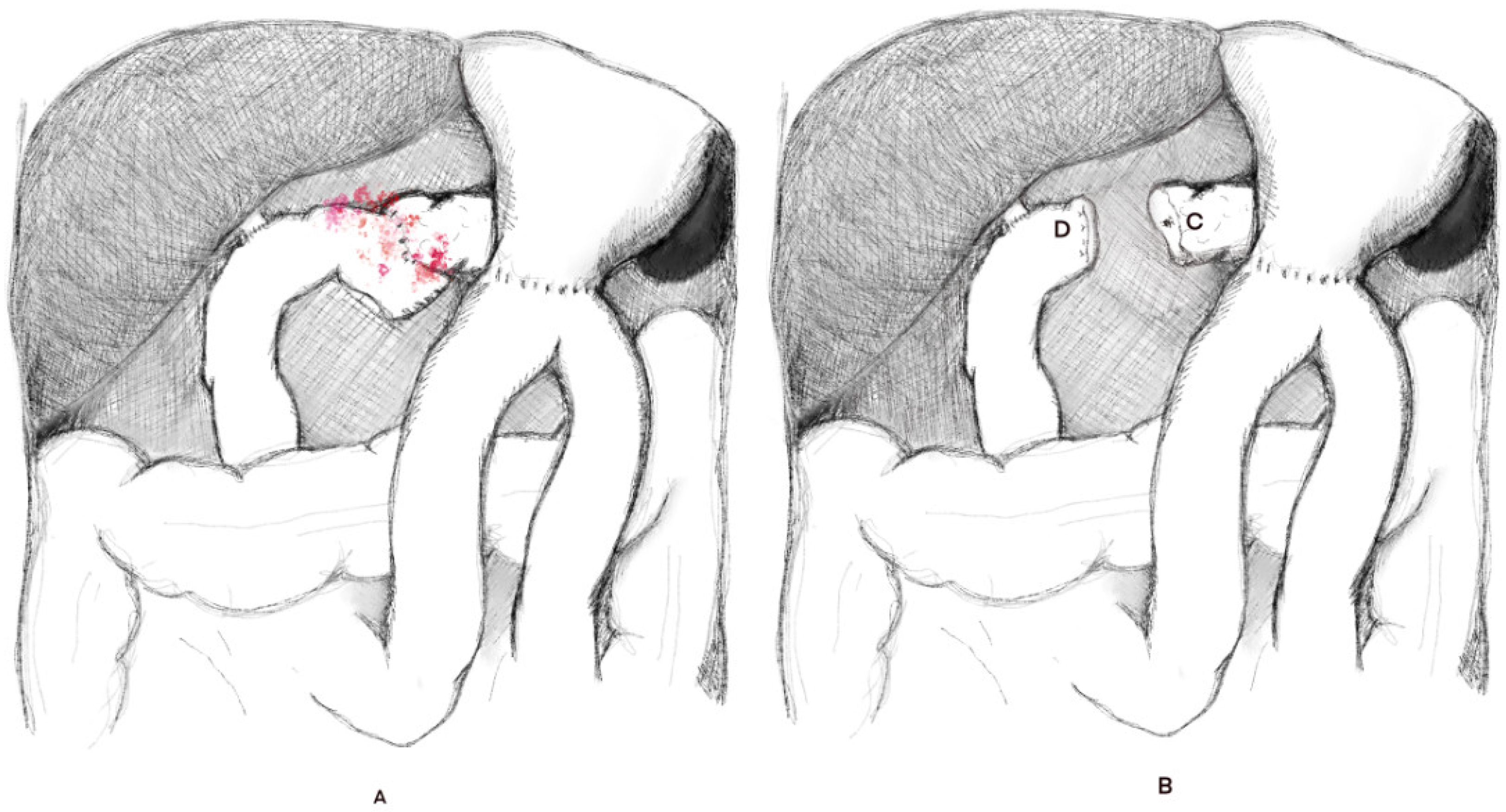
2.6. Conversion of the Pancreatojejunal Anastomosis to the Pancreatogastric Anastomosis (PJ to PG Conversion)
- -
- The patient is in relatively good general condition, allowing for the longer surgical time required for PG anastomosis with mobilization of the gastric wall, compared to drainage methods and PJ reanastomosis
- -
- The absence of massive postoperative adhesions—anatomical conditions should allow for safe mobilization of the posterior gastric wall
- -
- The absence of significant damage to the gastric wall caused by the ongoing inflammatory process
- -
- The absence of significant gastric mucosal disease
- -
- For the duct-to-mucosa technique, MPD must be identifiable intraoperatively.
3. Methods of Eliminating the Pancreatic Parenchyma (MEPP)
3.1. Debridement of the Peripancreatic Region (Damage Control)
- -
- Hemodynamically unstable patients, in septic shock, with metabolic acidosis, coagulopathy, poor prognosis, who would not survive more complex interventions due to their serious general condition, as a damage control technique;
- -
- Advanced, extensive, and continuously progressing necrosis with the formation of collections and abscesses;
- -
- Significantly altered intra-abdominal conditions with anatomical planes disrupted by the inflammation, when other surgical techniques are impossible.
3.2. Completion Pancreatectomy (CP)
- -
- Necrosis involving all/most of the pancreatic tissue—advanced parenchymal destruction does not allow for sparing the gland.
- -
- Progressive necrosis spreading beyond the pancreas, into the surrounding tissues/organs, with damage and/or perforation of surrounding organs.
- -
- Pancreatic apoplexy [42]: fulminant necrotizing pancreatitis developing after PD and leading to CP within 3 days: this phenomenon is associated with extremely high mortality (75%), and in these cases, CP often becomes the rescue treatment of choice. Pancreatic apoplexy is histologically associated with higher rates of pancreatic necrosis (p = 0.044) and hemorrhage (p = 0.001) and is accompanied by significantly higher levels of lactate dehydrogenase, C-reactive protein, serum amylase, serum lipase, drain amylase, and drain lipase compared with patients with CP after the third day [42].
- -
- Significant disruption of the PJ continuity, preventing its safe reconstruction (suturing or reanastomosis).
- -
- Inability to find the MPD, which is associated with the inability to effectively drain the MPD.
- -
- Diffuse peritonitis with developing sepsis.
- -
- Active bleeding/hemorrhage or features of previous bleeding (hematomas, anemia, sentinel bleeding).
- -
- Lack of improvement in the patient’s general condition after the PPPMs are performed (combined methods—see Section 4).
3.3. Near-Completion Pancreatectomy (NCP)
4. Combined Methods
5. Minimally Invasive Methods for Treating PPAP-C
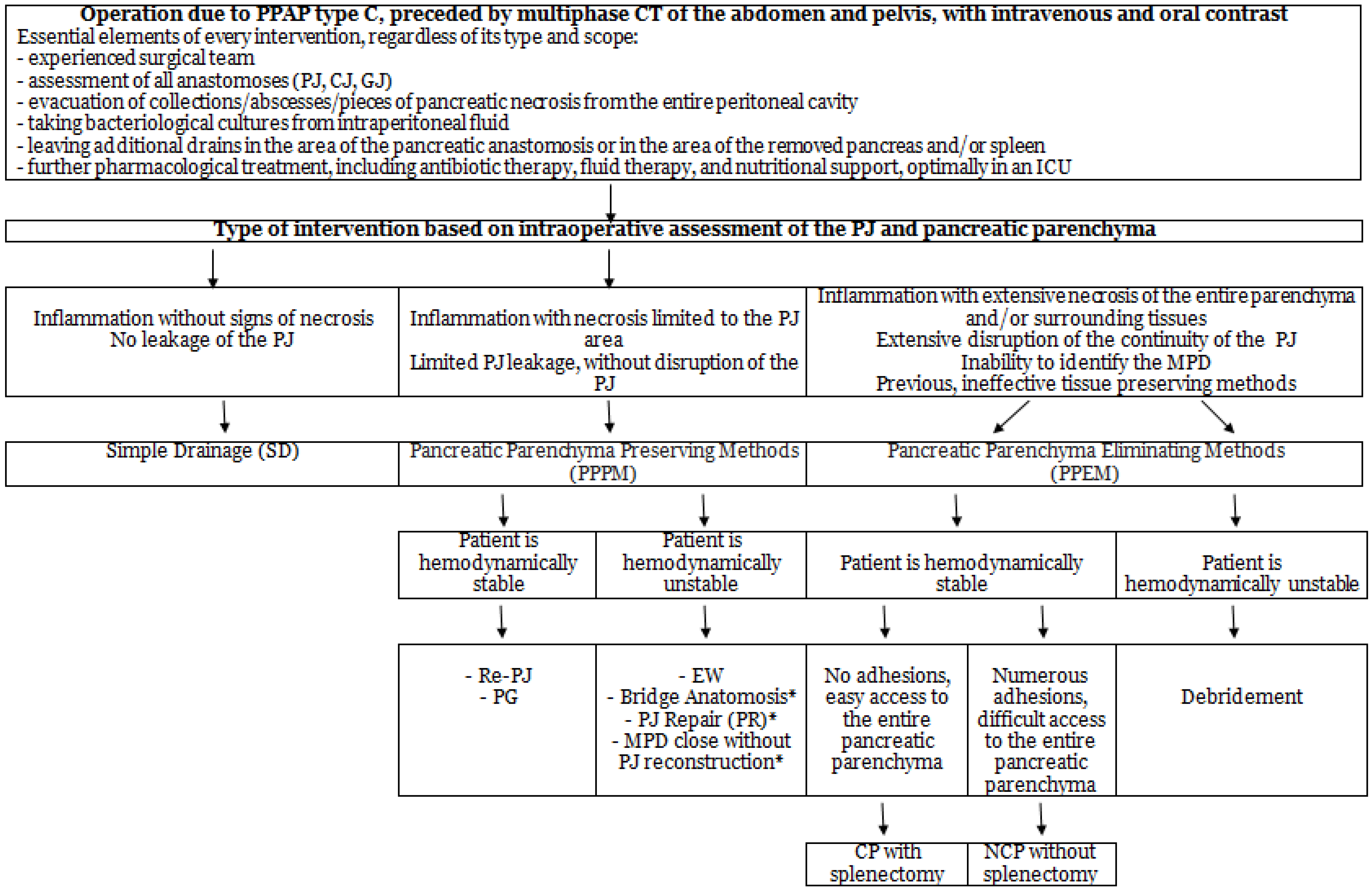
6. PPPM vs. MEPP—What to Choose?
- -
- Evacuation of all collections, abscesses, and necrotic masses by repeated irrigation of the surgical site
- -
- Thorough hemostasis, with particular attention to the pancreatic tissue
- -
- Inspection of all anastomoses (PJ, CJ, GJ)
- -
- Placement of abdominal drains—at least two, one proximal and one distal to the PJ; additional drains may be necessary in areas following evacuation of large collections, removal of the spleen, etc.
- -
- Culture collection from the peritoneal fluid for bacteriological testing to enable targeted antibiotic therapy.
7. Study Limitations
8. Conclusions
Supplementary Materials
Author Contributions
Funding
Institutional Review Board Statement
Informed Consent Statement
Data Availability Statement
Conflicts of Interest
Abbreviations
| AIT | Autologous Islet Transplantation |
| CJ | Choledochojejunostomy |
| CP | Completion Pancreatectomy |
| CT | Computed Tomography |
| DGE | Delayed Gastric Emptying |
| EUS | Endoscopic Ultrasonography |
| GDA | Gastroduodenal Artery |
| EW | External Wirsungostomy |
| GJ | Gastrojejunostomy |
| ICU | Intensive Care Unit |
| ISGPS | International Study Group of pancreatic Surgery |
| MEPP | Method of Eliminating Pancreatic Parenchyma |
| MPD | Main Pancreatic Duct |
| PPPM | Pancreatic Parenchyma Preserving Method |
| NCP | Near Completion Pancreatectomy |
| PD | Pancreatoduodenectomy |
| PG | Pancreatogastrostomy |
| PJ | Pancreatojejunostomy |
| PJR | Pancreatojejunostomy Repair |
| POPF | Postoperative Fistula |
| PPAP | Postpancreatectomy Acute Pancreatitis |
| PPH | Postpancreatectomy Hemorrhage |
| re-PJ | Re-pancreatojejunostomy |
| SD | Simple Drainage |
| USG | Ultrasonography |
| WON | Walled-Off Necrosis |
| VARD | Video-Assisted Retroperitoneal Debridement |
References
- Simon, R. Complications After Pancreaticoduodenectomy. Surg. Clin. N. Am. 2021, 101, 865–874. [Google Scholar] [CrossRef] [Scilit] [PubMed]
- Kokkinakis, S.; Kritsotakis, E.I.; Maliotis, N.; Karageorgiou, I.; Chrysos, E.; Lasithiotakis, K. Complications of modern pancreaticoduodenectomy: A systematic review and meta-analysis. Hepatobiliary Pancreat. Dis. Int. 2022, 21, 527–537. [Google Scholar] [CrossRef] [Scilit] [PubMed]
- Marchegiani, G.; Barreto, S.G.; Bannone, E.; Sarr, M.; Vollmer, C.M.; Connor, S.; Falconi, M.; Besselink, M.G.; Salvia, R.; Wolfgang, C.L.; et al. Postpancreatectomy Acute Pancreatitis (PPAP): Definition and Grading From the International Study Group for Pancreatic Surgery (ISGPS). Ann. Surg. 2022, 275, 663–672. [Google Scholar] [CrossRef] [Scilit] [PubMed]
- Lermite, E.; Pessaux, P.; Brehant, O.; Teyssedou, C.; Pelletier, I.; Etienne, S.; Jean-Pierre, A. Risk factors of pancreatic fistula and delayed gastric emptying after pancreaticoduodenectomy with pancreaticogastrostomy. J. Am. Coll. Surg. 2007, 204, 588–596. [Google Scholar] [CrossRef] [Scilit] [PubMed]
- El Nakeeb, A.; Salah, T.; Sultan, A.; El Hemaly, M.; Askr, W.; Ezzat, H.; Hamdy, E.; Atef, E.; El Hanafy, E.; El-Geidie, A.; et al. Pancreatic anastomotic leakage after pancreaticoduodenectomy. Risk factors, clinical predictors, and management (single center experience). World J. Surg. 2013, 37, 1405–1418. [Google Scholar] [CrossRef] [Scilit] [PubMed]
- Andrianello, S.; Bannone, E.; Marchegiani, G.; Malleo, G.; Paiella, S.; Esposito, A.; Salvia, R.; Bassi, C. Characterization of postoperative acute pancreatitis (POAP) after distal pancreatectomy. Surgery 2021, 169, 724–731. [Google Scholar] [CrossRef] [Scilit] [PubMed]
- Ikenaga, N.; Ohtsuka, T.; Nakata, K.; Watanabe, Y.; Mori, Y.; Nakamura, M. Clinical significance of postoperative acute pancreatitis after pancreatoduodenectomy and distal pancreatectomy. Surgery 2021, 169, 732–737. [Google Scholar] [CrossRef] [Scilit] [PubMed]
- Kühlbrey, C.M.; Samiei, N.; Sick, O.; Makowiec, F.; Hopt, U.T.; Wittel, U.A. Pancreatitis After Pancreatoduodenectomy Predicts Clinically Relevant Postoperative Pancreatic Fistula. J. Gastrointest. Surg. 2017, 21, 330–338. [Google Scholar] [CrossRef] [Scilit] [PubMed]
- Loos, M.; Strobel, O.; Dietrich, M.; Mehrabi, A.; Ramouz, A.; Al-Saeedi, M.; Müller-Stich, B.P.; Diener, M.K.; Schneider, M.; Berchtold, C.; et al. Hyperamylasemia and acute pancreatitis after pancreatoduodenectomy: Two different entities. Surgery 2021, 169, 369–376. [Google Scholar] [CrossRef] [Scilit] [PubMed]
- Loos, M.; Strobel, O.; Mehrabi, A.; Mihaljevic, A.L.; Ramouz, A.; Dietrich, M.; Müller-Stich, B.P.; Diener, M.K.; Schneider, M.; Berchtold, C.; et al. Postoperative acute pancreatitis is a serious but rare complication after distal pancreatectomy. HPB 2021, 23, 1339–1348. [Google Scholar] [CrossRef] [Scilit] [PubMed]
- Connor, S. Defining post-operative pancreatitis as a new pancreatic specific complication following pancreatic resection. HPB 2016, 18, 642–651. [Google Scholar] [CrossRef] [Scilit] [PubMed]
- Banks, P.A.; Bollen, T.L.; Dervenis, C.; Gooszen, H.G.; Johnson, C.D.; Sarr, M.G.; Tsiotos, G.G.; Vege, S.S. Classification of acute pancreatitis—2012: Revision of the Atlanta classification and definitions by international consensus. Gut 2013, 62, 102–111. [Google Scholar] [CrossRef] [Scilit] [PubMed]
- Thiyagarajan, S.K.; Verastegui, A.; Stauffer, J.A.; Poruk, K. Navigating the Spectrum of Pancreatic Surgery Complications: A Review. Complications 2025, 2, 24. [Google Scholar] [CrossRef] [Scilit]
- Wroński, M.; Cebulski, W.; Witkowski, B.; Guzel, T.; Karkocha, D.; Lech, G.; Słodkowski, M. Surgical management of the grade C pancreatic fistula after pancreatoduodenectomy. HPB 2019, 21, 1166–1174. [Google Scholar] [CrossRef] [Scilit] [PubMed]
- Balzano, G.; Pecorelli, N.; Piemonti, L.; Ariotti, R.; Carvello, M.; Nano, R.; Braga, M.; Staudacher, C. Relaparotomy for a pancreatic fistula after a pancreaticoduodenectomy: A comparison of different surgical strategies. HPB 2014, 16, 40–45. [Google Scholar] [CrossRef] [Scilit] [PubMed]
- de Castro, S.M.M.; Busch, O.R.C.; van Gulik, T.M.; Obertop, H.; Gouma, D.J. Incidence and management of pancreatic leakage after pancreatoduodenectomy. Br. J. Surg. 2005, 92, 1117–1123. [Google Scholar] [CrossRef] [Scilit] [PubMed]
- Haddad, L.B.P.; Scatton, O.; Randone, B.; Andraus, W.; Massault, P.-P.; Dousset, B.; Soubrane, O. Pancreatic fistula after pancreaticoduodenectomy: The conservative treatment of choice. HPB 2009, 11, 203–209. [Google Scholar] [CrossRef] [Scilit] [PubMed]
- Govil, S. Salvage pancreaticogastrostomy for pancreatic fistulae after pancreaticoduodenectomy. Indian J. Gastroenterol. 2012, 31, 263–266. [Google Scholar] [CrossRef] [Scilit] [PubMed]
- Záruba, P.; Rousek, M.; Kočišová, T.; Havlová, K.; Ryska, M.; Pohnán, R. A comparison of surgical approaches in the treatment of grade C postoperative pancreatic fistula: A retrospective study. Front. Surg. 2022, 9, 927737. [Google Scholar] [CrossRef] [Scilit] [PubMed]
- Wiltberger, G.; Schmelzle, M.; Tautenhahn, H.-M.; Krenzien, F.; Atanasov, G.; Hau, H.-M.; Moche, M.; Jonas, S. Alternative treatment of symptomatic pancreatic fistula. J. Surg. Res. 2015, 196, 82–89. [Google Scholar] [CrossRef] [Scilit] [PubMed]
- Horvath, P.; Beckert, S.; Nadalin, S.; Königsrainer, A.; Königsrainer, I. Pancreas-preserving surgical management of grade-C pancreatic fistulas after pancreatic head resection by external wirsungostomy. Langenbecks Arch. Surg. 2016, 401, 457–462. [Google Scholar] [CrossRef] [Scilit] [PubMed]
- Denost, Q.; Pontallier, A.; Rault, A.; Ewald, J.A.; Collet, D.; Masson, B.; Sa-Cunha, A. Wirsungostomy as a salvage procedure after pancreaticoduodenectomy. HPB 2012, 14, 82–86. [Google Scholar] [CrossRef] [Scilit] [PubMed]
- Conzo, G.; Gambardella, C.; Tartaglia, E.; Sciascia, V.; Mauriello, C.; Napolitano, S.; Orditura, M.; De Vita, F.; Santini, L. Pancreatic fistula following pancreatoduodenectomy. Evaluation of different surgical approaches in the management of pancreatic stump. Lit. Rev. Int. J. Surg. 2015, 21, S4–S9. [Google Scholar] [CrossRef] [Scilit] [PubMed]
- Egeli, T.; Unek, T.; Ozbilgin, M.; Goztok, M.; Astarcıoglu, I. A Novel Technique for Managing Pancreaticojejunal Anastomotic Leak after Pancreaticoduodenectomy. Case Rep. Surg. 2016, 2016, 1–3. [Google Scholar] [CrossRef] [Scilit] [PubMed]
- Yu, Z.; Wu, X.; Zhou, X.; Hu, X.; Lu, J.; Fang, S.; Wang, L.; Ruan, Y.; Lu, Y.; Li, H. Ligamentum teres hepatis wrapping of the gastroduodenal artery stump for protection in total laparoscopic pancreaticoduodenectomy: A single-center experience. J. Int. Med. Res. 2023, 51, 3000605231188288. [Google Scholar] [CrossRef] [Scilit] [PubMed]
- Paye, F.; Lupinacci, R.M.; Kraemer, A.; Lescot, T.; Chafaï, N.; Tiret, E.; Balladur, P. Surgical treatment of severe pancreatic fistula after pancreaticoduodenectomy by wirsungostomy and repeat pancreatico-jejunal anastomosis. Am. J. Surg. 2013, 206, 194–201. [Google Scholar] [CrossRef] [Scilit] [PubMed]
- Ribero, D.; Amisano, M.; Zimmitti, G.; Giraldi, F.; Ferrero, A.; Capussotti, L. External tube pancreatostomy reduces the risk of mortality associated with completion pancreatectomy for symptomatic fistulas complicating pancreaticoduodenectomy. J. Gastrointest. Surg. 2013, 17, 332–338. [Google Scholar] [CrossRef] [Scilit] [PubMed]
- Kent, T.S.; Callery, M.P.; Vollmer, C.M. The bridge stent technique for salvage of pancreaticojejunal anastomotic dehiscence. HPB 2010, 12, 577–582. [Google Scholar] [CrossRef] [Scilit] [PubMed]
- Ma, T.; Bai, X.; Chen, W.; Li, G.; Lao, M.; Liang, T. Pancreas-preserving management of grade-C pancreatic fistula and a novel bridging technique for repeat pancreaticojejunostomy: An observational study. Int. J. Surg. 2018, 52, 243–247. [Google Scholar] [CrossRef] [Scilit] [PubMed]
- Xu, J.; Dai, X.; Bu, X.; Gao, F.; Zhang, X. Pancreaticojejunal Bridge-Anastomosis: A Novel Option for Surgeon to Preserve Pancreatic Body and Tail in Urgent Reoperation for Intra-abdominal Massive Hemorrhage after Pancreaticoduodenectomy. World J. Surg. 2010, 34, 2457–2462. [Google Scholar] [CrossRef] [Scilit] [PubMed]
- Königsrainer, I.; Zieker, D.; Beckert, S.; Glatzle, J.; Schroeder, T.H.; Heininger, A.; Nadalin, S.; Konigsrainer, A. A pancreas-preserving technique for the management of symptomatic pancreatic anastomotic insufficiency refractory to conservative treatment after pancreas head resection. Langenbecks Arch. Surg. 2010, 395, 693–696. [Google Scholar] [CrossRef] [Scilit] [PubMed]
- Lee, J.; Lee, J.; Yun, J.H.; Choi, C.; Cho, S.; Kim, S.J.; Kim, J.H. Autocrine DUSP28 signaling mediates pancreatic cancer malignancy via regulation of PDGF-A. Sci. Rep. 2017, 7, 12760. [Google Scholar] [CrossRef] [Scilit] [PubMed]
- Mastalier, B.; Cauni, V.; Tihon, C.; Septimiu Petrutescu, M.; Ghita, B.; Popescu, V.; Andras, D.; Radu, I.M.; Vlasceanu, V.G.; Floroiu, M.F.; et al. Pancreaticogastrostomy versus Pancreaticojejunostomy and the Proposal of a New Postoperative Pancreatic Fistula Risk Score. J. Clin. Med. 2023, 12, 6193. [Google Scholar] [CrossRef] [Scilit] [PubMed]
- Kazantsev, G.B.; Spitzer, A.L.; Peng, P.D.; Ramirez, R.M.; Chang, C.-K.; Tsai, S.; Aldakkak, M.; Huyser, M.R.; Dominguez, D.A. Pancreaticogastrostomy as a fistula mitigating strategy for a high-risk pancreatic anastomosis following pancreaticoduodenectomy. HPB 2023, 25, 124–135. [Google Scholar] [CrossRef] [Scilit] [PubMed]
- Lee, S.J.; Choi, I.S.; Moon, J.I. Conversion to pancreaticogastrostomy for salvage of disrupted pancreaticojejunostomy following pancreaticoduodenectomy. Ann. Surg. Treat. Res. 2022, 103, 217–226. [Google Scholar] [CrossRef] [Scilit] [PubMed]
- Bachellier, P. Pancreatogastrostomy as a Salvage Procedure to Treat Severe Postoperative Pancreatic Fistula After Pancreatoduodenectomy. Arch. Surg. 2008, 143, 966. [Google Scholar] [CrossRef] [Scilit] [PubMed]
- Loos, M.; König, A.-K.; von Winkler, N.; Mehrabi, A.; Berchtold, C.; Müller-Stich, B.P.; Schneider, M.; Hoffmann, K.; Kulu, Y.; Feisst, M. Completion Pancreatectomy After Pancreatoduodenectomy: Who Needs It? Ann. Surg. 2023, 278, e87–e93. [Google Scholar] [CrossRef] [Scilit] [PubMed]
- Nentwich, M.F.; El Gammal, A.T.; Lemcke, T.; Ghadban, T.; Bellon, E.; Melling, N.; Bachmann, K.; Reeh, M.; Uzunoglu, F.G.; Izbicki, J.R.; et al. Salvage Completion Pancreatectomies as Damage Control for Post-pancreatic Surgery Complications: A Single-Center Retrospective Analysis. World J. Surg. 2015, 39, 1550–1556. [Google Scholar] [CrossRef] [Scilit] [PubMed]
- Gueroult, S.; Parc, Y.; Duron, F.; Paye, F.; Parc, R. Completion pancreatectomy for postoperative peritonitis after pancreaticoduodenectomy: Early and late outcome. Arch. Surg. 2004, 139, 16–19. [Google Scholar] [CrossRef] [Scilit] [PubMed]
- Tamijmarane, A.; Ahmed, I.; Bhati, C.S.; Mirza, D.F.; Mayer, A.D.; Buckels, J.A.C.; Bramhall, S.R. Role of Completion Pancreatectomy as a Damage Control Option for Post-Pancreatic Surgical Complications. Dig. Surg. 2006, 23, 229–234. [Google Scholar] [CrossRef] [Scilit] [PubMed]
- Groen, J.V.; Smits, F.J.; Koole, D.; Besselink, M.G.; Busch, O.R.; den Dulk, M.; van Eijck, C.H.J.; Groot Koerkamp, B.; van der Harst, E.; de Hingh, I.H.; et al. Completion pancreatectomy or a pancreas-preserving procedure during relaparotomy for pancreatic fistula after pancreatoduodenectomy: A multicentre cohort study and meta-analysis. Br. J. Surg. 2021, 108, 1371–1379. [Google Scholar] [CrossRef] [Scilit] [PubMed]
- Mintziras, I.; Stollenwerk, L.; Uhl, W.; Niescery, J.; Belyaev, O.; Luu, A.M.; Munding, J.; Tannapfel, A.; Kunzli, B.; Herzog, T. Pancreatic Apoplexy. Pancreas 2022, 51, 1128–1132. [Google Scholar] [CrossRef] [Scilit] [PubMed]
- Bramis, K.; Vouros, D.; Kotsarinis, V.; Frountzas, M.; Antonakis, P.; Memos, N.; Alexakis, N.; Konstadoulakis, M.; Toutouzas, K. Completion Pancreatectomy as a Treatment Option for Complications Following Pancreatoduodenectomy. Am. Surg. 2023, 89, 6348–6350. [Google Scholar] [CrossRef] [Scilit] [PubMed]
- Garnier, J.; Ewald, J.; Marchese, U.; Delpero, J.-R.; Turrini, O. Standardized salvage completion pancreatectomy for grade C postoperative pancreatic fistula after pancreatoduodenectomy (with video). HPB 2021, 23, 1418–1426. [Google Scholar] [CrossRef] [Scilit] [PubMed]
- Bressan, A.K.; Wahba, M.; Dixon, E.; Ball, C.G. Completion pancreatectomy in the acute management of pancreatic fistula after pancreaticoduodenectomy: A systematic review and qualitative synthesis of the literature. HPB 2018, 20, 20–27. [Google Scholar] [CrossRef] [Scilit] [PubMed]
- Almond, M.; Roberts, K.J.; Hodson, J.; Sutcliffe, R.; Marudanayagam, R.; Isaac, J.; Muiesan, P.; Miraz, D. Changing indications for a total pancreatectomy: Perspectives over a quarter of a century. HPB 2015, 17, 416–421. [Google Scholar] [CrossRef] [Scilit] [PubMed]
- Smits, F.J.; van Santvoort, H.C.; Besselink, M.G.; Batenburg, M.C.T.; Slooff, R.A.E.; Boerma, D.; Busch, O.R.; Coene, P.; van Dam, R.; van Dijk, D. Management of Severe Pancreatic Fistula After Pancreatoduodenectomy. JAMA Surg. 2017, 152, 540. [Google Scholar] [CrossRef] [Scilit] [PubMed]
- Roberts, K.J.; Blanco, G.; Webber, J.; Marudanayagam, R.; Sutcliffe, R.P.; Muiesan, P.; Bramhall, S.R.; Isaac, J.; Mirza, D.F. How severe is diabetes after total pancreatectomy? A case-matched analysis. HPB 2014, 16, 814–821. [Google Scholar] [CrossRef] [Scilit] [PubMed]
- Jethwa, P.; Sodergren, M.; Lala, A.; Webber, J.; Buckels, J.A.C.; Bramhall, S.R.; Mirza, D.F. Diabetic control after total pancreatectomy. Dig. Liver Dis. 2006, 38, 415–419. [Google Scholar] [CrossRef] [Scilit] [PubMed]
- Förster, S.; Liu, X.; Adam, U.; Schareck, W.D.; Hopt, U.T. Islet autotransplantation combined with pancreatectomy for treatment of pancreatic adenocarcinoma: A case report. Transplant. Proc. 2004, 36, 1125–1126. [Google Scholar] [CrossRef] [Scilit] [PubMed]
- Alsaif, F.; Molinari, M.; Al-Masloom, A.; Lakey, J.R.T.; Kin, T.; Shapiro, A.M.J. Pancreatic Islet Autotransplantation With Completion Pancreatectomy in the Management of Uncontrolled Pancreatic Fistula After Whipple Resection for Ampullary Adenocarcinoma. Pancreas 2006, 32, 430–431. [Google Scholar] [CrossRef] [Scilit] [PubMed]
- Eckhauser, F.E.; Strodel, W.E.; Knol, J.A.; Harper, M.; Turcotte, J.G. Near-total pancreatectomy for chronic pancreatitis. Surgery 1984, 96, 599–607. [Google Scholar] [PubMed]
- Singh, S.; Prakash, S.; Kaushal, D.; Chahal, H.; Sood, A. Percutaneous Catheter Drainage in Acute Infected Necrotizing Pancreatitis: A Real-World Experience at a Tertiary Care Hospital in North India. Cureus 2022, 14, e27994. [Google Scholar] [CrossRef] [Scilit] [PubMed]
- Keshavarz, P.; Azrumelashvili, T.; Yazdanpanah, F.; Nejati, S.F.; Ebrahimian Sadabad, F.; Tarjan, A.; Bazyar, A.; Mizandari, M. Percutaneous catheter drainage of pancreatic associated pathologies: A systematic review and meta-analysis. Eur. J. Radiol. 2021, 144, 109978. [Google Scholar] [CrossRef] [Scilit] [PubMed]
- Pinto, S.; Bellizzi, S.; Badas, R.; Canfora, M.L.; Loddo, E.; Spada, S.; Khalaf, H.; Fugazza, A.; Bergamini, S. Direct Endoscopic Necrosectomy: Timing and Technique. Medicina 2021, 57, 1305. [Google Scholar] [CrossRef] [Scilit] [PubMed]
- Ramai, D. Endoscopic management of pancreatic walled-off necrosis. Ann. Gastroenterol. 2023, 36, 123. [Google Scholar] [CrossRef] [Scilit] [PubMed]
- Wroński, M.; Cebulski, W.; Słodkowski, M.; Krasnodębski, I.W. Minimally invasive treatment of infected pancreatic necrosis. Gastroenterol. Rev. 2014, 6, 317–324. [Google Scholar] [CrossRef] [Scilit] [PubMed]
- Rey Chaves, C.E.; Azula Uribe, M.C.; Benavides Largo, S.; Becerra Sarmiento, L.; Gómez-Gutierrez, M.A.; Cuevas López, L. Video-assisted retroperitoneal debridement for necrotizing pancreatitis: A single center experience in Colombia. BMC Surg. 2024, 24, 293. [Google Scholar] [CrossRef] [Scilit] [PubMed]
- Akalın, S.; Aydoğan, O.; Cartı, E.B.; Edizsoy, A.; Coşkun, M.Ç.; Taşçı, V. Investigation of Risk Factors for Exocrine Pancreatic Insufficiency and Type 3c Diabetes After Pancreatic Surgery. Anatol. J. General. Med. Res. 2025, 35, 345–352. [Google Scholar] [CrossRef] [Scilit]
- Zhou, Y.-M.; Zhou, X.; Wan, T.; Xu, D.; Si, X.-Y. An evidence-based approach to the surgical interventions for severe pancreatic fistula after pancreatoduodenectomy. Surgeon 2018, 16, 119–124. [Google Scholar] [CrossRef] [Scilit] [PubMed]
- Gajda, M.; Grudzińska, E.; Szmigiel, P.; Czopek, P.; Rusinowski, C.; Putowski, Z.; Mrowiec, S. Risk Factors of Postoperative Acute Pancreatitis and Its Impact on the Postoperative Course after Pancreaticoduodenectomy-10 Years of Single-Center Experience. Life 2023, 13, 2344. [Google Scholar] [CrossRef] [Scilit] [PubMed]
- Grudzińska, E.; Gajda, M. Postoperative Acute Pancreatitis After Pancreatic Resections-A Narrative Review and a Diagnostic Algorithm. Cancers 2025, 17, 2773. [Google Scholar] [CrossRef] [Scilit] [PubMed]
- Ghimire, R.; Limbu, Y.; Regmee, S.; Maharjan, D.K.; Mishra, A.; Pahari, R.; Thapa, P.B. Indocyanine green fluorescence imaging: Assessment of perfusion at pancreatic resection margin during pancreatoduodenectomy: A cross sectional study. Health Sci. Rep. 2024, 7, e70153. [Google Scholar] [CrossRef] [Scilit] [PubMed]



| Author | Year | CP After PD (%) | Mortality (%) |
|---|---|---|---|
| Wroński M et al. [14] | 2019 | 2.7 | 47.1 |
| Balzano et al. [15] | 2014 | 2 | 21.4 |
| Ribero D et al. [27] | 2013 | 6.2 | 43.5 |
| Loos M et al. [37] | 2023 | 3 | 37 |
| Nentwich MF et al. [38] | 2015 | 3.8 | 55 |
| Gueroult S et al. [39] | 2004 | 2.8 | 38 |
| Tamijmarane A et al. [40] | 2006 | 3.7 | 52 |
| Groen JV et al. [41] | 2021 | 0.74 | 56 |
| Mintziras I et al. [42] | 2022 | 5.4 | 75 * or 36 ** (with * or without ** pancreatic apoplexy) |
| Bramis K et al. [43] | 2023 | - | 40 |
| Garnier J et al. [44] | 2021 | 4.6 | 23.8 |
| Bressan AK et al. [45] | 2018 | 3 | 42 |
| Almond et al. [46] | 2015 | 3 | 52.6 |
| Smits FJ et al. [47] | 2017 | 9 | 54 |
| Type of Method | Method Description |
|---|---|
| 1. Percutaneous drainage under imaging guidance (USG/CT) [53,54] | It involves inserting a catheter into a fluid collection or necrosis to eliminate infected pancreatic necrosis and remove fluid collections and abscesses. It requires precise planning of the access path based on a CT/USG scan, assessing the relationship to blood vessels and abdominal organs, in order to avoid damaging internal organs and anatomical structures As far as technical possibilities allow, passing through the peritoneal cavity is avoided, preferring an extraperitoneal approach It most often serves as the first stage of treatment before further procedures. |
| 2. Endoscopic Drainage [55,56] | Performed during an endoscopy, most often under the guidance of endoscopic ultrasound (EUS). It involves creating a connection between the stomach or duodenum and a fluid reservoir. Under EUS guidance, the spot with the shortest distance to the reservoir is chosen, avoiding large blood vessels. A puncture and widening of the access channel are performed, then a draining prosthesis is placed. |
| 3. ndoscopic Debridement [55,56] | It is usually performed after prior drainage and creating an access channel to the necrosis. It is typically implemented when endoscopic drainage alone does not provide sufficient clinical improvement, or when the collection is dominated by a solid component. It involves introducing a gastroscope through an inserted stent or a mature fistula into the cavity, followed by mechanically removing necrotic tissue under visual control using endoscopic tools. Most often, the procedure needs to be repeated several times later to fully eliminate the necrotic tissue. |
| 4. Video-Assisted Retroperitoneal Debridement (VARD) [57,58] | A hybrid minimally invasive technique that combines a small surgical access point with the use of laparoscopic tools to directly visualize and remove necrotic tissue using the retroperitoneal space. The procedure starts by gaining access through a small, lateral incision along the lumbar line, through which laparoscopic instruments and optics are introduced, and then the necrotic tissue is removed, usually without the need for a laparotomy. Allows direct control of the surgical field and mechanical removal of necrosis while limiting soft tissue trauma, reducing the risk of abdominal contamination and systemic complications compared to a classic laparotomy. |
| Type of Intervention | Advantages | Disadvantages |
|---|---|---|
| Pancreatic parenchyma preserving methods (PPPM) | Main advantage: possible preservation of some of the endocrine and exocrine functions by leaving part of the gland Shorter operation time [14] Less invasive procedure [19,21] Lower mortality rate *—yes [18,21,27,35,36]; no [14] Technically easier [21] Less frequent multiorgan failure [14] | Main disadvantage: lack of definitive elimination of the PPAP-C source, i.e., the inflamed pancreatic tissue Frequent need for repeated interventions, both planned (anastomotic reconstruction in the case of external drainage [14,27]) or unplanned (deterioration of the general and local condition caused by further evolution of PPAP [20]) |
| Methods eliminating the pancreatic parenchyma (MEPP) | Main advantage: definitive elimination of the PPAP-C cause Less frequent reoperations—yes [15]; no [60] | Main disadvantage: imminent exocrine and endocrine failure (brittle diabetes) Longer operation time [14] More demanding technically [14] More invasive Higher mortality rate *—yes [21]; no [14] More frequent blood transfusions [14] |
Disclaimer/Publisher’s Note: The statements, opinions and data contained in all publications are solely those of the individual author(s) and contributor(s) and not of MDPI and/or the editor(s). MDPI and/or the editor(s) disclaim responsibility for any injury to people or property resulting from any ideas, methods, instructions or products referred to in the content. |
© 2026 by the authors. Published by MDPI on behalf of the Lithuanian University of Health Sciences. Licensee MDPI, Basel, Switzerland. This article is an open access article distributed under the terms and conditions of the Creative Commons Attribution (CC BY) license.
Share and Cite
Grudzińska, E.; Gajda, M.; Zielonka, M.; Dubaj, W.; Mrowiec, S. Surgical Procedures Used in the Treatment of Postoperative Acute Pancreatitis Grade C After Pancreatoduodenectomy—A Narrative Review. Medicina 2026, 62, 1337. https://doi.org/10.3390/medicina62071337
Grudzińska E, Gajda M, Zielonka M, Dubaj W, Mrowiec S. Surgical Procedures Used in the Treatment of Postoperative Acute Pancreatitis Grade C After Pancreatoduodenectomy—A Narrative Review. Medicina. 2026; 62(7):1337. https://doi.org/10.3390/medicina62071337
Chicago/Turabian StyleGrudzińska, Ewa, Magdalena Gajda, Marek Zielonka, Wojciech Dubaj, and Sławomir Mrowiec. 2026. "Surgical Procedures Used in the Treatment of Postoperative Acute Pancreatitis Grade C After Pancreatoduodenectomy—A Narrative Review" Medicina 62, no. 7: 1337. https://doi.org/10.3390/medicina62071337
APA StyleGrudzińska, E., Gajda, M., Zielonka, M., Dubaj, W., & Mrowiec, S. (2026). Surgical Procedures Used in the Treatment of Postoperative Acute Pancreatitis Grade C After Pancreatoduodenectomy—A Narrative Review. Medicina, 62(7), 1337. https://doi.org/10.3390/medicina62071337