Article

Renal Dysfunction and Serum Sodium-Based Risk Stratification for In-Hospital Mortality in Liver Cirrhosis


by
Sonja Golubović
1,2,*,
Božidar Dejanović
2,3,
Dimitrije Damjanov
2,3,
Nebojša Janjić
2,3,
Vladimir Veselinov
1,2,
Gordana Stražmešter-Majstorović
1 and
Violeta Knežević
1,2
1
Clinic for Nephrology and Clinical Immunology, University Clinical Center of Vojvodina, 21000 Novi Sad, Serbia
2
Faculty of Medicine, University of Novi Sad, 21000 Novi Sad, Serbia
3
Clinic for Gastroenterology and Hepatology, University Clinical Center of Vojvodina, 21000 Novi Sad, Serbia
*
Author to whom correspondence should be addressed.
Medicina 2026, 62(7), 1274; https://doi.org/10.3390/medicina62071274
Submission received: 30 April 2026 / Revised: 28 May 2026 / Accepted: 9 June 2026 / Published: 2 July 2026
(This article belongs to the Section Urology & Nephrology)

Abstract

Background and Objectives: Kidney dysfunction and hyponatremia are prevalent in decompensated liver cirrhosis and are associated with suboptimal prognoses. Most prognostic tools used in cirrhosis are hepatic-centric and necessitate the utilization of multiple laboratory and clinical variables. This study endeavored to delineate and assess kidney function- and serum sodium-based prognostic models for the prediction of in-hospital mortality in patients with liver cirrhosis. Materials and Methods: This retrospective single-center cohort study comprised 547 hospitalized patients with liver cirrhosis and comprehensive data pertaining to serum urea, creatinine, sodium, age, sex, and in-hospital outcome. In-hospital mortality was the primary endpoint. Kidney function was evaluated via the assessment of serum urea, serum creatinine, and estimated glomerular filtration rate (eGFR), using the Chronic Kidney Disease Epidemiology Collaboration (CKD-EPI) 2021 equation. Simple categorical and point-based scores were constructed. Model discrimination, calibration, and operating characteristics were compared with MELD, Child–Pugh, and ALBI scores, as well as with selected combined models. Results: Of the 547 patients, 147 individuals (26.9%) succumbed during the hospitalization period. In the full model, lower eGFR, elevated urea levels, and diminished serum sodium concentrations were independently associated with in-hospital mortality, whereas age and sex did not demonstrate statistical significance. The full model appeared to exhibit moderate discrimination (AUC 0.701, 95% CI 0.652–0.750). A biochemical model based on urea, creatinine and sodium appeared to yield a similar AUC (0.696), and a renal–electrolyte model encompassing eGFR, urea, and sodium seemed to demonstrate an AUC of 0.694. A simple creatinine–sodium score may have attained an AUC of 0.681 and appeared to effectuate the stratification of mortality from 16.4% in the low-risk group to 53.1% in the high-risk group. Adding renal–electrolyte variables or the simple score to MELD did not appear to confer substantial enhancement to performance. Conclusions: Kidney dysfunction and hyponatremia at admission have been identified as independent predictors of in-hospital mortality in liver cirrhosis. A simple creatinine–sodium score may afford practical bedside risk stratification and may complement MELD-based assessment in routine clinical care.

1. Introduction

Liver cirrhosis represents a significant etiology of morbidity and mortality worldwide [1,2]. Episodes of acute decompensation frequently require hospitalization and are associated with substantial short-term mortality [3,4]. Accurate early risk stratification, therefore, appears essential, as its judicious application may guide monitoring intensity, referral to higher levels of care, and transplant evaluation [5,6].
Prognostic assessment in cirrhosis has traditionally relied upon liver-specific scoring systems [7,8,9,10,11,12]. Prominently, the Child–Pugh score and the Model for End-Stage Liver Disease (MELD) [6] are among the most widely utilized; these instruments serve to summarize hepatic dysfunction and, in the specific context of MELD, integrate renal function via serum creatinine assessment [13]. Furthermore, the albumin–bilirubin (ALBI) score has more recently been employed as an objective hepatic prognostic index [14].
However, patients with decompensated cirrhosis do not succumb solely to hepatic dysfunction [15,16]. Extrahepatic organ dysfunction, particularly renal impairment and electrolyte perturbations, assumes a considerable role [17]. Kidney dysfunction and hyponatremia are among the most clinically relevant abnormalities in advanced cirrhosis [18,19]. Both conditions typically reflect severe circulatory and neurohumoral dysregulation, and their manifestation correlates with the development of ascites, hepatorenal syndrome, hepatic encephalopathy, infection, and, ultimately, mortality.
Within routine clinical practice, particularly across internal medicine and nephrology contexts, early bedside assessment frequently depends upon routine laboratory variables, namely serum urea, creatinine, and sodium, prior to the formal computation of more intricate hepatic scoring systems [20,21]. Simple tools derived from these variables may therefore offer practical value. Nonetheless, the extent to which such kidney-based models may predict short-term mortality, and their comparative efficacy against established hepatic scoring systems, remains to be fully elucidated.
The objective of this investigation involved the development and subsequent evaluation of kidney function- and serum sodium-based prognostic models, including a simple point-based bedside score, for the prediction of in-hospital mortality in patients with liver cirrhosis. Although MELD-Na and MELD 3.0 are available through online calculators, their computation requires bilirubin, INR, and additional variables that may not be immediately available during initial triage. The proposed simple score requires only two routine biochemical values (serum creatinine and sodium), making it potentially applicable in emergency triage or resource-limited settings where comprehensive hepatic scoring is not immediately feasible. A subsequent objective entailed the comparison of their discrimination and calibration with MELD, Child–Pugh and ALBI, as well as with combined models integrating renal–electrolyte variables into MELD.

2. Materials and Methods

The present investigation comprised a retrospective, single-center cohort study of consecutive adult patients hospitalized with liver cirrhosis at University Clinical Center of Vojvodina, Clinic for gastroenterology and hepatology in the time period 2020–2025. The analytical framework relied upon a structured clinical and laboratory database, which encompassed demographic characteristics, admission laboratory values, clinical features of decompensation, established liver severity scores and in-hospital outcomes. The study was conducted in accordance with the Declaration of Helsinki and was approved by the Ethics Committee of University Clinical Center of Vojvodina (approval number available upon request). As this was a retrospective review of de-identified, routinely collected clinical data, individual informed consent was waived by the ethics committee in accordance with applicable local regulations.

2.1. Study Population

A total of 800 patients with liver cirrhosis hospitalized between 2020 and 2025 were identified from the institutional database and screened for potential inclusion. Of these, 253 were excluded due to missing data on one or more required variables (serum urea, serum creatinine, serum sodium, age, sex, or in-hospital outcome) or because they were formally listed for liver transplantation at the time of admission. The remaining 547 patients satisfied all inclusion criteria and were consequently incorporated into the primary complete-case analysis. A patient selection flowchart is presented in Figure S1. Regarding transplant-related considerations, this study was conducted at a non-transplant hepatology unit. No patients underwent liver transplantation during the index hospitalization, and transplantation was therefore not a competing outcome in this cohort.

2.2. Data Collection and Variables

The database encompassed demographic data, the duration of hospitalization, the etiology of cirrhosis, the rationale for admission, comorbidities, routine hematological and biochemical variables, coagulation parameters, clinical manifestations of portal hypertension and decompensation, and in-hospital outcome. Composite liver-related and inflammation-related indices available in the dataset included Child–Pugh class and score, MELD, ALBI, APRI, FIB-4, NLR, LMR and PLR. The assessment of renal function was conducted utilizing serum creatinine, serum urea, and the estimated glomerular filtration rate (eGFR). The eGFR computation was derived from admission serum creatinine through the application of the CKD-EPI 2021 equation, subsequent to the conversion of creatinine from µmol/L to mg/dL.

2.3. Outcome Definition

In-hospital mortality constituted the primary outcome measure. For the purpose of regression analyses, death was numerically encoded as one (1) for patients who expired during hospitalization, and as zero (0) for survivors.

2.4. Derivation of Simple Score Categories

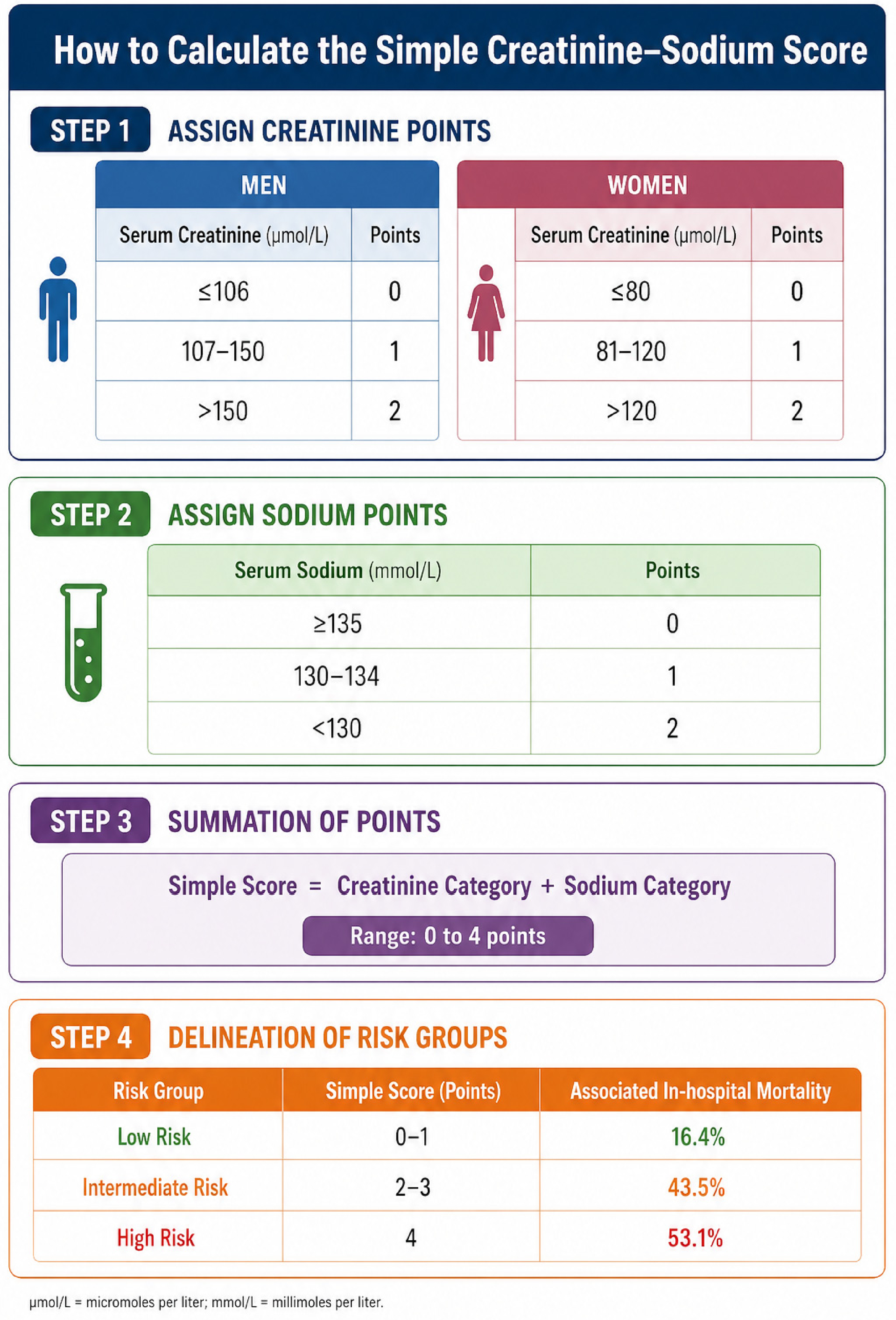
The derivation of simplified categorical models entailed the categorization of admission serum urea, creatinine, and sodium through the application of predefined clinical thresholds. The urea thresholds (\u22648, 8\u201320, >20 mmol/L) were selected based on published prognostic cut-points in decompensated cirrhosis cohorts. Sex-specific creatinine thresholds were derived from standard laboratory upper limits of normal and the CKD-EPI reference framework. Sodium thresholds corresponded to established clinical definitions of normonatremia (\u2265135 mmol/L), moderate hyponatremia (130\u2013134 mmol/L), and severe hyponatremia (<130 mmol/L) as per published consensus guidance on hyponatremia management in liver disease.
Urea was categorized as:
  • 0 points for values ≤8 mmol/L;
  • 1 point for values >8 to 20 mmol/L;
  • 2 points for values >20 mmol/L.
The categorization of creatinine involved the application of sex-specific thresholds, delineated as follows:
  • Men: ≤106 µmol/L = 0 points; 107–150 µmol/L = 1 point; >150 µmol/L = 2 points;
  • Women: ≤80 µmol/L = 0 points; 81–120 µmol/L = 1 point; >120 µmol/L = 2 points.
The classification of sodium levels proceeded as follows:
  • 0 points were assigned for values ≥135 mmol/L;
  • 1 point for values 130–134 mmol/L;
  • 2 points for values <130 mmol/L.
The evaluation encompassed two simplified scoring systems, specifically:
  • Simple score 2 = creatinine category + sodium category (range 0–4);
  • Simple score 3 = urea category + creatinine category + sodium category (range 0–6).
For purposes of clinical interpretation, the categorization of simple score 2 delineated risk into three strata: low risk (zero to one), intermediate risk (two to three), and high risk (four); similarly, simple score 3 was classified into low risk (zero to one), intermediate risk (two to three), and high risk (four or greater).

2.5. Statistical Analysis

Continuous variables underwent summarization through medians with interquartile ranges, while categorical variables were presented as counts and percentages; moreover, a descriptive comparison was conducted between survivors and non-survivors.
The analysis involved the fitting of several logistic regression models, employing in-hospital death as the dependent variable, delineated as follows:
  • Full model: estimated Glomerular Filtration Rate (eGFR), urea, sodium, age, sex;
  • Biochemical model: urea, creatinine, sodium;
  • Renal–electrolyte model: estimated Glomerular Filtration Rate (eGFR), urea, sodium;
  • Simple categorical model: urea category, creatinine category, sodium category;
  • Simple score 2 and simple score 3 as ordinal predictors.
The reporting of odds ratios, accompanied by their respective 95% confidence intervals, was undertaken. Quantification of discrimination was achieved utilizing the area under the receiver operating characteristic curve (AUC) and its associated 95% confidence intervals. AUC values were derived from logistic regression-predicted probabilities for each regression model; for established scores (MELD, Child–Pugh, ALBI), AUC was computed by treating the score value directly as the predictor in an ROC analysis. Confidence intervals for AUC were obtained using the DeLong method, and pairwise AUC comparisons between models were performed using the DeLong test for correlated ROC curves. Calibration was assessed using the Brier score and the Hosmer–Lemeshow goodness-of-fit test. The identification of optimal clinical cut-offs was performed employing the Youden index. Furthermore, the calculation of sensitivity, specificity, positive predictive value, negative predictive value, and accuracy was also conducted.
The performance of kidney-based models underwent comparison with the Model for End-Stage Liver Disease (MELD), Child–Pugh, and Albumin–Bilirubin (ALBI) scores. Specifically, combined models encompassed MELD and Child–Pugh, MELD and ALBI, MELD and renal–electrolyte variables, and MELD and simple score three. A p value < 0.05 was considered statistically significant.

3. Results

3.1. Patient Characteristics

A total of 547 patients with liver cirrhosis were included in the complete-case analysis. Among them, 147 patients (26.9%) died during hospitalization. The median age demonstrated similarity between survivors and non-survivors. The distribution of sexes, moreover, exhibited no statistically significant divergence (Table 1).
Non-survivors manifested a more pronounced renal dysfunction and an exacerbated electrolyte imbalance upon admission. The median urea concentration was 18.7 mmol/L in non-survivors, compared with 8.9 mmol/L in survivors. Median creatinine levels were 146 µmol/L versus 92 µmol/L. Median sodium concentrations were 131 mmol/L versus 136 mmol/L. The median eGFR was 41 mL/min/1.73 m2 versus 72 mL/min/1.73 m2. Liver-specific scores also exhibited a deterioration in patients who succumbed, characterized by elevated MELD and Child–Pugh values and diminished ALBI values.

3.2. Full Renal–Electrolyte Model and Related Models

Within the comprehensive model, which incorporated the estimated glomerular filtration rate (eGFR), urea, sodium, age, and sex, lower eGFR, elevated urea, and diminished sodium levels were independently associated with in-hospital mortality (Table 2). Age and sex did not demonstrate statistical significance.
The full model seemingly exhibited moderate discrimination, evidenced by an AUC of 0.701 (95% CI 0.652–0.750). Calibration appeared satisfactory, as indicated by a Brier score of 0.173 and a non-significant Hosmer–Lemeshow test.
A biochemical model, which incorporated urea, creatinine, and sodium, produced a comparable AUC of 0.696. A renal–electrolyte model, encompassing eGFR, urea, and sodium, demonstrated an AUC of 0.694.

3.3. Simple Categorical Models and Point-Based Scores

In the categorical model based on categorized urea, creatinine, and sodium, the creatinine and sodium categories demonstrated an independent association with mortality, whilst the urea category did not achieve statistical significance. This model achieved an AUC of 0.688. Simple score 3 attained an AUC of 0.682, whereas simple score 2 yielded an AUC of 0.681; nevertheless, despite their inherent simplicity, these point-based models retained a substantial proportion of the prognostic signal observed within the comprehensive model.
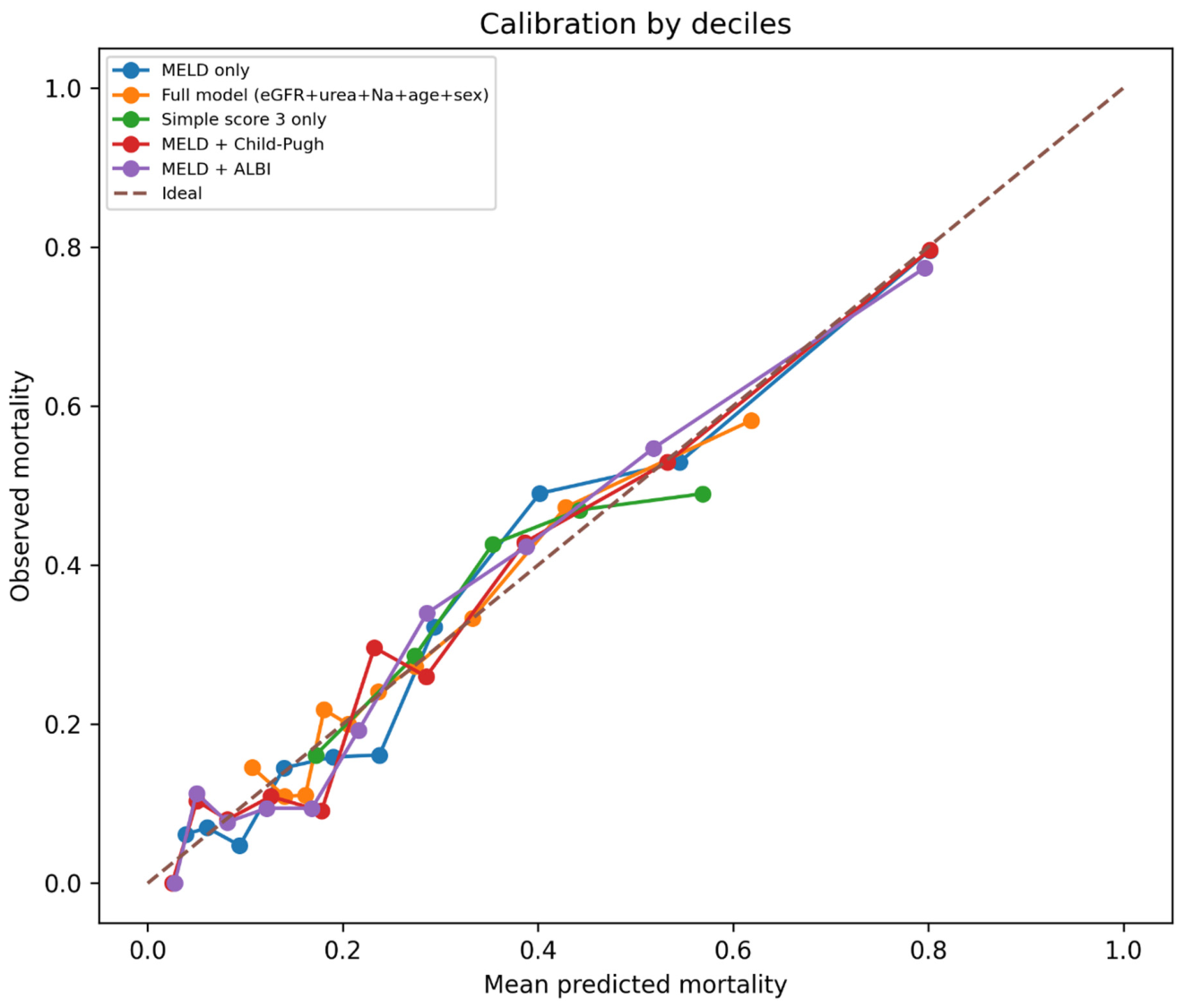
For simple score 2, mortality increased progressively across score values, with score 0: 15.7%, score 1: 18.0%, score 2: 42.1%, score 3: 46.8%, score 4: 53.1%. When grouped into clinically defined strata, simple score 2 showed low risk (0–1): 16.4% mortality; intermediate risk (2–3): 43.5% mortality; high risk (4): 53.1% mortality. All models are represented in Table 3, as well as Figure 1.

3.4. Comparison with Established Liver Scores

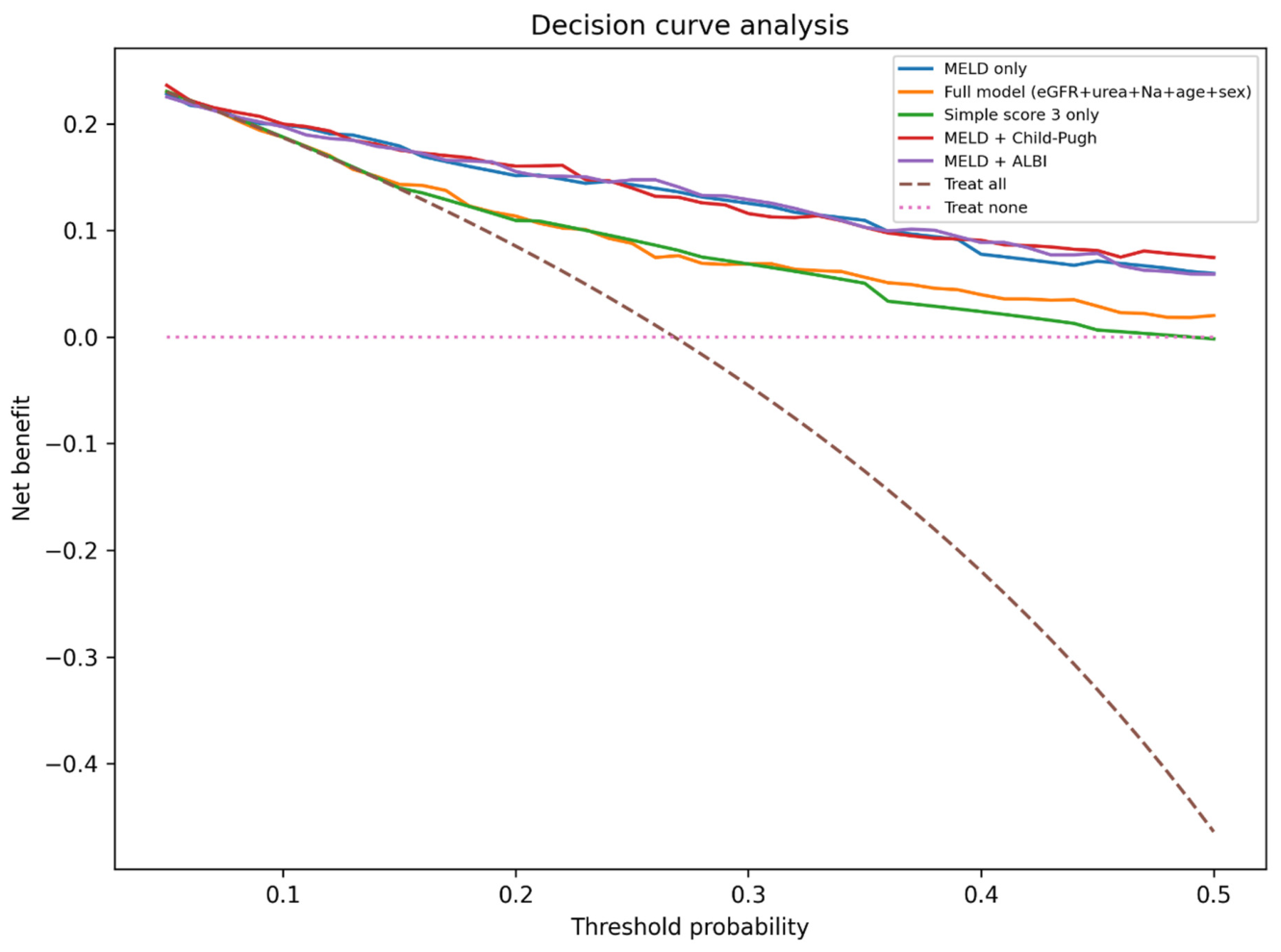
Among individual liver-related scores, Model for End-Stage Liver Disease (MELD) demonstrated the highest discriminatory capacity for in-hospital mortality, with an AUC of 0.814. Child–Pugh score yielded an AUC of 0.760, and the Albumin–Bilirubin (ALBI) index an AUC of 0.714. The kidney-based and simple models had AUCs between approximately 0.68 and 0.70. These results are illustrated in Figure 2. A simplified comparison of laboratory-based models and scores is shown in Figure 3.

3.5. Incremental Value Beyond MELD

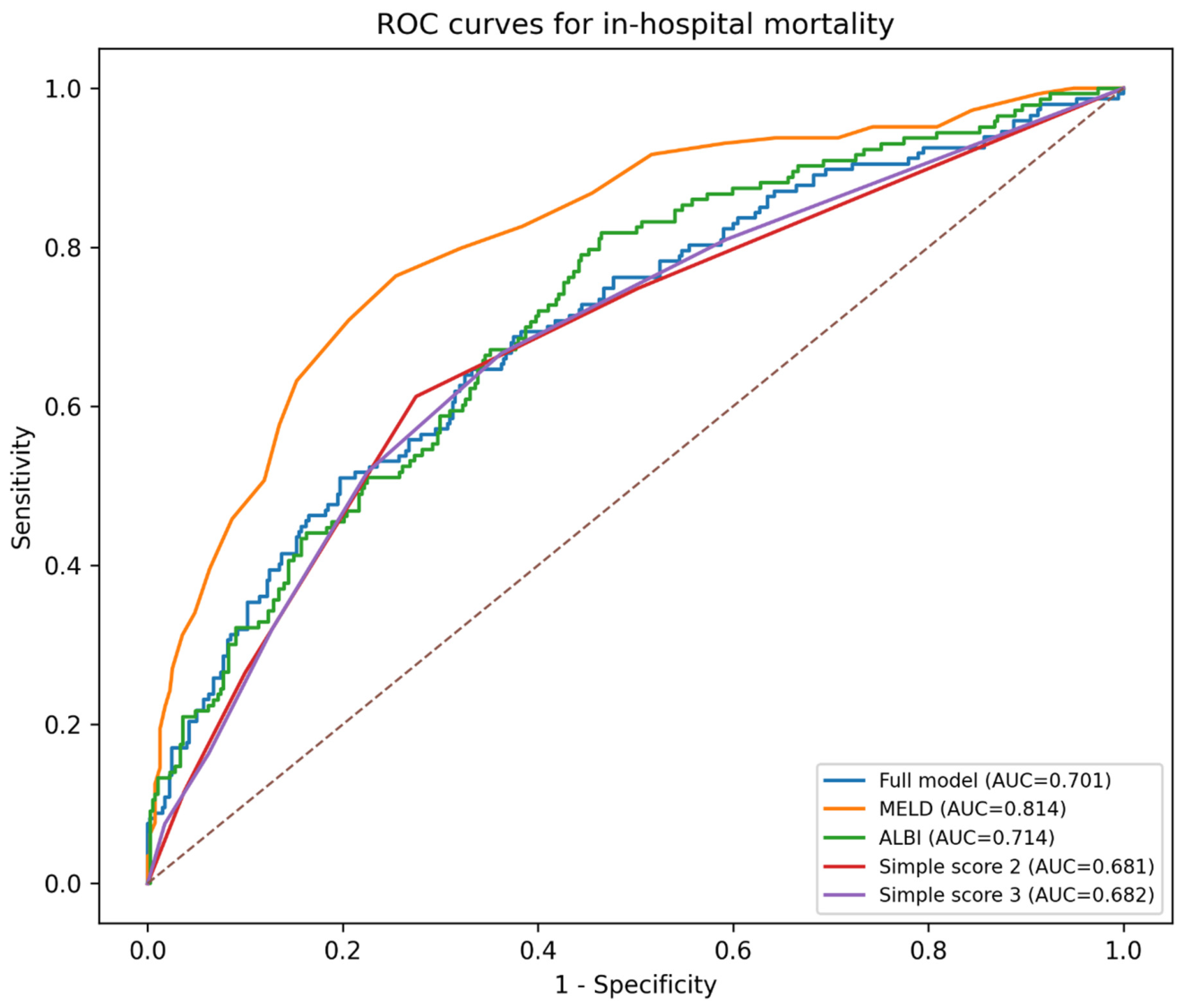
An evaluation of combined models was undertaken to ascertain whether the inclusion of renal–electrolyte variables or simple scores could enhance prediction beyond that afforded by MELD. MELD + Child–Pugh had the highest AUC (0.825), followed closely by MELD + ALBI (0.824). In contrast, MELD + renal–electrolyte variables and MELD + simple score 3 had AUCs that were essentially identical to MELD alone. These findings might suggest that, whilst renal dysfunction and hyponatremia appear to be clinically relevant predictors of mortality, they may not materially improve discrimination once MELD’s impact is accounted for. Decision curve analysis demonstrating the clinical utility of the evaluated models is presented in Figure 4.

4. Discussion

4.1. Principal Findings

The present investigation assessed kidney function- and sodium-based prognostic models in hospitalized patients with liver cirrhosis. The primary findings suggest several key observations: first, a reduced estimated Glomerular Filtration Rate (eGFR), an elevated urea concentration, and diminished serum sodium levels appeared to be independently associated with in-hospital mortality; second, renal–electrolyte models demonstrated moderate discriminative capacity; third, a simplified creatinine–sodium score may facilitate clinically meaningful bedside stratification; and fourth, the Model for End-Stage Liver Disease (MELD) score largely maintained its preeminence as an optimal individual prognostic index.
The observed in-hospital mortality of 26.9% appears largely consistent with reported mortality rates in hospitalized cohorts with acute decompensation [22]. Our MELD AUC of 0.814 is also in line with published short-term prognostic studies, where MELD often performs in the 0.75–0.90 range depending on disease severity and study endpoint [23]. This observation, therefore, lends support to the plausibility of the present findings and may underscore the considerable prognostic utility of MELD in advanced cirrhosis. While MELD demonstrates robust prognostic capabilities, the European Association for the Study of the Liver-CLIF consortium’s Acute-on-Chronic Liver Failure classification appears to demonstrate superior accuracy for predicting 28-day and 90-day mortality, particularly when patients are stratified by ACLF classification at 48 h post-enrollment [24].

4.2. The Contextualization of Renal Dysfunction

The independent association between renal dysfunction and mortality in this cohort is consistent with the established conceptualization that the kidney is a major determinant of outcome in cirrhosis, alongside hepatic parameters such as serum albumin which similarly reflect disease severity and prognosis [17]. Renal injury in cirrhosis reflects complex circulatory and inflammatory disturbances and is closely linked with hepatorenal syndrome, infection and multiorgan failure [25]. Prior studies have shown that acute kidney dysfunction markedly worsens short-term prognosis [24]. The present findings extend this observation through the demonstration that even baseline admission indices, including estimated glomerular filtration rate (eGFR) and urea, may convey independent prognostic information regarding in-hospital mortality. Furthermore, the predictive utility of renal markers may be enhanced through the incorporation of novel biomarkers like cystatin C, which has demonstrated improved prognostic accuracy when substituted for creatinine in the MELD score [26]. Conversely, the CLIF-C ACLF score and the CLIF-C AD score appear to exhibit significantly greater accuracy than MELD and MELD-Na scores in predicting short-term and long-term mortality among patients with and without acute-on-chronic liver failure (ACLF), respectively [27]. Collectively, these scores, alongside the CLIF-C Organ Failure score, demonstrably exhibit superior performance in predicting mortality among cirrhotic patients, thereby outperforming other established scoring systems, such as MELD, MELD-Na, and Child–Pugh, particularly within contexts of acute-on-chronic liver failure [28].
The performance of our renal–electrolyte models, with AUC values around 0.69–0.70, appears comparable to the range reported for numerous non-MELD prognostic tools in decompensated cirrhosis [13]. This observation thus suggests that the prognostic contribution of renal dysfunction, as observed herein, is not anomalous but rather constitutes an integral component of a broader, reproducible pattern consistently documented across hospital-based investigations.
Hyponatremia in cirrhosis is indicative of advanced circulatory dysfunction and compromised free water excretion [29]. Its association with ascites, hepatic encephalopathy, hepatorenal syndrome, and increased mortality has been established [29]; furthermore, prior investigations have demonstrated that each decrement in serum sodium concentration correlates with an unfavorable outcome, a correlation that ultimately precipitated the development of MELD-Na [29,30]. The present findings thus reiterate the clinical significance of hyponatremia as an independent prognosticator of adverse outcomes among cirrhotic patients, thereby reinforcing the utility of sodium-inclusive scoring systems [31].
In the present study, sodium appeared independently associated with in-hospital death within the comprehensive model, additionally demonstrating substantial contributive capacity to the simple bedside score. This observation may underscore the clinical relevance of sodium not only as a marker of disease severity but also as a practical component in the stratification of short-term risk. Nevertheless, the predictive advantage of serum sodium may diminish in patients presenting with higher MELD scores, suggesting its utility in individuals with less severe liver disease [32]. This observation appears consistent with findings in other cohorts wherein the incremental prognostic value of sodium, extending beyond MELD, is most pronounced among patients exhibiting lower MELD scores, thereby substantially contributing to a more refined risk assessment within this particular subgroup [33]. The incorporation of serum sodium levels into predictive models, such as the MELD-Na score, has been posited to enhance the prediction of short-term mortality in patients with liver disease; evidence from alcoholic hepatitis cohorts supports that serum sodium adds meaningful prognostic information beyond MELD alone [34].

4.3. Comparison with MELD, Child–Pugh and ALBI

MELD emerged as the strongest single prognostic score within this cohort; a finding that may not elicit surprise. MELD incorporates creatinine, thereby potentially encompassing a substantial portion of the risk associated with renal dysfunction. The absence of relevant improvement when renal–electrolyte variables or the simple score were added to MELD likely reflects this fact. Indeed, the MELD score’s objective and continuous variables make it a robust predictor of mortality in liver cirrhosis. Furthermore, serum sodium level has been independently associated with the severity of cirrhosis-related complications, underscoring its prognostic significance beyond MELD alone. An important limitation of the present analysis is that MELD-Na and MELD 3.0 were not formally calculated and compared as separate models. MELD-Na, which incorporates serum sodium, and MELD 3.0, which adds further clinical and sex-related parameters, represent the current recommended standards for prognostic assessment in cirrhosis. Direct comparison with these more contemporary MELD variants would have strengthened the conclusions, and their omission is acknowledged as a methodological limitation. Nevertheless, given that the sodium variable is already incorporated into MELD-Na, it is expected that the simple creatinine–sodium score would not outperform MELD-Na. Its intended role is as a rapid, first-contact triage instrument in settings where formal MELD calculation is not immediately feasible [35]. The integration of serum sodium into the MELD score to form MELD-Na further enhances prognostic accuracy, particularly in predicting waiting list mortality for liver transplantation [36,37].
Child–Pugh and ALBI demonstrated an intermediate performance profile. Their AUC values, as observed within this cohort, appear compatible with the broad range delineated in preceding studies [38]. Importantly, the simple creatinine–sodium score performed only modestly worse than these established liver scores, despite relying on only two routine laboratory variables and no clinical grading. This aspect may represent the primary practical contribution of the present investigation [39].
The score, therefore, is not purported to supersede MELD, Child–Pugh, or ALBI; rather, its utility may reside in its capacity as a rapid, minimal-data bedside instrument. This particular applicability may manifest as especially advantageous beyond specialized hepatology settings, specifically where expedited triage is necessitated and comprehensive liver-oriented scoring mechanisms remain inaccessible.

4.4. Clinical Implications

The findings possess substantial practical implications. Early assessment of renal dysfunction and hyponatremia is warranted for all hospitalized patients presenting with cirrhosis. Patients with hyponatremia may represent a high-risk subgroup [38]. The simple creatinine–sodium score may facilitate the expedited identification of such patients.
The score’s utility may be particularly pronounced in emergency departments, general medical wards and non-transplant hospitals. The score necessitates solely the utilization of basic admission laboratory data. It is capable of identifying patients, within its higher categories, who exhibit an anticipated mortality rate exceeding 40–50%. This may support earlier escalation of monitoring, closer hemodynamic assessment, avoidance of nephrotoxins, and timely nephrology consultation.

4.5. Limitations

Several limitations characterize the present study. Its design was retrospective and single-center, relying upon complete-case analysis; consequently, residual confounding and limited generalizability cannot be definitively excluded. The study’s focus was exclusively on admission values and in-hospital mortality; it did not encompass the evaluation of dynamic renal trajectories, acute kidney injury progression, or longer-term outcomes. Finally, creatinine-based assessment of renal function may be inherently imperfect in cirrhosis, particularly in individuals with diminished muscle mass. A further important limitation is the absence of MELD-Na and MELD 3.0 calculation and direct comparison in the primary analysis, as these represent current standards of care that incorporate sodium and additional variables. The simple creatinine–sodium score proposed herein should therefore be understood as a complementary bedside tool rather than a replacement for these validated models. Additionally, since MELD already incorporates creatinine as a component, the incremental prognostic value of further renal parameters over MELD is inherently constrained, which may limit the novelty of renal–electrolyte models as standalone prognostic tools. Prospective, multicenter validation and direct comparison with MELD-Na and MELD 3.0 are necessary before clinical implementation of the proposed score.

5. Conclusions

Among hospitalized patients presenting with hepatic cirrhosis, the presence of renal dysfunction and hyponatremia upon admission appears to constitute independent predictors of in-hospital mortality. The Model for End-Stage Liver Disease (MELD) score, however, remains the strongest solitary prognostic indicator. Nevertheless, a simple creatinine–sodium score does provide practical and clinically meaningful bedside risk stratification; its application may complement MELD-based assessment within routine clinical care.

Supplementary Materials

The following supporting information can be downloaded at: https://www.mdpi.com/article/10.3390/medicina62071274/s1, Figure S1. Patient selection flowchart (STROBE-compliant).

Author Contributions

Conceptualization, S.G., B.D. and V.K.; methodology, S.G.; software, V.V.; validation, S.G., B.D. and D.D.; formal analysis, N.J. and G.S.-M.; investigation, B.D.; resources, V.V.; data curation, S.G.; writing—original draft preparation, S.G.; writing—review and editing, B.D.; visualization, N.J.; supervision, V.K.; project administration, G.S.-M.; All authors have read and agreed to the published version of the manuscript.

Funding

This research received no external funding.

Institutional Review Board Statement

The study was conducted in accordance with the Declaration of Helsinki, and approved by the Ethics Committee of University Clinical Center of Vojvodina (Protocol code available upon request; 19 May 2023). This was a retrospective review of de-identified, routinely collected clinical data.

Informed Consent Statement

Informed consent was waived by the Ethics Committee in accordance with applicable regulations, given that this study constituted a retrospective analysis of de-identified, routinely collected clinical data.

Data Availability Statement

The data presented in this study are available on request from the corresponding author.

Acknowledgments

The authors have reviewed and edited the output and take full responsibility for the content of this publication.

Conflicts of Interest

The authors declare no conflicts of interest.

Abbreviations

The following abbreviations are used in this manuscript:
ALBIAlbumin–Bilirubin
APRIAspartate Aminotransferase to Platelet Ratio Index
AUCArea Under the Curve
CIConfidence Interval
CKD-EPIChronic Kidney Disease Epidemiology Collaboration
eGFREstimated Glomerular Filtration Rate
FIB-4Fibrosis-4 Index
IQRInterquartile Range
LMRLymphocyte-to-Monocyte Ratio
MELDModel for End-Stage Liver Disease
NLRNeutrophil-to-Lymphocyte Ratio
NPVNegative Predictive Value
OROdds Ratio
PLRPlatelet-to-Lymphocyte Ratio
PPVPositive Predictive Value
ROCReceiver Operating Characteristic
SDStandard Deviation
ACLFAcute-on-Chronic Liver Failure
CLIF-CChronic Liver Failure Consortium score
CLIF-C ADCLIF Consortium Acute Decompensation score

References

  1. Liu, Y.; Chen, M. Epidemiology of liver cirrhosis and associated complications: Current knowledge and future directions. World J. Gastroenterol. 2022, 28, 5910–5930. [Google Scholar] [CrossRef] [PubMed]
  2. Jasirwan, C.O.M. Liver Cirrhosis Mortality Worldwide: In Hospital Factors Associated? Indones. J. Gastroenterol. Hepatol. Dig. Endosc. 2021, 22, 1. [Google Scholar] [CrossRef]
  3. Teerasarntipan, T.; Thanapirom, K.; Chirapongsathorn, S.; Suttichaimongkol, T.; Chamroonkul, N.; Bunchorntavakul, C.; Siramolpiwat, S.; Chainuvati, S.; Sobhonslidsuk, A.; Leerapun, A.; et al. Validation of prognostic scores predicting mortality in acute liver decompensation or acute-on-chronic liver failure: A Thailand multicenter study. PLoS ONE 2022, 17, e0277959. [Google Scholar] [CrossRef] [PubMed]
  4. Gambino, C.; Piano, S. Identifying the four shades of acute decompensation of cirrhosis. United Eur. Gastroenterol. J. 2021, 9, 421–422. [Google Scholar] [CrossRef] [PubMed]
  5. Gülcicegi, D.; Goeser, T.; Kasper, P. Prognostic assessment of liver cirrhosis and its complications: Current concepts and future perspectives. Front. Med. 2023, 10, 1268102. [Google Scholar] [CrossRef] [PubMed]
  6. Durand, F.; Valla, D. Assessment of the prognosis of cirrhosis: Child–Pugh versus MELD. J. Hepatol. 2004, 42, S100–S107. [Google Scholar] [CrossRef] [PubMed]
  7. Gonzalez, S.A.; Trotter, J.F. Renal function and MELD: Being direct is better. J. Hepatol. 2010, 52, 622–623. [Google Scholar] [CrossRef] [PubMed][Green Version]
  8. Nguyen, N.N.; Mai, T.H.N.; Vo, N.H.; Vo, C.T.; Ngo, N.T.Y.; Vi, M.T.; Nguyen, T. Value of Acute Kidney Injury in Predicting Mortality in Vietnamese Patients with Decompensated Cirrhosis. Gastroenterol. Insights 2022, 13, 139–147. [Google Scholar] [CrossRef]
  9. Portincasa, P.; Ciaula, A.D.; Wang, D.Q.-H. Longer Walking Distance, More Fat, Better Survival: Prognostic Indicators of Liver Cirrhosis. J. Gastrointest. Liver Dis. 2021, 30, 8–12. [Google Scholar] [CrossRef] [PubMed]
  10. Rowe, I.; Neuberger, J. Prognostic models in cirrhosis: An aid but not a replacement for clinical judgement. Liver Int. 2007, 27, 595–597. [Google Scholar] [CrossRef] [PubMed]
  11. Valdivia, L.R.; Quiroz, J.F. Hiponatremia como factor pronóstico de mortalidad en pacientes cirróticos internados en el Hospital Nacional Guillermo Almenara Irigoyen. 2003–2005. Rev. Gastroenterol. 2007, 27, 27–36. [Google Scholar] [CrossRef]
  12. Bai, Z.; Yin, Y.; Xu, W.; Cheng, G.; Qi, X. Predictive model of in-hospital mortality in liver cirrhosis patients with hyponatremia: An artificial neural network approach. Sci. Rep. 2024, 14, 28719. [Google Scholar] [CrossRef] [PubMed]
  13. Lim, Y.; Larson, T.S.; Benson, J.T.; Kamath, P.S.; Kremers, W.K.; Therneau, T.M.; Kim, W.R. Serum sodium, renal function, and survival of patients with end-stage liver disease. J. Hepatol. 2010, 52, 523–528. [Google Scholar] [CrossRef] [PubMed]
  14. Fragaki, M. Comparative evaluation of ALBI, MELD, and Child-Pugh scores in prognosis of cirrhosis: Is ALBI the new alternative? Ann. Gastroenterol. 2019, 32, 626–632. [Google Scholar] [CrossRef] [PubMed]
  15. Horvath, A.; Leber, B.; Lemesch, S.; Stadlbauer, V. Hospital mortality of cirrhosis: Better, but still room for improvement! Liver Int. 2013, 33, 809–810. [Google Scholar] [CrossRef] [PubMed]
  16. López-Sánchez, G.N.; Domínguez-Pérez, M.; Uribe, M.; Nuño-Lámbarri, N. The fibrogenic process and the unleashing of acute-on-chronic liver failure. Clin. Mol. Hepatol. 2019, 26, 7–15. [Google Scholar] [CrossRef] [PubMed]
  17. Ripoll, C.; Bari, K.; García-Tsao, G. Serum Albumin Can Identify Patients with Compensated Cirrhosis with a Good Prognosis. J. Clin. Gastroenterol. 2014, 49, 613–619. [Google Scholar] [CrossRef] [PubMed]
  18. Bengus, A.; Babiuc, R.D. Hyponatremia—Predictor of adverse prognosis in cirrhosis. J. Med. Life 2012, 5, 176. [Google Scholar] [PubMed]
  19. Solà, E.; Ginès, P. Challenges and Management of Liver Cirrhosis: Pathophysiology of Renal Dysfunction in Cirrhosis. Dig. Dis. 2015, 33, 534–538. [Google Scholar] [CrossRef] [PubMed]
  20. Elias, T.P.; Shewaye, A.B.; Chichaybelu, H.F.; Nur, A.M.; Berhane, K.A.; Minyilshewa, A.T.; Kumsa, K.B.; Seid, B.M. Predictors of In-hospital Mortality among Cirrhotic Patients in Ethiopia: A Multicenter Retrospective Study. medRxiv 2024. [Google Scholar] [CrossRef]
  21. Nicoleta, S.; Ligia, B.; Corina, U.; Maria, B.; Ionela, S.; Marius, C.; Grigore, D. The Prevalence of Chronic Liver Disease: Implications for Renal Impairment. Acta Medica Marisiensis 2015, 61, 168–171. [Google Scholar] [CrossRef][Green Version]
  22. Wong, R.J.; Balasubramanian, J.; Jamil, K.; Huang, X. S1278 Increasing Burden of Hepatorenal Syndrome and Acute Kidney Injury Among Hospitalized Patients with Chronic Liver Disease Is Associated with High In-Hospital Mortality and Increased Healthcare Resource Utilization. Am. J. Gastroenterol. 2022, 117, e924. [Google Scholar] [CrossRef]
  23. Noiva-Perdigoto, D.; Figueiredo, P.; Tomé, L. The Role of the CLIF-C OF and the 2016 MELD in Prognosis of Cirrhosis with and without Acute-on-Chronic Liver Failure. Ann. Hepatol. 2019, 18, 48–57. [Google Scholar] [CrossRef] [PubMed]
  24. Angeli, P.; Rodríguez, E.; Piano, S.; Ariza, X.; Morando, F.; Solà, E.; Romano, A.; García, E.; Pavesi, M.; Risso, A.; et al. Acute kidney injury and acute-on-chronic liver failure classifications in prognosis assessment of patients with acute decompensation of cirrhosis. Gut 2014, 64, 1616–1622. [Google Scholar] [CrossRef] [PubMed]
  25. Macnaughtan, J.; Tritto, G.; Jalan, R. Intrinsic renal disease in cirrhosis: Adding insult to injury. Liver Int. 2010, 30, 639–641. [Google Scholar] [CrossRef] [PubMed]
  26. Jo, S.; Yang, J.; Hwang, S.M.; Lee, M.S.; Park, S.H. Role of biomarkers as predictors of acute kidney injury and mortality in decompensated cirrhosis. Sci. Rep. 2019, 9, 14508. [Google Scholar] [CrossRef] [PubMed]
  27. Shi, Y.; Shu, Z.; Sun, W.; Yang, Q.; Yu, Y.; Yang, G.; Wu, W.; Chen, S.; Huang, W.; Wang, T.; et al. Risk stratification of decompensated cirrhosis patients by Chronic Liver Failure Consortium scores: Classification and regression tree analysis. Hepatol. Res. 2016, 47, 328–337. [Google Scholar] [CrossRef] [PubMed]
  28. Jalan, R.; Saliba, F.; Pavesi, M.; Amorós, À.; Moreau, R.; Ginès, P.; Levesque, E.; Durand, F.; Angeli, P.; Caraceni, P.; et al. Development and validation of a prognostic score to predict mortality in patients with acute-on-chronic liver failure. J. Hepatol. 2014, 61, 1038–1047. [Google Scholar] [CrossRef] [PubMed]
  29. Ryu, J.Y.; Baek, S.H.; Kim, S. Evidence-based hyponatremia management in liver disease. Clin. Mol. Hepatol. 2023, 29, 924–944. [Google Scholar] [CrossRef] [PubMed]
  30. Vadicherla, U.; Immaneni, S.; Kini, P.R. The Association between Serum Sodium Level, Incidence and Severity of Complications in Liver Cirrhosis. Int. J. Sci. Res. IJSR 2023, 12, 2104–2108. [Google Scholar] [CrossRef]
  31. Kim, H.J.; Lee, H.W. Important predictor of mortality in patients with end-stage liver disease. Clin. Mol. Hepatol. 2013, 19, 105–115. [Google Scholar] [CrossRef] [PubMed]
  32. Annamalai, A.; Harada, M.Y.; Chen, M.; Tran, T.T.; Ko, A.; Ley, E.J.; Nuno, M.; Klein, A.; Nissen, N.; Noureddin, M. Predictors of Mortality in the Critically Ill Cirrhotic Patient: Is the Model for End-Stage Liver Disease Enough? J. Am. Coll. Surg. 2017, 224, 276–282. [Google Scholar] [CrossRef] [PubMed]
  33. Crawford, D.H.; Stuart, K. Adding serum sodium to model for end-stage liver disease: Identifying those most at risk. J. Gastroenterol. Hepatol. 2009, 24, 1804–1806. [Google Scholar] [CrossRef] [PubMed]
  34. Stelling, B.E.V.; Asrani, S.K.; Dunn, W.; Kamath, P.S.; Shah, V.H. Influence of Serum Sodium on MELD-Based Survival Prediction in Alcoholic Hepatitis. Mayo Clin. Proc. 2010, 86, 37–42. [Google Scholar] [CrossRef] [PubMed]
  35. Kim, J.; Lee, J.S.; Lee, S.H.; Bae, W.K.; Kim, N.; Kim, K.; Moon, Y.-S. The Association Between the Serum Sodium Level and the Severity of Complications in Liver Cirrhosis. Korean J. Intern. Med. 2009, 24, 106–112. [Google Scholar] [CrossRef] [PubMed]
  36. Kohir, G.V.; Kotli, N. Hyponatremia in Cirrhosis: Comparative Evaluation of MELD and MELD-Na Scores for Predicting Short- and Long-Term Mortality. APIK J. Intern. Med. 2025, 14, 37–43. [Google Scholar] [CrossRef] [PubMed]
  37. Ruf, A.E.; Kremers, W.K.; Chavez, L.L.; Descalzi, V.; Podestá, L.G.; Villamil, F. Addition of serum sodium into the MELD score predicts waiting list mortality better than MELD alone. Liver Transplant. 2005, 11, 336–343. [Google Scholar] [CrossRef] [PubMed]
  38. Naik, A.R.; Moorthy, S. A comparative analysis between Model for End-stage Liver Disease score (MELD), Modified Model for End-stage Liver Disease score (MELD-Na), and Child–Pugh score (CPS) in predicting complications among cirrhosis patients. Egypt. J. Intern. Med. 2025, 37, 99. [Google Scholar] [CrossRef]
  39. Kartoun, U.; Corey, K.E.; Simon, T.G.; Zheng, H.; Aggarwal, R.; Ng, K.; Shaw, S.Y. The MELD-Plus: A generalizable prediction risk score in cirrhosis. PLoS ONE 2017, 12, e0186301. [Google Scholar] [CrossRef] [PubMed]
Figure 1. How to calculate a simple score model.
Medicina 62 01274 g001
Figure 2. Calibration of models.
Medicina 62 01274 g002
Figure 3. Comparison of laboratory/based models and scores.
Medicina 62 01274 g003
Figure 4. Decision curve analysis.
Medicina 62 01274 g004
Table 1. Baseline Clinical and Laboratory Characteristics of Survivors and Non-Survivors.
VariableSurvivors (n = 400)Non-Survivors (n = 147)p-Value
Age (years), mean ± SD61.8 ± 10.963.1 ± 11.20.214
Male sex, n (%)268 (67.0%)102 (69.4%)0.598
Urea (mmol/L), median (IQR)8.9 (6.2–14.5)18.7 (12.4–29.8)<0.001
Creatinine (µmol/L), median (IQR)92 (71–121)146 (104–210)<0.001
Sodium (mmol/L), median (IQR)136 (133–139)131 (128–134)<0.001
eGFR (mL/min/1.73 m2), median (IQR)72 (52–91)41 (26–63)<0.001
MELD score, median (IQR)16 (12–21)24 (19–31)<0.001
ALBI score, mean ± SD−1.68 ± 0.52−1.21 ± 0.61<0.001
Table 2. Discriminative Performance of Liver-Specific and Kidney-Based Models for In-Hospital Mortality.
VariableOR95% CIp-Value
eGFR (per mL/min)0.9820.974–0.991<0.001
Urea (per mmol/L)1.0431.028–1.058<0.001
Sodium (per mmol/L)0.9420.913–0.971<0.001
Age (per year)1.0120.994–1.0310.182
Male sex1.110.74–1.670.613
Table 3. In-hospital mortality by simple creatinine–sodium score categories.
ModelAUC (95% CI)
Full model0.701 (0.661–0.741)
Categorical model0.680 (0.642–0.718)
Simple score 20.681 (0.643–0.719)
Simple score 30.682 (0.644–0.720)
MELD0.814 (0.780–0.848)
ALBI0.708 (0.671–0.745)
MELD + Child–Pugh0.825
MELD + ALBI0.824
Disclaimer/Publisher’s Note: The statements, opinions and data contained in all publications are solely those of the individual author(s) and contributor(s) and not of MDPI and/or the editor(s). MDPI and/or the editor(s) disclaim responsibility for any injury to people or property resulting from any ideas, methods, instructions or products referred to in the content.