The Clinical Role of Electrocardiographic Morphology of Premature Ventricular Contractions for Prognostic Outcomes in Children

Abstract
1. Introduction
2. Materials and Methods
2.1. Participants and Procedures
2.2. 12-Lead ECG
- (1)
- ECG-estimated anatomical localization of the PVCs was determined according to algorithms.
- Variant N1 (Table 1):
- -
- Left bundle branch block (LBBB)-morphology PVCs;
- -
- Right bundle branch block (RBBB)-morphology PVCs.
- Variant N2 (Table 1):
- -
- Outflow tract PVCs;
- -
- Non-outflow tract PVCs.
- Variant N3 (Table 1):
- -
- Outflow tract PVCs:
- -
- LVOT (left ventricular outflow tract);
- -
- RVOT (right ventricular outflow tract);
- -
- Left ventricular PVCs (papillary muscles, mitral valve, aortomitral region);
- -
- Right ventricular PVCs (tricuspid valve, papillary muscles, moderator muscle);
- -
- Fascicular PVCs;
- -
- Atypical PVCs (epicardial).
- (2)
- The following PVC parameters were measured and calculated in the recorded 12-lead ECGs:
- -
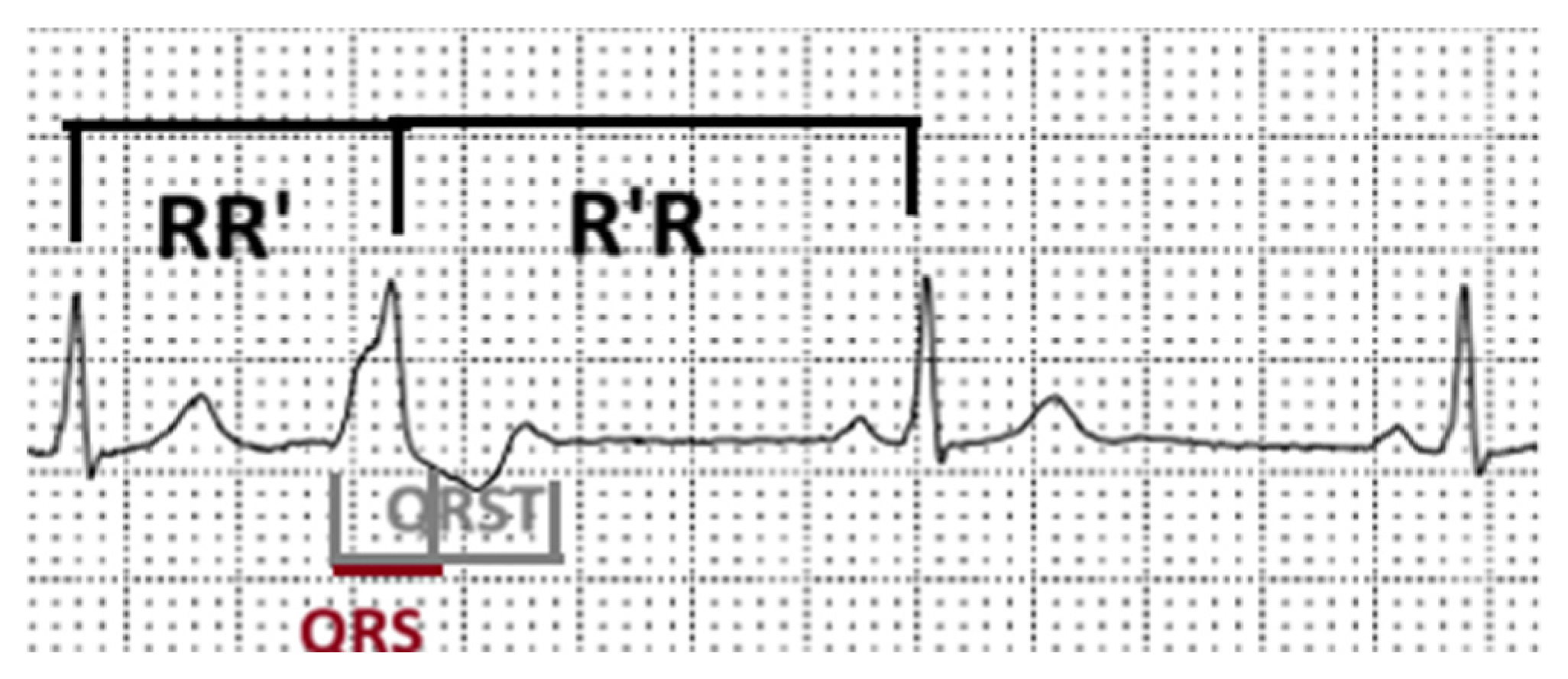
- Coupling interval (RR’)—the duration in seconds from the R wave of the normal QRS complex to the R wave of the extrasystolic QRS complex (Figure 1);
- -
- Postcoupling interval (R’R)—the duration in seconds from the R wave of the extrasystolic QRS complex to the R wave of the normal QRS complex (Figure 1);
- -
- Extrasystole (PVC) duration—the duration of the extrasystolic (PVC) QRS and QRST (Figure 1);
- -
- Normal complex QRS duration;
- -
- Ratio between the PVC QRS and normal complex QRS (ratio PVC/normal QRS);
- -
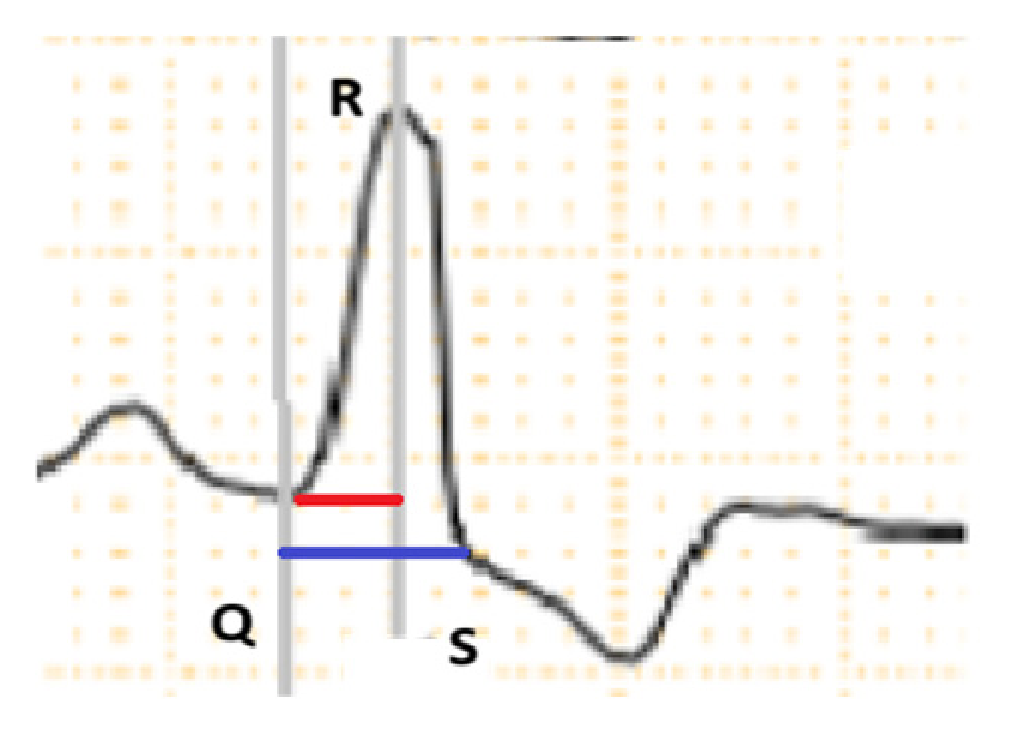
- Maximum deflection index, MDI—measured in precordial leads as the ratio between the shortest time from the beginning of the QRS to the R wave and the total QRS duration in V5-V6 derivations (Figure 2);
- -
- Heart rate on ECG;
- -
- Other signs of ECG pathology (hypertrophy, other rhythm and conduction disorders, repolarization changes in the sinus rhythm PQRST).


2.3. Outcomes
2.4. Statistical Analysis
3. Results
3.1. Participants and Procedures
3.2. 12-Lead-ECG
3.2.1. ECG-Estimated Anatomical Localization
Variant N1: LBBB vs. RBBB PVCs
Variant N2: Outflow Tracts vs. Non-Outflow Tracts PVCs
Variant N3: Precisely Localized PVCs
3.2.2. Other ECG Parameters
3.3. Outcomes
4. Discussion
5. Conclusions
Author Contributions
Funding
Institutional Review Board Statement
Informed Consent Statement
Data Availability Statement
Acknowledgments
Conflicts of Interest
Abbreviations
| ACC | American College of Cardiology |
| AAP | American Academy of Pediatrics |
| AHA | American Heart Association |
| ASE | American Society of Echocardiography |
| HRS | Heart Rhythm Society |
| SCAI | Society for Cardiovascular Angiography and Interventions |
| SCCT | Society of Cardiovascular Computed Tomography |
| SCMR | Society for Cardiovascular Magnetic Resonance |
| SOPE | Society of Pediatric Echocardiography |
| ANOVA | One-way analysis of variance |
| ECG | Electrocardiogram |
| IQR | Interquartile range |
| LBBB | Left bundle branch block |
| LV | Left ventricle/left ventricular |
| LVEF | Left ventricular ejection fraction |
| LVOT | Left ventricular outflow tract |
| MDI | Maximum deflection index |
| MRI | Magnetic resonance imaging |
| PVC | Premature ventricular contraction |
| PVCs | Premature ventricular contractions |
| RBBB | Right bundle branch block |
| RV | Right ventricle/right ventricular |
| RVOT | Right ventricular outflow tract |
| RyR2 | Ryanodine receptor type 2 |
References
- Klewer, J.; Springer, J.; Morshedzadeh, J. Premature Ventricular Contractions (PVCs): A Narrative Review. Am. J. Med. 2022, 135, 1300–1305. [Google Scholar] [CrossRef] [PubMed]
- Bertels, R.A.; Kammeraad, J.A.E.; Zeelenberg, A.M.; Filippini, L.H.; Knobbe, I.; Kuipers, I.M.; Blom, N.A. The Efficacy of Anti-Arrhythmic Drugs in Children with Idiopathic Frequent Symptomatic or Asymptomatic Premature Ventricular Complexes With or Without Asymptomatic Ventricular Tachycardia: A Retrospective Multi-Center Study. Pediatr. Cardiol. 2021, 42, 883–890. [Google Scholar] [CrossRef] [PubMed] [PubMed Central]
- Chueva, K.; Tatarskiy, R.; Lebedev, D.; Pervunina, T.; Vasichkina, E. Spontaneous resolution of idiopathic ventricular arrhythmias in children: Clinical predictors and a probability-based scoring system. Eur. J. Pediatr. 2026, 185, 104. [Google Scholar] [CrossRef] [PubMed]
- Flore, F.; Lioncino, M.; Cicenia, M.; Garozzo, D.; Raimondo, C.; Di Mambro, C.; Silvetti, M.S.; Drago, F. Premature ventricular contraction-induced ventricular dysfunction in children without structural heart disease: A systematic review and meta-analysis. Europace 2025, 27, euaf167. [Google Scholar] [CrossRef] [PubMed] [PubMed Central]
- Koester, C.; Ibrahim, A.M.; Cancel, M.; Labedi, M.R. The Ubiquitous Premature Ventricular Complex. Cureus 2020, 12, e6585. [Google Scholar] [CrossRef] [PubMed] [PubMed Central]
- Ling, Y.; Wan, Q.; Chen, Q.; Zhu, W. Assessment of subtle cardiac dysfunction in patients with frequent premature ventricular complexes by real-time three-dimensional speckle tracking echocardiography. Clin. Cardiol. 2017, 40, 554–558. [Google Scholar] [CrossRef] [PubMed] [PubMed Central]
- Kakavand, B.; Ballard, H.O.; Disessa, T.G. Frequent ventricular premature beats in children with a structurally normal heart: A cause for reversible left ventricular dysfunction? Pediatr. Cardiol. 2010, 31, 986–990. [Google Scholar] [CrossRef] [PubMed]
- Volpato, G.; Falanga, U.; Cipolletta, L.; Conti, M.A.; Grifoni, G.; Ciliberti, G.; Urbinati, A.; Barbarossa, A.; Stronati, G.; Fogante, M.; et al. Sports Activity and Arrhythmic Risk in Cardiomyopathies and Channelopathies: A Critical Review of European Guidelines on Sports Cardiology in Patients with Cardiovascular Diseases. Medicina 2021, 57, 308. [Google Scholar] [CrossRef]
- Scorza, R.; Jonsson, M.; Corander, J.M.; Rosenqvist, M.; Frykman, V. Prognostic impact of morphology and duration of premature ventricular contractions in a population without structural heart disease. Ann. Noninvasive Electrocardiol. 2023, 28, e13067. [Google Scholar] [CrossRef] [PubMed] [PubMed Central]
- Campbell, R.; Douglas, P.; Eidem, B.; Lai, W.W.; Lopez, L.; Sachdeva, R. ACC/AAP/AHA/ASE/HRS/SCAI/SCCT/SCMR/SOPE 2014 Appropriate Use Criteria for Initial Transthoracic Echocardiography in Outpatient Pediatric Cardiology: A Report of the American College of Cardiology Appropriate Use Criteria Task Force, American Academy of Pediatrics, American Heart Association, American Society of Echocardiography, Heart Rhythm Society, Society for Cardiovascular Angiography and Interventions, Society of Cardiovascular Computed Tomography, Society for Cardiovascular Magnetic Resonance, and Society of Pediatric Echocardiography. JACC 2014, 64, 2039–2060. [Google Scholar] [CrossRef] [PubMed]
- Fogel, M.A.; Anwar, S.; Broberg, C.; Browne, L.; Chung, T.; Johnson, T.; Muthurangu, V.; Taylor, M.; Valsangiacomo-Buechel, E.; Wilhelm, C. Society for Cardiovascular Magnetic Resonance/European Society of Cardiovascular Imaging/American Society of Echocardiography/Society for Pediatric Radiology/North American Society for Cardiovascular Imaging Guidelines for the Use of Cardiac Magnetic Resonance in Pediatric Congenital and Acquired Heart Disease: Endorsed by The American Heart Association. Circ. Cardiovasc. Imaging 2022, 15, e014415. [Google Scholar] [CrossRef]
- van der Ven, J.P.G.; Sadighy, Z.; Valsangiacomo Buechel, E.R.; Sarikouch, S.; Robbers-Visser, D.; Kellenberger, C.J.; Kaiser, T.; Beerbaum, P.; Boersma, E.; Helbing, W.A. Multicentre reference values for cardiac magnetic resonance imaging derived ventricular size and function for children aged 0–18 years. Eur. Heart J. Cardiovasc. Imaging 2020, 21, 102–113. [Google Scholar] [CrossRef]
- Spector, Z.Z.; Seslar, S.P. Premature ventricular contraction-induced cardiomyopathy in children. Cardiol. Young 2016, 26, 711–717. [Google Scholar] [CrossRef] [PubMed]
- Pinto, Y.M.; Elliott, P.M.; Arbustini, E.; Adler, Y.; Anastasakis, A.; Böhm, M.; Duboc, D.; Gimeno, J.; de Groote, P.; Imazio, M.; et al. Proposal for a revised definition of dilated cardiomyopathy, hypokinetic non-dilated cardiomyopathy, and its implications for clinical practice: A position statement of the ESC working group on myocardial and pericardial diseases. Eur. Heart J. 2016, 37, 1850–1858. [Google Scholar] [CrossRef]
- DiLorenzo, M.P.; Farooqi, K.M.; Shah, A.M.; Channing, A.; Harrington, J.K.; Connors, T.J.; Martirosyan, K.; Krishnan, U.S.; Ferris, A.; Weller, R.J.; et al. Ventricular function and tissue characterization by cardiac magnetic resonance imaging following hospitalization for multisystem inflammatory syndrome in children: A prospective study. Pediatr. Radiol. 2023, 53, 394–403. [Google Scholar] [CrossRef]
- Tian, J.; An, X.; Niu, L. Myocardial fibrosis in congenital and pediatric heart disease. Exp. Ther. Med. 2017, 13, 1660–1664. [Google Scholar] [CrossRef]
- Ackerman, M.J.; Priori, S.G.; Willems, S.; Berul, C.; Brugada, R.; Calkins, H.; Camm, A.J.; Ellinor, P.T.; Gollob, M.; Hamilton, R.; et al. HRS/EHRA expert consensus statement on the state of genetic testing for the channelopathies and cardiomyopathies: This document was developed as a partnership between the Heart Rhythm Society (HRS) and the European Heart Rhythm Association (EHRA). Europace 2011, 13, 1077–1109. [Google Scholar] [CrossRef]
- Cohen, M.I. Frequent premature ventricular beats in healthy children: When to ignore and when to treat? Curr. Opin. Cardiol. 2019, 34, 65–72. [Google Scholar] [CrossRef] [PubMed]
- Markman, T.M.; Nazarian, S. Treatment of ventricular arrhythmias: What’s New? Trends Cardiovasc. Med. 2019, 29, 249–261. [Google Scholar] [CrossRef] [PubMed]
- Anderson, R.D.; Kumar, S.; Parameswaran, R.; Wong, G.; Voskoboinik, A.; Sugumar, H.; Watts, T.; Sparks, P.B.; Morton, J.B.; McLellan, A.; et al. Differentiating Right- and Left-Sided Outflow Tract Ventricular Arrhythmias: Classical ECG Signatures and Prediction Algorithms. Circ. Arrhythmia Electrophysiol. 2019, 12 , 6. [Google Scholar] [CrossRef] [PubMed]
- Yamada, T. Twelve-lead electrocardiographic localization of idiopathic premature ventricular contraction origins. J. Cardiovasc. Electrophysiol. 2019, 30, 2603–2617. [Google Scholar] [CrossRef] [PubMed]
- Ibarrola, M. Ventricular extrasystoles in athletes: What can be learned from the clinical history, clinical examination, the electrocardiogram and the initial approach? E-J. Cardiol. Pract. 2019, 17. [Google Scholar]
- Çetin, K.; Ekici, F.; Kardelen, F.; Bulut, M.; Akbay, Ş. The Prognosis of Idiopathic Premature Ventricular Beats in Children with Structurally Normal Hearts. Turk. Arch. Pediatr. 2024, 59, 535–542. [Google Scholar] [CrossRef] [PubMed] [PubMed Central]
- Calo’, L.; Tatangelo, M.; Panattoni, G.; Crescenzi, C.; Squeglia, M.; Fanisio, F.; Romeo, F.; Toto, F.; de Ruvo, E.; Rebecchi, M. Unlocking the enigma: Decoding premature ventricular complexes for effective clinical assessment and risk management. Eur. Heart J. Suppl. 2024, 26, i23–i28. [Google Scholar] [CrossRef] [PubMed]
- Muser, D.; Tritto, M.; Mariani, M.V.; Di Monaco, A.; Compagnucci, P.; Accogli, M.; De Ponti, R.; Guarracini, F. Diagnosis and Treatment of Idiopathic Premature Ventricular Contractions: A Stepwise Approach Based on the Site of Origin. Diagnostics 2021, 11, 1840. [Google Scholar] [CrossRef] [PubMed] [PubMed Central]
- Perez-Silva, A.; Merino, G.L. Frequent ventricular extrasystoles: Significance, prognosis and treatment. ESC Counc. Cardiol. Pract. 2011, 9, 17. [Google Scholar]
- Sassone, B.; Muser, D.; Casella, M.; Luzi, M.; Virzì, S.; Balla, C.; Nucifora, G.; Task Force on Imaging and Task Force on Ablation of Ventricular Tachycardia of the Italian Association of Arrhythmias and Cardiac Pacing (AIAC). Detection of concealed structural heart disease by imaging in patients with apparently idiopathic premature ventricular complexes: A review of current literature. Clin. Cardiol. 2019, 42, 1162–1169. [Google Scholar] [CrossRef] [PubMed] [PubMed Central]
- Kunigeliene, R.; Kinciniene, O.; Marinskis, G.; Usonis, V. Predictors of Ventricular Abnormalities in Children with Idiopathic Ventricular Extrasystoles. Children 2025, 12, 206. [Google Scholar] [CrossRef] [PubMed] [PubMed Central]
- Lee, A.K.Y.; Andrade, J.; Hawkins, N.M.; Alexander, G.; Bennett, M.T.; Chakrabarti, S.; Laksman, Z.W.; Krahn, A.; Yeung-Lai-Wah, J.A.; Deyell, M.W. Outcomes of untreated frequent premature ventricular complexes with normal left ventricular function. Heart 2019, 105, 1408–1413. [Google Scholar] [CrossRef] [PubMed]

| Outflow Tracts | Non-Outflow Tracts | |||||
|---|---|---|---|---|---|---|
| RVOT | LVOT | RV | LV | Fascicular | Epicardial | |
| I |  |  |  |  |  |  |
| II |  |  |  |  |  |  |
| III |  |  |  |  |  |  |
| aVR |  |  |  |  |  |  |
| aVL |  |  |  |  |  |  |
| aVF |  |  |  |  |  |  |
| V1 |  |  |  |  |  |  |
| V2 |  |  |  |  |  |  |
| V3 |  |  |  |  |  |  |
| V4 |  |  |  |  |  |  |
| V5 |  |  |  |  |  |  |
| V6 |  |  |  |  |  |  |
| Characteristics | |
|---|---|
| Boys, count (%) | 42 (52.5%) |
| Age, years (IQR) | 12 (10–15) |
| Asymptomatic, count (%) | 65 (81.3%) |
| Positive family history, count (%) | 21 (26.3%) |
| 12-lead ECG | |
| Heart rate in ECG, beats/min, median (IQR) | 110 (94–124) |
| Coupling interval, s (IQR) | 0.4 (0.36–0.48) |
| Postcoupling interval, s (IQR) | 0.64 (0.52–0.8) |
| Normal QRS duration, s, median (IQR) | 0.06 (0.055–0.07) |
| PVC QRS duration, s, median (IQR) | 0.12 (0.1–0.12) |
| PVC QRST duration, s, median (IQR) | 0.32 (0.28–0.33) |
| PVC QRS/ normal QRS ratio (IQR) | 2 (1.55–2.65) |
| MDI, median (IQR) | 0.5 (0.25–0.5) |
| ECG signs of hypertrophy, count (%) | 5 (6.3%) |
| ECG prolonged QTc interval, count (%) | 5 (6.3%) |
| Other | |
| Follow-up time, months, median (IQR) | 29 (14.8–46) |
| Initial PVCs count, %, median (IQR) | 6 (3–16) |
| Maximal PVCs count, %, median (IQR) | 9.2 (5.3–19.7) |
| Last 24 h ECG PVCs count, %, median (IQR) | 5 (1.1–8.2) |
| Multiform PVCs, count (%) | 11 (13.9%) |
| Complex PVCs, count (%) | 42 (53.2%) |
| LV EF, %, median (IQR) | 64.1 (60.6–68.1) |
| MRI abnormalities, count (%) | 8/30 (26.7%) |
| Genetic abnormalities, count (%) | 7/19 (36.8%) |
Disclaimer/Publisher’s Note: The statements, opinions and data contained in all publications are solely those of the individual author(s) and contributor(s) and not of MDPI and/or the editor(s). MDPI and/or the editor(s) disclaim responsibility for any injury to people or property resulting from any ideas, methods, instructions or products referred to in the content. |
© 2026 by the authors. Published by MDPI on behalf of the Lithuanian University of Health Sciences. Licensee MDPI, Basel, Switzerland. This article is an open access article distributed under the terms and conditions of the Creative Commons Attribution (CC BY) license.
Share and Cite
Kunigeliene, R.; Marinskis, G.; Usonis, V.; Kinciniene, O. The Clinical Role of Electrocardiographic Morphology of Premature Ventricular Contractions for Prognostic Outcomes in Children. Medicina 2026, 62, 1165. https://doi.org/10.3390/medicina62061165
Kunigeliene R, Marinskis G, Usonis V, Kinciniene O. The Clinical Role of Electrocardiographic Morphology of Premature Ventricular Contractions for Prognostic Outcomes in Children. Medicina. 2026; 62(6):1165. https://doi.org/10.3390/medicina62061165
Chicago/Turabian StyleKunigeliene, Rita, Germanas Marinskis, Vytautas Usonis, and Odeta Kinciniene. 2026. "The Clinical Role of Electrocardiographic Morphology of Premature Ventricular Contractions for Prognostic Outcomes in Children" Medicina 62, no. 6: 1165. https://doi.org/10.3390/medicina62061165
APA StyleKunigeliene, R., Marinskis, G., Usonis, V., & Kinciniene, O. (2026). The Clinical Role of Electrocardiographic Morphology of Premature Ventricular Contractions for Prognostic Outcomes in Children. Medicina, 62(6), 1165. https://doi.org/10.3390/medicina62061165