Validation of Blood-Based Biomarkers After Mild Traumatic Brain Injury with GCS 15 in a Singapore Emergency Department: An Observational Study

 ,
,  , , , ,
Abstract
1. Introduction
2. Materials and Methods
Sample Size Calculation and Statistical Analyses
3. Results
4. Discussion
Limitations
5. Conclusions
Supplementary Materials
Author Contributions
Funding
Institutional Review Board Statement
Informed Consent Statement
Data Availability Statement
Acknowledgments
Conflicts of Interest
Abbreviations
| TBI | Traumatic brain injury |
| ED | Emergency department |
| GCS | Glasgow Coma Scale |
| mTBI | Mild traumatic brain injury |
| CT | Computed tomography |
| CCHR | Canadian Computed Tomography Head Rule |
| UCH-L1 | Ubiquitin C-terminal hydrolase-L1 |
| GFAP | Glial fibrillary acidic protein |
| STARD | Standards for Reporting Diagnostic Accuracy |
| IQR | Interquartile range |
| ICH | Intracranial hemorrhage |
| IPH | Intraparenchymal hemorrhage |
| SAH | Subarachnoid hemorrhage |
| SDH | Subdural hemorrhage |
References
- Menon, D.K.; Schwab, K.; Wright, D.W.; Maas, A.I. Position Statement: Definition of Traumatic Brain Injury. Arch. Phys. Med. Rehabil. 2010, 91, 1637–1640. [Google Scholar] [CrossRef]
- Capizzi, A.; Woo, J.; Verduzco-Gutierrez, M. Traumatic Brain Injury: An Overview of Epidemiology, Pathophysiology, and Medical Management. Med. Clin. N. Am. 2020, 104, 213–238. [Google Scholar] [CrossRef]
- Maas, A.I.R.; Menon, D.K.; Manley, G.T.; Abrams, M.; Åkerlund, C.; Andelic, N.; Aries, M.; Bashford, T.; Bell, M.J.; Bodien, Y.G.; et al. Traumatic brain injury: Progress and challenges in prevention, clinical care, and research. Lancet Neurol. 2022, 21, 1004–1060. [Google Scholar] [CrossRef]
- Korley, F.K.; Kelen, G.D.; Jones, C.M.; Diaz-Arrastia, R. Emergency Department Evaluation of Traumatic Brain Injury in the United States, 2009–2010. J. Head. Trauma. Rehabil. 2016, 31, 379–387. [Google Scholar] [CrossRef]
- Tan, D.W.; Lim, A.M.E.; Ong, D.Y.; Peng, L.L.; Chan, Y.H.; Ibrahim, I.; Kuan, W.S. Computed tomography of the head for adult patients with minor head injury: Are clinical decision rules a necessary evil? Singap. Med. J. 2018, 59, 199–204. [Google Scholar] [CrossRef]
- Liew, T.Y.S.; Ng, J.X.; Jayne, C.H.Z.; Ragupathi, T.; Teo, C.K.A.; Yeo, T.T. Changing Demographic Profiles of Patients With Traumatic Brain Injury: An Aging Concern. Front. Surg. 2019, 6, 37. [Google Scholar] [CrossRef]
- Majdan, M.; Plancikova, D.; Brazinova, A.; Rusnak, M.; Nieboer, D.; Feigin, V.; Maas, A. Epidemiology of traumatic brain injuries in Europe: A cross-sectional analysis. Lancet Public Health 2016, 1, e76–e83. [Google Scholar] [CrossRef]
- Dams-O’Connor, K.; Cuthbert, J.P.; Whyte, J.; Corrigan, J.D.; Faul, M.; Harrison-Felix, C. Traumatic brain injury among older adults at level I and II trauma centers. J. Neurotrauma 2013, 30, 2001–2013. [Google Scholar] [CrossRef]
- Teasdale, G.; Maas, A.; Lecky, F.; Manley, G.; Stocchetti, N.; Murray, G. The Glasgow Coma Scale at 40 years: Standing the test of time. Lancet Neurol. 2014, 13, 844–854. [Google Scholar] [CrossRef]
- Moppett, I.K. Traumatic brain injury: Assessment, resuscitation and early management. Br. J. Anaesth. 2007, 99, 18–31. [Google Scholar] [CrossRef]
- Jagoda, A.S.; Bazarian, J.J.; Bruns, J.J., Jr.; Cantrill, S.V.; Gean, A.D.; Howard, P.K.; Ghajar, J.; Riggio, S.; Wright, D.W.; Wears, R.L.; et al. Clinical policy: Neuroimaging and decision making in adult mild traumatic brain injury in the acute setting. Ann. Emerg. Med. 2008, 52, 714–748. [Google Scholar] [CrossRef]
- Easter, J.S.; Haukoos, J.S.; Meehan, W.P.; Novack, V.; Edlow, J.A. Will Neuroimaging Reveal a Severe Intracranial Injury in This Adult With Minor Head Trauma?: The Rational Clinical Examination Systematic Review. JAMA 2015, 314, 2672–2681. [Google Scholar] [CrossRef]
- Brenner, D.J.; Hall, E.J. Computed tomography--an increasing source of radiation exposure. N. Engl. J. Med. 2007, 357, 2277–2284. [Google Scholar] [CrossRef]
- Sharp, A.L.; Nagaraj, G.; Rippberger, E.J.; Shen, E.; Swap, C.J.; Silver, M.A.; McCormick, T.; Vinson, D.R.; Hoffman, J.R. Computed Tomography Use for Adults With Head Injury: Describing Likely Avoidable Emergency Department Imaging Based on the Canadian CT Head Rule. Acad. Emerg. Med. 2017, 24, 22–30. [Google Scholar] [CrossRef]
- McAlister, S.; McGain, F.; Petersen, M.; Story, D.; Charlesworth, K.; Ison, G.; Barratt, A. The carbon footprint of hospital diagnostic imaging in Australia. Lancet Reg. Health West. Pac. 2022, 24, 100459. [Google Scholar] [CrossRef]
- Stiell, I.G.; Wells, G.A.; Vandemheen, K.; Clement, C.; Lesiuk, H.; Laupacis, A.; McKnight, R.D.; Verbeek, R.; Brison, R.; Cass, D.; et al. The Canadian CT Head Rule for patients with minor head injury. Lancet 2001, 357, 1391–1396. [Google Scholar] [CrossRef]
- Mower, W.R.; Hoffman, J.R.; Herbert, M.; Wolfson, A.B.; Pollack, C.V., Jr.; Zucker, M.I. NEXUS II Investigators. Developing a decision instrument to guide computed tomographic imaging of blunt head injury patients. J. Trauma. 2005, 59, 954–959. [Google Scholar]
- Haydel, M.J.; Preston, C.A.; Mills, T.J.; Luber, S.; Blaudeau, E.; DeBlieux, P.M.C. Indications for computed tomography in patients with minor head injury. N. Engl. J. Med. 2000, 343, 100–105. [Google Scholar] [CrossRef]
- Oris, C.; Kahouadji, S.; Bouvier, D.; Sapin, V. Blood Biomarkers for the Management of Mild Traumatic Brain Injury in Clinical Practice. Clin. Chem. 2024, 70, 1023–1036. [Google Scholar] [CrossRef]
- Bazarian, J.J.; Biberthaler, P.; Welch, R.D.; Lewis, L.M.; Barzo, P.; Bogner-Flatz, V.; Gunnar Brolinson, P.; Büki, A.; Chen, J.Y.; Christenson, R.H.; et al. Serum GFAP and UCH-L1 for prediction of absence of intracranial injuries on head CT (ALERT-TBI): A multicentre observational study. Lancet Neurol. 2018, 17, 782–789. [Google Scholar] [CrossRef]
- Korley, F.K.; Jain, S.; Sun, X.; Puccio, A.M.; Yue, J.K.; Gardner, R.C.; Wang, K.K.W.; Okonkwo, D.O.; Yuh, E.L.; Mukherjee, P.; et al. Prognostic value of day-of-injury plasma GFAP and UCH-L1 concentrations for predicting functional recovery after traumatic brain injury in patients from the US TRACK-TBI cohort: An observational cohort study. Lancet Neurol. 2022, 21, 803–813. [Google Scholar] [CrossRef]
- Wang, K.K.W.; Kobeissy, F.H.; Shakkour, Z.; Tyndall, J.A. Thorough overview of ubiquitin C-terminal hydrolase-L1 and glial fibrillary acidic protein as tandem biomarkers recently cleared by US Food and Drug Administration for the evaluation of intracranial injuries among patients with traumatic brain injury. Acute Med. Surg. 2021, 8, e622. [Google Scholar] [CrossRef]
- Gil-Jardiné, C.; Payen, J.F.; Bernard, R.; Bobbia, X.; Bouzat, P.; Catoire, P.; Chauvin, A.; Claessens, Y.E.; Douay, B.; Dubucs, X.; et al. Management of patients suffering from mild traumatic brain injury 2023. Anaesth. Crit. Care Pain Med. 2023, 42, 101260. [Google Scholar] [CrossRef]
- Bossuyt, P.M.; Reitsma, J.B.; Bruns, D.E.; Gatsonis, C.A.; Glasziou, P.P.; Irwig, L.; Lijmer, J.G.; Moher, D.; Rennie, D.; de Vet, H.C.; et al. STARD 2015: An updated list of essential items for reporting diagnostic accuracy studies. BMJ 2015, 351, h5527. [Google Scholar] [CrossRef]
- Bazarian, J.J.; Welch, R.D.; Caudle, K.; Jeffrey, C.A.; Chen, J.Y.; Chandran, R.; McCaw, T.; Datwyler, S.A.; Zhang, H.; McQuiston, B. Accuracy of a rapid glial fibrillary acidic protein/ubiquitin carboxyl-terminal hydrolase L1 test for the prediction of intracranial injuries on head computed tomography after mild traumatic brain injury. Acad. Emerg. Med. 2021, 28, 1308–1317. [Google Scholar] [CrossRef]
- Sample Size Calculator. Available online: https://wnarifin.github.io/ssc/sssnsp.html (accessed on 10 January 2024).
- Chayoua, W.; Visser, K.; de Koning, M.E.; Beishuizen, A.; IJmker, R.; van der Naalt, J.; Krabbe, J.G.; van der Horn, H.J. Evaluation of Glial Fibrillary Acidic Protein and Ubiquitin C-Terminal Hydrolase-L1 Using a Rapid Point of Care Test for Predicting Head Computed Tomography Lesions After Mild Traumatic Brain Injury in a Dutch Multi-Center Cohort. J. Neurotrauma 2024, 41, e1630–e1640. [Google Scholar]
- Puravet, A.; Oris, C.; Pereira, B.; Kahouadji, S.; Dwamena, B.A.; Sapin, V.; Bouvier, D. Working group on Mild Traumatic Injury Biomarkers; European Federation of the Laboratory Medicine (Sapin). Can the Association of the Biomarkers GFAP and UCH-L1 Predict Intracranial Injury After Mild Traumatic Brain Injury in Adults? A Systematic Review and Meta-Analysis. Ann. Emerg. Med. 2026, 87, 167–180. [Google Scholar]
- Posti, J.P.; Tenovuo, O. Blood-based biomarkers and traumatic brain injury-A clinical perspective. Acta Neurol. Scand. 2022, 146, 389–399. [Google Scholar] [CrossRef]
- Katisko, K.; Cajanus, A.; Huber, N.; Jääskeläinen, O.; Kokkola, T.; Kärkkäinen, V.; Rostalski, H.; Hartikainen, P.; Koivisto, A.M.; Hannonen, S.; et al. GFAP as a biomarker in frontotemporal dementia and primary psychiatric disorders: Diagnostic and prognostic performance. J. Neurol. Neurosurg. Psychiatry 2021, 92, 1305–1312. [Google Scholar] [CrossRef]
- Kim, K.Y.; Shin, K.Y.; Chang, K.A. GFAP as a Potential Biomarker for Alzheimer’s Disease: A Systematic Review and Meta-Analysis. Cells 2023, 12, 1309. [Google Scholar] [CrossRef]
- Akamine, S.; Marutani, N.; Kanayama, D.; Gotoh, S.; Maruyama, R.; Yanagida, K.; Sakagami, Y.; Mori, K.; Adachi, H.; Kozawa, J.; et al. Renal function is associated with blood neurofilament light chain level in older adults. Sci. Rep. 2020, 10, 20350. [Google Scholar] [CrossRef]
- NICE (UK). Algorithm 1: Selecting People 16 and Over for a CT Head Scan. Available online: https://www.nice.org.uk/guidance/ng232/resources/imaging-algorithm-pdf-13061125549 (accessed on 15 November 2025).
- Roberts, N.B.; Xie, T.; Falk, H.; Bapuraj, J.; Demski, D.; Gherasim, C.; Fung, C.M.; Haas, N.L.; Kocher, K.E.; Seagly, K.S.; et al. Glial Fibrillary Acidic Protein and Ubiquitin C-Terminal Hydrolase L1 for Acute Traumatic Intracranial Lesions: The PIONEER Diagnostic Accuracy Study. Ann. Emerg. Med. 2026, 87, 640–649. [Google Scholar] [CrossRef]
- Jalali, R.; Bałuch, M.; Malinowska, J.; Zwiernik, J.; Kern, A.; Bil, J.; Romaszko, J. GFAP/UCH-L1 as a Biomarker for Rapid Assessment of Mild TBI in Emergency Departments. Med. Sci. Monit. 2025, 31, e948353. [Google Scholar] [CrossRef]
- Zetterberg, H.; Blennow, K. Fluid biomarkers for mild traumatic brain injury and related conditions. Nat. Rev. Neurol. 2016, 12, 563–574. [Google Scholar] [CrossRef]
- Papa, L.; Brophy, G.M.; Welch, R.D.; Lewis, L.M.; Braga, C.F.; Tan, C.N.; Ameli, N.J.; Lopez, M.A.; Haeussler, C.A.; Mendez Giordano, D.I.; et al. Time Course and Diagnostic Accuracy of Glial and Neuronal Blood Biomarkers GFAP and UCH-L1 in a Large Cohort of Trauma Patients with and Without Mild Traumatic Brain Injury. JAMA Neurol. 2016, 73, 551–560. [Google Scholar] [CrossRef]
- Ladang, A.; Vavoulis, G.; Trifonidi, I.; Calluy, E.; Karagianni, K.; Mitropoulos, A.; Vlachos, K.; Cavalier, E.; Makris, K. Increased specificity of the “GFAP/UCH-L1” mTBI rule-out test by age dependent cut-offs. Clin. Chem. Lab. Med. 2025, 63, 995–1003. [Google Scholar] [CrossRef]
- Lapić, I.; Rogić, D.; Bingula, M.; Miklić, L.; Gornik, I. Age-Adjusted Cut-Off Values for Glial Fibrillary Acidic Protein and Ubiquitin Carboxy-Terminal Hydrolase L1 Improve the Diagnostic Accuracy of the Abbott Mild Traumatic Brain Injury Assay. Diagnostics 2025, 15, 1093. [Google Scholar] [CrossRef]
- Yang, L.J.; Lassarén, P.; Londi, F.; Palazzo, L.; Fletcher-Sandersjöö, A.; Ängeby, K.; Thelin, E.P.; Rubenson Wahlin, R. Risk factors for traumatic intracranial hemorrhage in mild traumatic brain injury patients at the emergency department: A systematic review and meta-analysis. Scand. J. Trauma. Resusc. Emerg. Med. 2024, 32, 91. [Google Scholar] [CrossRef]
- Lecky, F.E.; Otesile, O.; Marincowitz, C.; Majdan, M.; Nieboer, D.; Lingsma, H.F.; Maegele, M.; Citerio, G.; Stocchetti, N.; Steyerberg, E.W.; et al. The burden of traumatic brain injury from low-energy falls among patients from 18 countries in the CENTER-TBI Registry: A comparative cohort study. PLoS Med. 2021, 18, e1003761. [Google Scholar] [CrossRef]
- Coffeng, S.M.; Foks, K.A.; van den Brand, C.L.; Jellema, K.; Dippel, D.W.J.; Jacobs, B.; van der Naalt, J. Evaluation of Clinical Characteristics and CT Decision Rules in Elderly Patients with Minor Head Injury: A Prospective Multicenter Cohort Study. J. Clin. Med. 2023, 12, 982. [Google Scholar] [CrossRef]
- Ha, A.C.T.; Bhatt, D.L.; Rutka, J.T.; Johnston, S.C.; Mazer, C.D.; Verma, S. Intracranial Hemorrhage During Dual Antiplatelet Therapy: JACC Review Topic of the Week. J. Am. Coll. Cardiol. 2021, 78, 1372–1384. [Google Scholar] [CrossRef]
- Menditto, V.G.; Rossetti, G.; Sampaolesi, M.; Buzzo, M.; Pomponio, G. Traumatic Brain Injury in Patients under Anticoagulant Therapy: Review of Management in Emergency Department. J. Clin. Med. 2024, 13, 3669. [Google Scholar] [CrossRef]
- Valente, J.H.; Anderson, J.D.; Paolo, W.F.; Sarmiento, K.; Tomaszewski, C.A.; Haukoos, J.S.; Diercks, D.B.; Byyny, R.; Carpenter, C.R.; Friedman, B.; et al. Clinical policy: Critical issues in the management of adult patients presenting to the emergency department with mild traumatic brain injury: Approved by ACEP Board of Directors, February 1, 2023 Clinical Policy Endorsed by the Emergency Nurses Association (April 5, 2023). Ann. Emerg. Med. 2023, 81, e63–e105. [Google Scholar]
- Manley, G.T.; Dams-O’Connor, K.; Alosco, M.L.; Awwad, H.O.; Bazarian, J.J.; Bragge, P.; Corrigan, J.D.; Doperalski, A.; Ferguson, A.R.; Mac Donald, C.L.; et al. A new characterisation of acute traumatic brain injury: The NIH-NINDS TBI Classification and Nomenclature Initiative. Lancet Neurol. 2025, 24, 512–523. [Google Scholar] [CrossRef]
- Calluy, E.; Beaudart, C.; Alokail, M.S.; Al-Daghri, N.M.; Bruyère, O.; Reginster, J.Y.; Cavalier, E.; Ladang, A. Confounding factors of the expression of mTBI biomarkers, S100B, GFAP and UCH-L1 in an aging population. Clin. Chem. Lab. Med. 2024, 62, 2062–2069. [Google Scholar] [CrossRef]



| Variables | Total (n = 120) | CT Positive for ICH (n = 11) | CT Negative for ICH (n = 109) | p Value |
|---|---|---|---|---|
| Age (years), median (IQR) | 73 (56–79) | 76 (55–83) | 72 (57–79) | 0.48 |
| Patients ≥ 65 years, n (%) | 81 (67.5) | 8 (72.7) | 73 (67.0) | 1.00 |
| Males, n (%) | 67 (55.8) | 6 (54.6) | 61 (56.0) | 1.00 |
| Ethnicity, n (%) | ||||
| Chinese | 91 (75.8) | 8 (72.7) | 83 (76.1) | 0.79 |
| Malay | 12 (10.0) | 1 (9.1) | 11 (10.1) | |
| Indian | 13 (10.8) | 2 (18.2) | 11 (10.1) | |
| Others | 4 (3.3) | 0 | 4 (3.7) | |
| Mechanism of injury, n (%) | ||||
| Fall | 98 (81.7) | 10 (90.9) | 88 (80.7) | 0.39 |
| Road traffic incident | 13 (10.8) | 0 | 13 (11.9) | |
| Sports | 4 (3.3) | 0 | 4 (3.7) | |
| Struck by object | 3 (2.5) | 1 (9.1) | 2 (1.8) | |
| Pedestrian struck by vehicle | 2 (1.7) | 0 | 2 (1.8) | |
| Loss of consciousness, n (%) | 35 (29.2) | 7 (63.6) | 28 (25.7) | 0.01 |
| Post-traumatic amnesia, n (%) | 11 (9.2) | 3 (27.3) | 8 (7.3) | 0.06 |
| Witnessed disorientation, n (%) | 1 (0.8) | 1 (9.1) | 0 | 0.09 |
| Antiplatelet, n (%) | 38 (31.7) | 5 (45.5) | 33 (30.3) | 0.32 |
| Anticoagulant, n (%) | 18 (15.0) | 2 (18.2) | 16 (14.7) | 0.67 |
| Intoxicated with alcohol, n (%) | 3 (2.5) | 0 | 3 (2.8) | 1.00 |
| Time from injury to blood draw (min), median (IQR) | 210 (161–355) | 210 (190–250) | 210 (160–355) | 0.87 |
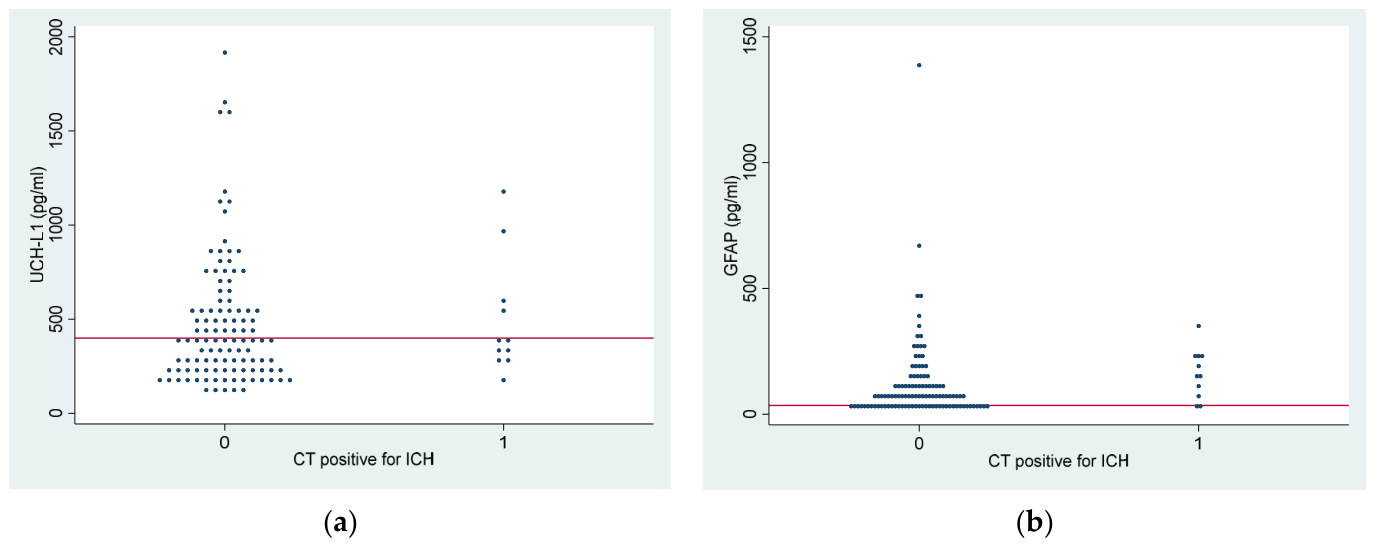
| GFAP (pg/mL), median (IQR) | 66.9 (40.4–146.2) | 148.6 (61.1–237.9) | 64.1 (39.2–122.7) | 0.02 |
| UCH-L1 (pg/mL), median (IQR) | 380 (232–560) | 370 (285–579) | 381 (231–555) | 0.58 |
| Intracranial head CT findings, n (%) | ||||
| SAH and SDH | 2 (18.2) | |||
| SAH and IPH | 2 (18.2) | |||
| SAH | 3 (27.3) | |||
| SDH | 2 (18.2) | |||
| IPH | 2 (18.2) |
| Variables | All Patients (n = 120) | Patients < 65 Years (n = 39) | GFAP (Cut-Off 35 pg/mL) (n = 120) | UCH-L1 (Cut-Off 400 pg/mL) (n = 120) | Patients Fulfilling CCHR (n = 39) |
|---|---|---|---|---|---|
| Prevalence | 9.2 (4.7–15.8) | 7.7 (1.6–20.9) | 9.2 (4.7–15.8) | 9.2 (4.7–15.8) | 21.0 (9.3–36.5) |
| Sensitivity | 100 (71.5–100) | 100 (29.2–100) | 100 (71.5–100) | 36.4 (10.9–69.2) | 87.5 (47.3–99.7) |
| Specificity | 13.8 (7.9–21.7) | 25.0 (12.1–42.2) | 21.1 (13.9–30.0) | 55 (45.2–64.6) | 16.1 (5.5–33.7) |
| Positive predictive value | 10.5 (5.4–18.0) | 10.0 (2.1–26.5) | 11.3 (5.8–19.4) | 7.55 (2.09–18.2) | 21.2 (9.0–38.9) |
| Negative predictive value | 100 (78.2–100) | 100 (66.4–100) | 100 (85.2–100) | 89.6 (79.7–95.7) | 83.3 (35.9–99.6) |
| Likelihood ratio positive test | 1.16 (1.08–1.25) | 1.33 (1.1–1.61) | 1.27 (1.15–1.4) | 0.81 (0.36–1.82) | 1.04 (0.77–1.41) |
| Likelihood ratio negative test | 0 | 0 | 0 | 1.16 (0.72–1.86) | 0.78 (0.11–5.73) |
Disclaimer/Publisher’s Note: The statements, opinions and data contained in all publications are solely those of the individual author(s) and contributor(s) and not of MDPI and/or the editor(s). MDPI and/or the editor(s) disclaim responsibility for any injury to people or property resulting from any ideas, methods, instructions or products referred to in the content. |
© 2026 by the authors. Published by MDPI on behalf of the Lithuanian University of Health Sciences. Licensee MDPI, Basel, Switzerland. This article is an open access article distributed under the terms and conditions of the Creative Commons Attribution (CC BY) license.
Share and Cite
Kuan, W.S.; Yau, Y.W.; Lim, D.X.Y.; Yeoh, C.K.; Cheung, N.M.T.; Lim, H.X.Y.; Chua, M.T. Validation of Blood-Based Biomarkers After Mild Traumatic Brain Injury with GCS 15 in a Singapore Emergency Department: An Observational Study. Medicina 2026, 62, 1095. https://doi.org/10.3390/medicina62061095
Kuan WS, Yau YW, Lim DXY, Yeoh CK, Cheung NMT, Lim HXY, Chua MT. Validation of Blood-Based Biomarkers After Mild Traumatic Brain Injury with GCS 15 in a Singapore Emergency Department: An Observational Study. Medicina. 2026; 62(6):1095. https://doi.org/10.3390/medicina62061095
Chicago/Turabian StyleKuan, Win Sen, Ying Wei Yau, Desiree Xin Ying Lim, Chew Kiat Yeoh, Nicole Mun Teng Cheung, Hannah Xin Yi Lim, and Mui Teng Chua. 2026. "Validation of Blood-Based Biomarkers After Mild Traumatic Brain Injury with GCS 15 in a Singapore Emergency Department: An Observational Study" Medicina 62, no. 6: 1095. https://doi.org/10.3390/medicina62061095
APA StyleKuan, W. S., Yau, Y. W., Lim, D. X. Y., Yeoh, C. K., Cheung, N. M. T., Lim, H. X. Y., & Chua, M. T. (2026). Validation of Blood-Based Biomarkers After Mild Traumatic Brain Injury with GCS 15 in a Singapore Emergency Department: An Observational Study. Medicina, 62(6), 1095. https://doi.org/10.3390/medicina62061095