The Association Between Serum C-Reactive Protein Levels and Body Fat Parameters: Results from the Korean National Health and Nutrition Examination Survey

Abstract
1. Introduction
2. Materials and Methods
2.1. Study Population
2.2. Data Collection
2.3. Measurement of Body Composition
2.4. Statistical Analysis
3. Results
3.1. Baseline Characteristics of the Study Population
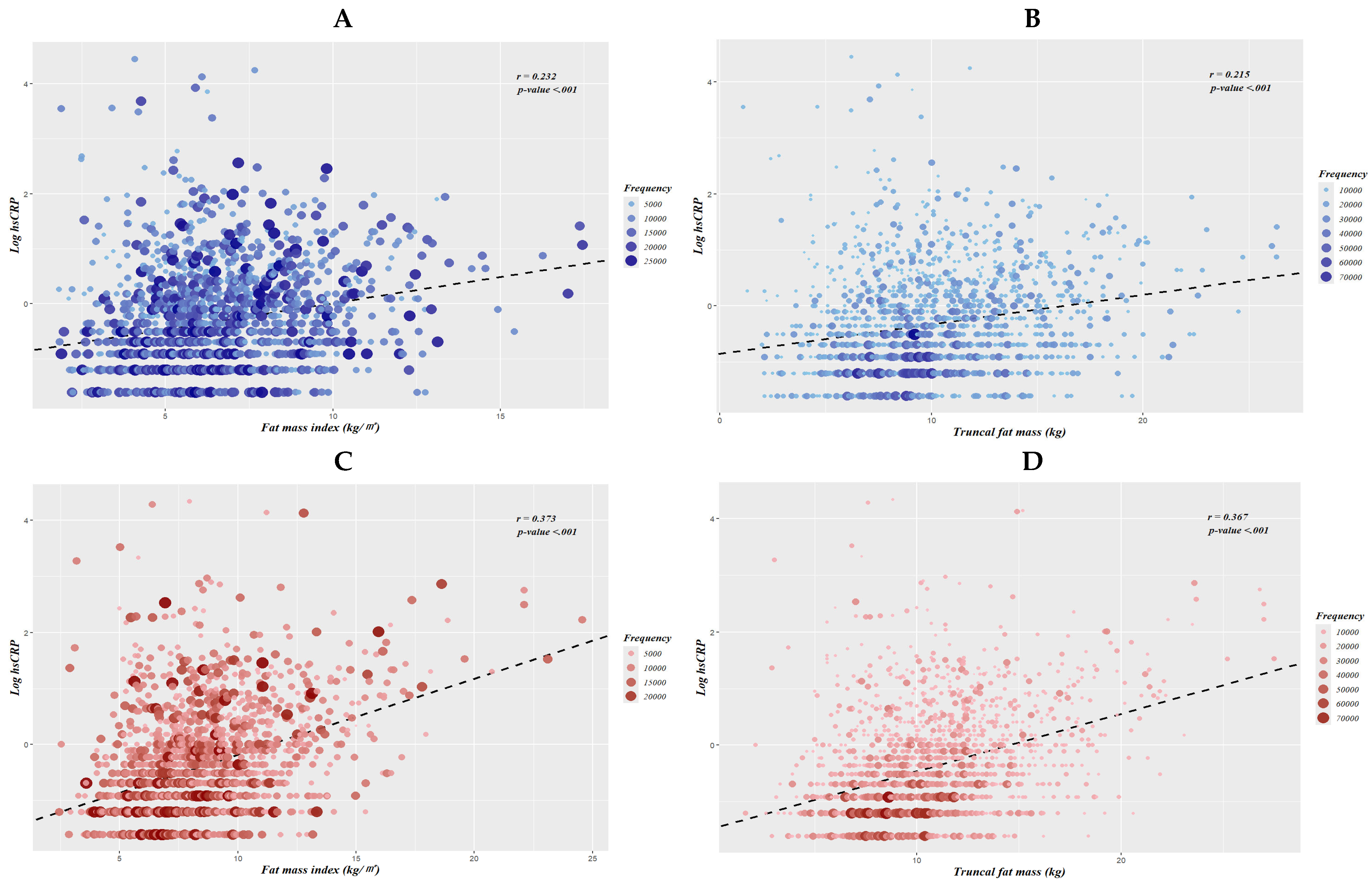
3.2. Correlation Between ln[hsCRP] and Metabolic Parameters
3.3. Association Between FMI and Ln[hsCRP]
3.4. Association Between Trunk Fat Mass and ln[hsCRP]
3.5. Association Between Adiposity and ln[hsCRP] According to Sex and Age
3.6. Association Between Adiposity Parameters and ln[hsCRP]
4. Discussion
5. Conclusions
Supplementary Materials
Funding
Institutional Review Board Statement
Informed Consent Statement
Data Availability Statement
Acknowledgments
Conflicts of Interest
Abbreviations
| AFM | Appendicular fat mass |
| BFM | Body fat mass |
| BIA | Bioelectrical impedance analysis |
| BMI | Body mass index |
| CI | Confidence intervals |
| CRP | C-reactive protein |
| DBP | Diastolic blood pressure |
| FMI | Fat mass index |
| HbA1c | Hemoglobin A1c |
| HDL | High-density lipoprotein cholesterol |
| KNHANES | Korea National Health and Nutrition Examination Survey |
| LDL | Low-density lipoprotein cholesterol |
| PBF | Percentage body fat |
| SBP | Systolic blood pressure |
References
- Malik, S.; Wong, N.D.; Franklin, S.; Pio, J.; Fairchild, C.; Chen, R. Cardiovascular disease in U.S. Patients with metabolic syndrome, diabetes, and elevated C-reactive protein. Diabetes Care 2005, 28, 690–693. [Google Scholar] [CrossRef]
- Koziarska-Rościszewska, M.; Gluba-Brzózka, A.; Franczyk, B.; Rysz, J. High-sensitivity C-reactive protein relationship with metabolic disorders and cardiovascular diseases risk factors. Life 2021, 11, 742. [Google Scholar] [CrossRef]
- Emerging Risk Factors Collaboration; Kaptoge, S.; Di Angelantonio, E.; Lowe, G.; Pepys, M.B.; Thompson, S.G.; Collins, R.; Danesh, J. C-reactive protein concentration and risk of coronary heart disease, stroke, and mortality: An individual participant meta-analysis. Lancet 2010, 375, 132–140. [Google Scholar] [CrossRef]
- Khanna, D.; Khanna, S.; Khanna, P.; Patel, B.M. Obesity: A chronic low-grade inflammation and its markers. Cureus 2022, 14, e22711. [Google Scholar] [CrossRef]
- Galic, S.; Oakhill, J.S.; Steinberg, G.R. Adipose tissue as an endocrine organ. Mol. Cell Endocrinol. 2010, 316, 129–139. [Google Scholar] [CrossRef]
- Gerner, R.R.; Wieser, V.; Moschen, A.R.; Tilg, H. Metabolic inflammation: Role of cytokines in the crosstalk between adipose tissue and liver. Can. J. Physiol. Pharmacol. 2013, 91, 867–872. [Google Scholar] [CrossRef] [PubMed]
- Liu, P.; Ma, F.; Lou, H.; Liu, Y. The utility of fat mass index vs. body mass index and percentage of body fat in the screening of metabolic syndrome. BMC Public Health 2013, 13, 629. [Google Scholar] [CrossRef]
- Marinou, K.; Hodson, L.; Vasan, S.K.; Fielding, B.A.; Banerjee, R.; Brismar, K.; Koutsilieris, M.; Clark, A.; Neville, M.J.; Karpe, F. Structural and functional properties of deep abdominal subcutaneous adipose tissue explain its association with insulin resistance and cardiovascular risk in men. Diabetes Care 2014, 37, 821–829. [Google Scholar] [CrossRef] [PubMed]
- Hill, J.H.; Solt, C.; Foster, M.T. Obesity associated disease risk: The role of inherent differences and location of adipose depots. Horm. Mol. Biol. Clin. Investig. 2018, 33, 20180012. [Google Scholar] [CrossRef]
- Thorand, B.; Baumert, J.; Döring, A.; Herder, C.; Kolb, H.; Rathmann, W.; Giani, G.; Koenig, W.; KORA Group. Sex differences in the relation of body composition to markers of inflammation. Atherosclerosis 2006, 184, 216–224. [Google Scholar] [CrossRef] [PubMed]
- Jeong, H.; Baek, S.Y.; Kim, S.W.; Park, E.J.; Lee, J.; Kim, H.; Jeon, C.H. C reactive protein level as a marker for dyslipidaemia, diabetes and metabolic syndrome: Results from the Korea National Health and Nutrition Examination Survey. BMJ Open 2019, 9, e029861. [Google Scholar] [CrossRef] [PubMed]
- Song, Y.; Yang, S.K.; Kim, J.; Lee, D.C. Association between C-reactive protein and metabolic syndrome in Korean adults. Korean J. Fam. Med. 2019, 40, 116–123. [Google Scholar] [CrossRef]
- Kim, C.S.; Ko, S.H.; Kwon, H.S.; Kim, N.H.; Kim, J.H.; Lim, S.; Choi, S.H.; Song, K.H.; Won, J.C.; Kim, D.J.; et al. Prevalence, awareness, and management of obesity in Korea: Data from the Korea national health and nutrition examination survey (1998–2011). Diabetes Metab. J. 2014, 38, 35–43. [Google Scholar] [CrossRef]
- Jo, G.; Park, D.; Kim, S.; Jun, H.J.; Magkos, F.; Merino, J.; Sun, Q.; Kim, R.; Subramanian, S.V.; Franks, P.W.; et al. Obesity transitions by age, period, and cohort: A population-based application of the Lancet Commission Framework in the United States and Korea. Korean Diabetes J. 2026. Online ahead of print. [Google Scholar]
- Kawai, T.; Autieri, M.V.; Scalia, R. Adipose tissue inflammation and metabolic dysfunction in obesity. Am. J. Physiol. Cell. Physiol. 2021, 320, C375–C391. [Google Scholar] [CrossRef]
- Kucuk, S.; Niven, J.; Caamano, J.; Jones, S.W.; Camacho-Muñoz, D.; Nicolaou, A.; Mauro, C. Unwrapping the mechanisms of ceramide and fatty acid-initiated signals leading to immune-inflammatory responses in obesity. Int. J. Biochem. Cell Biol. 2021, 135, 105972. [Google Scholar] [CrossRef]
- Ronti, T.; Lupattelli, G.; Mannarino, E. The endocrine function of adipose tissue: An update. Clin. Endocrinol. 2006, 64, 355–365. [Google Scholar] [CrossRef]
- Ellulu, M.S.; Patimah, I.; Khaza’ai, H.; Rahmat, A.; Abed, Y. Obesity and inflammation: The linking mechanism and the complications. Arch. Med. Sci. 2017, 13, 851–863. [Google Scholar] [CrossRef] [PubMed]
- Bibi, S.; Naeem, M.; Bahls, M.; Dörr, M.; Friedrich, N.; Nauck, M.; Bülow, R.; Völzke, H.; Paulista Markus, M.R.; Ittermann, T. Body composition markers from classic anthropometry, bioelectrical impedance analysis, and magnetic resonance imaging are associated with inflammatory markers in the general population. Nutr. Metab. Cardiovasc. Dis. 2023, 33, 1899–1906. [Google Scholar] [CrossRef]
- Liu, X.; Zhang, Y.; Li, Y.; Sang, Y.; Chai, Y.; Zhang, L.; Zhang, H. Systemic immunity-inflammation index is associated with body fat distribution among U.S. adults: Evidence from national health and nutrition examination survey 2011–2018. BMC Endocr. Disord. 2024, 24, 189. [Google Scholar] [CrossRef]
- Hocking, S.; Samocha-Bonet, D.; Milner, K.-L.; Greenfield, J.R.; Chisholm, D.J. Adiposity and insulin resistance in humans: The role of the different tissue and cellular lipid depots. Endocr. Rev. 2013, 34, 463–500. [Google Scholar] [CrossRef] [PubMed]
- Indulekha, K.; Anjana, R.M.; Surendar, J.; Mohan, V. Association of visceral and subcutaneous fat with glucose intolerance, insulin resistance, adipocytokines and inflammatory markers in Asian Indians (CURES-113). Clin. Biochem. 2011, 44, 281–287. [Google Scholar] [CrossRef]
- Harman-Boehm, I.; Blüher, M.; Redel, H.; Sion-Vardy, N.; Ovadia, S.; Avinoach, E.; Shai, I.; Klöting, N.; Stumvoll, M.; Bashan, N.; et al. Macrophage infiltration into omental versus subcutaneous fat across different populations: Effect of regional adiposity and the comorbidities of obesity. J. Clin. Endocrinol. Metab. 2007, 92, 2240–2247. [Google Scholar] [CrossRef]
- Després, J.-P. Abdominal obesity: The most prevalent cause of the metabolic syndrome and related cardiometabolic risk. Eur. Heart J. Suppl. 2006, 8, B4–B12. [Google Scholar] [CrossRef]
- Ichim, C.; Boicean, A.; Todor, S.B.; Anderco, P.; Bîrluțiu, V. Fecal microbiota transplantation in patients with alcohol-associated cirrhosis: A clinical trial. J. Clin. Med. 2025, 14, 5981. [Google Scholar] [CrossRef]
- Khera, A.; Vega, G.L.; Das, S.R.; Ayers, C.; McGuire, D.K.; Grundy, S.M.; de Lemos, J.A. Sex differences in the relationship between C-reactive protein and body fat. J. Clin. Endocrinol. Metab. 2009, 94, 3251–3258. [Google Scholar] [CrossRef]
- Craveiro, V.; Severo, M.; Ramos, E. Association between adiposity distribution and high-sensitivity C-reactive protein, adipokines, interleukins and plasminogen activator inhibitor-1. Int. J. Obes. 2025, 49, 1763–1769. [Google Scholar] [CrossRef]
- Ramirez, M.F.; Pan, A.S.; Parekh, J.K.; Owunna, N.; Courchesne, P.; Larson, M.G.; Levy, D.; Murabito, J.M.; Ho, J.E.; Lau, E.S. Sex differences in protein biomarkers and measures of fat distribution. J. Am. Heart Assoc. 2024, 13, e000223. [Google Scholar] [CrossRef]
- Monteiro, R.; Teixeira, D.; Calhau, C. Estrogen signaling in metabolic inflammation. Mediat. Inflamm. 2014, 2014, 615917. [Google Scholar] [CrossRef]
- Yang, W.; Jiang, W.; Liao, W.; Yan, H.; Ai, W.; Pan, Q.; Brashear, W.A.; Xu, Y.; He, L.; Guo, S. An estrogen receptor α-derived peptide improves glucose homeostasis during obesity. Nat. Commun. 2024, 15, 3410. [Google Scholar] [CrossRef]
- Eaton, S.A.; Sethi, J.K. Immunometabolic links between estrogen, adipose tissue and female reproductive metabolism. Biology 2019, 8, 8. [Google Scholar] [CrossRef]
- Kawamoto, R.; Kusunoki, T.; Abe, M.; Kohara, K.; Miki, T. An association between body mass index and high-sensitivity C-reactive protein concentrations is influenced by age in community-dwelling persons. Ann. Clin. Biochem. 2013, 50, 457–464. [Google Scholar] [CrossRef] [PubMed]
- Kosovski, I.B.; Bacârea, V.; Ghiga, D.; Ciurea, C.N.; Cucoranu, D.C.; Hutanu, A.; Bacârea, A. Exploring the link between inflammatory biomarkers and adipometrics in healthy young adults aged 20–35 Years. Nutrients 2024, 16, 257. [Google Scholar] [CrossRef] [PubMed]
- Li, A.; Tu, M.T.; Sousa, A.C.; Alvarado, B.; Kone, G.K.; Guralnik, J.; Zunzunegui, M.V. Early life adversity and C-reactive protein in diverse populations of older adults: A cross-sectional analysis from the International Mobility in Aging Study (IMIAS). BMC Geriatr. 2015, 15, 102. [Google Scholar] [CrossRef] [PubMed]
- Toprak, D.; Toprak, A.; Chen, W.; Xu, J.H.; Srinivasan, S.; Berenson, G.S. Adiposity in childhood is related to C-reactive protein and adiponectin in young adulthood: From the Bogalusa Heart Study. Obesity 2011, 19, 185–190. [Google Scholar] [CrossRef]


| Total (n = 32,635,626) | Male (n = 17,402,501) | Female (n = 15,233,125) | |
|---|---|---|---|
| Age | 49.6 ± 0.5 | 43.4 ± 0.6 | 51.0 ± 0.6 |
| Current smoker | 5,933,722 (18.2) | 5,257,393 (30.2) | 676,329 (4.4) |
| Alcohol consumption | 17,830,478 (54.6) | 11,659,734 (67.0) | 6,170,743 (40.5) |
| Aerobic exercise | 16,076,000 (49.3) | 9,037,962 (51.9) | 7,038,038 (46.2) |
| Waist circumference, cm | 85.7 ± 0.3 | 90.0 ± 0.3 | 81.2 ± 0.3 |
| BMI, kg/m2 | 24.7 ± 0.1 | 25.3 ± 0.1 | 24.0 ± 0.1 |
| Hypertension | 7,907,731 (24.2) | 4,358,543 (25.1) | 3,549,188 (23.3) |
| Diabetes | 3,256,414 (10.0) | 1,961,892 (11.3) | 1,294,522 (8.5) |
| Dyslipidemia | 7,183,621 (22.0) | 3,321,295 (19.1) | 3,862,326 (25.4) |
| SBP, mmHg | 119.7 ± 0.4 | 122.5 ± 0.5 | 116.4 ± 0.5 |
| DBP, mmHg | 74.9 ± 0.3 | 77.1 ± 0.3 | 72.5 ± 0.3 |
| Cholesterol, mg/dL | 192.9 ± 1.0 | 191.2 ± 1.4 | 195.0 ± 1.1 |
| HDL, mg/dL | 55.7 ± 0.3 | 50.6 ± 0.4 | 61.5 ± 0.4 |
| Triglyceride, mg/dL | 138.6 ± 2.3 | 160.3 ± 3.8 | 113.7 ± 1.9 |
| LDL, mg/dL | 119.2 ± 0.8 | 119.5 ± 1.2 | 118.9 ± 1.0 |
| HbA1c, % | 5.59 ± 0.02 | 5.61 ± 0.02 | 5.57 ± 0.02 |
| Glucose, mg/dL | 101.3 ± 0.5 | 103.3 ± 0.7 | 98.9 ± 0.7 |
| hsCRP, mg/L | 1.38 ± 0.07 | 1.42 ± 0.1 | 1.34 ± 0.1 |
| BFM, kg | 20.12 ± 0.17 | 19.44 ± 0.21 | 20.89 ± 0.21 |
| PBF, % | 29.44 ± 0.17 | 25.42 ± 0.17 | 34.04 ± 0.19 |
| FMI, kg/m2 | 7.4 ± 0.06 | 6.59 ± 0.07 | 8.34 ± 0.09 |
| AFM, kg | 8.58 ± 0.08 | 7.98 ± 0.09 | 9.26 ± 0.1 |
| Fat mass of trunk, kg | 10.4 ± 0.09 | 10.27 ± 0.11 | 10.54 ± 0.11 |
| Variables | Men | Women | ||
|---|---|---|---|---|
| Pearson Correlation | p-Value | Pearson Correlation | p-Value | |
| Height, cm | −0.065 | 0.010 | −0.025 | 0.283 |
| Weight, kg | 0.121 | <0.001 | 0.318 | <0.001 |
| Waist circumference, cm | 0.185 | <0.001 | 0.319 | <0.001 |
| BMI, kg/m2 | 0.171 | <0.001 | 0.348 | <0.001 |
| Systolic BP, mmHg | 0.087 | 0.001 | 0.105 | <0.001 |
| Diastolic BP | 0.037 | 0.137 | 0.077 | 0.001 |
| HbA1c, % | 0.111 | <0.001 | 0.167 | <0.001 |
| Fasting glucose, mg/dL | 0.083 | 0.001 | 0.170 | <0.001 |
| Total cholesterol, mg/dL | 0.037 | 0.139 | 0.051 | 0.030 |
| HDL cholesterol, mg/dL | −0.190 | <0.001 | −0.228 | <0.001 |
| Triglyceride, mg/dL | 0.094 | <0.001 | 0.198 | <0.001 |
| LDL cholesterol, mg/dL | 0.046 | 0.069 | 0.081 | 0.001 |
| BFM, kg | 0.218 | <0.001 | 0.374 | <0.001 |
| PBF, % | 0.238 | <0.001 | 0.330 | <0.001 |
| FMI, kg/m2 | 0.232 | <0.001 | 0.373 | <0.001 |
| AFM, kg | 0.219 | <0.001 | 0.373 | <0.001 |
| Trunk fat mass, kg | 0.215 | <0.001 | 0.367 | <0.001 |
| Variable | Univariable Analysis | Multivariable Analysis Model 1 | Multivariable Analysis Model 2 | |||
|---|---|---|---|---|---|---|
| β (95% CI) | p-Value | β (95% CI) | p-Value | β (95% CI) | p-Value | |
| Male | ||||||
| Age | 0 (0, 0.01) | 0.077 | 0 (0, 0.01) | 0.011 | 0.01 (0, 0.01) | 0.002 |
| Current smoker | 0.09 (−0.02, 0.21) | 0.116 | 0.13 (0.02, 0.25) | 0.022 | 0.14 (0.02, 0.25) | 0.022 |
| Alcohol consumption | −0.09 (−0.2, 0.03) | 0.145 | −0.09 (−0.21, 0.02) | 0.107 | −0.09 (−0.21, 0.02) | 0.115 |
| Aerobic exercise | −0.05 (−0.16, 0.07) | 0.429 | 0 (−0.11, 0.11) | 0.994 | 0 (−0.11, 0.11) | 0.956 |
| Hypertension | 0.16 (0, 0.33) | 0.049 | 0 (−0.14, 0.14) | 0.989 | ||
| Dyslipidemia | 0.07 (−0.06, 0.2) | 0.271 | −0.17 (−0.32, −0.02) | 0.032 | ||
| Diabetes | 0.17 (0.05, 0.28) | 0.004 | −0.03 (−0.2, 0.14) | 0.734 | ||
| FMI | 0.1 (0.07, 0.12) | <0.001 | 0.1 (0.08, 0.12) | <0.001 | 0.1 (0.08, 0.12) | <0.001 |
| Female | ||||||
| Age | 0 (0, 0) | 0.494 | 0 (−0.01, 0) | 0.065 | 0 (0, 0) | 0.769 |
| Current smoker | 0.09 (−0.12, 0.31) | 0.398 | −0.05 (−0.24, 0.14) | 0.624 | −0.04 (−0.23, 0.15) | 0.695 |
| Alcohol consumption | −0.03 (−0.14, 0.07) | 0.515 | 0 (−0.11, 0.1) | 0.951 | −0.02 (−0.12, 0.09) | 0.740 |
| Aerobic exercise | −0.04 (−0.14, 0.06) | 0.409 | −0.03 (−0.13, 0.07) | 0.582 | −0.02 (−0.12, 0.07) | 0.634 |
| Hypertension | 0.26 (0.06, 0.47) | 0.012 | −0.08 (−0.22, 0.05) | 0.218 | ||
| Dyslipidemia | −0.05 (−0.16, 0.06) | 0.333 | −0.19 (−0.31, −0.07) | 0.002 | ||
| Diabetes | 0.01 (−0.1, 0.12) | 0.866 | 0.08 (−0.12, 0.28) | 0.417 | ||
| FMI | 0.14 (0.11, 0.16) | <0.001 | 0.14 (0.12, 0.16) | <0.001 | 0.14 (0.12, 0.16) | <0.001 |
| Variable | Univariable Analysis | Multivariable Analysis Model 1 | Multivariable Analysis Model 2 | |||
|---|---|---|---|---|---|---|
| β (95% CI) | p-Value | β (95% CI) | p-Value | β (95% CI) | p-Value | |
| Male | ||||||
| Age | 0 (0, 0.01) | 0.077 | 0.01 (0, 0.01) | 0.0016 | 0.01 (0, 0.01) | 0.001 |
| Current smoker | 0.09 (−0.02, 0.21) | 0.116 | 0.13 (0.01, 0.24) | 0.0314 | 0.13 (0.01, 0.24) | 0.032 |
| Alcohol consumption | −0.09 (−0.2, 0.03) | 0.145 | −0.11 (−0.23, 0) | 0.0556 | −0.11 (−0.23, 0) | 0.058 |
| Aerobic exercise | −0.05 (−0.16, 0.07) | 0.429 | 0 (−0.11, 0.11) | 0.9464 | 0 (−0.11, 0.11) | 0.981 |
| Hypertension | 0.16 (0, 0.33) | 0.049 | 0.01 (−0.13, 0.16) | 0.837 | ||
| Dyslipidemia | 0.07 (−0.06, 0.2) | 0.271 | −0.16 (−0.31, −0.01) | 0.033 | ||
| Diabetes | 0.17 (0.05, 0.28) | 0.004 | −0.02 (−0.19, 0.15) | 0.799 | ||
| Trunk fat mass | 0.05 (0.04, 0.07) | <0.001 | 0.06 (0.04, 0.07) | <0.001 | 0.06 (0.05, 0.07) | <0.001 |
| Female | ||||||
| Age | 0 (0, 0) | 0.494 | 0 (0, 0) | 0.413 | 0 (0, 0.01) | 0.516 |
| Current smoker | 0.09 (−0.12, 0.31) | 0.398 | −0.04 (−0.23, 0.15) | 0.697 | −0.03 (−0.22, 0.16) | 0.770 |
| Alcohol consumption | −0.03 (−0.14, 0.07) | 0.515 | −0.01 (−0.12, 0.09) | 0.786 | −0.03 (−0.13, 0.08) | 0.585 |
| Aerobic exercise | −0.04 (−0.14, 0.06) | 0.409 | −0.03 (−0.13, 0.07) | 0.513 | −0.03 (−0.13, 0.07) | 0.561 |
| Hypertension | 0.26 (0.06, 0.47) | 0.012 | −0.09 (−0.22, 0.05) | 0.208 | ||
| Dyslipidemia | −0.05 (−0.16, 0.06) | 0.333 | −0.19 (−0.31, −0.07) | 0.002 | ||
| Diabetes | 0.01 (−0.1, 0.12) | 0.866 | 0.08 (−0.12, 0.29) | 0.416 | ||
| Trunk fat mass | 0.1 (0.09, 0.12) | <0.001 | 0.1 (0.08, 0.12) | <0.001 | 0.1 (0.09, 0.12) | <0.001 |
| Variable | Univariable Analysis | Multivariable Analysis Model 1 | Multivariable Analysis Model 2 | ||||
|---|---|---|---|---|---|---|---|
| β (95% CI) | p-Value | β (95% CI) | p-Value | β (95% CI) | p-Value | ||
| Male, total | Fat mass index | 0.1 (0.07, 0.12) | <0.001 | 0.1 (0.08, 0.12) | <0.001 | 0.1 (0.08, 0.12) | <0.001 |
| Trunk fat mass, kg | 0.05 (0.04, 0.07) | <0.001 | 0.06 (0.04, 0.07) | <0.001 | 0.06 (0.05, 0.07) | <0.001 | |
| Male aged 19–40 years | Fat mass index | 0.13 (0.1, 0.16) | <0.001 | 0.13 (0.1, 0.16) | <0.001 | 0.13 (0.1, 0.16) | <0.001 |
| Trunk fat mass, kg | 0.08 (0.06, 0.1) | <0.001 | 0.08 (0.06, 0.1) | <0.001 | 0.08 (0.06, 0.1) | <0.001 | |
| Male aged 41–70 years | Fat mass index | 0.07 (0.04, 0.1) | <0.001 | 0.08 (0.05, 0.11) | <0.001 | 0.09 (0.06, 0.12) | <0.001 |
| Trunk fat mass, kg | 0.04 (0.02, 0.06) | <0.001 | 0.04 (0.03, 0.06) | <0.001 | 0.05 (0.03, 0.07) | <0.001 | |
| Female, total | Fat mass index | 0.14 (0.11, 0.16) | <0.001 | 0.14 (0.12, 0.16) | <0.001 | 0.14 (0.12, 0.16) | <0.001 |
| Trunk fat mass, kg | 0.1 (0.09, 0.12) | <0.001 | 0.1 (0.08, 0.12) | <0.001 | 0.1 (0.09, 0.12) | <0.001 | |
| Female aged 19–40 years | Fat mass index | 0.18 (0.14, 0.21) | <0.001 | 0.18 (0.15, 0.21) | <0.001 | 0.18 (0.15, 0.21) | <0.001 |
| Trunk fat mass | 0.14 (0.11, 0.16) | <0.001 | 0.14 (0.11, 0.16) | <0.001 | 0.14 (0.11, 0.17) | <0.001 | |
| Female aged 41–70 years | Fat mass index | 0.13 (0.1, 0.16) | <0.001 | 0.13 (0.1, 0.16) | <0.001 | 0.14 (0.11, 0.16) | <0.001 |
| Trunk fat mass | 0.09 (0.07, 0.11) | <0.001 | 0.09 (0.07, 0.11) | <0.001 | 0.1 (0.07, 0.12) | <0.001 | |
Disclaimer/Publisher’s Note: The statements, opinions and data contained in all publications are solely those of the individual author(s) and contributor(s) and not of MDPI and/or the editor(s). MDPI and/or the editor(s) disclaim responsibility for any injury to people or property resulting from any ideas, methods, instructions or products referred to in the content. |
© 2026 by the author. Published by MDPI on behalf of the Lithuanian University of Health Sciences. Licensee MDPI, Basel, Switzerland. This article is an open access article distributed under the terms and conditions of the Creative Commons Attribution (CC BY) license.
Share and Cite
Jeong, H. The Association Between Serum C-Reactive Protein Levels and Body Fat Parameters: Results from the Korean National Health and Nutrition Examination Survey. Medicina 2026, 62, 1014. https://doi.org/10.3390/medicina62061014
Jeong H. The Association Between Serum C-Reactive Protein Levels and Body Fat Parameters: Results from the Korean National Health and Nutrition Examination Survey. Medicina. 2026; 62(6):1014. https://doi.org/10.3390/medicina62061014
Chicago/Turabian StyleJeong, Hyemin. 2026. "The Association Between Serum C-Reactive Protein Levels and Body Fat Parameters: Results from the Korean National Health and Nutrition Examination Survey" Medicina 62, no. 6: 1014. https://doi.org/10.3390/medicina62061014
APA StyleJeong, H. (2026). The Association Between Serum C-Reactive Protein Levels and Body Fat Parameters: Results from the Korean National Health and Nutrition Examination Survey. Medicina, 62(6), 1014. https://doi.org/10.3390/medicina62061014