Positive Correlates of Sclerostin and Association with Peripheral Arterial Stiffness in Patients with Type 2 Diabetes Mellitus




Abstract
1. Introduction
2. Materials and Methods
2.1. Participants
2.2. Anthropometric Analysis
2.3. Biochemical Investigations
2.4. Blood Pressure and Brachial–Ankle Pulse Wave Velocity Measurements
2.5. Statistical Analyses
3. Results
4. Discussion
5. Conclusions
Supplementary Materials
Author Contributions
Funding
Institutional Review Board Statement
Informed Consent Statement
Data Availability Statement
Acknowledgments
Conflicts of Interest
Abbreviations
| AS | Arterial stiffness |
| AUC | Area under the curve |
| baPWV | Brachial-ankle pulse wave velocity |
| BMI | Body mass index |
| BP | Blood pressure |
| BUN | Blood urea nitrogen |
| CI | Confidence interval |
| cIMT | Carotid intima-media thickness |
| CKD | Chronic kidney disease |
| CRP | C-reactive protein |
| CV | Cardiovascular |
| DBP | Diastolic blood pressure |
| DKK1 | Dickkopf-1 |
| eGFR | Estimated glomerular filtration rate |
| HbA1c | Glycated hemoglobin |
| OR | Odds ratio |
| PAS | Peripheral arterial stiffness |
| PWV | Pulse wave velocity |
| ROC | Receiver operating characteristic |
| SBP | Systolic blood pressure |
| T2DM | Type 2 diabetes mellitus |
| TG | Triglyceride |
| UACR | Urine albumin-to-creatinine ratio |
References
- Hsu, B.G.; Wang, Y.C.; Wu, D.A.; Chen, M.C. Serum 25-hydroxyvitamin D level is positively associated with vascular reactivity index in patients with type 2 diabetes mellitus. Nutrients 2024, 16, 1575. [Google Scholar] [CrossRef]
- Genitsaridi, I.; Salpea, P.; Salim, A.; Sajjadi, S.F.; Tomic, D.; James, S.; Thirunavukkarasu, S.; Issaka, A.; Chen, L.; Basit, A.; et al. 11th edition of the IDF Diabetes Atlas: Global, regional, and national diabetes prevalence estimates for 2024 and projections for 2050. Lancet Diabetes Endocrinol. 2026, 14, 149–156. [Google Scholar] [CrossRef]
- Harding, J.L.; Pavkov, M.E.; Magliano, D.J.; Shaw, J.E.; Gregg, E.W. Global trends in diabetes complications: A review of current evidence. Diabetologia 2019, 62, 3–16. [Google Scholar] [CrossRef] [PubMed]
- Chen, M.C.; Lee, C.J.; Yang, C.F.; Chen, Y.C.; Wang, J.H.; Hsu, B.G. Low serum adiponectin level is associated with metabolic syndrome and is an independent marker of peripheral arterial stiffness in hypertensive patients. Diabetol. Metab. Syndr. 2017, 9, 49. [Google Scholar] [CrossRef]
- Yokoyama, H.; Hirasawa, K.; Aoki, T.; Ishiyama, M.; Koyama, K. Brachial-ankle pulse wave velocity measured automatically by oscillometric method is elevated in diabetic patients with incipient nephropathy. Diabet. Med. 2003, 20, 942–945. [Google Scholar] [CrossRef]
- Vlachopoulos, C.; Aznaouridis, K.; Terentes-Printzios, D.; Ioakeimidis, N.; Stefanadis, C. Prediction of cardiovascular events and all-cause mortality with brachial-ankle elasticity index: A systematic review and meta-analysis. Hypertension 2012, 60, 556–562. [Google Scholar] [CrossRef] [PubMed]
- Zhang, Z.; Yang, R.; Wu, W.; Wang, Z. Association of aortic pulse wave velocity with cardiovascular outcomes and all-cause mortality in diabetes: A systematic review and meta-analysis. J. Diabetes Complicat. 2025, 39, 109118. [Google Scholar] [CrossRef]
- Catalano, A.; Bellone, F.; Morabito, N.; Corica, F. Sclerostin and vascular pathophysiology. Int. J. Mol. Sci. 2020, 21, 4779. [Google Scholar] [CrossRef]
- Foulquier, S.; Daskalopoulos, E.P.; Lluri, G.; Hermans, K.C.M.; Deb, A.; Blankesteijn, W.M. Wnt signaling in cardiac and vascular disease. Pharmacol. Rev. 2018, 70, 68–141. [Google Scholar] [CrossRef] [PubMed]
- Desjardins, L.; Liabeuf, S.; Oliveira, R.B.; Louvet, L.; Kamel, S.; Lemke, H.D.; Vanholder, R.; Choukroun, G.; Massy, Z.A. Uremic toxicity and sclerostin in chronic kidney disease patients. Nephrol. Ther. 2014, 10, 463–470. [Google Scholar] [CrossRef]
- Chern, Y.B.; Lee, P.S.; Wang, J.H.; Tsai, J.P.; Hsu, B.G. Increased serum sclerostin level is a risk factor for peripheral artery disease in patients with hypertension. Medicina 2025, 61, 1204. [Google Scholar] [CrossRef]
- Lattanzio, S.; Santilli, F.; Liani, R.; Vazzana, N.; Ueland, T.; Di Fulvio, P.; Formoso, G.; Consoli, A.; Aukrust, P.; Davì, G. Circulating dickkopf-1 in diabetes mellitus: Association with platelet activation and effects of improved metabolic control and low-dose aspirin. J. Am. Heart Assoc. 2014, 3, 4. [Google Scholar] [CrossRef]
- Shalash, M.A.M.; Rohoma, K.H.; Kandil, N.S.; Abdel Mohsen, M.A.; Taha, A.A.F. Serum sclerostin level and its relation to subclinical atherosclerosis in subjects with type 2 diabetes. J. Diabetes Complicat. 2019, 33, 592–597. [Google Scholar] [CrossRef]
- Ghardashi-Afousi, A.; Davoodi, M.; Keshtkar-Hesamabadi, B.; Asvadi-Fard, M.; Babaee Bigi, M.A.; Izadi, M.R.; Gaeini, A.A. Improved carotid intima-media thickness-induced high-intensity interval training associated with decreased serum levels of Dkk-1 and sclerostin in type 2 diabetes. J. Diabetes Complicat. 2020, 34, 107469. [Google Scholar] [CrossRef]
- Evenepoel, P.; D’Haese, P.; Brandenburg, V. Sclerostin and Dkk1: New players in renal bone and vascular disease. Kidney Int. 2015, 88, 235–240. [Google Scholar] [CrossRef]
- Hampson, G.; Edwards, S.; Conroy, S.; Blake, G.M.; Fogelman, I.; Frost, M.L. The relationship between inhibitors of the Wnt signalling pathway (Dickkopf-1 (DKK1) and sclerostin), bone mineral density, vascular calcification and arterial stiffness in post-menopausal women. Bone 2013, 56, 42–47. [Google Scholar] [CrossRef] [PubMed]
- Hsu, B.G.; Wu, D.A.; Yang, H.Y.; Chen, M.C. Serum sclerostin level is positively associated with endothelial dysfunction measured by digital thermal monitoring in patients with type 2 diabetes: A prospective cross-sectional study. Medicine 2023, 102, e34649. [Google Scholar] [CrossRef] [PubMed]
- James, P.A.; Oparil, S.; Carter, B.L.; Cushman, W.C.; Dennison-Himmelfarb, C.; Handler, J.; Lackland, D.T.; LeFevre, M.L.; MacKenzie, T.D.; Ogedegbe, O.; et al. 2014 evidence-based guideline for the management of high blood pressure in adults: Report from the panel members appointed to the Eighth Joint National Committee (JNC 8). JAMA 2014, 311, 507–520. [Google Scholar] [CrossRef]
- Wang, Y.H.; Hsiao, C.H.; Wang, J.H.; Hsu, B.G. Osteocalcin: A potential marker of peripheral arterial stiffness in hypertensive patients. Medicina 2024, 60, 835. [Google Scholar] [CrossRef] [PubMed]
- Tomiyama, H.; Shiina, K. State of the art review: Brachial-ankle PWV. J. Atheroscler. Thromb. 2020, 27, 621–636. [Google Scholar] [CrossRef]
- Tanaka, A.; Tomiyama, H.; Maruhashi, T.; Matsuzawa, Y.; Miyoshi, T.; Kabutoya, T.; Kario, K.; Sugiyama, S.; Munakata, M.; Ito, H.; et al. Physiological diagnostic criteria for vascular failure. Hypertension 2018, 72, 1060–1071. [Google Scholar] [CrossRef]
- Stavrinou, E.; Sarafidis, P.A.; Loutradis, C.; Memmos, E.; Faitatzidou, D.; Giamalis, P.; Koumaras, C.; Karagiannis, A.; Papagianni, A. Associations of serum sclerostin and Dickkopf-related protein-1 proteins with future cardiovascular events and mortality in haemodialysis patients: A prospective cohort study. Clin. Kidney J. 2021, 14, 1165–1172. [Google Scholar]
- Cohen, J. Statistical Power Analysis for the Behavioral Sciences, 2nd ed.; Lawrence Erlbaum Associates: Hillsdale, NJ, USA, 1988. [Google Scholar]
- Stone, K.; Veerasingam, D.; Meyer, M.L.; Heffernan, K.S.; Higgins, S.; Bruno, R.M.; Bueno, C.A.; Döerr, M.; Schmidt-Trucksäss, A.; Terentes-Printzios, D.; et al. Reimagining the value of brachial-ankle pulse wave velocity as a biomarker of cardiovascular disease risk-a call to action on behalf of Vascagenet. Hypertension 2023, 80, 1980–1992. [Google Scholar] [CrossRef]
- Ohkuma, T.; Ninomiya, T.; Tomiyama, H.; Kario, K.; Hoshide, S.; Kita, Y.; Inoguchi, T.; Maeda, Y.; Kohara, K.; Tabara, Y.; et al. Brachial-ankle pulse wave velocity and the risk prediction of cardiovascular disease: An individual participant data meta-analysis. Hypertension 2017, 69, 1045–1052. [Google Scholar] [PubMed]
- Kim, H.L.; Lim, W.H.; Seo, J.B.; Kim, S.H.; Zo, Z.H.; Kim, M.A. Prediction of cardiovascular events using brachial-ankle pulse wave velocity in hypertensive patients. J. Clin. Hypertens. 2020, 22, 1659–1665. [Google Scholar] [CrossRef] [PubMed]
- Jain, S.; Khera, R.; Corrales-Medina, V.F.; Townsend, R.R.; Chirinos, J.A. Inflammation and arterial stiffness in humans. Atherosclerosis 2014, 237, 381–390. [Google Scholar] [CrossRef] [PubMed]
- Kim, H.L.; Lim, W.H.; Seo, J.B.; Kim, S.H.; Zo, J.H.; Kim, M.A. Improved prognostic value in predicting long-term cardiovascular events by a combination of high-sensitivity C-reactive protein and brachial-ankle pulse wave velocity. J. Clin. Med. 2021, 10, 3291. [Google Scholar] [CrossRef]
- Inomoto, A.; Deguchi, J.; Fukuda, R.; Yotsumoto, T.; Toyonaga, T. Age-specific determinants of brachial-ankle pulse wave velocity among male Japanese workers. Tohoku J. Exp. Med. 2021, 253, 135–141. [Google Scholar]
- Li, C.I.; Kardia, S.L.; Liu, C.S.; Lin, W.Y.; Lin, C.H.; Lee, Y.D.; Sung, F.C.; Li, T.C.; Lin, C.C. Metabolic syndrome is associated with change in subclinical arterial stiffness: A community-based Taichung community health study. BMC Public Health 2011, 11, 808. [Google Scholar] [CrossRef]
- Semba, R.D.; Najjar, S.S.; Sun, K.; Lakatta, E.G.; Ferrucci, L. Serum carboxymethyl-lysine, an advanced glycation end product, is associated with increased aortic pulse wave velocity in adults. Am. J. Hypertens. 2009, 22, 74–79. [Google Scholar] [CrossRef]
- Wang, R.; Liu, X.L.; Jia, X.J.; Liu, Y.; Lu, Q. One-hour post-load plasma glucose levels are associated with early arterial stiffness in subjects with different glucose tolerance. Diabetes Metab. Syndr. Obes. 2022, 15, 1537–1542. [Google Scholar]
- Yapei, Y.; Xiaoyan, R.; Sha, Z.; Li, P.; Xiao, M.; Shuangfeng, C.; Lexin, W.; Lianqun, C. Clinical significance of arterial stiffness and thickness biomarkers in type 2 diabetes mellitus: An up-to-date meta-analysis. Med. Sci. Monit. 2015, 21, 2467–2475. [Google Scholar][Green Version]
- Aminuddin, A.; Lazim, M.; Hamid, A.A.; Hui, C.K.; Yunus, M.H.M.; Kumar, J.; Ugusman, A. The association between inflammation and pulse wave velocity in dyslipidemia: An evidence-based review. Mediat. Inflamm. 2020, 2020, 4732987. [Google Scholar] [CrossRef]
- Okamura, T.; Moriyama, Y.; Kadowaki, T.; Kanda, H.; Ueshima, H. Non-Invasive measurement of brachial-ankle pulse wave velocity is associated with serum C-reactive protein but not with alpha-tocopherol in Japanese middle-aged male workers. Hypertens. Res. 2004, 27, 173–180. [Google Scholar] [CrossRef] [PubMed][Green Version]
- Voicehovska, J.G.; Bormane, E.; Grigane, A.; Moisejevs, G.; Moreino, E.; Trumpika, D.; Voicehovskis, V.V. Association of arterial stiffness with chronic kidney disease progression and mortality. Heart Lung Circ. 2021, 30, 1694–1701. [Google Scholar] [CrossRef] [PubMed]
- Vallée, A. Arterial stiffness and the canonical Wnt/Β-catenin pathway. Curr. Hypertens. Rep. 2022, 24, 499–507. [Google Scholar] [CrossRef]
- Leto, G.; D’Onofrio, L.; Lucantoni, F.; Zampetti, S.; Campagna, G.; Foffi, C.; Moretti, C.; Carlone, A.; Palermo, A.; Leopizzi, M.; et al. Sclerostin is expressed in the atherosclerotic plaques of patients who undergoing carotid endarterectomy. Diabetes Metab. Res. Rev. 2019, 35, e3069. [Google Scholar] [CrossRef]
- Mayer, O., Jr.; Seidlerová, J.; Kučera, R.; Kučerová, A.; Černá, V.; Gelžinský, J.; Mateřánková, M.; Mareš, Š.; Kordíková, V.; Pešta, M.; et al. Synergistic effect of sclerostin and angiotensin II receptor 1 polymorphism on arterial stiffening. Biomark. Med. 2020, 14, 173–184. [Google Scholar] [CrossRef]
- Jin, S.; Zhu, M.; Yan, J.; Fang, Y.; Lu, R.; Zhang, W.; Zhang, Q.; Lu, J.; Qi, C.; Shao, X.; et al. Serum sclerostin level might be a potential biomarker for arterial stiffness in prevalent hemodialysis patients. Biomark. Med. 2016, 10, 689–699. [Google Scholar] [CrossRef]
- Gaudio, A.; Fiore, V.; Rapisarda, R.; Sidoti, M.H.; Xourafa, A.; Catalano, A.; Tringali, G.; Zanoli, L.; Signorelli, S.S.; Fiore, C.E. Sclerostin is a possible candidate marker of arterial stiffness: Results from a cohort study in Catania. Mol. Med. Rep. 2017, 15, 3420–3424. [Google Scholar] [CrossRef] [PubMed]
- Daniele, G.; Winnier, D.; Mari, A.; Bruder, J.; Fourcaudot, M.; Pengou, Z.; Tripathy, D.; Jenkinson, C.; Folli, F. Sclerostin and insulin resistance in prediabetes: Evidence of a cross talk between bone and glucose metabolism. Diabetes Care 2015, 38, 1509–1517. [Google Scholar] [CrossRef] [PubMed]
- Maruhashi, T.; Higashi, Y. Pathophysiological association between diabetes mellitus and endothelial dysfunction. Antioxidants 2021, 10, 1306. [Google Scholar] [CrossRef] [PubMed]
- Cejka, D.; Marculescu, R.; Kozakowski, N.; Plischke, M.; Reiter, T.; Gessl, A.; Haas, M. Renal elimination of sclerostin increases with declining kidney function. J. Clin. Endocrinol. Metab. 2014, 99, 248–255. [Google Scholar] [CrossRef]
- Bonani, M.; Rodriguez, D.; Fehr, T.; Mohebbi, N.; Brockmann, J.; Blum, M.; Graf, N.; Frey, D.; Wüthrich, R.P. Sclerostin blood levels before and after kidney transplantation. Kidney Blood Press. Res. 2014, 39, 230–239. [Google Scholar] [CrossRef]
- Park, H.J.; Rho, T.H.; Park, C.S.; Jang, S.W.; Shin, W.S.; Oh, Y.S.; Lee, M.Y.; Cho, E.J.; Seung, K.B.; Kim, J.H.; et al. The relationship between the acute changes of the systolic blood pressure and the brachial-ankle pulse wave velocity. Korean J. Intern. Med. 2007, 22, 147–151. [Google Scholar] [CrossRef]


| Characteristics | All Participants (n = 125) | Control Group (n = 78) | High PAS Group (n = 47) | p-Value |
|---|---|---|---|---|
| Demographics and Anthropometrics | ||||
| Age (years) | 62.41 ± 12.72 | 58.98 ± 13.00 | 65.15 ± 9.97 | <0.001 * |
| Male, n (%) | 71 (56.8) | 45 (57.7) | 26 (55.3) | 0.795 |
| BMI (kg/m2) | 26.61 ± 4.05 | 26.38 ± 4.13 | 26.99 ± 3.92 | 0.420 |
| Hemodynamic and Vascular Parameters | ||||
| Left brachial–ankle PWV (m/s) | 16.60 ± 2.99 | 14.87 ± 1.68 | 19.47 ± 2.42 | <0.001 * |
| Right brachial–ankle PWV (m/s) | 16.34 ± 2.90 | 14.68 ± 1.66 | 19.12 ± 2.33 | <0.001 * |
| SBP (mmHg) | 141.44 ± 20.05 | 134.87 ± 16.47 | 152.34 ± 20.85 | <0.001 * |
| DBP (mmHg) | 82.37 ± 10.68 | 80.53 ± 9.66 | 85.43 ± 11.65 | 0.012 * |
| Hypertension, n (%) | 74 (59.2) | 38 (48.7) | 36 (76.6) | 0.002 * |
| Renal Function and Electrolytes | ||||
| BUN (mg/dL) | 16.00 (12.00–19.50) | 14.00 (12.00–18.00) | 18.00 (15.00–22.00) | <0.001 * |
| Creatinine (mg/dL) | 0.9 (0.70–1.00) | 0.80 (0.70–0.90) | 1.00 (0.80–1.20) | 0.001 * |
| eGFR (mL/min) | 86.57 ± 26.45 | 94.77 ± 24.71 | 72.95 ± 23.66 | <0.001 * |
| Calcium (mg/dL) | 9.11 ± 0.44 | 9.12 ± 0.46 | 9.10 ± 0.40 | 0.818 |
| Phosphorus (mg/dL) | 3.57 ± 0.54 | 3.57 ± 0.52 | 3.57 ± 0.58 | 0.979 |
| UACR (mg/g) | 18.46 (7.45–99.07) | 14.34 (6.44–57.73) | 24.82 (9.73–212.89) | 0.039 * |
| Metabolic and Lipid Profiles | ||||
| Glucose (mg/dL) | 135.00 (119.00–170.50) | 129.50 (113.75–147.25) | 151.00 (128.00–214.00) | 0.001 * |
| Glycated hemoglobin (%) | 7.40 (6.60–8.85) | 7.05 (6.50–8.30) | 8.10 (6.90–9.40) | 0.008 * |
| TCH (mg/dL) | 163.48 ± 30.44 | 160.45 ± 30.79 | 168.51 ± 29.48 | 0.152 |
| Triglyceride (mg/dL) | 122.00 (87.00–176.00) | 103.50 (74.25–173.75) | 140.00 (114.00–178.00) | 0.001 * |
| HDL-C (mg/dL) | 46.38 ± 12.22 | 40.99 ± 11.99 | 45.36 ± 12.65 | 0.473 |
| LDL-C (mg/dL) | 100.93 ± 25.63 | 99.12 ± 25.27 | 103.94 ± 26.19 | 0.310 |
| Inflammatory and Bone Biomarkers | ||||
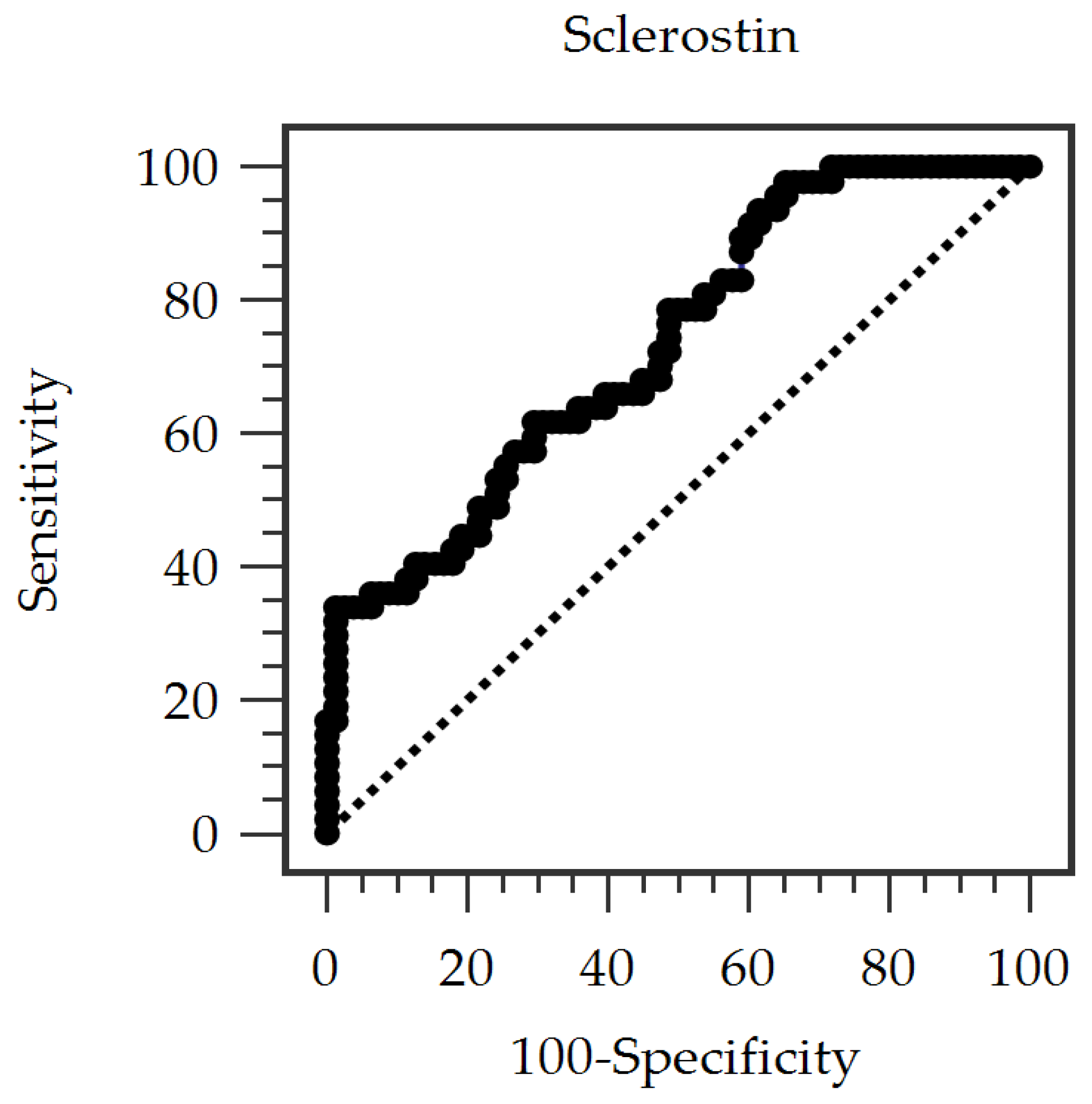
| Sclerostin (pmol/L) | 31.92 (24.43–39.68) | 28.50 (21.63–36.24) | 36.44 (28.73–52.25) | <0.001 * |
| Dickkopf-1 (pmol/L) | 12.85 (9.16–17.73) | 12.87 (8.75–17.62) | 12.85 (9.71–18.95) | 0.493 |
| C-reactive protein (mg/dL) | 0.09 (0.05–0.25) | 0.07 (0.05–0.22) | 0.15 (0.06–0.35) | 0.024 * |
| Medications | ||||
| ARB use, n (%) | 63 (50.4) | 36 (46.2) | 27 (57.4) | 0.221 |
| β-blocker use, n (%) | 16 (12.8) | 9 (11.5) | 7 (14.9) | 0.587 |
| CCB use, n (%) | 49 (39.2) | 28 (35.9) | 21 (44.7) | 0.330 |
| Statin use, n (%) | 62 (49.6) | 40 (51.3) | 22 (46.8) | 0.628 |
| Fibrate use, n (%) | 7 (5.6) | 4 (5.1) | 3 (6.4) | 0.768 |
| Metformin use, n (%) | 75 (60.0) | 49 (62.8) | 26 (55.3) | 0.407 |
| Sulfonylurea use, n (%) | 68 (54.4) | 43 (55.1) | 25 (53.2) | 0.833 |
| DPP-4 inhibitor use, n (%) | 72 (57.6) | 48 (61.5) | 24 (51.1) | 0.251 |
| Insulin use, n (%) | 44 (35.2) | 25 (32.1) | 19 (40.4) | 0.342 |
| Variables | Odds Ratio | 95% Confidence Interval | p-Value |
|---|---|---|---|
| Sclerostin (pmol/L) | 1.127 | 1.058–1.200 | <0.001 * |
| Age (years) | 1.099 | 1.023–1.181 | 0.010 * |
| SBP (mmHg) | 1.096 | 1.024–1.172 | 0.008 * |
| Fasting glucose (mg/dL) | 1.018 | 1.001–1.035 | 0.034 * |
| CRP (mg/dL) (per 0.1 increment) | 1.276 | 1.077–1.513 | 0.005 * |
| Hypertension (present) | 0.436 | 0.090–2.103 | 0.301 |
| DBP (mmHg) | 0.936 | 0.853–1.026 | 0.158 |
| Glycated hemoglobin (%) | 0.683 | 0.405–1.152 | 0.153 |
| Triglyceride (mg/dL) | 1.005 | 0.997–1.014 | 0.212 |
| eGFR (mL/min) | 0.983 | 0.954–1.014 | 0.276 |
| UACR (mg/g) | 1.000 | 0.999–1.000 | 0.118 |
| Variables | Left baPWV (m/s) | Right baPWV (m/s) | Log10 (Sclerostin) (pmol/L) | |||
|---|---|---|---|---|---|---|
| Spearman’s Coefficient of Correlation | p-Value | Spearman’s Coefficient of Correlation | p-Value | Spearman’s Coefficient of Correlation | p-Value | |
| Age (years) | 0.547 | <0.001 * | 0.573 | <0.001 * | 0.156 | 0.082 |
| BMI (kg/m2) | 0.120 | 0.184 | 0.074 | 0.413 | −0.098 | 0.279 |
| Left baPWV (m/s) | — | — | 0.810 | <0.001 * | 0.251 | 0.005 * |
| Right baPWV (m/s) | 0.810 | <0.001 * | — | — | 0.287 | 0.001 * |
| Log10 (Sclerostin) (pmol/L) | 0.251 | 0.005 * | 0.287 | 0.001 * | — | — |
| SBP (mmHg) | 0.440 | <0.001 * | 0.468 | <0.001 * | 0.153 | 0.089 |
| DBP (mmHg) | 0.237 | 0.008 * | 0.231 | 0.009 * | 0.095 | 0.291 |
| TCH (mg/dL) | 0.085 | 0.349 | 0.119 | 0.188 | −0.078 | 0.386 |
| Log10 (TG) (mg/dL) | 0.229 | 0.010 * | 0.218 | 0.015 * | 0.003 | 0.978 |
| HDL-C (mg/dL) | −0.062 | 0.491 | −0.061 | 0.498 | −0.107 | 0.235 |
| LDL-C (mg/dL) | 0.008 | 0.933 | 0.036 | 0.692 | −0.107 | 0.234 |
| Log10 (Glucose) (mg/dL) | 0.335 | <0.001 * | 0.269 | 0.002 * | 0.095 | 0.293 |
| Log10 (HbA1c) (%) | 0.213 | 0.017 * | 0.133 | 0.139 | 0.207 | 0.020 * |
| Log10 (BUN) (mg/dL) | 0.342 | <0.001 * | 0.332 | <0.001 * | 0.132 | 0.143 |
| Log10 (Creatinine) (mg/dL) | 0.430 | <0.001 * | 0.398 | <0.001 * | 0.336 | <0.001 * |
| eGFR (mL/min) | −0.445 | <0.001 * | −0.449 | <0.001 * | −0.332 | <0.001 * |
| Log10 (UACR) (mg/g) | 0.272 | 0.003 * | 0.204 | 0.027 * | 0.062 | 0.509 |
| Total calcium (mg/dL) | −0.100 | 0.269 | −0.094 | 0.296 | −0.061 | 0.496 |
| Phosphorus (mg/dL) | −0.079 | 0.378 | −0.054 | 0.547 | −0.092 | 0.308 |
| Log10 (DKK1) (pmol/L) | 0.022 | 0.811 | 0.037 | 0.686 | −0.010 | 0.912 |
| Log10 (CRP) (mg/dL) | 0.229 | 0.010 * | 0.267 | 0.003 * | −0.012 | 0.898 |
Disclaimer/Publisher’s Note: The statements, opinions and data contained in all publications are solely those of the individual author(s) and contributor(s) and not of MDPI and/or the editor(s). MDPI and/or the editor(s) disclaim responsibility for any injury to people or property resulting from any ideas, methods, instructions or products referred to in the content. |
© 2026 by the authors. Published by MDPI on behalf of the Lithuanian University of Health Sciences. Licensee MDPI, Basel, Switzerland. This article is an open access article distributed under the terms and conditions of the Creative Commons Attribution (CC BY) license.
Share and Cite
Hsu, B.-G.; Li, J.-C.; Wu, D.-A.; Chen, M.-C. Positive Correlates of Sclerostin and Association with Peripheral Arterial Stiffness in Patients with Type 2 Diabetes Mellitus. Medicina 2026, 62, 643. https://doi.org/10.3390/medicina62040643
Hsu B-G, Li J-C, Wu D-A, Chen M-C. Positive Correlates of Sclerostin and Association with Peripheral Arterial Stiffness in Patients with Type 2 Diabetes Mellitus. Medicina. 2026; 62(4):643. https://doi.org/10.3390/medicina62040643
Chicago/Turabian StyleHsu, Bang-Gee, Jer-Chuan Li, Du-An Wu, and Ming-Chun Chen. 2026. "Positive Correlates of Sclerostin and Association with Peripheral Arterial Stiffness in Patients with Type 2 Diabetes Mellitus" Medicina 62, no. 4: 643. https://doi.org/10.3390/medicina62040643
APA StyleHsu, B.-G., Li, J.-C., Wu, D.-A., & Chen, M.-C. (2026). Positive Correlates of Sclerostin and Association with Peripheral Arterial Stiffness in Patients with Type 2 Diabetes Mellitus. Medicina, 62(4), 643. https://doi.org/10.3390/medicina62040643