Comparison of the Effectiveness of the DNIPRO Gen 2 and SICH Tourniquets Versus the CAT Gen 7 and SOFTT-W Gen 4 Tourniquets

 ,
,  , ,
, ,  ,
,  ,
, 

Abstract
1. Introduction
2. Materials and Methods
2.1. Study Design
2.2. Participants
2.3. Devices
- •
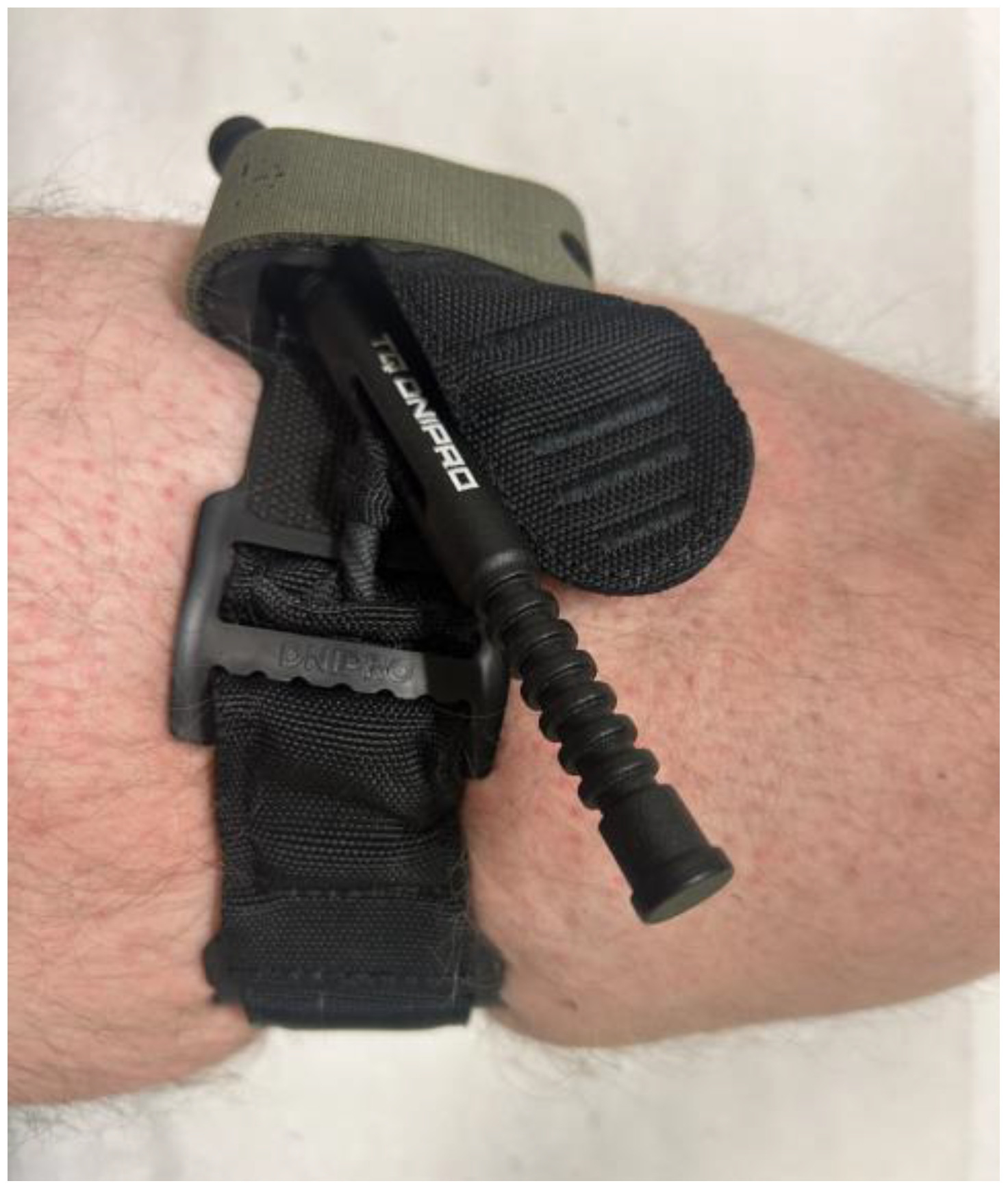
- DNIPRO Gen 2 (TQ Dnipro, Kyiv, Ukraine) is a windlass tourniquet manufactured by TQ Dnipro. It consists of a synthetic strap covered with Velcro, allowing rapid circumference adjustment. The internal tensioning strap is tightened by rotating a windlass rod made of lightweight metal alloy, generating occlusion pressure. The circumference of the tourniquet is adjusted by threading the strap through a metal buckle with notches that prevent loosening after tension is applied. The windlass rod is attached to a plastic plate, and its textured surface facilitates manipulation, including when wearing tactical gloves. The locking mechanism consists of a U-shaped component that stabilises the rod once the strap is tightened, along with an additional Velcro strap that secures the windlass from above. The strap features perforated markings that are intended for recording the time of application (Figure 1) [5].
- •
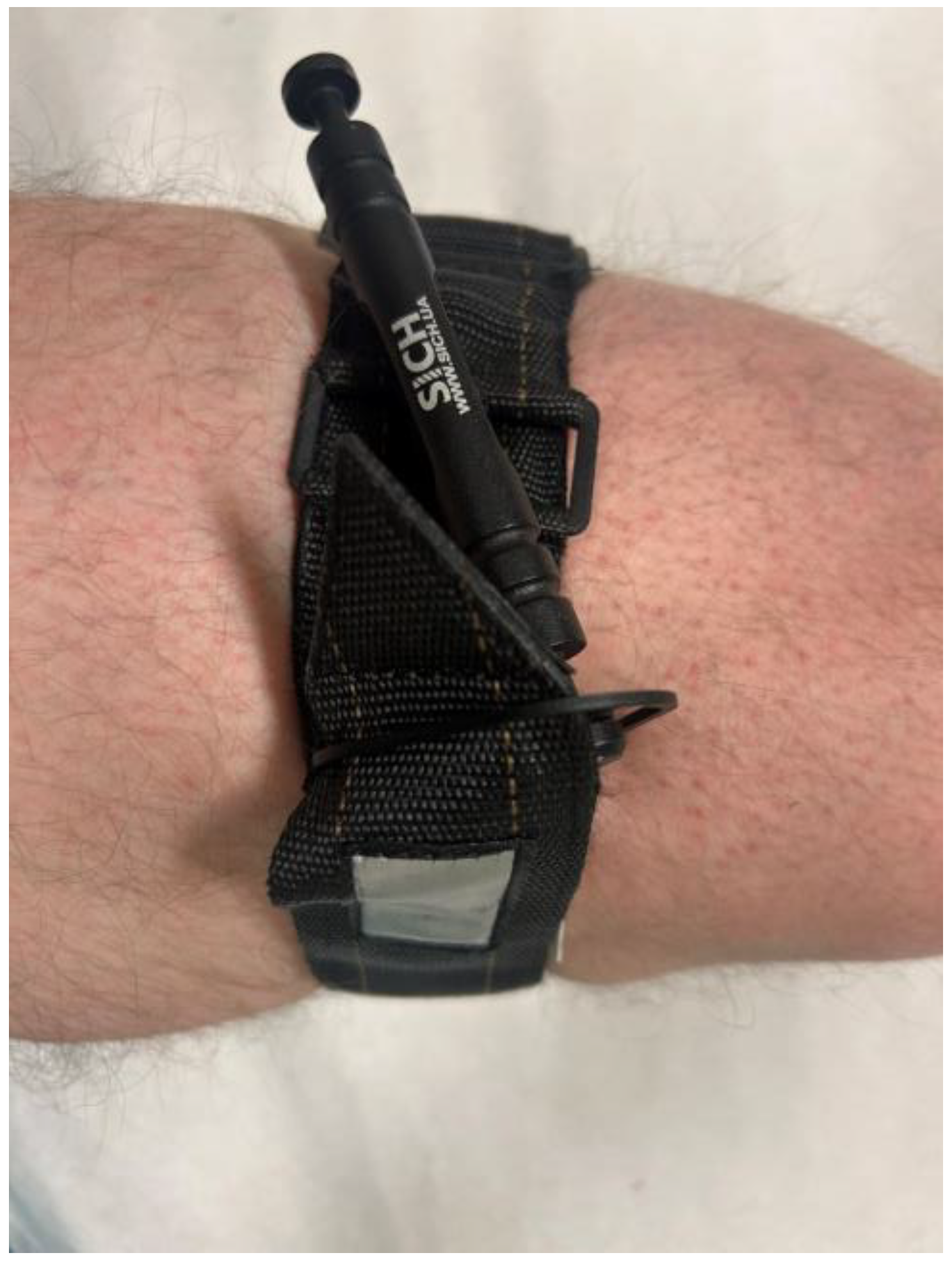
- SICH (Sich-Ukraine, Kyiv, Ukraine) is a windlass tourniquet developed by Sich Ukraine. It consists of a synthetic strap covered with Velcro, with a distinctive pattern of alternating loop-and-hook sections designed to ensure effective operation even when the Velcro surface becomes contaminated. The terminal portion of the strap is reinforced to facilitate rapid identification of the end and adjustment of the circumference of the tourniquet during application. The strap is threaded through a dual slot metal buckle, and occlusion pressure is generated by rotating a duralumin windlass rod that tightens the internal segment of the strap forming part of the tourniquet. The locking mechanism consists of a triangular plate with profiled grooves into which the windlass rod is inserted after tightening, then pressed toward the apex of the lock to stabilise it in position. The lateral holes in the locking element allow securing the loose end of the strap after application. The tourniquet has a coated tape sewn onto the strap end, on which the time of application can be indicated with a marker pen or any other sharp object (by scratching) (Figure 2) [6].
- •
- CAT Gen 7 (C-A-T Resources LLC, Rock Hill, SC, USA) is a widely used CoTCCC-recommended windlass tourniquet employed in both military and civilian prehospital systems. It consists of a synthetic strap covered on one side with Velcro. The circumference of the tourniquet is adjusted by threading the strap through a single slot buckle, enabling rapid fitting to the limb. Occlusion pressure is generated by rotating the windlass rod, which tightens the internal segment of the strap forming part of the tourniquet. The rod has profiled grooves that facilitate manipulation, including when used with tactical gloves. The locking mechanism consists of a U-shaped plate that secures the rod in place, with additional stabilisation provided by a Velcro strap, which closes over the windlass from above and provides a space for recording the time of application. The terminal portion of the strap is marked in red to facilitate rapid identification and gripping of the end of the tourniquet [7].
- •
- SOFTT-W Gen 4 (Tactical Medical Solutions, LLC, Anderson, SC, USA) is a windlass tourniquet that consists of a durable synthetic strap without Velcro, which distinguishes its design from that of the other tourniquets used in the study. The circumference of the tourniquet is adjusted by threading the end of the strap through a metal buckle attached to the windlass section. The necessary occlusion pressure is generated by rotating a metal windlass rod that tightens the strap as it passes through a specially formed structural element. The rod is stabilised by a movable U-shaped locking element, supported by an additional triangular securing element. The strap is reinforced with textile layers on the upper surface and a rubberised layer on the underside, improving stability and preventing slippage on the skin. The time of application can be recorded on a sewn-on tape located on the external portion of the device [8].
2.4. Procedures
2.5. Outcomes
- speed of application, measured in seconds;
- pain during tourniquet application, assessed using the 11-point NRS scale (0–10) [10] (assessed immediately after tourniquet removal);
- number of windlass turns required to achieve arterial occlusion;
- ease of use, assessed using a 5-point Likert scale (1 = very difficult, 5 = very easy) (recorded immediately after tourniquet application).
2.6. Ethics
2.7. Statistical Analysis
3. Results
4. Discussion
5. Conclusions
Author Contributions
Funding
Institutional Review Board Statement
Informed Consent Statement
Data Availability Statement
Conflicts of Interest
Abbreviations
| ATO | Anti-Terrorist Operation |
| CAT | Combat Application Tourniquet |
| CI | Confidence Interval |
| COINs | Counter-Insurgency Operations |
| CoTCCC | Committee on Tactical Combat Casualty Care |
| CUF | Care Under Fire |
| GWOT | Global War on Terror |
| IQR | Interquartile Range |
| Mdn | Median |
| NATO | North Atlantic Treaty Organisation |
| NRS | Numerical Rating Scale |
| ORs | Odds Ratio |
| POI | Point of Injury |
| RMT-T | Ratcheting Medical Tourniquet–Tactical |
| SAM-XT | SAM Extremity Tourniquet |
| SOFTT-W | SOF Tactical Tourniquet–Wide |
| TMT | Tactical Mechanical Tourniquet |
References
- Kotwal, R.S.; Montgomery, H.R.; Kotwal, B.M.; Champion, H.R.; Butler, F.K., Jr.; Mabry, R.L.; Cain, J.S.; Blackbourne, L.H.; Mechler, K.K.; Holcomb, J.B. Eliminating preventable death on the battlefield. Arch. Surg. 2011, 146, 1350–1358. [Google Scholar] [CrossRef] [Scilit] [PubMed]
- Kazmirchuk, A.; Yarmoliuk, Y.; Lurin, I.; Gybalo, R.; Burianov, O.; Derkach, S.; Karpenko, K. Ukraine’s experience with management of combat casualties using NATO’s four-tier “changing as needed” healthcare system. World J. Surg. 2022, 46, 2858–2862. [Google Scholar] [CrossRef] [Scilit] [PubMed]
- Samarskiy, I.M.; Khoroshun, E.M.; Vorokhta, Y. The use of tourniquets in the Russo–Ukrainian war. J. Spec. Oper. Med. 2024, 24, 67–70. [Google Scholar] [CrossRef] [Scilit] [PubMed]
- Committee on Tactical Combat Casualty Care. Recommended Devices & Adjuncts. Available online: https://books.allogy.com/web/tenant/8/books/f94aad5b-78f3-42be-b3de-8e8d63343866/ (accessed on 20 December 2025).
- DNIPRO Gen 2 Tourniquet Instruction Manual. Available online: https://www.relvad.ee/img/cms/Dnipro/Instruction.pdf (accessed on 20 December 2025).
- SICH Tourniquet Product Description. Available online: https://sicheurope.com/turniket/ (accessed on 20 December 2025).
- Combat Application Tourniquet GEN 7 Product Information. Available online: https://combattourniquet.com/ (accessed on 20 December 2025).
- SOF® Tactical Tourniquet Product Sheet. Available online: https://tacmedsolutions.com/products/sof-tourniquet (accessed on 20 December 2025).
- Butterfly Network Inc. Butterfly iQ+ Ultrasound System. Available online: https://www.butterflynetwork.com/iq-plus (accessed on 12 March 2026).
- Nugent, S.M.; Lovejoy, T.I.; Shull, S.; Dobscha, S.K.; Morasco, B.J. Associations of Pain Numeric Rating Scale Scores Collected during Usual Care with Research Administered Patient Reported Pain Outcomes. Pain Med. 2021, 22, 2235–2241. [Google Scholar] [CrossRef] [Scilit] [PubMed]
- Kragh, J.F., Jr.; Littrel, M.L.; Jones, J.A.; Walters, T.J.; Baer, D.G.; Wade, C.E.; Holcomb, J.B. Battle casualty survival with emergency tourniquet use to stop limb bleeding. J. Emerg. Med. 2011, 41, 590–597. [Google Scholar] [CrossRef] [Scilit] [PubMed]
- Kragh, J.F., Jr.; Walters, T.J.; Baer, D.G.; Fox, C.J.; Wade, C.E.; Salinas, J.; Holcomb, J.B. Survival with emergency tourniquet use to stop bleeding in major limb trauma. Ann. Surg. 2009, 249, 1–7. [Google Scholar] [CrossRef] [Scilit] [PubMed]
- Yatsun, V. Application of hemostatic tourniquet on wounded extremities in modern “trench” warfare: The view of a vascular surgeon. Mil. Med. 2024, 189, 332–336. [Google Scholar] [CrossRef] [Scilit] [PubMed]
- Eilertsen, K.A.; Winberg, M.; Jeppesen, E.; Hval, G.; Wisborg, T. Prehospital tourniquets in civilians: A systematic review. Prehosp. Disaster Med. 2021, 36, 86–94. [Google Scholar] [CrossRef] [Scilit] [PubMed]
- Ko, Y.C.; Tsai, T.Y.; Wu, C.K.; Lin, K.W.; Hsieh, M.J.; Lu, T.P.; Matsuyama, T.; Chiang, W.C.; Ma, M.H. Effectiveness and safety of tourniquet utilization for civilian vascular extremity trauma in prehospital settings: A systematic review and meta-analysis. World J. Emerg. Surg. 2024, 19, 10. [Google Scholar] [CrossRef] [Scilit] [PubMed]
- Treager, C.; Lopachin, T.; Mandichak, S.; Kinney, B.; Bohan, M.; Boboc, M.; Go, C.; Friedrich, E.; Stuart, S. A comparison of efficacy, efficiency, and durability in novel tourniquet designs. J. Trauma Acute Care Surg. 2021, 91, S139–S145. [Google Scholar] [CrossRef] [Scilit] [PubMed]
- Katsnelson, S.; Oppenheimer, J.; Gerrasi, R.; Furer, A.; Wagnert-Avraham, L.; Eisenkraft, A.; Nachman, D. Assessing the current generation of tourniquets. Mil. Med. 2020, 185, e377–e382. [Google Scholar] [CrossRef] [Scilit] [PubMed]
- Potac, M.; Humlicek, V.; Zdara, J.; Ruzicka, M.; Blazek, P.; Vankova, J. Assessment of the tourniquet application time in medical students. Med. Mil. Sci. Lett. 2021, 90, 137–145. [Google Scholar] [CrossRef] [Scilit]
- Hay-David, A.G.C.; Herron, J.B.T.; Thurgood, A.; Whittle, C.; Mahmood, A.; Bodger, O.; Hodgetts, T.J.; Pallister, I. Comparison of improvised and commercially available point-of-wounding tourniquets in simulated traumatic amputation with catastrophic haemorrhage. Mil. Med. 2020, 185, e1536–e1541. [Google Scholar] [CrossRef] [Scilit] [PubMed]
- Chan, K.; Jaibaji, R.; Barker, E.; Talwar, C.; Pang, C. A systematic review and meta-analysis of tourniquet pressures in upper limb surgery. J. Clin. Med. 2025, 14, 1938. [Google Scholar] [CrossRef] [Scilit] [PubMed]
- Smith, A.A.; Ochoa, J.E.; Wong, S.; Beatty, S.; Elder, J.; Guidry, C.; McGrew, P.; McGinness, C.; Duchesne, J.; Schroll, R. Prehospital tourniquet use in penetrating extremity trauma: Decreased blood transfusions and limb complications. J. Trauma Acute Care Surg. 2019, 86, 43–51. [Google Scholar] [CrossRef] [Scilit] [PubMed]
- Wall, P.L.; Buising, C.M.; Jonas, M. Lab evaluation of four Ukrainian-manufactured tourniquets. J. Spec. Oper. Med. 2025, 25, 11–24. [Google Scholar] [CrossRef] [Scilit] [PubMed]
- Kragh, J.F., Jr.; Aden, J.K., 3rd; Dubick, M.A. Interoperable readiness to use tourniquets by one’s familiarity with different models. J. Spec. Oper. Med. 2019, 19, 51–57. [Google Scholar] [CrossRef] [Scilit] [PubMed]
- Lechner, R.; Beres, Y.; Oberst, A.; Bank, K.; Tannheimer, M.; Kulla, M.; Hossfeld, B. Analysis of tourniquet pressure over military winter clothing and combat casualty care in cold weather warfare. Int. J. Circumpolar Health 2023, 82, 2194141. [Google Scholar] [CrossRef] [Scilit] [PubMed]
- Lechner, R.; Oberst, A.; Beres, Y.; Mayer, B.; Kulla, M.; Hossfeld, B.; Gässler, H. COMBAT-C: Control of major bleeding by application of tourniquets over clothing. BMC Emerg. Med. 2024, 24, 90. [Google Scholar] [CrossRef] [Scilit]



| Variable | Tourniquet Model | |||
|---|---|---|---|---|
| CAT Gen 7 | DNIPRO Gen 2 | SICH | SOFTT-W Gen 4 | |
| Arterial occlusion confirmed by Doppler—arm, n (%) | 48 (94.1) | 47 (94.0) | 48 (98.0) | 29 (61.7) |
| Arterial occlusion confirmed by Doppler—leg, n (%) | 48 (94.1) | 41 (80.4) | 44 (86.3) | 34 (68.0) |
| Application time (arm), s, Mdn (IQR) | 32 (25–36) | 36 (30–40) | 32 (26–38) | 35 (26–51) |
| Application time (leg), s, Mdn (IQR) | 29 (24–34) | 31 (24–34) | 30 (24–38) | 38 (30–45) |
| Pain intensity (arm), NRS, Mdn (IQR) | 5 (3–6) | 6 (4–7) | 4 (3–6) | 4 (3–6) |
| Pain intensity (leg), NRS, Mdn (IQR) | 5 (3–6) | 5 (4–7) | 5 (3–6) | 4 (4–6) |
| Windlass turns to occlusion (arm), Mdn (IQR) | 2 (1–3) | 2 (2–3) | 3 (3–4) | 3 (2–4) |
| Windlass turns to occlusion (leg), Mdn (IQR) | 3 (2–4) | 3 (3–4) | 4 (3–4) | 4 (3–5) |
| Ease of use (arm), 5-point Likert, Mdn (IQR) | 4 (4–5) | 4 (3–4) | 3 (2–3) | 2 (1–3) |
| Ease of use (leg), 5-point Likert, Mdn (IQR) | 3 (3–4) | 3 (2–3) | 2 (2–3) | 2 (1–2) |
| Tourniquet Model | Occlusion (by Doppler) Arm | p-Value | Occlusion (by Doppler) Leg | p-Value | ||
|---|---|---|---|---|---|---|
| OR (Exp(B)) | 95% CI | OR (Exp(B)) | 95% CI | |||
| SOFTT-W Gen 4 | 1 (reference) | 1 (reference) | ||||
| DNIPRO Gen 2 | 9.66 | 2.60–36.85 | <0.001 | 1.97 | 0.78–4.97 | 0.152 |
| CAT Gen 7 | 9.85 | 2.66–36.55 | <0.001 | 7.81 | 2.08–39.39 | 0.003 |
| SICH | 25.14 | 3.71–170.21 | 0.001 | 3.04 | 1.11–8.34 | 0.031 |
| Variable | Tourniquet Model | EMM | 95% CI | Pairwise Comparisons (Bonferroni) |
|---|---|---|---|---|
| Application time—arm (s) | SOFTT-W Gen 4 | 41.0 | 19.8–62.1 | SOFT > CAT (p = 0.034) |
| DNIPRO Gen 2 | 37.3 | 16.2–58.5 | ||
| CAT Gen 7 | 32.5 | 11.4–53.7 | ||
| SICH | 34.1 | 12.9–55.2 | ||
| Application time—leg (s) | SOFTT-W Gen 4 | 39.6 | 22.2–57.0 | SOFT > DNIPRO (p = 0.007) SOFT > CAT (p < 0.001) SOFT > SICH (p = 0.007) |
| DNIPRO Gen 2 | 31.6 | 14.2–49.0 | ||
| CAT Gen 7 | 28.9 | 11.6–46.3 | ||
| SICH | 31.5 | 14.2–48.9 | ||
| Pain intensity—arm (NRS) | SOFTT-W Gen 4 | 4.6 | 1.7–7.5 | ns |
| DNIPRO Gen 2 | 5.7 | 2.8–8.5 | ||
| CAT Gen 7 | 4.9 | 2.0–7.7 | ||
| SICH | 4.9 | 2.0–7.7 | ||
| Pain intensity—leg (NRS) | SOFTT-W Gen 4 | 4.5 | 1.6–7.5 | DNIPRO > SOFT (p = 0.013) DNIPRO > SICH (p = 0.011) |
| DNIPRO Gen 2 | 5.8 | 2.8–8.7 | ||
| CAT Gen 7 | 5.0 | 2.1–8.0 | ||
| SICH | 4.5 | 1.6–7.4 | ||
| Windlass turns to occlusion—arm | SOFTT-W Gen 4 | 3.1 | 1.6–4.6 | SOFT > DNIPRO (p = 0.015) SICH > DNIPRO (p < 0.001) SICH > CAT (p < 0.001) SOFT > CAT (p < 0.001) |
| DNIPRO Gen 2 | 2.5 | 1.0–3.9 | ||
| CAT Gen 7 | 2.3 | 0.8–3.7 | ||
| SICH | 3.3 | 1.9–4.8 | ||
| Windlass turns to occlusion—leg | SOFTT-W Gen 4 | 4.0 | 2.6–5.3 | SOFT > CAT (p < 0.001) SICH > CAT (p < 0.001) SOFT > DNIPRO (p = 0.014) |
| DNIPRO Gen 2 | 3.4 | 2.0–4.7 | ||
| CAT Gen 7 | 3.1 | 1.9–4.5 | ||
| SICH | 3.8 | 2.5–5.2 | ||
| Ease of use—arm | SOFTT-W Gen 4 | 2.3 | 0.8–3.9 | CAT > SICH (p < 0.001) CAT > SOFT (p < 0.001) DNIPRO > SICH (p < 0.001) DNIPRO > SOFT (p < 0.001) |
| DNIPRO Gen 2 | 3.5 | 2.0–5.0 | ||
| CAT Gen 7 | 4.1 | 2.6–5.5 | ||
| SICH | 2.6 | 1.1–4.1 | ||
| Ease of use—leg | SOFTT-W Gen 4 | 1.7 | 0.4–3.0 | CAT > DNIPRO (p = 0.026) CAT > SICH (p < 0.001) CAT > SOFT (p < 0.001) DNIPRO > SICH (p = 0.004) DNIPRO > SOFT (p < 0.001) |
| DNIPRO Gen 2 | 2.8 | 1.5–4.1 | ||
| CAT Gen 7 | 3.3 | 2.0–4.6 | ||
| SICH | 2.2 | 0.9–3.5 |
Disclaimer/Publisher’s Note: The statements, opinions and data contained in all publications are solely those of the individual author(s) and contributor(s) and not of MDPI and/or the editor(s). MDPI and/or the editor(s) disclaim responsibility for any injury to people or property resulting from any ideas, methods, instructions or products referred to in the content. |
© 2026 by the authors. Published by MDPI on behalf of the Lithuanian University of Health Sciences. Licensee MDPI, Basel, Switzerland. This article is an open access article distributed under the terms and conditions of the Creative Commons Attribution (CC BY) license.
Share and Cite
Zachaj, J.; Moorthi, K.; Kręglicki, Ł.; Bielka, K.; Formina, H.; Kryveshko, L.; Gałązkowski, R.; Podgórski, M.; Rzońca, P. Comparison of the Effectiveness of the DNIPRO Gen 2 and SICH Tourniquets Versus the CAT Gen 7 and SOFTT-W Gen 4 Tourniquets. Medicina 2026, 62, 627. https://doi.org/10.3390/medicina62040627
Zachaj J, Moorthi K, Kręglicki Ł, Bielka K, Formina H, Kryveshko L, Gałązkowski R, Podgórski M, Rzońca P. Comparison of the Effectiveness of the DNIPRO Gen 2 and SICH Tourniquets Versus the CAT Gen 7 and SOFTT-W Gen 4 Tourniquets. Medicina. 2026; 62(4):627. https://doi.org/10.3390/medicina62040627
Chicago/Turabian StyleZachaj, Jakub, Katarzyna Moorthi, Łukasz Kręglicki, Kateryna Bielka, Hanna Formina, Liliia Kryveshko, Robert Gałązkowski, Marcin Podgórski, and Patryk Rzońca. 2026. "Comparison of the Effectiveness of the DNIPRO Gen 2 and SICH Tourniquets Versus the CAT Gen 7 and SOFTT-W Gen 4 Tourniquets" Medicina 62, no. 4: 627. https://doi.org/10.3390/medicina62040627
APA StyleZachaj, J., Moorthi, K., Kręglicki, Ł., Bielka, K., Formina, H., Kryveshko, L., Gałązkowski, R., Podgórski, M., & Rzońca, P. (2026). Comparison of the Effectiveness of the DNIPRO Gen 2 and SICH Tourniquets Versus the CAT Gen 7 and SOFTT-W Gen 4 Tourniquets. Medicina, 62(4), 627. https://doi.org/10.3390/medicina62040627