Article

Prophylactic Supraclavicular Lymphadenectomy Does Not Improve Prognosis in Upper and Middle Thoracic Esophageal Squamous Cell Carcinoma: A Retrospective Single-Center Study

1
Division of Gastroenterological and General Surgery, Department of Surgery, School of Medicine, Showa Medical University, Tokyo 142-8555, Japan
2
Esophageal Cancer Center, Showa Medical University Hospital, Tokyo 142-8666, Japan
3
Digestive Disease Center, Showa Medical University Koto Toyosu Hospital, Tokyo 135-8577, Japan
*
Author to whom correspondence should be addressed.
Medicina 2026, 62(4), 625; https://doi.org/10.3390/medicina62040625

Submission received: 4 February 2026 / Revised: 13 March 2026 / Accepted: 21 March 2026 / Published: 25 March 2026
(This article belongs to the Section Oncology)

Abstract

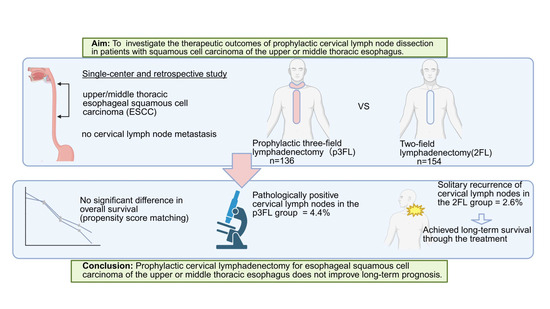
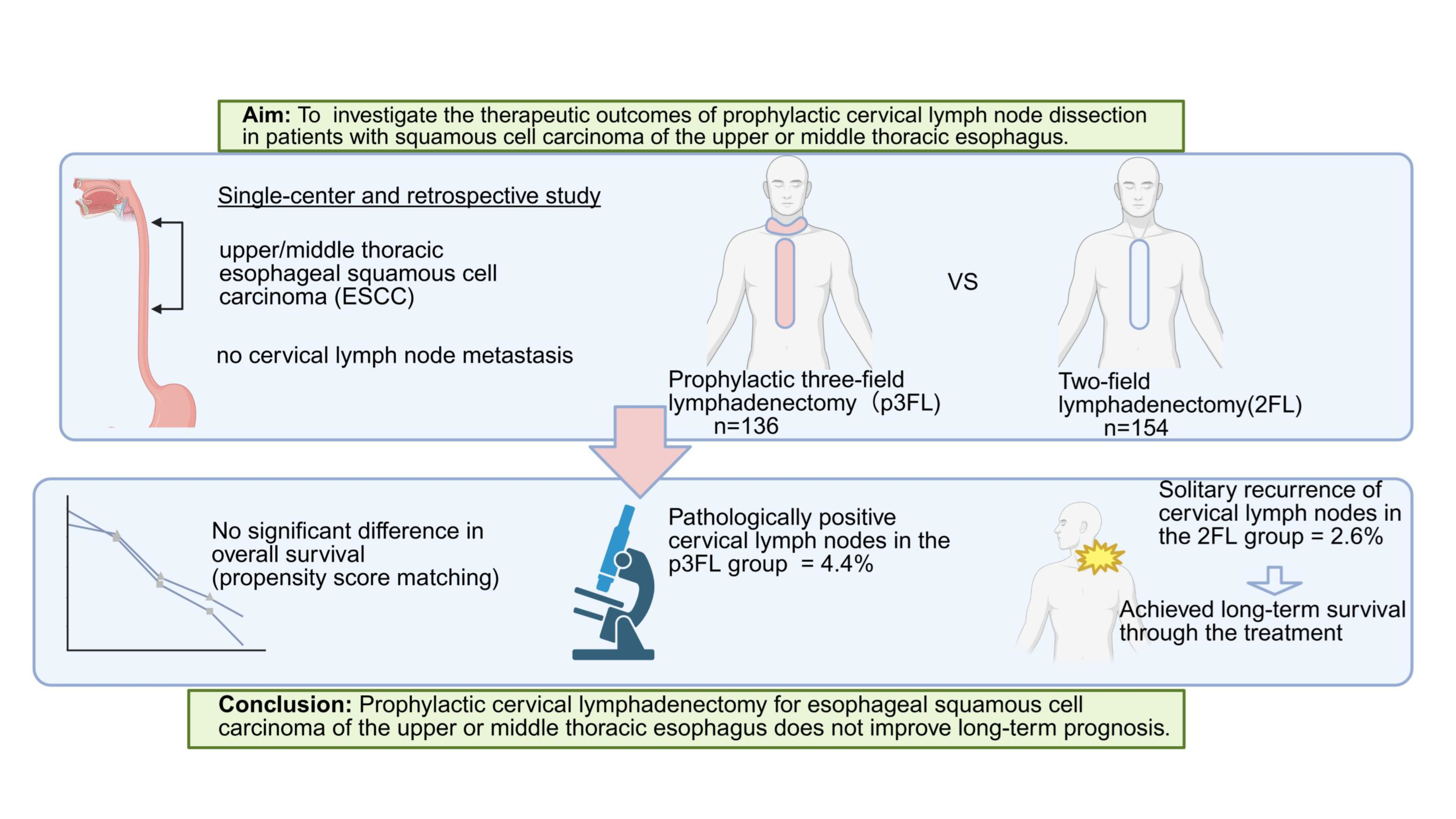
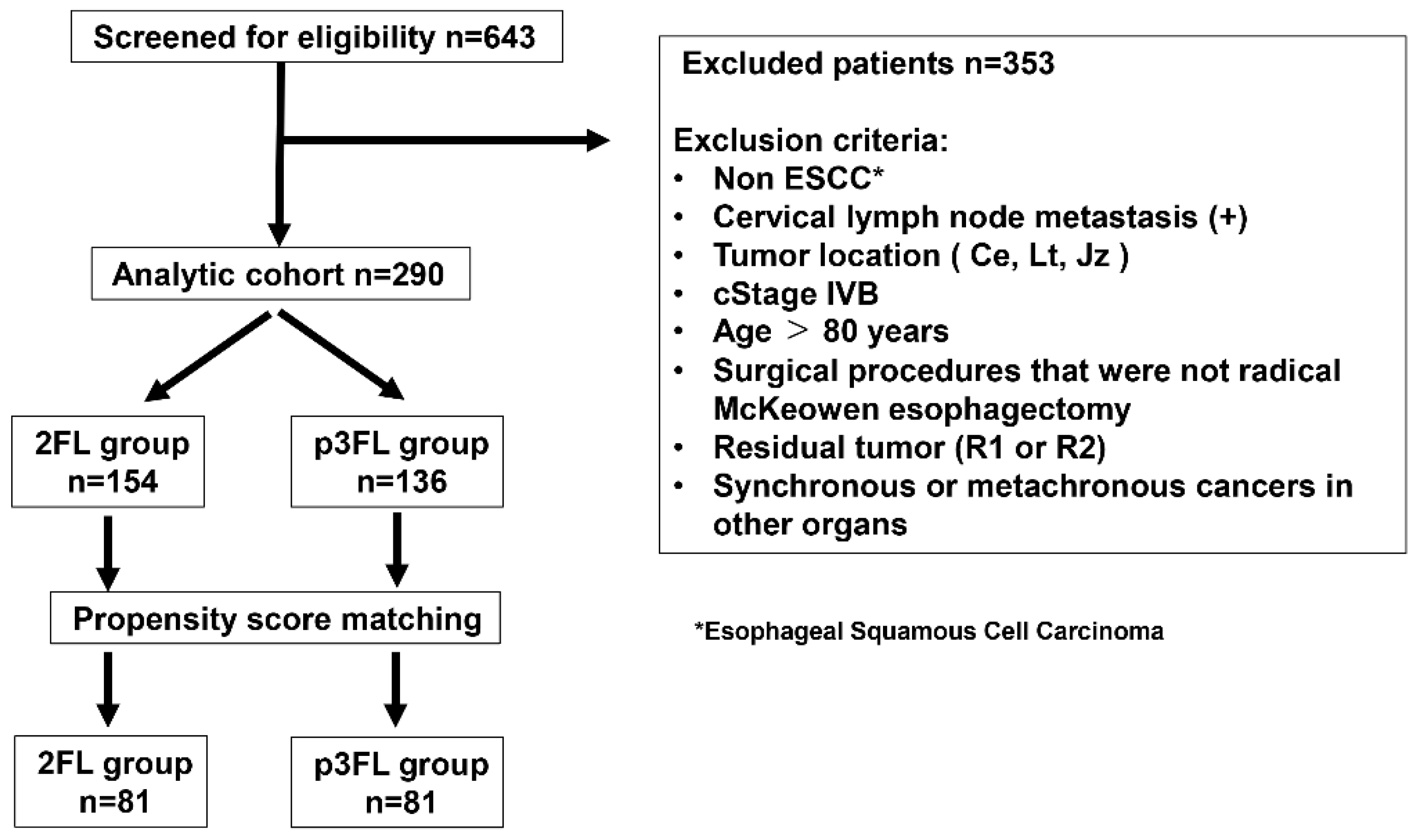
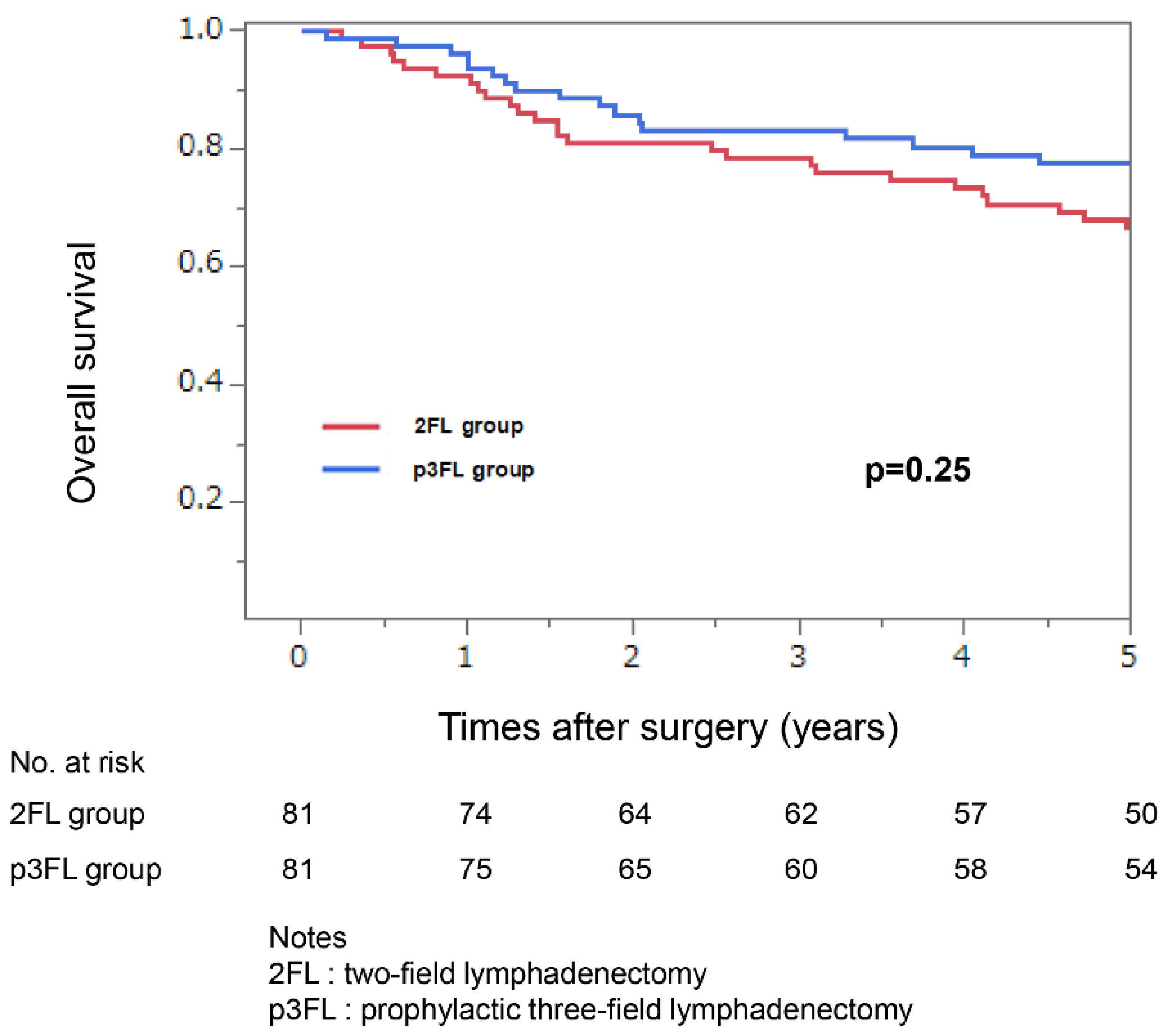
Background and Objectives: The benefits of prophylactic supraclavicular lymph node dissection for esophageal squamous cell carcinoma (ESCC) remain controversial. This study investigated whether prophylactic supraclavicular (cervical) lymphadenectomy improves the long-term outcomes of patients with upper or middle thoracic esophageal squamous cell carcinoma. Materials and Methods: This retrospective, single-center study included 290 patients who underwent thoracoscopic esophagectomy between January 2010 and December 2017. Patients treated with two-field lymphadenectomy (2FL) were compared with those who underwent prophylactic three-field lymphadenectomy (p3FL) after propensity score matching based on age, tumor location, clinical T and N stage, and preoperative treatment. The primary outcome was overall survival (OS), and secondary outcomes included postoperative complications and recurrence patterns. In a secondary analysis, the long-term outcomes were assessed in patients with solitary postoperative cervical (supraclavicular) lymph node recurrence in the 2FL group. Results: In the overall cohort, statistically significant differences were observed between the groups with respect to age, tumor location (p = 0.0002), cT and cN stages (p < 0.0001 and p < 0.0001), preoperative treatment (p = 0.02). No significant differences were observed between groups regarding age, organ for reconstruction, or postoperative complications. After propensity score matching, no significant differences were observed between the 2FL and p3FL groups in terms of overall survival or postoperative complications. Six patients (4.4%) in the p3FL group had pathologically confirmed supraclavicular lymph node metastasis, whereas four patients (2.6%) in the 2FL group developed solitary postoperative cervical lymph node recurrence. Patients with isolated cervical recurrence achieved favorable long-term survival following additional treatment. Conclusions: Prophylactic cervical lymphadenectomy did not improve the survival of patients with upper or middle thoracic esophageal squamous cell carcinoma. Given the low incidence of isolated cervical lymph node recurrence and the favorable outcomes achievable with additional treatment, routine prophylactic supraclavicular dissection appears unnecessary when two-field lymphadenectomy is feasible.
Keywords: esophagectomy; supraclavicular lymph node dissection; minimally invasive surgery; squamous cell carcinoma; upper or middle thoracic esophageal cancer esophagectomy; supraclavicular lymph node dissection; minimally invasive surgery; squamous cell carcinoma; upper or middle thoracic esophageal cancer
Graphical Abstract