Return-to-Work After Carpal Tunnel Release Across Surgical Techniques: A Narrative Review

 ,
,
Abstract
1. Introduction
2. Materials and Methods
Literature Identification and Narrative Synthesis Approach
3. Epidemiology and Socioeconomic Burden
4. Historical and Contextual Background of Carpal Tunnel Release
4.1. Early Recognition and Pathophysiological Understanding
4.2. The First Open Carpal Tunnel Releases
4.3. From Wide Exposure to Minimisation
4.4. Enduring Contributions of Early Innovators
5. Early Return-to-Work Evidence
6. Minimally Invasive and Endoscopic Techniques
6.1. The Rise in Endoscopic Approaches
6.2. Complications and the Learning Curve
6.3. Return-to-Work as a Functional Outcome
6.4. The Transitional Step Toward Ultraminimal Access
7. Ultrasound-Guided Minimally Invasive Carpal Tunnel Release
7.1. Visual Control and Anatomical Safety
7.2. Functional Recovery and Return-to-Work Outcomes
7.3. Operator Learning Curve and Adoption
7.4. A Platform for Further Innovation
8. Ultraminimally Invasive Techniques
8.1. Thread-Based Percutaneous Release
8.2. Hook-Knife and Micro-Blade Approaches
8.3. Functional Recovery and Return-to-Work
8.4. Position Within the Carpal Tunnel Release Development Pathway
9. Microinvasive and Needle-Mounted Blade Techniques
9.1. Development of Needle-Mounted Blade Systems
9.2. Clinical Outcomes and Return-to-Work
9.3. Procedural Efficiency and System-Level Implications
9.4. Scope Beyond Carpal Tunnel Release
9.5. Position of Microinvasive Carpal Tunnel Release in Contemporary Practice
10. Comparative Synthesis: Return-to-Work as a Core Functional Metric
10.1. Evolution of Return-to-Work Across Carpal Tunnel Release Modalities
10.2. Return-to-Work as a Functional and Socioeconomic Indicator
10.3. Implications for Comparative Evaluation
11. Discussion
11.1. Reframing Success Through Return-to-Work
11.2. Technical Refinement as the Primary Driver of Recovery Acceleration
11.3. The Limits of Further Miniaturisation
11.4. Return-to-Work as a Value-Based Outcome Measure
11.5. Implications for Clinical Practice and Research
12. Conclusion and Future Directions
12.1. Summary of Evidence
12.2. Return-to-Work as a Definitive Functional Endpoint
12.3. Clinical Implications
12.4. Future Directions: Recovery Pathways and Return-to-Work
12.5. Closing Statement
Author Contributions
Funding
Institutional Review Board Statement
Informed Consent Statement
Data Availability Statement
Acknowledgments
Conflicts of Interest
Abbreviations
| CTS | Carpal Tunnel Syndrome |
| CTR | Carpal Tunnel Release |
| OCTR | Open Carpal Tunnel Release |
| ECTR | Endoscopic Carpal Tunnel Release |
| US-CTR | Ultrasound-Guided Carpal Tunnel Release |
| Ultra-MIS | Ultraminimally Invasive Surgery |
| Micro-CTR | Microinvasive Carpal Tunnel Release |
| RTW | Return-to-Work |
| TCL | Transverse Carpal Ligament |
References
- Atroshi, I.; Gummesson, C.; Johnsson, R.; Ornstein, E.; Ranstam, J.; Rosén, I. Prevalence of carpal tunnel syndrome in a general population. JAMA 1999, 282, 153–158. [Google Scholar] [CrossRef] [PubMed]
- Kao, S.Y. Carpal Tunnel Syndrome as an Occupational Disease. J. Am. Board Fam. Med. 2003, 16, 533–542. [Google Scholar] [CrossRef] [PubMed]
- Cowan, J.; Makanji, H.; Mudgal, C.; Jupiter, J.; Ring, D. Determinants of return to work after carpal tunnel release. J. Hand Surg. 2012, 37, 18–27. [Google Scholar] [CrossRef]
- English, J.H.J.; Gwynne-Jones, D.P. Incidence of Carpal Tunnel Syndrome Requiring Surgical Decompression: A 10.5-Year Review of 2309 Patients. J. Hand Surg. Am. 2015, 40, 2427–2434. [Google Scholar] [CrossRef]
- Newington, L.; Ntani, G.; Warwick, D.; Adams, J.; Walker-Bone, K. Sickness absence after carpal tunnel release: A multicentre prospective cohort study. BMJ Open 2021, 11, e041656. [Google Scholar] [CrossRef]
- Sanati, K.A.; Mansouri, M.; MacDonald, D.; Ghafghazi, S.; MacDonald, E.; Yadegarfar, G. Surgical techniques and return to work following carpal tunnel release: A systematic review and meta-analysis. J. Occup. Rehabil. 2011, 21, 474–481. [Google Scholar] [CrossRef]
- Zhou, M.; Deek, R.; Crittenden, T.; Dean, N.R. A five-year retrospective cohort study of carpal tunnel surgery complications in an Australian population. ANZ J. Surg. 2022, 92, 3283–3287. [Google Scholar] [CrossRef]
- Radwin, R.G.; Sesto, M.E.; Zachary, S.V. Functional Tests to Quantify Recovery Following Carpal Tunnel Release. J. Bone Joint Surg. 2004, 86, 2614–2620. [Google Scholar] [CrossRef]
- Louie, D.L.; Earp, B.E.; Collins, J.E.; Losina, E.; Katz, J.N.; Black, E.M.; Simmons, B.P.; Blazar, P.E. Outcomes of open carpal tunnel release at a minimum of ten years. J. Bone Jt. Surg. 2013, 95, 1067–1073. [Google Scholar] [CrossRef] [PubMed]
- De Kleermaeker, F.G.C.M.; Meulstee, J.; Bartels, R.H.M.A.; Verhagen, W.I.M. Long-term outcome after carpal tunnel release and identification of prognostic factors. Acta Neurochir. 2019, 161, 663–671. [Google Scholar] [CrossRef]
- Newington, L.; Brooks, C.; Warwick, D.; Adams, J.; Walker-Bone, K. Return to work after carpal tunnel release surgery: A qualitative interview study. BMC Musculoskelet. Disord. 2019, 20, 242. [Google Scholar] [CrossRef]
- Amick, B.C.; Habeck, R.V.; Ossmann, J.; Fossel, A.H.; Keller, R.; Katz, J.N. Predictors of Successful Work Role Functioning after Carpal Tunnel Release Surgery. J. Occup. Environ. Med. 2004, 46, 490–500. [Google Scholar] [CrossRef]
- Nazzi, V.; Franzini, A.; Messina, G.; Broggi, G. Carpal tunnel syndrome: Matching minimally invasive surgical techniques: Technical note. J. Neurosurg. 2008, 108, 1033–1036. [Google Scholar] [CrossRef]
- Vanni, D.; Sirabella, F.S.; Galzio, R.; Salini, V.; Magliani, V. The double tunnels technique: An alternative minimally invasive approach for carpal tunnel syndrome. J. Neurosurg. 2015, 123, 1230–1237. [Google Scholar] [CrossRef] [PubMed]
- Kamel, S.I.; Freid, B.; Pomeranz, C.; Halpern, E.J.; Nazarian, L.N. Minimally Invasive Ultrasound-Guided Carpal Tunnel Release Improves Long-Term Clinical Outcomes in Carpal Tunnel Syndrome. Am. J. Roentgenol. 2021, 217, 460–468. [Google Scholar] [CrossRef] [PubMed]
- Honold, S.; Loizides, A.; Skalla, E.; Gruber, L.; Plaikner, M.; Gruber, H. Minimally invasive ultrasound-guided carpal tunnel release: Long-term clinical outcomes. Ultraschall Med. Eur. J. Ultrasound 2025. Online ahead of print. [Google Scholar] [CrossRef]
- Loizides, A.; Honold, S.; Skalla-Oberherber, E.; Gruber, L.; Löscher, W.; Moriggl, B.; Konschake, M.; Gruber, H. Ultrasound-Guided Minimal Invasive Carpal Tunnel Release: An Optimized Algorithm. Cardiovasc. Interv. Radiol. 2021, 44, 976–981. [Google Scholar] [CrossRef]
- Petrover, D.; Hakime, A.; Silvera, J.; Richette, P.; Nizard, R. Ultrasound-Guided Surgery for Carpal Tunnel Syndrome: A New Interventional Procedure. Semin. Interv. Radiol. 2018, 35, 248–254. [Google Scholar] [CrossRef]
- Hebbard, P.D.; Hebbard, A.I.T.; Tomka, J.; Appleyard, R. Ultrasound-Guided Microinvasive Carpal Tunnel Release Using a Novel Retractable Needle-Mounted Blade: A Cadaveric Study. J. Ultrasound Med. 2018, 37, 2075–2081. [Google Scholar] [CrossRef]
- Hebbard, P.; Echo, D.; Thomas, P.; Fransch, S.V.; Cichowitz, A.; Franzi, S. Microinvasive Carpal Tunnel Release Using a Retractable Needle-Mounted Blade. J. Ultrasound Med. 2020, 40, 1451–1458. [Google Scholar] [CrossRef] [PubMed]
- Capa-Grasa, A.; Rojo-Manaute, J.M.; Rodríguez, F.C.; Martín, J.V. Ultra minimally invasive sonographically guided carpal tunnel release: An external pilot study. Orthop. Traumatol. Surg. Res. 2014, 100, 287–292. [Google Scholar] [CrossRef]
- Rojo-Manaute, J.M.; Capa-Grasa, A.; Rodríguez-Maruri, G.E.; Moran, L.M.; Martínez, M.V.; Martín, J.V. Ultra-minimally invasive sonographically guided carpal tunnel release anatomic study of a new technique. J. Ultrasound Med. 2013, 32, 131–142. [Google Scholar] [CrossRef]
- Rojo-Manaute, J.M.; Capa-Grasa, A.; Chana-Rodríguez, F.; Perez-Mañanes, R.; Rodriguez-Maruri, G.; Sanz-Ruiz, P.; Muñoz-Ledesma, J.; Aburto-Bernardo, M.; Esparragoza-Cabrera, L.; Cerro-Gutiérrez, M.D.; et al. Ultra-Minimally Invasive Ultrasound-Guided Carpal Tunnel Release. J. Ultrasound Med. 2016, 35, 1149–1157. [Google Scholar] [CrossRef]
- Cano, L.C.; Leiby, B.M.; Shum, L.C.; Ward, M.G.; Joseph, A.E. Clinical Results of Carpal Tunnel Release Using Ultrasound Guidance in Over 100 Patients at Two to Six Years. J. Hand Surg. Glob. Online 2024, 6, 354–359. [Google Scholar] [CrossRef]
- Ulusoy, İ.; Yılmaz, M.; Tantekin, M.F.; Güzel, İ.; Kıvrak, A. Ultrasound-Guided Percutaneous Release and Mini-Open Surgery in Carpal Tunnel Syndrome: A Comparison of Short- and Long-Term Outcomes. Medicina 2025, 61, 799. [Google Scholar] [CrossRef]
- Kumar, N.; Saifi, A.S.; Singh, U.; Singh, D.K. USG-Guided Percutaneous Thread Carpal Tunnel Release. Indian J. Radiol. Imaging 2024, 34, 745–749. [Google Scholar] [CrossRef] [PubMed]
- Kumar, N.; Singh, U.; Singh, D.K.; Saifi, A.S. Ultrasound-Guided Partial Release of Transverse Carpal Ligament in Severe Carpal Tunnel Syndrome Using a Curved Needle. Indian J. Radiol. Imaging 2024, 35, 490–493. [Google Scholar] [CrossRef] [PubMed]
- Hobson-Webb, L.D.; Juel, V.C. Common Entrapment Neuropathies. Continuum 2017, 23, 487–511. [Google Scholar] [CrossRef]
- Hubbard, Z.S.; Law, T.Y.; Rosas, S.; Jernigan, S.C.; Chim, H. Economic benefit of carpal tunnel release in the Medicare patient population. Neurosurg. Focus 2018, 44, E16. [Google Scholar] [CrossRef] [PubMed]
- Anderson, J.T.; Stephens, A.R.; Haas, A.R.; Ahn, N.U.; Kazmers, N.H. Evaluation of Factors Affecting Return to Work Following Carpal Tunnel Release: A Statewide Cohort Study of Workers’ Compensation Subjects. J. Hand Surg. Am. 2022, 47, 544–553. [Google Scholar] [CrossRef] [PubMed]
- Foley, M.; Silverstein, B.; Polissar, N. The economic burden of carpal tunnel syndrome: Long-term earnings of CTS claimants in Washington State. Am. J. Ind. Med. 2007, 50, 155–172. [Google Scholar] [CrossRef]
- Gabrielli, A.S.; Lesiak, A.C.; Fowler, J.R. The Direct and Indirect Costs to Society of Carpal Tunnel Release. Hand 2018, 15, NP1. [Google Scholar] [CrossRef]
- Korthals-De Bos, I.B.C.; Gerritsen, A.A.M.; Van Tulder, M.W.; Rutten-Van Mölken, M.P.M.H.; Adèr, H.J.; De Vet, H.C.W.; Bouter, L.M. Surgery is more cost-effective than splinting for carpal tunnel syndrome in the Netherlands: Results of an economic evaluation alongside a randomized controlled trial. BMC Musculoskelet. Disord. 2006, 7, 86. [Google Scholar] [CrossRef]
- Jansen, M.C.; van der Oest, M.J.W.; de Haas, N.P.; Selles, R.W.; Zuidam, J.M.; Hand-Wrist Study Group. The Influence of Illness Perception and Mental Health on Return to Work After Carpal Tunnel Release Surgery. J. Hand Surg. 2021, 46, 748–757. [Google Scholar] [CrossRef]
- Katz, J.N.; Amick, B.C.; Keller, R.; Fossel, A.H.; Ossman, J.; Soucie, V.; Losina, E. Determinants of work absence following surgery for carpal tunnel syndrome. Am. J. Ind. Med. 2005, 47, 120–130. [Google Scholar] [CrossRef]
- Learmonth, J.R. The principle of decompression in the treatment of certain diseases of peripheral nerves. Surg. Clin. N. Am. 1933, 13, 905–913. [Google Scholar]
- Dellon, A.L.; Amadio, P.C.; James, R. Learmonth: The first peripheral nerve surgeon. J. Reconstr. Microsurg. 2000, 16, 213–217. [Google Scholar] [CrossRef] [PubMed]
- Russell Brain, W.; Dickson Wright, A.; Wilkinson, M. Spontaneous Compression of Both Median Nerves in the Carpal Tunnel Six Cases Treated Surgically. Lancet 1947, 249, 277–282. [Google Scholar] [CrossRef] [PubMed]
- Phalen, G.S. The Carpal-Tunnel Syndrome: Seventeen Years’ Experience in Diagnosis and Treatment of Six Hundred Fifty-Four Hands. J. Bone Joint Surg. 1966, 48, 211–228. [Google Scholar] [CrossRef] [PubMed]
- Phalen, G.S. The Carpal-tunnel Syndrome: Clinical Evaluation of 598 hands. Clin. Orthop. Relat. Res. 1972, 83, 29–40. [Google Scholar] [CrossRef]
- Tanzer, R.C. The Carpal-Tunnel Syndrome: A Clinical and Anatomical Study. J. Bone Joint Surg. 1959, 41, 626–634. [Google Scholar] [CrossRef]
- Lanz, U. Anatomical variations of the median nerve in the carpal tunnel. J. Hand Surg. Am. 1977, 2, 44–53. [Google Scholar] [CrossRef]
- Cook, A.C.; Szabo, R.M.; Birkholz, S.W.; King, E.F. Early Mobilization Following Carpal Tunnel Release. J. Hand Surg. 1995, 20, 228–230. [Google Scholar] [CrossRef]
- Chaise, F.; Bellemère, P.; Fril, J.P.; Gaisne, E.; Poirier, P.; Menadi, A. Return-to-Work Interval and Surgery for Carpal Tunnel Syndrome. Results of a Prospective Series of 233 Patients. J. Hand Surg. 2004, 29, 568–570. [Google Scholar] [CrossRef] [PubMed]
- Agee, J.M.; McCarroll, H.R.; Tortosa, R.D.; Berry, D.A.; Szabo, R.M.; Peimer, C.A. Endoscopic release of the carpal tunnel: A randomized prospective multicenter study. J. Hand Surg. Am. 1992, 17, 987–995. [Google Scholar] [CrossRef]
- Kerr, C.D.; Gittins, M.E.; Sybert, D.R. Endoscopic versus open carpal tunnel release: Clinical results. Arthrosc. J. Arthrosc. Relat. Surg. 1994, 10, 266–269. [Google Scholar] [CrossRef]
- Palmer, A.K.; Toivonen, D.A. Complications of endoscopic and open carpal tunnel release. J. Hand Surg. Am. 1999, 24, 561–565. [Google Scholar] [CrossRef]
- Boeckstyns, M.E.H.; Sørensen, A.I. Does endoscopic carpal tunnel release have a higher rate of complications than open carpal tunnel release?: An analysis of published series. J. Hand Surg. Br. Eur. Vol. 1999, 24, 9–15. [Google Scholar] [CrossRef] [PubMed]
- Chow, J.C.Y.; Hantes, M.E. Endoscopic carpal tunnel release: Thirteen years’ experience with the Chow technique. J. Hand Surg. Am. 2002, 27, 1011–1018. [Google Scholar] [CrossRef] [PubMed]
- Chow, J.C.Y. Endoscopic release of the carpal ligament: A new technique for carpal tunnel syndrome. Arthrosc. J. Arthrosc. Relat. Surg. 1989, 5, 19–24. [Google Scholar] [CrossRef]
- Chow, J.C.Y. Endoscopic release of the carpal ligament for carpal tunnel syndrome: 22-month clinical result. Arthrosc. J. Arthrosc. Relat. Surg. 1990, 6, 288–296. [Google Scholar] [CrossRef] [PubMed]
- Okutsu, I.; Ninomiya, S.; Takatori, Y.; Ugawa, Y. Endoscopic management of carpal tunnel syndrome. Arthrosc. J. Arthrosc. Relat. Surg. 1989, 5, 11–18. [Google Scholar] [CrossRef]
- Trumble, T.E.; Diao, E.; Abrams, R.A.; Gilbert-Anderson, M.M. Single-portal endoscopic carpal tunnel release compared with open release: A prospective, randomized trial. J. Bone Joint Surg. Am. 2002, 84, 1107–1115. [Google Scholar] [CrossRef]
- MacDermid, J.C.; Richards, R.S.; Roth, J.H.; Ross, D.C.; King, G.J.W. Endoscopic versus open carpal tunnel release: A randomized trial. J. Hand Surg. Am. 2003, 28, 475–480. [Google Scholar] [CrossRef]
- Benson, L.S.; Bare, A.A.; Nagle, D.J.; Harder, V.S.; Williams, C.S.; Visotsky, J.L. Complications of Endoscopic and Open Carpal Tunnel Release. Arthrosc. J. Arthrosc. Relat. Surg. 2006, 22, 919–924.e2. [Google Scholar] [CrossRef] [PubMed]
- Helm, R.H.; Vaziri, S. Evaluation of carpal tunnel release using the Knifelight® instrument. J. Hand Surg. 2003, 28, 251–254. [Google Scholar] [CrossRef]
- Bhattacharya, R.; Birdsall, P.D.; Finn, P.; Stothard, J. A Randomized Controlled Trial of Knifelight and Open Carpal Tunnel Release. J. Hand Surg. 2004, 29, 113–115. [Google Scholar] [CrossRef]
- Cellocco, P.; Rossi, C.; El Boustany, S.; Di Tanna, G.L.; Costanzo, G. Minimally Invasive Carpal Tunnel Release. Orthop. Clin. N. Am. 2009, 40, 441–448. [Google Scholar] [CrossRef] [PubMed]
- Petrover, D.; Silvera, J.; De Baere, T.; Vigan, M.; Hakimé, A. Percutaneous Ultrasound-Guided Carpal Tunnel Release: Study Upon Clinical Efficacy and Safety. Cardiovasc. Interv. Radiol. 2017, 40, 568–575. [Google Scholar] [CrossRef]
- Nakamichi, K.I.; Tachibana, S. Ultrasonographically assisted carpal tunnel release. J. Hand Surg. Am. 1997, 22, 853–862. [Google Scholar] [CrossRef]
- Tomažin, T.; Pušnik, L.; Albano, D.; Jengojan, S.A.; Snoj, Ž. Multiparametric Ultrasound Assessment of Carpal Tunnel Syndrome: Beyond Nerve Cross-sectional Area. Semin. Musculoskelet. Radiol. 2024, 28, 661–671. [Google Scholar] [CrossRef]
- Pistorio, A.L.; Marwin, V.M.; Paterson, P.D.; Alexander, R.D.; Nelson, J.T.; Miller, L.E. Office-Based Carpal Tunnel Release With Ultrasound Guidance: 6-month Outcomes from the Multicenter ROBUST Trial. J. Hand Surg. Glob. Online 2024, 6, 268–274. [Google Scholar] [CrossRef]
- Henning, P.T.; Yang, L.; Awan, T.; Lueders, D.; Pourcho, A.M. Minimally Invasive Ultrasound-Guided Carpal Tunnel Release: Preliminary Clinical Results. J. Ultrasound Med. 2018, 37, 2699–2706. [Google Scholar] [CrossRef]
- Fowler, J.R.; Chung, K.C.; Miller, L.E. Multicenter pragmatic study of carpal tunnel release with ultrasound guidance. Expert Rev. Med. Devices 2022, 19, 273–280. [Google Scholar] [CrossRef] [PubMed]
- Chern, T.C.; Kuo, L.C.; Shao, C.J.; Wu, T.T.; Wu, K.C.; Jou, I.M. Ultrasonographically guided percutaneous carpal tunnel release: Early clinical experiences and outcomes. Arthrosc. J. Arthrosc. Relat. Surg. 2015, 31, 2400–2410. [Google Scholar] [CrossRef]
- Descamps, J.; Draznieks, G.; Nizard, R.; Bouché, P.A.; Apard, T. Real-world data on efficacy and safety of 1256 consecutive ultrasound-guided percutaneous carpal tunnel release. J. Plast. Reconstr. Aesthetic Surg. 2025, 106, 11–18. [Google Scholar] [CrossRef]
- Guo, D.; Tang, Y.; Ji, Y.; Sun, T.; Guo, J.; Guo, D. A Non-Scalpel Technique for Minimally Invasive Surgery: Percutaneously Looped Thread Transection of the Transverse Carpal Ligament. Hand 2015, 10, 40–48. [Google Scholar] [CrossRef]
- Guo, D.; Guo, D.; Guo, J.; Schmidt, S.C.; Lytie, R.M. A Clinical Study of the Modified Thread Carpal Tunnel Release. Hand 2017, 12, 453–460. [Google Scholar] [CrossRef]
- Burnham, R.; Playfair, L.; Loh, E.; Roberts, S.; Agur, A. Response to the Letter to the Editor on “ultrasound Anatomy of the Transverse Carpal Ligament”. Am. J. Phys. Med. Rehabil. 2017, 96, e217–e218. [Google Scholar] [CrossRef]
- Burnham, R.; Playfair, L.; Loh, E.; Roberts, S.; Agur, A. Evaluation of the effectiveness and safety of ultrasound-guided percutaneous carpal tunnel release: A Cadaveric Study. Am. J. Phys. Med. Rehabil. 2017, 96, 457–463. [Google Scholar] [CrossRef] [PubMed]
- Burnham, R.S.; Loh, E.Y.; Rambaransingh, B.; Roberts, S.L.; Agur, A.M.; Playfair, L.D. A Controlled Trial Evaluating the Safety and Effectiveness of Ultrasound-Guided Looped Thread Carpal Tunnel Release. Hand 2021, 16, 73–80. [Google Scholar] [CrossRef]
- Ma, T.; Wang, D.; Hu, Y.; Zhao, X.; Wang, W.; Song, L. Mini-transverse incision using a novel bush-hook versus conventional open incision for treatment of carpal tunnel syndrome: A prospective study. J. Orthop. Surg. Res. 2021, 16, 462. [Google Scholar] [CrossRef]
- Ferreira-Silva, N.; Ribeiro-Da-Silva, T.; Lucas-Neto, L.; Aziz, K.; Troyer, W.; Rosario-Concepción, R.A. Minimally invasive ultrasound-guided thread carpal tunnel release: A video demonstration protocol. J. Ultrasound. 2025, 28, 803–810. [Google Scholar] [CrossRef]
- Vega, T.F.; Colberg, R.E.; Kremser, V.J.; Sankar, S.; Aiken, C.B.; Naman, T.; Yates, A.M.; Ithurburn, M.P. Ultrasound-guided microinvasive trigger thumb release with an 18-gauge blade-tipped needle: A case series. Medicine 2025, 104, e42474. [Google Scholar] [CrossRef]
- Katz, J.N.; Losina, E.; Amick, B.C.; Fossel, A.H.; Bessette, L.; Keller, R.B. Predictors of Outcomes of Carpal Tunnel Release. Arthritis Rheum. 2001, 44, 1184–1193. [Google Scholar] [CrossRef]
- Chappell, C.D.; Beckman, J.P.; Baird, B.C.; Takke, A.V. Ultrasound (US) Changes in the Median Nerve Cross-Sectional Area After Microinvasive US-Guided Carpal Tunnel Release. J. Ultrasound Med. 2020, 39, 693–702. [Google Scholar] [CrossRef]



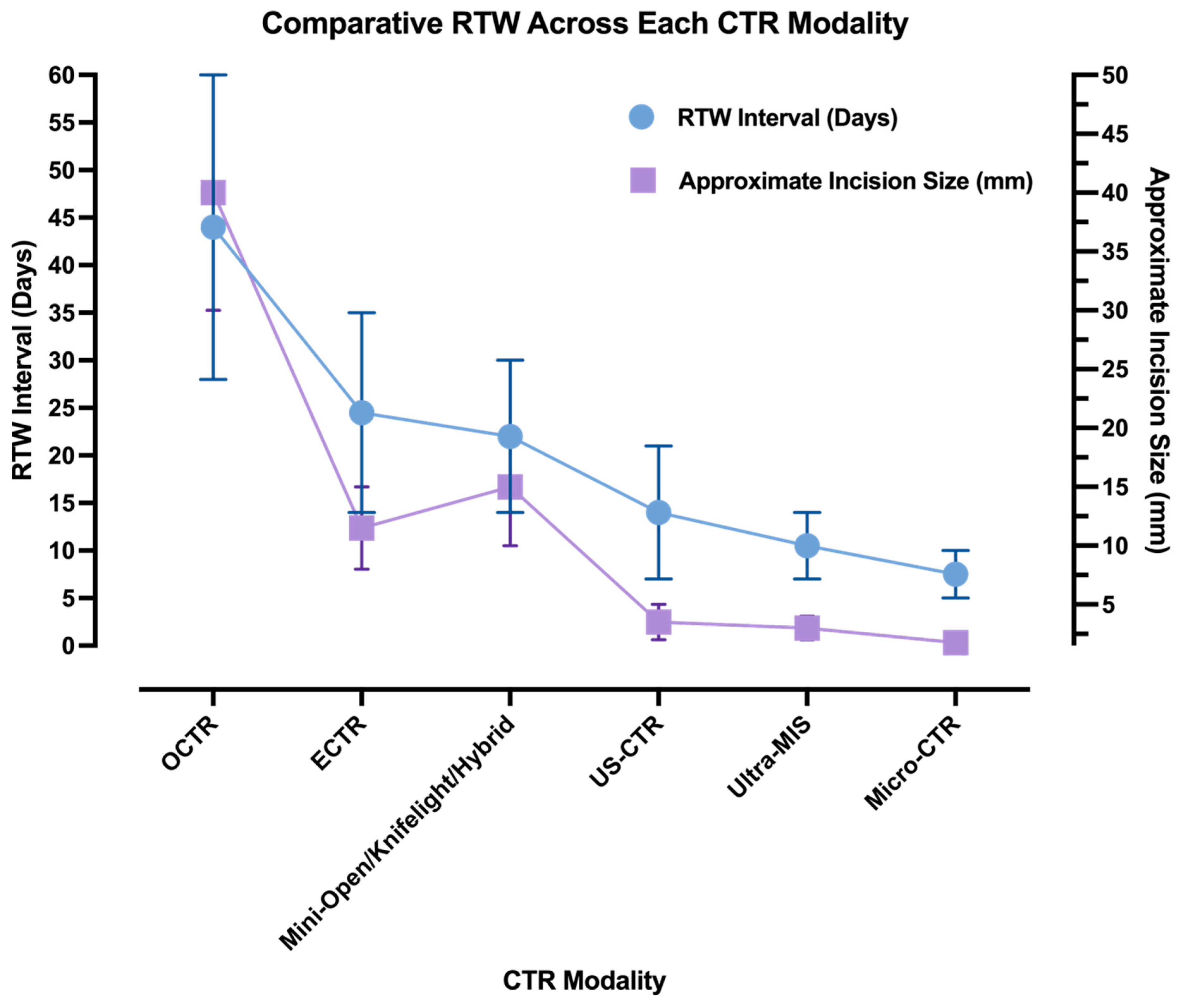
| CTR Modality | Representative Studies | Typical RTW Interval | Key Determinants of RTW | Clinical/Economic Implications |
|---|---|---|---|---|
| Open Carpal Tunnel Release (OCTR) | [9,40,41,44] | 4–6 weeks (28–42 days) | Wound healing, pillar pain, occupation type | Baseline for efficacy; prolonged convalescence and work loss. |
| Endoscopic CTR (ECTR) | [45,46,49,53,54] | 2–4 weeks (14–28 days) | Technique mastery, pillar pain, nerve irritation | Faster RTW and reduced morbidity; equivalent long-term outcomes to OCTR. |
| Mini-Open/KnifeLight/Hybrid | [56,57,58] | 2–3 weeks (14–21 days) | Incision length, scar tenderness | Transitional approach toward minimally invasive CTR. |
| Ultrasound-Guided CTR (US-CTR) | [15,24,63,64,66] | 10–21 days | Sonographic precision, local anaesthesia, job autonomy | Outpatient feasibility; >90% RTW within 3 weeks; reduced indirect cost. |
| Ultraminimally Invasive CTR (Ultra-MIS) | [14,23,67,68,71,72] | 7–14 days | Micro-access safety, thread tension control | Halves convalescence time compared to ECTR; minimal scar and pain. |
| Microinvasive CTR (Micro-CTR) | [19,20,25,73] | 5–10 days | Needle trajectory control, ultrasound guidance, operator training | Fastest RTW documented; outpatient local anaesthesia; optimised cost-effectiveness. |
Disclaimer/Publisher’s Note: The statements, opinions and data contained in all publications are solely those of the individual author(s) and contributor(s) and not of MDPI and/or the editor(s). MDPI and/or the editor(s) disclaim responsibility for any injury to people or property resulting from any ideas, methods, instructions or products referred to in the content. |
© 2026 by the authors. Published by MDPI on behalf of the Lithuanian University of Health Sciences. Licensee MDPI, Basel, Switzerland. This article is an open access article distributed under the terms and conditions of the Creative Commons Attribution (CC BY) license.
Share and Cite
Lobos, C.A.; Wilcox, K.; De Campos Silva, T.; Wilcox, S. Return-to-Work After Carpal Tunnel Release Across Surgical Techniques: A Narrative Review. Medicina 2026, 62, 557. https://doi.org/10.3390/medicina62030557
Lobos CA, Wilcox K, De Campos Silva T, Wilcox S. Return-to-Work After Carpal Tunnel Release Across Surgical Techniques: A Narrative Review. Medicina. 2026; 62(3):557. https://doi.org/10.3390/medicina62030557
Chicago/Turabian StyleLobos, Christian A., Kyle Wilcox, Thomaz De Campos Silva, and Shea Wilcox. 2026. "Return-to-Work After Carpal Tunnel Release Across Surgical Techniques: A Narrative Review" Medicina 62, no. 3: 557. https://doi.org/10.3390/medicina62030557
APA StyleLobos, C. A., Wilcox, K., De Campos Silva, T., & Wilcox, S. (2026). Return-to-Work After Carpal Tunnel Release Across Surgical Techniques: A Narrative Review. Medicina, 62(3), 557. https://doi.org/10.3390/medicina62030557