Long-Term Outcomes of Intermittent Exotropia: A Real-World Longitudinal Cohort Study of 415 Patients


Abstract
1. Introduction
2. Materials and Methods
2.1. Study Design and Setting
2.2. Participants
- A confirmed clinical diagnosis of IXT.
- Documented age at presentation.
- Complete ocular alignment measurements at both distance (6 m) and near (33 cm) using the prism and alternate cover test.
- Availability of detailed preoperative, surgical, and postoperative follow-up records.
- Minimum follow-up duration of 6 months.
- Restrictive or paralytic strabismus.
- Structural ocular pathologies (e.g., cataract, retinal disease).
- Prior extraocular muscle surgery before initial evaluation.
- Significant systemic or neurological comorbidities.
- Inability to attend regular follow-up visits.
2.3. Clinical Assessments
- Best Corrected Visual Acuity testing using age-appropriate methods.
- Binocular Single Vision assessment via the Bagolini, Titmus or Randot tests.
- Ocular motility assessment and alignment measurement using the prism and alternate cover test at distance and near fixation.
- Occlusion testing: Parents were informed that at a subsequent visit the non-dominant eye would be occluded for 1 h to reveal the largest angle of deviation.
- 5.
- Dynamic retinoscopy to assess binocular accommodative function.
- 6.
- Cycloplegic refraction performed using cyclopentolate 1%.
- 7.
- Anterior and posterior segment evaluation via slit-lamp biomicroscopy and indirect ophthalmoscopy.
2.4. Treatments
2.5. Statistical Analysis
- For categorical variables, the Pearson Chi-square test, Fisher’s Exact test, or the Fisher–Freeman–Halton Exact test (in cases of small, expected cell counts) was used. Where appropriate, post hoc analyses included pairwise comparisons or adjusted residuals.
- For non-normally distributed continuous variables, comparisons between two independent groups were performed using the Mann–Whitney U test, while comparisons among more than two groups were assessed using the Kruskal–Wallis test. In cases of statistical significance, pairwise Mann–Whitney U tests were applied for post hoc evaluation.
- Within-subject comparisons of non-normally distributed variables over time were analyzed using the Friedman test, with Wilcoxon signed-rank tests for post hoc pairwise analyses.
- For repeated categorical measures, the Cochran’s Q test was used, followed by McNemar’s test for pairwise comparisons when appropriate.
2.6. Longitudinal and Survival Analyses
3. Results
3.1. Patient Demographics and Clinical Characteristics
3.2. Non-Surgical Management
3.3. Over-Minus Therapy
3.4. Longitudinal Refractive Change
3.5. Age-Related Control Analysis Among Surgically Treated Patients (n = 167)
3.6. Surgical Outcomes and Associated Factors
3.7. Surgical Procedures and Postoperative Stability
3.8. Reoperations
3.9. Changes in Binocular Sensory Function During Follow-Up
3.10. Kaplan–Meier Analysis of Surgical and Non-Surgical Outcomes
3.11. Univariate Log-Rank Analysis
3.12. Multivariate Cox Proportional Hazards Model
4. Discussion
5. Conclusions
Author Contributions
Funding
Institutional Review Board Statement
Informed Consent Statement
Data Availability Statement
Conflicts of Interest
Abbreviations
| BLR | Bilateral Lateral Rectus Recession |
| CI | Confidence Interval |
| ECS | Eye Control Scale |
| HR | Hazard Ratio |
| IQR | Interquartile Range |
| IXT | Intermittent Exotropia |
| LMM | Linear Mixed-Effects Model |
| MAR | Missing At Random |
| OML | Over-Minus Lens (Over-minus Lens) |
| PD | Prism Diopters |
| PEDIG | Pediatric Eye Disease Investigator Group |
| R&R | Recession–Resection |
| SD | Standard Deviation |
| SE | Spherical Equivalent |
| SPSS | Statistical Package For The Social Sciences (IBM SPSS Statistics) |
References
- Lino, P.; de Aguiar, P.V.; Cunha, J.P. Success of Strabismus Surgery in Intermittent Exotropia. J. Pers. Med. 2025, 15, 333. [Google Scholar] [CrossRef] [Scilit] [PubMed]
- Ma, M.M.-L.; Scheiman, M. Divergence excess and basic exotropia types of intermittent exotropia: A major review. Part 1: Prevalence, classification, risk factors, natural history and clinical characteristics. Strabismus 2023, 31, 97–128. [Google Scholar] [CrossRef] [Scilit] [PubMed]
- Liu, P.; Fu, J.; Zhang, R.; Chu, H. Initial postoperative plasticity as a predictor of mid-term stereoacuity outcome after surgery for intermittent exotropia. BMC Ophthalmol. 2023, 23, 213. [Google Scholar] [CrossRef] [Scilit] [PubMed]
- Shen, T.; Chen, J.; Kang, Y.; Deng, D.; Lin, X.; Wu, H.; Li, J.; Wang, Z.; Qiu, X.; Jin, L.; et al. Surgical treatment versus observation in moderate intermittent exotropia (SOMIX): Study protocol for a randomized controlled trial. Trials 2023, 24, 153. [Google Scholar] [CrossRef] [Scilit]
- Kopmann, S.; Grenzebach, U.; Ehrt, O.; Biermann, J. Effectiveness of Strabismus Surgery in Intermittent Exotropia and Factors Influencing Outcome. J. Clin. Med. 2024, 13, 1031. [Google Scholar] [CrossRef] [Scilit]
- Anand, K.; Krishnan, A.; Kumar, P.; Bharadwaj, A.; Dutta, P.; Rastogi, A.; Hariani, A. Comparative Study of Bilateral Versus Unilateral Strabismus Surgery in the Management of Lateral Incomitance in Intermittent Exotropia. J. Pediatr. Ophthalmol. Strabismus 2023, 60, 277–281. [Google Scholar] [CrossRef] [Scilit]
- Donahue, S.P.; Chandler, D.L.; Wu, R.; Marsh, J.D.; Law, C.; Areaux, R.G.; Ghasia, F.F.; Li, Z.; Kraker, R.T.; Cotter, S.A.; et al. Eight-Year Outcomes of Bilateral Lateral Rectus Recessions versus Unilateral Recession-Resection in Childhood Basic-Type Intermittent Exotropia. Ophthalmology 2024, 131, 98–106. [Google Scholar] [CrossRef] [Scilit]
- Dong, Y.; Nan, L.; Liu, Y.Y. Surgery at early versus late for intermittent exotropia: A Meta-analysis and systematic review. Int. J. Ophthalmol. 2021, 14, 582–588. [Google Scholar] [CrossRef] [Scilit]
- Mohney, B.G.; Holmes, J.M. An office-based scale for assessing control in intermittent exotropia. Strabismus 2006, 14, 147–150. [Google Scholar] [CrossRef] [Scilit]
- Wright, W.; Spiegel, P.H.; Thompson, L.S. (Eds.) Handbook of Pediatric Strabismus and Amblyopia; Springer: New York, NY, USA, 2006; 576p. [Google Scholar]
- Pang, Y.; Gnanaraj, L.; Gayleard, J.; Han, G.; Hatt, S.R. Interventions for intermittent exotropia. Cochrane Database Syst. Rev. 2021, 9, Cd003737. [Google Scholar]
- Hopker, L.M.; Rossetto, J.D.; Ejzenbaum, F.; Sá, L.C.F.D.; Ribeiro, G.D.B.; Mendonça, T.S.; Goldchmit, M.; Debert, I. Management of Intermittent exotropia in childhood: Current concepts of the literature and the experts. Arq. Bras. Oftalmol. 2022, 85, V–VIII. [Google Scholar] [CrossRef] [Scilit] [PubMed]
- Issaho, D.C.; Wang, S.X.; Weakley, D.R., Jr. Intermittent exotropia surgery: Results in different age groups. Arq. Bras. Oftalmol. 2017, 80, 355–358. [Google Scholar] [CrossRef] [Scilit] [PubMed]
- Akbari, M.R.; Khorrami-Nejad, M.; Azizi, E.; Masoomian, B.; Shakor, Y.A.; Hadi, A. Clinical features in patients with acquired intermittent and constant exotropia who underwent surgery. BMC Ophthalmol. 2024, 24, 548. [Google Scholar] [CrossRef] [Scilit] [PubMed]
- Kim, D.H.; Jung, J.H.; Choi, M.Y.; Hwang, J.M.; Kim, S.J.; Lee, Y.H.; Han, S.H.; Choi, D.G.; The Korean Association of Pediatric Ophthalmology and Strabismus (KAPOS). A cross-sectional study of ophthalmologic examination findings in 5385 Koreans presenting with intermittent exotropia. Sci. Rep. 2023, 13, 1329. [Google Scholar] [CrossRef] [Scilit]
- Chen, A.M.; Erzurum, S.A.; Chandler, D.L.; Hercinovic, A.; Melia, B.M.; Bhatt, A.R.; Suh, D.W.; Vricella, M.; Erickson, J.W.; Miller, A.M.; et al. Over-minus Lens Therapy for Children 3 to 10 Years of Age with Intermittent Exotropia: A Randomized Clinical Trial. JAMA Ophthalmol. 2021, 139, 464–476. [Google Scholar] [CrossRef] [Scilit]
- Heydarian, S.; Hashemi, H.; Jafarzadehpour, E.; Ostadi, A.; Yekta, A.; Aghamirsalim, M.; Dadbin, N.; Ostadimoghaddam, H.; Khoshhal, F.; Khabazkhoob, M. Non-surgical Management Options of Intermittent Exotropia: A Literature Review. J. Curr. Ophthalmol. 2020, 32, 217–225. [Google Scholar] [CrossRef] [Scilit]
- Horwood, A.M.; Riddell, P.M. Evidence that convergence rather than accommodation controls intermittent distance exotropia. Acta Ophthalmol. 2012, 90, e109–e117. [Google Scholar] [CrossRef] [Scilit]
- Bayramlar, H.; Gurturk, A.Y.; Sari, U.; Karadag, R. Overcorrecting minus lens therapy in patients with intermittent exotropia: Should it be the first therapeutic choice? Int. Ophthalmol. 2017, 37, 385–390. [Google Scholar] [CrossRef] [Scilit]
- Aghdam, K.A.; Zand, A.; Sanjari, M.S.; Khorramdel, S.; Asadi, R. Over-minus Lens Therapy in the Management of Children with Intermittent Exotropia. J. Curr. Ophthalmol. 2021, 33, 36–40. [Google Scholar] [CrossRef] [Scilit]
- Alizadeh, Y.; Medghalchi, A.; Soltanipour, S.; Mohammadi, M.J.; Soltani-Moghadam, R.; Behboudi, H.; Ebrahim, A.; Altinai, S. Role of Overcorrecting Minus Lens Therapy in Intermittent Exotropia for Prevention of Constant Exotropia in Children Under the Age of 7 Years. Int. J. Prev. Med. 2023, 14, 80. [Google Scholar] [CrossRef] [Scilit]
- Paula, J.S.; Ibrahim, F.M.; Martins, M.C.; Bicas, H.E.A.; Cruz, A.A.V.E. Refractive error changes in children with intermittent exotropia under over-minus lens therapy. Arq. Bras. Oftalmol. 2009, 72, 751–754. [Google Scholar] [CrossRef] [Scilit]
- Rowe, F.J.; Noonan, C.P.; Freeman, G.; DeBell, J. Intervention for intermittent distance exotropia with overcorrecting minus lenses. Eye 2009, 23, 320–325. [Google Scholar] [CrossRef] [Scilit] [PubMed]
- Pediatric Eye Disease Investigator Group; Chen, A.M.; Holmes, J.M.; Chandler, D.L.; Patel, R.A.; Gray, M.E.; Erzurum, S.A.; Wallace, D.K.; Kraker, R.T.; Jensen, A.A. A Randomized Trial Evaluating Short-term Effectiveness of Over-minus Lenses in Children 3 to 6 Years of Age with Intermittent Exotropia. Ophthalmology 2016, 123, 2127–2136. [Google Scholar] [CrossRef] [Scilit] [PubMed]
- Somer, D.; Cinar, F.G.; Duman, S. The accommodative element in accommodative esotropia. Am. J. Ophthalmol. 2006, 141, 819–826. [Google Scholar] [CrossRef] [Scilit] [PubMed]
- Han, D.; Jiang, D.; Zhang, J.; Pei, T.; Zhao, Q. Clinical study of the effect of refractive status on stereopsis in children with intermittent exotropia. BMC Ophthalmol. 2018, 18, 143. [Google Scholar] [CrossRef] [Scilit]
- Lavrich, J.B. Intermittent exotropia: Continued controversies and current management. Curr. Opin. Ophthalmol. 2015, 26, 375–381. [Google Scholar] [CrossRef] [Scilit]
- Suwal, R.; Dev, M.K.; Khatri, B.; Khadka, D.; Shrestha, A.; Sharma, S.; Upadhyay, M.P. Impact of active vision therapy compared to conventional patching therapy on visual acuity and stereoacuity in children with amblyopia. J. Optom. 2024, 17, 100484. [Google Scholar] [CrossRef] [Scilit]
- Pediatric Eye Disease Investigator Group; Cotter, S.A.; Mohney, B.G.; Chandler, D.L.; Holmes, J.M.; Repka, M.X.; Melia, M.; Wallace, D.K.; Beck, R.W.; Birch, E.E.; et al. A randomized trial comparing part-time patching with observation for children 3 to 10 years of age with intermittent exotropia. Ophthalmology 2014, 121, 2299–2310. [Google Scholar] [CrossRef] [Scilit]
- Mohney, B.G.; Cotter, S.A.; Chandler, D.L.; Holmes, J.M.; Chen, A.M.; Melia, M.; Donahue, S.P.; Wallace, D.K.; Kraker, R.T.; Christian, M.L.; et al. A Randomized Trial Comparing Part-time Patching with Observation for Intermittent Exotropia in Children 12 to 35 Months of Age. Ophthalmology 2015, 122, 1718–1725. [Google Scholar] [CrossRef] [Scilit]
- Chew, F.L.M.; Gesitede Leon, B.U.; Quah, B.L. Post-operative strabismus control and motor alignment for basic intermittent exotropia. Int. J. Ophthalmol. 2016, 9, 1011–1015. [Google Scholar] [CrossRef] [Scilit]
- Lee, C.M.; Sun, M.H.; Kao, L.Y.; Lin, K.K.; Yang, M.L. Factors affecting surgical outcome of intermittent exotropia. Taiwan J. Ophthalmol. 2018, 8, 24–30. [Google Scholar] [CrossRef] [Scilit] [PubMed]
- Sun, Y.; Zhang, T.; Chen, J. Bilateral lateral rectus recession versus unilateral recession resection for basic intermittent exotropia: A meta-analysis. Graefe’s Arch. Clin. Exp. Ophthalmol. 2018, 256, 451–458. [Google Scholar] [CrossRef] [Scilit] [PubMed]
- Wang, X.; Zhu, Q.; Liu, L. Efficacy of bilateral lateral rectus recession versus unilateral recession and resection for basic-type intermittent exotropia: A meta-analysis. Acta Ophthalmol. 2021, 99, e984–e990. [Google Scholar] [CrossRef] [Scilit] [PubMed]
- Spierer, O.; Spierer, A. Unilateral lateral rectus recession is an effective surgery for intermittent exotropia in young children. BMC Ophthalmol. 2021, 21, 10. [Google Scholar] [CrossRef] [Scilit]
- Srimanan, W.; Keokajee, P. Early postoperative alignment and preoperative stereopsis as determinants of success in intermittent exotropia surgery. PLoS ONE 2025, 20, e0329609. [Google Scholar] [CrossRef] [Scilit]
- Peng, T.; Xu, M.; Zheng, F.; Zhang, J.; Chen, S.; Lou, J.; Wang, C.; Wang, Y.; Yu, X. Longitudinal Rehabilitation of Binocular Function in Adolescent Intermittent Exotropia After Successful Corrective Surgery. Front. Neurosci. 2021, 15, 685376. [Google Scholar] [CrossRef] [Scilit]
- Kushner, B.J. Selective surgery for intermittent exotropia based on distance/near differences. Arch. Ophthalmol. 1998, 116, 324–328. [Google Scholar] [CrossRef] [Scilit]
- Kim, H.; Yang, H.K.; Hwang, J.M. Long-Term Surgical Outcomes of Augmented Bilateral Lateral Rectus Recession in Children with Intermittent Exotropia. Am. J. Ophthalmol. 2016, 163, 11–17. [Google Scholar] [CrossRef] [Scilit]
- Arda, H.; Atalay, H.T.; Orge, F.H. Augmented surgical amounts for intermittent exotropia to prevent recurrence. Indian J. Ophthalmol. 2014, 62, 1056–1059. [Google Scholar] [CrossRef] [Scilit]
- Kim, J.S.; Yang, H.K.; Hwang, J.M. Long-term outcomes of augmented unilateral recess-resect procedure in children with intermittent exotropia. PLoS ONE 2017, 12, e0184863. [Google Scholar] [CrossRef] [Scilit]
- Wang, Z.; Li, T.; Zuo, X.; Liu, L.; Zhang, T.; Leng, Z.; Chen, X.; Liu, H. Preoperative and Postoperative Clinical Factors in Predicting the Early Recurrence Risk of Intermittent Exotropia After Surgery. Am. J. Ophthalmol. 2023, 251, 115–125. [Google Scholar] [CrossRef] [Scilit]



| Continuous Variables | ||
|---|---|---|
| Variable | Mean ± SD | Median (IQR) |
| Age at onset (years) | 3.7 ± 2.9 | 3 (3.5) |
| Age at presentation (years) | 6.8 ± 4.9 | 6 (5.0) |
| Follow-up duration (months) | 53.2 ± 47.8 | 40 (63) |
| Categorical variables | ||
| Variable | Category | n (%) |
| Sex | Female | 243 (58.6) |
| Male | 172 (41.4) | |
| Gestational age | Term | 317 (76.4) |
| Preterm | 98 (23.6) | |
| Birth type | Vaginal | 213 (51.3) |
| Cesarean | 127 (30.6) | |
| Unknown * | 75 (18.1) | |
| Family history of strabismus/amblyopia | Positive | 74 (17.8) |
| Negative | 341 (82.2) | |
| IXT subtype | Basic | 201 (48.4) |
| Pseudo-divergence excess | 139 (33.5) | |
| Divergence excess | 59 (14.2) | |
| Convergence insufficiency | 16 (3.9) | |
| Age Group Years | XT Types—Simple | XT Types—Divergence | XT Types—Convergence | XT Types—Pseudo-D | Test Value | p |
|---|---|---|---|---|---|---|
| ≤4 | 59 (43.4%) | 25 (18.4%) | 1 (0.7%) | 51 (37.5%) | 24.735 | 0.002 |
| 4–6 years | 41 (44.6%) | 13 (14.1%) | 1 (1.1%) | 37 (40.2%) | ||
| 7–14 years | 84 (52.8%) | 18 (11.3%) | 10 (6.3%) | 47 (29.6%) | ||
| ≥15 years | 17 (60.7%) | 3 (10.7%) | 4 (14.3%) | 4 (14.3%) |
| Parameter | Group | n | Mean ± SD | Median (IQR) | Statistical Test | p-Value |
|---|---|---|---|---|---|---|
| Age at surgery (years) | No OML | 84 | 11.2 ± 7.1 | 10 (7–14) | −3.329 | 0.001 |
| OML | 83 | 7.9 ± 3.5 | 7 (5–9) | |||
| Time from first visit to surgery (years) | No OML | 84 | 1.34 ± 2.07 | 0.75 (0–2) | −2.075 | 0.038 |
| OML | 83 | 1.83 ± 2.40 | 1 (0–2) |
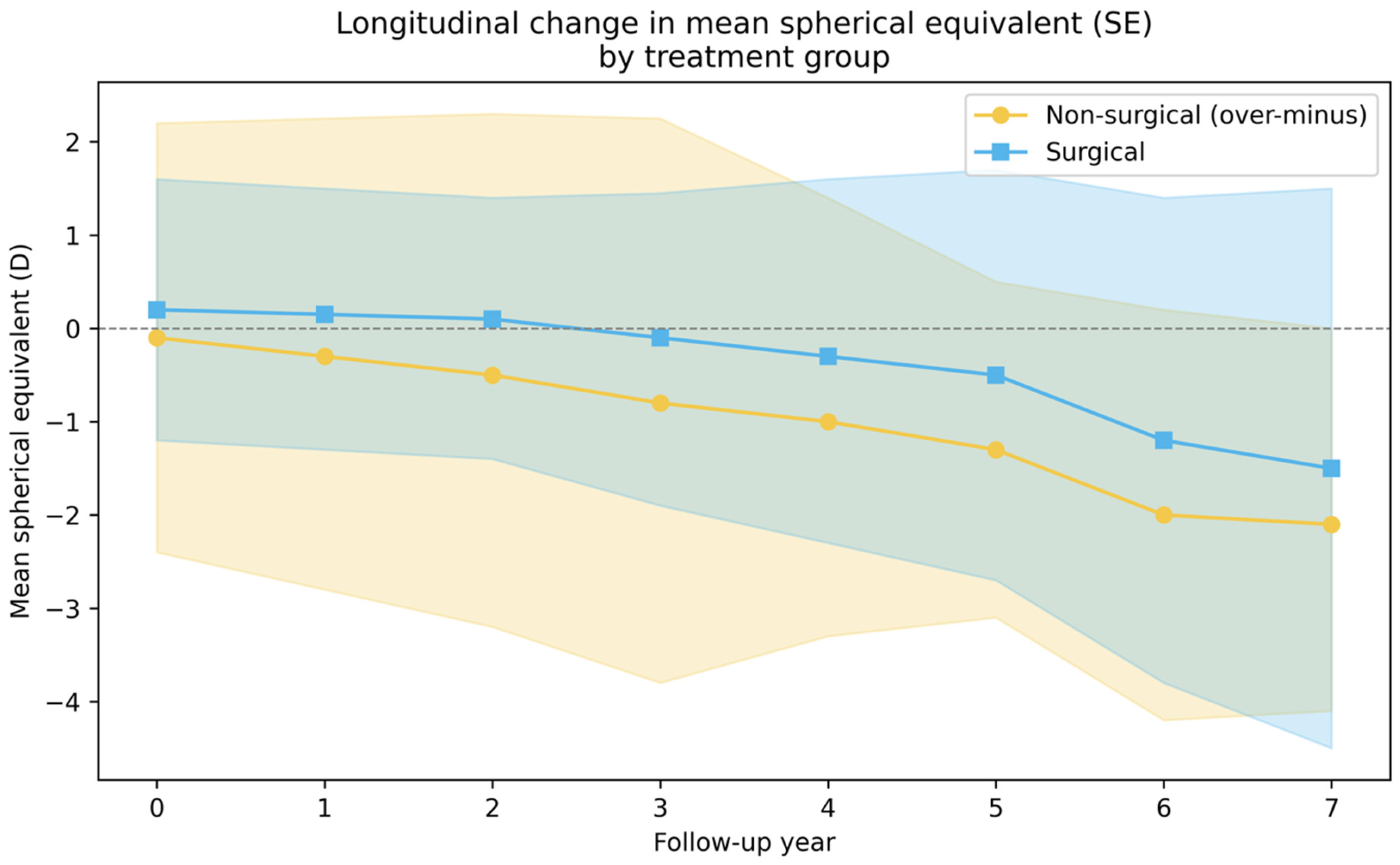
| Follow-Up Year | Over-Minus Group (Mean ± SD) | Surgical Group (Mean ± SD) | Mean Difference (95% CI) |
|---|---|---|---|
| Baseline | −0.10 ± 2.34 | +0.24 ± 1.44 | 0.34 (−0.21 to 0.89) |
| Year 3 | −1.05 ± 2.03 | −0.84 ± 2.41 | 0.21 (−0.48 to 0.89) |
| Year 5 | −1.61 ± 2.06 | −1.38 ± 2.63 | 0.23 (−0.61 to 1.08) |
| Year 7 | −2.10 ± 1.98 | −1.51 ± 3.02 | 0.59 (−0.42 to 1.60) |
| β (slope) | −0.25 D/year, p < 0.001 | −0.26 D/year, p < 0.001 | Interaction p = 0.541 |
| ECS Group | n | Age at Presentation (Years) | Delay from Onset to Presentation (Years) | |||||
|---|---|---|---|---|---|---|---|---|
| Mean ± SD | Median (IQR) | p | Mean ± SD | Median (IQR) | p | |||
| ECS–Near | Good (1–2) | 93 | 6.83 ± 4.59 | 6 (4–9) | 0.006 * (H = 10.285) | 3.41 ± 4.02 | 2 (1–5) | 0.038 * (H = 6.535) |
| Moderate (3) | 54 | 8.49 ± 5.82 | 7 (5–11) | 4.79 ± 5.13 | 3 (1–6) | |||
| Poor (4–5) | 19 | 11.92 ± 7.91 | 10 (7–16) | 6.02 ± 5.10 | 5 (3–9) | |||
| ECS–Distance | Good (1–2) | 18 | 6.80 ± 6.10 | 6 (4–9) | 0.155 (H = 3.731) | 3.52 ± 5.50 | 2 (1–5) | 0.014 * (H = 8.580) |
| Moderate (3) | 73 | 7.42 ± 4.75 | 7 (5–10) | 3.38 ± 4.15 | 2 (1–5) | |||
| Poor (4–5) | 74 | 8.83 ± 6.30 | 8 (6–12) | 5.13 ± 4.70 | 4 (2–8) | |||
| Parameter | Metric | Successful (n = 109) | Unsuccessful (n = 58) | p-Value |
|---|---|---|---|---|
| Overall success rate | n (%) | 109 (65.3%) | 58 (34.7%) | — |
| Age (years) * | Mean ± SD/Median (IQR) | 7.72 ± 5.42/6 (6) | 8.28 ± 6.13/6.25 (7) | 0.737 |
| Surgical age (years) * | Mean ± SD/Median (IQR) | 9.30 ± 5.65/8 (5) | 9.89 ± 6.06/9 (6.25) | 0.757 |
| IXT subtype † | n (%) | 0.771 | ||
| Basic | 49 (66.2%) | 25 (33.8%) | ||
| Divergence excess | 21 (67.7%) | 10 (32.3%) | ||
| Pseudo-divergence excess | 32 (59.3%) | 22 (40.7%) | ||
| Convergence insufficiency | 1 (100%) | 0 (0%) | ||
| Surgical type ‡ | n (%) | 0.108 | ||
| BLR | 32 (80.7%) | 11 (19.3%) | ||
| R/R | 71 (60.7%) | 46 (39.3%) | ||
| Surgical dose ‡ | n (%) | 0.461 | ||
| Standard | 43 (66.1%) | 19 (33.9%) | ||
| Augmented | 65 (63.7%) | 37 (36.3%) |
| Parameter | Category | BLR n (%) | R/R n (%) | Statistical Test | p-Value |
|---|---|---|---|---|---|
| Age group (years) * | ≤6 (n = 84) | 29 (34.5%) | 55 (65.5%) | 5.321 | 0.066 |
| 7–14 (n = 60) | 12 (20.0%) | 48 (80.0%) | |||
| ≥15 (n = 16) | 2 (12.5%) | 14 (87.5%) | |||
| Gender † | Male (n = 69) | 18 (26.1%) | 51 (73.9%) | 0.038 | 0.845 |
| Female (n = 91) | 25 (27.5%) | 66 (72.5%) | |||
| IXT subtype * | Basic (n = 74) | 14 (18.9%) | 60 (81.1%) | 11.652 | 0.005 |
| Divergence excess (n = 31) | 16 (51.6%) | 15 (48.4%) | |||
| Pseudo-divergence excess (n = 54) | 13 (24.1%) | 41 (75.9%) | |||
| Convergence insufficiency (n = 1) | 0 (0%) | 1 (100%) | |||
| Mean surgical age (years) ‡ | Mean ± SD/Median (IQR) | 6.5 ± 5.4/5 (6) | 8.3 ± 5.6/7 (6) | −2.401 | 0.016 |
| Final Fusion | Total | ||||
|---|---|---|---|---|---|
| Abnormal Fusion | Fusion | Suppression | |||
| Initial Fusion | Abnormal Fusion | 3 (6.5%) | 42 (91.3%) | 1 (2.2%) | 46 |
| Fusion | 1 (0.4%) | 229 (99.1%) | 1 (0.4%) | 231 | |
| Suppression | 1 (6.7%) | 12 (80%) | 2 (13.3%) | 15 | |
| 5 (1.7%) | 283 (96.9%) | 4(1.4%) | 292 | ||
| N | Mean | Standard Deviation | Min | Max | Median (IQR) | Test Value | p | |
|---|---|---|---|---|---|---|---|---|
| Initial Stereopsis | 255 | 1.015.69 | 1.314.20 | 40 | 3000 | 200 (2940) | −9.884 | <0.001 |
| Final Stereopsis | 255 | 244.71 | 622.48 | 40 | 3000 | 80 (40) |
| Final Stereopsis | p | ||||
|---|---|---|---|---|---|
| Absent | Present | Total | |||
| Initial Stereopsis | Absent | 26 (49.1%) | 27 (50.9%) | 53 (16.9%) | 0.000 |
| Present | 6 (2.3%) | 255 (97.7%) | 261 (83.1%) | ||
| Total | 32 (10.2%) | 282 (89.8%) | 314 (100%) | ||
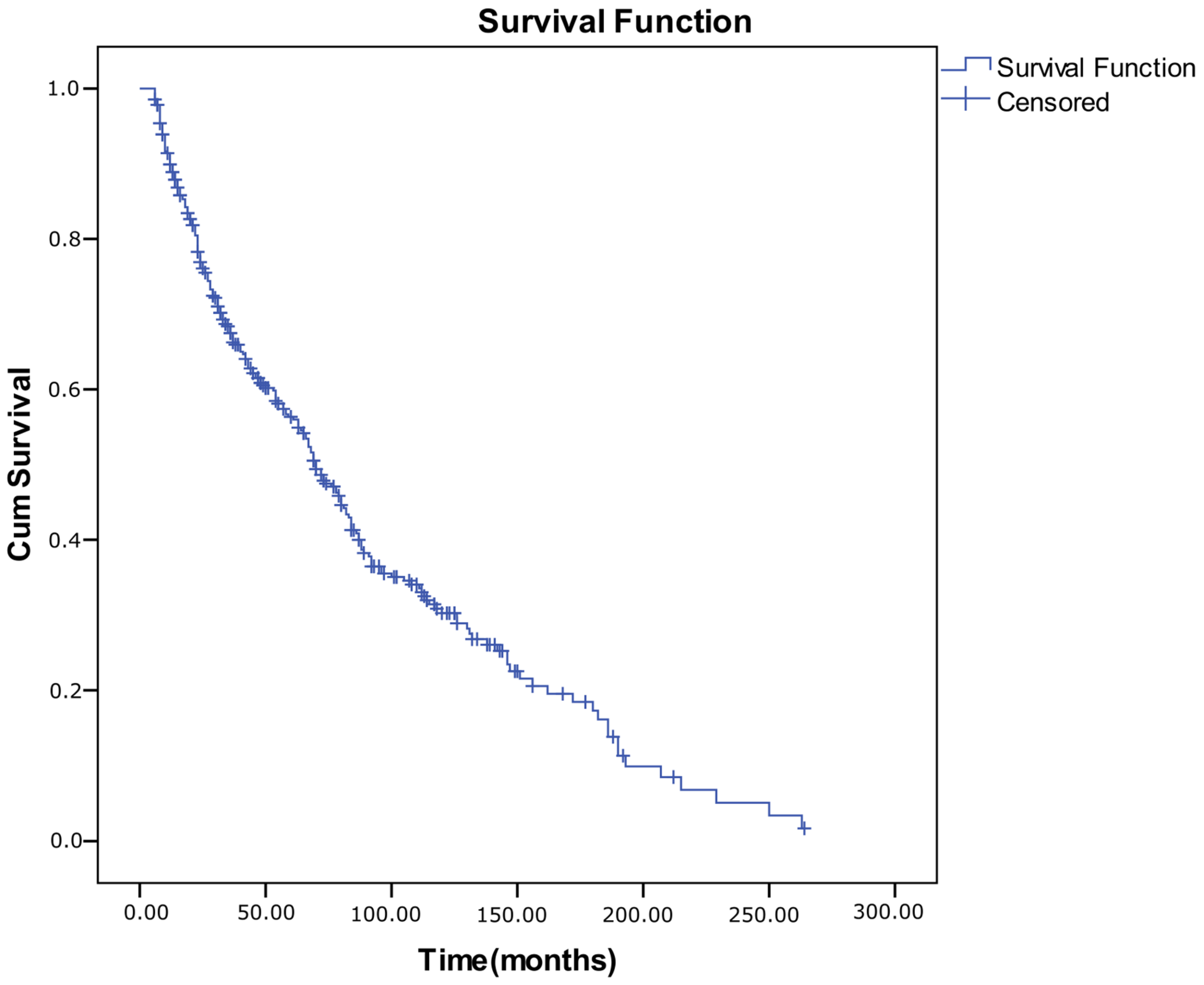
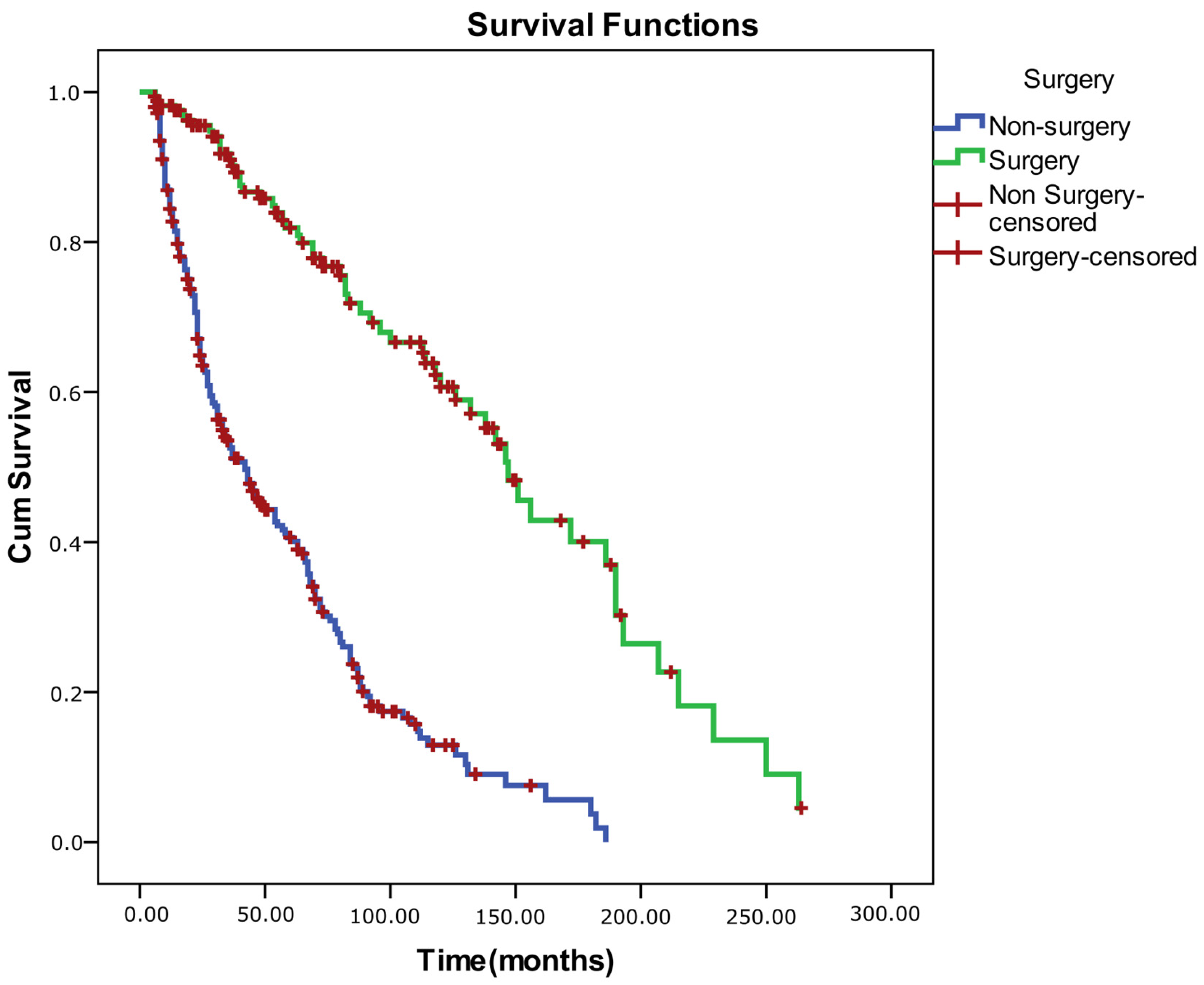
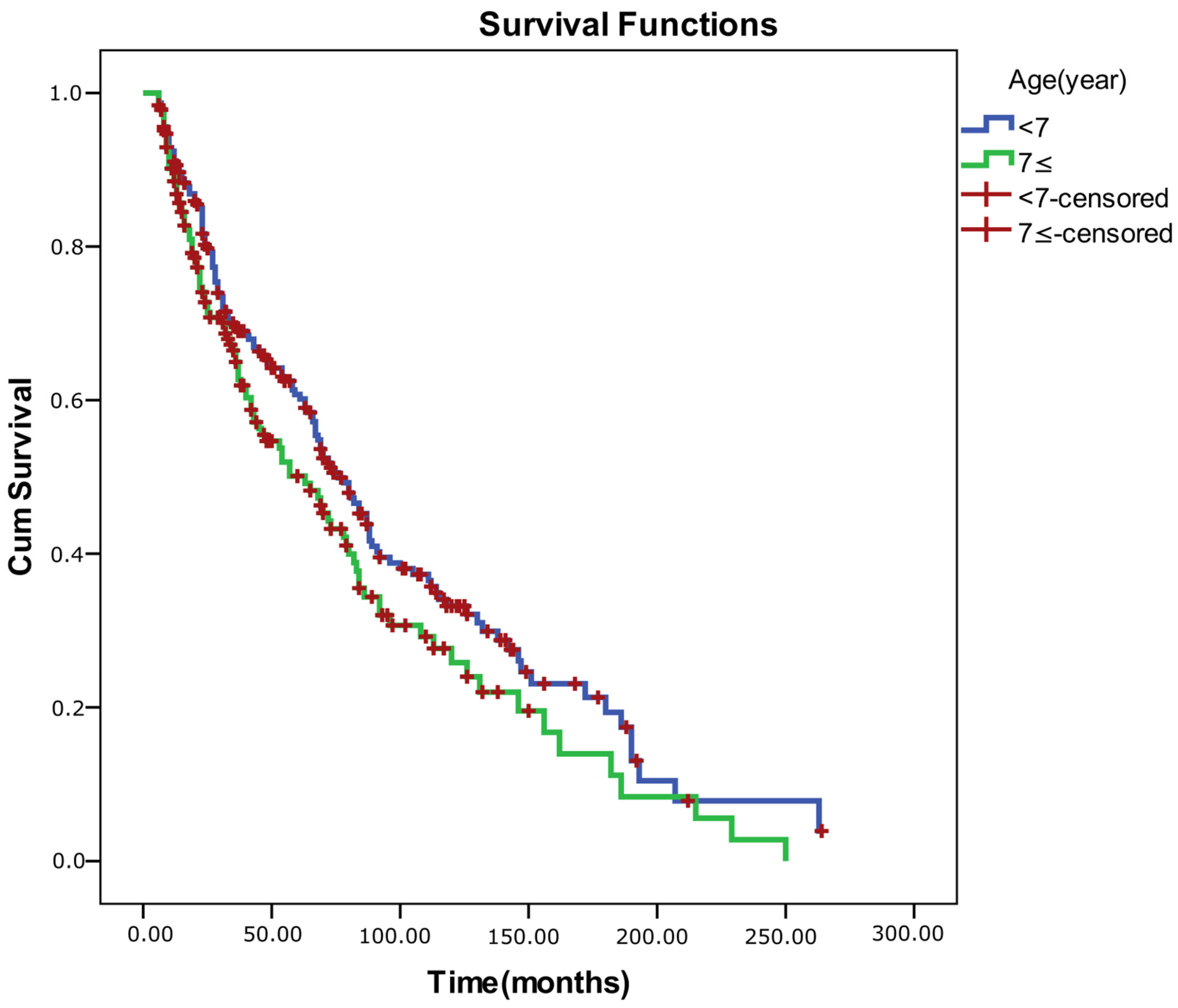
| Variable | Category/Metric | n | Events | Censored (%) | Median Survival (Months, 95% CI) | χ2 (Log-Rank) | p-Value | Hazard Ratio (HR, 95% CI) | p (Cox) |
|---|---|---|---|---|---|---|---|---|---|
| Overall | — | 415 | 245 | 41.0 | 70 (60.9–79.1) | — | — | — | — |
| Sex | Male vs. Female | 172/243 | 92/153 | 46.5/37.0 | 78 (57.3–98.7)/70 (60.6–79.4) | 1.874 | 0.171 | — | — |
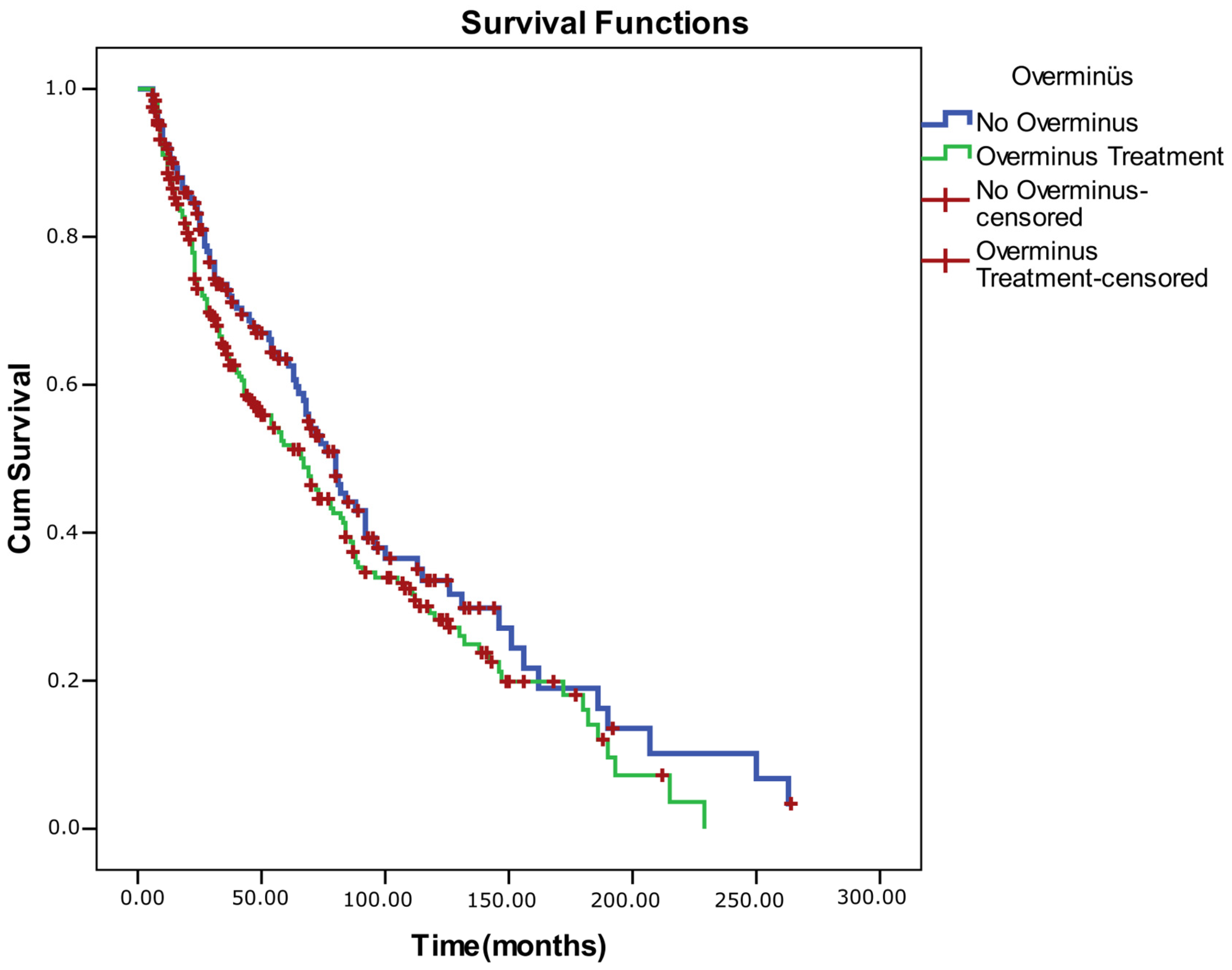
| Surgery | Yes vs. No | 167/248 | 58/187 | 65.3/24.6 | 147 (129.3–164.7)/42 (31.8–52.2) | 98.781 | <0.001 | 0.174 (0.120–0.252) | <0.001 |
| ECS–Near | Good (1–2) vs. Poor (3–5) | 307/105 | 192/51 | 37.5/51.4 | 69 (55.7–82.3)/79 (58.5–99.6) | 4.847 | 0.028 | 1.147 (0.806–1.633) | 0.446 |
| ECS–Distance | Good (1–2) vs. Poor (3–5) | 182/229 | 125/118 | 31.3/48.5 | 58 (41.7–74.3)/84 (70.6–97.4) | 11.324 | 0.001 | 1.421 (1.051–1.920) | 0.022 |
| Age group | <7 vs. ≥7 years | 228/187 | 138/107 | 39.5/42.8 | 76 (63.6–88.4)/63 (43.6–82.4) | 3.649 | 0.056 | 1.040 (1.010–1.070) | 0.008 |
| Over-minus therapy | Yes vs. No | 252/163 | 156/89 | 37.1/45.4 | 67 (53.0–81.0)/80 (67.5–92.6) | 2.843 | 0.092 | 1.089 (0.824–1.438) | 0.550 |
Disclaimer/Publisher’s Note: The statements, opinions and data contained in all publications are solely those of the individual author(s) and contributor(s) and not of MDPI and/or the editor(s). MDPI and/or the editor(s) disclaim responsibility for any injury to people or property resulting from any ideas, methods, instructions or products referred to in the content. |
© 2026 by the authors. Published by MDPI on behalf of the Lithuanian University of Health Sciences. Licensee MDPI, Basel, Switzerland. This article is an open access article distributed under the terms and conditions of the Creative Commons Attribution (CC BY) license.
Share and Cite
Yilmaz Cinar, F.G.; Guvenc, U.; Akmaz, R.; Topalak, Y.; Burcu, A. Long-Term Outcomes of Intermittent Exotropia: A Real-World Longitudinal Cohort Study of 415 Patients. Medicina 2026, 62, 481. https://doi.org/10.3390/medicina62030481
Yilmaz Cinar FG, Guvenc U, Akmaz R, Topalak Y, Burcu A. Long-Term Outcomes of Intermittent Exotropia: A Real-World Longitudinal Cohort Study of 415 Patients. Medicina. 2026; 62(3):481. https://doi.org/10.3390/medicina62030481
Chicago/Turabian StyleYilmaz Cinar, Fatma Gul, Umay Guvenc, Rabia Akmaz, Yasemin Topalak, and Ayse Burcu. 2026. "Long-Term Outcomes of Intermittent Exotropia: A Real-World Longitudinal Cohort Study of 415 Patients" Medicina 62, no. 3: 481. https://doi.org/10.3390/medicina62030481
APA StyleYilmaz Cinar, F. G., Guvenc, U., Akmaz, R., Topalak, Y., & Burcu, A. (2026). Long-Term Outcomes of Intermittent Exotropia: A Real-World Longitudinal Cohort Study of 415 Patients. Medicina, 62(3), 481. https://doi.org/10.3390/medicina62030481