Fractional Flow Reserve Derived from a Single Angiographic View: Fact or Fiction?

 ,
,  ,
,  , ,
, ,
Abstract
1. Introduction
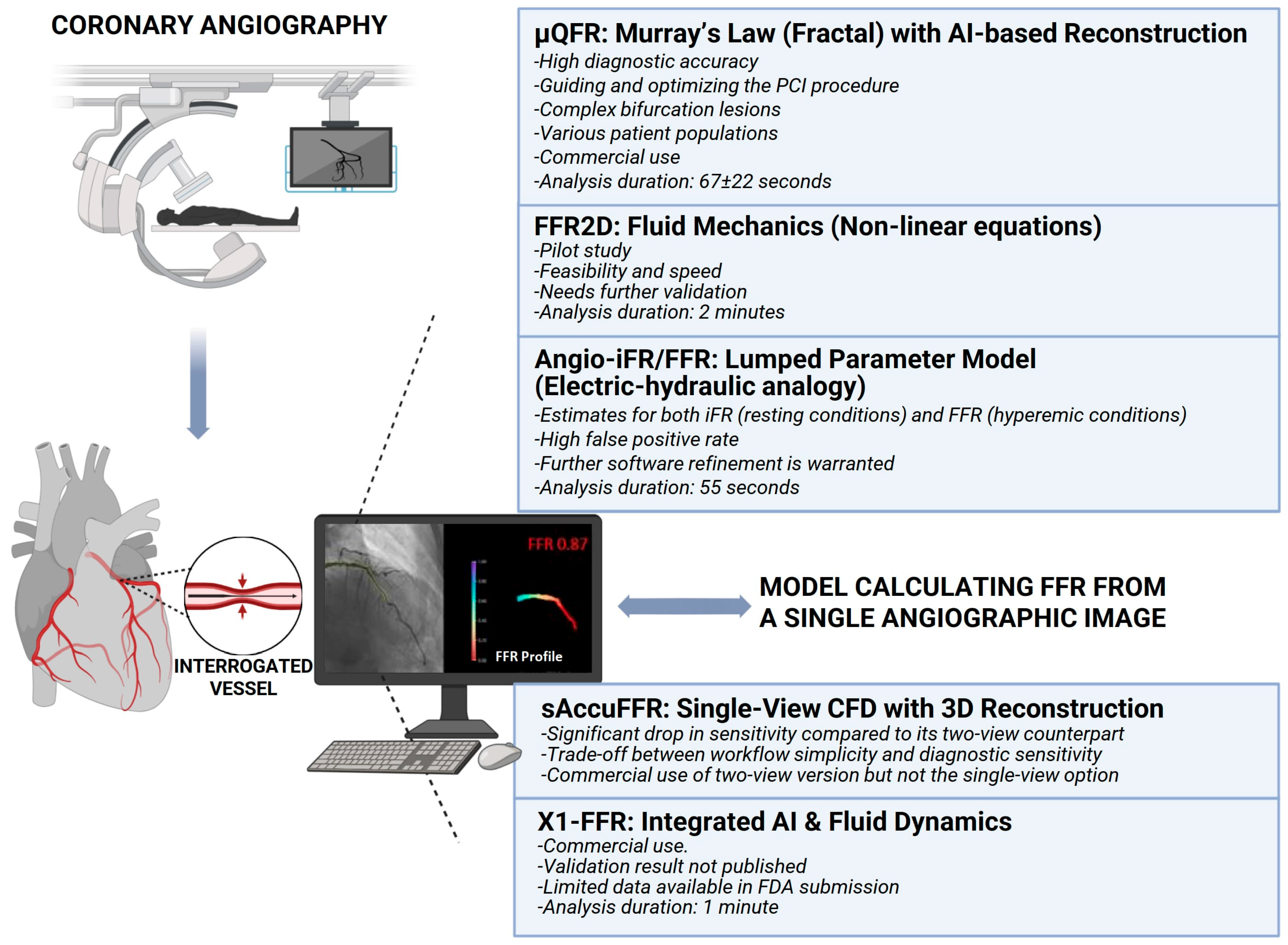
2. Single-View Angiography-Derived FFR Approaches
2.1. Murray Law-Based Quantitative Flow Ratio (μQFR)
2.2. FFR2D
2.3. Angio-iFR/FFR
2.4. Single-View AccuFFRangio (sAccuFFR)
2.5. X1-FFR
3. Challenges and Clinical Application
4. Conclusions
Author Contributions
Funding
Data Availability Statement
Acknowledgments
Conflicts of Interest
References
- Faria, D.; Hennessey, B.; Shabbir, A.; Mejia-Renteria, H.; Wang, L.; Lee, J.M.; Matsuo, H.; Biscaglia, S.; Koo, B.-K.; Xu, B.; et al. Functional coronary angiography for the assessment of the epicardial vessels and the microcirculation. EuroIntervention 2023, 19, 203–221. [Google Scholar] [CrossRef] [PubMed]
- Nikopoulos, S.; Papafaklis, M.I.; Tsompou, P.; Sakellarios, A.; Siogkas, P.; Sioros, S.; Fotiadis, D.I.; Katsouras, C.S.; Naka, K.K.; Nikas, D.; et al. Virtual Hemodynamic Assessment of Coronary Lesions: The Advent of Functional Angiography and Coronary Imaging. J. Clin. Med. 2024, 13, 2243. [Google Scholar] [CrossRef] [PubMed]
- Papafaklis, M.I.; Mavrogiannis, M.C.; Siogkas, P.K.; Lakkas, L.S.; Katsouras, C.S.; Fotiadis, D.I.; Michalis, L.K. Functional assessment of lesion severity without using the pressure wire: Coronary imaging and blood flow simulation. Expert Rev. Cardiovasc. Ther. 2017, 15, 863–877. [Google Scholar] [CrossRef] [PubMed]
- Cerrato, E.; Mejia-Renteria, H.; Franze, A.; Quadri, G.; Belliggiano, D.; Biscaglia, S.; Savio, L.L.; Spataro, F.; Erriquez, A.; Giacobbe, F.; et al. Quantitative flow ratio as a new tool for angiography-based physiological evaluation of coronary artery disease: A review. Future Cardiol. 2021, 17, 1435–1452. [Google Scholar] [CrossRef]
- Virani, S.S.; Newby, L.K.; Arnold, S.V.; Bittner, V.; Brewer, L.C.; Demeter, S.H.; Dixon, D.L.; Fearon, W.F.; Hess, B.; Johnson, H.M.; et al. 2023 AHA/ACC/ACCP/ASPC/NLA/PCNA Guideline for the Management of Patients with Chronic Coronary Disease. J. Am. Coll. Cardiol. 2023, 82, 833–955. [Google Scholar] [CrossRef]
- Vrints, C.; Andreotti, F.; Koskinas, K.C.; Rossello, X.; Adamo, M.; Ainslie, J.; Banning, A.P.; Budaj, A.; Buechel, R.R.; Chiariello, G.A.; et al. 2024 ESC Guidelines for the management of chronic coronary syndromes: Developed by the task force for the management of chronic coronary syndromes of the European Society of Cardiology (ESC) Endorsed by the European Association for Cardio-Thoracic Surgery (EACTS). Eur. Heart J. 2024, 45, 3415–3537. [Google Scholar] [CrossRef]
- Parikh, R.V.; Liu, G.; Plomondon, M.E.; Sehested, T.S.G.; Hlatky, M.A.; Waldo, S.W.; Fearon, W.F. Utilization and Outcomes of Measuring Fractional Flow Reserve in Patients with Stable Ischemic Heart Disease. J. Am. Coll. Cardiol. 2020, 75, 409–419. [Google Scholar] [CrossRef]
- Chow, H.B.; Tan, S.S.N.; Lai, W.H.; Fong, A.Y.Y. Angiography-Derived Fractional Flow Reserve in Coronary Assessment: Current Developments and Future Perspectives. Cardiovasc. Innov. Appl. 2023, 8, 992. [Google Scholar] [CrossRef]
- Yuta, F.; Kawamori, H.; Toba, T.; Hiromasa, T.; Sasaki, S.; Hamana, T.; Fujii, H.; Osumi, Y.; Iwane, S.; Yamamoto, T.; et al. Diagnostic accuracy of Murray law-based quantitative flow ratio in patients with severe aortic stenosis undergoing transcatheter aortic valve replacement. Heart Vessels 2024, 39, 735–745. [Google Scholar] [CrossRef]
- Li, X.; Mi, L.; Duan, J.; Tao, L.; Xu, X.; Wang, G. Murray law-based quantitative flow ratio for assessment of nonculprit lesions in patients with ST-segment elevation myocardial infarction. Cardiol. J. 2024, 31, 522–527. [Google Scholar] [CrossRef]
- Gonzalez-Urbistondo, F.; Alperi, A.; Moris, C.; Avanzas, P. muQFR in ASET Pilot Studies: More Assets in the decision-making process for stable ischemic heart disease. Int. J. Cardiol. 2024, 403, 131880. [Google Scholar] [CrossRef] [PubMed]
- Ono, M.; Serruys, P.W.; Patel, M.R.; Escaned, J.; Akasaka, T.; Lavieren, M.A.V.; Haase, C.; Grass, M.; Kogame, N.; Hara, H.; et al. A prospective multicenter validation study for a novel angiography-derived physiological assessment software: Rationale and design of the radiographic imaging validation and evaluation for Angio-iFR (ReVEAL iFR) study. Am. Heart J. 2021, 239, 19–26. [Google Scholar] [CrossRef] [PubMed]
- Toth, G.G.; Johnson, N.P.; Jeremias, A.; Pellicano, M.; Vranckx, P.; Fearon, W.F.; Barbato, E.; Kern, M.J.; Pijls, N.H.; De Bruyne, B. Standardization of Fractional Flow Reserve Measurements. J. Am. Coll. Cardiol. 2016, 68, 742–753. [Google Scholar] [CrossRef] [PubMed]
- Papafaklis, M.I.; Baumbach, A. From Lumenogram to “Functional Angiography” and the Evolution of Virtual Fractional Flow Reserve. Circulation 2019, 139, 485–488. [Google Scholar] [CrossRef]
- Tsigkas, G.; Bozika, M.; Papafaklis, M.I.; Skalidis, I.; Nastouli, K.M.; Apostolos, A.; Karanasos, A.; Koros, R.; Vasilagkos, G.; Pepa, K.; et al. Coronary angiography-based wire-free FFR methods. Hellenic J. Cardiol. 2025, in press. [Google Scholar] [CrossRef]
- Song, L.; Xu, B.; Tu, S.; Guan, C.; Jin, Z.; Yu, B.; Fu, G.; Zhou, Y.; Wang, J.; Chen, Y.; et al. 2-Year Outcomes of Angiographic Quantitative Flow Ratio-Guided Coronary Interventions. J. Am. Coll. Cardiol. 2022, 80, 2089–2101. [Google Scholar] [CrossRef]
- Jain, S.S.; Fearon, W.F. When Two Isn’t Better Than One: Single Versus Multiple Angiographic Views for Quantitative Flow Ratio. J. Soc. Cardiovasc. Angiogr. Interv. 2022, 1, 100411. [Google Scholar] [CrossRef]
- Wang, W.; Hu, Y.; Xiang, P.; Sheng, X.; Leng, X.; Yang, X.; Dong, L.; Li, C.; Sun, Y.; Jiang, J.; et al. The diagnostic performance of AccuFFRangio for evaluating coronary artery stenosis under different computational conditions. Quant. Imaging Med. Surg. 2023, 13, 2496–2506. [Google Scholar] [CrossRef]
- Morris, P.D.; Ryan, D.; Morton, A.C.; Lycett, R.; Lawford, P.V.; Hose, D.R.; Gunn, J.P. Virtual fractional flow reserve from coronary angiography: Modeling the significance of coronary lesions: Results from the VIRTU-1 (VIRTUal Fractional Flow Reserve From Coronary Angiography) study. JACC Cardiovasc. Interv. 2013, 6, 149–157. [Google Scholar] [CrossRef]
- Cortes, C.; Liu, L.; Berdin, S.L.; Fernandez-Corredoira, P.M.; Zhang, R.; Schafer, U.; López, M.; Diarte, J.A.; Tu, S.; Gutiérrez-Chico, J.L. Agreement between Murray law-based quantitative flow ratio (muQFR) and three-dimensional quantitative flow ratio (3D-QFR) in non-selected angiographic stenosis: A multicenter study. Cardiol. J. 2022, 29, 388–395. [Google Scholar] [CrossRef]
- Tu, S.; Ding, D.; Chang, Y.; Li, C.; Wijns, W.; Xu, B. Diagnostic accuracy of quantitative flow ratio for assessment of coronary stenosis significance from a single angiographic view: A novel method based on bifurcation fractal law. Catheter. Cardiovasc. Interv. 2021, 97, 1040–1047. [Google Scholar] [CrossRef]
- Cortes, C.; Carrasco-Moraleja, M.; Aparisi, A.; Rodriguez-Gabella, T.; Campo, A.; Gutierrez, H.; Julca, F.; Gómez, I.; Román, J.A.S.; Amat-Santos, I.J. Quantitative flow ratio-Meta-analysis and systematic review. Catheter. Cardiovasc. Interv. 2021, 97, 807–814. [Google Scholar] [CrossRef]
- Ding, D.; Tu, S.; Chang, Y.; Li, C.; Xu, B.; Wijns, W. Quantitative Flow Ratio Based on Murray Fractal Law: Accuracy of Single Versus Two Angiographic Views. J. Soc. Cardiovasc. Angiogr. Interv. 2022, 1, 100399. [Google Scholar] [CrossRef] [PubMed]
- Ahmad, Y.; Gotberg, M.; Cook, C.; Howard, J.P.; Malik, I.; Mikhail, G.; Frame, A.; Petraco, R.; Rajkumar, C.; Demir, O.; et al. Coronary Hemodynamics in Patients with Severe Aortic Stenosis and Coronary Artery Disease Undergoing Transcatheter Aortic Valve Replacement: Implications for Clinical Indices of Coronary Stenosis Severity. JACC Cardiovasc. Interv. 2018, 11, 2019–2031. [Google Scholar] [CrossRef] [PubMed]
- Zhou, J.; Gao, W.; Wang, W.; Zhang, F.; Wang, Y.; Wang, J.; Zhang, Q.; Chen, Z.; Sun, Y.; Qian, J.; et al. Prognostic Value of Functional Incomplete Revascularization for Intermediate Coronary Stenosis in Patients with Valvular Surgery. Catheter. Cardiovasc. Interv. 2025, 106, 3766–3773. [Google Scholar] [CrossRef] [PubMed]
- Wu, X.; Wang, K.; Li, G.; Wu, J.; Jiang, J.; Gao, F.; Zhu, L.; Xu, Q.; Wang, X.; Xu, M.; et al. Diagnostic Performance of Angiography-Derived Quantitative Flow Ratio in Complex Coronary Lesions. Circ. Cardiovasc. Imaging 2024, 17, e016046. [Google Scholar] [CrossRef]
- Bennar, W.; Arroyo, D.; Oppe, C.; Garin, D.; Allemann, L.; Pittet, T.; Meier, P.; Puricel, S.; Togni, M.; Cook, S. Diagnostic Accuracy of Angiography-Derived Murray Law-Based Quantitative Flow Ratio (muQFR) Versus Pressure-Derived Fractional Flow Reserve (FFR) in Moderate to Severe Calcified Coronary Lesions-The DIAMOND Study. Catheter. Cardiovasc. Interv. 2025, 106, 377–383. [Google Scholar] [CrossRef]
- Chen, L.; Yan, Y.; Zhong, J.; Chen, P.; Chen, W.; Xu, C.; Chen, L.; Tu, S.; Luo, Y. Prognostic Value of Murray Law-Based QFR (muQFR)-Guided Virtual PCI in Patients with Physiological Ischemia. Circ. Cardiovasc. Interv. 2024, 17, e014362. [Google Scholar] [CrossRef]
- Ding, D.; Zhang, J.; Wu, P.; Wang, Z.; Shi, H.; Yu, W.; Hu, X.; Kang, J.; Hahn, J.-Y.; Nam, C.-W.; et al. Prognostic Value of Postpercutaneous Coronary Intervention Murray-Law-Based Quantitative Flow Ratio: Post Hoc Analysis from FLAVOUR Trial. JACC Asia 2025, 5, 59–70. [Google Scholar] [CrossRef]
- Tsigkas, G.G.; Bourantas, G.C.; Moulias, A.; Karamasis, G.V.; Bekiris, F.V.; Davlouros, P.; Katsanos, K. Rapid and Precise Computation of Fractional Flow Reserve from Routine Two-Dimensional Coronary Angiograms Based on Fluid Mechanics: The Pilot FFR2D Study. J. Clin. Med. 2024, 13, 3831. [Google Scholar] [CrossRef]
- Young, D.F.; Tsai, F.Y. Flow characteristics in models of arterial stenoses. I. Steady flow. J. Biomech. 1973, 6, 395–410. [Google Scholar] [CrossRef]
- Young, D.F.; Cholvin, N.R.; Kirkeeide, R.L.; Roth, A.C. Hemodynamics of arterial stenoses at elevated flow rates. Circ. Res. 1977, 41, 99–107. [Google Scholar] [CrossRef]
- Gould, K.L. Pressure-flow characteristics of coronary stenoses in unsedated dogs at rest and during coronary vasodilation. Circ. Res. 1978, 43, 242–253. [Google Scholar] [CrossRef]
- Onuma, Y.; Ninomiya, K.; Sjauw, K.; Damman, P.; Matsuo, H.; von Birgelen, C.; Sevestre, E.; Ono, M.; O’Leary, N.; Garg, S.; et al. Accuracy of instantaneous wave-free ratio and fractional flow reserve derived from single coronary angiographic projections. Am. Heart J. 2025, 288, 111–121. [Google Scholar] [CrossRef]
- K251355; Premarket Notification, SpectraWAVE X1-FFR Software. US Food and Drug Administration: Silver Spring, MD, USA, 2025.


| Methodology | Core Principle | Validation Data (Number of Patients) | Performance | Remarks |
|---|---|---|---|---|
| μQFR | Murray’s Law (Fractal) with AI-based reconstruction | Sub-analysis of FAVOR II China (306) DIAMOND study in calcified lesions (107) | acc: 93.0% sens: 87.5% spec: 96.2% sens: 75% spec: 77.8% | Mostly retrospective analyses; available data in complex lesions (bifurcation and calcified) |
| FFR2D | Fluid mechanics (non-linear equations) | Pilot FFR2D (88) | acc: 90.9%, sens: 85.7%, spec: 93.3% | Retrospective data; semi-automatic process makes it user-dependent |
| Angio-iFR/FFR | Lumped parameter model (electric-hydraulic analogy) | REVEAL iFR (441) | sens: 77%, spec: 49% | Prospective data; high false positive rate; technical limitations noted; difficulty of modeling resting physiology from a single image for Angio-iFR |
| sAccuFFR | CFD with 3D reconstruction | Wang et al. [18] (256) | acc: 83.5%, sens: 43.3% | Retrospective data; significant drop in sensitivity compared to its 2-view counterpart |
| X1-FFR | Integrated AI & Fluid dynamics | FDA data (285) | limits of agreement: ±0.12 | Lacks published data |
Disclaimer/Publisher’s Note: The statements, opinions and data contained in all publications are solely those of the individual author(s) and contributor(s) and not of MDPI and/or the editor(s). MDPI and/or the editor(s) disclaim responsibility for any injury to people or property resulting from any ideas, methods, instructions or products referred to in the content. |
© 2026 by the authors. Published by MDPI on behalf of the Lithuanian University of Health Sciences. Licensee MDPI, Basel, Switzerland. This article is an open access article distributed under the terms and conditions of the Creative Commons Attribution (CC BY) license.
Share and Cite
Papafaklis, M.I.; Papoutsoglou, A.; Bourantas, G.C.; Tsigkas, G.; Katsanos, K.; Karanasos, A.; Bekiris, F.V.; Davlouros, P. Fractional Flow Reserve Derived from a Single Angiographic View: Fact or Fiction? Medicina 2026, 62, 434. https://doi.org/10.3390/medicina62030434
Papafaklis MI, Papoutsoglou A, Bourantas GC, Tsigkas G, Katsanos K, Karanasos A, Bekiris FV, Davlouros P. Fractional Flow Reserve Derived from a Single Angiographic View: Fact or Fiction? Medicina. 2026; 62(3):434. https://doi.org/10.3390/medicina62030434
Chicago/Turabian StylePapafaklis, Michail I., Anastasios Papoutsoglou, George C. Bourantas, Grigorios Tsigkas, Konstantinos Katsanos, Antonios Karanasos, Foivos V. Bekiris, and Periklis Davlouros. 2026. "Fractional Flow Reserve Derived from a Single Angiographic View: Fact or Fiction?" Medicina 62, no. 3: 434. https://doi.org/10.3390/medicina62030434
APA StylePapafaklis, M. I., Papoutsoglou, A., Bourantas, G. C., Tsigkas, G., Katsanos, K., Karanasos, A., Bekiris, F. V., & Davlouros, P. (2026). Fractional Flow Reserve Derived from a Single Angiographic View: Fact or Fiction? Medicina, 62(3), 434. https://doi.org/10.3390/medicina62030434