
Surgical Site Infections and Antimicrobial Resistance: Six Years of Data from a Western Romanian Hospital

 ,
,  , , ,
, , ,  ,
,  , and
, and
Abstract
1. Introduction
2. Materials and Methods
2.1. Study Design and Setting
- Pre-pandemic period: 26 February 2018–25 February 2020;
- Pandemic period: 26 February 2020–25 February 2022;
- Post-pandemic period: 26 February 2022–25 February 2024.
2.2. Eligibility Criteria and Participant Selection
- Underwent conventional surgical procedures in the clinic during the study period and subsequently developed an SSI.
- Had available microbiological cultures from the surgical wound and corresponding antibiotic susceptibility data (antibiograms).
- Tested negative for SARS-CoV-2 both at admission and throughout hospitalization.
2.3. Patient Screening and Hospital Protocol
2.4. Ethical Approval, Data Collection, and Management
2.5. Variables Collected
- Demographic variables: age, sex, and residence (urban/rural).
- Clinical data: length of hospitalization, interval between admission and wound sampling, surgery type (emergency vs. elective), postoperative ICU admission, and in-hospital mortality.
- Primary diagnosis: categorized into seven groups—abdominopelvic neoplasms, acute abdomen, abdominal wall defects, chronic limb-threatening ischemia, soft-tissue infections, venous leg ulcers, and other conditions.
- Microbiological findings: pathogen identification, monomicrobial vs. polymicrobial infection status, and antibiotic susceptibility profiles.
2.6. Microbiological Analysis
2.7. Statistical Analysis
3. Results
3.1. Demographic and Clinical Characteristics
3.2. Hospitalization Parameters
3.3. Diagnostic Categories
- pre-pandemic: chronic limb-threatening ischemia (36 patients, 50.0%), abdominopelvic neoplasms (14, 19.4%), and abdominal wall defects (8, 11.1%);
- pandemic: chronic limb-threatening ischemia (14, 29.2%), soft-tissue infections (9, 18.8%), and venous leg ulcers (6, 12.5%);
- post-pandemic: chronic limb-threatening ischemia (15, 28.3%), soft-tissue infections (11, 20.8%), and abdominopelvic neoplasms (10, 18.9%).
3.4. Type of Surgical Intervention
3.5. Microbiological Findings
3.6. Pathogen Distribution by Diagnostic Category
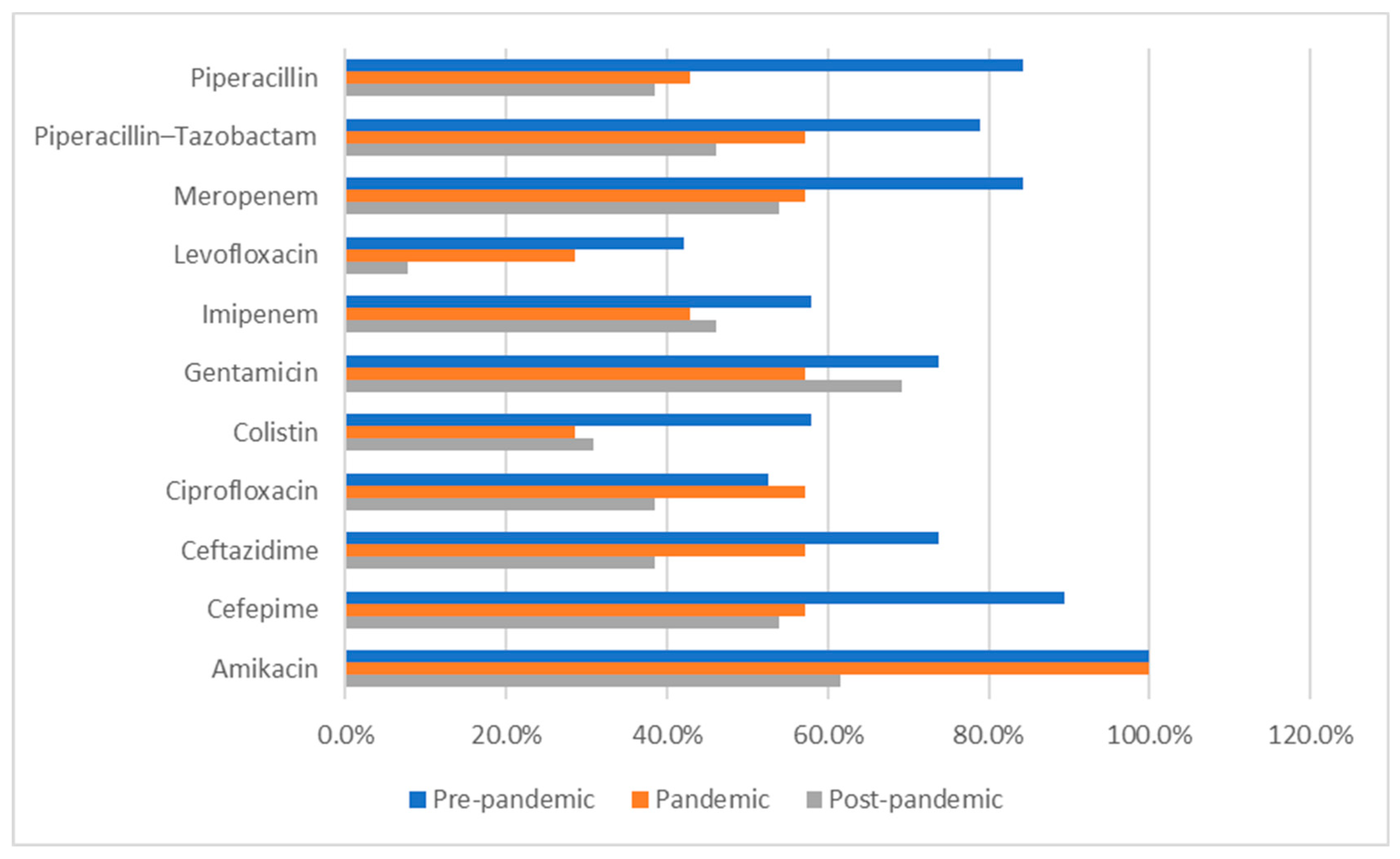
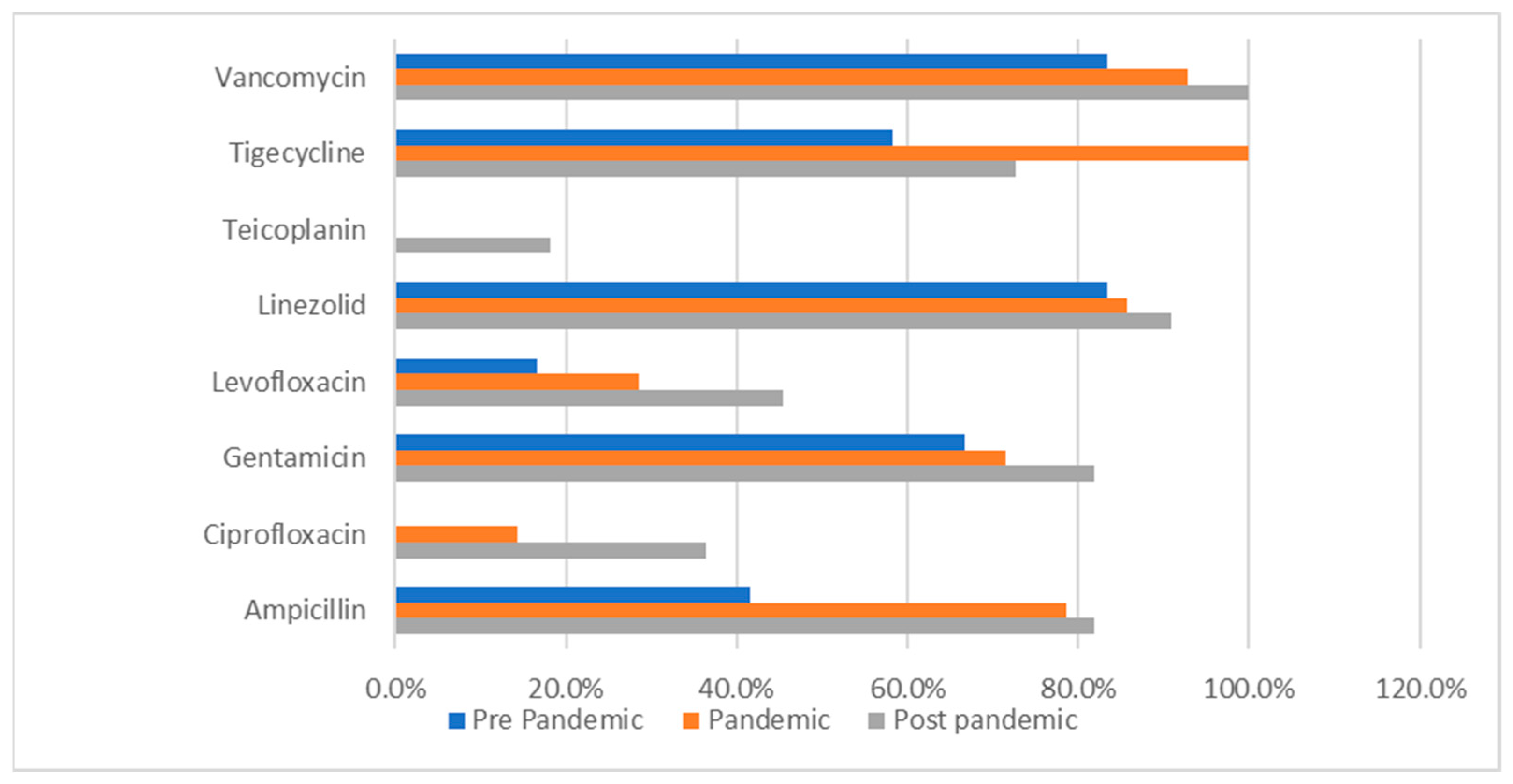
3.7. Antibiotic Resistance Profiles
- Amikacin: 100% (pre- and pandemic) → 61.5% (post-pandemic);
- Cefepime: 89.5% → 57.1% → 53.8%;
- Ceftazidime: 73.7% → 57.1% → 38.5%;
- Piperacillin/Tazobactam: 78.9% → 57.1% → 46.2%.
3.8. Clinical Outcomes
4. Discussion
5. Conclusions
Author Contributions
Funding
Institutional Review Board Statement
Informed Consent Statement
Data Availability Statement
Conflicts of Interest
Abbreviations
| CCI | Charlson Comorbidity Index |
| CDC | The Centers for Disease Control and Prevention |
| CLSI | Clinical and Laboratory Standards Institute |
| CI | Confidence intervals |
| EMR | Electronic Medical Record |
| ERAS | Enhanced Recovery After Surgery |
| EU GDPR | European Union General Data Protection Regulation |
| HAI | Hospital-Acquired Infections |
| IBM SPSS | IBM Statistical Package for the Social Sciences |
| ICU | Intensive Care Unit |
| M ± SD | Mean ± Standard Deviation |
| RT-PCR | Reverse transcription polymerase chain reaction |
| SSIs | Surgical site infections |
| WHO | World Health Organisation |
References
- Gillespie, B.M.; Harbeck, E.; Rattray, M.; Liang, R.; Walker, R.; Latimer, S.; Thalib, L.; Erichsen Andersson, A.; Griffin, B.; Ware, R.; et al. Worldwide incidence of surgical site infections in general surgical patients: A systematic review and meta-analysis of 488,594 patients. Int. J. Surg. 2021, 95, 106136. [Google Scholar] [CrossRef]
- Smith, B.B.; Bosch, W.; O’Horo, J.C.; Girardo, M.E.; Bolton, P.B.; Murray, A.W.; Hirte, I.L.; Singbartl, K.; Martin, D.P. Surgical site infections during the COVID-19 era: A retrospective, multicenter analysis. Am. J. Infect. Control. 2023, 51, 607–611. [Google Scholar] [CrossRef] [PubMed]
- Losurdo, P.; Paiano, L.; Samardzic, N.; Germani, P.; Bernardi, L.; Borelli, M.; Pozzetto, B.; de Manzini, N.; Bortul, M. Impact of lockdown for SARS-CoV-2 (COVID-19) on surgical site infection rates: A monocentric observational cohort study. Updat. Surg. 2020, 72, 1263–1271. [Google Scholar] [CrossRef]
- Jagdewsing, D.R.; Fahmy, N.S.C.; Chen, X.; Keuzetien, Y.K.; Silva, F.A.; Kang, H.; Xu, Y.; Al-Sharabi, A.; Jagdewsing, S.A.; Jagdewsing, S.A. Postoperative Surgical Site and Secondary Infections in Colorectal Cancer Patients With a History of SARS-CoV-2: A Retrospective Cohort Study. Cureus 2025, 17, e78077. [Google Scholar] [CrossRef]
- Monahan, M.; Jowett, S.; Pinkney, T.; Brocklehurst, P.; Morton, D.G.; Abdali, Z.; Roberts, T.E. Surgical site infection and costs in low- And middle-income countries: A systematic review of the economic burden. PLoS ONE 2020, 15, e0232960. [Google Scholar] [CrossRef]
- Matei, S.C.; Dumitru, C.Ș.; Radu, D. Measuring the Quality of Life in Patients with Chronic Venous Disease before and Short Term after Surgical Treatment—A Comparison between Different Open Surgical Procedures. J. Clin. Med. 2022, 11, 7171. [Google Scholar] [CrossRef] [PubMed]
- CDC; Ncezid; DHQP. Surgical Site Infection Event (SSI). Available online: https://www.cdc.gov/nhsn/pdfs/ps-analysis-resources/ImportingProcedureData.pdf (accessed on 20 November 2025).
- Bhakta, A.; Tafen, M.; Glotzer, O.; Ata, A.; Chismark, A.D.; Valerian, B.T.; Stain, S.C.; Lee, E.C. Increased Incidence of Surgical Site Infection in IBD Patients. Dis. Colon Rectum 2016, 59, 316–322. [Google Scholar] [CrossRef] [PubMed]
- Li, Z.; Li, H.; Lv, P.; Peng, X.; Wu, C.; Ren, J.; Wang, P. Prospective multicenter study on the incidence of surgical site infection after emergency abdominal surgery in China. Sci. Rep. 2021, 11, 7794. [Google Scholar] [CrossRef]
- European Antimicrobial Resistance Collaborators. The burden of bacterial antimicrobial resistance in the WHO European region in 2019: A cross-country systematic analysis. Lancet Public Health 2022, 7, e897–e913. [Google Scholar] [CrossRef]
- Zlatian, O.; Balasoiu, A.T.; Balasoiu, M.; Cristea, O.; Docea, A.O.; Mitrut, R.; Spandidos, D.A.; Tsatsakis, A.M.; Bancescu, G.; Calina, D. Antimicrobial resistance in bacterial pathogens among hospitalised patients with severe invasive infections. Exp. Ther. Med. 2018, 16, 4499–4510. [Google Scholar] [CrossRef]
- Călina, D.; Docea, A.O.; Roșu, L.; Zlatian, O.; Roșu, A.F.; Anghelina, F.; Rogoveanu, O.; Arsene, A.L.; Nicolae, A.C.; Drăgoi, C.M.; et al. Antimicrobial resistance development following surgical site infections. Mol. Med. Rep. 2017, 15, 681–688. [Google Scholar] [CrossRef]
- Zaha, D.C.; Bungau, S.; Uivarosan, D.; Tit, D.M.; Maghiar, T.A.; Maghiar, O.; Pantis, C.; Fratila, O.; Rus, M.; Vesa, C.M. Antibiotic consumption and microbiological epidemiology in surgery departments: Results from a single study center. Antibiotics 2020, 9, 81. [Google Scholar] [CrossRef] [PubMed]
- Mişcă, O.M.; Maghiar, P.B.; Mişcă, L.C.; Totolici, B.D.; Neamţu, C.; Faur, I.F.; Dragomirescu, L.; Chioibaş, D.R.; Mişcă, C.D.; Neamţu, A.A.; et al. Resistance phenotypes of bacterial strains isolated from patients admitted to surgical wards. Chirurgia 2025, 120, 218–227. [Google Scholar] [CrossRef]
- Chisavu, L.; Chisavu, F.; Marc, L.; Mihaescu, A.; Bob, F.; Licker, M.; Ivan, V.; Schiller, A. Bacterial resistances and sensibilities in a tertiary care hospital in Romania—A retrospective analysis. Microorganisms 2024, 12, 1517. [Google Scholar] [CrossRef]
- Vintilă, C.; Coșeriu, R.L.; Mare, A.D.; Ciurea, C.N.; Togănel, R.O.; Simion, A.; Cighir, A.; Man, A. Biofilm formation and antibiotic resistance profiles in carbapenemase-producing Gram-negative rods—A comparative analysis between screening and pathological isolates. Antibiotics 2024, 13, 687. [Google Scholar] [CrossRef] [PubMed]
- Gheorghe-Barbu, I.; Barbu, I.C.; Popa, L.I.; Pîrcălăbioru, G.G.; Popa, M.; Măruțescu, L.; Niță-Lazar, M.; Banciu, A.; Stoica, C.; Gheorghe, Ș.; et al. Temporo-spatial variations in resistance determinants and clonality of Acinetobacter baumannii and Pseudomonas aeruginosa strains from Romanian hospitals and wastewaters. Antimicrob. Resist. Infect. Control 2022, 11, 115. [Google Scholar] [CrossRef] [PubMed]
- Hennebique, A.; Monge-Ruiz, J.; Roger-Margueritat, M.; Morand, P.; Terreaux-Masson, C.; Maurin, M.; Mercier, C.; Landelle, C.; Buelow, E. The hospital sink drain biofilm resistome is independent of the corresponding microbiota, the environment and disinfection measures. Water Res. 2025, 284, 123902. [Google Scholar] [CrossRef]
- MetaSUB Consortium; Chng, K.R.; Li, C.; Bertrand, D.; Ng, A.H.Q.; Kwah, J.S.; Low, H.M.; Tong, C.; Natrajan, M.; Zhang, M.H.; et al. Cartography of opportunistic pathogens and antibiotic resistance genes in a tertiary hospital environment. Nat. Med. 2020, 26, 941–951. [Google Scholar] [CrossRef]
- NIHR Global Health Research Unit on Global Surgery. Microbiology testing capacity and antimicrobial drug resistance in surgical-site infections: A post-hoc, prospective, secondary analysis of the FALCON randomised trial in seven low-income and middle-income countries. Lancet Glob. Health 2024, 12, e1816–e1825. [Google Scholar] [CrossRef]
- Khaznadar, O.; Khaznadar, F.; Petrovic, A.; Kuna, L.; Loncar, A.; Omanovic Kolaric, T.; Mihaljevic, V.; Tabll, A.A.; Smolic, R.; Smolic, M. Antimicrobial Resistance and Antimicrobial Stewardship: Before, during and after the COVID-19 Pandemic. Microbiol. Res. 2023, 14, 727–740. [Google Scholar] [CrossRef]
- Lynch, C.; Mahida, N.; Gray, J. Antimicrobial stewardship: A COVID casualty? J. Hosp. Infect. 2020, 106, 401–403. [Google Scholar] [CrossRef]
- Elshenawy, R.A.; Umaru, N.; Alharbi, A.B.; Aslanpour, Z. Antimicrobial stewardship implementation before and during the COVID-19 pandemic in acute care settings: A systematic review. BMC Public Health 2023, 23, 1962. [Google Scholar] [CrossRef] [PubMed]
- Mahida, N.; Winzor, G.; Wilkinson, M.; Jumaa, P.; Gray, J. Antimicrobial stewardship in the post COVID-19 pandemic era: An opportunity for renewed focus on controlling the threat of antimicrobial resistance. J. Hosp. Infect. 2022, 127, 36–41. [Google Scholar] [CrossRef] [PubMed]
- Enciu, B.G.; Tănase, A.A.; Drăgănescu, A.C.; Aramă, V.; Pițigoi, D.; Crăciun, M.-D. The COVID-19 Pandemic in Romania: A Comparative Description with Its Border Countries. Healthcare 2022, 10, 1223. [Google Scholar] [CrossRef] [PubMed]
- Assadian, O.; Golling, M.; Krüger, C.M.; Leaper, D.; Mutters, N.T.; Roth, B.; Kramer, A. Surgical site infections: Guidance for elective surgery during the SARS-CoV-2 pandemic—International recommendations and clinical experience. J. Hosp. Infect. 2021, 111, 189–199. [Google Scholar] [CrossRef]
- Liyanage, A.S.D.; Weerasinghe, C.; Gokul, K.; Babu, B.H.; Ainsworth, P. Prospects of ERAS (Enhanced Recovery after Surgery) Protocols in the Post-Pandemic Era. Br. J. Surg. 2020, 107, e443. [Google Scholar] [CrossRef]
- Reichert, M.; Sartelli, M.; Weigand, M.A.; Doppstadt, C.; Hecker, A.; Reinisch-Liese, A.; Bender, F.; Askevold, I.; Padberg, W.; Coccolini, F.; et al. Impact of the SARS-CoV-2 pandemic on emergency surgery services: A multinational survey among WSES members. World J. Emerg. Surg. 2020, 15, 64. [Google Scholar] [CrossRef]
- Serban, D.; Socea, B.; Badiu, C.D.; Tudor, C.; Balasescu, S.A.; Dumitrescu, D.; Trotea, A.M.; Spataru, R.I.; Vancea, G.; Dascalu, A.M.; et al. Acute surgical abdomen during the COVID-19 pandemic: Clinical and therapeutic challenges. Exp. Ther. Med. 2021, 21, 519. [Google Scholar] [CrossRef]
- Matei, S.C.; Dumitru, C.Ș.; Fakhry, A.M.; Ilijevski, N.; Pešić, S.; Petrović, J.; Crăiniceanu, Z.P.; Murariu, M.-S.; Olariu, S. Bacterial Species Involved in Venous Leg Ulcer Infections and Their Sensitivity to Antibiotherapy—An Alarm Signal Regarding the Seriousness of Chronic Venous Insufficiency C6 Stage and Its Need for Prompt Treatment. Microorganisms 2024, 12, 472. [Google Scholar] [CrossRef]
- Garcia, D.; Siegel, J.B.; Mahvi, D.A.; Zhang, B.; Mahvi, D.M.; Camp, E.R.; Graybill, W.; Savage, S.J.; Giordano, A.; Giordano, S.; et al. What Is Elective Oncologic Surgery in the Time of COVID-19? A Literature Review of the Impact of Surgical Delays on Outcomes in Patients with Cancer. Clin. Oncol. Res. 2020, 3, 1–11. [Google Scholar] [CrossRef]
- Matei, S.-C.; Matei, M.; Anghel, F.M.; Olariu, A.; Olariu, S. Great saphenous vein giant aneurysm. Acta Phlebol. 2022, 23, 87–92. [Google Scholar] [CrossRef]
- Matei, S.C.; Radu-Teodorescu, D.; Murariu, M.S.; Dumitru, C.A.; Olariu, S. Cryostripping Versus Conventional Safenectomy in Chronic Venous Disease Treatment: A Single-Center Retrospective Cohort Study. Chirurgia 2024, 119, 56–64. [Google Scholar] [CrossRef]
- STROBE Statement. STROBE Checklists for Observational Studies. Available online: https://www.strobe-statement.org/checklists/ (accessed on 21 December 2025).
- Roffman, C.E.; Buchanan, J.; Allison, G.T. Charlson Comorbidities Index. J. Physiother. 2016, 62, 171. [Google Scholar] [CrossRef]
- Charlson, M.E.; Carrozzino, D.; Guidi, J.; Patierno, C. Charlson Comorbidity Index: A critical review of clinimetric properties. Psychother. Psychosom. 2022, 91, 8–35. [Google Scholar] [CrossRef]
- Sayed, A.A. The Preparation of Future Statistically Oriented Physicians: A Single-Center Experience in Saudi Arabia. Medicina 2024, 60, 1694. [Google Scholar] [CrossRef]
- Martí-Pastor, A.; Moreno-Pérez, O.; Lobato-Martínez, E.; Valero-Sempere, F.; Amo-Lozano, A.; Martínez-García, M.-Á.; Merino, E.; Sanchez-Martinez, R.; Ramos-Rincón, J.-M. Association between Clinical Frailty Scale (CFS) and Clinical Presentation and Outcomes in Older Inpatients with COVID-19. BMC Geriatr. 2023, 23, 1. [Google Scholar] [CrossRef] [PubMed]
- Keske, Ş.; Altunok, E.S.; Azak, E.; Gülten, E.; Gülen, T.A.; Hatipoğlu, Ç.A.; Asan, A.; Korkmaz, D.; Kaçmaz, B.; Kızmaz, Y.; et al. Impact of the COVID-19 Pandemic on Surgical Site Infections: A Multicenter Study Evaluating Incidence, Pathogen Distribution, and Antimicrobial Resistance Patterns. Antimicrob. Resist. Infect. Control 2025, 14, 42. [Google Scholar] [CrossRef]
- Yavuz, A.; Büyükkasap, A.Ç.; Altınier, S.; Gobut, H.; Kubat, Ö.; Yıldız, P.A.; Erdem, M.; Demir, Ö.; Şahin, M.; Çolak, O. The Effects of the COVID-19 Pandemic on Surgical Site Infections after Abdominal Surgery. Med. Sci. Int. Med. J. 2023, 12, 442–447. [Google Scholar] [CrossRef]
- Danwang, C.; Bigna, J.J.; Tochie, J.N.; Mbonda, A.; Mbanga, C.M.; Nzalie, R.N.T.; Guifo, M.L.; Essomba, A. Global Incidence of Surgical Site Infection after Appendectomy: A Systematic Review and Meta-Analysis. BMJ Open 2020, 10, e034266. [Google Scholar] [CrossRef] [PubMed]
- Mojtahedi, M.F.; Sepidarkish, M.; Almukhtar, M.; Eslami, Y.; Mohammadianamiri, F.; Behzad Moghadam, K.; Rouholamin, S.; Razavi, M.; Jafari Tadi, M.; Fazlollahpour-Naghibi, A.; et al. Global Incidence of Surgical Site Infections following Caesarean Section: A Systematic Review and Meta-Analysis. J. Hosp. Infect. 2023, 139, 82–92. [Google Scholar] [CrossRef]
- Pararas, N.; Pikouli, A.; Papaconstantinou, D.; Bagias, G.; Nastos, C.; Pikoulis, A.; Dellaportas, D.; Lykoudis, P.; Pikoulis, E. Colorectal Surgery in the COVID-19 Era: A Systematic Review and Meta-Analysis. Cancers 2022, 14, 1229. [Google Scholar] [CrossRef]
- Ishibashi, Y.; Tsujimoto, H.; Sugasawa, H.; Mochizuki, S.; Okamoto, K.; Kajiwara, Y.; Shinto, E.; Takahata, R.; Kobayashi, M.; Fujikura, Y.; et al. How Has the COVID-19 Pandemic Affected Gastrointestinal Surgery for Malignancies and Surgical Infections? Nagoya J. Med. Sci. 2021, 83, 715–725. [Google Scholar] [CrossRef]
- Myles, P.S.; Maswime, S. Mitigating the Risks of Surgery during the COVID-19 Pandemic. Lancet 2020, 396, 2–3. [Google Scholar] [CrossRef] [PubMed]
- Butt, A.A.; Kartha, A.B.; Masoodi, N.A.; Azad, A.M.; Asaad, N.A.; Alhomsi, M.U.; Saleh, H.A.H.; Bertollini, R.; Abou-Samra, A.-B. Hospital Admission Rates, Length of Stay, and In-Hospital Mortality for Common Acute Care Conditions in COVID-19 vs. Pre-COVID-19 Era. Public Health 2020, 189, 6–11. [Google Scholar] [CrossRef]
- Yeates, E.O.; Grigorian, A.; Schellenberg, M.; Owattanapanich, N.; Barmparas, G.; Margulies, D.; Juillard, C.; Garber, K.; Cryer, H.; Tillou, A.; et al. Decreased Hospital Length of Stay and Intensive Care Unit Admissions for Non-COVID Blunt Trauma Patients during the COVID-19 Pandemic. Am. J. Surg. 2022, 224, 90–95. [Google Scholar] [CrossRef]
- Stone, R.; Scheib, S. Advantages of, and Adaptations to, Enhanced Recovery Protocols for Perioperative Care during the COVID-19 Pandemic. J. Minim. Invasive Gynecol. 2021, 28, 481–489. [Google Scholar] [CrossRef] [PubMed]
- Matheus, G.G.; Chamoun, M.N.; Khosrotehrani, K.; Sivakumaran, Y.; Wells, T.J. Understanding the Pathophysiology of Pseudomonas aeruginosa Colonization as a Guide for Future Treatment for Chronic Leg Ulcers. Burn. Trauma 2025, 13, tkae083. [Google Scholar] [CrossRef] [PubMed]
- Sivanmaliappan, T.S.; Sevanan, M. Antimicrobial Susceptibility Patterns of Pseudomonas aeruginosa from Diabetes Patients with Foot Ulcers. Int. J. Microbiol. 2011, 2011, 605195. [Google Scholar] [CrossRef]
- Coșeriu, R.L.; Vintilă, C.; Mare, A.D.; Ciurea, C.N.; Togănel, R.O.; Cighir, A.; Simion, A.; Man, A. Epidemiology, Evolution of Antimicrobial Profile and Genomic Fingerprints of Pseudomonas aeruginosa before and during COVID-19: Transition from Resistance to Susceptibility. Life 2022, 12, 2049. [Google Scholar] [CrossRef]
- Savic, P.; Bukarica, L.G.; Stevanovic, P.; Vitorovic, T.; Bukumiric, Z.; Vucicevic, O.; Milanov, N.; Zivanovic, V.; Bukarica, A.; Gostimirovic, M. Increased Antimicrobial Consumption, Isolation Rate, and Resistance Profiles of Multidrug-Resistant Klebsiella pneumoniae, Pseudomonas aeruginosa, and Acinetobacter baumannii during the COVID-19 Pandemic in a Tertiary Healthcare Institution. Antibiotics 2025, 14, 871. [Google Scholar] [CrossRef]
- Altorf-van der Kuil, W.; Wielders, C.C.H.; Zwittink, R.D.; de Greeff, S.C.; Dongelmans, D.A.; Kuijper, E.J.; Notermans, D.W.; Schoffelen, A.F. Study Collaborators ISIS-AR Study Group. Impact of the COVID-19 Pandemic on Prevalence of Highly Resistant Microorganisms in Hospitalised Patients in the Netherlands, March 2020 to August 2022. Euro Surveill. 2023, 28, 2300152. [Google Scholar] [CrossRef]
- Serretiello, E.; Manente, R.; Dell’Annunziata, F.; Folliero, V.; Iervolino, D.; Casolaro, V.; Perrella, A.; Santoro, E.; Galdiero, M.; Capunzo, M.; et al. Antimicrobial resistance in Pseudomonas aeruginosa before and during the COVID-19 pandemic. Microorganisms 2023, 11, 1918. [Google Scholar] [CrossRef] [PubMed]
- Langford, B.J.; Soucy, J.-P.R.; Leung, V.; So, M.; Kwan, A.T.H.; Portnoff, J.S.; Bertagnolio, S.; Raybardhan, S.; MacFadden, D.R.; Daneman, N. Antibiotic resistance associated with the COVID-19 pandemic: A systematic review and meta-analysis. Clin. Microbiol. Infect. 2023, 29, 302–309. [Google Scholar] [CrossRef]
- Meschiari, M.; López Lozano, J.M.; Medioli, F.; Bacca, E.; Sarti, M.; Cancian, L.; Bertrand, X.; Sauget, M.; Rosolen, B.; Bingham, G.C. A time-series analysis approach to quantify change in incidence and antimicrobial resistance of clinical isolates during the COVID-19 pandemic: A multicentre cross-national ecological study. Clin. Microbiol. Infect. 2025, 31, 1500–1509. [Google Scholar] [CrossRef] [PubMed]
- Lin, J.-N.; Chen, Y.-H.; Chang, L.-L.; Lai, C.-H.; Lin, H.-L.; Lin, H.-H. Clinical Characteristics and Outcomes of Patients with Extended-Spectrum β-Lactamase-Producing Bacteremias in the Emergency Department. Intern. Emerg. Med. 2011, 6, 547–555. [Google Scholar] [CrossRef]
- Yang, Y.; Zhang, L.; Wang, J.; Chen, Z.; Tong, L.; Wang, Z.; Li, G.; Luo, Y. Proportions of Pseudomonas aeruginosa and Anti-microbial-Resistant Pseudomonas aeruginosa among Patients with Surgical Site Infections in China: A Systematic Review and Me-ta-Analysis. Open Forum Infect. Dis. 2024, 11, ofad647. [Google Scholar] [CrossRef]
- Ng, Q.X.; Ong, N.Y.; Lee, D.Y.X.; Yau, C.E.; Lim, Y.L.; Kwa, A.L.H.; Tan, B.H. Trends in Pseudomonas aeruginosa (P. aeruginosa) Bacteremia during the COVID-19 Pandemic: A Systematic Review. Antibiotics 2023, 12, 409. [Google Scholar] [CrossRef] [PubMed]
- Bongiovanni, M.; Barda, B. Pseudomonas aeruginosa Bloodstream Infections in SARS-CoV-2 Infected Patients: A Systematic Review. J. Clin. Med. 2023, 12, 2252. [Google Scholar] [CrossRef]
- Toc, D.A.; Mihăilă, R.M.; Botan, A.; Bobohalma, C.N.; Risteiu, G.A.; Simut-Cacuci, B.N.; Steorobelea, B.; Troancă, S.; Junie, L.M. Enterococcus and COVID-19: The Emergence of a Perfect Storm? Int. J. Transl. Med. 2022, 2, 20. [Google Scholar] [CrossRef]
- Hamidi, A.A.; Yılmaz, Ş. Antibiotic Consumption in the Hospital during the COVID-19 Pandemic, Distribution of Bacterial Agents and Antimicrobial Resistance: A Single-Center Study. J. Surg. Med. 2021, 5, 124–127. [Google Scholar] [CrossRef]
- Lagadinou, M.; Michailides, C.; Chatzigrigoriadis, C.; Erginousakis, I.; Avramidis, P.; Amerali, M.; Tasouli, F.; Chondroleou, A.; Skintzi, K.; Spiliopoulou, A. Impact of the COVID-19 pandemic on vancomycin-resistant Enterococcus bloodstream infections: A six-year study in Western Greece. Front. Microbiol. 2025, 16, 1656334. [Google Scholar] [CrossRef]
- Önal, U.; Tüzemen, Ü.; Kazak, E.; Gençol, N.; Souleiman, E.; İmer, H.; Heper, Y.; Yılmaz, E.; Özakın, C.; Ener, B.; et al. Effects of the COVID-19 pandemic on healthcare-associated infections, antibiotic resistance and consumption rates in intensive care units. Infez. Med. 2023, 31, 195–203. [Google Scholar] [CrossRef] [PubMed]
- Righi, E.; Lambertenghi, L.; Gorska, A.; Sciammarella, C.; Ivaldi, F.; Mirandola, M.; Sartor, A.; Tacconelli, E. Impact of COVID-19 and antibiotic treatments on gut microbiome: A role for Enterococcus spp. Biomedicines 2022, 10, 2786. [Google Scholar] [CrossRef] [PubMed]
- STARSurg Collaborative; COVIDSurg Collaborative. Death following pulmonary complications of surgery before and during the SARS-CoV-2 pandemic. Br. J. Surg. 2021, 108, 1448–1464. [Google Scholar] [CrossRef] [PubMed]
- Gómez-Romero, F.J.; Fernández-Prada, M.; Navarro-Gracia, J.F.; Ruiz-Ruiz, A.; López-González, Á.A. Prevención de la infección de sitio quirúrgico: Análisis y revisión narrativa de las guías de práctica clínica. Cir. Esp. 2017, 95, 490–502. [Google Scholar] [CrossRef]
- Rubulotta, F.; Soliman-Aboumarie, H.; Filbey, K.; Geldner, G.; Kuck, K.; Ganau, M.; Hemmerling, T.M. Technologies to optimize the care of severe COVID-19 patients for health care providers challenged by limited resources. Anesth. Analg. 2020, 131, 351–364. [Google Scholar] [CrossRef]



| Variables | Pre-Pandemic n = 72 | Pandemic n = 48 | Post-Pandemic n = 53 | p |
|---|---|---|---|---|
| Age (years, M ± SD) | 66.92 ± 10.36 | 62.29 ± 14.72 | 64.29 ± 11.66 | 0.117 |
| Gender | ||||
| Male | 31 (43.1%) | 29 (60.4%) | 24 (45.3%) | 0.149 |
| Female | 41 (56.9%) | 19 (39.6%) | 29 (54.7%) | |
| Environment | ||||
| Urban | 41 (56.9%) | 26 (54.2%) | 31 (58.5%) | 0.907 |
| Rural | 31 (43.1%) | 22 (45.8%) | 22 (41.5%) | |
| Charlson Index > 3 | 37 (51.4%) | 19 (39.6%) | 22 (41.5%) | 0.4 |
| Diagnostics | Pre-Pandemic n = 72 | Pandemic n = 48 | Post-Pandemic n = 53 | p |
|---|---|---|---|---|
| Abdominopelvic neoplasm | 14 (19.4%) | 4 (8.3%) | 10 (18.9%) | 0.012 |
| Acute abdomen | 2 (2.8%) | 5 (10.4%) | 4 (7.5%) | |
| Abdominal wall defect | 8 (11.1%) | 4 (8.3%) | 6 (11.3%) | |
| Chronic limb-threatening ischemia | 36 (50%) | 14 (29.2%) | 15 (28.3%) | |
| Soft tissue infections | 3 (4.2%) | 9 (18.8%) | 11 (20.8%) | |
| Venous leg ulcer | 7 (9.7%) | 6 (12.5%) | 6 (11.3%) | |
| Others | 2 (2.8%) | 6 (12.5%) | 1 (1.9%) |
| Bacterial Species | Pre-Pandemic | Pandemic | Post-Pandemic | p |
|---|---|---|---|---|
| Pseudomonas aeruginosa | 19 (26.4%) | 7 (14.6%) | 13 (24.5%) | 0.291 |
| Enterococcus spp. | 12 (16.7%) | 15 (31.3%) | 11 (20.8%) | 0.162 |
| Escherichia coli | 14 (19.4%) | 12 (25%) | 6 (11.3%) | 0.202 |
| Klebsiella spp. | 9 (12.5%) | 6 (12.5%) | 11 (20.8%) | 0.375 |
| Staphylococcus aureus | 16 (22.2%) | 6 (12.5%) | 13 (24.5%) | 0.278 |
| Proteus mirabilis | 8 (11.1%) | 2 (4.2%) | 5 (9.4%) | 0.405 |
| Acinetobacter baumannii | 7 (9.7%) | 1 (2.1%) | 3 (5.7%) | 0.263 |
| Morganella morganii | 1 (1.4%) | 4 (8.3%) | 4 (7.5%) | 0.160 |
| Pseudomonas aeruginosa Postoperative Wound Infection | Pre-Pandemic n = 19 | Pandemic n = 7 | Post-Pandemic n = 13 | p |
|---|---|---|---|---|
| Abdominopelvic neoplasm | 4 (21.1%) | 0 | 0 | 0.007 |
| Acute abdomen | 1 (5.3%) | 0 | 2 (15.4%) | |
| Abdominal wall defect | 0 | 0 | 3 (23.1%) | |
| Chronic limb-threatening ischemia | 7 (36.8%) | 2 (28.6%) | 0 | |
| Soft tissue infections | 0 | 3 (42.9%) | 2 (15.4%) | |
| Venous leg ulcer | 7 (36.8%) | 2 (28.6%) | 6 (46.2%) |
| Enterococcus spp. Postoperative Wound Infection | Pre-Pandemic n = 12 | Pandemic n = 15 | Post-Pandemic n = 11 | p |
|---|---|---|---|---|
| Abdominopelvic neoplasm | 4 (33.3%) | 2 (13.3%) | 4 (36.4%) | 0.178 |
| Acute abdomen | 0 | 3 (20%) | 1 (9.1%) | |
| Abdominal wall defect | 1 (8.3%) | 1 (6.7%) | 0 | |
| Chronic limb-threatening ischemia | 7 (58.3%) | 3 (20%) | 5 (45.5%) | |
| Soft tissue infections | 0 | 4 (26.7%) | 0 | |
| Venous leg ulcer | 0 | 1 (6.7%) | 1 (9.1%) | |
| Others | 0 | 1 (6.7%) | 0 |
| Pre-Pandemic n = 19 | Pandemic n = 7 | Post-Pandemic n = 13 | p | |
|---|---|---|---|---|
| Amikacin | 19 (100.0%) | 7 (100.0%) | 8 (61.5%) | 0.689 |
| Cefepime | 17 (89.5%) | 4 (57.1%) | 7 (53.8%) | |
| Ceftazidime | 14 (73.7%) | 4 (57.1%) | 5 (38.5%) | |
| Ciprofloxacin | 10 (52.6%) | 4 (57.1%) | 5 (38.5%) | |
| Colistin | 11 (57.9%) | 2 (28.6%) | 4 (30.8%) | |
| Gentamicin | 14 (73.7%) | 4 (57.1%) | 9 (69.2%) | |
| Imipenem | 11 (57.9%) | 3 (42.9%) | 6 (46.2%) | |
| Levofloxacin | 8 (42.1%) | 2 (28.6%) | 1 (7.7%) | |
| Meropenem | 16 (84.2%) | 4 (57.1%) | 7 (53.8%) | |
| Piperacillin–Tazobactam | 15 (78.9%) | 4 (57.1%) | 6 (46.2%) | |
| Piperacillin | 16 (84.2%) | 3 (42.9%) | 5 (38.5%) |
| Antibiotic | Pre-Pandemic n = 12 | Pandemic n = 15 | Post-Pandemic n = 11 | p |
|---|---|---|---|---|
| Ampicillin | 5 (41.7%) | 11 (78.6%) | 9 (81.8%) | 0.672 |
| Ciprofloxacin | 0 (0.0%) | 2 (14.3%) | 4 (36.4%) | |
| Gentamicin | 8 (66.7%) | 10 (71.4%) | 9 (81.8%) | |
| Levofloxacin | 2 (16.7%) | 4 (28.6%) | 5 (45.5%) | |
| Linezolid | 10 (83.3%) | 12 (85.7%) | 10 (90.9%) | |
| Tigecycline | 7 (58.3%) | 14 (100.0%) | 8 (72.7%) | |
| Vancomycin | 10 (83.3%) | 13 (92.9%) | 11 (100.0%) |
| Antibiotic | Pre-Pandemic n = 19 | Pandemic n = 7 | Post-Pandemic n = 13 | p |
|---|---|---|---|---|
| Cefepime | 1 (5.3%) | 2 (28.6%) | 1 (7.7%) | |
| Ceftazidime | 1 (5.3%) | 2 (28.6%) | 1 (7.7%) | |
| Imipenem | 3 (15.8%) | 2 (28.6%) | 2 (15.4%) | |
| Meropenem | 2 (10.5%) | 2 (28.6%) | 1 (7.7%) | |
| Ticarcillin/ Clavulanic Acid | 1 (5.3%) | – | 2 (15.4%) | 0.421 |
| Piperacillin | 3 (15.8%) | 3 (42.9%) | 3 (23.1%) | |
| Piperacillin/ Tazobactam | 1 (5.3%) | 1 (14.3%) | 1 (7.7%) | |
| Tobramycin | 1 (5.3%) | – | – | |
| Ciprofloxacin | 4 (21.1%) | 2 (28.6%) | 4 (30.8%) | |
| Levofloxacin | 6 (31.6%) | 2 (28.6%) | – | |
| Norfloxacin | 1 (5.3%) | – | – | |
| Colistin | – | – | 1 (7.7%) |
| Antibiotic | Pre-Pandemic n = 19 | Pandemic n = 7 | Post-Pandemic n = 13 | p |
|---|---|---|---|---|
| Imipenem | 4 (21.1%) | 2 (28.6%) | 3 (23.1%) | |
| Meropenem | 1 (5.3%) | 1 (14.3%) | – | |
| Cefepime | – | 1 (14.3%) | 3 (23.1%) | |
| Ceftazidime | 1 (5.3%) | 1 (14.3%) | 4 (30.8%) | |
| Piperacillin/ Tazobactam | 2 (10.5%) | 2 (28.6%) | 3 (23.1%) | 0.712 |
| Piperacillin | – | 1 (14.3%) | 2 (15.4%) | |
| Ciprofloxacin | 1 (5.3%) | 1 (14.3%) | 3 (23.1%) | |
| Levofloxacin | 1 (5.3%) | 1 (14.3%) | 2 (15.4%) | |
| Gentamicin | 1 (5.3%) | – | – |
| Antibiotic | Pre-Pandemic n = 12 | Pandemic n = 15 | Post-Pandemic n = 11 |
|---|---|---|---|
| Ampicillin | 4 (33.3%) | 2 (13.3%) | 1 (9.1%) |
| Ciprofloxacin | 6 (50.0%) | 8 (53.3%) | 1 (9.1%) |
| Gentamicin | 2 (16.7%) | 4 (26.7%) | 2 (18.2%) |
| Imipenem | – | – | 1 (9.1%) |
| Levofloxacin | 6 (50.0%) | 8 (53.3%) | 1 (9.1%) |
| Tigecycline | – | – | 2 (18.2%) |
| Antibiotic | Pre-Pandemic n = 12 | Pandemic n = 15 | Post-Pandemic n = 11 |
|---|---|---|---|
| Ampicillin | 2 (16.7%) | – | – |
| Ciprofloxacin | 3 (25.0%) | 4 (26.7%) | – |
| Gentamicin | 1 (8.3%) | – | – |
| Imipenem | – | – | 1 (9.1%) |
| Levofloxacin | 3 (25.0%) | 2 (13.3%) | – |
Disclaimer/Publisher’s Note: The statements, opinions and data contained in all publications are solely those of the individual author(s) and contributor(s) and not of MDPI and/or the editor(s). MDPI and/or the editor(s) disclaim responsibility for any injury to people or property resulting from any ideas, methods, instructions or products referred to in the content. |
© 2026 by the authors. Published by MDPI on behalf of the Lithuanian University of Health Sciences. Licensee MDPI, Basel, Switzerland. This article is an open access article distributed under the terms and conditions of the Creative Commons Attribution (CC BY) license.
Share and Cite
Feier, C.V.I.; Teodor, A.; Muntean, C.; Faităr, O.C.; Cilibiu, C.I.; Jianu, N.; Muntean, D.; Buda, V.; Gaborean, V.; Murariu, M. Surgical Site Infections and Antimicrobial Resistance: Six Years of Data from a Western Romanian Hospital. Medicina 2026, 62, 108. https://doi.org/10.3390/medicina62010108
Feier CVI, Teodor A, Muntean C, Faităr OC, Cilibiu CI, Jianu N, Muntean D, Buda V, Gaborean V, Murariu M. Surgical Site Infections and Antimicrobial Resistance: Six Years of Data from a Western Romanian Hospital. Medicina. 2026; 62(1):108. https://doi.org/10.3390/medicina62010108
Chicago/Turabian StyleFeier, Catalin Vladut Ionut, Ana Teodor, Calin Muntean, Oliana Cristina Faităr, Corina Iuliana Cilibiu, Narcisa Jianu, Delia Muntean, Valentina Buda, Vasile Gaborean, and Marius Murariu. 2026. "Surgical Site Infections and Antimicrobial Resistance: Six Years of Data from a Western Romanian Hospital" Medicina 62, no. 1: 108. https://doi.org/10.3390/medicina62010108
APA StyleFeier, C. V. I., Teodor, A., Muntean, C., Faităr, O. C., Cilibiu, C. I., Jianu, N., Muntean, D., Buda, V., Gaborean, V., & Murariu, M. (2026). Surgical Site Infections and Antimicrobial Resistance: Six Years of Data from a Western Romanian Hospital. Medicina, 62(1), 108. https://doi.org/10.3390/medicina62010108