Predicting Postoperative Myopic Shift After Paediatric Intraocular Lens Implantation: A Scoping Review of Associated Factors


Abstract
1. Introduction
2. Materials and Methods
2.1. Study Design
2.2. Search Strategy
2.3. Eligibility Criteria
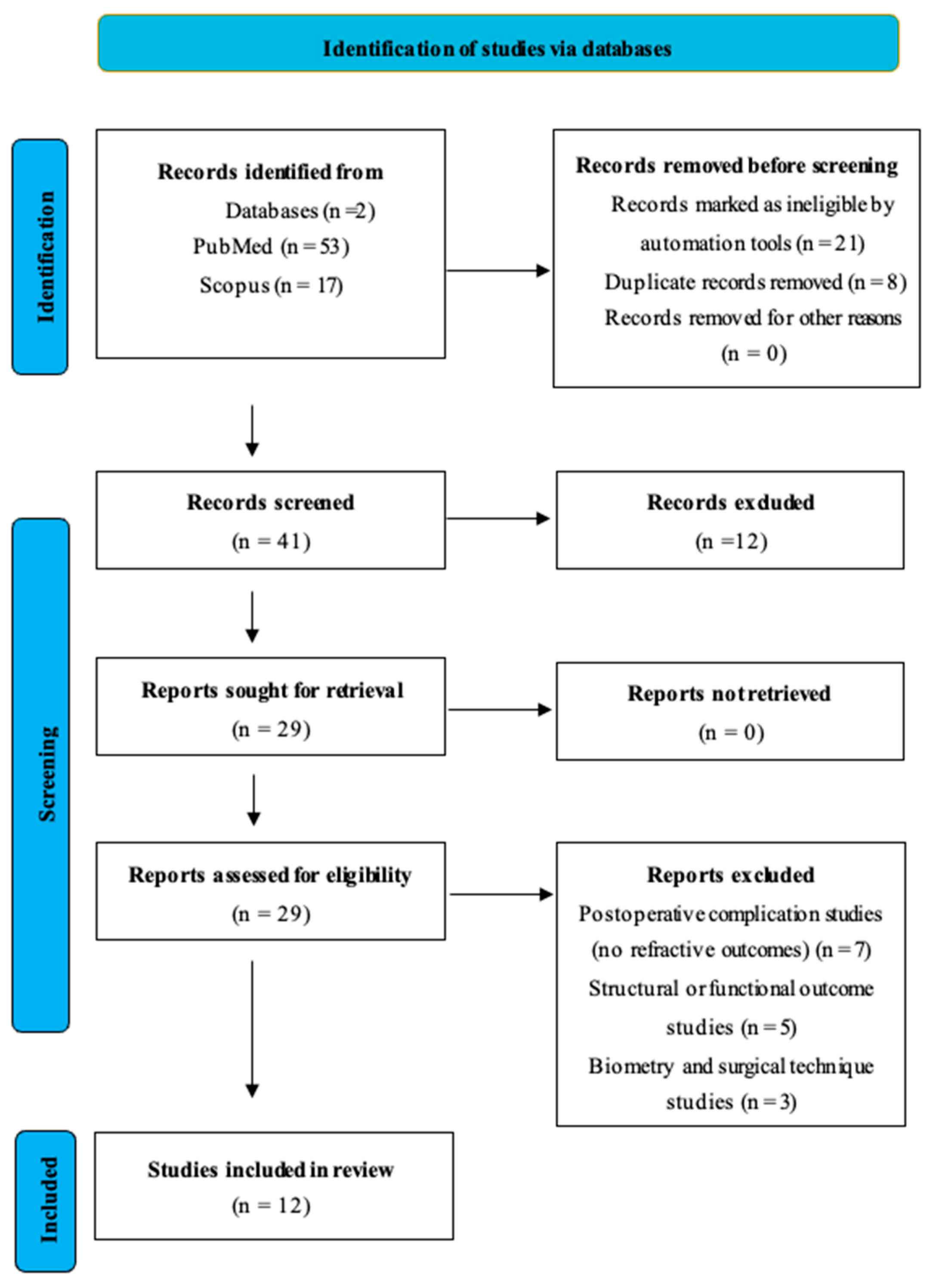
- Included children ≤ 18 years undergoing primary or secondary IOL implantation for congenital, developmental, or paediatric cataract.
- Reported quantitative postoperative refractive outcomes (spherical equivalent refraction or myopic shift, in diopters) and/or axial length change (in millimeters).
- Examined determinants, predictors, or risk factors associated with postoperative refractive change.
- Were original, peer-reviewed articles published in English.
- Studies focusing solely on postoperative complications (e.g., glaucoma, retinal detachment) without refractive data.
- Traumatic, syndromic, or PFV-associated cataracts.
- Reviews, case reports, technical notes, or animal studies.
- Lack of quantitative refractive outcomes or follow-up duration.
2.4. Study Selection
2.5. Data Charting
2.6. Data Synthesis
3. Results
3.1. Study Characteristics
3.2. Study Design and Population
3.3. Reported Refractive and Biometric Outcomes
3.4. Age, Laterality, and Biometric Predictors
3.5. Surgical and Technical Parameters
3.6. Postoperative Complications
3.7. Summary of Reported Evidence
4. Discussion
4.1. Factors Influencing Refractive Change After Surgery
- Age and Axial Growth
- 2.
- Laterality, Corneal Curvature, and Inter-Eye Factors
- 3.
- Surgical Technique and Biometric Accuracy
4.2. Complications and Postoperative Course
4.3. Methodological Variability in Study Design and Reporting
4.4. Context Within Global Practice
4.5. Future Research and Clinical Implications
5. Conclusions
Supplementary Materials
Author Contributions
Funding
Institutional Review Board Statement
Informed Consent Statement
Data Availability Statement
Acknowledgments
Conflicts of Interest
References
- Negalur, M.; Sachdeva, V.; Neriyanuri, S.; Ali, M.H.; Kekunnaya, R. Long-term outcomes following primary intraocular lens implantation in infants younger than 6 months. Indian J. Ophthalmol. 2018, 66, 1088–1093. [Google Scholar] [CrossRef] [PubMed]
- AlObaisi, S.; Alnasser, B.N.; Almuhawas, H.A.; Alhoshan, S.A.; Aldebasi, M.H.; Alshaye, R.; Aldakhil, S.; Alrasheed, S.H. Understanding post-operative refractive outcome in paediatrics after IOL implementation: Factors and predictors. Int. Ophthalmol. 2024, 44, 364. [Google Scholar] [CrossRef] [PubMed]
- Menezes Filho, C.; Messias, A.; Silva, P.H.F.; Antunes-Foschini, R. Myopic shift in paediatric cataract surgery associated with age and surgical complications. Indian J. Ophthalmol. 2024, 72, S734–S740. [Google Scholar] [CrossRef] [PubMed]
- Valera Cornejo, D.A.; Flores Boza, A. Relationship between preoperative axial length and myopic shift over 3 years after congenital cataract surgery with primary intraocular lens implantation at the National Institute of ophthalmology of Peru, 2007–2011. Clin. Ophthalmol. 2018, 12, 395–399. [Google Scholar] [CrossRef] [PubMed]
- Kaplan, A.T.; Öskan Yalçin, S.; Oral Aydin, A.Y. Primary versus secondary intraocular lens implantation following removal of congenital/developmental cataracts: Outcomes after at least 4 years. Turk. J. Med. Sci. 2023, 53, 77–87. [Google Scholar] [CrossRef] [PubMed]
- Li, Y.; Jin, G.; Tan, Y.; Chen, H.; Jin, J.; Luo, L.; Chen, W.; Lin, H.; Liu, Y.; Liu, Z. Myopic shift after primary intraocular lens implantation in unilateral cataract children and its association with preoperative ocular parameters. J. Cataract. Refract. Surg. 2025, 51, 53–59. [Google Scholar] [CrossRef] [PubMed]
- Valeina, S.; Heede, S.; Erts, R.; Sepetiene, S.; Skaistkalne, E.; Radecka, L.; Vanags, J.; Laganovska, G. Factors influencing myopic shift in children after intraocular lens implantation. Eur. J. Ophthalmol. 2020, 30, 933–940. [Google Scholar] [CrossRef] [PubMed]
- VanderVeen, D.K.; Oke, I.; Nihalani, B.R. Deviations From Age-Adjusted Normative Biometry Measures in Children Undergoing Cataract Surgery: Implications for Postoperative Target Refraction and IOL Power Selection. Am. J. Ophthalmol. 2022, 239, 190–201. [Google Scholar] [CrossRef] [PubMed]
- Chan, J.J.T.; Wong, E.S.; Lam, C.P.S.; Yam, J.C. Ten-year refractive and visual outcomes of intraocular lens implantation in infants with congenital cataract. Hong Kong Med. J. 2023, 29, 22–30. [Google Scholar] [CrossRef] [PubMed]
- Aldamri, A.; AlKhaldi, S.A.; AlQahtani, D.S.; AlShaalan, K.S.; Alshamrani, M. Long-term outcome and determinants of primary paediatric cataract surgery. Saudi J. Ophthalmol. 2024, 38, 252–256. [Google Scholar] [CrossRef] [PubMed]
- Li, Y.; Tan, Y.; Xu, C.; Jin, G.; Chen, H.; Jin, L.; Luo, L.; Chen, W.; Lin, H.; Liu, Y.; et al. Association Between Preoperative Ocular Parameters and Myopic Shift in Children Undergoing Primary Intraocular Lens Implantation. Transl. Vis. Sci. Technol. 2024, 13, 24. [Google Scholar] [CrossRef] [PubMed]
- Lloyd, I.C.; Ashworth, J.; Biswas, S.; Abadi, R.V. Advances in the management of congenital and infantile cataract. Eye 2007, 21, 1301–1309. [Google Scholar] [CrossRef] [PubMed]
- Koch, C.R.; Kara-Junior, N.; Serra, A.; Morales, M. Long-term results of secondary intraocular lens implantation in children under 30 months of age. Eye 2018, 32, 1858–1863. [Google Scholar] [CrossRef] [PubMed]



| Study (Author, Year) | Country | Design | Sample (Eyes) | Age at Surgery (Months/Years) | Follow-Up (Years, Months) | Primary Outcome (Myopic Shift, D) | Secondary Outcome (AL change, mm) | Predictive Parameters Tested | Main Findings, Direction of Association |
|---|---|---|---|---|---|---|---|---|---|
| Koch et al., 2018 (Eye) [13] | Brazil, Spain | Retrospective cohort | 75 | 94 ± 45 days; secondary IOL implantation at 20.7 ± 6.0 months (range 11–30) | 6.9 years (82.3 ± 48.9 months; range 13–189) | At 30 days +2.16 ± 3.12 D → −2.20 ± 4.19 D at last follow-up; glaucomatous eyes excluded: −1.72 ± 3.66 D. Longer follow-up correlated with greater myopic SE | Axial length at IOL implantation 20.27 ± 1.46 mm; not longitudinally compared but correlated with refractive change | Age at cataract surgery and IOL implantation, formula type (SRK-II vs. SRK/T), IOL power, glaucoma status, laterality | Younger cataract extraction age (<2 mo) and use of SRK-II formula predicted more myopic final SE. Secondary IOL ≤ 20 mo not a glaucoma risk. Secondary IOL under 30 mo gave stable long-term refraction with predictable mild MS |
| Negalur et al., 2018 (Indian J Ophthalmol) [1] | India | Retrospective, observational cohort | 69 | 4.6 months (range 1.5–6) | 4.2 years (range 3–7) | −6.7 D over 4.2 years (≈−2.0 D/year). Median SE: +5.75 D immediate postop → −0.25 D at 3 years → −1.31 D at 5 years (total ≈ −8.4 D). Greater shift in unilateral vs. bilateral | Bilateral +1.73 mm; unilateral +2.80 mm at 3 years | Age, gender, laterality, IOL undercorrection, baseline AL, postoperative complications (VAO, deposits, glaucoma) | Unilateral cataracts showed significantly higher myopic shift and AL elongation. No significant association between age, gender, AL, or IOL undercorrection and final VA. VAO most common complication (18.8%), followed by IOL deposits (15.9%) and glaucoma (2.9%). Supports safety of primary IOL implantation <6 months with predictable large MS |
| Valera-Cornejo & Flores Boza, 2018 (Clin Ophthalmol) [4] | Peru | Retrospective cohort | 76 | 25.3 ± 16.5 months (range < 48 mo; all < 4 y) | 3.3 years (39.7 ± 14.1 months) | 3.6 ± 2.3 D; AL > 21.5 mm = 3.2 ± 3.3; AL ≤ 21.5 mm = 3.9 ± 3.2 (p = 0.36). Unilateral cataracts = 6.3 ± 6.2 D; bilateral = 3.0 ± 1.9 D (p = 0.001). Bilateral subgroup: AL > 21.5 mm = 2.6 ± 2.0 vs. AL ≤ 21.5 mm = 3.4 ± 1.8 (p = 0.098). MS increased with follow-up time: 1.95 D (1–2 y), 3.46 D (2–3 y), 3.84 D (3 y) | Mean preoperative AL 21.2 ± 2.4 mm; no significant correlation between AL and shift | Preoperative AL, laterality, age at surgery, visual axis obscuration, follow-up time | Laterality strongly associated with MS: unilateral eyes had >2× greater shift than bilateral. No significant correlation between initial AL and MS overall. Trend toward greater shift with smaller AL in bilateral cataracts. Visual axis obscuration not significant. Concluded that unilateral cases need more hyperopic target refraction |
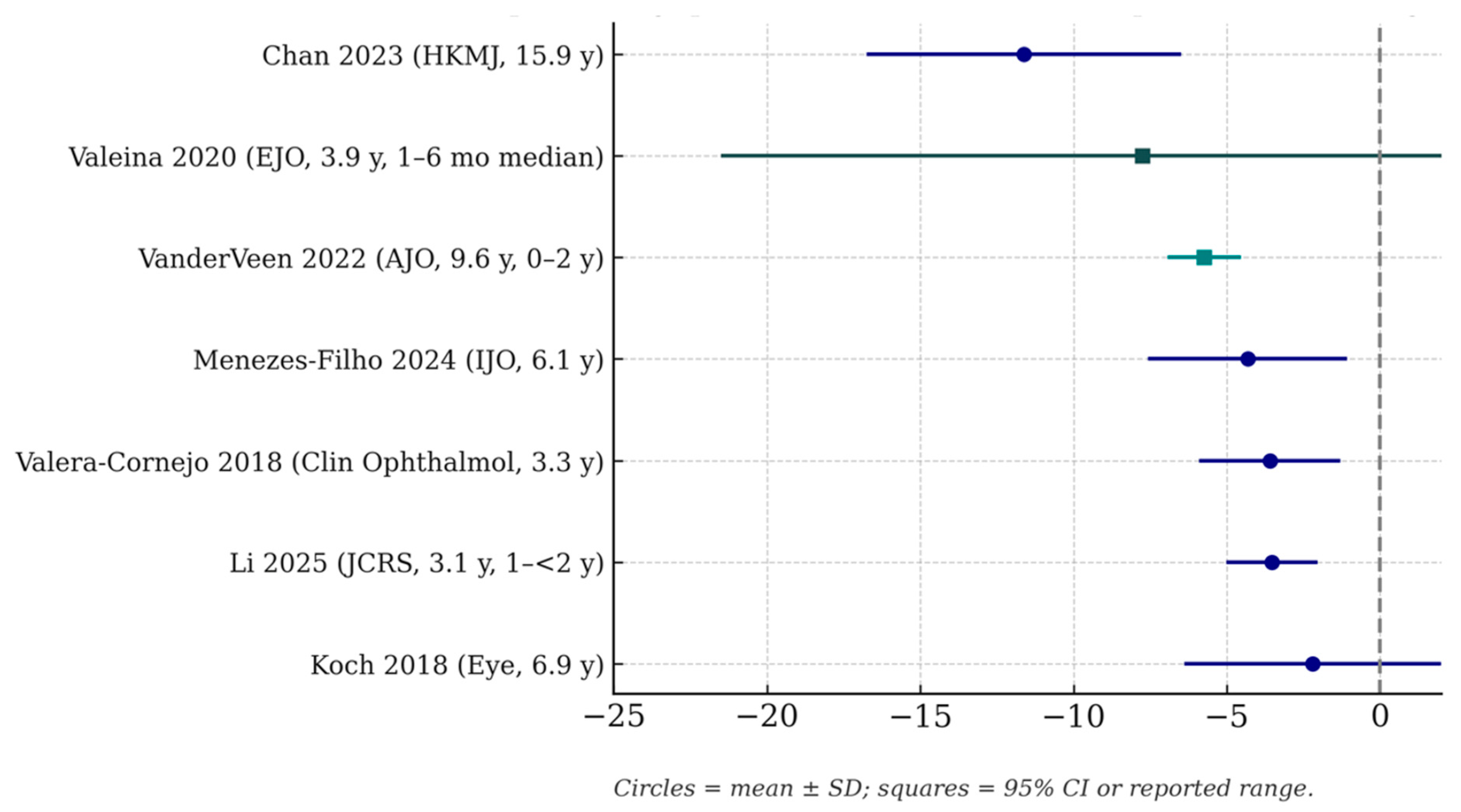
| Valeina et al., 2020 (European J Ophthalmol) [7] | Latvia | Retrospective cohort | 137 | Grouped by age (months) at IOL implantation: 1–6, 7–12, 13–24, 25–48, 49–84; 7–18 years | 3.9 years (range 0.5–10) | 1–6 mo group median −7.75 D (−21.5 to +2.0); 7–12 mo −3.0 D (−8.75 to +2.0); 13–24 mo −2.5 D (−7.5 to +0.5); ≥25 mo ≈ 0 to −1 D | Not numerically reported; trend of greater AL elongation in younger groups and eyes with SG | Age at surgery, IOL power, morphology, laterality, SG, SC, refraction target, BCVA | Younger age at surgery strongly predicted larger MS. Higher IOL power correlated negatively with shift. Eyes with SG had greater MS (−6 D vs. −2.75 D). No difference between emmetropic and hypermetropic targets. VA correlated with magnitude of MS. Largest shift in diffuse/total and nuclear cataracts; earlier surgery produced 3× greater MS than later groups. |
| VanderVeen et al., 2022 (Am J Ophthalmol) [8] | USA | Longitudinal cohort | 162 | Grouped by age: 0–2, 2–4, 4–6, 6–8, 8–10 years | Median 9.6 years (IQR 7.3–12.2) | 0–2 y −5.75 D (−6.94, −4.53); 2–4 y −2.25 D (−3.56, −0.94); 4–6 y −1.56 D (−2.81, −0.53); 6–8 y −0.06 D (−0.91, 0.12); 8–10 y 0.00 D (0.00, 0.00) | Not directly quantified per group; RRG: 0–2 y −11, 2–4 y −10, 4–6 y −10, 6–8 y −11, 8–10 y −6 | Age, sex, laterality, AL percentile, K, IOL power, follow-up duration | Younger age → greater MS. Lower K (<25th percentile) independently predicted more MS and faster refractive growth. No significant association with AL percentile, laterality, or sex after adjustment. Proposed refined postoperative hyperopia targets by age and K. Greater shift in flatter corneas |
| Chan et al., 2023 (Hong Kong Med J) [9] | Hong Kong | Retrospective cohort | 22 | 5.3 ± 2.4 months (1.8–10.5) | 15.9 ± 2.8 years (10–20.5) | 10-year = −11.62 ± 5.14 D (−21.88 to −3.75) | +5.83 ± 2.05 mm increase (17.72 → 24.80 mm) | Age at surgery, immediate post-op refraction, AL, laterality, need for posterior capsulotomy | Younger age → greater MS at 1 and 10 years. Greatest MS during first year. AL change correlated with MS. Immediate post-op refraction ≥ +7 D linked to worse BCVA |
| Kaplan et al., 2023 (Turk J Med Sci) [5] | Turkey | Retrospective and comparative cohort | 242 | Primary IOL: 5.9 ± 3.3 years (2–15 y); Secondary IOL: 0.4 ± 0.3 years (0.08–1.5 y; IOL at 2.8 ± 0.4 y) | Primary IOL: 5.9 ± 3.3 years (2–15 y); Secondary IOL: 0.4 ± 0.3 years (0.08–1.5 y; IOL at 2.8 ± 0.4 y) Primary IOL median 5 years (range 4–16); Secondary IOL median 8 years (range 4–19) | No significant difference in MS between groups (p = 0.172); Myopia in 57.7% of secondary vs. 48.9% of primary IOL eyes. In unilateral cases, greater myopic shift in operated vs. fellow eyes | AL not measured longitudinally; shift presumed optical rather than axial | Age at surgery, type of IOL (primary vs. secondary), laterality, strabismus, nystagmus, binocular vision, VAO, SG | Primary IOL eyes showed better BCVA and less strabismus/nystagmus, but similar MS compared to secondary IOLs. Unilateral cases in both groups had greater MS than fellow eyes. Early surgery not associated with less nystagmus. Suggests delayed secondary IOL reduces high myopia risk when optical correction compliance is good |
| Aldamri et al., 2024 (Saudi J Ophthalmol) [10] | Saudi Arabia | Retrospective cohort | 202 | ≤4 years old at surgery (mean age at presentation 15–16 months) | Minimum 3 years (up to 8 years) | MS > −4.00 D observed in 14% of eyes, more common with primary IOL implantation (19 eyes) vs. secondary IOL (10 eyes). One case operated at 5 months had −19.00 D at age 6 years | Not quantified numerically; eyes with primary IOL showed greater elongation and more frequent glaucoma | Age at surgery, IOL type (primary vs. secondary), laterality, cataract morphology, strabismus, nystagmus, glaucoma, VAO | MS ≥ −4 D occurred in 14% of eyes, significantly more frequent in primary IOL cases. Early IOL (<6 mo) associated with larger MS and more SG. Glaucoma was most common complication (19%). Presence of nystagmus/strabismus correlated with poorer VA outcomes |
| AlObaisi et al., 2024 (Int Ophthalmol) [2] | Saudi Arabia | Retrospective and cross-sectional cohort | 47 (29 primary IOL, 18 secondary IOL) | 6.52 ± 4.61 years (range 1–15) | Two follow-ups: 2 months and 2 years post-op | Postoperative SE: +1.31 ± 2.65 D; at last follow-up −0.53 ± 2.60 D (net MS ≈ −1.84 D over 2 years) | Not measured directly, but AL correlated negatively with postoperative refraction | Age, AL, ΔK, target refraction, preoperative SE, IOL placement, IOL type (primary vs. secondary), calculation method (Holladay 1 vs. SRK/T) | High ΔK and sulcus IOL placement increased APE. Calculation method strongly influenced outcomes: Holladay 1 yielded lower PE/APE than SRK/T. AL and age correlated negatively with PE and postoperative SE, indicating reduced refractive error in older children. Concluded calculation method and astigmatism are strongest predictors of postoperative refractive error |
| Li et al., 2024 (TVST) [11] | China | Retrospective cohort | 222 | 4.36 years (IQR 3.16–6.0) | Median 4.18 years (IQR 3.48–4.64) | Myopic shift (D) by age × AL subgroup 2–<4 y: <25% −3.00 D (−4.38, −2.50); 25–75% −2.63 D (−4.63, −1.00); >75% −1.38 D (−2.13, −0.50). 4–<6 y: <25% −3.00 D (−3.63, −1.75); 25–75% −1.50 D (−2.13, −1.13); >75% −0.88 (−2.06, 0.06). ≥6 y: <25% −2.50 D (−5.13, −1.88); 25–75% −1.38 D (−3.19, −1.00); >75% −0.50 D (−0.88, 0.13) | Not specifically quantified, but shorter AL associated with greater elongation and shift | Age at surgery, preoperative AL, K, IOL position, VAO, Nd:YAG, follow-up | Younger age and shorter preoperative AL predicted greater MS and faster rate. No effect of K or IOL position. Suggested AL-based target refraction adjustment (+0.5 to +1 D for short AL) |
| Menezes-Filho et al., 2024 (Indian J Ophthalmol) [3] | Brazil | Cross-sectional retrospective | 81 | 7.7 months (IQR 3.7–30.5) | 6.1 years (72.9 ± 37.1 months) | Overall −4.32 D ± 3.25; by age — <6 mo −5.73 D ± 3.14, 6–24 mo −4.00 D ± 3.15, >24 mo −2.52 D ± 2.57. Greater shift in aphakic eyes (−5.57 D) vs. pseudophakic (−3.44 D). Strabismic eyes −4.99 D vs. non-strabismic −2.52 D. Eyes with surgical complications −5.87 D vs. no complications −3.75 D | Not numerically detailed; shorter AL and microphthalmia correlated with greater MS and complications | Age at surgery, bilaterality, strabismus, aphakia/pseudophakia, BCVA, surgical complications, VAO, anterior vitrectomy, microphthalmia, SG, follow-up duration | Multivariate model: younger age and surgical complications independently predicted greater MS. Strabismus, VAO, and aphakia significant only in univariate models. Concluded that early surgery and intraoperative/postoperative complications strongly increase postoperative MS |
| Li et al., 2025 (J Cataract Refract Surg) [6] | China | Retrospective, single center cohort | 252 | 3.99 ± 1.98 years (range 1.21–11.89) | 3.14 ± 0.25 | 1–<2 y: −3.53 D ± 1.49; 2–<4 y: −3.08 D ± 1.77; 4–<6 y: −1.75 D ± 1.55; ≥6 y: −1.99 D ± 1.80. Fellow eyes showed minimal shift (−0.34 to −1.67 D). Mean interocular difference significant for groups < 6 y | Not measured longitudinally; mean preoperative AL 22.51 ± 1.70 mm (treated) vs. 22.13 ± 1.04 mm (fellow); shorter interocular AL difference (IALD) linked to greater postoperative change | Age at surgery, preoperative AL, AK, IALD, IAKD, IOL power, VAO, Nd: YAG, laterality | Younger age and smaller IALD independently predicted greater MS. No association with preoperative AL, AK, or IOL power. Recommended age- and IALD-adjusted target refractions: +3 to +4 D for 1–<2 y; +3 D for 2 y; +2 D for 3 y; +1 D for 4 y; 0 to +1 D for 4–<6 y; emmetropic for ≥6 y |
Disclaimer/Publisher’s Note: The statements, opinions and data contained in all publications are solely those of the individual author(s) and contributor(s) and not of MDPI and/or the editor(s). MDPI and/or the editor(s) disclaim responsibility for any injury to people or property resulting from any ideas, methods, instructions or products referred to in the content. |
© 2026 by the authors. Published by MDPI on behalf of the Lithuanian University of Health Sciences. Licensee MDPI, Basel, Switzerland. This article is an open access article distributed under the terms and conditions of the Creative Commons Attribution (CC BY) license.
Share and Cite
Mravičić, I.; Orešković, E.G.; Bohač, M.; Drača, N. Predicting Postoperative Myopic Shift After Paediatric Intraocular Lens Implantation: A Scoping Review of Associated Factors. Medicina 2026, 62, 106. https://doi.org/10.3390/medicina62010106
Mravičić I, Orešković EG, Bohač M, Drača N. Predicting Postoperative Myopic Shift After Paediatric Intraocular Lens Implantation: A Scoping Review of Associated Factors. Medicina. 2026; 62(1):106. https://doi.org/10.3390/medicina62010106
Chicago/Turabian StyleMravičić, Ivana, Emma Grace Orešković, Maja Bohač, and Nataša Drača. 2026. "Predicting Postoperative Myopic Shift After Paediatric Intraocular Lens Implantation: A Scoping Review of Associated Factors" Medicina 62, no. 1: 106. https://doi.org/10.3390/medicina62010106
APA StyleMravičić, I., Orešković, E. G., Bohač, M., & Drača, N. (2026). Predicting Postoperative Myopic Shift After Paediatric Intraocular Lens Implantation: A Scoping Review of Associated Factors. Medicina, 62(1), 106. https://doi.org/10.3390/medicina62010106