
The Pullback Pressure Gradient: Transforming Invasive Coronary Physiology from Lesion Assessment to Disease Pattern Characterization—A Perspective


Abstract
1. Introduction
1.1. The Limitations of Angiography and the Dawn of Coronary Physiology
1.2. The Unanswered Question: FFR as a “Spot” Measurement
1.3. Invasive Pullback Pressure Gradient
2. The Pullback Pressure Gradient (PPG): From Physiological Concept to Clinical Calculation
2.1. Conceptual Development: Standardizing the Pullback Curve
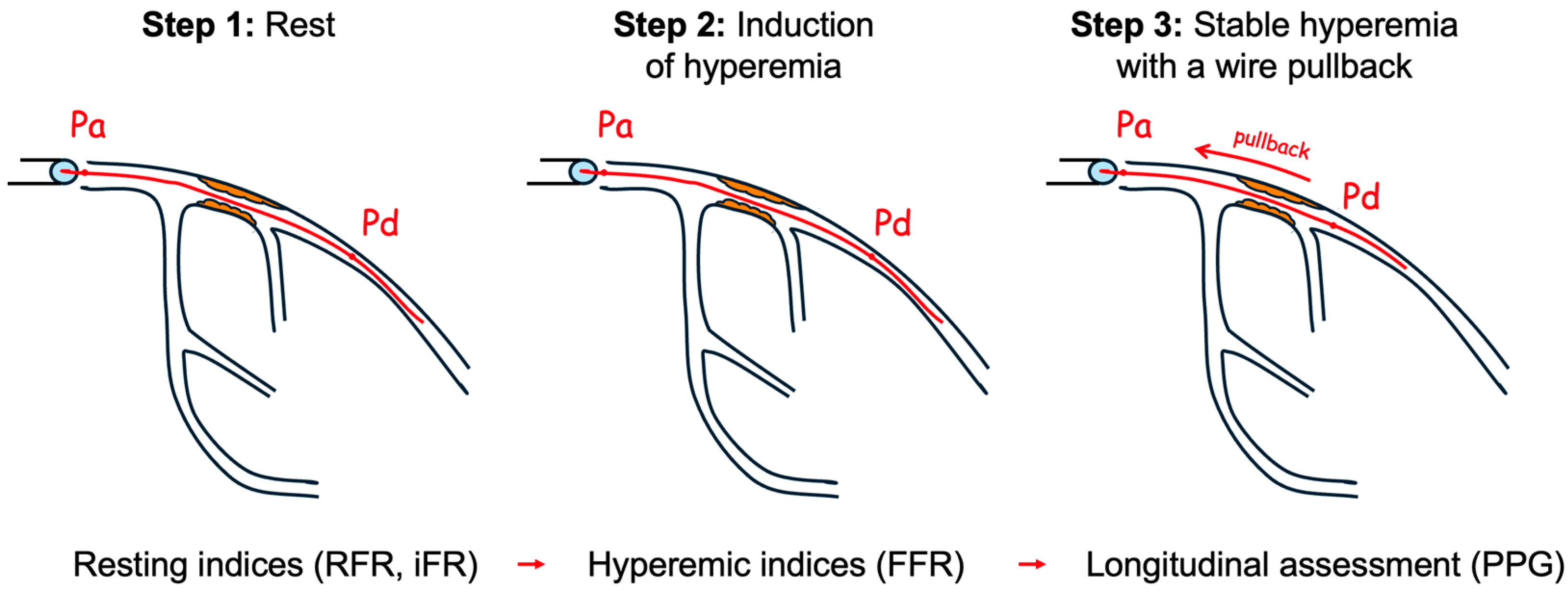
2.2. The Invasive Procedure and Calculation of the PPG Index
- Initial setup and wire positioning: The procedure begins with standard coronary angiography and engagement of the target vessel with a guiding catheter. A 0.014-inch pressure-sensing guidewire (e.g., PressureWire X, Abbott Vascular) is prepared, calibrated, and advanced through the guiding catheter. Pressure from the guidewire sensor is “equalized” with pressure from the guiding catheter tip to ensure identical readings in the absence of a gradient [4,7,12,15]. The pressure wire is then advanced until its sensor is positioned in the distal third of the coronary artery, typically in a segment with a visually estimated diameter of at least 2.0 mm [4,7,12,15].
- The pullback maneuver: Once stable hyperemia is established, the pressure wire is withdrawn slowly at constant speed from its distal position to the guiding catheter tip while continuously recording pressure from both wire and catheter [4,7,12,15]. Two techniques are available:Motorized pullback: This method, used in initial validation studies, ensures perfectly constant and known pullback speed (typically 1 mm/s) using a dedicated motorized device [7,15]. This technique provided rigorous standardization of the pressure-length relationship necessary for index development and validation [7,15]. However, these devices are not widely available and can be cumbersome, representing a barrier to routine clinical use.Manual pullback: This is the current standard clinical technique, whereby the operator manually withdraws the wire over 20 to 30 s [4,7,12,15]. Translation of PPG from research concept to practical clinical tool critically depended on demonstrating that manual pullbacks yield accurate and reproducible results. A key validation study demonstrated excellent agreement between manual and motorized pullbacks (mean difference −0.01 ± 0.07) under controlled laboratory conditions. However, translation to routine clinical practice remains operator-dependent and requires adequate training to maintain the slow, steady pullback technique essential for achieving comparable results. The laboratory validation provides necessary—but not sufficient—evidence for clinical implementation [4,7,12,14,15].
2.3. Emerging Techniques: Non-Hyperemic Pullback Pressure Gradient
3. Clinical Applications: PPG as a Predictive and Procedural Guidance Tool
3.1. Predicting the Functional Outcome of PCI
3.2. Guiding Revascularization Strategy and Procedural Planning
3.3. Correlation with Patient-Centered Outcomes and Procedural Safety
4. Resolving a Clinical Conundrum: The Role of PPG in FFR-iFR Discordance
4.1. The Clinical Problem: FFR-iFR Discordance
4.2. The Mechanistic Link: Disease Pattern as the Primary Determinant of Discordance
- FFR-positive/iFR-negative (FFR+/iFR−) discordance: This pattern, where the lesion is deemed significant by the hyperemic index (FFR) but not by the resting index (iFR), strongly and consistently associates with physiologically focal disease, indicated by high PPG [17]. In a recent multicenter study, 76.3% of vessels with FFR+/iFR− discordance demonstrated predominantly focal disease pattern [17]. Another study found 58.5% of FFR+/iFR− lesions were focal [14].
- FFR-negative/iFR-positive (FFR−/iFR+) discordance: This pattern, where the lesion is non-significant during hyperemia (FFR) but significant at rest (iFR), equally strongly associates with physiologically diffuse disease, indicated by low PPG [17]. The same multicenter study found that 96.3% of vessels with FFR−/iFR+ discordance exhibited predominantly diffuse disease pattern [17]. Another study found 81.6% of FFR−/iFR+ lesions were diffuse [14]. Median PPG was significantly lower in the FFR−/iFR+ group compared to the FFR+/iFR− group (0.65 vs. 0.82) [26].
4.3. The Underlying Hemodynamics: Frictional Loss Versus Separation Loss
- 1.
- Frictional loss (): Energy lost due to viscous friction between flowing blood and the endothelial vessel wall surface. This loss is linearly proportional to flow velocity (v) and stenotic segment length (L), representing the dominant pressure loss mode in long, diffusely diseased arteries:
- 2.
- Separation loss (): Energy lost due to turbulence, eddy currents, and flow separation occurring at the abrupt exit of a discrete focal stenosis. This loss is proportional to the square of flow velocity (v2). Because of this squared relationship, separation loss is minimal at low (resting) flow rates but becomes exponentially larger as flow accelerates during hyperemia:
- Explaining FFR+/iFR− in focal disease: A classic focal stenosis is short in length but severely narrowed. At rest, blood flow velocity is relatively low. Frictional loss is minimal because the lesion is short, and separation loss is minimal because flow velocity is not yet squared. Therefore, total pressure drop is small, resulting in negative iFR (iFR > 0.89). However, during hyperemia, adenosine administration dramatically increases flow velocity (often 2–3 times resting rate). This velocity surge profoundly affects the separation loss component due to the v2 term, causing large pressure drop across the stenosis and resulting in positive FFR (FFR ≤ 0.80) [14,31].
- Explaining FFR−/iFR+ in diffuse disease: The FFR−/iFR+ discordance pattern reflects a combination of epicardial and microvascular factors. In long, diffusely diseased vessels, high cumulative frictional loss dominates hemodynamics, causing significant pressure drop even at rest and resulting in a positive iFR. However, these patients frequently harbor coexisting microvascular dysfunction, particularly in those with advanced age and diabetes [14,31,32]. This microvascular impairment is quantitatively captured by elevated index of microcirculatory resistance (IMR) or reduced coronary flow reserve (CFR). Microvascular dysfunction fundamentally alters the vessel’s response to hyperemia. The high-resistance distal bed impairs microcirculatory vasodilation in response to adenosine, creating a “physiological cap” on achievable hyperemic flow velocity. This flow limitation has critical hemodynamic consequences: because hyperemic pressure losses—both frictional and separation—are flow-dependent, blunted flow velocity directly attenuates the total pressure gradient. In diffusely diseased vessels, this attenuated flow results in a smaller-than-expected pressure drop across the epicardial disease, often insufficient to push FFR below its ischemic threshold of 0.80 despite substantial epicardial atherosclerotic burden. Therefore, the FFR−/iFR+ discordant pattern (low PPG) serves as a powerful diagnostic signature not merely of diffuse epicardial disease, but of global coronary vasculopathy encompassing both diffuse epicardial atherosclerosis and compromised microcirculatory function (high IMR) [14,31,32].
4.4. Clinical Implications of Understanding Discordance
- FFR+/iFR− discordance (focal disease signature): This pattern indicates a lesion that is an ideal PCI target. Positive FFR confirms significant ischemia under stress, and the focal disease nature (high PPG) predicts that stenting will abolish separation losses, yielding substantial functional gain and favorable clinical outcome [14,17,26,31].
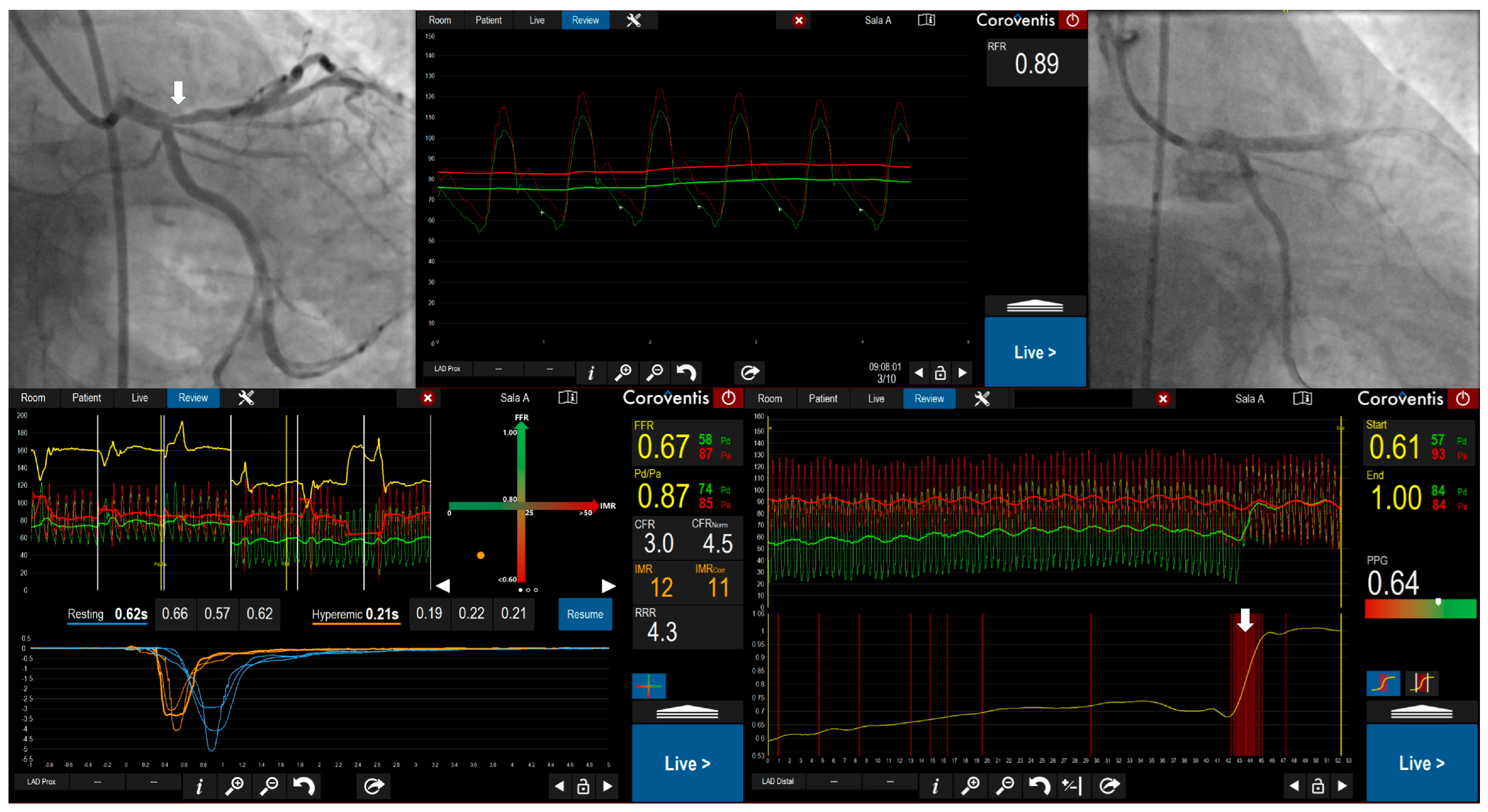
- FFR−/iFR+ discordance (diffuse disease signature): This pattern suggests a more challenging clinical scenario. Positive iFR indicates significant resting pressure loss, but the diffuse disease nature (low PPG) predicts that focal stenting will provide only modest functional improvement, likely resulting in suboptimal post-PCI FFR and higher probability of residual symptoms [14,17,26,31]. In this scenario, clinicians may favor optimal medical therapy or CABG (Figure 3).
5. Conclusions and Future Horizons
5.1. Summary of Evidence and Integration into Clinical Practice for the Interventional Cardiologist
- Pre-PCI planning and strategy: Routine pressure pullback to calculate PPG may be considered in all patients with hemodynamically significant lesions (e.g., FFR ≤ 0.80) being considered for PCI. PPG should be used to phenotype disease and forecast procedural outcome. High PPG (e.g., >0.75) strongly supports PCI, predicting favorable functional results and greater symptom relief [12,14,15,19,21,23]. Conversely, low PPG (e.g., <0.62) identifies patients with diffuse disease, in whom PCI benefit is less certain and procedural risk is higher [12,14,15,19,21,23]. This should prompt careful reconsideration of the risk-benefit ratio and discussion of alternative strategies such as CABG or OMT, particularly in patients with stable angina.
- Interpreting discordance: In cases of FFR/iFR discordance, performing pullback to determine PPG can resolve clinical uncertainty. As outlined in Section 4, the disease pattern revealed by PPG provides clear physiological rationale for discordance and guides appropriate therapeutic strategy [12,14,15,17,19,21,23,26].
5.2. Key Messages for the General Cardiologist and General Practitioner
- Managing patient expectations: A simple analogy explains the difference between focal and diffuse disease. Focal blockage resembles a single large boulder in a river; removing it with a stent effectively restores flow. In contrast, diffuse disease resembles a long, shallow, rocky river stretch; placing a short paved section (a stent) may not significantly improve overall flow [15]. This helps patients understand why stenting may not be a complete solution for everyone.
- Understanding treatment decisions: This framework provides clear rationale for why interventional cardiologists might recommend medical therapy or CABG even when physiological tests like FFR or iFR are “positive.” Decisions are based not solely on ischemia presence but on sophisticated assessment of disease pattern and predicted durability and effectiveness of PCI.
- Interpreting post-PCI symptoms: Persistent angina after technically successful PCI is a common clinical challenge. Knowledge that diffuse disease (identified by low pre-PCI PPG) is a primary cause of this phenomenon is invaluable [15]. This allows physicians to reassure patients that their symptoms are not necessarily indicative of procedural failure or acute stent complications but rather reflect the underlying chronic, diffuse atherosclerosis that was not fully correctable with focal stenting. This understanding guides appropriate medical management and prevents unnecessary repeat diagnostic procedures [34].
5.3. Limitations and Unanswered Questions
- Technical considerations: Although manual pullback has been validated as highly reproducible, it is a technique-dependent maneuver requiring operators to withdraw the wire at slow, steady pace to avoid artifacts. Sudden movements or wire whip can distort pressure tracings [12,15,18,19,21,23,26]. Standard hyperemic PPG also requires adenosine administration, a limitation that resting PPG development aims to overcome.
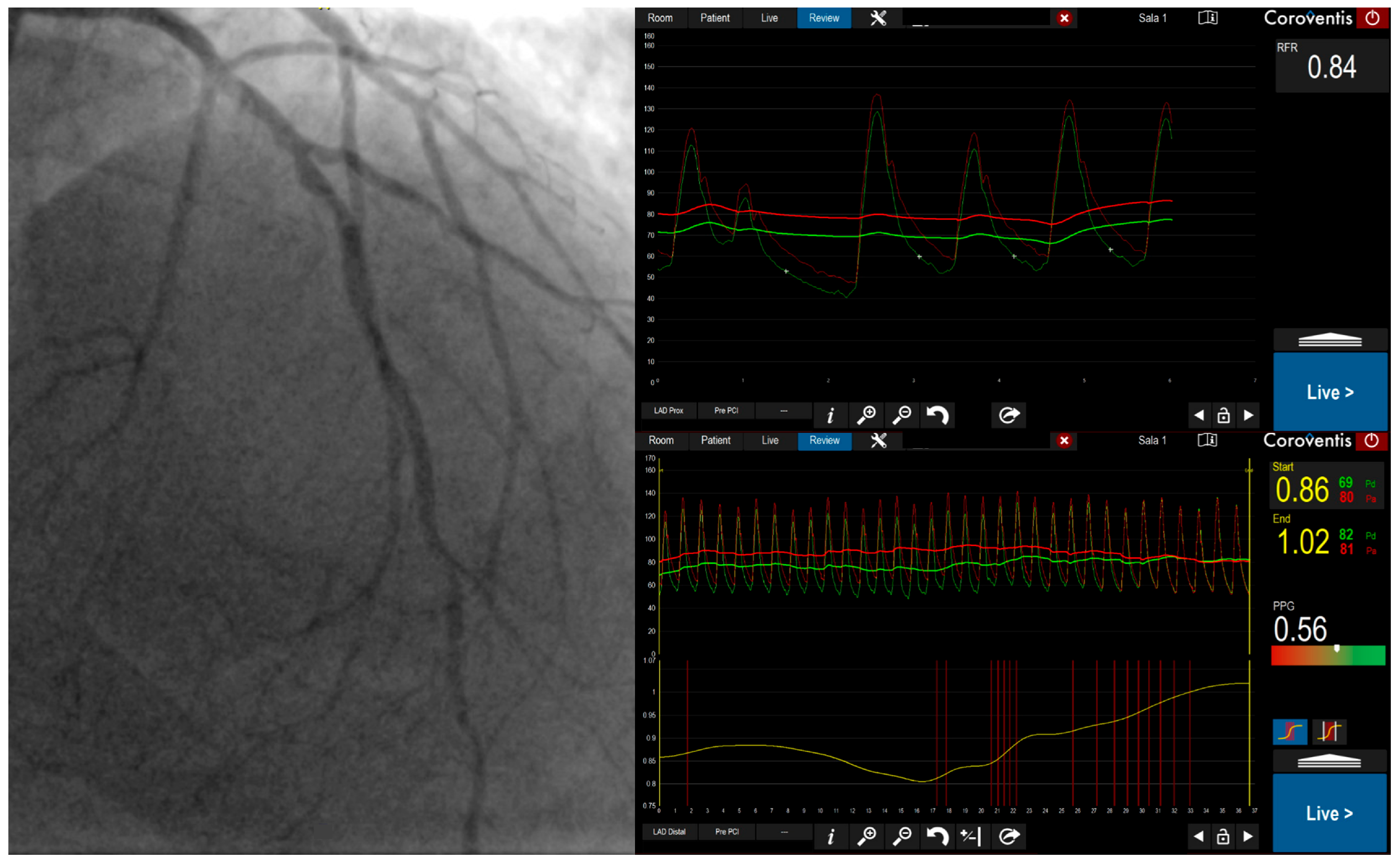
- Lack of a universal cutoff value and the importance of the continuous spectrum: A major limitation is the absence of a single, universally accepted PPG value to dichotomously classify disease. The literature reflects significant heterogeneity in thresholds. The PPG Global study used a median value of <0.62 to define higher periprocedural myocardial infarction risk [12], while FFR-iFR discordance studies have employed <0.75 to define diffuse disease [26], and other analyses have used >0.73 to identify focal patterns [14]. This variability highlights that cutoffs are often derived post hoc from specific study populations and may lack generalizability. Therefore, PPG must be interpreted as a continuous variable rather than a binary test. The clinical principle is straightforward: the lower the PPG, the more diffuse the disease and the greater the caution required before proceeding with PCI. This spectrum also reveals a substantial “gray zone” of intermediate disease patterns (PPG 0.60–0.75), as exemplified in Figure 3 (PPG 0.64), which represent mixed pathology. These cases are likely suboptimal PCI targets but may not warrant outright deferral, representing a key area for future research into nuanced risk-benefit assessment and shared decision-making [15].
- Evidence gaps/external validation: Despite robust findings from the PPG Global Registry—including an AUC of 0.82 for predicting optimal revascularization and strong associations with post-PCI functional outcomes—independent prospective validation studies remain essential. Until such data is available, the generalizability of this predictive value remains a key unanswered question. Furthermore, the majority of PPG research has been conducted in patients with single-vessel disease already considered PCI candidates. Its applicability and predictive value in more complex patient subsets—such as those with diffuse multivessel disease, left main disease, or acute coronary syndromes—require further dedicated investigation [12,15,16,18,19,21,23,26].
5.4. Future Research Directions: From Prediction to Prescription
- The definitive randomized controlled trial: The most critical unmet need is a large-scale randomized controlled trial stratifying patients with hemodynamically significant ischemia (FFR ≤ 0.80) by PPG. Patients with low PPG (diffuse disease) could be randomized to optimal medical therapy versus CABG versus optimized PCI with long stents to determine the best management strategy for diffuse atherosclerosis. Patients with high PPG (focal disease) could be randomized to focal PCI versus optimal medical therapy to definitively test whether revascularization improves clinical outcomes in this theoretically ideal subgroup. Primary endpoints should include a composite of long-term major adverse cardiovascular events and patient-reported outcomes such as angina relief and quality of life. For patients with low PPG and significant ischemia, in whom PCI is predicted to be suboptimal and CABG may not be an option, OMT is the current standard. However, this leaves a therapeutic gap for those with refractory angina. Future research should investigate novel device-based therapies for this specific phenotype. The coronary sinus reducer is a promising percutaneous device designed for patients with refractory angina who are not candidates for conventional revascularization [35,36]. A future trial randomizing patients with low FFR and low PPG to either OMT alone or OMT plus coronary sinus reducer implantation would be a critical step in establishing a new, targeted treatment pathway for diffuse, non-revascularizable disease.
- Defining optimal therapy for diffuse disease: A key randomized controlled trial question is the optimal management strategy for patients with physiologically significant ischemia (low FFR) but diffuse disease pattern (low PPG). Whether these patients benefit most from aggressive PCI with long stents, surgical revascularization with CABG, or intensive OMT alone remains unknown [12,15,18,19,21,23,26].
- Technological refinement and accessibility: Continued research is needed to validate and refine non-hyperemic PPG, which would significantly streamline workflow and increase adoption [12,15,18,19,21,23,26,37]. Similarly, further validation of angiography-based PPG calculations (such as QFR-PPG) could make longitudinal physiological assessment possible without pressure wires, dramatically expanding accessibility [38,39,40].
- Integration with intravascular imaging: The relationship between PPG (a hemodynamic measure of pressure distribution) and underlying plaque morphology (burden and composition) remains incompletely characterized, with inconsistent findings across studies. Future studies should integrate PPG with intravascular imaging modalities such as intravascular ultrasound and optical coherence tomography. This would allow direct correlation between physiological patterns of pressure loss and underlying anatomical plaque morphology and composition [5,37,41]. Such approaches could identify high-risk features, such as thin-cap fibroatheromas, within hemodynamically significant focal lesions, potentially enabling truly comprehensive assessment of both physiological and anatomical vulnerability.
Author Contributions
Funding
Conflicts of Interest
Abbreviations
| AUC | Area under the curve |
| CABG | Coronary artery bypass grafting |
| CAD | Coronary artery disease |
| FFR | Fractional flow reserve |
| iFR | Instantaneous wave-free ratio |
| LAD | Left anterior descending |
| OMT | Optimal medical therapy |
| Pa | Aortic pressure |
| PCI | Percutaneous coronary intervention |
| Pd | Pressure distal to a stenosis |
| PPG | Pullback pressure gradient |
References
- Modi, B.; Dutta, S.; Collison, D.; Lampadakis, I.; Sen, S. After RIPCORD 2, FAME 3, FLOWER-MI and FUTURE: Has the Pressure Wire Had Its Day? Interv. Cardiol. 2024, 19, e09. [Google Scholar] [CrossRef]
- Gurav, A.; Revaiah, P.C.; Tsai, T.Y.; Miyashita, K.; Tobe, A.; Oshima, A.; Sevestre, E.; Garg, S.; Aben, J.P.; Reiber, J.H.C.; et al. Coronary Angiography: A Review of the State of the Art and the Evolution of Angiography in Cardio Therapeutics. Front. Cardiovasc. Med. 2024, 11, 1468888. [Google Scholar] [CrossRef]
- Aleksandric, S.; Tesic, M.; Orlic, D. Editorial: Challenges in the Contemporary Assessment of Coronary Physiology. Front. Cardiovasc. Med. 2023, 10, 1305913. [Google Scholar] [CrossRef]
- Munhoz, D.; Collet, C.; Mizukami, T.; Yong, A.; Leone, A.M.; Eftekhari, A.; Ko, B.; da Costa, B.R.; Berry, C.; Collison, D.; et al. Rationale and Design of the Pullback Pressure Gradient (PPG) Global Registry. Am. Heart J. 2023, 265, 170–179. [Google Scholar] [CrossRef]
- Pasaroiu, D.; Benedek, I.; Popa, T.; Tolescu, C.; Chitu, M.; Benedek, T. Intracoronary Imaging for Changing Therapeutic Decisions in Patients with Multivascular Coronary Artery Disease. Medicina 2024, 60, 1320. [Google Scholar] [CrossRef]
- Ali, N.; Patel, P.A.; Malkin, C.J. Assessment of Coronary Physiology-the Evidence and Implications. Clin. Med. 2019, 19, 364–368. [Google Scholar] [CrossRef] [PubMed]
- Collet, C.; Sonck, J.; Vandeloo, B.; Mizukami, T.; Roosens, B.; Lochy, S.; Argacha, J.F.; Schoors, D.; Colaiori, I.; Di Gioia, G.; et al. Measurement of Hyperemic Pullback Pressure Gradients to Characterize Patterns of Coronary Atherosclerosis. J. Am. Coll. Cardiol. 2019, 74, 1772–1784. [Google Scholar] [CrossRef] [PubMed]
- Vrints, C.; Andreotti, F.; Koskinas, K.C.; Rossello, X.; Adamo, M.; Ainslie, J.; Banning, A.P.; Budaj, A.; Buechel, R.R.; Chiariello, G.A.; et al. 2024 ESC Guidelines for the Management of Chronic Coronary Syndromes. Eur. Heart J. 2024, 45, 3415–3537. [Google Scholar] [CrossRef] [PubMed]
- Siudak, Z.; Hawranek, M.; Kleczyński, P.; Bartuś, S.; Kusa, J.; Milewski, K.; Opolski, M.P.; Pawłowski, T.; Protasiewicz, M.; Smolka, G.; et al. Interventional Cardiology in Poland in 2022. Annual Summary Report of the Association of Cardiovascular Interventions of the Polish Cardiac Society (AISN PTK) and Jagiellonian University Medical College. Adv. Interv. Cardiol. 2023, 19, 82–85. [Google Scholar] [CrossRef]
- Siudak, Z.; Grygier, M.; Tomaniak, M.; Kałużna-Oleksy, M.; Kleczyński, P.; Milewski, K.; Opolski, M.P.; Smolka, G.; Sabiniewicz, R.; Malinowski, K.P.; et al. Interventional Cardiology in Poland in 2023. Annual Summary Report of the Association of Cardiovascular Interventions of the Polish Cardiac Society (AISN PTK) and Jagiellonian University Medical College. Adv. Interv. Cardiol. 2024, 20, 379–381. [Google Scholar] [CrossRef]
- Echavarría-Pinto, M.; Collet, C.; Escaned, J.; Piek, J.; Serruys, P. State of the Art: Pressure Wire and Coronary Functional Assessment. EuroIntervention 2017, 13, 666–679. [Google Scholar] [CrossRef]
- Collet, C.; Munhoz, D.; Mizukami, T.; Sonck, J.; Matsuo, H.; Shinke, T.; Ando, H.; Ko, B.; Biscaglia, S.; Rivero, F.; et al. Influence of Pathophysiologic Patterns of Coronary Artery Disease on Immediate Percutaneous Coronary Intervention Outcomes. Circulation 2024, 150, 586–597. [Google Scholar] [CrossRef] [PubMed]
- Niewiara, Ł.; Kleczyński, P.; Szolc, P.; Guzik, B.; Diachyshyn, M.; Jelonek, M.; Handzlik, J.; Żmudka, K.; Legutko, J. The Change of Angina Levels in Patients with Chronic Coronary Syndromes and Coronary Microcirculatory Dysfunction-a Prospective Study with 24 Months Follow-Up. Adv. Interv. Cardiol. 2023, 19, 318–325. [Google Scholar] [CrossRef] [PubMed]
- Warisawa, T.; Cook, C.M.; Howard, J.P.; Ahmad, Y.; Doi, S.; Nakayama, M.; Goto, S.; Yakuta, Y.; Karube, K.; Shun-Shin, M.J.; et al. Physiological Pattern of Disease Assessed by Pressure-Wire Pullback Has an Influence on Fractional Flow Reserve/Instantaneous Wave-Free Ratio Discordance. Circ. Cardiovasc. Interv. 2019, 12, e007494. [Google Scholar] [CrossRef] [PubMed]
- Carvalho, P.E.P.; Collet, C.; De Bruyne, B.; Munhoz, D.; Sonck, J.; Sara, J.D.S.; Strepkos, D.; Mutlu, D.; Alexandrou, M.; Ser, O.S.; et al. The Pullback Pressure Gradient: A Physiologic Index to Differentiate Focal from Diffuse Coronary Artery Disease. JACC Adv. 2025, 4, 101679. [Google Scholar] [CrossRef]
- Zdzierak, B.; Zasada, W.; Dziewierz, A.; Pawlik, A.; Rzeszutko, Ł.; Bartuś, S. Pullback Pressure Gradient: A Novel Dimension in Coronary Physiology. Kardiol. Pol. 2025. [Google Scholar] [CrossRef]
- Wong, C.C.Y.; Fearon, W.F. Pulling Back to See the Forest from the Trees: Insights into FFR and iFR Discordance. JACC Cardiovasc. Interv. 2025, 18, 835–837. [Google Scholar] [CrossRef]
- Sakai, K.; Sonck, J.; Mizukami, T.; Matsuo, H.; Ko, B.; Perera, D.; Ando, H.; Biscaglia, S.; Rivero, F.; Leone, A.M.; et al. Validation of the Pullback Pressure Gradient in Resting Conditions. EuroIntervention 2025, 21, e820–e823. [Google Scholar] [CrossRef]
- Ohashi, H.; Collison, D.; Mizukami, T.; Didagelos, M.; Sakai, K.; Aetesam-Ur-Rahman, M.; Munhoz, D.; McCartney, P.; Ford, T.J.; Lindsay, M.; et al. Fractional Flow Reserve-Guided Stent Optimisation in Focal and Diffuse Coronary Artery Disease. Diagnostics 2023, 13, 2612. [Google Scholar] [CrossRef]
- Figura, E.; Zaremba, M.; Rogula, S.; Rolek, B.; Gasecka, A.; Kołtowski, Ł. Coronary Slow Flow and Microvascular Spasm as an Underrecognized Cause of Chest Pain. Adv. Interv. Cardiol. 2023, 19, 289–291. [Google Scholar] [CrossRef]
- Ando, H.; Collet, C.; Sakai, K.; Ohashi, H.; Amano, T. Unmasking the Hidden Risk: Potential Implication of Pullback Pressure Gradient in Ischemia-Negative Lesions. Cardiovasc. Interv. Ther. 2025, 40, 1007–1008. [Google Scholar] [CrossRef] [PubMed]
- Bourantas, C.V.; Yap, N.A.L. Pullback Pressure Gradient Index: Can It Predict Plaque Phenotype? EuroIntervention 2023, 19, e877–e879. [Google Scholar] [CrossRef]
- Kechichian, A.; Mizukami, T.; Malhotra, G.; Spratt, J.C.; Ikeda, K.; Corradetti, S.; Munhoz, D.; Sakai, K.; Sonck, J.; Wyffels, E.; et al. Pullback Pressure Gradient: A Paradigm Shift in Physiology-Guided Revascularization. Cardiovasc. Revascularization Med. Mol. Interv. 2025, 76, 1–10. [Google Scholar] [CrossRef]
- Dziewierz, A.; Zdzierak, B.; Zasada, W. Beyond Paradox: A Physiological and Methodological Perspective on RFR-FFR Discordance. J. Cardiol. 2025. [Google Scholar] [CrossRef]
- Kayaert, P.; Coeman, M.; Ghafari, C.; Drieghe, B.; Gheeraert, P.; Bennett, J.; McCutcheon, K.; Ungureanu, C.; Vandeloo, B.; Floré, V.; et al. iFR/FFR/IVUS Discordance and Clinical Implications: Results from the Prospective Left Main Physiology Registry. J. Invasive Cardiol. 2023, 35, E234–E247. [Google Scholar] [CrossRef] [PubMed]
- Revaiah, P.C.; Tsai, T.Y.; Chinhenzva, A.; Miyashita, K.; Tobe, A.; Oshima, A.; Ferraz-Costa, G.; Garg, S.; Biscaglia, S.; Patel, M.; et al. Physiological Disease Pattern as Assessed by Pull Back Pressure Gradient Index in Vessels With FFR/iFR Discordance. JACC Cardiovasc. Interv. 2025, 18, 823–834. [Google Scholar] [CrossRef]
- Fogelson, B.; Tahir, H.; Livesay, J.; Baljepally, R. Pathophysiological Factors Contributing to Fractional Flow Reserve and Instantaneous Wave-Free Ratio Discordance. Rev. Cardiovasc. Med. 2022, 23, 70. [Google Scholar] [CrossRef]
- Tehrani, D.M.; Seto, A.H. Understanding Fractional Flow Reserve/Instantaneous Wave-Free Ratio Discordance Can Provide Coronary Clarity. J. Am. Heart Assoc. 2022, 11, e026118. [Google Scholar] [CrossRef]
- Zasada, W.; Zdzierak, B.; Rakowski, T.; Bobrowska, B.; Krawczyk-Ożóg, A.; Surowiec, S.; Bartuś, S.; Surdacki, A.; Dziewierz, A. The Impact of Age on the Physiological Assessment of Borderline Coronary Stenoses. Medicina 2023, 59, 1863. [Google Scholar] [CrossRef]
- Scoccia, A.; Neleman, T.; Ziedses des Plantes, A.C.; Groenland, F.T.W.; Ligthart, J.M.; den Dekker, W.K.; Diletti, R.; Wilschut, J.; Jan Nuis, R.; Zijlstra, F.; et al. Predictors of Discordance between Fractional Flow Reserve (FFR) and Diastolic Pressure Ratio (dPR) in Intermediate Coronary Lesions. Int. J. Cardiol. Heart Vasc. 2023, 47, 101217. [Google Scholar] [CrossRef] [PubMed]
- Ekmejian, A.A.; Carpenter, H.J.; Ciofani, J.L.; Gray, B.H.M.; Allahwala, U.K.; Ward, M.; Escaned, J.; Psaltis, P.J.; Bhindi, R. Advances in the Computational Assessment of Disturbed Coronary Flow and Wall Shear Stress: A Contemporary Review. J. Am. Heart Assoc. 2024, 13, e037129. [Google Scholar] [CrossRef]
- Zdzierak, B.; Zasada, W.; Rakowski, T.; Krawczyk-Ożóg, A.; Bartuś, S.; Surdacki, A.; Dziewierz, A. Influence of Diabetes Mellitus on the Invasive Assessment of Myocardial Ischemia in Patients with Coronary Artery Disease. Pol. Arch. Intern. Med. 2023, 133, 16502. [Google Scholar] [CrossRef]
- Omari, M.; Ibrahem, A.; Bawamia, B.; Cartlidge, T.; Bagnall, A.; Purcell, I.; Egred, M.; Zaman, A.; Farag, M.; Alkhalil, M. Pullback Pressure Gradient-An Emerging Concept in Patients with Coronary Artery Disease. Rev. Cardiovasc. Med. 2024, 25, 278. [Google Scholar] [CrossRef]
- Bourdillon, M.T.; Johnson, N.P.; Anderson, H.V.S. Post-PCI Coronary Physiology: Clinical Outcomes and Can We Optimize? Cardiovasc. Revascularization Med. Mol. Interv. 2025, 73, 91–97. [Google Scholar] [CrossRef]
- Włodarczak, S.; Rola, P.; Jastrzębski, A.; Barycki, M.; Kędzierska, M.; Korda, A.; Włodarczak, A.; Lesiak, M. Implantation of a Coronary Sinus Reducer for Refractory Angina Due to Coronary Microvascular Dysfunction. Pol. Heart J. (Kardiol. Pol.) 2024, 82, 103–104. [Google Scholar] [CrossRef] [PubMed]
- Włodarczak, S.; Rola, P.; Jastrzębski, A.; Turkiewicz, K.; Korda, A.; Włodarczak, P.; Barycki, M.; Kulczycki, J.J.; Furtan, Ł.; Włodarczak, A.; et al. Safety and Effectiveness of Coronary Sinus Reducer in the Therapy of Refractory Angina Pectoris-Mid-Term Results of the Real-Life Cohort. J. Clin. Med. 2024, 13, 4413. [Google Scholar] [CrossRef]
- Scala, A.; Marchini, F.; Meossi, S.; Zanarelli, L.; Sanguettoli, F.; Frascaro, F.; Bianchi, N.; Cocco, M.; Erriquez, A.; Tonet, E.; et al. Future of Invasive and Non-Invasive Hemodynamic Assessment for Coronary Artery Disease Management. Minerva Cardiol. Angiol. 2024, 72, 385–404. [Google Scholar] [CrossRef]
- Fezzi, S.; Prado, G.F.A.; Iossa, L.A.; Ding, D.; Pianezzola, E.; Vigo, F.C.; Sole, P.A.D.; Galli, V.; Andreaggi, S.; Tavella, D.; et al. Novel Non-Hyperemic Coronary Physiology Indices for Vessel Longitudinal Analysis. Catheter. Cardiovasc. Interv. Off J. Soc. Card. Angiogr. Interv. 2025, 106, 2374–2385. [Google Scholar] [CrossRef]
- Dai, N.; Hwang, D.; Lee, J.M.; Zhang, J.; Jeon, K.H.; Paeng, J.C.; Cheon, G.J.; Koo, B.K.; Ge, J. Feasibility of Quantitative Flow Ratio-Derived Pullback Pressure Gradient Index and Its Impact on Diagnostic Performance. JACC Cardiovasc. Interv. 2021, 14, 353–355. [Google Scholar] [CrossRef] [PubMed]
- Zhu, Y.; Fezzi, S.; Bargary, N.; Ding, D.; Scarsini, R.; Lunardi, M.; Leone, A.M.; Mammone, C.; Wagener, M.; McInerney, A.; et al. Validation of Machine Learning Angiography-Derived Physiological Pattern of Coronary Artery Disease. Eur. Heart J. Digit. Health 2025, 6, 577–586. [Google Scholar] [CrossRef] [PubMed]
- Yang, S.; Hwang, D.; Sakai, K.; Mizukami, T.; Leipsic, J.; Belmonte, M.; Sonck, J.; Nørgaard, B.L.; Otake, H.; Ko, B.; et al. Predictors for Vulnerable Plaque in Functionally Significant Lesions. JACC Cardiovasc. Imaging 2025, 18, 195–206. [Google Scholar] [CrossRef] [PubMed]



| Index | What It Measures | Hyperemia Required? | Primary Output | Key Strength | Key Limitation |
|---|---|---|---|---|---|
| Angiography | Lumen diameter | No | Visual stenosis severity (%) | Anatomical roadmap | Poor correlation with ischemia |
| FFR | Maximal myocardial flow reduction | Yes | Pd/Pa ratio (≤0.80) | Gold standard for hemodynamic significance | Single-point measurement; does not assess disease distribution |
| iFR/RFR | Resting pressure gradient | No | Pd/Pa ratio (≤0.89) | Procedural simplicity; adenosine-free | Approximately 20% discordance with FFR |
| PPG | Longitudinal disease distribution | Yes (hyperemic) or No (resting) | Continuous index (0–1) | Quantifies focal vs. diffuse disease pattern | Requires pullback maneuver |
| Study/Registry | Publication Year | Study Design | Patients/Vessels (N) | Key Question | Main Finding |
|---|---|---|---|---|---|
| Collet et al. (Validation) | 2022 [7] | Prospective, multicenter | 116 pullbacks (96 manual, 20 motorized) | Validation of manual versus motorized PPG | Excellent agreement and reproducibility of manual pullback PPG, enabling clinical application |
| PPG Global Registry | 2024 [12] | Prospective, multicenter, international registry | 993 patients (1044 vessels) | Predictive capacity for post-PCI FFR and impact on clinical decision-making | Excellent prediction of optimal post-PCI FFR (AUC 0.82); changed treatment strategy in 14% of patients; low PPG associated with higher periprocedural myocardial infarction |
| TARGET-FFR (Substudy) | 2023 [19] | Randomized trial substudy | 114 patients | Impact of disease pattern on physiology-guided incremental optimization strategy | Physiology-guided incremental optimization strategy applied more frequently in diffuse disease; however, focal disease patients achieved higher final post-PCI FFR, highlighting challenges of optimizing diffuse CAD |
| Discordance Pattern | Associated Disease Pattern | Typical PPG Value | Dominant Hemodynamic Force | Clinical Implication |
|---|---|---|---|---|
| FFR+/iFR− | Predominantly focal | High (median 0.82) | Separation loss (highly flow-dependent, ) | Favorable PCI target with high potential for functional gain and symptom relief |
| FFR−/iFR+ | Predominantly diffuse | Low (median 0.62) | Frictional loss (significant at rest, ∝ v·L) | PCI may yield suboptimal functional gain; consider higher procedural risk and potential for residual angina. OMT or CABG may be preferable |
Disclaimer/Publisher’s Note: The statements, opinions and data contained in all publications are solely those of the individual author(s) and contributor(s) and not of MDPI and/or the editor(s). MDPI and/or the editor(s) disclaim responsibility for any injury to people or property resulting from any ideas, methods, instructions or products referred to in the content. |
© 2025 by the authors. Published by MDPI on behalf of the Lithuanian University of Health Sciences. Licensee MDPI, Basel, Switzerland. This article is an open access article distributed under the terms and conditions of the Creative Commons Attribution (CC BY) license (https://creativecommons.org/licenses/by/4.0/).
Share and Cite
Dziewierz, A.; Zdzierak, B.; Bartuś, S.; Zasada, W. The Pullback Pressure Gradient: Transforming Invasive Coronary Physiology from Lesion Assessment to Disease Pattern Characterization—A Perspective. Medicina 2025, 61, 2034. https://doi.org/10.3390/medicina61112034
Dziewierz A, Zdzierak B, Bartuś S, Zasada W. The Pullback Pressure Gradient: Transforming Invasive Coronary Physiology from Lesion Assessment to Disease Pattern Characterization—A Perspective. Medicina. 2025; 61(11):2034. https://doi.org/10.3390/medicina61112034
Chicago/Turabian StyleDziewierz, Artur, Barbara Zdzierak, Stanisław Bartuś, and Wojciech Zasada. 2025. "The Pullback Pressure Gradient: Transforming Invasive Coronary Physiology from Lesion Assessment to Disease Pattern Characterization—A Perspective" Medicina 61, no. 11: 2034. https://doi.org/10.3390/medicina61112034
APA StyleDziewierz, A., Zdzierak, B., Bartuś, S., & Zasada, W. (2025). The Pullback Pressure Gradient: Transforming Invasive Coronary Physiology from Lesion Assessment to Disease Pattern Characterization—A Perspective. Medicina, 61(11), 2034. https://doi.org/10.3390/medicina61112034