Article

Prognostic Factors in Idiopathic Sudden Sensorineural Hearing Loss: The Experience of Two Audiology Tertiary Referral Centres

1
Otorhinolaryngology Unit, Department of Medical and Surgical Sciences for Children and Adults, University of Modena and Reggio Emilia, 41121 Modena, Italy
2
Phoniatrics and Audiology Unit, Department of Neuroscience DNS, University of Padova, 31100 Treviso, Italy
3
Department of Neurosurgery, Treviso Hospital, 31100 Treviso, Italy
4
Department of Anesthesiology and Critical Care, Treviso Hospital, 31100 Treviso, Italy
*
Author to whom correspondence should be addressed.
These authors contributed equally to this work.
Medicina 2024, 60(7), 1130; https://doi.org/10.3390/medicina60071130

Submission received: 5 June 2024 / Revised: 7 July 2024 / Accepted: 11 July 2024 / Published: 13 July 2024

Abstract

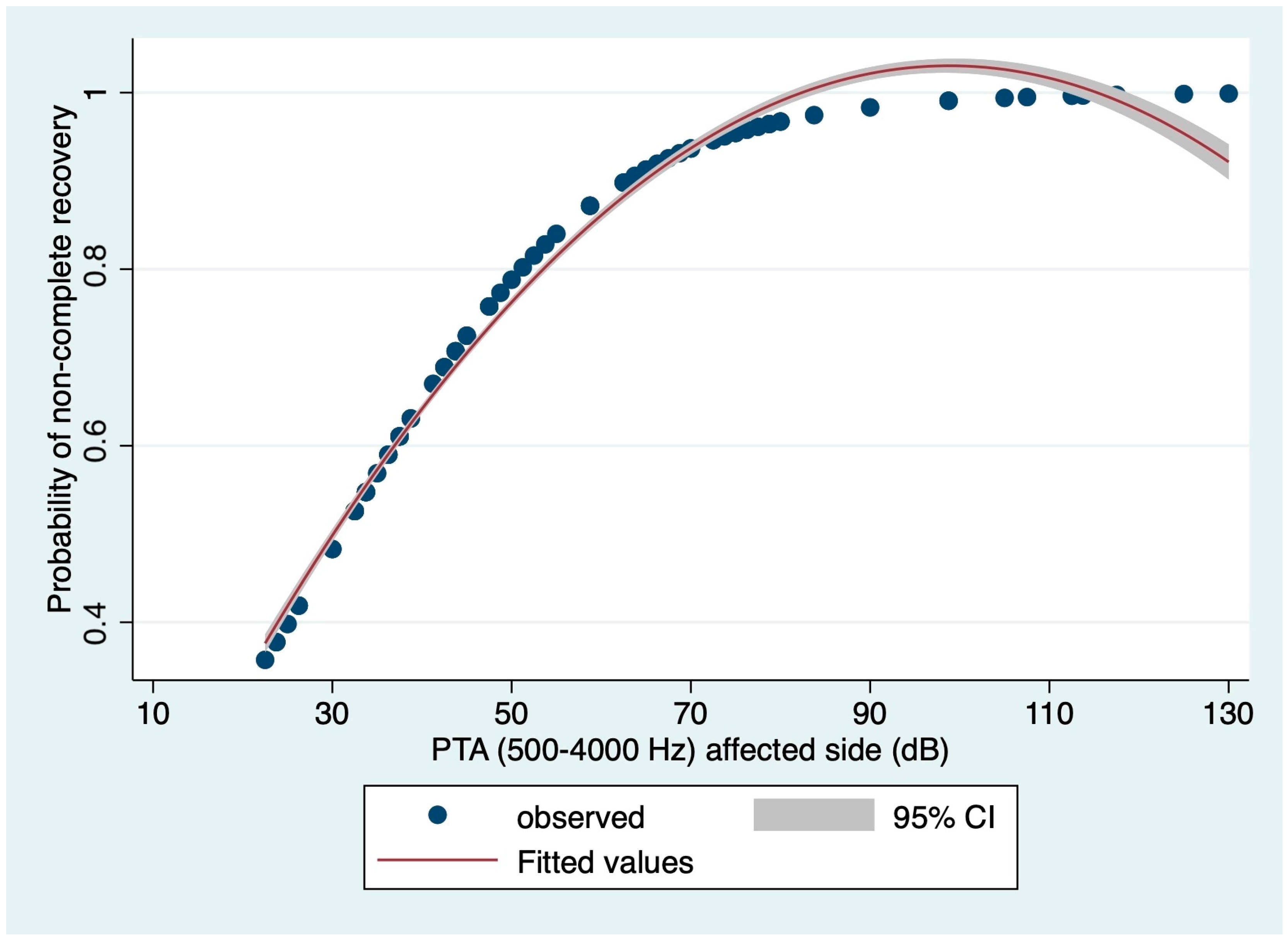
Background and Objectives: Although different hypotheses have been proposed over time, there is a dearth of information on factors able to predict the response to treatment for idiopathic sudden sensorineural hearing loss (ISSNHL) and hearing recovery. The aim of this study was to apply univariate and multivariate statistical models in a retrospective clinical setting of patients given therapy for ISSNHL at our tertiary academic audiological centers to investigate the prognostic value of clinical signs, symptoms, and comorbidities in relation to hearing recovery. Materials and Methods: The inclusion criteria were: history of ISSNHL diagnosed and treated at the Padova or Modena tertiary academic audiological centers; age ≥ 18 years; availability of clinical and audiological outcome data. The exclusion criteria were: hearing loss in acoustic schwannoma, endolymphatic hydrops, meningitis, trauma (head trauma, temporal bone fracture, acoustic trauma), barotrauma, perilymphatic fistula; exposure to noise levels ≥ 80 dB in the work environment; any unilateral or bilateral hearing loss (except for presbycusis) prior to ISSNHL diagnosis; any disorders affecting the external or middle ear; any previous ear surgery; refusal to make medical data available for research purposes. Eighty-six consecutive patients (38 females, 48 males; median age: 58 years; interquartile range: 47.00–69.00 years) were included. A systemic steroid therapy was administered to all patients, either orally with prednisone or intravenously with methylprednisolone. Second-line therapy included intratympanic steroid injections and/or hyperbaric oxygen therapy. Results: A multivariate logistic regression model was used, including the non-multicollinear clinical and audiological variables, which showed a p-value < 0.10 at the univariate analyses (namely age at diagnosis, time to diagnosis, oral steroid dose, and PTA on the affected side). Only PTA on the affected side retained its statistical significance (OR: 1.0615, 95% CI: 1.0185–1.1063, p = 0.005). Conclusions: The analysis of our data showed an association between the hearing threshold before treatment and the recovery from ISSNHL. Further studies on larger cohorts (especially in a prospective setting) are needed to shed more light on the prognostic role of clinical parameters in patients with ISSNHL. In a correct counseling setting, with regard to the patient’s concern about not being able to recover hearing, it is important to offer perspectives of appropriate hearing rehabilitation approaches.
Keywords: sudden; sensorineural hearing loss; idiopathic; prognosis; treatment sudden; sensorineural hearing loss; idiopathic; prognosis; treatment