


Social Inhibition and Depressive Symptoms among Couples with Children with Autism Spectrum Disorder: The Mediating Role of Perceived Family Support


 ,
,  ,
, 
Abstract
1. Introduction
2. Materials and Methods
2.1. Participants
2.2. Study Measures
2.2.1. Demographic Data on Parents’ and Children’s Demographic Information
2.2.2. Inventory for Interpersonal Problems (IIP)—Social Inhibition Subscale
2.2.3. Multidimensional Scale for Perceived Social Support (MSPSS)—Family Support Subscale
2.2.4. Core Symptom Index (CSI)—Depression Subscale
2.3. Statistical Analysis
3. Results
3.1. Sociodemographic Results
3.2. Correlation Results
3.3. APIMeM Analysis Results (Standardized Estimates)
4. Discussion
4.1. Research Implication
4.2. Clinical Implication
4.3. Limitations
5. Conclusions
Supplementary Materials
Author Contributions
Funding
Institutional Review Board Statement
Informed Consent Statement
Data Availability Statement
Acknowledgments
Conflicts of Interest
References
- First, M.B. DSM-5® Handbook of Differential Diagnosis; American Psychiatric Pub: Washington, DC, USA, 2013. [Google Scholar]
- Cohrs, A.C.; Leslie, D.L. Depression in Parents of Children Diagnosed with Autism Spectrum Disorder: A Claims-Based Analysis. J. Autism Dev. Disord. 2017, 47, 1416–1422. [Google Scholar] [CrossRef] [Scilit] [PubMed]
- Chan, K.K.S.; Leung, D.C.K. Linking child autism to parental depression and anxiety: The mediating roles of enacted and felt stigma. J. Autism Dev. Disord. 2021, 51, 527–537. [Google Scholar] [CrossRef] [Scilit] [PubMed]
- Wang, L.; Li, D.; Pan, S.; Zhai, J.; Xia, W.; Sun, C.; Zou, M. The relationship between 2019-nCoV and psychological distress among parents of children with autism spectrum disorder. Glob. Health 2021, 17, 23. [Google Scholar] [CrossRef] [Scilit] [PubMed]
- Karst, J.S.; Van Hecke, A.V. Parent and family impact of autism spectrum disorders: A review and proposed model for intervention evaluation. Clin. Child Fam. Psychol. Rev. 2012, 15, 247–277. [Google Scholar] [CrossRef] [Scilit] [PubMed]
- Zhao, M.; You, Y.; Chen, S.; Li, L.; Du, X.; Wang, Y. Effects of a Web-Based Parent-Child Physical Activity Program on Mental Health in Parents of Children with ASD. Int. J. Environ. Res. Public Health 2021, 18, 12913. [Google Scholar] [CrossRef] [Scilit]
- Bitsika, V.; Sharpley, C.F. Stress, anxiety and depression among parents of children with autism spectrum disorder. J. Psychol. Couns. Sch. 2004, 14, 151–161. [Google Scholar] [CrossRef] [Scilit]
- Wanxing, O.; Caihui, C.; Linghua, W. Mental health state of parents of children with autism. Chin. J. Contemp. Pediatr. 2010, 12, 947–949. [Google Scholar]
- Olsson, M.B.; Hwang, C.P. Depression in mothers and fathers of children with intellectual disability. J. Intellect. Disabil. Res. 2001, 45, 535–543. [Google Scholar] [CrossRef] [Scilit]
- Lin, L. A Study on Life Adaptation and Social Participation of Parents of Children with Autism. Master’s Thesis, Institute of Youth and Child Welfare, Cultural University, Taipei, China, 2010. [Google Scholar]
- Zhang, S.; Cao, Y.; Zheng, M.; Yao, X. Effects of narrative psychotherapy on quality of life and mental health of parents of children with autism. Chin. Trop. Med. 2015, 15, 962–965. [Google Scholar]
- Duijndam, S.; Karreman, A.; Denollet, J.; Kupper, N. Emotion regulation in social interaction: Physiological and emotional responses associated with social inhibition. Int. J. Psychophysiol. Off. J. Int. Organ. Psychophysiol. 2020, 158, 62–72. [Google Scholar] [CrossRef] [Scilit]
- Wongpakaran, N.; Wongpakaran, T.; van Reekum, R. Social inhibition as a mediator of neuroticism and depression in the elderly. BMC Geriatr. 2012, 12, 41. [Google Scholar] [CrossRef] [Scilit] [PubMed]
- Parker, G.; Hadzi-Pavlovic, D.; Brodaty, H.; Boyce, P.; Mitchell, P.; Wilhelm, K.; Hickie, I.; Eyers, K. Psychomotor disturbance in depression: Defining the constructs. J. Affect. Disord. 1993, 27, 255–265. [Google Scholar] [CrossRef] [Scilit] [PubMed]
- Crawford, J.G.; Parker, G.B.; Malhi, G.S.; Mitchell, P.B.; Wilhelm, K.; Proudfoot, J. Social inhibition and treatment-resistant depression. Pers. Ment. Health 2007, 1, 62–73. [Google Scholar] [CrossRef] [Scilit]
- Alden, L.E.; Bieling, P.J. Interpersonal convergence of personality constructs in dynamic and cognitive models of depression. J. Res. Personal. 1996, 30, 60–75. [Google Scholar] [CrossRef] [Scilit]
- Pearson, K.A.; Watkins, E.R.; Mullan, E.G. Submissive interpersonal style mediates the effect of brooding on future depressive symptoms. Behav. Res. Ther. 2010, 48, 966–973. [Google Scholar] [CrossRef] [Scilit] [PubMed]
- Pattini, E.; Carnevali, L.; Troisi, A.; Matrella, G.; Rollo, D.; Fornari, M.; Sgoifo, A. Psychological characteristics and physiological reactivity to acute stress in mothers of children with autism spectrum disorder. Stress Health 2019, 35, 421–431. [Google Scholar] [CrossRef] [Scilit] [PubMed]
- Wongpakaran, T.; Wongpakaran, N. Personality traits influencing somatization symptoms and social inhibition in the elderly. Clin. Interv. Aging 2014, 9, 111–118. [Google Scholar] [CrossRef] [Scilit]
- Wenjun, G.; Mengjuan, H.; Cheng, L. The effect of parental discrimination perception on intergroup relationship in children with autism: A moderated mediation model. Psychol. Dev. Educ. 2021, 37, 854–863. [Google Scholar]
- Treffers, E.; Duijndam, S.; Schiffer, A.S.; Scherders, M.J.; Habibović, M.; Denollet, J. Validity of the 15-item social inhibition questionnaire in outpatients receiving psychological or psychiatric treatment: The association between social inhibition and affective symptoms. Gen. Hosp. Psychiatry 2021, 73, 1–8. [Google Scholar] [CrossRef] [Scilit]
- Dunn, M.E.; Burbine, T.; Bowers, C.A.; Tantleff-Dunn, S. Moderators of stress in parents of children with autism. Community Ment. Health J. 2001, 37, 39–52. [Google Scholar] [CrossRef] [Scilit]
- Manor-Binyamini, I.; Shoshana, A. Listening to Bedouin Mothers of Children with Autism. Cult. Med. Psychiatry 2018, 42, 401–418. [Google Scholar] [CrossRef] [Scilit]
- Levens, S.M.; Elrahal, F.; Sagui, S.J. The role of family support and perceived stress reactivity in predicting depression in college freshman. J. Soc. Clin. Psychol. 2016, 35, 342–355. [Google Scholar] [CrossRef] [Scilit]
- Ha, J.H.; Greenberg, J.S.; Seltzer, M.M. Parenting a Child with a Disability: The Role of Social Support for African American Parents. Fam. Soc. J. Contemp. Hum. Serv. 2011, 92, 405–411. [Google Scholar] [CrossRef] [Scilit] [PubMed]
- Johnson, J.E.; Esposito-Smythers, C.; Miranda, R., Jr.; Rizzo, C.J.; Justus, A.N.; Clum, G. Gender, social support, and depression in criminal justice-involved adolescents. Int. J. Offender Ther. Comp. Criminol. 2011, 55, 1096–1109. [Google Scholar] [CrossRef] [Scilit] [PubMed]
- Ang, K.Q.P.; Loh, P.R. Mental Health and Coping in Parents of Children with Autism Spectrum Disorder (ASD) in Singapore: An Examination of Gender Role in Caring. J. Autism Dev. Disord. 2019, 49, 2129–2145. [Google Scholar] [CrossRef] [Scilit] [PubMed]
- Zhu, Y. Language representation of the level of depression: The mediating role of negative cognitive processing bias and perceived social support. Master’s Thesis, Guangzhou University, Guangzhou, China, 2020. [Google Scholar]
- Scheepers, E.R.M.; de Rooij, B.H.; Pijnenborg, J.M.A.; van Huis-Tanja, L.H.; Ezendam, N.P.M.; Hamaker, M.E. Perceived social support in patients with endometrial or ovarian cancer: A secondary analysis from the ROGY care study. Gynecol. Oncol. 2021, 160, 811–816. [Google Scholar] [CrossRef] [Scilit] [PubMed]
- Kalsoom, U.; Hanifa, B. Depression, anxiety, psychosomatic symptoms, and perceived social support in type D and non-type D individuals. Iran. J. Psychiatry Clin. Psychol. 2021, 27, 92–103. [Google Scholar] [CrossRef] [Scilit]
- Ledermann, T.; Macho, S.; Kenny, D.A. Assessing mediation in dyadic data using the actor-partner interdependence model. Struct. Equ. Model. A Multidiscip. J. 2011, 18, 595–612. [Google Scholar] [CrossRef] [Scilit]
- Horowitz, L.M.; Rosenberg, S.E.; Baer, B.A.; Ureño, G.; Villaseñor, V.S. Inventory of interpersonal problems: Psychometric properties and clinical applications. J. Consult. Clin. Psychol. 1988, 56, 885–892. [Google Scholar] [CrossRef]
- Sun, Q.-W.; Jiang, G.-R.; Zhang, Q.-J. A report on the application of Inventory of Interpersonal Problems (IIP-32) to 1498 college students. Chin. J. Clin. Psychol. 2010, 18, 466–468. [Google Scholar]
- Zimet, G.D.; Dahlem, N.W.; Zimet, S.G.; Farley, G.K. The multidimensional scale of perceived social support. J. Personal. Assess. 1988, 52, 30–41. [Google Scholar] [CrossRef] [Scilit]
- Ng, S.S.M.; Liu, T.W.; Ho, L.Y.W.; Chan, N.H.; Wong, T.W.L.; Tsoh, J. Assessing the level of perceived social support among community-dwelling stroke survivors using the Multidimensional Scale of Perceived Social Support. Sci. Rep. 2022, 12, 19318. [Google Scholar] [CrossRef] [Scilit]
- Wongpakaran, N.; Wongpakaran, T.; Lertkachatarn, S.; Sirirak, T.; Kuntawong, P. Core Symptom Index (CSI): Testing for bifactor model and differential item functioning. Int. Psychogeriatr. 2019, 31, 1769–1779. [Google Scholar] [CrossRef] [Scilit]
- Hayes, A.F. Introduction to Mediation, Moderation, and Conditional Process Analysis: A Regression-Based Approach, 3rd ed.; The Guilford Press: New York, NY, USA, 2022. [Google Scholar]
- Wang, R. Mental Health Status of Mothers of Autistic Children and Their Relationship with Emotional Resilience and Social Support. Adv. Psychol. 2023, 13, 338–345. [Google Scholar]
- Cox, M.J.; Paley, B. Families as systems. Annu. Rev. Psychol. 1997, 48, 243–267. [Google Scholar] [CrossRef] [Scilit]
- Hu, X.; Han, Z.R.; Bai, L.; Gao, M.M. The mediating role of parenting stress in the relations between parental emotion regulation and parenting behaviors in Chinese families of children with autism spectrum disorders: A dyadic analysis. J. Autism. Dev. Disord. 2019, 49, 3983–3998. [Google Scholar] [CrossRef] [Scilit]
- Wang, H.; Hu, X.; Han, Z.R. Parental stress, involvement, and family quality of life in mothers and fathers of children with autism spectrum disorder in mainland China: A dyadic analysis. Res. Dev. Disabil. 2020, 107, 103791. [Google Scholar] [CrossRef] [Scilit] [PubMed]
- Ozturk, Y.; Riccadonna, S.; Venuti, P. Parenting dimensions in mothers and fathers of children with Autism Spectrum Disorders. Res. Autism Spectr. Disord. 2014, 8, 1295–1306. [Google Scholar] [CrossRef] [Scilit]
- Robinson, C.A.; York, K.; Rothenberg, A.; Bissell, L.J. Parenting a child with Asperger’s syndrome: A balancing act. J. Child Fam. Stud. 2015, 24, 2310–2321. [Google Scholar] [CrossRef] [Scilit]
- Ekas, N.V.; Timmons, L.; Pruitt, M.; Ghilain, C.; Alessandri, M. The Power of Positivity: Predictors of Relationship Satisfaction for Parents of Children with Autism Spectrum Disorder. J. Autism. Dev. Disord. 2015, 45, 1997–2007. [Google Scholar] [CrossRef] [Scilit]
- Xu, J. The Roles of Family and School Members in Influencing Children’s Eating Behaviours in China: A Narrative Review. Children 2022, 9, 315. [Google Scholar] [CrossRef] [Scilit] [PubMed]
- Ma, J.L.C.; Lai, K.Y.C. Paternal and Maternal Experiences in Caring for Chinese Children with Attention Deficit Hyperactivity Disorder in Hong Kong. Asian Soc. Work. Policy Rev. 2016, 10, 185–199. [Google Scholar] [CrossRef] [Scilit]
- Yirmiya, N.; Shaked, M. Psychiatric disorders in parents of children with autism: A meta-analysis. J. Child Psychol. Psychiatry 2005, 46, 69–83. [Google Scholar] [CrossRef] [Scilit] [PubMed]
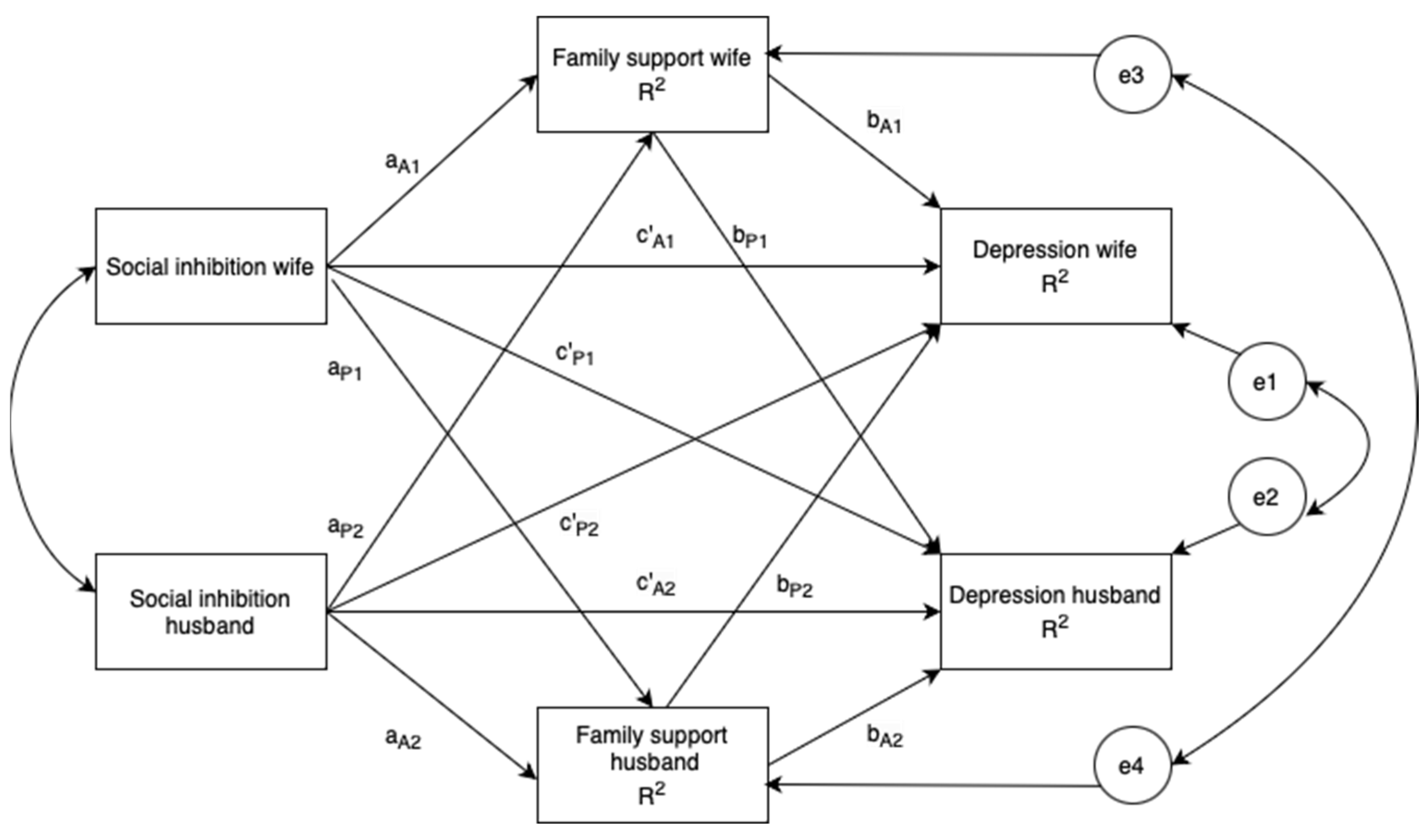

| Actor Effect (Individual’s social inhibition → individual’s depression) | |||
| Wife | Total effect | aA1 × bA1 + aP1 × bP2 + c’A1 | Wife actor TE |
| Indirect effect | aA1 × bA1 + aP1 × bP2 | Wife actor total IE | |
| Actor–actor simple IE | aA1 × bA1 | Wife actor–actor IE | |
| Partner–partner simple IE | aP1 × bP2 | Wife partner–partner IE | |
| Direct effect | c’A1 | Wife actor direct effect | |
| Husband | Total effect | aA2 × bA2 + aP2 × bP1 + c’A2 | Husband actor TE |
| Total IE | aA2 × bA2 + aP2 × bP1 | Husband actor total IE | |
| Actor–actor simple IE | aA2 × bA2 | Husband actor–actor IE | |
| Partner–partner simple IE | aP2 × bP1 | Husband partner–partner IE | |
| Direct effect | c’A2 | Husband actor direct effect | |
| Partner Effect (Individual’s social inhibition → partner’s depression) | |||
| Wife | Total effect | aA1 × bP1 +aP1 × bA2 + c’P2 | Wife partner TE |
| Total IE | aA1 × bP1 +aP1 × bA2 | Wife partner total IE | |
| Actor–actor simple IE | aA1 × bP1 | Wife actor–partner IE | |
| Partner–actor simple IE | aP1 × bA2 | Wife partner–actor IE | |
| Direct effect | c’P2 | Wife partner direct effect | |
| Husband | Total effect | aA2 × bP2 + aP2 × bA1 + c’P1 | Husband partner TE |
| Indirect effect | aA2 × bP2 + aP2 × bA1 | Husband partner total IE | |
| Actor–partner simple IE | aA2 × bP2 | Husband actor–partner IE | |
| Partner–actor simple IE | aP2 × bA1 | Husband partner–actor IE | |
| Direct effect | c’P1 | Husband partner direct effect | |
| Variable | Family (n = 794) | Wives (n = 397) | Husbands (n = 397) | Test Difference |
|---|---|---|---|---|
| Age (years), mean (SD) | 35.35 (3.07) | 36.33 (3.36) | t = 4.29, p < 0.001 | |
| Number of children n (%) | ||||
| 1 | 284 (71.5) | |||
| 2 | 112 (28.2) | |||
| 3 | 1 (0.3) | |||
| Educational background n (%) | χ2 (4) = 15.89, p = 0.003 | |||
| Elementary | 3 (0.8) | 4 (1) | ||
| Junior high school | 62 (15.7) | 28 (7.1) | ||
| High school | 157 (39.6) | 157 (39.6) | ||
| Bachelor’s | 171 (43.2) | 204 (51.5) | ||
| Master’s | 3 (0.8) | 3(0.8) | ||
| Occupation n (%) | χ2 (1) = 45.80, p < 0.001 | |||
| Unemployed or housekeeper | 46 (11.6) | 1 (0.3) | ||
| Employed | 351 (88.4) | 396 (99.7) | ||
| Living area n (%) | ||||
| Urban | 271 (68.3) | |||
| Rural | 126 (31.7) | |||
| Monthly income a (CNY) n (%) | χ2 (3) = 119.57, p < 0.001 | |||
| 0–3000 | 71 (18) | 7 (1.8) | ||
| 3001–6000 | 205 (52) | 142 (35.8) | ||
| 6001–10,000 | 112 (28.4) | 202 (50.9) | ||
| >10,000 | 6 (1.5) | 45 (11.3) | ||
| Family’s monthly earnings (CNY) n (%) | χ2 (3) = 0.25, p = 0.969 | |||
| 0–5000 | 3 (0.8) | |||
| 5001–10,000 | 158 (39.8) | |||
| 10,001–15,000 | 105 (26.4) | |||
| >15,000 | 131 (33.0) | |||
| Childcare expenses for child(ren) with ASD (CNY/year) n (%) | χ2 (3) = 0.04, p = 0.998 | |||
| None | 15 (3.8) | |||
| 1–30,000 | 324 (81.6) | |||
| 30,001–60,000 | 49 (12.3) | |||
| >60,000 | 9 (2.3) | |||
| Time spent caretaking for children each day (hours) n (%) | χ2 (3) = 176.66, p < 0.001 | |||
| 0–3 | 40 (10.1) | 176 (44.3) | ||
| 6–8 | 165 (41.7) | 174 (43.8) | ||
| 9–10 | 119 (30.1) | 38 (9.6) | ||
| >10 | 72 (18.2) | 9 (2.3) | ||
| Duration of marriage (years) n (%) | χ2 (3) = 0.27, p = 0.965 | |||
| 3–5 | 4 (1) | 3 (0.8) | ||
| 6–8 | 5 (1.3) | 4 (1) | ||
| 9–10 | 39 (9.8) | 39 (9.8) | ||
| >10 | 349 (87.9) | 351 (88.4) |
| Variables | Wives (M ± SD) | Husbands (M ± SD) | Test Difference |
|---|---|---|---|
| Social inhibition | 6.26 (3.06) | 6.21 (3.20) | t = −0.23, p = 0.821 |
| Perceived family support | 18.03 (3.77) | 18.14 (3.60) | t = 0.45, p = 0.656 |
| Depressive symptoms | 1.40 (0.89) | 1.20 (0.88) | t = −3.21, p = 0.001 |
| Variable | 1 | 2 | 3 | 4 | 5 | 6 |
|---|---|---|---|---|---|---|
| 1. Wives’ social inhibition | - | |||||
| 2. Husbands’ social inhibition | 0.06 | - | ||||
| 3. Wives’ perceived family support | −0.154 ** | 0.01 | - | |||
| 4. Husbands’ perceived family support | 0.01 | −0.154 ** | 0.092 ** | - | ||
| 5. Wives’ depression | 0.338 ** | 0.071 * | −0.310 ** | −0.077 * | - | |
| 6. Husbands’ depression | 0.069 | 0.405 ** | −0.109 ** | −0.311 ** | 0.257 ** | - |
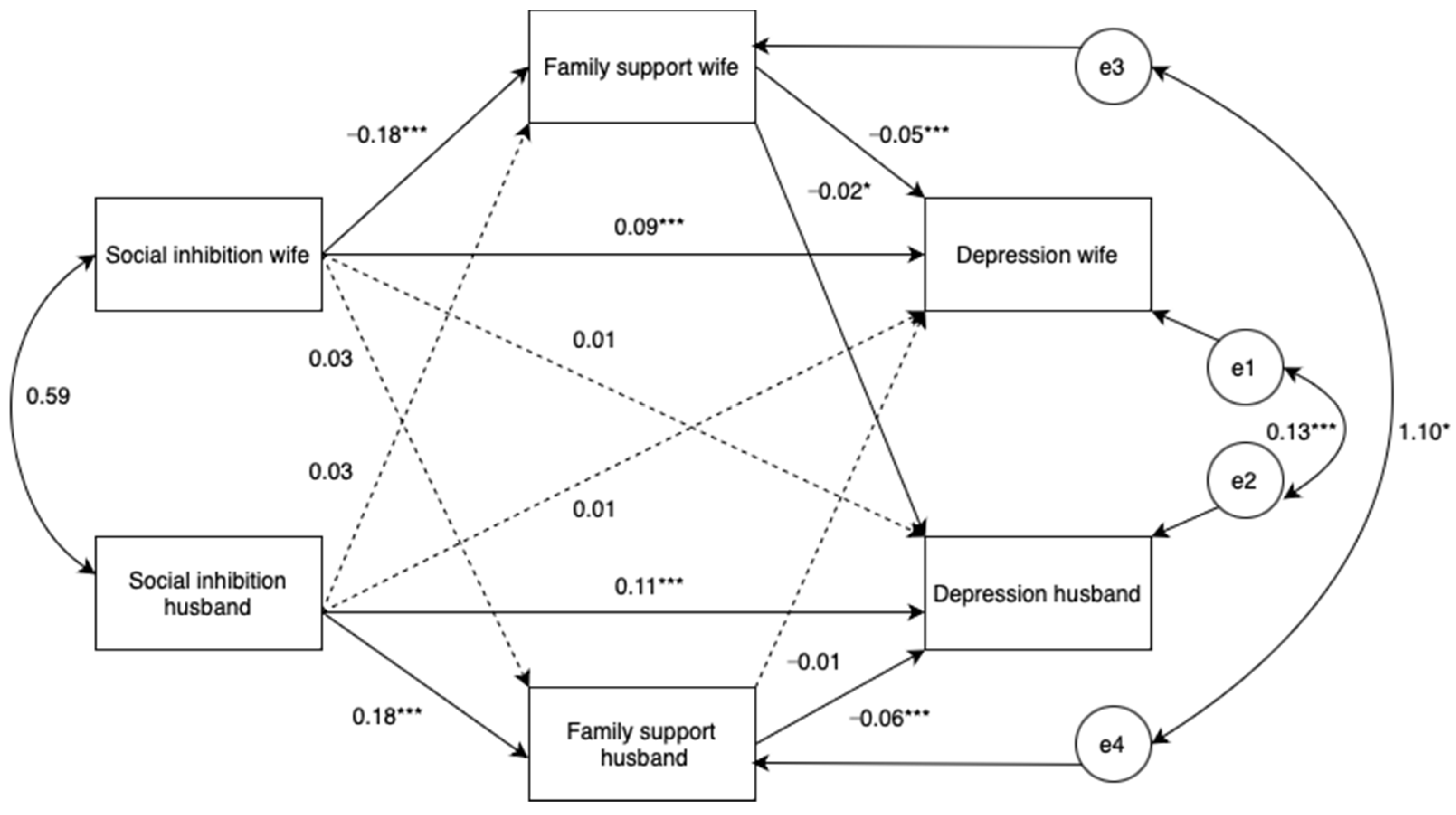
| Actor Effect (Individual’s social inhibition → individual’s depression) | ||||
| coefficient | 95% CI | p value | ||
| Wife | Total effect | 0.095 | (0.071, 0.117) | 0.001 |
| Indirect effect | 0.009 | (0.004, 0.017) | <0.001 | |
| Actor–actor simple IE | 0.010 | (0.004, 0.017) | <0.001 | |
| Partner–partner simple IE | 0.000 | (−0.002, 0.000) | 0.317 | |
| Direct effect | 0.086 | (0.062, 0.108) | 0.001 | |
| Husband | Total effect | 0.118 | (0.095, 0.141) | <0.001 |
| Total IE | 0.010 | (0.004, 0.018) | 0.001 | |
| Actor–actor simple IE | 0.010 | (0.005, 0.018) | <0.001 | |
| Partner–partner simple IE | 0.000 | (−0.003, 0.001) | 0.371 | |
| Direct effect | 0.108 | (0.084, 0.131) | <0.001 | |
| Partner Effect (Individual’s social inhibition → partner’s depression) | ||||
| Wife | Total effect | 0.012 | (−0.009, 0.031) | 0.259 |
| Total IE | 0.002 | (−0.005, 0.008) | 0.577 | |
| Actor–actor simple IE | 0.003 | (0.001, 0.008) | 0.018 | |
| Partner–actor simple IE | −0.002 | (−0.007, 0.003) | 0.506 | |
| Direct effect | 0.010 | (−0.010, 0.030) | 0.317 | |
| Husband | Total effect | 0.012 | (−0.009, 0.033) | 0.248 |
| Indirect effect | 0.000 | (−0.005, 0.006) | 0.833 | |
| Actor–partner simple IE | 0.002 | (−0.001, 0.006) | 0.139 | |
| Partner–actor simple IE | −0.001 | (−0.007, 0.003) | 0.514 | |
| Direct effect | 0.012 | (−0.009, 0.032) | 0.237 | |
Disclaimer/Publisher’s Note: The statements, opinions and data contained in all publications are solely those of the individual author(s) and contributor(s) and not of MDPI and/or the editor(s). MDPI and/or the editor(s) disclaim responsibility for any injury to people or property resulting from any ideas, methods, instructions or products referred to in the content. |
© 2024 by the authors. Licensee MDPI, Basel, Switzerland. This article is an open access article distributed under the terms and conditions of the Creative Commons Attribution (CC BY) license (https://creativecommons.org/licenses/by/4.0/).
Share and Cite
Pan, T.; Wongpakaran, T.; Wongpakaran, N.; He, B.; Wedding, D. Social Inhibition and Depressive Symptoms among Couples with Children with Autism Spectrum Disorder: The Mediating Role of Perceived Family Support. Medicina 2024, 60, 488. https://doi.org/10.3390/medicina60030488
Pan T, Wongpakaran T, Wongpakaran N, He B, Wedding D. Social Inhibition and Depressive Symptoms among Couples with Children with Autism Spectrum Disorder: The Mediating Role of Perceived Family Support. Medicina. 2024; 60(3):488. https://doi.org/10.3390/medicina60030488
Chicago/Turabian StylePan, Ting, Tinakon Wongpakaran, Nahathai Wongpakaran, Bijing He, and Danny Wedding. 2024. "Social Inhibition and Depressive Symptoms among Couples with Children with Autism Spectrum Disorder: The Mediating Role of Perceived Family Support" Medicina 60, no. 3: 488. https://doi.org/10.3390/medicina60030488
APA StylePan, T., Wongpakaran, T., Wongpakaran, N., He, B., & Wedding, D. (2024). Social Inhibition and Depressive Symptoms among Couples with Children with Autism Spectrum Disorder: The Mediating Role of Perceived Family Support. Medicina, 60(3), 488. https://doi.org/10.3390/medicina60030488

