Article

Comparative Analysis of Psychophysiological Responses in Fibromyalgia Patients: Evaluating Neuromodulation Alone, Neuromodulation Combined with Virtual Reality, and Exercise Interventions

by
Alejandro Rubio-Zarapuz
1,
María Dolores Apolo-Arenas
2,3,
Pablo Tomas-Carus
4,5,
José Francisco Tornero-Aguilera
1,*,
Vicente Javier Clemente-Suárez
1,6 and
Jose A. Parraca
4,5,*
1
Faculty of Sports Sciences, Universidad Europea de Madrid, Tajo Street, s/n, 28670 Madrid, Spain
2
Department of Medical Surgical-Therapy, Faculty of Medicine and Health Sciences, Universidad de Extremadura, 06006 Badajoz, Spain
3
Research Group PhysioH, University of Extremadura, 06006 Badajoz, Spain
4
Departamento de Desporto e Saúde, Escola de Saúde e Desenvolvimento Humano, Universidade de Évora, 7004-516 Évora, Portugal
5
Comprehensive Health Research Centre (CHRC), University of Évora, 7004-516 Évora, Portugal
6
Grupo de Investigación en Cultura, Educación y Sociedad, Universidad de la Costa, Barranquilla 080002, Colombia
*
Authors to whom correspondence should be addressed.
Medicina 2024, 60(3), 404; https://doi.org/10.3390/medicina60030404

Submission received: 25 January 2024 / Revised: 9 February 2024 / Accepted: 21 February 2024 / Published: 27 February 2024
(This article belongs to the Special Issue Updates on Fibromyalgia Research)

Abstract

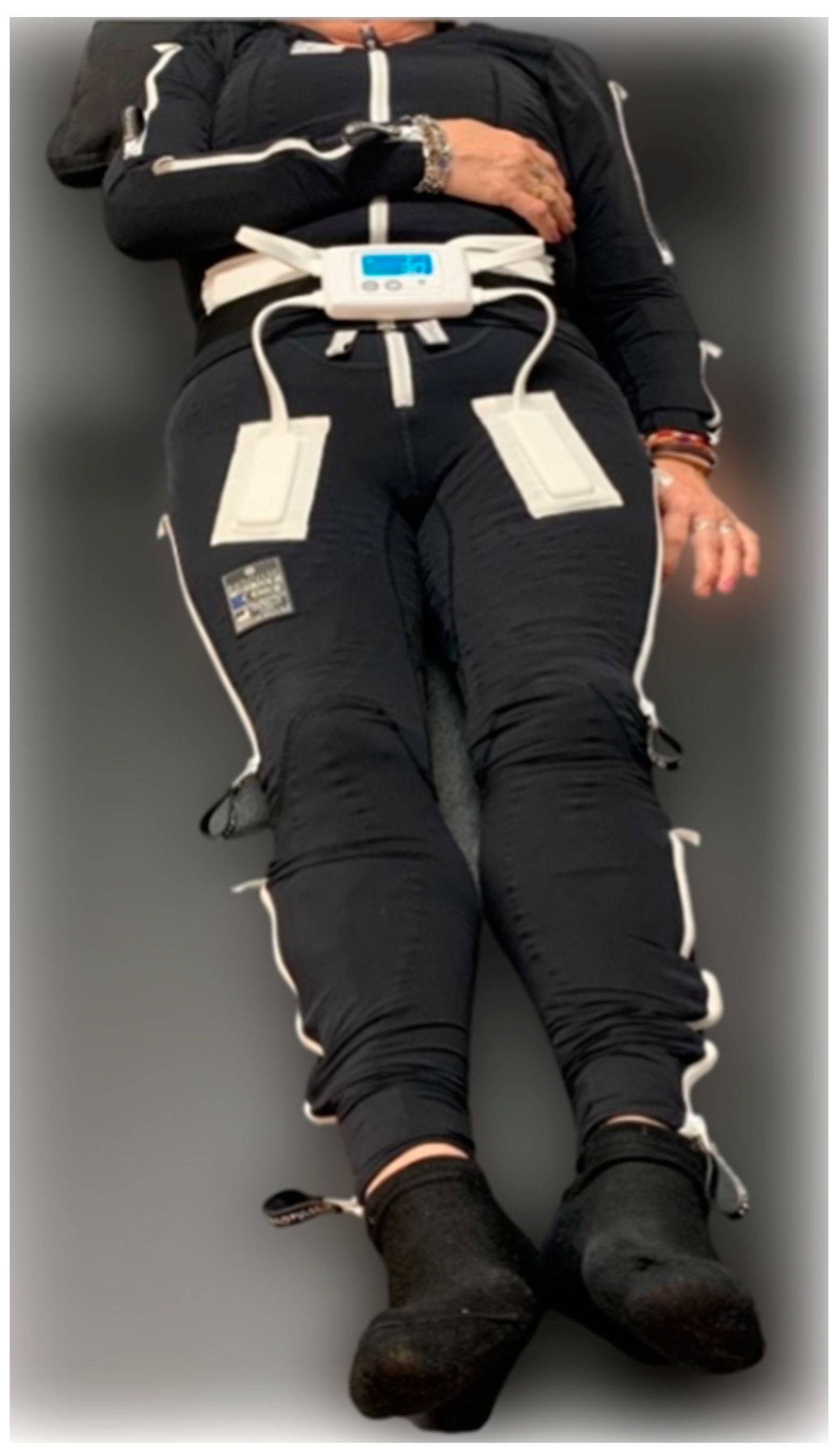
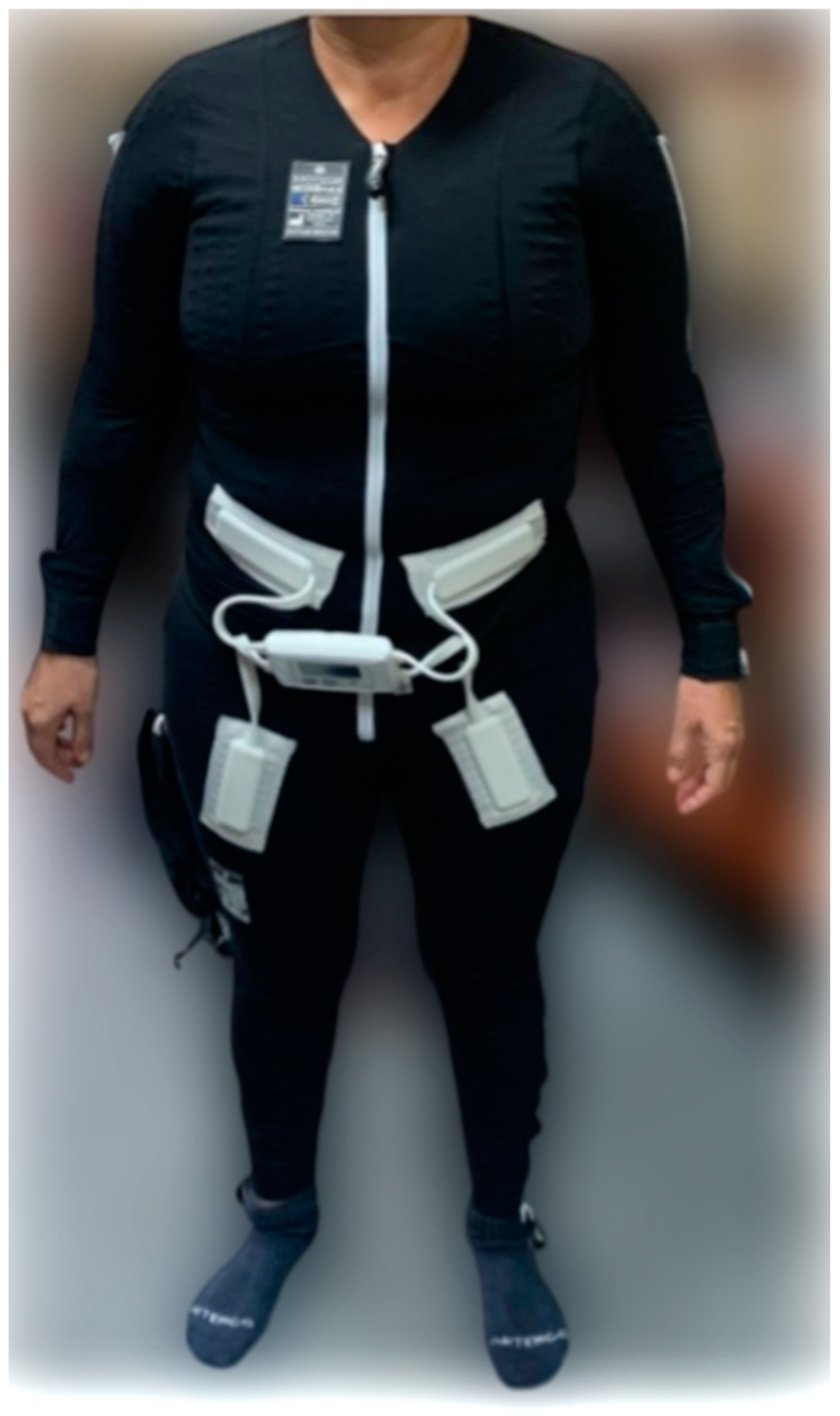
Background and Objectives: Fibromyalgia, a chronic condition, manifests as widespread musculoskeletal pain, fatigue, sleep disturbances, autonomic and cognitive dysfunction, hypersensitivity to stimuli, and various somatic and psychiatric symptoms. This study, a controlled and randomized experiment, aimed to evaluate and compare the immediate effects of different treatments on fibromyalgia patients. Materials and Methods: The treatments included the EXOPULSE Mollii suit, a combination of the EXOPULSE Mollii suit with a virtual reality (VR) protocol, and a physical exercise regimen. A cohort of 89 female fibromyalgia patients was randomly assigned to one of four groups: Control (n = 20), Suit only (n = 22), Suit combined with VR (n = 21), and Exercise (n = 26). Results: This study found notable differences across the groups in several key parameters. In the Control group, significant changes were observed in Forced Expiratory Volume (FEV 1/FEV 6), the Numeric Rating Scale (NRS) for pain, Pressure Pain Threshold (PPT) at the epicondyle, cortical arousal levels, the 10 m up-and-go test, and in all measured variables related to temperature and muscle oxygenation. For the group using the suit alone, there were significant differences noted in the NRS, the chair stand test, palm temperature, and all muscle oxygenation parameters. The Suit + VR group showed significant changes in the NRS, PPT at the knee, handgrip strength test, the 10 m up-and-go test, one-leg balance test with the right leg, muscle oxygen saturation (SmO2), deoxygenated hemoglobin (HHb), and oxygenated hemoglobin (O2Hb). Finally, the Exercise group exhibited significant differences in FEV 1/FEV 6, chest perimeter difference, NRS, PPT at both the epicondyle and knee, cortical arousal, the chair stand test, the 10-m up-and-go test, and in SmO2, HHb, and O2Hb levels. Conclusions: combining neuromodulation with VR and targeted exercise regimens can effectively alleviate fibromyalgia symptoms, offering promising avenues for non-pharmacological management.
Keywords: fibromyalgia innovations; pain modulation; virtual rehabilitation; exercise therapy; electrostimulation; pain management; psychophysiological assessment fibromyalgia innovations; pain modulation; virtual rehabilitation; exercise therapy; electrostimulation; pain management; psychophysiological assessment