Article

Time from Symptom Onset to Diagnosis and Treatment among Haematological Malignancies: Influencing Factors and Associated Negative Outcomes


by
Austėja Dapkevičiūtė
1,2,*,
Virginijus Šapoka
2,
Elena Martynova
3 and
Valdas Pečeliūnas
1,2
1
Haematology, Oncology and Transfusion Medicine Centre, Vilnius University Hospital Santaros Klinikos, Santariškių 2, LT-08661 Vilnius, Lithuania
2
Institute of Clinical Medicine, Vilnius University, Santariškių 2, LT-08661 Vilnius, Lithuania
3
Quantitative Psychology Program, University of Virginia, 485 McCormick Road Charlottesville, VA 22903, USA
*
Author to whom correspondence should be addressed.
Medicina 2019, 55(6), 238; https://doi.org/10.3390/medicina55060238

Submission received: 29 January 2019 / Revised: 17 May 2019 / Accepted: 30 May 2019 / Published: 3 June 2019

Abstract

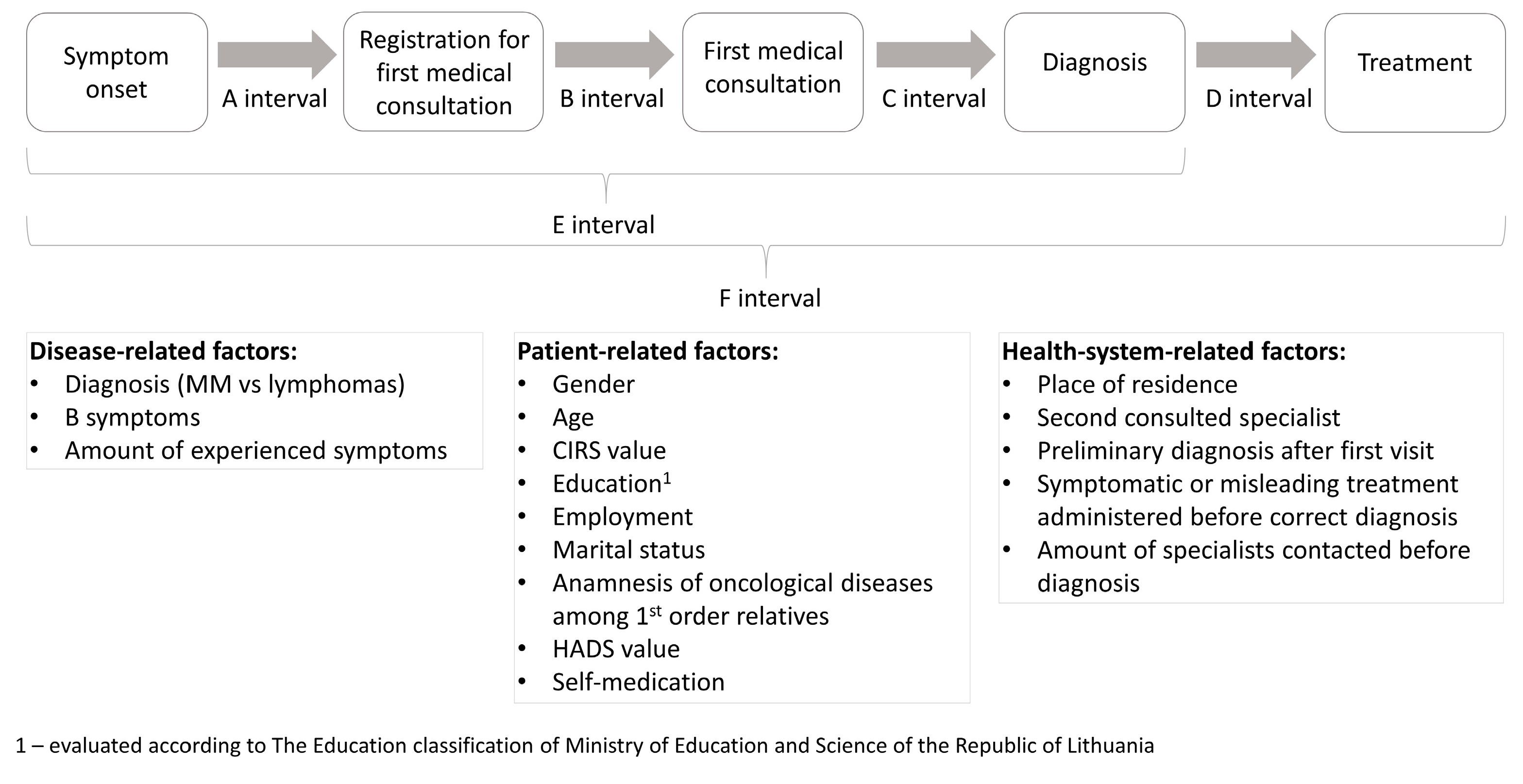
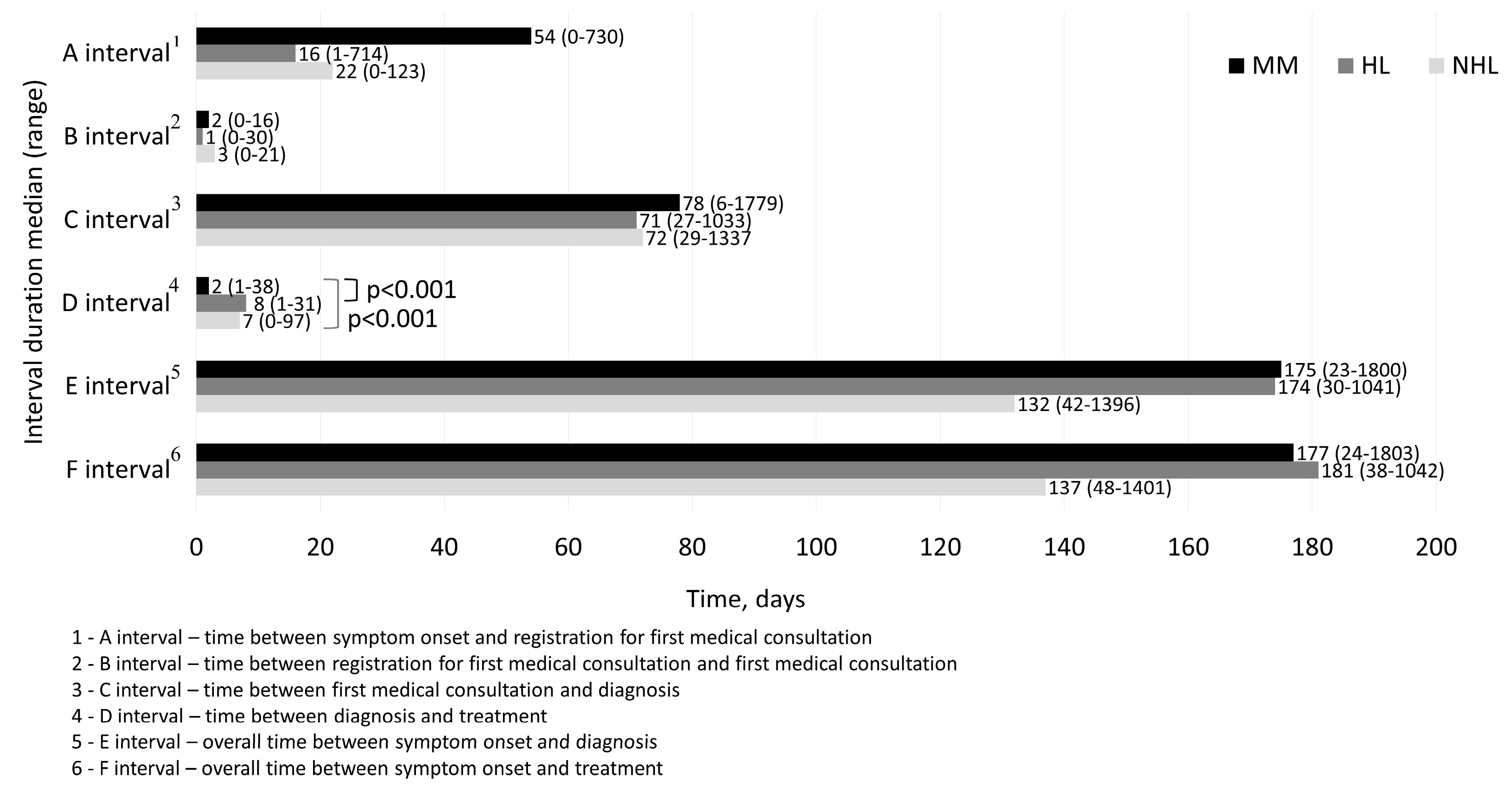
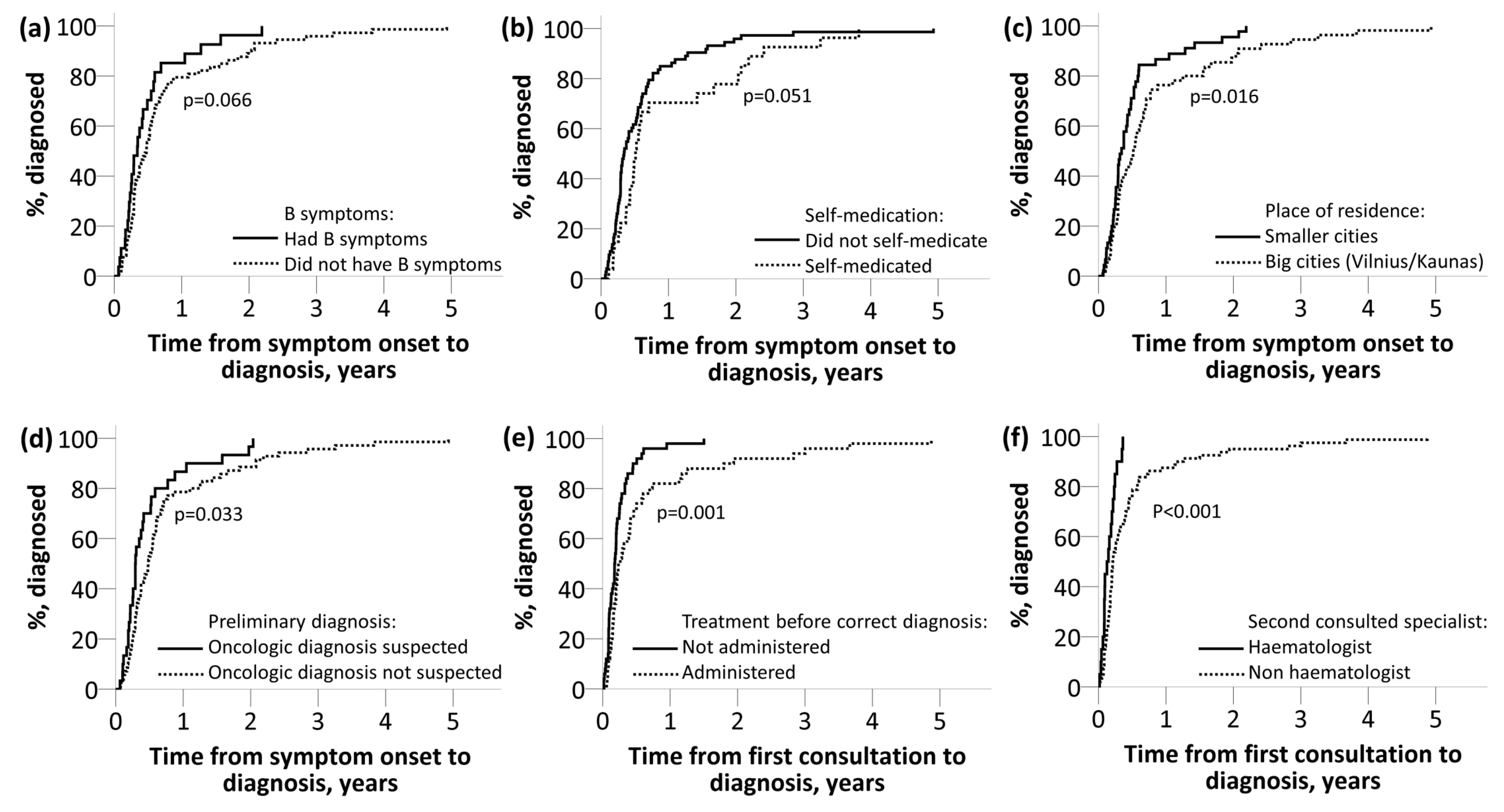
Background and objectives: Diagnostic delay causes unfavorable outcomes among cancer patients. It has been widely analyzed in solid tumors. However, data regarding hematological malignancies diagnostic delay are scarce. We aimed to evaluate diagnostic intervals, their influencing factors, and the negative effect on clinical outcomes among multiple myeloma and lymphoma patients. Materials and methods: One hundred patients diagnosed with multiple myeloma (n = 53) or lymphoma (n = 47) (ICD codes—C90, C81–C84) were asked to participate during their scheduled hematology consultations. Interval durations and the majority of influencing factors were assessed based on a face-to-face questionnaire. Data of disease characteristics were collected from medical records. Results: The median interval from symptom onset to registration for medical consultation was 30 (0–730) days, from registration to consultation 2 (0–30) days, from first consultation to diagnosis 73 (6–1779) days, and from diagnosis to treatment 5 (0–97) days. Overall time to diagnosis median was 151 (23–1800) days. Factors significantly prolonging diagnostic intervals in multivariate linear regression were living in big cities (p = 0.008), anxiety and depression (p = 0.002), self-medication (p = 0.019), and more specialists seen before diagnosis (p = 0.022). Longer diagnostic intervals resulted in higher incidences of multiple myeloma complications (p = 0.024) and more advanced Durie-Salmon stage (p = 0.049), but not ISS stage and Ann-Arbor staging systems for lymphomas. Conclusion: Median overall diagnostic delay was nearly 5 months, indicating that there is room for improvement. The most important factors causing delays were living in big cities, anxiety and depression, self-medication, and more specialists seen before diagnosis. Diagnostic delay may have a negative influence on clinical outcomes for multiple myeloma patients.
Keywords: diagnostic lagtime; diagnostic delay; multiple myeloma; Hodgkin lymphoma; Non-Hodgkin lymphoma diagnostic lagtime; diagnostic delay; multiple myeloma; Hodgkin lymphoma; Non-Hodgkin lymphoma