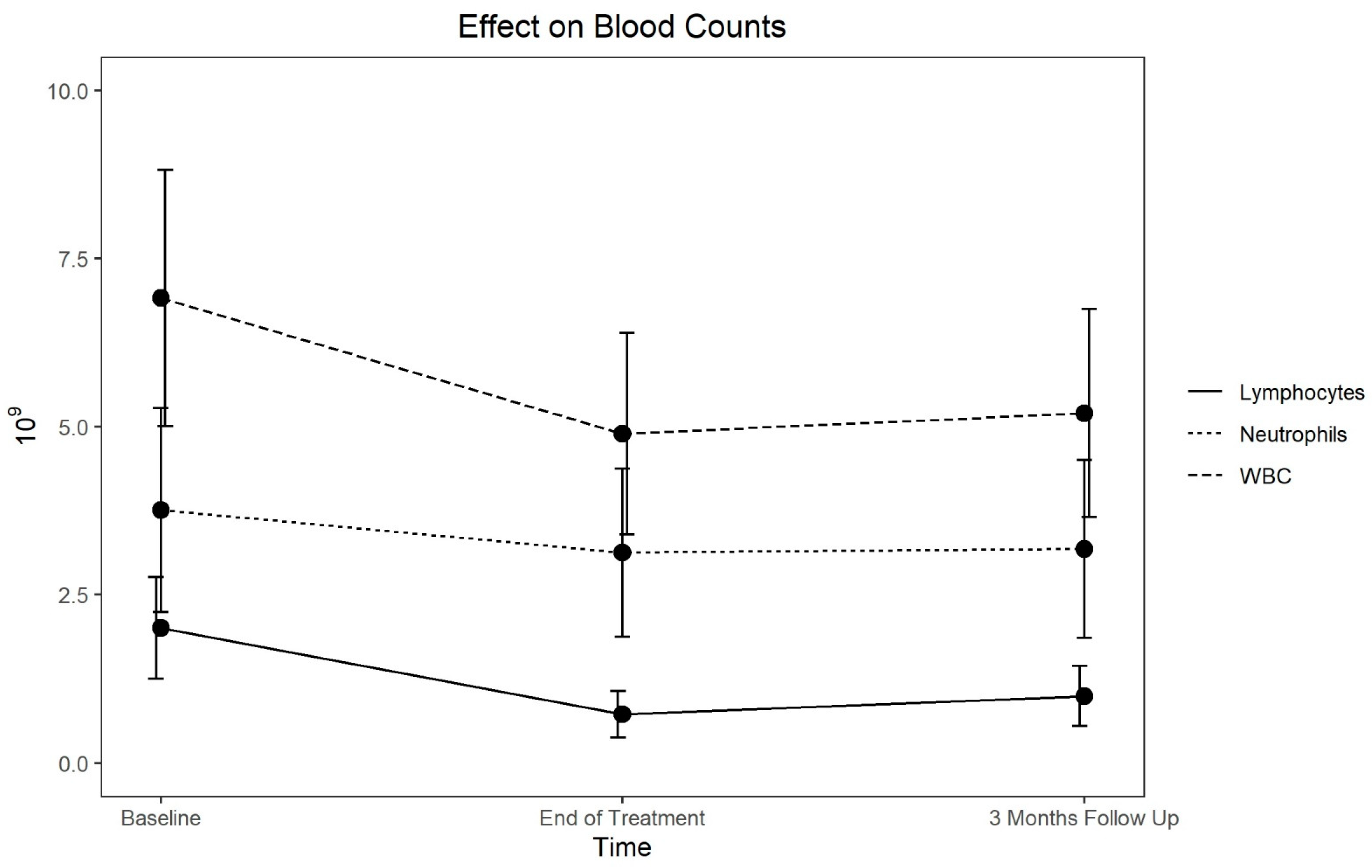

Reference Results for Blood Parameter Changes and Recovery after Pelvic Radiation without Chemotherapy

Abstract
Share and Cite
Swanson, G.P.; Hammonds, K.; Jhavar, S. Reference Results for Blood Parameter Changes and Recovery after Pelvic Radiation without Chemotherapy. Hematol. Rep. 2022, 14, 155-164. https://doi.org/10.3390/hematolrep14020023
Swanson GP, Hammonds K, Jhavar S. Reference Results for Blood Parameter Changes and Recovery after Pelvic Radiation without Chemotherapy. Hematology Reports. 2022; 14(2):155-164. https://doi.org/10.3390/hematolrep14020023
Chicago/Turabian StyleSwanson, Gregory P., Kendall Hammonds, and Sameer Jhavar. 2022. "Reference Results for Blood Parameter Changes and Recovery after Pelvic Radiation without Chemotherapy" Hematology Reports 14, no. 2: 155-164. https://doi.org/10.3390/hematolrep14020023
APA StyleSwanson, G. P., Hammonds, K., & Jhavar, S. (2022). Reference Results for Blood Parameter Changes and Recovery after Pelvic Radiation without Chemotherapy. Hematology Reports, 14(2), 155-164. https://doi.org/10.3390/hematolrep14020023