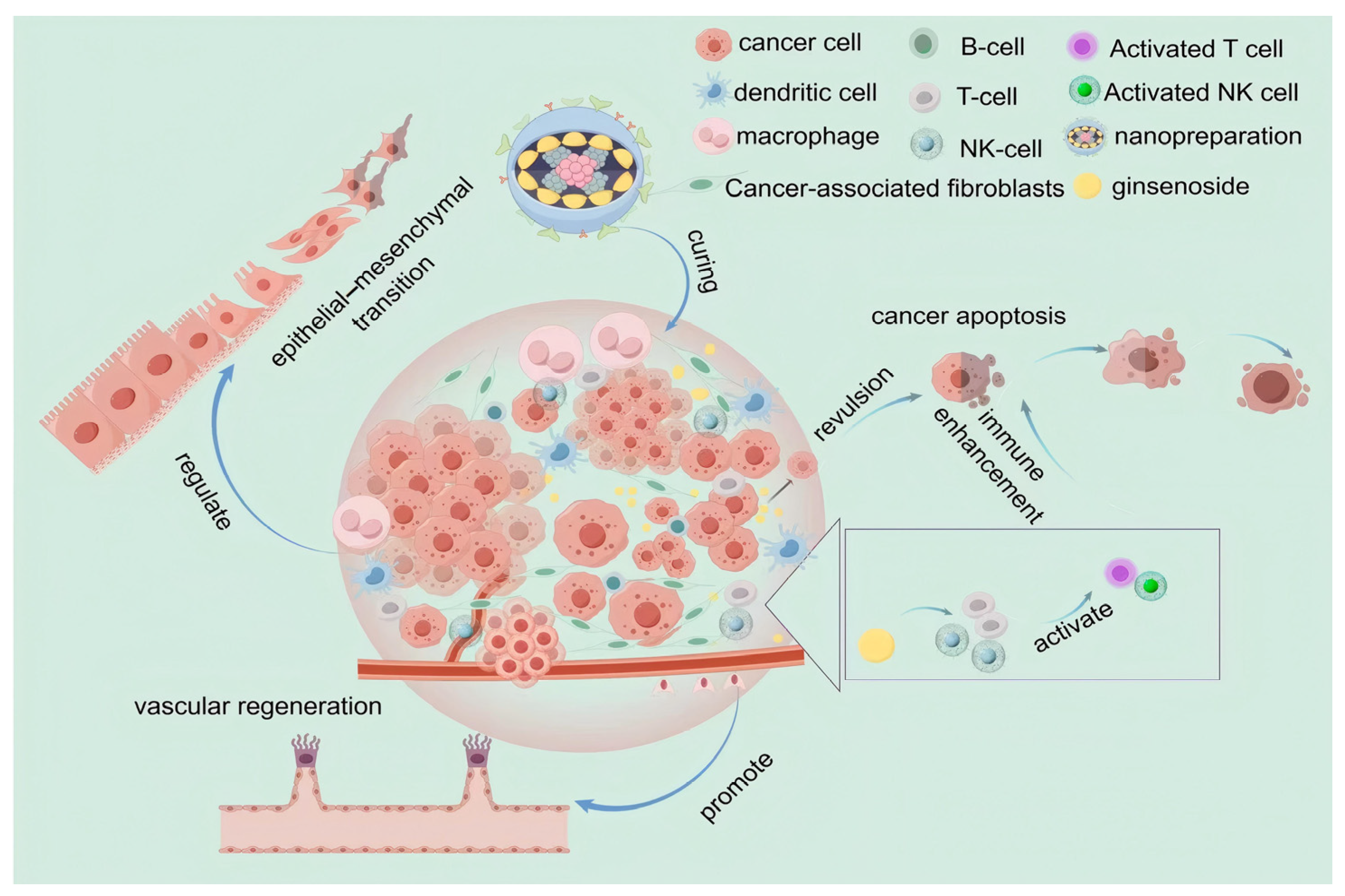
Research Progress on Anticancer Mechanism of Ginsenoside Regulating Tumor Microenvironment

Abstract
1. Introduction
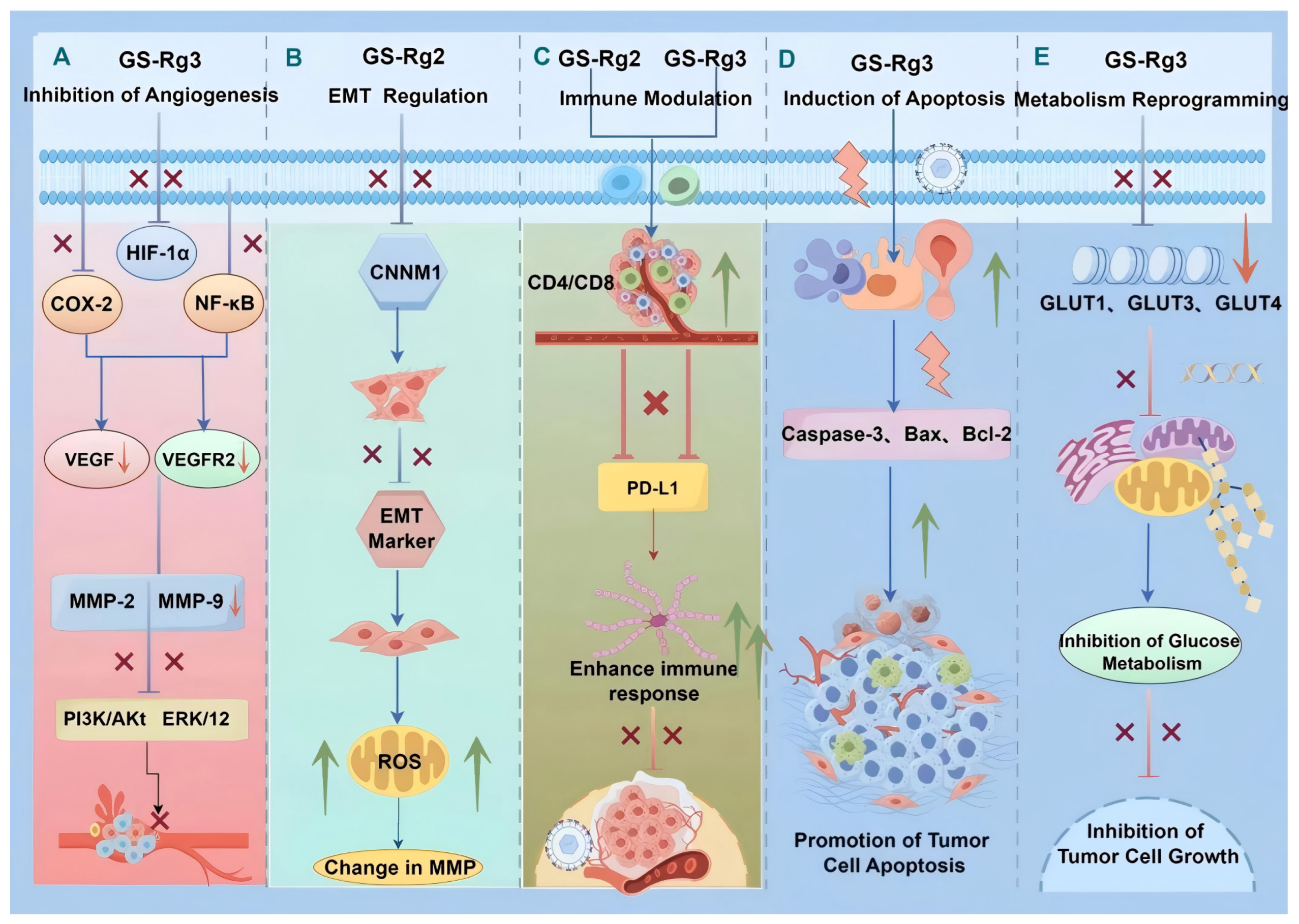
2. Ginsenoside Regulates Tumor Angiogenesis in the TME of Cancer
2.1. In Vitro Evidence of Anti-Angiogenic Effects
2.2. In Vivo Evidence from Animal Models
2.3. Molecular Mechanisms Underlying Angiogenesis Inhibition
2.4. Clinical Evidence and Translational Potential
3. Ginsenoside Regulates EMT in the TME of Cancer
3.1. Ginsenoside Rb1 and Rg1: Modulating EMT Through Canonical Pathways
3.2. Ginsenoside Rg3 and Its Stereoisomers: Dual Regulation of EMT
3.3. Ginsenoside Rb2: Convergence of EMT and Immunosuppression
4. Ginsenoside Regulates Immunoreactive Cells in the TME of Cancer
5. Ginsenosides Regulate Metabolic Reprogramming in the Tumor Microenvironment
5.1. Ginsenosides Inhibit Glucose Metabolism Reprogramming
5.2. Ginsenosides Regulate Lipid Metabolism Reprogramming
5.3. Synergistic Relationship Between Ginsenoside-Mediated Regulation of Metabolic Reprogramming and Other Anticancer Effects
6. Modulation of Tumor Microenvironment by Ginsenoside Nano-Drug Delivery System
7. Conclusions and Perspectives
Author Contributions
Funding
Data Availability Statement
Conflicts of Interest
Abbreviations
| TME | Tumor microenvironment |
| GS-Rg3 | Ginsenoside Rg3 |
| RTK | Receptor tyrosine kinase |
| TAE | Transcatheter arterial embolization |
| PTC | Papillary thyroid carcinoma |
| MMP-2 | Matrix metalloproteinase 2 |
| VEGF | Vascular endothelial growth factor |
| COX-2 | Cyclooxygenase-2 |
| NSCLC | Non-small cell lung cancer |
| KF | Keloid fibroblasts |
| TGF | Transforming growth factor |
| GS-Rh2 | Ginsenoside Rh2 |
| GS-Rg1 | Ginsenoside Rg1 |
| ROS | Reactive oxygen species |
| MMP | Mitochondrial membrane potential |
| EMT | Epithelial–mesenchymal transition |
| GS-Rb2 | Ginsenoside Rb2 |
| T-ALL | T-cell acute lymphoblastic leukemia |
| MDSCs | Marrow-derived suppressor cells |
| CSCs | Stem cell-like cells |
| GS-CK | Ginsenoside CK |
| TAMs | Tumor-associated macrophages |
| IL-10 | Interleukin-10 |
| DCs | Dendritic cells |
| CAFs | Cancer-associated fibroblasts |
| TNBC | Triple-negative breast cancer |
| GLUT1 | Glucose transporter |
| PTX | Paclitaxel |
| C-LPs | Cholesterol liposomes |
References
- Guo, M.; Shao, S.; Wang, D.; Zhao, D.; Wang, M. Recent progress in polysaccharides from Panax ginseng C. A. Meyer. Food Funct. 2021, 12, 494–518. [Google Scholar] [CrossRef] [Scilit] [PubMed]
- Zhou, G.; Wang, C.Z.; Mohammadi, S.; Sawadogo, W.R.; Ma, Q.; Yuan, C.S. Pharmacological Effects of Ginseng: Multiple Constituents and Multiple Actions on Humans. Am. J. Chin. Med. 2023, 51, 1085–1104. [Google Scholar] [CrossRef] [Scilit] [PubMed]
- Zhang, H.; Park, S.; Huang, H.; Kim, E.; Yi, J.; Choi, S.-K.; Ryoo, Z.; Kim, M. Anticancer effects and potential mechanisms of ginsenoside Rh2 in various cancer types. Oncol. Rep. 2021, 45, 33. [Google Scholar] [CrossRef] [Scilit]
- Jeon, H.; Jin, Y.; Myung, C.-S.; Heo, K.-S. Ginsenoside-Rg2 exerts anti-cancer effects through ROS-mediated AMPK activation associated mitochondrial damage and oxidation in MCF-7 cells. Arch. Pharmacal Res. 2021, 44, 702–712. [Google Scholar] [CrossRef] [Scilit]
- Heo, H.; Kim, Y.; Cha, B.; Brito, S.; Kim, H.; Kim, H.; Fatombi, B.M.; Jung, S.Y.; Lee, S.M.; Lei, L.; et al. A systematic exploration of ginsenoside Rg5 reveals anti-inflammatory functions in airway mucosa cells. J. Ginseng Res. 2022, 47, 97–105. [Google Scholar] [CrossRef] [Scilit] [PubMed]
- Xu, H.-L.; Chen, G.-H.; Wu, Y.-T.; Xie, L.-P.; Tan, Z.-B.; Liu, B.; Fan, H.-J.; Chen, H.-M.; Huang, G.-Q.; Liu, M.; et al. Ginsenoside Ro, an oleanolic saponin of Panax ginseng, exerts anti-inflammatory effect by direct inhibiting toll like receptor 4 signaling pathway. J. Ginseng Res. 2022, 46, 156–166, Erratum in J. Ginseng Res. 2022, 46, 315–319.. [Google Scholar] [CrossRef] [Scilit]
- Jugran, A.K.; Rawat, S.; Devkota, H.P.; Bhatt, I.D.; Rawal, R.S. Diabetes and plant-derived natural products: From ethnopharmacological approaches to their potential for modern drug discovery and development. Phytother. Res. 2021, 35, 223–245. [Google Scholar] [CrossRef] [Scilit]
- Liu, Y.; Zhang, H.; Dai, X.; Zhu, R.; Chen, B.; Xia, B.; Ye, Z.; Zhao, D.; Gao, S.; Orekhov, A.N.; et al. A comprehensive review on the phytochemistry, pharmacokinetics, and antidiabetic effect of Ginseng. Phytomedicine 2021, 92, 153717. [Google Scholar] [CrossRef] [Scilit]
- Li, Y.; Li, J.; Yang, L.; Ren, F.; Dong, K.; Zhao, Z.; Duan, W.; Wei, W.; Guo, R. Ginsenoside Rb1 protects hippocampal neurons in depressed rats based on mitophagy-regulated astrocytic pyroptosis. Phytomedicine 2023, 121, 155083. [Google Scholar] [CrossRef] [Scilit]
- Zhao, L.; Zhang, T.; Zhang, K. Pharmacological effects of ginseng and ginsenosides on intestinal inflammation and the immune system. Front. Immunol. 2024, 15, 1353614. [Google Scholar] [CrossRef] [Scilit]
- Wang, H.; Zheng, Y.; Sun, Q.; Zhang, Z.; Zhao, M.; Peng, C.; Shi, S. Ginsenosides emerging as both bifunctional drugs and nanocarriers for enhanced antitumor therapies. J. Nanobiotechnol. 2021, 19, 322. [Google Scholar] [CrossRef] [Scilit]
- Yao, W.; Guan, Y. Ginsenosides in cancer: A focus on the regulation of cell metabolism. Biomed. Pharmacother. 2022, 156, 113756. [Google Scholar] [CrossRef] [Scilit]
- Liu, Y.; Ju, Y.; Wang, Y.; Cui, X.; Sun, Y.; Hu, P.; Chen, Y. Ginsenoside in the treatment of type 2 diabetes and its complications: A promising traditional chinese medicine. Front. Pharmacol. 2025, 16, 1593780. [Google Scholar] [CrossRef] [Scilit]
- Zhou, Y.; Wang, Z.; Ren, S.; Li, W. Mechanism of action of protopanaxadiol ginsenosides on hepatocellular carcinoma and network pharmacological analysis. Chin. Herb. Med. 2024, 16, 548–557. [Google Scholar] [CrossRef] [Scilit] [PubMed]
- Zheng, W.; Shen, P.; Yu, C.; Tang, Y.; Qian, C.; Yang, C.; Gao, M.; Wu, Y.; Yu, S.; Tang, W.; et al. Ginsenoside Rh1, a novel casein kinase II subunit alpha (CK2α) inhibitor, retards metastasis via disrupting HHEX/CCL20 signaling cascade involved in tumor cell extravasation across endothelial barrier. Pharmacol. Res. 2023, 198, 106986. [Google Scholar] [CrossRef] [Scilit]
- Yang, Y.; Nan, Y.; Du, Y.; Liu, W.; Ning, N.; Chen, G.; Gu, Q.; Yuan, L. Ginsenosides in cancer: Proliferation, metastasis, and drug resistance. Biomed. Pharmacother. 2024, 177, 117049. [Google Scholar] [CrossRef] [Scilit] [PubMed]
- Xia, J.; Ma, S.; Zhu, X.; Chen, C.; Zhang, R.; Cao, Z.; Chen, X.; Zhang, L.; Zhu, Y.; Zhang, S.; et al. Versatile ginsenoside Rg3 liposomes inhibit tumor metastasis by capturing circulating tumor cells and destroying metastatic niches. Sci. Adv. 2022, 8, eabj1262. [Google Scholar] [CrossRef] [Scilit] [PubMed]
- Wang, L.; Zhang, Y.; Song, Z.; Liu, Q.; Fan, D.; Song, X. Ginsenosides: A potential natural medicine to protect the lungs from lung cancer and inflammatory lung disease. Food Funct. 2023, 14, 9137–9166. [Google Scholar] [CrossRef] [Scilit]
- Ben-Eltriki, M.; Shankar, G.; Tomlinson Guns, E.S.; Deb, S. Pharmacokinetics and pharmacodynamics of Rh2 and aPPD ginsenosides in prostate cancer: A drug interaction perspective. Cancer Chemother. Pharmacol. 2023, 92, 419–437. [Google Scholar] [CrossRef] [Scilit]
- Zhao, L.; Zhang, Y.; Li, Y.; Li, C.; Shi, K.; Zhang, K.; Liu, N. Therapeutic effects of ginseng and ginsenosides on colorectal cancer. Food Funct. 2022, 13, 6450–6466. [Google Scholar] [CrossRef] [Scilit]
- Yan, Y.B.; Tian, Q.; Zhang, J.F.; Xiang, Y. Antitumor effects and molecular mechanisms of action of natural products in ovarian cancer. Oncol. Lett. 2020, 20, 141. [Google Scholar] [CrossRef] [Scilit]
- Jin, Y.; Huynh, D.T.N.; Nguyen, T.L.L.; Jeon, H.; Heo, K.-S. Therapeutic effects of ginsenosides on breast cancer growth and metastasis. Arch. Pharmacal Res. 2020, 43, 773–787. [Google Scholar] [CrossRef] [Scilit]
- Zhang, L.; Gao, X.; Yang, C.; Liang, Z.; Guan, D.; Yuan, T.; Qi, W.; Zhao, D.; Li, X.; Dong, H.; et al. Structural Characters and Pharmacological Activity of Protopanaxadiol-Type Saponins and Protopanaxatriol-Type Saponins from Ginseng. Adv. Pharmacol. Pharm. Sci. 2024, 2024, 9096774. [Google Scholar] [CrossRef] [Scilit]
- Tong, Y.; Song, X.; Zhang, Y.; Xu, Y.; Liu, Q. Insight on structural modification, biological activity, structure-activity relationship of PPD-type ginsenoside derivatives. Fitoterapia 2022, 158, 105135. [Google Scholar] [CrossRef] [Scilit]
- Yue, P.Y.K.; Mak, N.K.; Cheng, Y.K.; Leung, K.W.; Ng, T.B.; Fan, D.T.P.; Yeung, H.W.; Wong, R.N.S. Pharmacogenomics and the Yin/Yang actions of ginseng: Anti-tumor, angiomodulating and steroid-like activities of ginsenosides. Chin. Med. 2007, 2, 6. [Google Scholar] [CrossRef] [Scilit]
- Kim, Y.-J.; Choi, W.-I.; Jeon, B.-N.; Choi, K.-C.; Kim, K.; Kim, T.-J.; Ham, J.; Jang, H.J.; Kang, K.S.; Ko, H. Stereospecific effects of ginsenoside 20-Rg3 inhibits TGF-β1-induced epithelial–mesenchymal transition and suppresses lung cancer migration, invasion and anoikis resistance. Toxicology 2014, 322, 23–33. [Google Scholar] [CrossRef] [Scilit]
- Valavanidis, A. Global Burden of Diseases, Injuries and Risk Factors for Mortality and Disability of Adults. Available online: https://www.researchgate.net/profile/Athanasios-Valavanidis/publication/364315719_Global_Burden_of_Diseases_Injuries_and_Risk_Factors_for_Mortality_and_Disability_of_Adults_Lifestyle_causes_or_modern_civilization_risk_factors/links/6346ac469cb4fe44f3211983/Global-Burden-of-Diseases-Injuries-and-Risk-Factors-for-Mortality-and-Disability-of-Adults-Lifestyle-causes-or-modern-civilization-risk-factors.pdf (accessed on 17 March 2026).
- Ferreira, L.L.G.; Andricopulo, A.D. Cancer estimates in Brazil reveal progress for the most lethal malignancies. Curr. Top. Med. Chem. 2020, 20, 1962–1966. [Google Scholar] [CrossRef] [Scilit] [PubMed]
- Ferlay, J.; Colombet, M.; Soerjomataram, I.; Parkin, D.M.; Piñeros, M.; Znaor, A.; Bray, F. Cancer statistics for the year 2020: An overview. Int. J. Cancer 2021, 149, 778–789. [Google Scholar] [CrossRef] [Scilit]
- Taylor, D.G. The political economics of cancer drug discovery and pricing. Drug Discov. Today 2020, 25, 2149–2160. [Google Scholar] [CrossRef] [Scilit] [PubMed]
- Yin, L.; Duan, J.-J.; Bian, X.-W.; Yu, S.-C. Triple-negative breast cancer molecular subtyping and treatment progress. Breast Cancer Res. 2020, 22, 61. [Google Scholar] [CrossRef] [Scilit] [PubMed]
- Xiao, Y.; Yu, D. Tumor microenvironment as a therapeutic target in cancer. Pharmacol. Ther. 2021, 221, 107753. [Google Scholar] [CrossRef] [Scilit]
- Jayaram, M.A.; Phillips, J.J. Role of the Microenvironment in Glioma Pathogenesis. Annu. Rev. Pathol. 2024, 19, 181–201. [Google Scholar] [CrossRef] [Scilit] [PubMed]
- Xiao, Y.; Hassani, M.; Moghaddam, M.B.; Fazilat, A.; Ojarudi, M.; Valilo, M. Contribution of tumor microenvironment (TME) to tumor apoptosis, angiogenesis, metastasis, and drug resistance. Med. Oncol. 2025, 42, 108. [Google Scholar] [CrossRef] [Scilit]
- Jiang, M.; Jia, K.; Wang, L.; Li, W.; Chen, B.; Liu, Y.; Wang, H.; Zhao, S.; He, Y.; Zhou, C. Alterations of DNA damage response pathway: Biomarker and therapeutic strategy for cancer immunotherapy. Acta Pharm. Sin. B 2021, 11, 2983–2994. [Google Scholar] [CrossRef] [Scilit]
- Patel, S.A.; Nilsson, M.B.; Le, X.; Cascone, T.; Jain, R.K.; Heymach, J.V. Molecular Mechanisms and Future Implications of VEGF/VEGFR in Cancer Therapy. Clin. Cancer Res. 2023, 29, 30–39. [Google Scholar] [CrossRef] [Scilit]
- Asif, P.J.; Longobardi, C.; Hahne, M.; Medema, J.P. The role of cancer-associated fibroblasts in cancer invasion and metastasis. Cancers 2021, 13, 4720. [Google Scholar] [CrossRef] [Scilit]
- Tan, Y.T.; Lin, J.F.; Li, T.; Li, J.J.; Xu, R.H.; Ju, H.Q. LncRNA-mediated posttranslational modifications and reprogramming of energy metabolism in cancer. Cancer Commun. 2021, 41, 109–120. [Google Scholar]
- Yi, M.; Xu, L.; Jiao, Y.; Luo, S.; Li, A.; Wu, K. The role of cancer-derived microRNAs in cancer immune escape. J. Hematol. Oncol. 2020, 13, 25. [Google Scholar] [PubMed]
- Qiu, J.; Liu, J.; Zhong, Y.; Liu, W.; Zhou, Z.; Li, Y.; Li, S. Analysis of Urinary Flora Characteristics in Urinary Tumor Based on 16S rRNA Sequence. BioMed Res. Int. 2022, 2022, 9368687. [Google Scholar] [CrossRef] [Scilit]
- Huang, J.; Zhang, L.; Wan, D.; Zhou, L.; Zheng, S.; Lin, S.; Qiao, Y. Extracellular matrix and its therapeutic potential for cancer treatment. Signal Transduct. Target. Ther. 2021, 6, 153. [Google Scholar] [CrossRef] [Scilit] [PubMed]
- Tang, T.; Huang, X.; Zhang, G.; Hong, Z.; Bai, X.; Liang, T. Advantages of targeting the tumor immune microenvironment over blocking immune checkpoint in cancer immunotherapy. Signal Transduct. Target. Ther. 2021, 6, 72. [Google Scholar] [CrossRef] [Scilit]
- Li, Y.; Ren, X.; Gao, W.; Cai, R.; Wu, J.; Liu, T.; Chen, X.; Jiang, D.; Chen, C.; Cheng, Q.; et al. The biological behavior and clinical outcome of pituitary adenoma are affected by the microenvironment. CNS Neurosci. Ther. 2024, 30, e14729. [Google Scholar] [CrossRef] [Scilit]
- Saman, H.; Raza, S.S.; Uddin, S.; Rasul, K. Inducing angiogenesis, a key step in cancer vascularization, and treatment approaches. Cancers 2020, 12, 1172. [Google Scholar] [CrossRef] [Scilit]
- Lugano, R.; Ramachandran, M.; Dimberg, A. Tumor angiogenesis: Causes, consequences, challenges and opportunities. Cell. Mol. Life Sci. 2020, 77, 1745–1770. [Google Scholar] [CrossRef] [Scilit]
- Liu, G.; Chen, T.; Ding, Z.; Wang, Y.; Wei, Y.; Wei, X. Inhibition of FGF-FGFR and VEGF-VEGFR signalling in cancer treatment. Cell Prolif. 2021, 54, e13009. [Google Scholar] [CrossRef] [Scilit] [PubMed]
- Meresman, G.F.; Götte, M.; Laschke, M.W. Plants as source of new therapies for endometriosis: A review of preclinical and clinical studies. Hum. Reprod. Update 2021, 27, 367–392. [Google Scholar] [CrossRef] [Scilit] [PubMed]
- Sun, D.; Zou, Y.; Song, L.; Han, S.; Yang, H.; Chu, D.; Dai, Y.; Ma, J.; O’Driscoll, C.M.; Yu, Z.; et al. A cyclodextrin-based nanoformulation achieves co-delivery of ginsenoside Rg3 and quercetin for chemo-immunotherapy in colorectal cancer. Acta Pharm. Sin. B 2022, 12, 378–393. [Google Scholar] [CrossRef] [Scilit] [PubMed]
- Nakhjavani, M.; Smith, E.; Townsend, A.R.; Price, T.J.; Hardingham, J.E. Anti-angiogenic properties of ginsenoside Rg3. Molecules 2020, 25, 4905. [Google Scholar] [CrossRef] [Scilit]
- Oh, H.M.; Cho, C.K.; Son, C.G. Experimental Evidence for the Anti-Metastatic Action of Ginsenoside Rg3: A Systematic Review. Int. J. Mol. Sci. 2022, 23, 9077. [Google Scholar] [CrossRef] [Scilit]
- Wu, W.; Zhou, Q.; Zhao, W.; Gong, Y.; Su, A.; Liu, F.; Liu, Y.; Li, Z.; Zhu, J. Ginsenoside Rg3 inhibition of thyroid cancer metastasis is associated with alternation of actin skeleton. J. Med. Food 2018, 21, 849–857. [Google Scholar] [CrossRef] [Scilit]
- Ben-Eltriki, M.; Deb, S.; Guns, E.S.T. 1α,25-Dihydroxyvitamin D3 synergistically enhances anticancer effects of ginsenoside Rh2 in human prostate cancer cells. J. Steroid Biochem. Mol. Biol. 2021, 209, 105828. [Google Scholar] [CrossRef] [Scilit]
- Chu, Y.; Zhang, W.; Kanimozhi, G.; Brindha, G.R.; Tian, D. Ginsenoside Rg1 Induces Apoptotic Cell Death in Triple-Negative Breast Cancer Cell Lines and Prevents Carcinogen-Induced Breast Tumorigenesis in Sprague Dawley Rats. Evid. Based Complement. Altern. Med. 2020, 2020, 8886955. [Google Scholar] [CrossRef] [Scilit] [PubMed]
- Zhao, Y.; Deng, L.; Cao, Y.; Ma, B.; Li, Y.; Xu, J.; Li, H.; Huang, Y. Inhibitory Effect of Ginsenoside Rg3 Combined With 5-Fluorouracil on Tumor Angiogenesis and Tumor Growth of Colon Cancer in Mice: An Experimental Study. Sichuan Da Xue Xue Bao Yi Xue Ban 2024, 55, 111–117. [Google Scholar] [CrossRef] [Scilit] [PubMed]
- Nakhjavani, M.; Smith, E.; Yeo, K.; Palethorpe, H.M.; Tomita, Y.; Price, T.J.; Townsend, A.R.; Hardingham, J.E. Anti-Angiogenic Properties of Ginsenoside Rg3 Epimers: In Vitro Assessment of Single and Combination Treatments. Cancers 2021, 13, 2223. [Google Scholar] [CrossRef] [Scilit] [PubMed]
- Zheng, W.; Huang, Y.; Wu, Q.; Cheng, P.; Song, Y.; Wang, B.; Huang, Q.; Hu, S. Poly(lactic acid hydroxyacetic acid)-poly(ethylene glycol)-modified ginsenoside Rg3 nanomedicine enhances anti-tumor effect in hepatocellular carcinoma. Drug Dev. Ind. Pharm. 2024, 50, 763–775. [Google Scholar] [CrossRef] [Scilit]
- Chen, T.; Li, B.; Qiu, Y.; Qiu, Z.; Qu, P. Functional mechanism of Ginsenosides on tumor growth and metastasis. Saudi J. Biol. Sci. 2018, 25, 917–922. [Google Scholar] [CrossRef] [Scilit]
- Zeng, D.; Wang, J.; Kong, P.; Chang, C.; Li, J.; Li, J. Ginsenoside Rg3 inhibits HIF-1α and VEGF expression in patient with acute leukemia via inhibiting the activation of PI3K/Akt and ERK1/2 pathways. Int. J. Clin. Exp. Pathol. 2014, 7, 2172–2178. [Google Scholar]
- Xu, T.; Jin, Z.; Yuan, Y.; Wei, H.; Xu, X.; He, S.; Chen, S.; Hou, W.; Guo, Q.; Hua, B. Ginsenoside Rg3 Serves as an Adjuvant Chemotherapeutic Agent and VEGF Inhibitor in the Treatment of Non-Small Cell Lung Cancer: A Meta-Analysis and Systematic Review. Evid. Based Complement. Altern. Med. 2016, 2016, 7826753. [Google Scholar] [CrossRef] [Scilit]
- Tang, M.; Bian, W.; Cheng, L.; Zhang, L.; Jin, R.; Wang, W.; Zhang, Y. Ginsenoside Rg3 inhibits keloid fibroblast proliferation, angiogenesis and collagen synthesis in vitro via the TGF-β/Smad and ERK signaling pathways. Int. J. Mol. Med. 2018, 41, 1487–1499. [Google Scholar] [CrossRef] [Scilit]
- Meng, L.; Ji, R.; Dong, X.; Xu, X.; Xin, Y.; Jiang, X. Antitumor activity of ginsenoside Rg3 in melanoma through downregulation of the ERK and Akt pathways. Int. J. Oncol. 2019, 54, 2069–2079. [Google Scholar] [CrossRef] [Scilit]
- Zeng, Z.; Nian, Q.; Chen, N.; Zhao, M.; Zheng, Q.; Zhang, G.; Zhao, Z.; Chen, Y.; Wang, J.; Zeng, J.; et al. Ginsenoside Rg3 inhibits angiogenesis in gastric precancerous lesions through downregulation of Glut1 and Glut4. Biomed. Pharmacother. 2022, 145, 112086. [Google Scholar] [CrossRef] [Scilit]
- Huang, Y.; Huang, H.; Han, Z.; Li, W.; Mai, Z.; Yuan, R. Ginsenoside Rh2 inhibits angiogenesis in prostate cancer by targeting CNNM1. J. Nanosci. Nanotechnol. 2019, 19, 1942–1950. [Google Scholar] [CrossRef] [Scilit]
- Liu, T.; Duo, L.; Duan, P. Ginsenoside Rg3 Sensitizes Colorectal Cancer to Radiotherapy through Downregulation of Proliferative and Angiogenic Biomarkers. Evid. Based Complement. Altern. Med. 2018, 2018, 1580427. [Google Scholar] [CrossRef] [Scilit]
- Zhao, L.; Sun, W.; Zheng, A.; Zhang, Y.; Fang, C.; Zhang, P. Ginsenoside Rg3 suppresses ovarian cancer cell proliferation and invasion by inhibiting the expression of lncRNA H19. Acta Biochim. Pol. 2021, 68, 575–582. [Google Scholar] [CrossRef] [Scilit]
- Liu, X.; Zhang, Z.; Liu, J.; Wang, Y.; Zhou, Q.; Wang, S.; Wang, X. Ginsenoside Rg3 improves cyclophosphamide-induced immunocompetence in Balb/c mice. Int. Immunopharmacol. 2019, 72, 98–111. [Google Scholar] [CrossRef] [Scilit]
- Yao, Z.-W.; Zhu, H. Pharmacological mechanisms and drug delivery systems of ginsenoside Rg3: A comprehensive review. Pharmacol. Res. 2025, 216, 107799. [Google Scholar] [CrossRef] [Scilit] [PubMed]
- Zeng, X.; Liu, S.; Yang, H.; Jia, M.; Liu, W.; Zhu, W. Synergistic anti-tumour activity of ginsenoside Rg3 and doxorubicin on proliferation, metastasis and angiogenesis in osteosarcoma by modulating mTOR/HIF-1α/VEGF and EMT signalling pathways. J. Pharm. Pharmacol. 2023, 75, 1405–1417. [Google Scholar] [CrossRef] [Scilit]
- Lv, Q.; Xia, Z.; Huang, Y.; Ruan, Z.; Wang, J.; Huang, Z. Ginsenoside Rg3 alleviates the migration, invasion, and angiogenesis of lung cancer cells by inhibiting the expressions of cyclooxygenase-2 and vascular endothelial growth factor. Chem. Biol. Drug Des. 2023, 101, 937–951. [Google Scholar] [CrossRef] [Scilit] [PubMed]
- Wang, W.; Li, K.; Xiao, W. The pharmacological role of Ginsenoside Rg3 in liver diseases: A review on molecular mechanisms. J. Ginseng Res. 2024, 48, 129–139. [Google Scholar] [CrossRef] [Scilit] [PubMed]
- Marium, Z.; Siddiqi, M.Z.; Lee, J.H.; Im, W.T.; Hwang, S.G. Repressing effect of transformed ginsenoside Rg3-mix against LPS-induced inflammation in RAW264.7 macrophage cells. J. Genet. Eng. Biotechnol. 2023, 21, 6. [Google Scholar] [CrossRef] [Scilit]
- Zhou, J.; Zhao, D.; Niu, S.; Meng, W.; Chen, Z.; Li, H.; Liu, Y.; Zou, L.; Li, W. RGD-Functionalized Ginsenoside Rg3 Liposomes for Alleviating Oxidative Stress and Choroidal Neovascularization in Age-Related Macular Degeneration. Int. J. Nanomed. 2025, 20, 7915–7933. [Google Scholar] [CrossRef] [Scilit] [PubMed]
- Bu, X.; Feng, H.; Yan, Z. Ginsenoside Rg3 enhances the anticancer effects of 5-fluorouracil in colorectal cancer and reduces drug resistance and the Hedgehog pathway activation. Arab. J. Gastroenterol. 2024, 25, 437–443. [Google Scholar] [CrossRef] [Scilit]
- Huang, M.-Y.; Chen, Y.-C.; Lyu, W.-Y.; He, X.-Y.; Ye, Z.-H.; Huang, C.-Y.; He, X.-L.; Chen, X.; Chen, X.; Zhang, B.; et al. Ginsenoside Rh2 augmented anti-PD-L1 immunotherapy by reinvigorating CD8+ T cells via increasing intratumoral CXCL10. Pharmacol. Res. 2023, 198, 106988. [Google Scholar] [CrossRef] [Scilit]
- Liang, Y.; Zhang, T.; Jing, S.; Zuo, P.; Li, T.; Wang, Y.; Xing, S.; Zhang, J.; Wei, Z. 20(S)-Ginsenoside Rg3 Inhibits Lung Cancer Cell Proliferation by Targeting EGFR-Mediated Ras/Raf/MEK/ERK Pathway. Am. J. Chin. Med. 2021, 49, 753–765. [Google Scholar] [CrossRef] [Scilit]
- Kikuchi, Y.; Sasa, H.; Kita, T.; Hirata, J.; Tode, T.; Nagata, I. Inhibition of human ovarian cancer cell proliferation in vitro by ginsenoside Rh2 and adjuvant effects to cisplatin in vivo. Anticancer Drugs 1991, 2, 63–67. [Google Scholar] [CrossRef] [Scilit]
- Lee, J.S.; Lee, H.Y. Ginseng-derived compounds as potential anticancer agents targeting cancer stem cells. J. Ginseng Res. 2024, 48, 266–275. [Google Scholar] [CrossRef] [Scilit]
- Zhang, R.; Li, X.; Gao, Y.; Tao, Q.; Lang, Z.; Zhan, Y.; Li, C.; Zheng, J. Ginsenoside Rg1 Epigenetically Modulates Smad7 Expression in Liver Fibrosis via MicroRNA-152. J. Ginseng Res. 2023, 47, 534–542. [Google Scholar] [CrossRef] [Scilit]
- Wang, J.; Tian, L.; Khan, M.N.; Zhang, L.; Chen, Q.; Zhao, Y.; Yan, Q.; Fu, L.; Liu, J. Ginsenoside Rg3 sensitizes hypoxic lung cancer cells to cisplatin via blocking of NF-κB mediated epithelial–mesenchymal transition and stemness. Cancer Lett. 2018, 415, 73–85. [Google Scholar] [CrossRef] [Scilit] [PubMed]
- Chen, Z.; Wei, X.; Shen, L.; Zhu, H.; Zheng, X. 20 (S)-ginsenoside-Rg3 reverses temozolomide resistance and restrains epithelial-mesenchymal transition progression in glioblastoma. Cancer Sci. 2019, 110, 389–400. [Google Scholar] [CrossRef] [Scilit]
- Zhou, Y.; Zheng, X.; Lu, J.; Chen, W.; Li, X.; Zhao, L. Ginsenoside 20(S)-Rg3 Inhibits the Warburg Effect Via Modulating DNMT3A/MiR-532-3p/HK2 Pathway in Ovarian Cancer Cells. Cell Physiol. Biochem. 2018, 45, 2548–2559. [Google Scholar] [CrossRef] [Scilit] [PubMed]
- Phi, L.T.H.; Wijaya, Y.T.; Sari, I.N.; Kim, K.S.; Yang, Y.G.; Lee, M.W.; Kwon, H.Y. 20(R)-Ginsenoside Rg3 Influences Cancer Stem Cell Properties and the Epithelial-Mesenchymal Transition in Colorectal Cancer via the SNAIL Signaling Axis. Onco Targets Ther. 2019, 12, 10885–10895. [Google Scholar] [CrossRef] [Scilit] [PubMed]
- He, F.; Zhou, Y.; Fu, J.; Chang, S.; Cui, X.; Feng, Z.; Zhao, L.; Li, X. Ginsenoside 20(S)-Rg3 upregulates SQLE to reprogram cholesterol metabolism of ovarian cancer cells. iScience 2025, 28, 112853. [Google Scholar] [CrossRef] [Scilit]
- Dai, G.; Sun, B.; Gong, T.; Pan, Z.; Meng, Q.; Ju, W. Ginsenoside Rb2 inhibits epithelial-mesenchymal transition of colorectal cancer cells by suppressing TGF-β/Smad signaling. Phytomedicine 2019, 56, 126–135. [Google Scholar] [CrossRef] [Scilit] [PubMed]
- Li, J.K.; Jiang, X.L.; Zhang, Z.; Chen, W.Q.; Peng, J.J.; Liu, B.; Yung, K.K.; Zhu, P.L. 20(S)-Ginsenoside Rh2 induces apoptosis and autophagy in melanoma cells via suppressing Src/STAT3 signaling. J. Ginseng Res. 2024, 48, 559–569. [Google Scholar] [CrossRef] [Scilit] [PubMed]
- Xia, T.; Zhang, B.; Li, Y.; Fang, B.; Zhu, X.; Xu, B.; Zhang, J.; Wang, M.; Fang, J. New insight into 20(S)-ginsenoside Rh2 against T-cell acute lymphoblastic leukemia associated with the gut microbiota and the immune system. Eur. J. Med. Chem. 2020, 203, 112582. [Google Scholar] [CrossRef] [Scilit]
- Song, J.H.; Eum, D.Y.; Park, S.Y.; Jin, Y.H.; Shim, J.W.; Park, S.J.; Kim, M.Y.; Park, S.J.; Heo, K.; Choi, Y.J. Inhibitory effect of ginsenoside Rg3 on cancer stemness and mesenchymal transition in breast cancer via regulation of myeloid-derived suppressor cells. PLoS ONE 2020, 15, e0240533. [Google Scholar] [CrossRef] [Scilit]
- Su, M.X.; Xu, Y.L.; Jiang, X.M.; Huang, M.Y.; Zhang, L.L.; Yuan, L.W.; Xu, X.H.; Zhu, Q.; Gao, J.L.; Lu, J.H.; et al. c-MYC-mediated TRIB3/P62+ aggresomes accumulation triggers paraptosis upon the combination of everolimus and ginsenoside Rh2. Acta Pharm. Sin. B 2022, 12, 1240–1253. [Google Scholar] [CrossRef] [Scilit]
- Zhang, M.; Shi, Z.; Zhang, S.; Li, X.; To, S.K.Y.; Peng, Y.; Liu, J.; Chen, S.; Hu, H.; Wong, A.S.T.; et al. The Ginsenoside Compound K Suppresses Stem-Cell-like Properties and Colorectal Cancer Metastasis by Targeting Hypoxia-Driven Nur77-Akt Feed-Forward Signaling. Cancers 2022, 15, 24. [Google Scholar] [CrossRef] [Scilit]
- Huang, Y.; Zou, Y.; Lin, L.; Zheng, R. Ginsenoside Rg1 activates dendritic cells and acts as a vaccine adjuvant inducing protective cellular responses against lymphomas. DNA Cell Biol. 2017, 36, 1168–1177. [Google Scholar] [CrossRef] [Scilit]
- Liu, R.; Zhang, B.; Zou, S.; Cui, L.; Lin, L.; Li, L. Ginsenoside Rg1 Induces Autophagy in Colorectal Cancer through Inhibition of the Akt/mTOR/p70S6K Pathway. J. Microbiol. Biotechnol. 2024, 34, 774–782. [Google Scholar] [CrossRef] [Scilit]
- Zhang, R.; Li, L.; Li, H.; Bai, H.; Suo, Y.; Cui, J.; Wang, Y. Ginsenoside 20(S)-Rg3 reduces KIF20A expression and promotes CDC25A proteasomal degradation in epithelial ovarian cancer. J. Ginseng Res. 2024, 48, 40–51. [Google Scholar] [CrossRef] [Scilit] [PubMed]
- Zhou, P.; Deng, F.; Yang, Z.; Cao, C.; Zhao, H.; Liu, F.; Zhong, K.; Fu, L.; Peng, T.; Sun, D.; et al. Ginsenoside Rb1 inhibits oxidative stress-induced ovarian granulosa cell injury through Akt-FoxO1 interaction. Sci. China Life Sci. 2022, 65, 2301–2315. [Google Scholar] [CrossRef] [Scilit]
- Man, S.; Luo, C.; Yan, M.; Zhao, G.; Ma, L.; Gao, W. Treatment for liver cancer: From sorafenib to natural products. Eur. J. Med. Chem. 2021, 224, 113690. [Google Scholar] [CrossRef] [Scilit]
- Qu, L.; Liu, Y.; Deng, J.; Ma, X.; Fan, D. Ginsenoside Rk3 is a novel PI3K/AKT-targeting therapeutics agent that regulates autophagy and apoptosis in hepatocellular carcinoma. J. Pharm. Anal. 2023, 13, 463–482. [Google Scholar] [CrossRef] [Scilit] [PubMed]
- Lee, Y.J.; Park, S.H.; Oh, B.; Yoon, S.J.; Lee, S.J.; Choi, S.; Kim, M.J.; Kim, J.; Cho, Y.L.; Kim, W.; et al. Particulate matter-induced lung cancer metastasis is inhibited by ginsenoside Rg3. J. Environ. Sci. 2025, 158, 60–71. [Google Scholar] [CrossRef] [Scilit]
- Niu, X.; Shi, Y.; Li, Q.; Chen, H.; Fan, X.; Yu, Y.; Lv, C.; Lu, J. Ginsenoside Rb1 for overcoming cisplatin-insensitivity of A549/DDP cells in vitro and vivo through the dual-inhibition on two efflux pumps of ABCB1 and PTCH1. Phytomedicine 2023, 115, 154776. [Google Scholar] [CrossRef] [Scilit]
- Hyun Jeong, K.; Chang Ki, L.; Kwang-Kyun, P.; Yeong-Sik, K.; Won-Yoon, C. Ginsenoside Rg3 Inhibits the Expressions of Nrf2-mediated Cytoprotective and Multidrug-associated Proteins in A549 Human Lung Cancer Cells. J. Cancer Prev. 2011, 16, 216–222. [Google Scholar]
- Peng, Y.; Guo, Y.; Zhao, S.; Yan, H.; Hao, Z.; Zheng, F.; Zhang, Z.; Miao, L.; Sun, L.K.; Cuendet, M. 20(S)-ginsenoside Rg3 induced the necroptosis of prostate cancer cells via ROS overproduction. Neoplasma 2025, 72, 48–58. [Google Scholar] [CrossRef] [Scilit] [PubMed]
- Hiam-Galvez, K.J.; Allen, B.M.; Spitzer, M.H. Systemic immunity in cancer. Nat. Rev. Cancer 2021, 21, 345–359. [Google Scholar] [CrossRef] [Scilit]
- Li, J.; Li, F.; Jin, D. Ginsenosides are Promising Medicine for Tumor and Inflammation: A Review. Am. J. Chin. Med. 2023, 51, 883–908. [Google Scholar] [CrossRef] [Scilit]
- Ye, Z.; Ding, J.; Huang, J.; Hu, Z.; Jin, F.; Wu, K. Ginsenoside Rg3 activates the immune function of CD8+ T cells via circFOXP1-miR-4477a-PD-L1 axis to induce ferroptosis in gallbladder cancer. Arch. Pharm. Res. 2024, 47, 793–811. [Google Scholar] [CrossRef] [Scilit]
- Zhou, Z.; Wu, S.; Li, Y.; Shao, P.; Jiang, J. Ginsenoside Rh2-Pretreated Mesenchymal Stem Cell Exosomes Ameliorate Collagen-Induced Arthritis via N6-Methyladenosine Methylation. Biomater. Res. 2025, 29, 0220. [Google Scholar] [CrossRef] [Scilit] [PubMed]
- Yang, C.; Qian, C.; Zheng, W.; Dong, G.; Zhang, S.; Wang, F.; Wei, Z.; Xu, Y.; Wang, A.; Zhao, Y.; et al. Ginsenoside Rh2 enhances immune surveillance of natural killer (NK) cells via inhibition of ERp5 in breast cancer. Phytomedicine 2024, 123, 155180. [Google Scholar] [CrossRef] [Scilit]
- Liu, J.; Wang, Y.; Yu, Z.; Lv, G.; Huang, X.; Lin, H.; Ma, C.; Lin, Z.; Qu, P. Functional Mechanism of Ginsenoside Compound K on Tumor Growth and Metastasis. Integr. Cancer Ther. 2022, 21, 15347354221101203. [Google Scholar] [CrossRef] [Scilit]
- Zhang, Y.; Qiu, Z.; Qiu, Y.; Su, T.; Qu, P.; Jia, A. Functional Regulation of Ginsenosides on Myeloid Immunosuppressive Cells in the Tumor Microenvironment. Integr. Cancer Ther. 2019, 18, 1534735419886655. [Google Scholar] [CrossRef] [Scilit]
- Pan, Y.; Yu, Y.; Wang, X.; Zhang, T. Tumor-Associated Macrophages in Tumor Immunity. Front. Immunol. 2020, 11, 583084, Erratum in Front. Immunol. 2021, 12, 775758.. [Google Scholar] [CrossRef] [Scilit]
- Chen, D.; Zhang, X.; Li, Z.; Zhu, B. Metabolic regulatory crosstalk between tumor microenvironment and tumor-associated macrophages. Theranostics 2021, 11, 1016–1030. [Google Scholar] [CrossRef] [Scilit]
- Xia, Y.; Rao, L.; Yao, H.; Wang, Z.; Ning, P.; Chen, X. Engineering Macrophages for Cancer Immunotherapy and Drug Delivery. Adv. Mater. 2020, 32, e2002054. [Google Scholar] [CrossRef] [Scilit] [PubMed]
- Qi, Y.; Yan, J.; Huang, X.; Jiang, X.; Li, R.; Wan, J.; Li, Y.; Miao, Z.; Song, Z.; Liu, Y.; et al. Targeting tumor-associated macrophage polarization with traditional Chinese medicine active ingredients: Dual reversal of chemoresistance and immunosuppression in tumor microenvironment. Pharmacol. Res. 2025, 216, 107788. [Google Scholar] [CrossRef] [Scilit]
- Zhu, Y.; Wang, A.; Zhang, S.; Kim, J.; Xia, J.; Zhang, F.; Wang, D.; Wang, Q.; Wang, J. Paclitaxel-loaded ginsenoside Rg3 liposomes for drug-resistant cancer therapy by dual targeting of the tumor microenvironment and cancer cells. J. Adv. Res. 2023, 49, 159–173. [Google Scholar] [CrossRef] [Scilit] [PubMed]
- Wang, M.; Yan, S.J.; Zhang, H.T.; Li, N.; Liu, T.; Zhang, Y.L.; Li, X.X.; Ma, Q.; Qiu, X.C.; Fan, Q.Y.; et al. Ginsenoside Rh2 enhances the antitumor immunological response of a melanoma mice model. Oncol. Lett. 2017, 13, 681–685. [Google Scholar] [CrossRef] [Scilit]
- Huang, M.Y.; Xu, C.C.; Chen, Q.; Zhang, Y.M.; Lyu, W.Y.; Ye, Z.H.; Li, T.; Huang, M.Q.; Lu, J.J. Ginsenoside Rh2 in combination with IFNγ potentiated the anti-cancer effect by enhancing interferon signaling response in colorectal cancer cells. Acta Pharmacol. Sin. 2025, 46, 2534–2546. [Google Scholar] [CrossRef] [Scilit]
- Shapir Itai, Y.; Barboy, O.; Salomon, R.; Bercovich, A.; Xie, K.; Winter, E.; Shami, T.; Porat, Z.; Erez, N.; Tanay, A.; et al. Bispecific dendritic-T cell engager potentiates anti-tumor immunity. Cell 2024, 187, 375–389.e18. [Google Scholar] [CrossRef] [Scilit]
- Kvedaraite, E.; Ginhoux, F. Human dendritic cells in cancer. Sci. Immunol. 2022, 7, eabm9409. [Google Scholar] [CrossRef] [Scilit] [PubMed]
- Wang, X.H.; Fu, Y.L.; Xu, Y.N.; Zhang, P.C.; Zheng, T.X.; Ling, C.Q.; Feng, Y.L. Ginsenoside Rh1 regulates the immune microenvironment of hepatocellular carcinoma via the glucocorticoid receptor. J. Integr. Med. 2024, 22, 709–718. [Google Scholar] [CrossRef] [Scilit] [PubMed]
- Forte, D.; Krause, D.S.; Andreeff, M.; Bonnet, D.; Méndez-Ferrer, S. Updates on the hematologic tumor microenvironment and its therapeutic targeting. Haematologica 2019, 104, 1928–1934. [Google Scholar] [CrossRef] [Scilit]
- Petr, S.; Vit, V.; Martina, R.; Jaromir, G.; Vojtech, A.; Michal, M. Metabolic and Amino Acid Alterations of the Tumor Microenvironment. Curr. Med. Chem. 2021, 28, 1270–1289. [Google Scholar] [CrossRef] [Scilit] [PubMed]
- Takasugi, M.; Yoshida, Y.; Ohtani, N. Cellular senescence and the tumour microenvironment. Mol. Oncol. 2022, 16, 3333–3351. [Google Scholar] [CrossRef] [Scilit]
- Margulies, B.S.; Likhitpanichkul, M.; Tripathy, D. Reshaping the Landscape of Locoregional Treatments for Breast Cancer Liver Metastases: A novel, intratumoral, p21-targeted percutaneous therapy increases survival in BALB/c mice inoculated with 4T1 triple negative breast cancer cells in the liver. bioRxiv 2024. [Google Scholar] [CrossRef] [Scilit]
- Miricescu, D.; Totan, A.; Stanescu-Spinu, I.-I.; Badoiu, S.C.; Stefani, C.; Greabu, M. PI3K/AKT/mTOR Signaling Pathway in Breast Cancer: From Molecular Landscape to Clinical Aspects. Int. J. Mol. Sci. 2020, 22, 173. [Google Scholar] [CrossRef] [Scilit]
- Maslankova, J.; Vecurkovska, I.; Rabajdova, M.; Katuchova, J.; Kicka, M.; Gayova, M.; Katuch, V. Regulation of transforming growth factor-β signaling as a therapeutic approach to treating colorectal cancer. World J. Gastroenterol. 2022, 28, 4744–4761. [Google Scholar] [CrossRef] [Scilit]
- Fontana, F.; Giannitti, G.; Marchesi, S.; Limonta, P. The PI3K/Akt Pathway and Glucose Metabolism: A Dangerous Liaison in Cancer. Int. J. Biol. Sci. 2024, 20, 3113–3125. [Google Scholar] [CrossRef] [Scilit] [PubMed]
- Zhang, Y.; Li, W.; Niu, J.; Fan, Z.; Li, X.; Zhang, H. Reprogramming of glucose metabolism in pancreatic cancer: Mechanisms, implications, and therapeutic perspectives. Front. Immunol. 2025, 16, 1586959. [Google Scholar] [CrossRef] [Scilit] [PubMed]
- Wu, L.; Bai, L.; Dai, W.; Wu, Y.; Xi, P.; Zhang, J.; Zheng, L. Ginsenoside Rg3: A Review of its Anticancer Mechanisms and Potential Therapeutic Applications. Curr. Top. Med. Chem. 2024, 24, 869–884. [Google Scholar] [CrossRef] [Scilit]
- Miao, L.; Ma, H.; Dong, T.; Zhao, C.; Gao, T.; Wu, T.; Xu, H.; Zhang, J. Ginsenoside Rg3 liposomes regulate tumor microenvironment for the treatment of triple negative breast cancer. Drug Dev. Ind. Pharm. 2023, 49, 139–148. [Google Scholar] [CrossRef] [Scilit] [PubMed]
- Xia, T.; Wang, Y.N.; Zhou, C.X.; Wu, L.M.; Liu, Y.; Zeng, Q.H.; Zhang, X.L.; Yao, J.H.; Wang, M.; Fang, J.P. Ginsenoside Rh2 and Rg3 inhibit cell proliferation and induce apoptosis by increasing mitochondrial reactive oxygen species in human leukemia Jurkat cells. Mol. Med. Rep. 2017, 15, 3591–3598. [Google Scholar] [CrossRef] [Scilit]
- Cheng, C.; Geng, F.; Cheng, X.; Guo, D. Lipid metabolism reprogramming and its potential targets in cancer. Cancer Commun. 2018, 38, 27. [Google Scholar] [CrossRef] [Scilit]
- Jin, H.R.; Wang, J.; Wang, Z.J.; Xi, M.J.; Xia, B.H.; Deng, K.; Yang, J.L. Lipid metabolic reprogramming in tumor microenvironment: From mechanisms to therapeutics. J. Hematol. Oncol. 2023, 16, 103. [Google Scholar] [CrossRef] [Scilit]
- Yoshioka, H.; Coates, H.W.; Chua, N.K.; Hashimoto, Y.; Brown, A.J.; Ohgane, K. A key mammalian cholesterol synthesis enzyme, squalene monooxygenase, is allosterically stabilized by its substrate. Proc. Natl. Acad. Sci. USA 2020, 117, 7150–7158. [Google Scholar] [CrossRef] [Scilit]
- Zhao, L.; Shou, H.; Chen, L.; Gao, W.; Fang, C.; Zhang, P. Effects of ginsenoside Rg3 on epigenetic modification in ovarian cancer cells. Oncol. Rep. 2019, 41, 3209–3218. [Google Scholar] [CrossRef] [Scilit]
- Huang, B.; Song, B.-l.; Xu, C. Cholesterol metabolism in cancer: Mechanisms and therapeutic opportunities. Nat. Metab. 2020, 2, 132–141. [Google Scholar] [CrossRef] [Scilit]
- Yan, J.; Horng, T. Lipid Metabolism in Regulation of Macrophage Functions. Trends Cell Biol. 2020, 30, 979–989. [Google Scholar] [CrossRef] [Scilit] [PubMed]
- Boutilier, A.J.; Elsawa, S.F. Macrophage Polarization States in the Tumor Microenvironment. Int. J. Mol. Sci. 2021, 22, 6995. [Google Scholar] [CrossRef] [Scilit] [PubMed]
- Ye, F.; Wang, Y.; Du, Q.; Sun, B.; Zhang, M.; Guo, J. Network Pharmacology and Transcriptomic Analysis Reveal the Mechanism by Which Ginsenoside CK Remodels the Tumor Immune Microenvironment to Inhibit Liver Cancer Progression. Chem. Biol. Drug Des. 2025, 106, e70204. [Google Scholar] [CrossRef] [Scilit]
- Zhang, L.; Li, C.; Song, X.; Guo, R.; Zhao, W.; Liu, C.; Chen, X.; Song, Q.; Wu, B.; Deng, N. Targeting ONECUT2 inhibits tumor angiogenesis via down-regulating ZKSCAN3/VEGFA. Biochem. Pharmacol. 2024, 225, 116315. [Google Scholar] [CrossRef] [Scilit]
- Elebiyo, T.C.; Rotimi, D.; Evbuomwan, I.O.; Maimako, R.F.; Iyobhebhe, M.; Ojo, O.A.; Oluba, O.M.; Adeyemi, O.S. Reassessing vascular endothelial growth factor (VEGF) in anti-angiogenic cancer therapy. Cancer Treat. Res. Commun. 2022, 32, 100620. [Google Scholar] [CrossRef] [Scilit]
- Hong, T.; Kim, M.Y.; Da Ly, D.; Park, S.J.; Eom, Y.W.; Park, K.S.; Baik, S.K. Ca2+-activated mitochondrial biogenesis and functions improve stem cell fate in Rg3-treated human mesenchymal stem cells. Stem Cell Res. Ther. 2020, 11, 467. [Google Scholar] [CrossRef] [Scilit]
- Lu, K.; Xia, Y.; Cheng, P.; Li, Y.; He, L.; Tao, L.; Wei, Z.; Lu, Y. Synergistic potentiation of the anti-metastatic effect of a Ginseng-Salvia miltiorrhiza herbal pair and its biological ingredients via the suppression of CD62E-dependent neutrophil infiltration and NETformation. J. Adv. Res. 2025, 75, 739–753. [Google Scholar] [CrossRef] [Scilit] [PubMed]
- Kim, E.O.; Cha, K.H.; Lee, E.H.; Kim, S.M.; Choi, S.W.; Pan, C.-H.; Um, B.-H. Bioavailability of Ginsenosides from White and Red Ginsengs in the Simulated Digestion Model. J. Agric. Food Chem. 2014, 62, 10055–10063. [Google Scholar] [CrossRef] [Scilit]
- Chen, Y.; Zhang, K.X.; Liu, H.; Zhu, Y.; Bu, Q.Y.; Song, S.X.; Li, Y.C.; Zou, H.; You, X.Y.; Zhao, G.P. Impact of ginsenoside Rb1 on gut microbiome and associated changes in pharmacokinetics in rats. Sci. Rep. 2024, 14, 21168. [Google Scholar] [CrossRef] [Scilit]
- Fang, Z.Z.; Cao, Y.F.; Hu, C.M.; Hong, M.; Sun, X.Y.; Ge, G.B.; Liu, Y.; Zhang, Y.Y.; Yang, L.; Sun, H.Z. Structure-inhibition relationship of ginsenosides towards UDP-glucuronosyltransferases (UGTs). Toxicol. Appl. Pharmacol. 2013, 267, 149–154. [Google Scholar] [CrossRef] [Scilit] [PubMed]
- Rommasi, F.; Esfandiari, N. Liposomal Nanomedicine: Applications for Drug Delivery in Cancer Therapy. Nanoscale Res. Lett. 2021, 16, 95. [Google Scholar] [CrossRef] [Scilit]
- Large, D.E.; Abdelmessih, R.G.; Fink, E.A.; Auguste, D.T. Liposome composition in drug delivery design, synthesis, characterization, and clinical application. Adv. Drug Deliv. Rev. 2021, 176, 113851. [Google Scholar] [CrossRef] [Scilit] [PubMed]
- Xia, J.; Zhang, S.; Zhang, R.; Wang, A.; Zhu, Y.; Dong, M.; Ma, S.; Hong, C.; Liu, S.; Wang, D.; et al. Targeting therapy and tumor microenvironment remodeling of triple-negative breast cancer by ginsenoside Rg3 based liposomes. J. Nanobiotechnol. 2022, 20, 414. [Google Scholar] [CrossRef] [Scilit]
- Zhu, Y.; Liang, J.; Gao, C.; Wang, A.; Xia, J.; Hong, C.; Zhong, Z.; Zuo, Z.; Kim, J.; Ren, H.; et al. Multifunctional ginsenoside Rg3-based liposomes for glioma targeting therapy. J. Control. Release 2021, 330, 641–657. [Google Scholar] [CrossRef] [Scilit]
- Hong, C.; Wang, D.; Liang, J.; Guo, Y.; Zhu, Y.; Xia, J.; Qin, J.; Zhan, H.; Wang, J. Novel ginsenoside-based multifunctional liposomal delivery system for combination therapy of gastric cancer. Theranostics 2019, 9, 4437–4449. [Google Scholar] [CrossRef] [Scilit]
- Neganova, M.E.; Aleksandrova, Y.R.; Sukocheva, O.A.; Klochkov, S.G. Benefits and limitations of nanomedicine treatment of brain cancers and age-dependent neurodegenerative disorders. Semin. Cancer Biol. 2022, 86, 805–833. [Google Scholar] [CrossRef] [Scilit]
- Hong, C.; Liang, J.; Xia, J.; Zhu, Y.; Guo, Y.; Wang, A.; Lu, C.; Ren, H.; Chen, C.; Li, S.; et al. One stone four birds: A novel liposomal delivery system multi-functionalized with ginsenoside Rh2 for tumor targeting therapy. Nano-Micro Lett. 2020, 12, 129. [Google Scholar] [CrossRef] [Scilit]
- Ma, C.; Gao, L.; Song, K.; Gu, B.; Wang, B.; Yu, Y.; Wang, X.; Li, X.; Hu, J.; Pu, W.; et al. Targeted Dual-Responsive Liposomes Co-Deliver Jolkinolide B and Ce6 to Synergistically Enhance the Photodynamic/Immunotherapy Efficacy in Gastric Cancer through the PANoptosis Pathway. Adv. Sci. 2025, 12, e02289. [Google Scholar] [CrossRef] [Scilit] [PubMed]
- Bai, X.; Duan, Z.; Deng, J.; Zhang, Z.; Fu, R.; Zhu, C.; Fan, D. Ginsenoside Rh4 inhibits colorectal cancer via the modulation of gut microbiota-mediated bile acid metabolism. J. Adv. Res. 2025, 72, 37–52. [Google Scholar] [CrossRef] [Scilit]
- Yun, U.J.; Lee, I.H.; Lee, J.S.; Shim, J.; Kim, Y.N. Ginsenoside Rp1, A Ginsenoside Derivative, Augments Anti-Cancer Effects of Actinomycin D via Downregulation of an AKT-SIRT1 Pathway. Cancers 2020, 12, 605. [Google Scholar] [CrossRef] [Scilit]
- Teng, S.; Lei, X.; Zhang, X.; Shen, D.; Liu, Q.; Sun, Y.; Wang, Y.; Cong, Z. Transcriptome Analysis of the Anti-Proliferative Effects of Ginsenoside Rh3 on HCT116 Colorectal Cancer Cells. Molecules 2022, 27, 5002. [Google Scholar] [CrossRef] [Scilit]
- Zhang, Y.H.; Li, H.D.; Li, B.; Jiang, S.D.; Jiang, L.S. Ginsenoside Rg3 induces DNA damage in human osteosarcoma cells and reduces MNNG-induced DNA damage and apoptosis in normal human cells. Oncol. Rep. 2014, 31, 919–925. [Google Scholar] [CrossRef] [Scilit]
- Shen, L.; Lee, S.; Joo, J.C.; Tian, J.Y.; Chen, M.G.; Liu, Y.; Baek, J.-I.; Jeon, B.M.; Kim, S.C.; Ha, K.-C.; et al. Effectiveness and safety of SGL 121(ginsenoside F2-enhanced mixture) in hepatic dysfunction: A randomized, double-blind, placebo-controlled clinical trial. J. Funct. Foods 2022, 98, 105290. [Google Scholar] [CrossRef] [Scilit]
- Chen, Q.; Liu, D.; Qu, Y.; Lei, J.; Zhang, J.; Cui, X.; Ge, F. Construction of plant cell factory for biosynthesis of ginsenoside Rh2 in tobacco. Ind. Crops Prod. 2023, 192, 116057. [Google Scholar] [CrossRef] [Scilit]
- Chen, Q.; Liu, C.; Li, N.; Hu, Z.; Li, X.; Cui, X.; Ge, F. Biosynthesis of ginsenoside compound K in Panax japonicus by metabolic regulation. Plant J. 2025, 122, e70235. [Google Scholar] [CrossRef] [Scilit] [PubMed]
- Uto, T.; Tuvshintogtokh, I.; Shoyama, Y. Preparation of knockout extract for determination of really active compound using MAb. Curr. Drug Discov. Technol. 2011, 8, 16–23. [Google Scholar] [CrossRef] [Scilit] [PubMed]


| Ginsenoside | Cancer | Target Makers | Related Hallmark | Reference |
|---|---|---|---|---|
| Rg3 | Colorectal cancer | Ki-67/ ANGPT1/ CCL13 decrease | Tumor angiogenesis | [54] |
| Rg3 | Colorectal cancer | VEGF/ COX-2/NF-κB decrease | Tumor angiogenesis | [55] |
| Rg3 | Liver cancer | VEGF/Bcl-2 decrease Bax increase | Tumor angiogenesis | [56] |
| Rg3 | Human esophageal cancer/renal cell carcinoma | VEGF/ HIF-1α/COX-2 decrease | Tumor angiogenesis | [57] |
| Rg3 | Thyroid cancer | VEGF-A/ MMP-2 decrease | Tumor angiogenesis | [51] |
| Rg3 | Acute leukemia | VEGF/PI3K/ Akt decrease | Tumor angiogenesis | [58] |
| Rg3 | NSCLC | VEGF/CD4/CD8 decrease | Tumor angiogenesis | [59] |
| Rg3 | KF | TGF/Smad decrease | Tumor angiogenesis | [60] |
| Rg3 | Advanced metastatic melanoma | VEGF/MMP-9/ P53 decrease | Tumor angiogenesis | [61] |
| Rg3 | Hepatocellular carcinoma | CD105 decrease | Tumor angiogenesis | [55] |
| Rg3 | Gastric cancer | VEGF/ GLUT1/3/4 decrease | Tumor angiogenesis | [62] |
| Rh2 | Prostatic cancer | CD31/VEGF/ PDGF/CNNM1 decrease | Tumor angiogenesis | [63] |
| Rg1 | Triple-negative breast cancer | VEGF/MMP-2 decrease | Tumor angiogenesis | [53] |
| Ginsenoside | Cancer | Target Makers | Related Hallmark | Experimental Model | Reference |
|---|---|---|---|---|---|
| Rb1 | Ovarian cancer | Wnt/β-catenin decrease | EMT | In vitro (ovarian cancer cells); In vivo (ovarian cancer xenografts) | [77] |
| Rg1 | Liver cancer | Smad7 increase | EMT | In vitro (HepG2 cells) | [78] |
| Rg3 | Lung cancer | mTOR/HIF-1α/VEGF decrease | EMT | In vitro (A549/H1299/H358 cells) | [68] |
| Rg3 | Lung cancer | NF-κB decrease | EMT | In vitro (hypoxic lung cancer cells); In vivo (lung cancer xenografts) | [79] |
| 20(S)-Rg3 | Glioblastoma multiforme | Wnt/β-catenin decrease | EMT | In vitro (GBM cells); In vivo (GBM xenografts) | [80] |
| 20(S)-Rg3 | Ovarian cancer | DNMT3A decrease | EMT | In vitro (ovarian cancer cells) | [81] |
| 20(R)-Rg3 | Colorectal cancer | SNAIL/PI3K/Akt decrease | EMT | In vitro (colorectal cancer cells); In vivo (colorectal cancer xenografts) | [82] |
| 20(S)-Rg3 | Ovarian cancer | SQLE increase | EMT | In vitro (ovarian cancer cells) | [83] |
| Rb2 | Colorectal cancer | TGF-β1/Smad4/ Smad2/3 decrease | EMT | In vitro (colorectal cancer cells); In vivo (colorectal cancer xenografts) | [84] |
| Rh2 | Melanoma | Src/STAT3 decrease | EMT | In vitro (B16-F10 cells); In vivo (melanoma xenografts) | [85] |
| Rh2 | Pancreatic Cancer | CARD9/BCL10/ MALT1/NF-κB increase | Immunosuppression | In vitro (pancreatic cancer cells) | [85] |
| Rh2 | Acute lymphoblastic leukemia | PI3K/Akt/mTOR decrease | Immunosuppression | In vitro (leukemia cells); In vivo (leukemia model mice) | [86] |
| Rg3 | Breast cancer | GLUT1/ALDH1/ OCT4/KLF4 decrease | Immunosuppression | In vitro (breast cancer cells); In vivo (breast cancer xenografts) | [87] |
| Rh2 | Lung cancer | MMP-2/MMP-9 decrease | Immunosuppression | In vitro (lung cancer cells); In vivo (lung cancer xenografts) | [88] |
| CK | Colorectal cancer | PI3K/Akt/CD44/CD133 decrease | Immunosuppression | In vivo (colorectal cancer xenografts) | [89] |
| Rg1 | Lymphoma | IL-8/IP-10 increase | Immunosuppression | In vitro (lymphoma cells); In vivo (lymphoma model mice) | [90] |
| Rh1 | Cancer | IL-2 increase | Immunosuppression | In vitro (immune cell lines) | [91] |
| Ginsenoside | Cancer | Target Makers | Related Hallmark | Experimental Model | Reference |
|---|---|---|---|---|---|
| Rg3 | Gastric cancer | GLUT1/3/4/ CD34 decrease | Glucose metabolism | In vivo (rat model) | [62] |
| Rg3 | Breast cancer | GLUT1/ GLUT4 decrease | Glucose metabolism | In vivo (breast cancer xenografts) | [87] |
| Rg3 | Triple-negative breast cancer | GLUT1 decrease | Glucose metabolism | In vitro (4T1 cells); In vivo (tumor-bearing mice) | [120] |
| 20(S)-Rg3 | Ovarian cancer | SQLE increase | Lipid metabolism | In vitro (ovarian cancer cells); In vivo (ovarian cancer xenograft) | [83] |
| 20(R)-Rg3 | Colorectal cancer | SNAIL decrease | Lipid metabolism | In vitro (colorectal cancer cells); In vivo (colorectal cancer xenograft) | [82] |
| Rh2 | Acute lymphoblastic leukemia | PI3K/Akt/ mTOR decrease | Glucose metabolism | In vitro (leukemia cells); In vivo (leukemia model) | [121] |
| Rb2 | Colorectal cancer | TGF-β1/ Smad4/ Smad2/3 decrease | Lipid metabolism | In vitro/In vivo | [122] |
| Ginsenoside | Cancer | Target Makers | Nanoparticle Drug Carrier | Experimental Model | Reference |
|---|---|---|---|---|---|
| Rg3 | Triple-negative breast cancer | GLUT1 decrease | Lipidosome | 4T1 cell-derived xenograft in BALB/c mice | [145] |
| Rg3 | Breast cancer | IL-6/ STAT3/ p-STAT3 decrease | Lipidosome | MCF-7/T cell-derived xenograft | [111] |
| Rg3 | Glioma | CD8+ decrease | Lipidosome | C6 orthotopic glioma model in rats | [146] |
| Rg3 | Gastric cancer | GLUT1 decrease | Lipidosome | SGC-7901 xenograft in nude mice | [147] |
| Rg5 | Gastric cancer | GLUT2 decrease | Lipidosome | SGC-7901 xenograft in nude mice | [147] |
| Rh2 | Gastric cancer | GLUT5 decrease | Lipidosome | SGC-7901 xenograft in nude mice | [147] |
Disclaimer/Publisher’s Note: The statements, opinions and data contained in all publications are solely those of the individual author(s) and contributor(s) and not of MDPI and/or the editor(s). MDPI and/or the editor(s) disclaim responsibility for any injury to people or property resulting from any ideas, methods, instructions or products referred to in the content. |
© 2026 by the authors. Licensee MDPI, Basel, Switzerland. This article is an open access article distributed under the terms and conditions of the Creative Commons Attribution (CC BY) license.
Share and Cite
Liu, T.; Li, W.; Liu, D.; Xue, B. Research Progress on Anticancer Mechanism of Ginsenoside Regulating Tumor Microenvironment. Curr. Issues Mol. Biol. 2026, 48, 329. https://doi.org/10.3390/cimb48030329
Liu T, Li W, Liu D, Xue B. Research Progress on Anticancer Mechanism of Ginsenoside Regulating Tumor Microenvironment. Current Issues in Molecular Biology. 2026; 48(3):329. https://doi.org/10.3390/cimb48030329
Chicago/Turabian StyleLiu, Tianjia, Wei Li, Da Liu, and Baiji Xue. 2026. "Research Progress on Anticancer Mechanism of Ginsenoside Regulating Tumor Microenvironment" Current Issues in Molecular Biology 48, no. 3: 329. https://doi.org/10.3390/cimb48030329
APA StyleLiu, T., Li, W., Liu, D., & Xue, B. (2026). Research Progress on Anticancer Mechanism of Ginsenoside Regulating Tumor Microenvironment. Current Issues in Molecular Biology, 48(3), 329. https://doi.org/10.3390/cimb48030329