
Article

Genes and Gene Functions Associated with Morphological, Productive, Reproductive, and Carcass Quality Traits in Pigs: A Functional Bioinformatics Approach

by
Wilber Hernández-Montiel
1,*,
Víctor M. Meza-Villalvazo
2,
Dany A. Dzib-Cauich
3,
Juan M. Zaldívar-Cruz
4,
José Abad-Zavaleta
2,
Nubia Noemi Cob-Calan
5,
Nicolás Valenzuela-Jiménez
1,
Roberto Zamora-Bustillos
6 and
Amada I. Osorio-Terán
1,*
1
Instituto de Agroingeniería, Universidad del Papaloapan, Av. Ferrocarril s/n, Ciudad Universitaria, Campus Loma Bonita, Loma Bonita 68400, Mexico
2
Instituto de Biotecnología Animal, Universidad del Papaloapan, Circuito Central No. 200, Parque Industrial, Tuxtepec 68301, Mexico
3
Instituto Tecnológico Superior de Escárcega, Calle 85 Entre 10b s/n Colonia: Unidad Esfuerzo y Trabajo, Escárcega 24350, Mexico
4
Colegio de Postgraduados, Campus Tabasco, Periférico Carlos A. Molina S/N Km. 3, Huimanguillo 86500, Mexico
5
Departamento de Posgrado e Investigación, Instituto Tecnológico Superior de Calkiní, Av. Ah Canul S/N por carretera Federal, Calkiní 24900, Mexico
6
TecNM/Instituto Tecnológico de Conkal, Av. Tecnológico S/N, Conkal 97345, Mexico
*
Authors to whom correspondence should be addressed.
Curr. Issues Mol. Biol. 2026, 48(2), 153; https://doi.org/10.3390/cimb48020153
Submission received: 14 December 2025 / Revised: 5 January 2026 / Accepted: 10 January 2026 / Published: 30 January 2026
(This article belongs to the Special Issue Challenges and Advances in Bioinformatics and Computational Biology)

Abstract

Understanding the functional mechanisms of genes influencing economically important traits in the domestic pig is essential for optimizing marker-assisted selection (MAS). This study aimed to characterize the biological functions, molecular mechanisms, and metabolic pathways of genes associated with morphological, productive, reproductive, and carcass quality traits through a functional bioinformatics approach. Genes were compiled from 116 peer-reviewed studies published between 2000 and 2024, and subsequently grouped according to trait. A de novo functional bioinformatics analysis was performed on this dataset. Functional enrichment analysis was conducted using DAVID and the clusterProfiler package in R, applying FDR correction (≤0.05). Protein-protein interaction (PPI) networks were explored using STRING. No individual gene was consistently reported with high frequency. Among the most frequently reported genes were VRTN (17 studies) for teat number, HOMER1 (3 studies) for leg strength, and BMPR1B (3 studies) for litter size. Enriched GO terms included processes such as positive regulation of transcription (GO:0045944), chondrocyte differentiation (GO:0032331), and SMAD signaling (GO:0060391; an FDR = 7.34 × 10⁻⁷). The PPI networks revealed key genes involved in signaling and immune regulation. In conclusion, this bioinformatics analysis provides an integrated functional overview of the genes underlying key economic traits in pigs, identifying pleiotropic pathways such as SMAD/TGF-β signaling, which supports the development of more effective MAS strategies in pig breeding programs.

1. Introduction

Domestic pigs (Sus scrofa f. domestica) are among the most important livestock species worldwide due to their high productive and reproductive potential, providing approximately 35% of the total meat consumed globally [1]. For decades, genetic improvement programs have focused on identifying animals with superior production performance, aiming to optimize intensive production systems, particularly growth rate and feed conversion efficiency [2]. Genetic selection programs have traditionally prioritized traits such as weight gain, feed conversion ratio, and number of piglets born alive [3,4]. However, other traits of great economic and biological importance, such as body morphology, leg strength, teat number, and carcass quality are regulated by complex polygenic and multilevel genetic mechanisms. Therefore, elucidating the interactions and combined effects of these genes is essential to effectively integrate them into modern genetic selection and breeding schemes [5].
Advances in omics technologies and bioinformatics tools have enabled the identification of a large number of genes and single nucleotide polymorphisms (SNPs) associated with morphological, productive, reproductive, and meat quality traits in pigs [6,7]. However, the functional understanding of these genes remains limited. It is therefore essential to further elucidate their biological functions, mechanisms of action, and involvement in specific metabolic pathways [8]. Functional integration of these data is crucial for the efficient application of genetic knowledge in marker-assisted selection (MAS) programs [9].
Although pig breeding programs are primarily aimed at improving polygenic traits of economic importance, the final phenotypic expression is modulated by non-genetic factors, such as environmental conditions [10], and breed effects [11]. This interaction highlights the need to unravel the underlying genetic mechanisms governing these traits. Therefore, the identification of candidate genes and key biological pathways is a fundamental step toward optimizing breeding programs and enhancing the application of MAS and genomic selection strategies.
Functional annotation of livestock genomes is essential to understand the molecular mechanisms underlying complex traits of economic importance and contributes to the study of adaptive evolution and comparative genomics among species [12,13]. Gene Ontology (GO) resource serves as a central framework for functional genomics research; GO annotations are widely used for hypothesis generation and are often combined with high-throughput biological data, improving the interpretation of genetic and genomic results [14]. In parallel, PPI networks are valuable tools for systematically investigating complex biological activities within cells [15].
Functional annotation thus provides a more comprehensive understanding of the roles of genes in animal phenotypes and establishes the foundation for MAS-based selection strategies with improved efficiency, targeting traits of economic and zootechnical value, and offering potential applications in genome editing of pig breeds.
This study therefore employed a functional bioinformatics approach to characterize the biological roles, molecular mechanisms, and associated metabolic pathways of genes influencing key morphological, productive, reproductive, and carcass quality traits in pigs. To achieve this, bioinformatics tools such as DAVID and clusterProfiler were employed to compare and interpret gene functions.

2. Materials and Methods

2.1. Database

This study conducted a functional bioinformatics analysis on the gene dataset previously compiled and reported by Dzib-Cauich et al. [5], which includes a total of 116 open-access scientific articles. Of these, 20 were excluded for not reporting specific genes associated with the target traits. Consequently, 96 articles met the inclusion criteria and were used for gene extraction. The complete list of the 96 studies included, along with the genes extracted from each one categorized by trait, is provided in Supplementary Table S1. The search for these articles was performed in the PubMed, Mendeley, ScienceDirect, Springer, and Google Scholar databases, covering studies published between 2000 and 2024, following a systematic synthesis approach [16]. The extracted information was organized using LibreOffice Calc (v5.0), including the following parameters: author, year, title, journal, abstract, issue, volume, pages, breed, traits (productive, reproductive, and carcass), genes, and molecular tool/model.

2.2. Gene Selection and Inclusion/Exclusion Criteria

The genes selected for analysis were grouped according to trait category (Table S1). These genes were annotated from the studies analyzed in Dzib-Cauich et al. [5]. All genes reported in the scientific literature between 2002 and 2024 that were associated with the traits of interest: morphology, limb strength, teat number, litter uniformity, prolificacy, and carcass and meat quality in domestic pigs (Sus scrofa f. domestica) were included.
Only studies reporting molecular associations (e.g., PCR, SNPs, QTL, GWAS, differential expression, or functional validation assays) and providing the name of the gene(s) were considered for inclusion. Studies reporting gene-trait associations without functional validation were not excluded, provided they reported a specific gene name, as the primary goal was to compile a comprehensive gene list for subsequent bioinformatic analysis.

2.3. Gene Frequency, Functional Enrichment (GO), and Metabolic Pathways

The frequency of gene occurrence in the published studies was calculated using the tidyverse package (v2.0.0) [17], in R (v4.4.1). An initial functional enrichment analysis (GO) and metabolic pathway identification (KEGG Pathway) were performed using DAVID Bioinformatics Resources v2024q4 (https://davidbioinformatics.nih.gov/home.jsp (accessed on 7 July 2025)).
Subsequently, a second analysis was conducted using the clusterProfiler package (v4.12.0) [18] in R, applying the org.Ss.eg.db annotation database (v3.19.1) for Sus scrofa f. domestica. To ensure consistency, we used the official gene identifier (Entrez Gene ID or standard gene symbol) for each reported gene, without distinguishing among specific isoforms. Functional analyses (GO, KEGG) were based on the canonical gene annotation, assuming that the main functions are conserved across isoforms. Semantic networks of GO terms were generated using the GOSemSim package (v2.32.0) in R, which computes semantic similarity between GO terms based on their ontological structure and shared gene annotations [19].
Enrichment plots (dotplots) were generated using tidyverse (v2.0.0) and ggplot2 (v4.0.1) in R, displaying the 20 most significant GO terms (lowest FDR) for each trait. The selection for presentation was thus based solely on statistical significance. Subsequently, the biological interpretation and discussion of these terms focused on their relevance to the studied porcine traits. The significance of the enrichment was determined using a False Discovery Rate (FDR) correction, with a threshold of FDR ≤ 0.05 considered statistically significant.

2.4. Protein-Protein Interaction (PPI) Networks (STRING)

Functional interactions among the proteins encoded by the analyzed genes were explored using STRING v12.0 (https://string-db.org/ (accessed on 22 August 2025)). For each trait, the PPI network was built using all genes involved in significantly enriched GO terms (FDR ≤ 0.05).
Only interactions with a confidence score threshold ≥ 0.7 (high confidence) were considered, as this is a standard and recommended cutoff in the STRING database to ensure high reliability of the predicted interactions while minimizing false positives [20].
The analysis incorporated known and predicted interactions based on experimental evidence, curated databases, and co-expression data, with database access on 31 July 2024. Hub genes within each network were identified quantitatively based on their connectivity, specifically using the ‘degree’ centrality metric (the number of direct interactions a node has). Genes with a degree value in the top 10% of their respective network were defined as hubs for subsequent analysis.
Networks were visualized to highlight key nodes (hub genes) and functional clusters, using the protein annotation and functional annotation output files generated by STRING.

2.5. Code Availability

The R scripts used for gene frequency calculation, functional enrichment analysis with clusterProfiler, and generation of plots are available in a public GitHub repository (https://github.com/wilbermontiel11-droid/R-scripts-porcine (accessed on 2 January 2026)).

3. Results

3.1. Gene Frequency, GO Enrichment Analysis, and Semantic Network

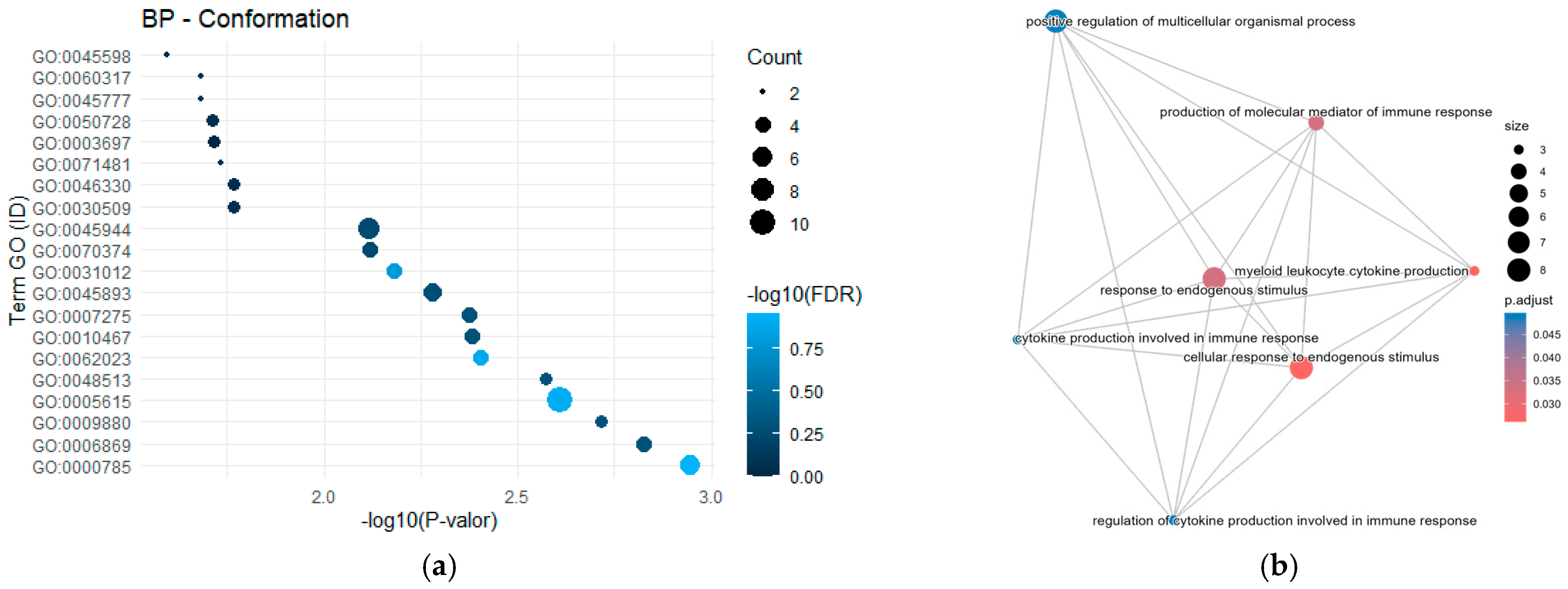
No single gene stood out with consistently high frequency across all traits; however, several genes were recurrently reported for specific traits, indicating trait-dependent genetic associations. For the morphological traits GO analysis for Biological Processes revealed the term GO:0045944-positive regulation of transcription by RNA polymerase II, enriched with seven genes (NFYA, IHH, NUCKS1, BMPR1B, TLR4, WNT2 and PPARD) and an FDR value of 0.571 (Figure 1a). Although this term did not reach statistical significance, its identification suggests a biological trend that could be further explored in studies with greater statistical power.
It is important to clarify that the frequency of a gene’s occurrence across the compiled studies primarily reflects the degree of research attention it has received in the literature for a given trait. This metric is useful for identifying recurrent candidate genes but does not directly correlate with their effect size, functional impact, or causal relationship to the phenotype. This interpretive caveat applies to all gene frequency mentions throughout the results section.
The semantic network visualization (Figure 1b) illustrates the functional interrelationships among the enriched GO terms, showing a clustering pattern primarily associated with immune and cell signaling functions, suggesting potential shared regulatory pathways among genes linked to body conformation. The most significant term was “positive regulation of multicellular organismal process,” which displayed high connectivity with other biologically related terms.
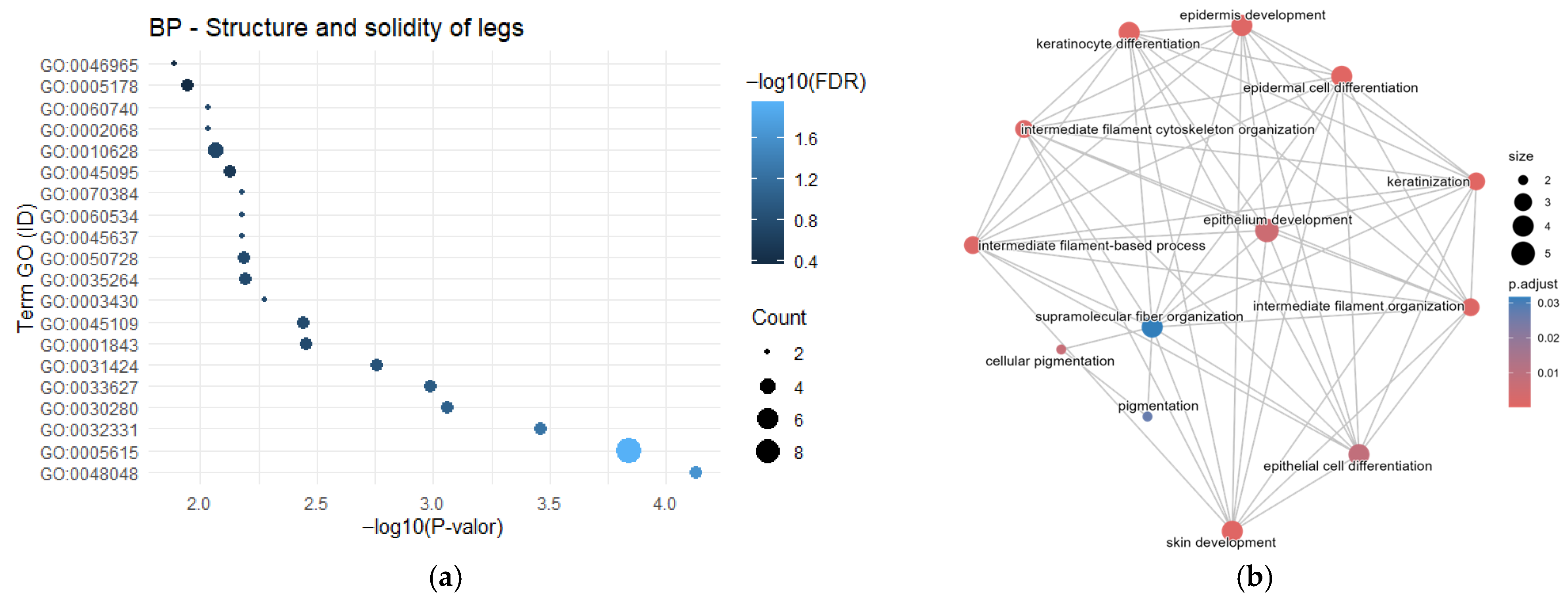
Genes associated with leg strength in pigs have been previously reported. In this study, the GLP1R gene was identified in two independent studies, whereas HOMER1 appeared in three studies. The GO enrichment analysis revealed 20 annotated classifications (Figure 2a). The term GO:0010628-positive regulation of gene expression was enriched with four genes (RARG, CALCR, ITGB7 and WNT16), while GO:0032331-negative regulation of chondrocyte differentiation was enriched with three genes (RARG, IHH and ITGB7), showing an FDR of 0.053. Conversely, the semantic network (Figure 2b) displayed multiple interactions among the terms “epithelial cell differentiation”, “skin development”, and “keratinocyte differentiation”, indicating a high level of significance and suggesting shared molecular mechanisms related to tissue differentiation and limb development.
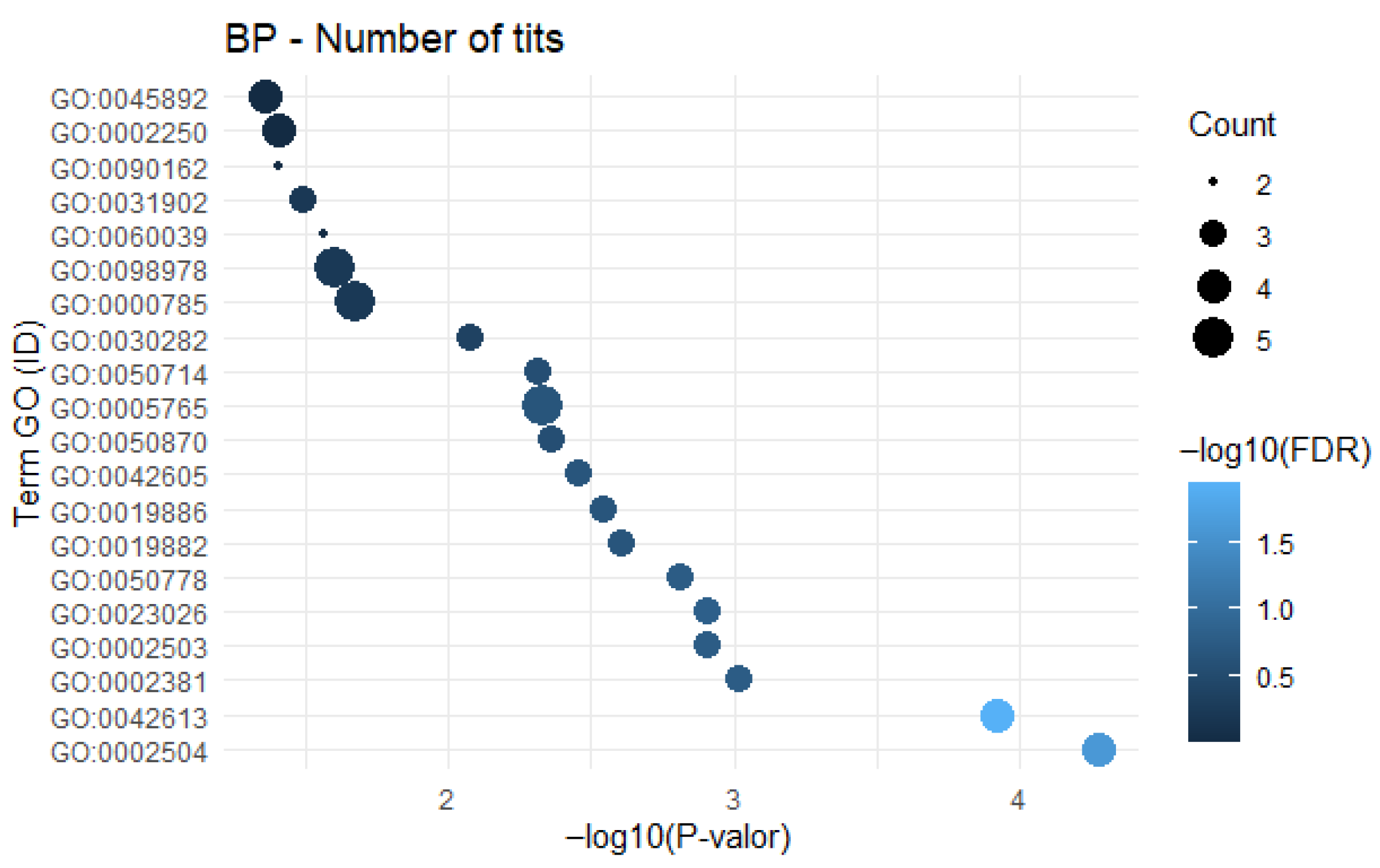
For teat number, the VRTN (Vertebrae Development Associated) gene was identified with a frequency of 17 studies, followed by ABCD4, reported in four studies, and PTHLH (Parathyroid Hormone-Like Hormone), reported in two studies. These results indicate that VRTN, ABCD4 and PTHLH exhibit recurrent frequency across studies, suggesting a strong association with body conformation traits. A total of 71 genes were included in the GO analysis performed on both platforms. The GO enrichment analysis revealed 22 annotated biological process classifications (Figure 3). The terms GO:0002504-antigen processing and presentation of peptide or polysaccharide antigen via MHC class II, and GO:0002250-adaptive immune response, were enriched with four genes (SLA-DQB1, SLA-DRB1, SLA-DQA1 and SLA-DRA), showing FDR values of 0.024 and 0.993, respectively.
The term GO:0050714-positive regulation of protein secretion showed suggestive enrichment (p-value = 0.0049), involving three genes (TGFB3, FRMD4A and ARF6). However, this result did not survive strict multiple-testing correction (FDR = 0.27) and is therefore not statistically significant according to our threshold. It is presented here as a suggestive biological trend that merits validation in future, targeted studies. No semantic network was plotted for the genes reported in relation to teat number.
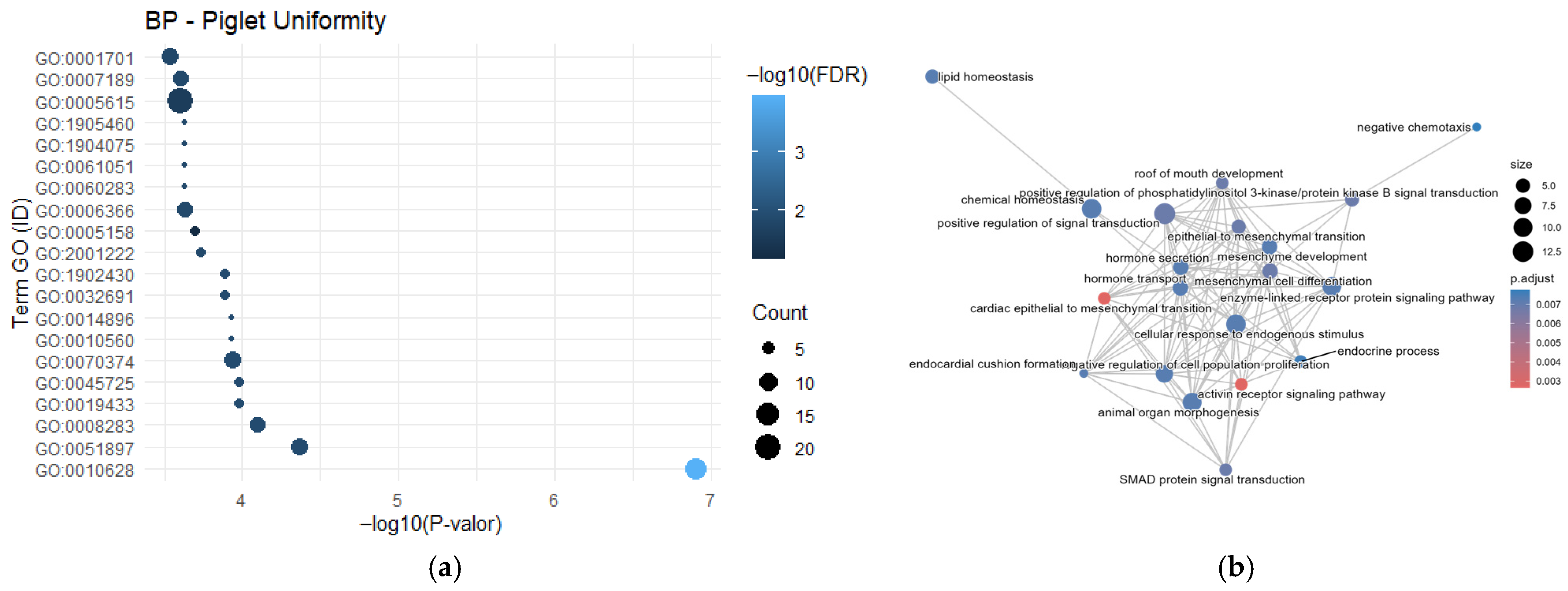
For the litter uniformity trait, only the genes SMAD2 and BMP2 were identified, each reported in two independent studies. A total of 140 genes were included in the Gene Ontology analysis using the DAVID platform. The GO enrichment analysis for Biological Process (BP) terms revealed a significant enrichment for GO:0008283-cell population proliferation, which involved five genes (SMAD2, NDST1, SMAD4, PDGFA and IGF1) with a false discovery rate (FDR) of 0.012034.
Additionally, the term GO:0010628-positive regulation of gene expression was found to be highly enriched, comprising twelve genes (SMAD2, SEC16B, SMAD4, BMP2, CALCR, IL1B2, GPER1, KPNA7, INHBA, IGF1, WNT16 and APOB) with an FDR of 1.17 × 10⁻⁴ (Figure 4a).
The semantic network (Figure 4b) of genes associated with litter uniformity revealed multiple interactions among the activin receptor signaling pathway and cellular response to estradiol stimulus, as well as additional processes including hormone secretion, hormone transport, SMAD protein signal transduction, and lipid homeostasis.
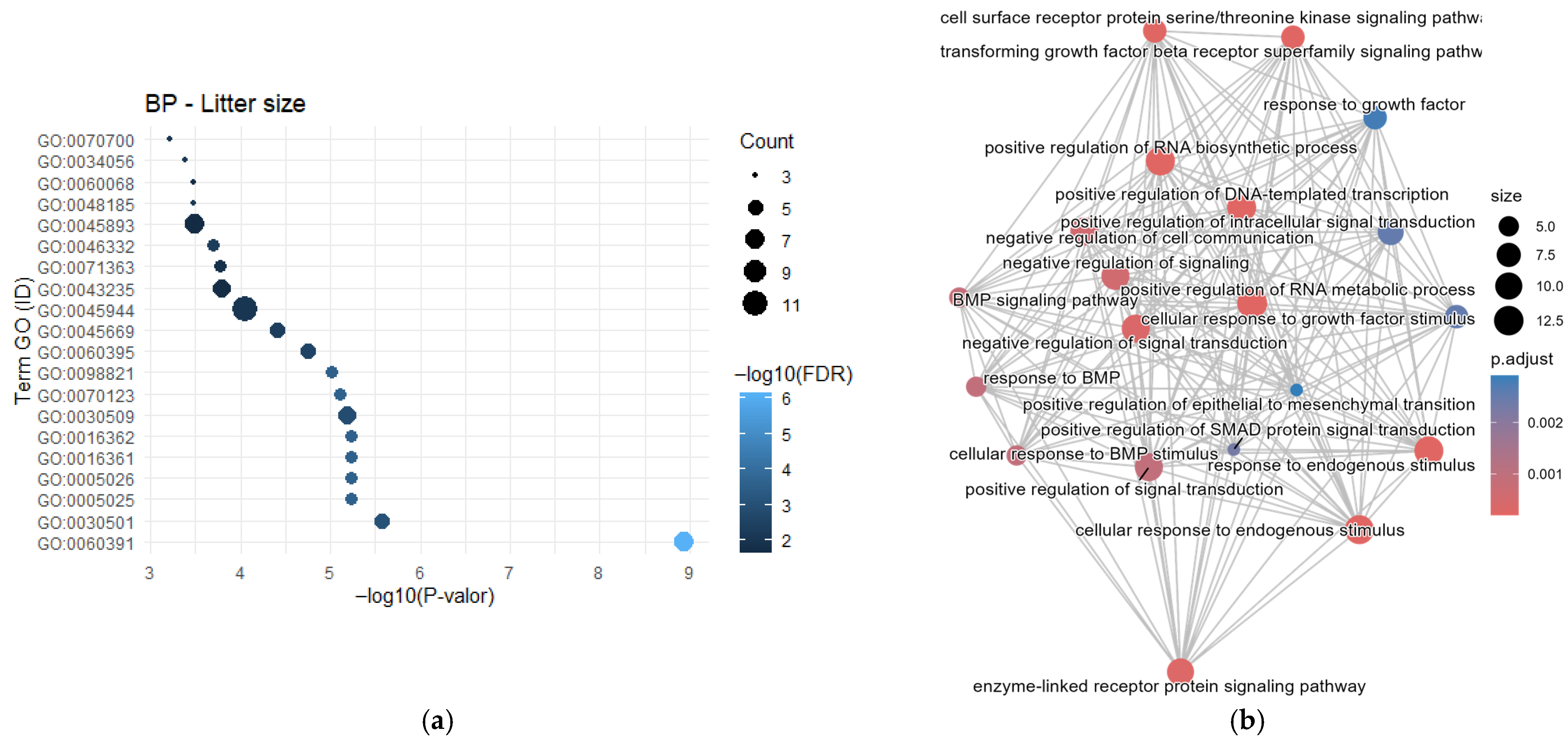
For the litter size (prolificacy) trait, four genes (ESRRG, MAP1LC3A, ESR1 and ZFYVE9) were identified with a frequency of two studies each, while the gene BMPR1B was reported in three studies. A total of 75 genes were annotated and included in the GO analysis using the DAVID platform (Figure 5a).
The GO term GO:0060391~positive regulation of SMAD protein signal transduction was enriched in seven genes (ACVR1, INHBA, BMP7, ACVR2A, BMP6, BMP5, and TGFBR2), showing an FDR of 7.34 × 10⁻⁷. The semantic network (Figure 5b) reveals a distribution of functional and biological links related to reproductive activity, highlighting the TGF-β/BMP signaling pathway, which is mediated by serine/threonine kinase receptors, as well as SMAD proteins and the intracellular signaling cascade. A general activation of gene transcription processes, such as “RNA biosynthetic process” and “DNA-templated transcription”, was also observed. These processes suggest a role in maintaining epithelial homeostasis and in the cellular response to stimuli associated with reproductive activity in sows.
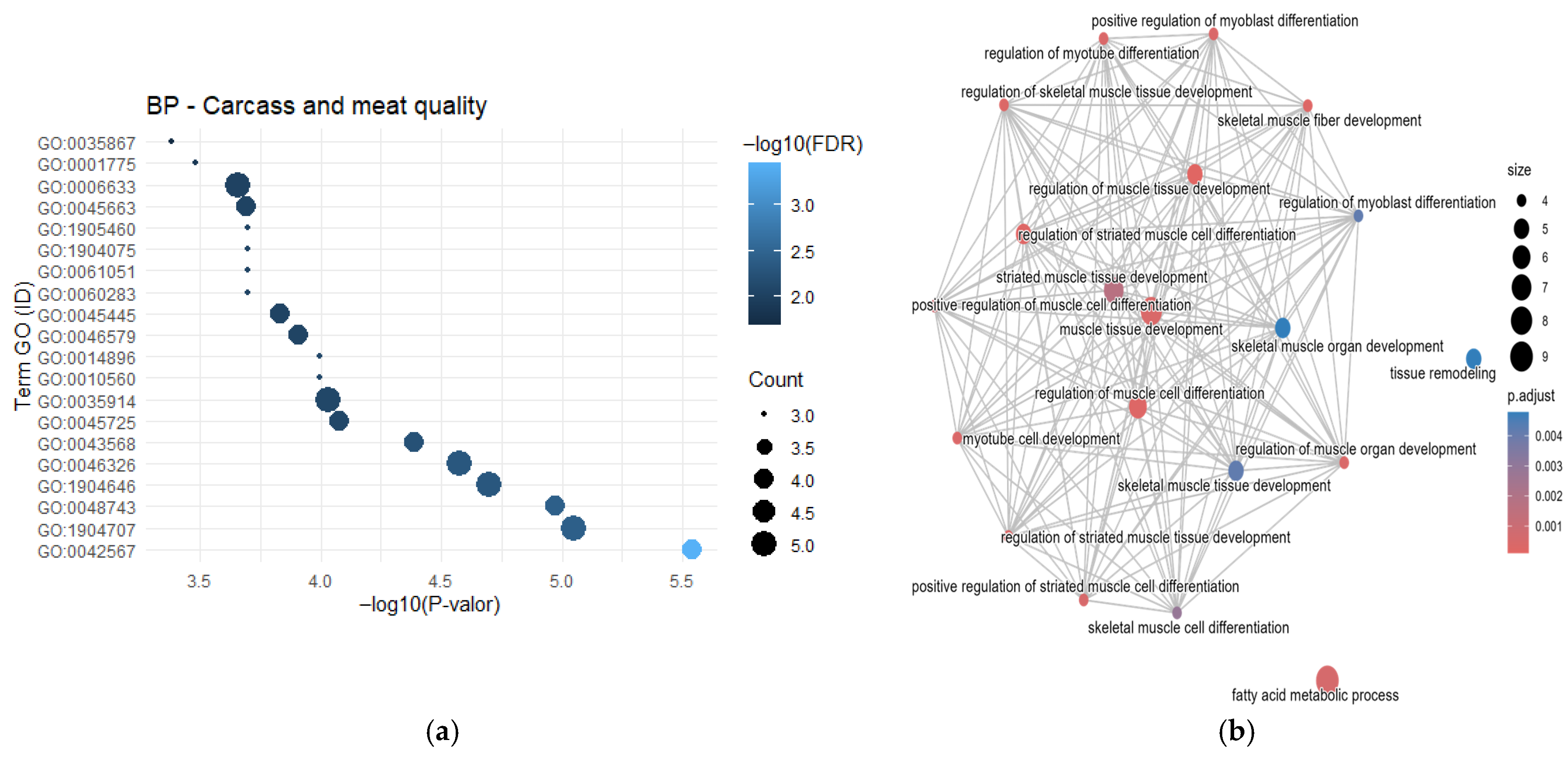
For carcass quality traits, only two studies were found reporting the frequency of each of the following genes: ACACA, GRM4, TNNI1 and TNNI2. A total of 119 genes were annotated in the GO analysis. Among these, the most significant genes identified using DAVID were IGF1, MYOG, MYOD1, MYF6, MYF5, FOS and IGFBP, whereas in clusterProfiler, the most relevant genes were MYOG, MYF5, MYOD1, MYF6, BMP2, IGFBP5, AKIRIN2, SGCZ and METTL8. The GO terms associated with these traits include GO:0045663-positive regulation of myoblast differentiation (IGF1), GO:0035914-skeletal muscle cell differentiation (MYOG, MYOD1, MYF6, FOS and MYF5), GO:1904707~positive regulation of vascular-associated smooth muscle cell proliferation (ERN1, IGFBP5 and IGF1), and GO:0042567~insulin-like growth factor ternary complex (IGFBP5 and IGF1) (Figure 6a).
The semantic network for genes reported in association with carcass and meat quality traits revealed strong interactions among the terms “regulation of muscle organ development”, “skeletal muscle tissue development” and “regulation of myoblast differentiation”. This indicates a close relationship between muscle tissue development and differentiation and fatty acid metabolism, suggesting that these genes influence key meat quality attributes such as tenderness, marbling, texture, and consistency (Figure 6b).

3.2. Protein–Protein Interaction Networks (STRING)

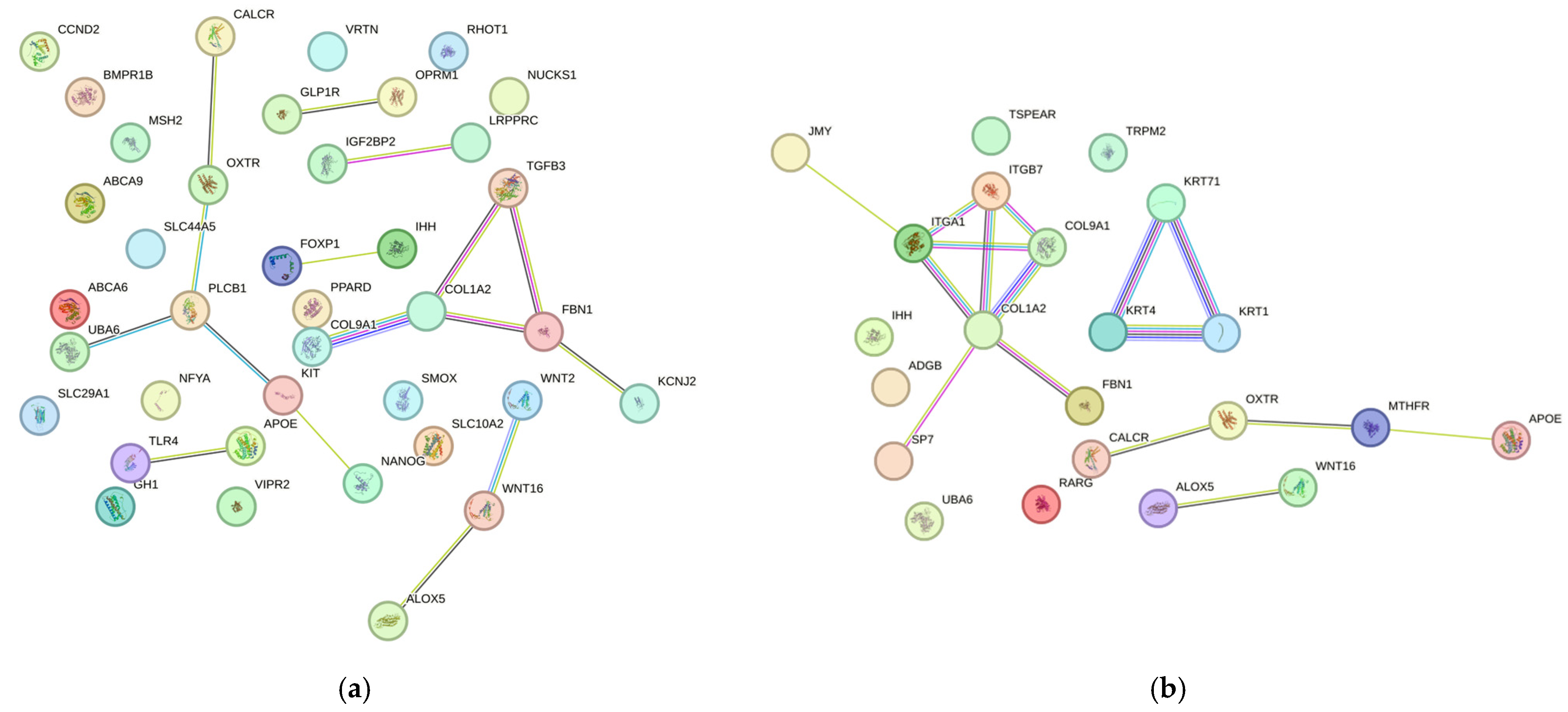
To understand the functional relationships among the genes, a PPI analysis was performed using STRING. For the conformation trait, the PPI network highlighted hub genes including COL1A2, TGFB3, and FBN1, with the COL1A2-FBN1 interaction showing the highest confidence score (0.867). Across all traits, notable interactions included: SMAD4-SMAD2 (0.999) for litter uniformity, ACVR2A-INHBA (0.987) for litter size, HLA-DRA-SLA-DRB1 (0.936) for teat number, and ACACA-FASN (0.999) for meat quality (Table S2). The analysis revealed genes with high connectivity (hub genes, high node degree), highlighting proteins such as COL1A2, TGFB3, FBN1, WNT2, WNT16 and KIT, which showed the greatest number of interactions within the network (Figure 7a). The OPRM1 gene was identified in the metabolic pathways ssc04081: Hormone signaling and ssc04080: Neuroactive ligand–receptor interaction.
For the structure and leg strength trait, the PPI analysis included 21 related genes (Figure 7b). The network contained 15 key genes: JMY, TSPEAR, ITGB7, TRPM2, KRT71, COL9A1, KRT4, KRT1, FBN1, CALCR, RARG, ALOX5, WNT16, MTHFR and APOE. The proteins showing the highest interaction were enriched in the metabolic pathways ssc04512: ECM–receptor interaction and ssc04151: PI3K–Akt signaling pathway, particularly involving the genes COL1A2, ITGB7, COL9A1 and ITGA1.
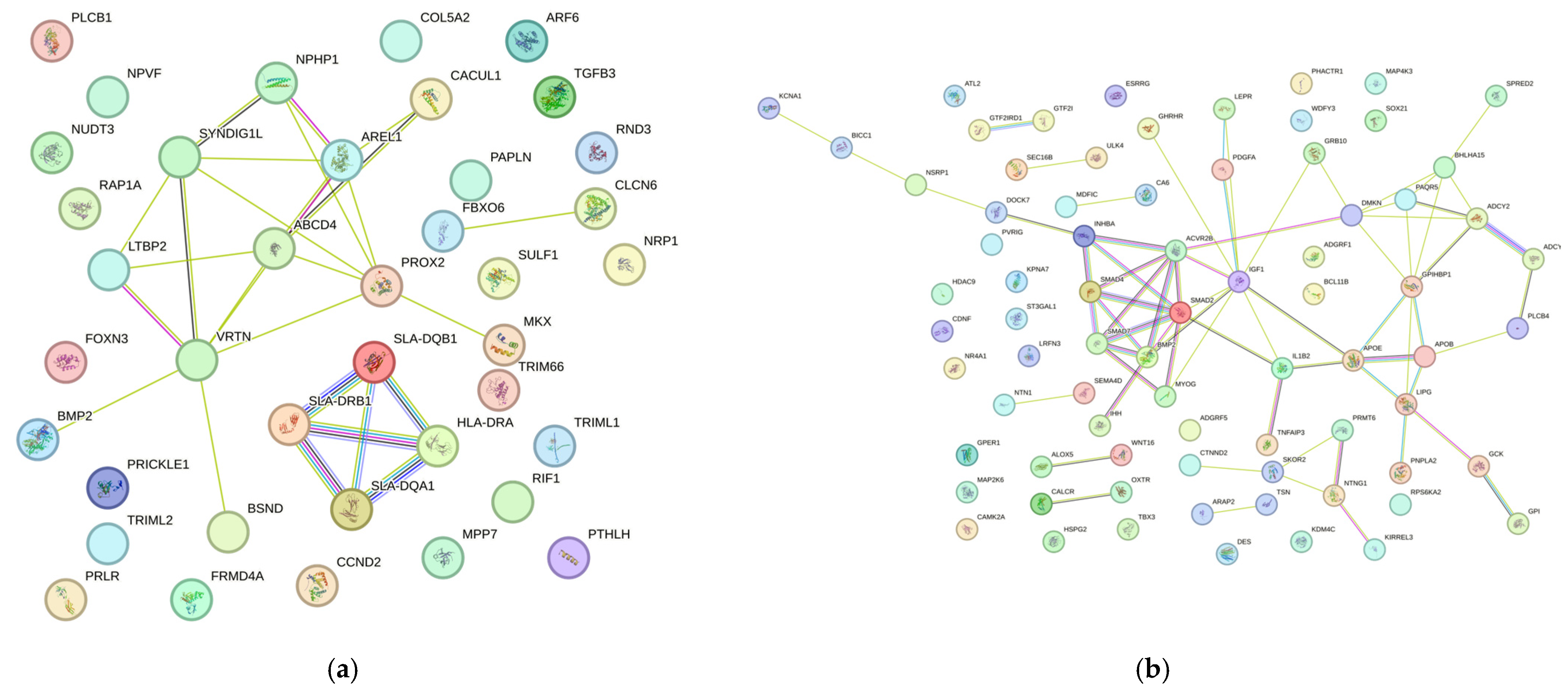
The PPI network analysis for the number of teats, an important trait related to milk production, included a total of 41 genes analyzed using STRING. The generated network revealed several highly connected nodes (hubs), with ABCD4, AREL1, PROX2 and VRTN showing the highest number of interactions within the network (Figure 8a). This suggests a possible functional coordination among these genes in determining the number of teats. The metabolic pathway with a potential effect on mammary gland development was ssc05321: Inflammatory bowel disease, identified in the TGFB3 gene. The PPI network analysis for the litter uniformity trait, which reflects the even growth of piglets within a litter, included a total of 76 genes analyzed using STRING. Among the most highly connected hubs were ACVR2B, BMP2, SMAD2, SMAD4, SMAD7, IGF1, DMKN and BHLHA15 (Figure 8b). The enriched signaling pathways associated with these genes included ssc04550: Signaling pathways regulating pluripotency of stem cells, ssc04350: TGF-beta signaling pathway, ssc04935: Growth hormone synthesis, secretion and action, and ssc04913: Ovarian steroidogenesis.
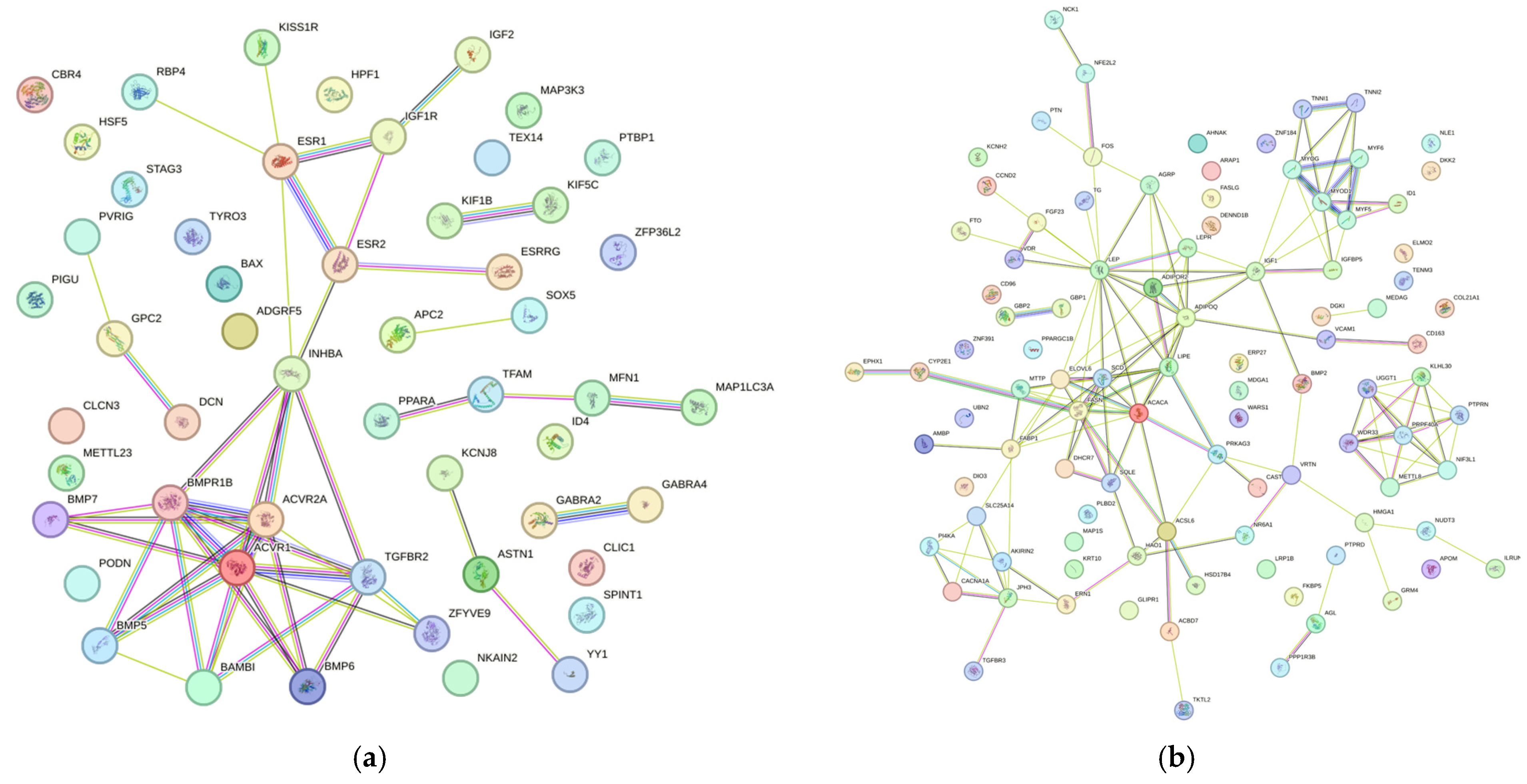
The PPI network analysis for the litter size trait, which reflects the overall growth performance of the litter, included a total of 52 genes analyzed using STRING. The analysis revealed a set of central hub nodes primarily involved in the TGF-β and BMP signaling pathways, which play essential roles in embryonic development and cell proliferation. Among the identified hub genes were ACVR1, ACVR2A, BMPR1B, BMP5, BMP6, BMP7, INHBA, TGFBR2, ESR1 and ESR2 (Figure 9a). In addition, peripheral nodes such as ASTN1, GPC2, PVRIG, KIF1B and KIF5C were observed, exhibiting fewer interactions and potentially acting as modulators of specific biological processes in pigs.
The PPI network analysis for the carcass and meat quality trait, an economically important characteristic, revealed regulation primarily through metabolic processes. A total of 99 genes were analyzed using STRING. Among the central hub genes identified were ACACA, FASN, SCD, ELOVL6, ADIPOQ, LEP and PRKAG3 (Figure 9b). The main metabolic pathways associated with carcass and meat quality included ssc04152: AMPK signaling pathway, ssc04920: Adipocytokine signaling pathway, and ssc01212: Fatty acid metabolism.

4. Discussion

This study provides an integrated overview of the functional mechanisms underlying morphological, productive, reproductive, and carcass and meat quality traits in pigs.
For carcass quality traits, the GO terms associated with these traits include GO:0045663-positive regulation of myoblast differentiation (IGF1) and GO:0035914-skeletal muscle cell differentiation.

4.1. Morphological Characteristics

Morphometric traits are recognized as key phenotypic indicators in livestock and play a crucial role in phenotype-based selection strategies [21]. The functional enrichment analysis performed using DAVID identified FBN1, COL1A2, PLCB1, KIT, WNT16 and APOE as the principal genes associated with phenotypic conformation. Furthermore, the STRING network analysis revealed additional enrichment of APOE, VIPR2, CALCR and GLP1R, supporting their involvement in extracellular matrix organization and bone development. These findings suggest that the coordinated activity of these genes contributes to the structural integrity and morphogenetic architecture that underlie body conformation in pigs.
It has been observed that the FBN1 (Fibrillin-1) gene contributes to both the structural and instructive information that flows to and from the cell, orchestrating tissue formation, homeostasis, and repair [22]. The FBN1 gene is strongly linked to TGF-β3 (Figure 7a) within conformation-related traits, as one of the principal functions of FBN1 is its ability to regulate the bioavailability and activation of TGF-β3, a key growth factor involved in tissue and skeletal system development. The regulation and association between FBN1 and TGF-β3 are of critical importance in the organism, since it is well known that mutations in the FBN1 gene can cause an autosomal dominant disease that affects connective tissue. This condition is characterized by various abnormalities in the bones, ocular tissues, and the cardiovascular system [23]. Moreover, a strong expression and correlation were also observed with the COL1A2 (Collagen Type I Alpha 2 Chain) gene, which encodes type I collagen. Variants of this gene have been associated with low bone mass and increased susceptibility to fractures [24].
On the other hand, the STRING analysis revealed a strong relationship among APOE, UBA6 and PLCB1. The APOE (Apolipoprotein E) gene is a component of plasma lipoproteins that plays an important role in the transport and metabolism of cholesterol and other lipids [25]. The UBA6 (Ubiquitin Like Modifier Activating Enzyme 6) gene encodes an activating enzyme that regulates numerous cellular processes, including protein turnover, iron homeostasis, and cell development [26]. Meanwhile, PLCB1 (Phospholipase C Beta 1) encodes a protein that enables the use of calcium as a cofactor and plays a key role in the intracellular transduction of multiple extracellular signals. The results obtained in the present study confirm the findings reported by Fan et al. [27], reported that the CALCR and COL1A2 genes are significantly associated (p < 0.05) with calcium metabolism and body size traits (length, depth, and width). Overall, these associations provide evidence of the strong interrelationship among genes and proteins involved in lipid and protein metabolism, as well as calcium regulation processes that are fundamental to conformation-related traits.
Similarly, according to the results obtained from the GO and STRING analyses, the conformation trait is polygenic and does not depend on a single gene. Although gene expression is important, the genotype-environment interaction is responsible for determining the phenotype. Furthermore, gene expression depends on allelic frequencies as well as on transcriptional regulatory patterns that are characteristic of each population [28].
For the leg strength trait, the main genes identified were RARG, ITGB7, FBN1, KRT4, COL1A2, IHH and KRT71, as determined by the functional analysis performed using DAVID (Figure 2a). The RARG gene (Retinoic Acid Receptor Gamma) encodes a retinoic acid receptor that functions as a potent cellular regulator and belongs to the nuclear hormone receptor family. Liu et al. [29], demonstrated that inhibition of RARG in mesenchymal cells increases the expression of chondrogenic genes such as Sox9 and Col2a1, suggesting a direct regulatory role in the cartilage formation pathway. Moreover, mice with the Rarg^Δ/Δ genotype exhibit reduced trabecular bone mass and an increased number of trabecular osteoclasts. Therefore, RARG expression in Prrx1-Cre–targeted cells directly regulates endochondral bone formation and indirectly influences tibial vascularization [30].
The STRING analysis for the leg strength trait (Figure 7b) revealed a strong association among different gene clusters. On one side, a strong interaction was observed among ITGB7, ITGB1, COL9A1, COL1A2 and SBN; on the other side, a marked association was identified among KRT71, KRT1 and KRT4.
The ITGB7 (Integrin Subunit Beta 7) gene encodes a protein belonging to the integrin superfamily. This gene is regulated by kisspeptin, which acts by increasing progesterone secretion and promoting cell proliferation, thereby reducing apoptosis in ovarian granulosa cells [31]. As previously mentioned, the FBN1 (Fibrillin 1) gene is an essential component of the extracellular matrix microfibrils. In skeletal tissues, despite its low abundance, FBN1 is fundamental for the organization of elastic and collagen fibers and for regulating the bioavailability of growth factors such as TGF-β and BMP [32]. Fibrillin-rich microfibrils are present in all connective tissues and form part of the structural framework specific to each tissue, conferring essential physical and mechanical properties-either alone or together with elastin within elastic fibers [33]. In humans, mutations in the FBN1 gene have been identified with negative effects on the structure and function of the limbs [34]. Consistent with the associations observed in this study by Fan et al. [27], reported that genes such as APOE, CALCR, OXTR, OPG and MTHFR directly influence leg strength and locomotion. In the present analysis, the COL1A2 gene stands out, as it appears in two main network nodes by Body Conformation and Leg Strength, highlighting its biological relevance (Figure 8b).
On the other hand, the KRT71, KRT4 and KRT1 genes are involved in the formation of keratin filaments and other structural proteins essential for the assembly of keratin networks [35]. Keratin is a key protein responsible for the structural integrity of skin, hair, and nails; therefore, the interactions observed among these genes indicate that they are crucial elements for the selection of productive traits in pigs.
Finally, the STRING network analysis for the Leg Strength trait revealed a strong association between WNT16 and ALOX5. The WNT16 (Wnt Family Member 16) gene plays a fundamental role in the establishment of digit patterning during limb development in vertebrates. Meyers et al. [36] reported that WNT16 acts as a combined mitogenic and pro-osteogenic stimulus, potentially playing a functional role in bone repair mediated by human mesenchymal stem cells. This gene is therefore significantly involved in osteogenic differentiation during developmental stages. In contrast, the ALOX5 (Arachidonate 5-Lipoxygenase) gene is implicated in the regulation and proliferation of myoblasts, playing an essential role in muscle growth and development [37]. Consequently, mutations or overexpression of this gene could directly affect muscle formation and overall growth performance.
Considering the results from the GO and PPI analyses for the conformation trait, the genes analyzed demonstrated their importance through their ability to regulate both morphological integrity and locomotor functionality.

4.2. Productive Performance

Productive performance is one of the most important parameters within production systems. These traits are largely determined by the females, in which the phenotype–environment interaction influences piglet weight during growth and at weaning [38,39].
The genes identified for number of teats, enriched in the DAVID analysis, included BMP2, TGFB3, PRLR, PTHLH, PRICKLE1, PROX2 and MKX. In contrast, for milk production, the enriched genes were PRLR, TGFB3, BMP2, PTHLH, SLA-DQA1, SLA-DRB1, SLA-DQB1 and CCND2.
The BMP2 (Bone Morphogenetic Protein 2) gene plays a key role in chondrogenesis, a process involved in the formation of cartilage from mesenchymal cells, which is crucial for teat development. Wang et al. [40], reported that a combination of BMP2 and TGF-β3 promotes the chondrogenic differentiation of bone marrow-derived mesenchymal stem cells (BMSCs). In Duroc × (Landrace × Yorkshire) crossbred pigs, a mutation (rs320706814) in the BMP2 gene affects carcass length due to its role in bone growth and development [41]. Hong et al. [42], reported an association between the BMP2 and ABCD4 genes and their influence on body length in sows, which consequently affects the number of teats. The correlation between these genes suggests that a greater body length in sows corresponds to a higher number of teats available for piglets. Indeed, in Duroc × (Landrace × Yorkshire) hybrid pigs, among the genes associated with body weight and conformation, BMP2 was identified as a pleiotropic gene due to its effects on multiple traits in these hybrids [43]. Meanwhile, the TGFB3 (Transforming Growth Factor Beta 3) gene is involved in several important cellular functions, including cell proliferation and differentiation, as well as the growth and development of theca and granulosa cells [44]. On the other hand, the PRLR (Prolactin Receptor) gene has been shown to influence growth traits in livestock [45]. In Holstein cattle, two polymorphisms (g.9206G > A and g.9681C > T) have been identified, both exhibiting a positive effect on milk production [46]. In indigenous Hungarian pigs, the most advantageous AA genotype was the least frequent (8.75%), whereas the BA and BB genotypes accounted for 40% and 51.25%, respectively. However, the AA genotype was associated with the largest litter size [47].
On the other hand, the STRING analysis for the number of teats trait revealed a strong interaction among ABCD4, AREL, VRTN, LTBP2, NPHP1, CACUL1 and SYNDIG1L. Likewise, a strong association was also observed among SLA-DRB1, SLA-DQB1, SLA-DQA1 and SLA-DRA (Figure 9a).
The strong correlation among SLA-DRB1, SLA-DQB1, SLA-DQA1 and SLA-DRA can be explained by the fact that these genes belong to the porcine leukocyte antigen (SLA) class II complex, which comprises highly polymorphic gene clusters that play an active role in immune response. These genes encode cell-surface glycoproteins involved in responses to vaccines, infectious diseases, and productive traits. It has been reported that pigs carrying homozygous SLA haplotypes at immunologically relevant loci exhibit greater consistency in their immune responses to allografts and xenografts [48], suggesting that the expression of this gene complex could serve as a useful selection criterion for animals intended for xenotransplantation studies.
For Litter uniformity (birth and weaning weight of piglets), the genes showing the highest significance in the DAVID analysis were IGF1, BMP2, SMAD2/4, INHBA, PDGFA, GHRHR, CALCR, GPER1, APOE and APOB. In contrast, the most significant genes identified using clusterProfiler were SMAD4, BMP2, TBX3, WNT16, SMAD7, INHBA, ACVR2B, GPER1 and IGF1.
The IGF1 (Insulin-Like Growth Factor 1) gene regulates growth factors and energy metabolism in domestic animals [49]. In lambs from different breeds and their crosses, a SNP (g.0.195C > T) in the IGF1-R gene has been identified, showing a significant effect on growth traits [50]. In Landrace and Lantang pigs, the hepatic mRNA and/or serum protein levels of members of the IGF system are significantly correlated at different ages, acting in coordination to regulate growth performance and carcass composition in these breeds [51]. A study by Pierzchała et al. [52], reported breed-specific differences in the hepatic gene expression of GHR, IGF1R, IGF1 and IGF2 at various developmental stages in primiparous gilts, with the highest expression level of IGF1 observed in Pietrain gilts at 60 and 90 days of age. The SMAD2/4/7 (SMAD Family Member 2, SMAD Family Member 4, and SMAD Family Member 7) genes are components of the Transforming Growth Factor Beta (TGF-β) signaling pathway and exhibit transcriptional activity. Their phosphorylation activity has been observed in association with myostatin, promoting muscle fiber growth [53]. However, there is limited information available regarding the role of SMAD genes in developmental processes.
Moreover, the STRING analysis for the litter uniformity trait revealed strong associations among BMP2, SMAD2, SMAD7, SMAD4, INHBA, ACVR2B and MYOG, as well as a significant interaction between ADCY2 and ADCY. The close relationship between BMP2 and SMAD genes can be explained by their joint participation in the TGF-β signaling pathway, which regulates cellular activity and tissue growth. Similarly, the strong correlation between ADCY and ADCY2, illustrated in Figure 9b, reflects the influence of multiple genes on litter uniformity. Wang et al. [54] reported that ADCY and ADCY2 are involved in key processes related to embryonic development, energy metabolism, and cell differentiation, underscoring their functional role in determining this trait.
Taken together, these findings emphasize the importance of considering the interaction among multiple genes and signaling pathways to better understand the genetic variability of reproductive traits in pigs, providing molecular evidence supporting the link between gene expression and reproductive phenotype.

4.3. Reproductive

Reproductive activity in both females and males is regulated by multiple genes; however, heritability is generally low. Consequently, reproductive failure is a common reason for the culling of females from production systems [55].
Genes associated with reproduction. Among the genes showing the highest significance for litter size are ACVR1, ACVR2A, BMPR1B, BMP7, BMP6, BMP5, INHBA and TGFBR2. In contrast, the genes most significantly enriched in the clusterProfiler analysis were SMAD2, SMAD3, SMAD4, GDF9, BMPR2, FSHR, ESR1 and LHCGR.
The ACVR1 (Activin A Receptor Type I) and ACVR2A (Activin A Receptor Type IIA) genes belong to the TGF-β ligand family, which performs multiple biological functions in embryonic stem cells as well as in differentiated tissues [56]. These genes are also crucial for skeletal development, including the formation of bones and cartilage [57]. A study conducted by Li et al. [58], in Yorkshire pigs with high and low prolificacy identified the SNP rs342908929, located near the ACVR1 gene, showing a significant association (p < 0.05) with total number born (TNB), number born alive (NBA), and litter weight in this breed. The SMAD2/3/4 (SMAD Family Member 2, SMAD Family Member 3, and SMAD Family Member 4) genes play a major role in ovarian function, particularly in follicular development, atresia, and follicle selection [59,60]. In Tibetan sheep, two loci have been identified: g.10729C > T in the SMAD1 gene (genotype CC) and g.21447C > T in the SMAD3 gene (genotype TT), both of which are associated with increased litter size (p < 0.05 [59]. The ESR1 (Estrogen Receptor 1) gene in females is also associated with increased litter size [61,62].
The STRING analysis confirmed the GO analysis for the litter size trait, highlighting a strong interaction among INHBA, BMP7, BMPR1B, BMP5, BMP6, BAMBI, ACVR, ACVR2A and TGFBR2 (Figure 9a). Bone morphogenetic proteins (BMPs) belong to the transforming growth factor (TGF)-β superfamily, a group of signaling molecules that mediate a wide range of biological processes, from early embryonic tissue formation to postnatal tissue homeostasis [63]; Therefore, the strong relationships observed in the STRING network underscore the importance of these genes’ expression in genetic selection for this trait.
Additionally, the STRING analysis revealed a significant association between the ESR1, ESR2, IGF1R, IGF2 and ESRRG genes and litter size. The estrogen receptors (ESR1 and ESR2) function as transcription factors predominantly expressed in female reproductive tissues, where they play a crucial role in regulating hormonal processes. According to Muñoz et al. [62], the ESR2 gene participates in estrogenic functions related to follicular maturation and embryonic development during the peri-implantation phase. Similarly, IGF2 is involved in signaling mechanisms associated with cell growth and differentiation. Taken together, the differential expression and close relationship of these genes with fertility suggest their determinant contribution to the genetic variability of litter size in pigs.
Other significant associations were identified for the KIF1B, KIF5C, GABRA2 and GABRA4 genes (Figure 9a). These results are consistent with those reported by Zhang et al. [64], who indicated that these and other related genes are potential candidates that provide new insights into the genetic basis of litter traits in pigs, which could be useful for improving reproductive performance in sow breeding programs.
The KIF1B (Kinesin Family Member 1B) and KIF5C (Kinesin Family Member 5C) genes belong to the kinesin family, which encodes motor proteins involved in intracellular transport along microtubules. In pigs, their expression has been associated with key cellular processes in reproduction, including oocyte maturation, apoptosis, and cell communication [65]. Genetic variations within these loci may alter the efficiency of these mechanisms, thereby influencing fertility and embryonic survival, which in turn directly affects litter size.

4.4. Carcass and Meat Quality

The most significant genes associated with carcass and meat quality identified through the DAVID analysis were MYOG, MYOD1, MYF5, MYF6, FASN, SCD, LEP, ADIPOQ, BMP2 and IGF1, while those showing the highest significance in the clusterProfiler analysis included FOS, IGFBP5, TGFBR3, FGF23, LEPR, ELOVL6, PPARGC1B, VCAM1, PTN and CCND2.
The MYOD1 (Myogenic Differentiation 1) gene belongs to the myogenic regulatory factor (MRF) family [66] and plays a key role in myogenesis and, consequently, in determining muscle fiber characteristics [67]. The MYOG, MYOD1 and MYF5 genes function in a regulatory cascade, controlling the expression of myogenic regulatory factors within different prenatal and postnatal myogenic cells [68]. In Yorkshire and Berkshire pig breeds, two SNPs g.489C > T and g.1264C > A, were identified in the MYOD1 gene; these polymorphisms are significantly associated with muscle fiber traits, loin eye area, and meat lightness [69]. The FASN (Fatty Acid Synthase) gene encodes an enzyme responsible for the de novo synthesis of long-chain fatty acids. During oncogenesis, it plays a role in cell growth and survival, rather than functioning solely in energy storage pathways [70]. A study by Dzib-Cauich et al. [71], evaluated the expression of genes related to fatty acid profiles and lipid metabolism (SCD, SREBP1, FASN and ACP) in Pelón Mexicano and Landrace-Yorkshire pig breeds. The results indicated that these genes have a significant effect in the Pelón Mexicano breed, where their expression contributes to a higher intramuscular fat content in the Longissimus dorsi muscle.
The SCD (Stearoyl-CoA Desaturase) gene plays a key role in intramuscular fat content and is responsible for the biosynthesis of oleic acid (C18:1) from stearic acid (18:0) [72]. A study conducted by Estany et al. (2014), in Duroc pigs and their crossbreeds provided evidence of three SNPs (g.2108C > T; g.2228T > C; g.2281A > G) located in the promoter region, which were associated with an increased 18:1/18:0 ratio in both muscle and subcutaneous fat, but not in the liver [73]. In this regard, Liu et al. [74], demonstrated that low expression of the SCD gene impairs porcine adipocyte differentiation. The LEPR (Leptin Receptor) gene, located on SSC6, influences backfat thickness (BF), fat area proportions, and serum leptin concentration (LEPC) [75]. Moreover, LEPR is associated with fatty acid composition in muscle tissue and contributes to increased intramuscular fat, resulting in a higher proportion of saturated fatty acids (SFA), lower levels of polyunsaturated fatty acids (PUFA), and an increased SFA/PUFA ratio [72]. In Hanwoo cattle, two loci (g.16024A > G and g.10329C > T) have been identified as being associated with fatty acid composition, adipogenic gene expression, and carcass traits, revealing a systemic interaction between genetic factors and adipogenesis in this breed [76].
The STRING analysis revealed a strong interaction among the genes MYF6, MYOG and MYOD1; EPHX1, CYP2E1, MTTP, FASN and ACACA; as well as WDR33, NF3L1, UGGT1, PRPF40A and METTL8, all associated with meat and carcass quality traits (Figure 9b).
A study conducted by Cho et al. [77] on the functional relevance of the EPHX1 gene demonstrated that the nsSNP c.685T > G showed significant effects on meat color, protein content, collagen content, and in 24 h. These findings suggest that the c.685T > G polymorphism in EPHX1 may serve as a promising DNA marker for improving economically important traits in pigs.
Ropka-Molik et al. [78], reported that the MTTP gene can be considered a candidate gene influencing pork meat quality traits. The expression of MTTP (Microsomal Triglyceride Transfer Protein) is involved in lipid transport between membrane vesicles, a key mechanism for the assembly of chylomicrons, low-density lipoproteins (LDL), and very-low-density lipoproteins (VLDL). The biological importance of this protein lies in the fact that, in both humans and pigs, mutations in the MTTP locus have been shown to affect lipid transfer activity.
The genes FASN and ACACA exhibited a strong association with meat quality traits. These results are consistent with those reported by Piórkowska et al. [79] who evaluated mutations in the SCD, ACACA and FASN genes in relation to pork meat quality and other production traits. Their findings indicated that selection for the FASN A allele in Polish Large White pigs could improve meat quality characteristics such as water-holding capacity and meat color.

5. Conclusions

In conclusion, this integrative study demonstrates that economically important traits in pigs are regulated by complex and interconnected genetic networks. The identification of high-frequency genes such as VRTN and BMPR1B, together with the consistent enrichment in specific biological pathways such as SMAD/TGF-β and BMP signaling, underscores a shared molecular basis (pleiotropy) among morphological, reproductive, and carcass quality traits. The PPI network analysis confirmed the centrality of these genes within critical functional modules. Altogether, this functional characterization provides a valuable resource for genomic selection, enabling the prioritization of candidate genes and pleiotropic pathways for the simultaneous and more efficient improvement of multiple traits in pig breeding programs.

Supplementary Materials

The following supporting information can be downloaded at: https://www.mdpi.com/article/10.3390/cimb48020153/s1. References [27,42,43,54,58,62,64,80,81,82,83,84,85,86,87,88,89,90,91,92,93,94,95,96,97,98,99,100,101,102,103,104,105,106,107,108,109,110,111,112,113,114,115,116,117,118,119,120,121,122,123,124,125,126,127,128,129,130,131,132,133,134,135,136,137,138,139,140,141,142,143,144,145,146,147,148,149,150,151,152,153,154,155,156,157,158,159,160,161,162,163,164,165,166,167,168] are cited in the Supplementary Materials.

Author Contributions

Conceptualization, A.I.O.-T. and W.H.-M.; methodology, A.I.O.-T. and W.H.-M.; software, W.H.-M.; validation, W.H.-M., V.M.M.-V. and A.I.O.-T.; formal analysis, J.M.Z.-C., N.N.C.-C. and R.Z.-B.; investigation, V.M.M.-V. and D.A.D.-C.; data curation, J.A.-Z. and R.Z.-B.; writing—original draft preparation, W.H.-M., A.I.O.-T. and D.A.D.-C.; writing—review and editing, N.V.-J. and V.M.M.-V.; visualization, J.M.Z.-C., N.V.-J. and J.A.-Z.; supervision, A.I.O.-T., R.Z.-B. and N.N.C.-C. All authors have read and agreed to the published version of the manuscript.

Funding

This work was supported by the Tecnológico Nacional de México (Project No. 23473.25-PD), granted to N.N.C.-C.

Institutional Review Board Statement

Not applicable.

Informed Consent Statement

Not applicable.

Data Availability Statement

The raw data supporting the conclusions of this article will be made available by the authors on request.

Conflicts of Interest

The authors declare no conflicts of interest.

References

  1. Vicente, F.; Pereira, P.C. Pork Meat Composition and Health: A Review of the Evidence. Foods 2024, 13, 1905. [Google Scholar] [CrossRef]
  2. Dekkers, J.C.M. Opportunities to Improve Environmental Sustainability of Pork Production through Genetics. J. Anim. Sci. 2025, 103, skaf042. [Google Scholar] [CrossRef]
  3. Boonkum, W.; Permthongchoochai, S.; Chankitisakul, V.; Duangjinda, M. Genetic Strategies for Enhancing Litter Size and Birth Weight Uniformity in Piglets. Front. Vet. Sci. 2025, 12, 1512701. [Google Scholar] [CrossRef] [PubMed]
  4. Parraguez, M. Effect of Different Culture Conditions on Gene Expression Associated with Cyst Production in Populations of Artemia Franciscana. Front. Genet. 2022, 13, 768391. [Google Scholar] [CrossRef] [PubMed]
  5. Dzib-Cauich, D.A.; Meza-villalvazo, V.M.; Osorio-Teran, A.I.; Abad-Zavaleta, J.; Cob-Calan, N.N.; Hernández-Montiel, W. Genes and Mutations in Morphological Characteristics, Productive and Reproductive Behavior, and Carcass and Meat Quality in Pig Breeds—Advances in Genetic Improvement. Trop. Subtrop. Agroecosyst. 2025, 28, 132. [Google Scholar]
  6. Tian, R.; Mahmoodi, M.; Tian, J.; Esmailizadeh Koshkoiyeh, S.; Zhao, M.; Saminzadeh, M.; Li, H.; Wang, X.; Li, Y.; Esmailizadeh, A. Leveraging Functional Genomics for Understanding Beef Quality Complexities and Breeding Beef Cattle for Improved Meat Quality. Genes 2024, 15, 1104. [Google Scholar] [CrossRef] [PubMed]
  7. Wang, J.; Chai, J.; Chen, L.; Zhang, T.; Long, X.; Diao, S.; Chen, D.; Guo, Z.; Tang, G.; Wu, P. Enhancing Genomic Prediction Accuracy of Reproduction Traits in Rongchang Pigs Through Machine Learning. Animals 2025, 15, 525. [Google Scholar] [CrossRef]
  8. Triant, D.A.; Walsh, A.T.; Hartley, G.A.; Petry, B.; Stegemiller, M.R.; Nelson, B.M.; Mckendrick, M.M.; Fuller, E.P.; Cockett, N.E.; Koltes, J.E.; et al. AgAnimalGenomes: Browsers for Viewing and Manually Annotating Farm Animal Genomes. Mamm. Genome 2023, 34, 418–436. [Google Scholar] [CrossRef]
  9. Verma, S.; Gupta, A.R.S.S.H.; Yalla, S.; Shreya; Patel, P.J.; Sharma, R.; V, A.A.; Donga, A. Integrating Marker-Assisted (MAS) and Genomic Selection (GS) for Plant Functional Trait Improvement. Plant Funct. Trait. Improv. Product. 2024, 1, 203–215. [Google Scholar] [CrossRef]
  10. VanHouten, J.; Dann, P.; McGeoch, G.; Brown, E.M.; Krapcho, K.; Neville, M.; Wysolmerski, J.J. The Calcium-Sensing Receptor Regulates Mammary Gland Parathyroid Hormone–Related Protein Production and Calcium Transport. J. Clin. Investig. 2004, 113, 598–608. [Google Scholar] [CrossRef]
  11. Dekkers, J.C.M. Application of Genomics Tools to Animal Breeding. Curr. Genom. 2012, 13, 207–212. [Google Scholar] [CrossRef]
  12. Pan, Z.; Yao, Y.; Yin, H.; Cai, Z.; Wang, Y.; Bai, L.; Kern, C.; Halstead, M.; Chanthavixay, G.; Trakooljul, N.; et al. Pig Genome Functional Annotation Enhances the Biological Interpretation of Complex Traits and Human Disease. Nat. Commun. 2021, 12, 5848. [Google Scholar] [CrossRef] [PubMed]
  13. Summers, K.M.; Bush, S.J.; Wu, C.; Su, A.I.; Muriuki, C.; Clark, E.L.; Finlayson, H.A.; Eory, L.; Waddell, L.A.; Talbot, R.; et al. Functional Annotation of the Transcriptome of the Pig, Sus Scrofa, Based Upon Network Analysis of an RNAseq Transcriptional Atlas. Front. Genet. 2020, 10, 1355. [Google Scholar] [CrossRef]
  14. Zhu, J.; Zhao, Q.; Katsevich, E.; Sabatti, C. Exploratory Gene Ontology Analysis with Interactive Visualization. Sci. Rep. 2019, 9, 7793. [Google Scholar] [CrossRef] [PubMed]
  15. Hao, T.; Peng, W.; Wang, Q.; Wang, B.; Sun, J. Reconstruction and Application of Protein–Protein Interaction Network. Int. J. Mol. Sci. 2016, 17, 907. [Google Scholar] [CrossRef]
  16. Sobrido Prieto, M.; Rumbo-Prieto, J.M. The Systematic Review: Plurality of Approaches and Methodologies. Enfermería Clínica 2018, 28, 387–393. [Google Scholar] [CrossRef]
  17. Wickham, H.; Averick, M.; Bryan, J.; Chang, W.; McGowan, L.; François, R.; Grolemund, G.; Hayes, A.; Henry, L.; Hester, J.; et al. Welcome to the Tidyverse. J. Open Source Softw. 2019, 4, 1686. [Google Scholar] [CrossRef]
  18. Wu, T.; Hu, E.; Xu, S.; Chen, M.; Guo, P.; Dai, Z.; Feng, T.; Zhou, L.; Tang, W.; Zhan, L.; et al. ClusterProfiler 4.0: A Universal Enrichment Tool for Interpreting Omics Data. Innovation 2021, 2, 100141. [Google Scholar] [CrossRef]
  19. Yu, G.; Li, F.; Qin, Y.; Bo, X.; Wu, Y.; Wang, S. GOSemSim: An R Package for Measuring Semantic Similarity among GO Terms and Gene Products. Bioinformatics 2010, 26, 976–978. [Google Scholar] [CrossRef]
  20. Szklarczyk, D.; Kirsch, R.; Koutrouli, M.; Nastou, K.; Mehryary, F.; Hachilif, R.; Gable, A.L.; Fang, T.; Doncheva, N.T.; Pyysalo, S.; et al. The STRING Database in 2023: Protein-Protein Association Networks and Functional Enrichment Analyses for Any Sequenced Genome of Interest. Nucleic Acids Res. 2023, 51, D638–D646. [Google Scholar] [CrossRef]
  21. Nikkilä, M.T.; Stalder, K.J.; Mote, B.E.; Rothschild, M.F.; Gunsett, F.C.; Johnson, A.K.; Karriker, L.A.; Boggess, M.V.; Serenius, T.V. Genetic Associations for Gilt Growth, Compositional, and Structural Soundness Traits with Sow Longevity and Lifetime Reproductive Performance. J. Anim. Sci. 2013, 91, 1570–1579. [Google Scholar] [CrossRef]
  22. Olivieri, J.; Smaldone, S.; Ramirez, F. Fibrillin Assemblies: Extracellular Determinants of Tissue Formation and Fibrosis. Fibrogenes. Tissue Repair 2010, 3, 24. [Google Scholar] [CrossRef]
  23. Li, L.; Huang, J.; Liu, Y. The Extracellular Matrix Glycoprotein Fibrillin-1 in Health and Disease. Front. Cell Dev. Biol. 2023, 11, 1302285. [Google Scholar] [CrossRef]
  24. Saldarriaga-Gil, W.; Lizcano-González, K.; Ramírez-Cheyne, J.A. Osteogénesis Imperfecta Tipo IV Originada En Una Rara Variante de Cambio de Sentido En COL1A2. CES Med. 2019, 33, 215–223. [Google Scholar] [CrossRef]
  25. Li, S.; Zhang, H.; Gao, P.; Chen, Z.; Wang, C.; Li, J. A Functional Mutation at Position -155 in Porcine APOE Promoter Affects Gene Expression. BMC Genet. 2011, 12, 40. [Google Scholar] [CrossRef] [PubMed]
  26. Lee, J.Y.; An, E.K.; Hwang, J.; Jin, J.O.; Lee, P.C.W. Ubiquitin Activating Enzyme Uba6 Regulates Th1 and Tc1 Cell Differentiation. Cells 2022, 11, 105. [Google Scholar] [CrossRef] [PubMed]
  27. Fan, B.; Onteru, S.K.; Mote, B.E.; Serenius, T.; Stalder, K.J.; Rothschild, M.F. Large-Scale Association Study for Structural Soundness and Leg Locomotion Traits in the Pig. Genet. Sel. Evol. 2009, 41, 14. [Google Scholar] [CrossRef]
  28. Brandt, H.; Werner, D.N.; Baulain, U.; Brade, W.; Weissmann, F. Genotype-Environment Interactions for Growth and Carcass Traits in Different Pig Breeds Kept under Conventional and Organic Production Systems. Animal 2010, 4, 535–544. [Google Scholar] [CrossRef]
  29. Liu, N.; He, J.N.; Yu, W.M.; Liu, K.D.; Cheng, M.; Liu, J.F.; He, Y.H.; Zhao, J.S.; Qu, X.X. Transcriptome Analysis of Skeletal Muscle at Prenatal Stages in Polled Dorset versus Small-Tailed Han Sheep. Genet. Mol. Res. 2015, 14, 1085–1095. [Google Scholar] [CrossRef] [PubMed]
  30. Green, A.C.; Rudolph-Stringer, V.; Straszkowski, L.; Tjin, G.; Crimeen-Irwin, B.; Walia, M.; Martin, T.J.; Sims, N.A.; Purton, L.E. Retinoic Acid Receptor γ Activity in Mesenchymal Stem Cells Regulates Endochondral Bone, Angiogenesis, and B Lymphopoiesis. J. Bone Miner. Res. 2018, 33, 2202–2213. [Google Scholar] [CrossRef]
  31. Dai, T.; Wei, S.; Li, X.; Yang, D.; Gui, L.; Xiang, H.; Ma, Y.; Dan, X. A Novel Mechanism of Kisspeptin Regulating Ovarian Granulosa Cell Function via Down-Regulating Let-7b to Activate ERK/PI3K-Akt Pathway in Tan Sheep. Domest. Anim. Endocrinol. 2025, 92, 106947. [Google Scholar] [CrossRef] [PubMed]
  32. Smaldone, S.; Ramirez, F. Fibrillin Microfibrils in Bone Physiology. Matrix Biol. 2015, 52–54, 191–197. [Google Scholar] [CrossRef]
  33. Asano, K.; Cantalupo, A.; Sedes, L.; Ramirez, F. The Multiple Functions of Fibrillin-1 Microfibrils in Organismal Physiology. Int. J. Mol. Sci. 2022, 23, 1892. [Google Scholar] [CrossRef]
  34. Sakai, L.Y.; Keene, D.R.; Renard, M.; De Backer, J. FBN1: The Disease-Causing Gene for Marfan Syndrome and Other Genetic Disorders. Gene 2016, 591, 279–291. [Google Scholar] [CrossRef]
  35. Törmä, H. Regulation of Keratin Expression by Retinoids. Dermatoendocrinol. 2011, 3, 136–140. [Google Scholar] [CrossRef]
  36. Meyers, C.A.; Shen, J.; Lu, A.; James, A.W. WNT16 Induces Proliferation and Osteogenic Differentiation of Human Perivascular Stem Cells. J. Orthop. 2018, 15, 854–857. [Google Scholar] [CrossRef] [PubMed]
  37. Yin, X.; Fang, W.; Yuan, M.; Sun, H.; Wang, J. Transcriptome Analysis of Leg Muscles and the Effects of ALOX5 on Proliferation and Differentiation of Myoblasts in Haiyang Yellow Chickens. Genes 2023, 14, 1213. [Google Scholar] [CrossRef]
  38. Mex, J.E.E.; Correa, J.C.S.; García, L.B.; López, A.A. Factores Ambientales Que Afectan Los Componentes de Producción y Productividad Durante La Vida de Las Cerdas. Trop. Subtrop. Agroecosyst 2014, 17, 447–462. [Google Scholar]
  39. Alberto García-Munguía, C.; Ruíz-Flores, A.; López-Ordaz, R.; Margarito García-Munguía, A.; Arturo Ibarra-Juárez, L. Productive and Reproductive Performance at Farrowing and at Weaning of Sows of Seven Genetic Lines. Rev. Mex. Cienc. Pecu. 2014, 5, 201–211. [Google Scholar]
  40. Wang, Y.; He, T.; Liu, J.; Liu, H.; Zhou, L.; Hao, W.; Sun, Y.; Wang, X. Synergistic Effects of Overexpression of BMP-2 and TGF-Β3 on Osteogenic Differentiation of Bone Marrow Mesenchymal Stem Cells. Mol. Med. Rep. 2016, 14, 5514–5520. [Google Scholar] [CrossRef][Green Version]
  41. Li, J.; Peng, S.; Zhong, L.; Zhou, L.; Yan, G.; Xiao, S.; Ma, J.; Huang, L. Identification and Validation of a Regulatory Mutation Upstream of the BMP2 Gene Associated with Carcass Length in Pigs. Genet. Sel. Evol. 2021, 53, 94. [Google Scholar] [CrossRef]
  42. Hong, Y.; Ye, J.; Dong, L.; Li, Y.; Yan, L.; Cai, G.; Liu, D.; Tan, C.; Wu, Z. Genome-Wide Association Study for Body Length, Body Height, and Total Teat Number in Large White Pigs. Front. Genet. 2021, 12, 650370. [Google Scholar] [CrossRef] [PubMed]
  43. Zhang, H.; Zhuang, Z.; Yang, M.; Ding, R.; Quan, J.; Zhou, S.; Gu, T.; Xu, Z.; Zheng, E.; Cai, G.; et al. Genome-Wide Detection of Genetic Loci and Candidate Genes for Body Conformation Traits in Duroc × Landrace × Yorkshire Crossbred Pigs. Front. Genet. 2021, 12, 664343. [Google Scholar] [CrossRef] [PubMed]
  44. Jackowska, M.; Kempisty, B.; Woźna, M.; Piotrowska, H.; Antosik, P.; Zawierucha, P.; Bukowska, D.; Nowicki, M.; Jaśkowski, J.; Brüssow, K.-P. Differential Expression of GDF9, TGFB1, TGFB2 and TGFB3 in Porcine Oocytes Isolated from Follicles of Different Size before and after Culture in Vitro. Acta Vet. Hung. 2013, 61, 99–115. [Google Scholar] [CrossRef]
  45. Lü, A.; Hu, X.; Chen, H.; Dong, Y.; Pang, Y. Single Nucleotide Polymorphisms of the Prolactin Receptor (PRLR) Gene and Its Association with Growth Traits in Chinese Cattle. Mol. Biol. Rep. 2011, 38, 261–266. [Google Scholar] [CrossRef] [PubMed]
  46. Lü, A.; Hu, X.; Chen, H.; Dong, Y.; Zhang, Y.; Wang, X. Novel SNPs of the Bovine PRLR Gene Associated with Milk Production Traits. Biochem. Genet. 2011, 49, 177–189. [Google Scholar] [CrossRef]
  47. Tempfli, K.; Farkas, G.; Simon, Z.; Bali Papp, Á. Effects of Prolactin Receptor Genotype on the Litter Size of Mangalica. Acta Vet. Hung. 2011, 59, 269–277. [Google Scholar] [CrossRef] [PubMed]
  48. Liu, Z.Z.; Xia, J.H.; Xin, L.L.; Wang, Z.G.; Qian, L.; Wu, S.G.; Yang, S.L.; Li, K. Swine Leukocyte Antigen Class II Genes (SLA-DRA, SLA-DRB1, SLA-DQA, SLA-DQB1) Polymorphism and Genotyping in Guizhou Minipigs. Genet. Mol. Res. 2015, 14, 15256–15266. [Google Scholar] [CrossRef]
  49. Bhattacharya, T.K.; Chatterjee, R.N.; Dushyanth, K.; Paswan, C.; Shukla, R.; Shanmugam, M. Polymorphism and Expression of Insulin-like Growth Factor 1 (IGF1) Gene and Its Association with Growth Traits in Chicken. Br. Poult. Sci. 2015, 56, 398–407. [Google Scholar] [CrossRef]
  50. Karadag, O. The Polymorphism of Insulin-like Growth Factor-1 Receptor (IGF-1R) Gene in Meat-Type Lambs in Turkey: I. Effect on Growth Traits and Body Measurements. Small Rumin. Res. 2022, 215, 106765. [Google Scholar] [CrossRef]
  51. Li, Z.; Wu, Z.; Ren, G.; Zhao, Y.; Liu, D. Expression Patterns of Insulin-like Growth Factor System Members and Their Correlations with Growth and Carcass Traits in Landrace and Lantang Pigs during Postnatal Development. Mol. Biol. Rep. 2013, 40, 3569–3576. [Google Scholar] [CrossRef] [PubMed]
  52. Pierzchała, M.; Pareek, C.S.; Urbański, P.; Goluch, D.; Kamyczek, M.; Różycki, M.; Smoczynski, R.; Horbańczuk, J.O.; Kurył, J. Study of the Differential Transcription in Liver of Growth Hormone Receptor (GHR), Insulin-like Growth Factors (IGF1, IGF2) and Insulin-like Growth Factor Receptor (IGF1R) Genes at Different Postnatal Developmental Ages in Pig Breeds. Mol. Biol. Rep. 2012, 39, 3055–3066. [Google Scholar] [CrossRef]
  53. Welle, S.L. Myostatin and Muscle Fiber Size. Focus on “Smad2 and 3 Transcription Factors Control Muscle Mass in Adulthood” and “Myostatin Reduces Akt/TORC1/P70S6K Signaling, Inhibiting Myoblast Differentiation and Myotube Size”. Am. J. Physiol.-Cell Physiol. 2009, 296, C1245–C1247. [Google Scholar] [CrossRef] [PubMed]
  54. Wang, Y.; Ding, X.; Tan, Z.; Xing, K.; Yang, T.; Pan, Y.; Wang, Y.; Mi, S.; Sun, D.; Wang, C. Genome-Wide Association Study for Reproductive Traits in a Large White Pig Population. Anim. Genet. 2018, 49, 127–131. [Google Scholar] [CrossRef]
  55. Nonneman, D.J.; Lents, C.A. Functional Genomics of Reproduction in Pigs: Are We There Yet? Mol. Reprod. Dev. 2023, 90, 436–444. [Google Scholar] [CrossRef]
  56. Olsen, O.E.; Wader, K.F.; Hella, H.; Mylin, A.K.; Turesson, I.; Nesthus, I.; Waage, A.; Sundan, A.; Holien, T. Activin A Inhibits BMP-Signaling by Binding ACVR2A and ACVR2B. Cell Commun. Signal. 2015, 13, 27. [Google Scholar] [CrossRef]
  57. Katagiri, T.; Tsukamoto, S.; Kuratani, M. Accumulated Knowledge of Activin Receptor-Like Kinase 2 (ALK2)/Activin A Receptor, Type 1 (ACVR1) as a Target for Human Disorders. Biomedicines 2021, 9, 736. [Google Scholar] [CrossRef]
  58. Li, X.; Ye, J.; Han, X.; Qiao, R.; Li, X.; Lv, G.; Wang, K. Whole-Genome Sequencing Identifies Potential Candidate Genes for Reproductive Traits in Pigs. Genomics 2020, 112, 199–206. [Google Scholar] [CrossRef]
  59. Li, M.; He, N.; Sun, R.; Deng, Y.; Wen, X.; Zhang, J. Expression and Polymorphisms of SMAD1, SMAD2 and SMAD3 Genes and Their Association with Litter Size in Tibetan Sheep (Ovis Aries). Genes 2022, 13, 2307. [Google Scholar] [CrossRef]
  60. Han, Y.; Cao, G.; Chen, W.; Wang, C.; Khan, M.Z. The Role of TGF-β Signaling Pathway in Determining Small Ruminant Litter Size. Biology 2025, 14, 786. [Google Scholar] [CrossRef] [PubMed]
  61. Pang, P.; Li, Z.; Hu, H.; Wang, L.; Sun, H.; Mei, S.; Li, F. Genetic Effect and Combined Genotype Effect of ESR, FSH β, CTNNAL1 and MiR-27a Loci on Litter Size in a Large White Population. Anim. Biotechnol. 2019, 30, 287–292. [Google Scholar] [CrossRef]
  62. Muñoz, G.; Ovilo, C.; Estellé, J.; Silió, L.; Fernández, A.; Rodriguez, C. Association with Litter Size of New Polymorphisms on ESR1 and ESR2 Genes in a Chinese-European Pig Line. Genet. Sel. Evol. 2007, 39, 195–206. [Google Scholar] [CrossRef]
  63. Li, X.; Cao, X. BMP Signaling and Skeletogenesis. Ann. N. Y. Acad. Sci. 2006, 1068, 26–40. [Google Scholar] [CrossRef] [PubMed]
  64. Zhang, Y.; Lai, J.; Wang, X.; Li, M.; Zhang, Y.; Ji, C.; Chen, Q.; Lu, S. Genome-Wide Single Nucleotide Polymorphism (SNP) Data Reveal Potential Candidate Genes for Litter Traits in a Yorkshire Pig Population. Arch. Anim. Breed. 2023, 66, 357–368. [Google Scholar] [CrossRef] [PubMed]
  65. Hirokawa, N.; Noda, Y. Intracellular Transport and Kinesin Superfamily Proteins, KIFs: Structure, Function, and Dynamics. Physiol. Rev. 2008, 88, 1089–1118. [Google Scholar] [CrossRef]
  66. Rudnicki, M.A.; Jaenisch, R. The MyoD Family of Transcription Factors and Skeletal Myogenesis. BioEssays 1995, 17, 203–209. [Google Scholar] [CrossRef] [PubMed]
  67. Dong, X.; Cao, H.; Mao, H.; Hong, Q.; Yin, Z. Association of MyoD1 Gene Polymorphisms with Meat Quality Traits in Domestic Pigeons (Columba Livia). J. Poult. Sci. 2019, 56, 20–26. [Google Scholar] [CrossRef]
  68. Asfour, H.A.; Allouh, M.Z.; Said, R.S. Myogenic Regulatory Factors: The Orchestrators of Myogenesis after 30 Years of Discovery. Exp. Biol. Med. 2018, 243, 118–128. [Google Scholar] [CrossRef]
  69. Lee, E.A.; Kim, J.M.; Lim, K.S.; Ryu, Y.C.; Jeon, W.M.; Hong, K.C. Effects of Variation in Porcine MYOD1 Gene on Muscle Fiber Characteristics, Lean Meat Production, and Meat Quality Traits. Meat Sci. 2012, 92, 36–43. [Google Scholar] [CrossRef]
  70. Guo, J.; Kim, N.H.; Cui, X.S. Inhibition of Fatty Acid Synthase Reduces Blastocyst Hatching through Regulation of the AKT Pathway in Pigs. PLoS ONE 2017, 12, e0170624. [Google Scholar] [CrossRef][Green Version]
  71. Dzib-Cauich, L.-F.; Bugarín-Prado, J.; Ayala-Valdovinos, M.; Moo-Huchin, V. Perfil de Ácidos Grasos en Músculo Longissimus Dorsi y Expresión de Genes Asociados con Metabolismo Lipídico en Cerdos Pelón Mexicanos y Cerdos Landrace-Yorkshire. Livest. Res. Rural Dev. 2020, 32, 1–8. [Google Scholar]
  72. Ros-Freixedes, R.; Gol, S.; Pena, R.N.; Tor, M.; Ibáñez-Escriche, N.; Dekkers, J.C.M.; Estany, J. Genome-Wide Association Study Singles Out SCD and LEPR as the Two Main Loci Influencing Intramuscular Fat Content and Fatty Acid Composition in Duroc Pigs. PLoS ONE 2016, 11, e0152496. [Google Scholar] [CrossRef]
  73. Estany, J.; Ros-Freixedes, R.; Tor, M.; Pena, R.N. A Functional Variant in the Stearoyl-CoA Desaturase Gene Promoter Enhances Fatty Acid Desaturation in Pork. PLoS ONE 2014, 9, e86177. [Google Scholar] [CrossRef]
  74. Liu, L.; Wang, Y.; Liang, X.; Wu, X.; Liu, J.; Yang, S.; Tao, C.; Zhang, J.; Tian, J.; Zhao, J.; et al. Stearoyl-CoA Desaturase Is Essential for Porcine Adipocyte Differentiation. Int. J. Mol. Sci. 2020, 21, 2446. [Google Scholar] [CrossRef] [PubMed]
  75. Uemoto, Y.; Kikuchi, T.; Nakano, H.; Sato, S.; Shibata, T.; Kadowaki, H.; Katoh, K.; Kobayashi, E.; Suzuki, K. Effects of Porcine Leptin Receptor Gene Polymorphisms on Backfat Thickness, Fat Area Ratios by Image Analysis, and Serum Leptin Concentrations in a Duroc Purebred Population. Anim. Sci. J. 2012, 83, 375–385. [Google Scholar] [CrossRef]
  76. Yu, J.; Naseem, S.; Park, S.; Hur, S.; Choi, Y.; Lee, T.; Li, X.; Choi, S. FASN, SCD, and PLAG1 Gene Polymorphism and Association with Carcass Traits and Fatty Acid Profile in Hanwoo Cattle. Animals 2025, 15, 897. [Google Scholar] [CrossRef]
  77. Cho, H.R.; Ha, J.; Kwon, S.G.; Hwang, J.H.; Park, D.H.; Kim, T.W.; Lee, H.K.; Song, K.D.; Kim, S.W.; Kim, C.W. Single-Nucleotide Polymorphisms in Pig EPHX1 Gene Are Associated with Pork Quality Traits. Anim. Biotechnol. 2015, 26, 237–242. [Google Scholar] [CrossRef]
  78. Ropka-Molik, K.; Podstawski, P.; Piórkowska, K.; Tyra, M. Association of Missense MTTP Gene Polymorphism with Carcass Characteristics and Meat Quality Traits in Pigs. Czech J. Anim. Sci. 2017, 62, 9–14. [Google Scholar] [CrossRef]
  79. Piórkowska, K.; Małopolska, M.; Ropka-Molik, K.; Szyndler-Nędza, M.; Wiechniak, A.; Żukowski, K.; Lambert, B.; Tyra, M. Evaluation of SCD, ACACA and FASN Mutations: Effects on Pork Quality and Other Production Traits in Pigs Selected Based on RNA-Seq Results. Animals 2020, 10, 123. [Google Scholar] [CrossRef] [PubMed]
  80. Gao, X.; Zhou, S.; Liu, Z.; Ruan, D.; Wu, J.; Quan, J.; Zheng, E.; Yang, J.; Cai, G.; Wu, Z.; et al. Genome-Wide Association Study for Somatic Skeletal Traits in Duroc × (Landrace × Yorkshire) Pigs. Animals 2024, 14, 37. [Google Scholar] [CrossRef]
  81. Liu, M.; Lan, Q.; Yang, L.; Deng, Q.; Wei, T.; Zhao, H.; Peng, P.; Lin, X.; Chen, Y.; Ma, H.; et al. Genome-Wide Association Analysis Identifies Genomic Regions and Candidate Genes for Growth and Fatness Traits in Diannan Small-Ear (DSE) Pigs. Animals 2023, 13, 1571. [Google Scholar] [CrossRef]
  82. Lan, Q.; Deng, Q.; Qi, S.; Zhang, Y.; Li, Z.; Yin, S.; Li, Y.; Tan, H.; Wu, M.; Yin, Y.; et al. Genome-Wide Association Analysis Identified Variants Associated with Body Measurement and Reproduction Traits in Shaziling Pigs. Genes 2023, 14, 522. [Google Scholar] [CrossRef]
  83. Le, T.H.; Christensen, O.F.; Nielsen, B.; Sahana, G. Genome-Wide Association Study for Conformation Traits in Three Danish Pig Breeds. Genet. Sel. Evol. 2017, 49, 12. [Google Scholar] [CrossRef]
  84. Fan, B.; Onteru, S.K.; Nikkilä, M.T.; Stalder, K.J.; Rothschild, M.F. Identification of Genetic Markers Associated with Fatness and Leg Weakness Traits in the Pig. Anim. Genet. 2009, 40, 967–970. [Google Scholar] [CrossRef] [PubMed]
  85. Hao, X.; Plastow, G.; Zhang, C.; Xu, S.; Hu, Z.; Yang, T.; Wang, K.; Yang, H.; Yin, X.; Liu, S.; et al. Genome-Wide Association Study Identifies Candidate Genes for Piglet Splay Leg Syndrome in Different Populations. BMC Genet. 2017, 18, 64. [Google Scholar] [CrossRef]
  86. Schumacher, T.; Reyer, H.; Maak, S.; Röntgen, M. Homer 1 Genotype AA Variant Relates to Congenital Splay Leg Syndrome in Piglets by Repressing Pax7 in Myogenic Progenitors. Front. Vet. Sci. 2023, 10, 1028879. [Google Scholar] [CrossRef] [PubMed]
  87. Xu, S.; Hao, X.; Zhang, M.; Wang, K.; Li, S.; Chen, X.; Yang, L.; Hu, L.; Zhang, S. Polymorphisms of HOMER1 Gene Are Associated with Piglet Splay Leg Syndrome and One Significant SNP Can Affect Its Intronic Promoter Activity in Vitro. BMC Genet. 2018, 19, 110. [Google Scholar] [CrossRef] [PubMed]
  88. Zhou, F.; Wang, S.; Qin, H.; Zeng, H.; Ye, J.; Yang, J.; Cai, G.; Wu, Z.; Zhang, Z. Genome-Wide Association Analysis Unveils Candidate Genes and Loci Associated with Aplasia Cutis Congenita in Pigs. BMC Genom. 2023, 24, 701. [Google Scholar] [CrossRef]
  89. Duijvesteijn, N.; Veltmaat, J.M.; Knol, E.F.; Harlizius, B. High-Resolution Association Mapping of Number of Teats in Pigs Reveals Regions Controlling Vertebral Development. BMC Genom. 2014, 15, 542. [Google Scholar] [CrossRef]
  90. Lopes, M.S.; Bastiaansen, J.W.M.; Harlizius, B.; Knol, E.F.; Bovenhuis, H. A Genome-Wide Association Study Reveals Dominance Effects on Number of Teats in Pigs. PLoS ONE 2014, 9, e105867. [Google Scholar] [CrossRef]
  91. Rohrer, G.A.; Nonneman, D.J. Genetic Analysis of Teat Number in Pigs Reveals Some Developmental Pathways Independent of Vertebra Number and Several Loci Which Only Affect a Specific Side. Genet. Sel. Evol. 2017, 49, 4. [Google Scholar] [CrossRef] [PubMed]
  92. Wei, J.; Sun, J.; Pan, Y.; Cao, M.; Wang, Y.; Yuan, T.; Guo, A.; Han, R.; Ding, X.; Yang, G.; et al. Revealing Genes Related Teat Number Traits via Genetic Variation in Yorkshire Pigs Based on Whole-Genome Sequencing. BMC Genom. 2024, 25, 1217. [Google Scholar] [CrossRef]
  93. Shi, L.; Li, Y.; Liu, Q.; Zhang, L.; Wang, L.; Liu, X.; Gao, H.; Hou, X.; Zhao, F.; Yan, H.; et al. Identification of SNPs and Candidate Genes for Milk Production Ability in Yorkshire Pigs. Front. Genet. 2021, 12, 724533. [Google Scholar] [CrossRef] [PubMed]
  94. Bian, C.; Prakapenka, D.; Tan, C.; Yang, R.; Zhu, D.; Guo, X.; Liu, D.; Cai, G.; Li, Y.; Liang, Z.; et al. Haplotype Genomic Prediction of Phenotypic Values Based on Chromosome Distance and Gene Boundaries Using Low-Coverage Sequencing in Duroc Pigs. Genet. Sel. Evol. 2021, 53, 78. [Google Scholar] [CrossRef] [PubMed]
  95. Jin, S.; Lee, J.B.; Kang, K.; Yoo, C.K.; Kim, B.M.; Park, H.B.; Lim, H.T.; Cho, I.C.; Maharani, D.; Lee, J.H. The Possibility of TBC1D21 as a Candidate Gene for Teat Numbers in Pigs. Asian-Australas. J. Anim. Sci. 2013, 26, 1374–1378. [Google Scholar] [CrossRef]
  96. Tan, C.; Wu, Z.; Ren, J.; Huang, Z.; Liu, D.; He, X.; Prakapenka, D.; Zhang, R.; Li, N.; Da, Y.; et al. Genome-Wide Association Study and Accuracy of Genomic Prediction for Teat Number in Duroc Pigs Using Genotyping-by-Sequencing. Genet. Sel. Evol. 2017, 49, 35. [Google Scholar] [CrossRef]
  97. Liu, Z.; Li, H.; Zhong, Z.; Jiang, S. A Whole Genome Sequencing-Based Genome-Wide Association Study Reveals the Potential Associations of Teat Number in Qingping Pigs. Animals 2022, 12, 1057. [Google Scholar] [CrossRef]
  98. Uzzaman, M.R.; Park, J.E.; Lee, K.T.; Cho, E.S.; Choi, B.H.; Kim, T.H. Whole-Genome Association and Genome Partitioning Revealed Variants and Explained Heritability for Total Number of Teats in a Yorkshire Pig Population. Asian-Australas. J. Anim. Sci. 2018, 31, 473–479. [Google Scholar] [CrossRef]
  99. Verardo, L.L.; Silva, F.F.; Lopes, M.S.; Madsen, O.; Bastiaansen, J.W.M.; Knol, E.F.; Kelly, M.; Varona, L.; Lopes, P.S.; Guimarães, S.E.F. Revealing New Candidate Genes for Reproductive Traits in Pigs: Combining Bayesian GWAS and Functional Pathways. Genet. Sel. Evol. 2016, 48, 9. [Google Scholar] [CrossRef]
  100. Zhuang, Z.; Ding, R.; Peng, L.; Wu, J.; Ye, Y.; Zhou, S.; Wang, X.; Quan, J.; Zheng, E.; Cai, G.; et al. Genome-Wide Association Analyses Identify Known and Novel Loci for Teat Number in Duroc Pigs Using Single-Locus and Multi-Locus Models. BMC Genom. 2020, 21, 344. [Google Scholar] [CrossRef]
  101. Chen, Z.; Teng, J.; Diao, S.; Xu, Z.; Ye, S.; Qiu, D.; Zhang, Z.; Pan, Y.; Li, J.; Zhang, Q.; et al. Insights into the Architecture of Human-Induced Polygenic Selection in Duroc Pigs. J. Anim. Sci. Biotechnol. 2022, 13, 99. [Google Scholar] [CrossRef]
  102. Yang, J.; Huang, L.; Yang, M.; Fan, Y.; Li, L.; Fang, S.; Deng, W.; Cui, L.; Zhang, Z.; Ai, H.; et al. Possible Introgression of the VRTN Mutation Increasing Vertebral Number, Carcass Length and Teat Number from Chinese Pigs into European Pigs. Sci. Rep. 2016, 6, 19240. [Google Scholar] [CrossRef] [PubMed]
  103. Hong, S.T.; Thi, V.N.; Duy, P.P.; Duc, L.D.; Kim, D.P.; Phuong, G.N.T.; Minh, T.N.N.; Hoang, T.N. Polymorphism of Candidate Genes Related to the Number of Teat, Vertebrae and Ribs in Pigs. Adv. Anim. Vet. Sci. 2020, 8, 229–233. [Google Scholar] [CrossRef]
  104. Li, Y.; Pu, L.; Shi, L.; Gao, H.; Zhang, P.; Wang, L.; Zhao, F. Revealing New Candidate Genes for Teat Number Relevant Traits in Duroc Pigs Using Genome-Wide Association Studies. Animals 2021, 11, 806. [Google Scholar] [CrossRef]
  105. Lin, D.; Qiu, Y.; Zhou, F.; Li, X.; Deng, S.; Yang, J.; Chen, Q.; Cai, G.; Yang, J.; Wu, Z.; et al. Genome-Wide Detection of Multiple Variants Associated with Teat Number in French Yorkshire Pigs. BMC Genom. 2024, 25, 722. [Google Scholar] [CrossRef]
  106. Martínez-Giner, M.; Noguera, J.L.; Balcells, I.; Alves, E.; Varona, L.; Pena, R.N. Expression Study on the Porcine PTHLH Gene and Its Relationship with Sow Teat Number. J. Anim. Breed. Genet. 2011, 128, 344–353. [Google Scholar] [CrossRef] [PubMed]
  107. Nosková, A.; Mehrotra, A.; Kadri, N.K.; Lloret-Villas, A.; Neuenschwander, S.; Hofer, A.; Pausch, H. Comparison of Two Multi-Trait Association Testing Methods and Sequence-Based Fine Mapping of Six Additive QTL in Swiss Large White Pigs. BMC Genom. 2023, 24, 192. [Google Scholar] [CrossRef]
  108. Park, J.; Do, K.T.; Park, K.D.; Lee, H.K. Genome-Wide Association Study Using a Single-Step Approach for Teat Number in Duroc, Landrace and Yorkshire Pigs in Korea. Anim. Genet. 2023, 54, 743–751. [Google Scholar] [CrossRef] [PubMed]
  109. Tetzlaff, S.; Chomdej, S.; Jonas, E.; Ponsuksili, S.; Murani, E.; Phatsara, C.; Schellander, K.; Wimmers, K. Association of Parathyroid Hormone-like Hormone (PTHLH) and Its Receptor (PTHR1) with the Number of Functional and Inverted Teats in Pigs. J. Anim. Breed. Genet. 2009, 126, 237–241. [Google Scholar] [CrossRef]
  110. Van Son, M.; Lopes, M.S.; Martell, H.J.; Derks, M.F.L.; Gangsei, L.E.; Kongsro, J.; Wass, M.N.; Grindflek, E.H.; Harlizius, B. A QTL for Number of Teats Shows Breed Specific Effects on Number of Vertebrae in Pigs: Bridging the Gap between Molecular and Quantitative Genetics. Front. Genet. 2019, 10, 272. [Google Scholar] [CrossRef]
  111. Xu, R.X.; Wei, N.; Wang, Y.; Wang, G.Q.; Yang, G.S.; Pang, W.J. Association of Novel Polymorphisms in Lymphoid Enhancer Binding Factor 1 (LEF-1) Gene with Number of Teats in Different Breeds of Pig. Asian-Australas. J. Anim. Sci. 2014, 27, 1254–1262. [Google Scholar] [CrossRef][Green Version]
  112. Yang, R.; Guo, X.; Zhu, D.; Tan, C.; Bian, C.; Ren, J.; Huang, Z.; Zhao, Y.; Cai, G.; Liu, D.; et al. Accelerated Deciphering of the Genetic Architecture of Agricultural Economic Traits in Pigs Using a Low-Coverage Whole-Genome Sequencing Strategy. Gigascience 2021, 10, giab048. [Google Scholar] [CrossRef] [PubMed]
  113. Yang, L.; Li, X.; Zhuang, Z.; Zhou, S.; Wu, J.; Xu, C.; Ruan, D.; Qiu, Y.; Zhao, H.; Zheng, E.; et al. Genome-Wide Association Study Identifies the Crucial Candidate Genes for Teat Number in Crossbred Commercial Pigs. Animals 2023, 13, 1880. [Google Scholar] [CrossRef]
  114. Wang, Y.; Ding, X.; Tan, Z.; Ning, C.; Xing, K.; Yang, T.; Pan, Y.; Sun, D.; Wang, C. Genome-Wide Association Study of Piglet Uniformity and Farrowing Interval. Front. Genet. 2017, 8, 194. [Google Scholar] [CrossRef] [PubMed]
  115. Bakoev, S.; Getmantseva, L.; Kolosova, M.; Bakoev, F.; Kolosov, A.; Romanets, E.; Shevtsova, V.; Romanets, T.; Kolosov, Y.; Usatov, A. Identifying Significant SNPs of the Total Number of Piglets Born and Their Relationship with Leg Bumps in Pigs. Biology 2024, 13, 1034. [Google Scholar] [CrossRef]
  116. Kumchoo, T.; Mekchay, S. Association of NR4A1 and GNB2L1 Genes with Reproductive Traits in Commercial Pig Breeds. Genet. Mol. Res. 2015, 14, 16276–16284. [Google Scholar] [CrossRef] [PubMed]
  117. Sun, J.; Xiao, J.; Jiang, Y.; Wang, Y.; Cao, M.; Wei, J.; Yu, T.; Ding, X.; Yang, G. Genome-Wide Association Study on Reproductive Traits Using Imputation-Based Whole-Genome Sequence Data in Yorkshire Pigs. Genes 2023, 14, 861. [Google Scholar] [CrossRef]
  118. Zhang, L.; Zhou, X.; Michal, J.J.; Ding, B.; Li, R.; Jiang, Z. Genome Wide Screening of Candidate Genes for Improving Piglet Birth Weight Using High and Low Estimated Breeding Value Populations. Int. J. Biol. Sci. 2014, 10, 236–244. [Google Scholar] [CrossRef]
  119. Zhang, Z.; Chen, Z.; Ye, S.; He, Y.; Huang, S.; Yuan, X.; Chen, Z.; Zhang, H.; Li, J. Genome-wide Association Study for Reproductive Traits in a Duroc Pig Population. Animals 2019, 9, 732. [Google Scholar] [CrossRef]
  120. Zhao, Y.X.; Gao, G.X.; Zhou, Y.; Guo, C.X.; Li, B.; El-Ashram, S.; Li, Z.L. Genome-Wide Association Studies Uncover Genes Associated with Litter Traits in the Pig. Animal 2022, 16, 100672. [Google Scholar] [CrossRef]
  121. Stange, K.; Miersch, C.; Sponder, G.; Röntgen, M. Low Birth Weight Influences the Postnatal Abundance and Characteristics of Satellite Cell Subpopulations in Pigs. Sci. Rep. 2020, 10, 6149. [Google Scholar] [CrossRef] [PubMed]
  122. Sell-Kubiak, E.; Knol, E.F.; Lopes, M. Evaluation of the Phenotypic and Genomic Background of Variability Based on Litter Size of Large White Pigs. Genet. Sel. Evol. 2022, 54, 1. [Google Scholar] [CrossRef] [PubMed]
  123. Wang, X.; Liu, X.; Deng, D.; Yu, M.; Li, X. Genetic Determinants of Pig Birth Weight Variability. BMC Genet. 2016, 17, S15. [Google Scholar] [CrossRef] [PubMed]
  124. Deng, S.; Qiu, Y.; Zhuang, Z.; Wu, J.; Li, X.; Ruan, D.; Xu, C.; Zheng, E.; Yang, M.; Cai, G.; et al. Genome-Wide Association Study of Body Conformation Traits in a Three-Way Crossbred Commercial Pig Population. Animals 2023, 13, 2414. [Google Scholar] [CrossRef]
  125. Lee, J.; Lee, S.M.; Lim, B.; Park, J.; Song, K.L.; Jeon, J.H.; Na, C.S.; Kim, J.M. Estimation of Variance Components and Genomic Prediction for Individual Birth Weight Using Three Different Genome-Wide Snp Platforms in Yorkshire Pigs. Animals 2020, 10, 2219. [Google Scholar] [CrossRef]
  126. Qiu, Y.; Ding, R.; Zhuang, Z.; Wu, J.; Yang, M.; Zhou, S.; Ye, Y.; Geng, Q.; Xu, Z.; Huang, S.; et al. Genome-Wide Detection of CNV Regions and Their Potential Association with Growth and Fatness Traits in Duroc Pigs. BMC Genom. 2021, 22, 332. [Google Scholar] [CrossRef]
  127. Wu, P.-X.; Zhou, J.; Wang, K.; Chen, D.-J.; Yang, X.-D.; Liu, Y.-H.; Jiang, A.-A.; Shen, L.-Y.; Jin, L.; Xiao, W.-H.; et al. Identifying SNPs Associated with Birth Weight and Days to 100 Kg Traits in Yorkshire Pigs Based on Genotyping-by-Sequencing. J. Integr. Agric. 2021, 20, 2483–2490. [Google Scholar] [CrossRef]
  128. Korwin-kossakowska, A.; Sender, G.; Kurył, J. Associations between the Microsatellite DnA Sequence in the IGF1 Gene, Polymorphism in the ESR Gene and Selected Reproduction Traits in F1 (Zlotnicka Spotted × Polish Large White) Sows. Anim. Sci. Pap. Rep. 2004, 22, 215–226. [Google Scholar]
  129. Ni, Y.; Liu, J.; Wu, F.; Cai, J.; Zhang, J.; Hua, J.; Fu, J. Association of Single-Nucleotide Polymorphisms of MDR1 and OPN Genes with Reproductive Traits in Different Breeds of Sows. Pak. J. Zool. 2021, 53, 493–500. [Google Scholar] [CrossRef]
  130. Wu, F.; Zhang, W.; Song, Q.-Q.; Li, H.-H.; Xu, M.-S.; Liu, G.-L.; Zhang, J.-Z. Association Analysis of Polymorphisms of G Protein-Coupled Receptor 54 Gene Exons with Reproductive Traits in Jiaxing Black Sows. Asian-Australas. J. Anim. Sci. 2019, 32, 1104–1111. [Google Scholar] [CrossRef] [PubMed]
  131. Zhang, Y.; Li, M.; Liu, J.; Peng, Y.; Zuo, B.; Xu, Z. Effects of KPNA7 Gene Polymorphisms on Reproductive Traits in France Large White Pigs. J. Appl. Anim. Res. 2021, 49, 352–356. [Google Scholar] [CrossRef]
  132. Cieleń, G.; Derks, M.F.L.; Knol, E.F.; Sell-Kubiak, E. The Impact of Box-Cox Transformation on Phenotypic and Genomic Characteristics of Litter Size Variability in Landrace Pigs. Animal 2023, 17, 100784. [Google Scholar] [CrossRef]
  133. Hwang, J.H.; An, S.M.; Yu, G.E.; Park, D.H.; Kang, D.G.; Kim, T.W.; Park, H.C.; Ha, J.; Kim, C.W. Association of Single-Nucleotide Polymorphisms in NAT9 and MAP3K3 Genes with Litter Size Traits in Berkshire Pigs. Arch. Anim. Breed. 2018, 61, 379–386. [Google Scholar] [CrossRef] [PubMed]
  134. Norseeda, W.; Liu, G.; Teltathum, T.; Supakankul, P.; Sringarm, K.; Naraballobh, W.; Khamlor, T.; Chomdej, S.; Nganvongpanit, K.; Krutmuang, P.; et al. Association of IL-4 and IL-4R Polymorphisms with Litter Size Traits in Pigs. Animals 2021, 11, 1154. [Google Scholar] [CrossRef]
  135. Sun, X.; Mei, S.; Tao, H.; Wang, G.; Su, L.; Jiang, S.; Deng, C.; Xiong, Y.; Li, F. Microarray Profiling for Differential Gene Expression in PMSG-HCG Stimulated Preovulatory Ovarian Follicles of Chinese Taihu and Large White Sows. BMC Genom. 2011, 12, 111. [Google Scholar] [CrossRef]
  136. Sun, J.; Wang, C.; Wu, Y.; Xiang, J.; Zhang, Y. Association Analysis of METTL23 Gene Polymorphisms with Reproductive Traits in Kele Pigs. Genes 2024, 15, 1061. [Google Scholar] [CrossRef]
  137. Wu, P.; Wang, K.; Zhou, J.; Yang, Q.; Yang, X.; Jiang, A.; Jiang, Y.; Li, M.; Zhu, L.; Bai, L.; et al. A Genome Wide Association Study for the Number of Animals Born Dead in Domestic Pigs. BMC Genet. 2019, 20, 4. [Google Scholar] [CrossRef] [PubMed]
  138. Zhao, X.; Yang, Q.; Zhao, K.; Jiang, C.; Ren, D.; Xu, P.; He, X.; Liao, R.; Jiang, K.; Ma, J.; et al. Production of Transgenic Pigs with an Introduced Missense Mutation of the Bone Morphogenetic Protein Receptor Type IB Gene Related to Prolificacy. Asian-Australas. J. Anim. Sci. 2016, 29, 925–937. [Google Scholar] [CrossRef]
  139. Liu, Z.; Xu, R.; Zhang, H.; Wang, D.; Wang, J.; Wu, K. A Unique 15-Bp InDel in the First Intron of BMPR1B Regulates Its Expression in Taihu Pigs. BMC Genom. 2022, 23, 799. [Google Scholar] [CrossRef]
  140. Mũoz, M.; Fernández, A.I.; Óvilo, C.; Mũoz, G.; Rodriguez, C.; Fernández, A.; Alves, E.; Silió, L. Non-Additive Effects of RBP4, ESR1 and IGF2 Polymorphisms on Litter Size at Different Parities in a Chinese-European Porcine Line. Genet. Sel. Evol. 2010, 42, 23. [Google Scholar] [CrossRef]
  141. Niu, B.; Li, F.; Xiong, Y.; Wang, X. Characterization and Association Analysis with Litter Size Traits of Porcine Matrix Metalloproteinase-9 Gene (PMMP-9). Appl. Biochem. Biotechnol. 2013, 171, 786–794. [Google Scholar] [CrossRef]
  142. Liu, H.; Wang, J.; Wang, D.; Kong, M.; Ning, C.; Zhang, X.; Xiao, J.; Zhang, X.; Liu, J.; Zhao, X. Cybrid Model Supports Mitochondrial Genetic Effect on Pig Litter Size. Front. Genet. 2020, 11, 579382. [Google Scholar] [CrossRef]
  143. Zhang, C.; MacNeil, M.D.; Kemp, R.A.; Dyck, M.K.; Plastow, G.S. Putative Loci Causing Early Embryonic Mortality in Duroc Swine. Front. Genet. 2018, 9, 655. [Google Scholar] [CrossRef]
  144. Gozalo-Marcilla, M.; Buntjer, J.; Johnsson, M.; Batista, L.; Diez, F.; Werner, C.R.; Chen, C.Y.; Gorjanc, G.; Mellanby, R.J.; Hickey, J.M.; et al. Genetic Architecture and Major Genes for Backfat Thickness in Pig Lines of Diverse Genetic Backgrounds. Genet. Sel. Evol. 2021, 53, 76. [Google Scholar] [CrossRef]
  145. Ha, J.; Kwon, S.; Hwang, J.H.; Park, D.H.; Kim, T.W.; Kang, D.G.; Yu, G.E.; Park, H.C.; An, S.M.; Kim, C.W. Squalene Epoxidase Plays a Critical Role in Determining Pig Meat Quality by Regulating Adipogenesis, Myogenesis, and ROS Scavengers. Sci. Rep. 2017, 7, 16740. [Google Scholar] [CrossRef]
  146. Jo, J.L.; Hwang, J.H.; Kwon, S.G.; Park, D.H.; Kim, T.W.; Kang, D.G.; Yu, G.E.; Kim, I.S.; Ha, J.G.; Kim, C.W. Association between a Non-Synonymous HSD17B4 Single Nucleotide Polymorphism and Meat-Quality Traits in Berkshire Pigs. Genet. Mol. Res. 2016, 15, 1–11. [Google Scholar] [CrossRef] [PubMed]
  147. Palma-Granados, P.; Muñoz, M.; Delgado-Gutierrez, M.A.; Óvilo, C.; Nuñez, Y.; Fernández-Barroso, M.A.; Sánchez-Esquiliche, F.; Ramírez, L.; García-Casco, J.M. Candidate SNPs for Meat Quality and Carcass Composition in Free-Range Iberian Pigs. Meat Sci. 2024, 207, 109373. [Google Scholar] [CrossRef]
  148. Wang, Y.; Thakali, K.; Morse, P.; Shelby, S.; Chen, J.; Apple, J.; Huang, Y. Comparison of Growth Performance and Meat Quality Traits of Commercial Cross-Bred Pigs versus the Large Black Pig Breed. Animals 2021, 11, 200. [Google Scholar] [CrossRef] [PubMed]
  149. Xie, L.; Qin, J.; Yao, T.; Tang, X.; Cui, D.; Chen, L.; Rao, L.; Xiao, S.; Zhang, Z.; Huang, L. Genetic Dissection of 26 Meat Cut, Meat Quality and Carcass Traits in Four Pig Populations. Genet. Sel. Evol. 2023, 55, 43. [Google Scholar] [CrossRef]
  150. Zong, W.; Wang, J.; Zhao, R.; Niu, N.; Su, Y.; Hu, Z.; Liu, X.; Hou, X.; Wang, L.; Wang, L.; et al. Associations of Genome-Wide Structural Variations with Phenotypic Differences in Cross-Bred Eurasian Pigs. J. Anim. Sci. Biotechnol. 2023, 14, 136. [Google Scholar] [CrossRef] [PubMed]
  151. Chao, Z.; Wang, F.; Deng, C.Y.; Wei, L.M.; Sun, R.P.; Liu, H.L.; Liu, Q.W.; Zheng, X.L. Distribution and Linkage Disequilibrium Analysis of Polymorphisms of MC4R, LEP, H-FABP Genes in the Different Populations of Pigs, Associated with Economic Traits in DIV2 Line. Mol. Biol. Rep. 2012, 39, 6329–6335. [Google Scholar] [CrossRef]
  152. Fernández, A.I.; Pérez-Montarelo, D.; Barragán, C.; Ramayo-Caldas, Y.; Ibáñez-Escriche, N.; Castelló, A.; Noguera, J.L.; Silió, L.; Folch, J.M.; Rodríguez, M.C. Genome-Wide Linkage Analysis of QTL for Growth and Body Composition Employing the PorcineSNP60 BeadChip. BMC Genet. 2012, 13, 41. [Google Scholar] [CrossRef] [PubMed]
  153. He, S.; Wang, Y.; Luo, Y.; Xue, M.; Wu, M.; Tan, H.; Peng, Y.; Wang, K.; Fang, M. Integrated Analysis Strategy of Genome-Wide Functional Gene Mining Reveals DKK2 Gene Underlying Meat Quality in Shaziling Synthesized Pigs. BMC Genom. 2024, 25, 30. [Google Scholar] [CrossRef]
  154. Liu, M.; Peng, J.; Xu, D.Q.; Zheng, R.; Li, F.E.; Li, J.L.; Zuo, B.; Lei, M.G.; Xiong, Y.Z.; Deng, C.Y.; et al. Association of MYF5 and MYOD1 Gene Polymorphisms and Meat Quality Traits in Large White x Meishan F2 Pig Populations. Biochem. Genet. 2008, 46, 720–732. [Google Scholar] [CrossRef]
  155. Óvilo, C.; Trakooljul, N.; Núñez, Y.; Hadlich, F.; Murani, E.; Ayuso, M.; García-Contreras, C.; Vázquez-Gómez, M.; Rey, A.I.; Garcia, F.; et al. SNP Discovery and Association Study for Growth, Fatness and Meat Quality Traits in Iberian Crossbred Pigs. Sci. Rep. 2022, 12, 16361. [Google Scholar] [CrossRef] [PubMed]
  156. Pan, G.; Fu, Y.; Zuo, B.; Ren, Z.; Xu, D.; Lei, M.; Zheng, R.; Xiong, Y.Z. Molecular Characterization, Expression Profile and Association Analysis with Fat Deposition Traits of the Porcine APOM Gene. Mol. Biol. Rep. 2010, 37, 1363–1371. [Google Scholar] [CrossRef]
  157. Qiao, M.; Wu, H.Y.; Guo, L.; Mei, S.Q.; Zhang, P.P.; Li, F.E.; Zheng, R.; Deng, C.Y. Imprinting Analysis of Porcine DIO3 Gene in Two Fetal Stages and Association Analysis with Carcass and Meat Quality Traits. Mol. Biol. Rep. 2012, 39, 2329–2335. [Google Scholar] [CrossRef]
  158. Wyszyńska-Koko, J.; Pierzchała, M.; Flisikowski, K.; Kamyczek, M.; Rózycki, M.; Kurył, J. Polymorphisms in Coding and Regulatory Regions of the Porcine MYF6 and MYOG Genes and Expression of the MYF6 Gene in m. Longissimus Dorsi versus Productive Traits in Pigs. J. Appl. Genet. 2006, 47, 131–138. [Google Scholar] [CrossRef]
  159. Daza, K.R.; Velez-Irizarry, D.; Casiró, S.; Steibel, J.P.; Raney, N.E.; Bates, R.O.; Ernst, C.W. Integrated Genome-Wide Analysis of MicroRNA Expression Quantitative Trait Loci in Pig Longissimus Dorsi Muscle. Front. Genet. 2021, 12, 644091. [Google Scholar] [CrossRef]
  160. Liu, X.; Li, H.; Zhang, L.; Wang, L.; Wang, L. Expression and Genetic Effects of GLI Pathogenesis-Related 1 Gene on Backfat Thickness in Pigs. Genes 2022, 13, 1448. [Google Scholar] [CrossRef] [PubMed]
  161. Cinar, M.U.; Kayan, A.; Uddin, M.J.; Jonas, E.; Tesfaye, D.; Phatsara, C.; Ponsuksili, S.; Wimmers, K.; Tholen, E.; Looft, C.; et al. Association and Expression Quantitative Trait Loci (EQTL) Analysis of Porcine AMBP, GC and PPP1R3B Genes with Meat Quality Traits. Mol. Biol. Rep. 2012, 39, 4809–4821. [Google Scholar] [CrossRef]
  162. Ding, R.; Zhuang, Z.; Qiu, Y.; Wang, X.; Wu, J.; Zhou, S.; Ruan, D.; Xu, C.; Hong, L.; Gu, T.; et al. A Composite Strategy of Genome-Wide Association Study and Copy Number Variation Analysis for Carcass Traits in a Duroc Pig Population. BMC Genom. 2022, 23, 590. [Google Scholar] [CrossRef] [PubMed]
  163. Jeong, H.; Song, K.D.; Seo, M.; Caetano-Anollés, K.; Kim, J.; Kwak, W.; Oh, J.-d.; Kim, E.S.; Jeong, D.K.; Cho, S.; et al. Exploring Evidence of Positive Selection Reveals Genetic Basis of Meat Quality Traits in Berkshire Pigs through Whole Genome Sequencing. BMC Genet. 2015, 16, 104. [Google Scholar] [CrossRef]
  164. Ngu, N.; Nhan, N. Analysis of Troponin I Gene Polymorphisms and Meat Quality in Mongcai Pigs. S. Afr. J. Anim. Sci. 2012, 42, 288–295. [Google Scholar] [CrossRef]
  165. Niu, P.; Kim, S.-W.; Kim, W.-I.; Kim, K.-S. Association Analyses of DNA Polymorphisms in Immune-Related Candidate Genes GBP1, GBP2, CD163, and CD169 with Porcine Growth and Meat Quality Traits. J. Biomed. Res. 2015, 16, 040–046. [Google Scholar] [CrossRef]
  166. Oh, J.D.; Kim, E.S.; Lee, H.K.; Song, K.D. Effect of a C-MYC Gene Polymorphism (g.3350G>C) on Meat Quality Traits in Berkshire. Asian-Australas. J. Anim. Sci. 2015, 28, 1545–1550. [Google Scholar] [CrossRef] [PubMed][Green Version]
  167. Wang, H.; Wang, X.; Yan, D.; Sun, H.; Chen, Q.; Li, M.; Dong, X.; Pan, Y.; Lu, S. Genome-Wide Association Study Identifying Genetic Variants Associated with Carcass Backfat Thickness, Lean Percentage and Fat Percentage in a Four-Way Crossbred Pig Population Using SLAF-Seq Technology. BMC Genom. 2022, 23, 594. [Google Scholar] [CrossRef] [PubMed]
  168. Yang, H.; Xu, Z.Y.; Lei, M.G.; Li, F.E.; Deng, C.Y.; Xiong, Y.Z.; Zuo, B. Association of 3 Polymorphisms in Porcine Troponin I Genes (TNNI1 AndTNNI2) with Meat Quality Traits. J. Appl. Genet. 2010, 51, 51–57. [Google Scholar] [CrossRef]
Figure 1. Functional enrichment analysis of candidate genes for body conformation. (a) Significantly enriched GO Biological Process terms; (b) Network visualization showing the relationships between enriched terms, highlighting central processes like muscle organ development and regulation of multicellular organismal processes.
Cimb 48 00153 g001
Figure 2. Gene Ontology analysis reveals processes underlying genetic variants for leg strength. (a) Enriched GO Biological Process terms highlighting the role of striated muscle development and aerobic respiration; (b) Semantic similarity network where cluster colors group terms into cohesive functional modules, emphasizing the theme of muscle system process.
Cimb 48 00153 g002
Figure 3. Functional enrichment of candidate genes for porcine teat number. Bar chart showing the top 10 significantly enriched GO Biological Process terms (FDR < 0.05).
Cimb 48 00153 g003
Figure 4. Functional profiling of genes associated with litter uniformity. (a) Significantly enriched GO Biological Processes highlight pathways involved in prenatal development and endocrinology; and (b) Network visualization groups these processes into functional modules, illustrating the complex interplay of systems underlying this reproductive trait.
Cimb 48 00153 g004
Figure 5. Functional characterization of candidate genes for litter size. (a) Significant enrichment of GO Biological Processes related to embryonic development, uterine receptivity, and blood vessel formation; and (b) Network visualization groups these terms into interconnected functional modules, illustrating the multifaceted biological basis of this key reproductive trait.
Cimb 48 00153 g005
Figure 6. Functional profiling of genes influencing carcass composition and meat quality. (a) Significantly enriched GO Biological Processes highlight pathways central to myogenesis, adipogenesis, and extracellular matrix organization; and (b) network visualization groups these terms into functional modules, illustrating the biological complexity underlying these economically crucial traits.
Cimb 48 00153 g006
Figure 7. STRING network of genes associated with the traits: (a) conformation, and (b) structure and leg strength. The thickness of the edges indicates the strength of the interaction.
Cimb 48 00153 g007
Figure 8. STRING network of genes associated with the traits: (a) number of teats and (b) litter uniformity.
Cimb 48 00153 g008
Figure 9. STRING network of genes associated with the traits: (a) litter size and (b) carcass and meat quality.
Cimb 48 00153 g009
Disclaimer/Publisher’s Note: The statements, opinions and data contained in all publications are solely those of the individual author(s) and contributor(s) and not of MDPI and/or the editor(s). MDPI and/or the editor(s) disclaim responsibility for any injury to people or property resulting from any ideas, methods, instructions or products referred to in the content.