Review

Subjective Cognitive Decline and Genetic Propensity for Dementia beyond Apolipoprotein ε4: A Systematic Review


by
Stefanos N. Sampatakakis
1,
Maria Roma
1 and
Nikolaos Scarmeas
1,2,*
1
1st Department of Neurology, Aiginition Hospital, Athens Medical School, National and Kapodistrian University, 11528 Athens, Greece
2
Department of Neurology, The Gertrude H. Sergievsky Center, Taub Institute for Research in Alzheimer’s Disease and the Aging Brain, Columbia University, New York, NY 10027, USA
*
Author to whom correspondence should be addressed.
Curr. Issues Mol. Biol. 2024, 46(3), 1975-1986; https://doi.org/10.3390/cimb46030129
Submission received: 14 February 2024 / Revised: 28 February 2024 / Accepted: 1 March 2024 / Published: 2 March 2024
(This article belongs to the Special Issue Latest Review Papers in Molecular Biology 2024)

Abstract

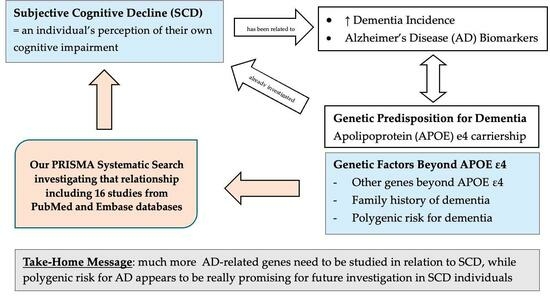
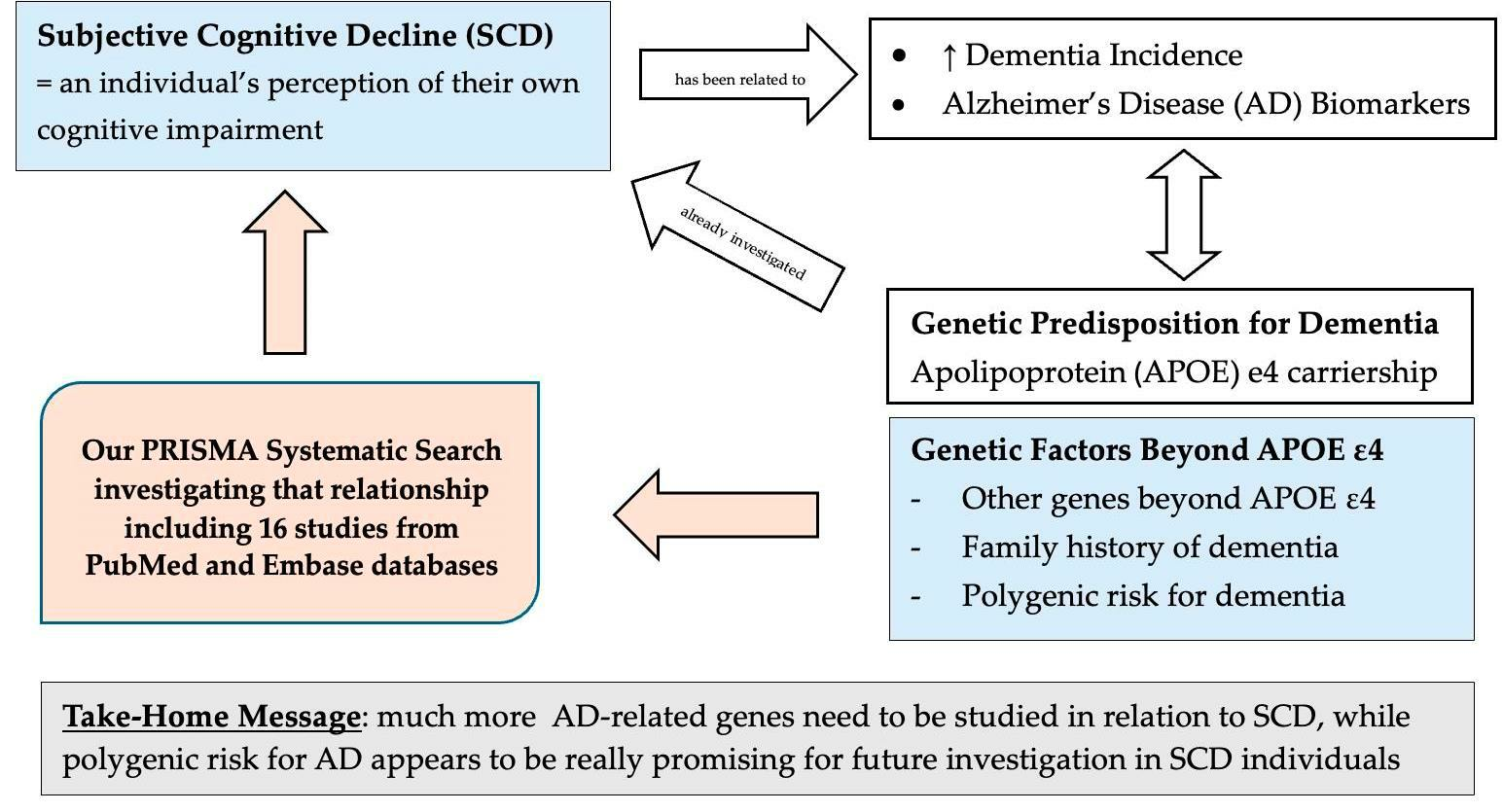
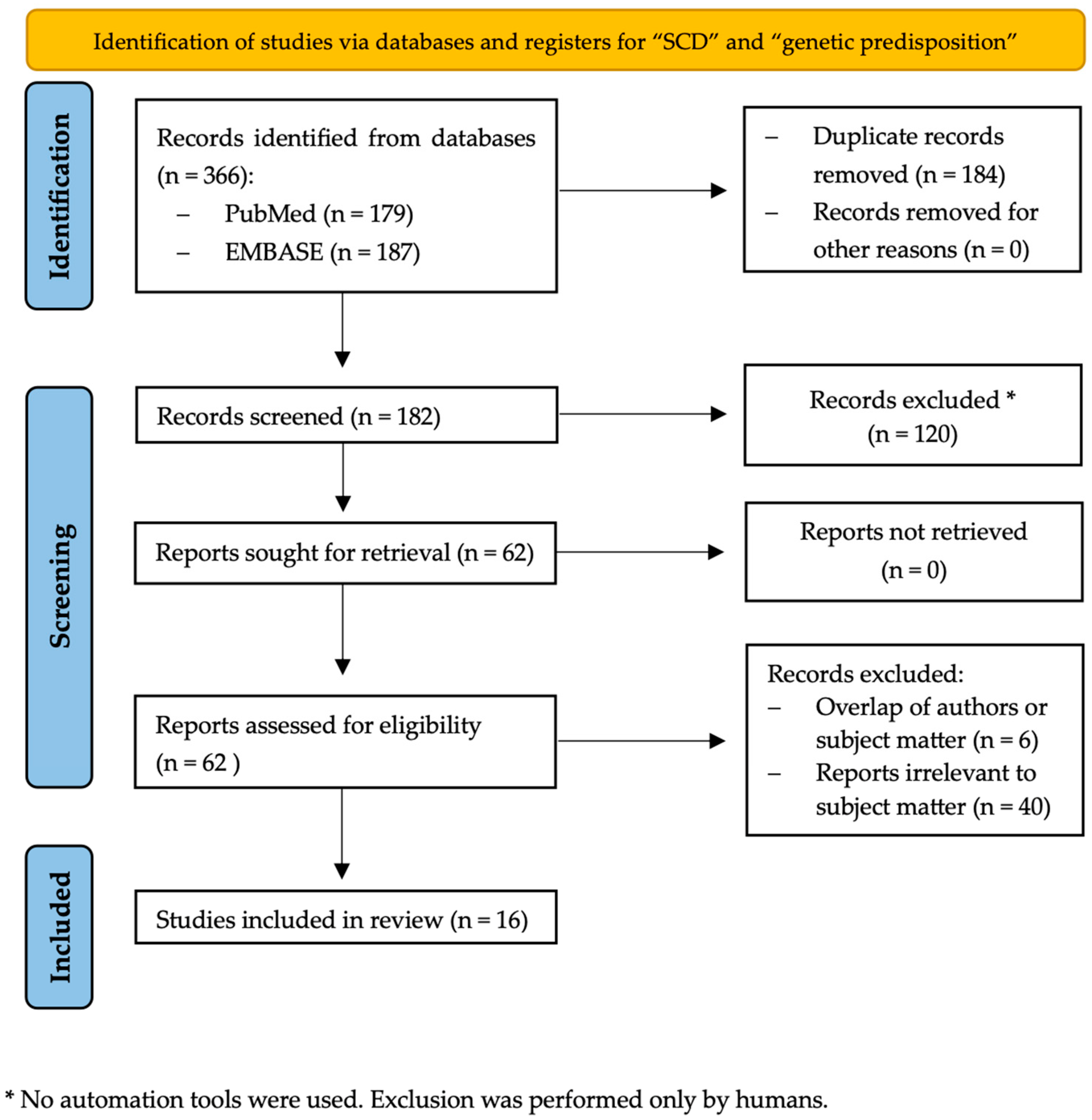
Subjective cognitive decline (SCD) has been described as a probable early stage of dementia, as it has consistently appeared to precede the onset of objective cognitive impairment. SCD is related to many risk factors, including genetic predisposition for dementia. The Apolipoprotein (APOE) ε4 allele, which has been thoroughly studied, seems to explain genetic risk for SCD only partially. Therefore, we aimed to summarize existing data regarding genetic factors related to SCD, beyond APOE ε4, in order to improve our current understanding of SCD. We conducted a PRISMA systematic search in PubMed/MEDLINE and Embase databases using the keywords “subjective cognitive decline” and “genetic predisposition” with specific inclusion and exclusion criteria. From the 270 articles identified, 16 were finally included for the qualitative analysis. Family history of Alzheimer’s disease (AD) in regard to SCD was explored in eight studies, with conflicting results. Other genes implicated in SCD, beyond APOE ε4, were investigated in six studies, which were not strong enough to provide clear conclusions. Very few data have been published regarding the association of polygenic risk for AD and SCD. Thus, many more genes related to AD must be studied, with polygenic risk scores appearing to be really promising for future investigation.
Keywords: subjective cognitive decline; cognitive complaints; early dementia stages; genetic propensity; polygenic risk subjective cognitive decline; cognitive complaints; early dementia stages; genetic propensity; polygenic risk
Graphical Abstract