Article

Oxidative Stress and Inflammatory Responses in Horses Naturally Infected with Theileria equi

Department of Veterinary Sciences, University of Messina—Via Giovanni Palatucci, 98168 Messina, Italy
*
Author to whom correspondence should be addressed.
Pharmaceuticals 2026, 19(8), 1208; https://doi.org/10.3390/ph19081208
Submission received: 29 June 2026 / Revised: 27 July 2026 / Accepted: 30 July 2026 / Published: 1 August 2026
(This article belongs to the Section Pharmacology)

Abstract

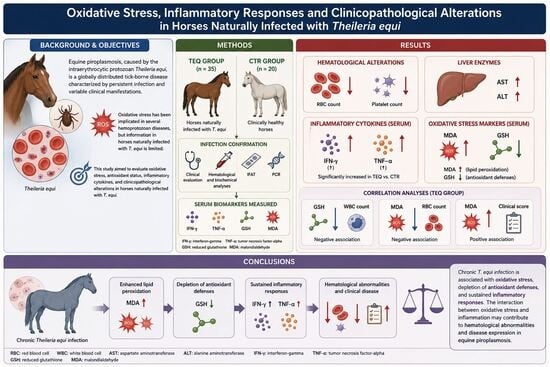
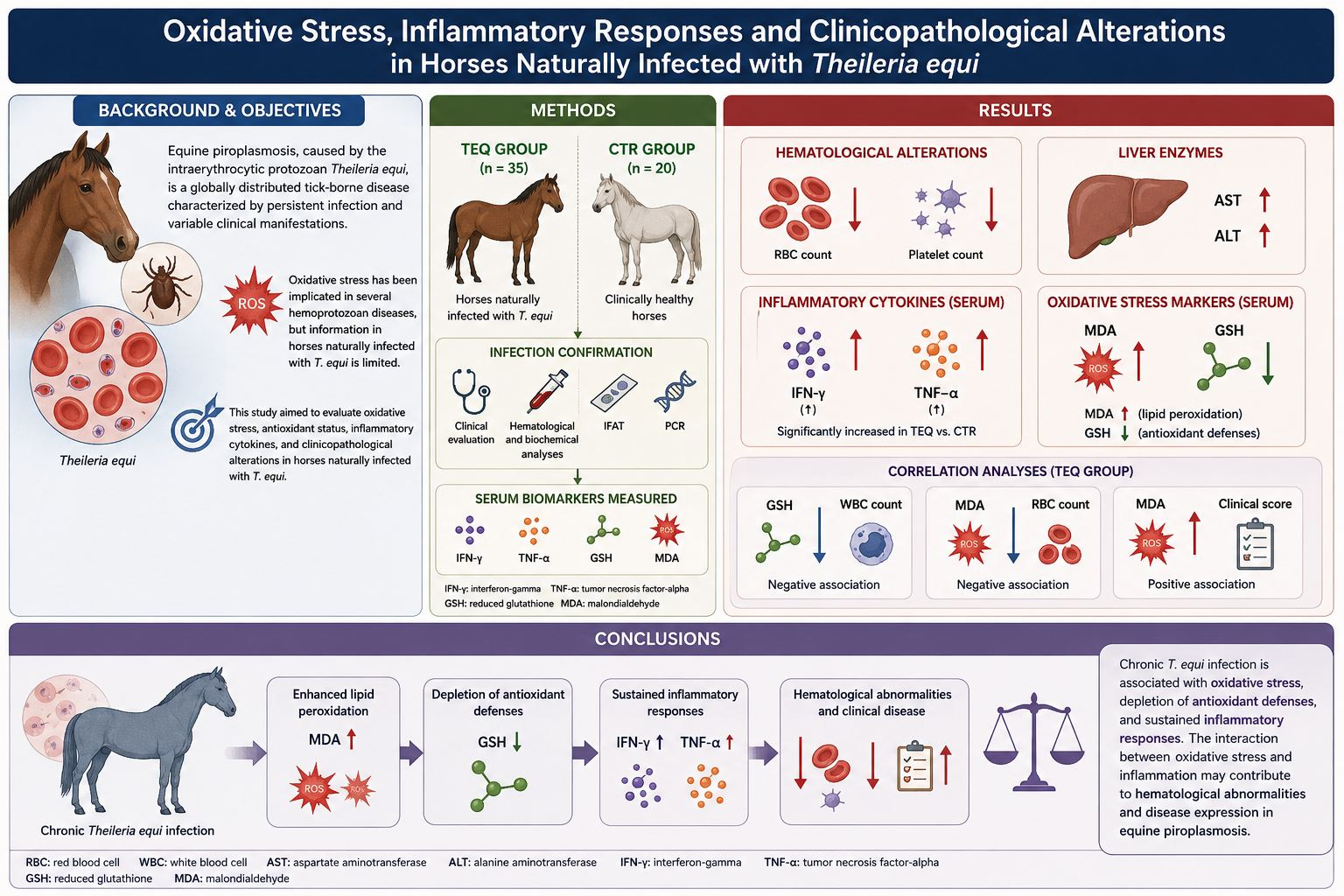
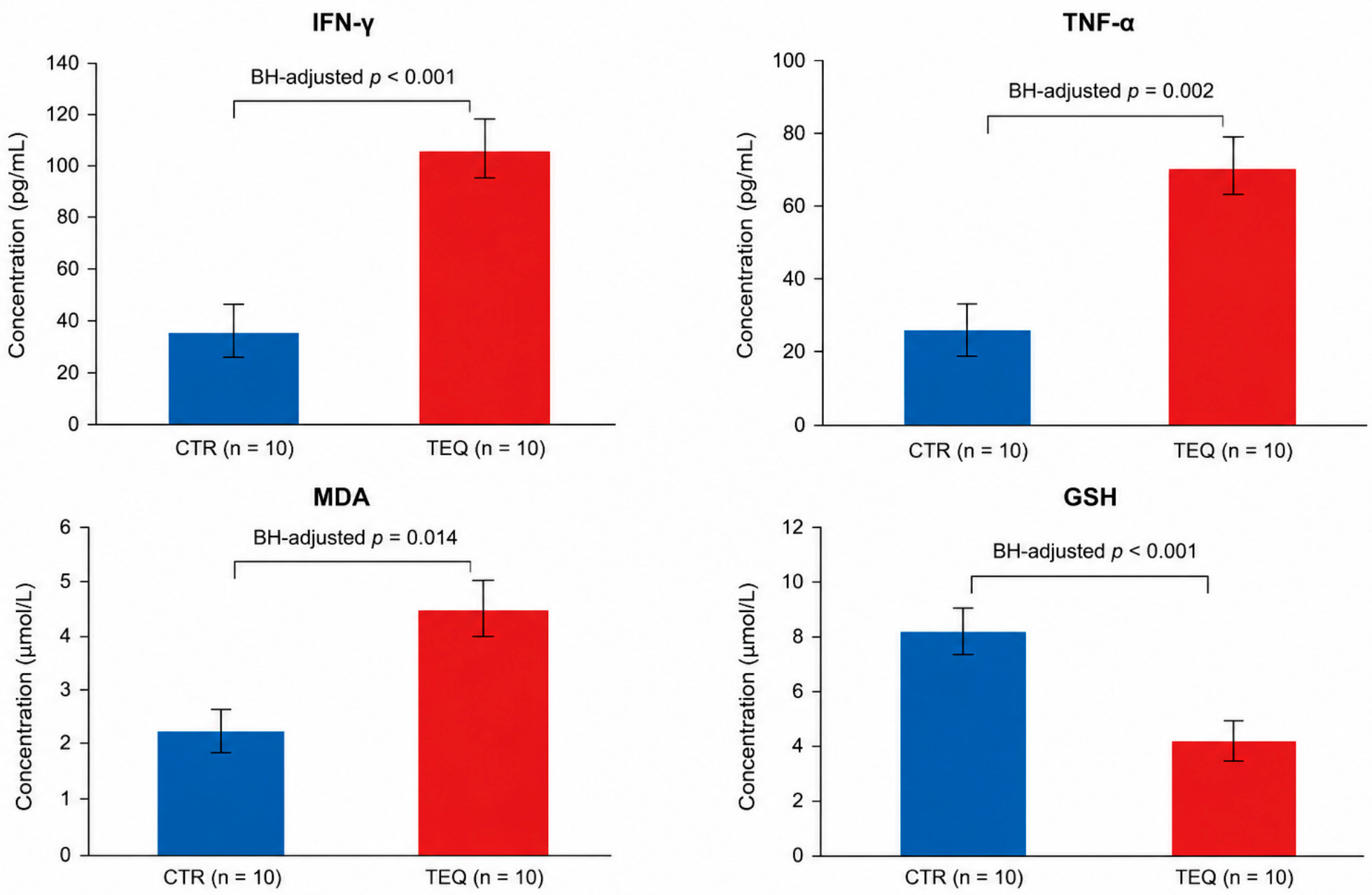
Equine piroplasmosis, caused by the intraerythrocytic protozoan Theileria equi, is a globally distributed tick-borne disease characterized by persistent infection and variable clinical manifestations. Although oxidative stress has been implicated in the pathogenesis of several hemoprotozoan diseases, information regarding redox imbalance and its relationship with inflammatory responses in horses naturally infected with T. equi remains limited. This study aimed to evaluate oxidative stress, antioxidant status, inflammatory cytokines, and clinicopathological alterations in horses naturally infected with T. equi. Thirty-five horses naturally infected with T. equi and twenty clinically healthy horses were enrolled. Infection was confirmed by clinical evaluation, hematological and biochemical analyses, an indirect fluorescent antibody test, and polymerase chain reaction. Serum concentrations of interferon-gamma, tumor necrosis factor-alpha, reduced glutathione, and malondialdehyde were assayed. Infected horses showed significantly lower platelet counts and significantly higher serum activities of aspartate aminotransferase than controls. Serum interferon-gamma and tumor necrosis factor concentrations were significantly increased, indicating persistent inflammatory activation. Infected horses also exhibited significantly higher malondialdehyde concentrations and lower reduced glutathione levels, consistent with enhanced lipid peroxidation and impaired antioxidant defenses. Correlation analyses revealed a negative association between reduced glutathione and white blood cell count and between malondialdehyde and red blood cell count, whereas malondialdehyde concentrations were positively associated with clinical score. Chronic T. equi infection is associated with oxidative stress, depletion of antioxidant defenses, and sustained inflammatory responses. The interaction between oxidative stress and inflammation may contribute to hematological abnormalities and disease expression.
Keywords: Theileria equi; equine piroplasmosis; oxidative stress; malondialdehyde; glutathione; IFN-γ; TNF-α; inflammation; antioxidant status; horse Theileria equi; equine piroplasmosis; oxidative stress; malondialdehyde; glutathione; IFN-γ; TNF-α; inflammation; antioxidant status; horse
Graphical Abstract