Engineering Strategies for Allogeneic T Cell-Based Platforms in Cancer Immunotherapy


Abstract
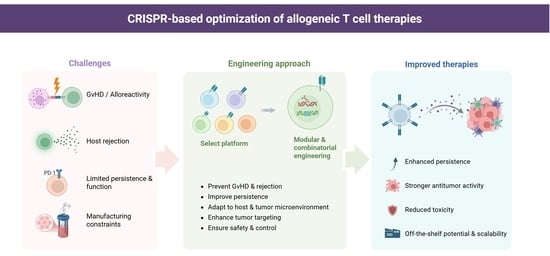
1. Introduction
2. Immunological Barriers in Allogeneic T Cell Therapies
3. Clinically Advanced Allogeneic αβ T Cell Therapies
3.1. First-in-Human Studies and Proof-of-Concept
3.2. Expansion of Allogeneic CAR-T Platforms
3.3. Safety, Resistance, and Strategies to Enhance Clinical Durability
4. Alternative Allogeneic Platforms Beyond αβ T Cells
4.1. γδ T Cells: MHC-Independent Recognition and Innate-like Cytotoxicity
4.2. iNKT Cells: Invariant Recognition and Reduced Alloreactivity
4.3. MAIT Cells: Tissue Homing and Antimicrobial-like Recognition
4.4. iPSC-Derived Immune Cells: Scalable and Programmable Platforms
5. Cross-Platform Comparison and Translational Positioning
5.1. Persistence and Tumor Targeting
5.2. Safety, Alloreactivity, and Engineering Complexity
5.3. Integrated Platform Positioning
6. Engineering Strategies Shaping Next-Generation Allogeneic T Cell Platforms
6.1. Engineering Immune Compatibility and Evasion
6.2. Enhancing Persistence and Functional Fitness
6.3. Safety Control and Regulatory Design
6.4. Multiplex Engineering and Integrated Design Frameworks
7. Translational and Manufacturing Challenges
7.1. Manufacturing Scalability and Regulatory Constraints
7.2. Clinical and Economic Limitations
8. Conclusions and Future Perspectives
Author Contributions
Funding
Data Availability Statement
Acknowledgments
Conflicts of Interest
References
- Maude, S.L.; Laetsch, T.W.; Buechner, J.; Rives, S.; Boyer, M.; Bittencourt, H.; Bader, P.; Verneris, M.R.; Stefanski, H.E.; Myers, G.D.; et al. Tisagenlecleucel in Children and Young Adults with B-Cell Lymphoblastic Leukemia. N. Engl. J. Med. 2018, 378, 439–448. [Google Scholar] [CrossRef] [PubMed]
- Neelapu, S.S.; Locke, F.L.; Bartlett, N.L.; Lekakis, L.J.; Miklos, D.B.; Jacobson, C.A.; Braunschweig, I.; Oluwole, O.O.; Siddiqi, T.; Lin, Y.; et al. Axicabtagene Ciloleucel CAR T-Cell Therapy in Refractory Large B-Cell Lymphoma. N. Engl. J. Med. 2017, 377, 2531–2544. [Google Scholar] [CrossRef] [PubMed]
- Lonez, C.; Breman, E. Allogeneic CAR-T Therapy Technologies: Has the Promise Been Met? Cells 2024, 13, 146. [Google Scholar] [CrossRef] [PubMed]
- Kawamoto, H.; Masuda, K. Trends in cell medicine: From autologous cells to allogeneic universal-use cells for adoptive T-cell therapies. Int. Immunol. 2024, 36, 65–73. [Google Scholar] [CrossRef] [PubMed]
- Lee, H.-M. Strategies for Manipulating T Cells in Cancer Immunotherapy. Biomol. Ther. 2022, 30, 299–308. [Google Scholar] [CrossRef] [PubMed]
- Lee, S.W.; Lee, H.-M. Engineered T Cell Receptor for Cancer Immunotherapy. Biomol. Ther. 2024, 32, 424–431. [Google Scholar] [CrossRef] [PubMed]
- Depil, S.; Duchateau, P.; Grupp, S.A.; Mufti, G.; Poirot, L. ‘Off-the-shelf’ allogeneic CAR T cells: Development and challenges. Nat. Rev. Drug Discov. 2020, 19, 185–199. [Google Scholar] [CrossRef] [PubMed]
- Levine, B.L.; Miskin, J.; Wonnacott, K.; Keir, C. Global Manufacturing of CAR T Cell Therapy. Mol. Ther. Methods Clin. Dev. 2017, 4, 92–101. [Google Scholar] [CrossRef] [PubMed]
- Abodunrin, F.; Olson, D.J.; Emehinola, O.; Bestvina, C.M. Adopting tomorrow’s therapies today: A perspective review of adoptive cell therapy in lung cancer. Ther. Adv. Med. Oncol. 2025, 17, 17588359251320280. [Google Scholar] [CrossRef] [PubMed]
- Krakow, E.F.; Brault, M.; Summers, C.; Cunningham, T.M.; Biernacki, M.A.; Black, R.G.; Woodward, K.B.; Vartanian, N.; Kanaan, S.B.; Yeh, A.C.; et al. HA-1-targeted T-cell receptor T-cell therapy for recurrent leukemia after hematopoietic stem cell transplantation. Blood 2024, 144, 1069–1082. [Google Scholar] [CrossRef] [PubMed]
- Silva-Santos, B.; Mensurado, S.; Coffelt, S.B. γδ T cells: Pleiotropic immune effectors with therapeutic potential in cancer. Nat. Rev. Cancer 2019, 19, 392–404. [Google Scholar] [CrossRef] [PubMed]
- Schonefeldt, S.; Wais, T.; Herling, M.; Mustjoki, S.; Bekiaris, V.; Moriggl, R.; Neubauer, H.A. The Diverse Roles of gammadelta T Cells in Cancer: From Rapid Immunity to Aggressive Lymphoma. Cancers 2021, 13, 6212. [Google Scholar] [CrossRef] [PubMed]
- Shokati, A.; Sanjari-Pour, M.; Akhavan Rahnama, M.; Hoseinzadeh, S.; Vaezi, M.; Ahmadvand, M. Allogeneic CART progress: Platforms, current progress and limitations. Front. Immunol. 2025, 16, 1557157. [Google Scholar] [CrossRef] [PubMed]
- Godfrey, D.I.; Koay, H.F.; McCluskey, J.; Gherardin, N.A. The biology and functional importance of MAIT cells. Nat. Immunol. 2019, 20, 1110–1128. [Google Scholar] [CrossRef] [PubMed]
- Heczey, A.; Liu, D.; Tian, G.; Courtney, A.N.; Wei, J.; Marinova, E.; Gao, X.; Guo, L.; Yvon, E.; Hicks, J.; et al. Invariant NKT cells with chimeric antigen receptor provide a novel platform for safe and effective cancer immunotherapy. Blood 2014, 124, 2824–2833. [Google Scholar] [CrossRef] [PubMed]
- Chen, T.; Wang, M.; Chen, Y.; Liu, Y. Current challenges and therapeutic advances of CAR-T cell therapy for solid tumors. Cancer Cell Int. 2024, 24, 133. [Google Scholar] [CrossRef] [PubMed]
- Rafiq, S.; Hackett, C.S.; Brentjens, R.J. Engineering strategies to overcome the current roadblocks in CAR T cell therapy. Nat. Rev. Clin. Oncol. 2020, 17, 147–167. [Google Scholar] [CrossRef] [PubMed]
- Ren, J.; Liu, X.; Fang, C.; Jiang, S.; June, C.H.; Zhao, Y. Multiplex Genome Editing to Generate Universal CAR T Cells Resistant to PD1 Inhibition. Clin. Cancer Res. 2017, 23, 2255–2266. [Google Scholar] [CrossRef] [PubMed]
- Lyu, Z.; Niu, S.; Fang, Y.; Chen, Y.; Li, Y.R.; Yang, L. Addressing graft-versus-host disease in allogeneic cell-based immunotherapy for cancer. Exp. Hematol. Oncol. 2025, 14, 66. [Google Scholar] [CrossRef] [PubMed]
- Ferrara, J.L.M.; Levine, J.E.; Reddy, P.; Holler, E. Graft-versus-host disease. Lancet 2009, 373, 1550–1561. [Google Scholar] [CrossRef] [PubMed]
- Ljunggren, H.G.; Kärre, K. In search of the ‘missing self’: MHC molecules and NK cell recognition. Immunol. Today 1990, 11, 237–244. [Google Scholar] [CrossRef] [PubMed]
- Tokarew, N.; Ogonek, J.; Endres, S.; von Bergwelt-Baildon, M.; Kobold, S. Teaching an old dog new tricks: Next-generation CAR T cells. Br. J. Cancer 2019, 120, 26–37. [Google Scholar] [CrossRef] [PubMed]
- Mailankody, S.; Matous, J.V.; Chhabra, S.; Liedtke, M.; Sidana, S.; Oluwole, O.O.; Malik, S.; Nath, R.; Anwer, F.; Cruz, J.C.; et al. Allogeneic BCMA-targeting CAR T cells in relapsed/refractory multiple myeloma: Phase 1 UNIVERSAL trial interim results. Nat. Med. 2023, 29, 422–429. [Google Scholar] [CrossRef] [PubMed]
- Lonez, C.; Bolsee, J.; Huberty, F.; Nguyen, T.; Jacques-Hespel, C.; Anguille, S.; Flament, A.; Breman, E. Clinical Proof-of-Concept of a Non-Gene Editing Technology Using miRNA-Based shRNA to Engineer Allogeneic CAR T-Cells. Int. J. Mol. Sci. 2024, 26, 1658. [Google Scholar] [CrossRef] [PubMed]
- Benjamin, R.; Jain, N.; Maus, M.V.; Boissel, N.; Graham, C.; Jozwik, A.; Yallop, D.; Konopleva, M.; Frigault, M.J.; Teshima, T.; et al. UCART19, a first-in-class allogeneic anti-CD19 chimeric antigen receptor T-cell therapy for adults with relapsed or refractory B-cell acute lymphoblastic leukaemia (CALM): A phase 1, dose-escalation trial. Lancet Haematol. 2022, 9, e833–e843. [Google Scholar] [CrossRef] [PubMed]
- Benjamin, R.; Graham, C.; Yallop, D.; Jozwik, A.; Mirci-Danicar, O.C.; Lucchini, G.; Pinner, D.; Jain, N.; Kantarjian, H.; Boissel, N.; et al. Genome-edited, donor-derived allogeneic anti-CD19 chimeric antigen receptor T cells in paediatric and adult B-cell acute lymphoblastic leukaemia: Results of two phase 1 studies. Lancet 2020, 396, 1885–1894. [Google Scholar] [CrossRef] [PubMed]
- Neelapu, S.S.; Nath, R.; Munoz, J.; Tees, M.; Miklos, D.B.; Frank, M.J.; Malik, S.A.; Stevens, D.; Shin, C.R.; Balakumaran, A.; et al. ALPHA Study: ALLO-501 Produced Deep and Durable Responses in Patients with Relapsed/Refractory Non-Hodgkin’s Lymphoma Comparable to Autologous CAR T. Blood 2021, 138, 3878. [Google Scholar] [CrossRef]
- Jallouk, A.P.; Ge, Z.; Kaimal, V.; Furmanak, T.; Sommer, C.; Lauron, E.J.; Sasu, B.J.; Neelapu, S.S.; Bachireddy, P. Cellular Mechanisms Affecting Allogeneic CAR T Cell Expansion and Rejection in Large B-Cell Lymphoma. Blood 2023, 142, 4832. [Google Scholar] [CrossRef]
- McGuirk, J.P.; Tam, C.S.; Kröger, N.; Riedell, P.A.; Murthy, H.S.; Ho, P.J.; Maakaron, J.E.; Waller, E.K.; Awan, F.T.; Shaughnessy, P.J. CTX110 allogeneic CRISPR-Cas9-engineered CAR T cells in patients (Pts) with relapsed or refractory (R/R) large B-cell lymphoma (LBCL): Results from the phase 1 dose escalation carbon study. Blood 2022, 140, 10303–10306. [Google Scholar] [CrossRef]
- O’Brien, S.; Nastoupil, L.J.; Essell, J.; Dsouza, L.; Hart, D.; Matsuda, E.; Satterfield, T.; Nesheiwat, T.; Hammad, A.; Davi, F. A first-in-Human phase 1, multicenter, open-label study of CB-010, a next-generation CRISPR-edited allogeneic anti-CD19 CAR-T cell therapy with a PD-1 knock-out, in patients with Relapsed/Refractory b cell non-Hodgkin lymphoma (ANTLER study). Blood 2022, 146, 9457–9458. [Google Scholar] [CrossRef]
- Hu, Y.; Zhou, Y.; Zhang, M.; Ge, W.; Li, Y.; Yang, L.; Wei, G.; Han, L.; Wang, H.; Yu, S.; et al. CRISPR/Cas9-Engineered Universal CD19/CD22 Dual-Targeted CAR-T Cell Therapy for Relapsed/Refractory B-cell Acute Lymphoblastic Leukemia. Clin. Cancer Res. 2021, 27, 2764–2772. [Google Scholar] [CrossRef] [PubMed]
- Chiesa, R.; Georgiadis, C.; Syed, F.; Zhan, H.; Etuk, A.; Gkazi, S.A.; Preece, R.; Ottaviano, G.; Braybrook, T.; Chu, J.; et al. Base-Edited CAR7 T Cells for Relapsed T-Cell Acute Lymphoblastic Leukemia. N. Engl. J. Med. 2023, 389, 899–910. [Google Scholar] [CrossRef] [PubMed]
- Abramson, J.S.; Ramakrishnan, A.; Pierola, A.A.; Braunschweig, I.; Cartron, G.; Thieblemont, C.; Pérez-Simón, J.A.; Barba, P.; Riedell, P.A.; Solano, C. Preliminary results of nathali-01: A first-in-human phase I/IIa study of UCART20x22, a dual allogeneic CAR-T cell product targeting CD20 and CD22, in relapsed or refractory (R/R) non-hodgkin lymphoma (NHL). Blood 2023, 142, 2110. [Google Scholar] [CrossRef]
- Jain, N.; Roboz, G.J.; Konopleva, M.; Liu, H.; Jabbour, E.; Poirot, C.; Schiffer-Manniou, C.; Gouble, A.; Haider, A.; Zernovak, O. Preliminary results of Balli-01: A phase I study of UCART22 (allogeneic engineered T-cells expressing anti-CD22 chimeric antigen receptor) in adult patients with relapsed or refractory (R/R) CD22+ B-cell acute lymphoblastic leukemia (B-ALL). Blood 2020, 136, 7–8. [Google Scholar] [CrossRef]
- Iyer, S.P.; Sica, R.A.; Ho, P.J.; Prica, A.; Zain, J.; Foss, F.M.; Hu, B.; Beitinjaneh, A.; Weng, W.-K.; Kim, Y.H. Safety and activity of CTX130, a CD70-targeted allogeneic CRISPR-Cas9-engineered CAR T-cell therapy, in patients with relapsed or refractory T-cell malignancies (COBALT-LYM): A single-arm, open-label, phase 1, dose-escalation study. Lancet Oncol. 2025, 26, 110–122. [Google Scholar] [CrossRef] [PubMed]
- Roboz, G.J.; DeAngelo, D.J.; Sallman, D.A.; Guzman, M.L.; Desai, P.; Kantarjian, H.M.; Konopleva, M.; Bejanyan, N.; Elmariah, H.; Esteva, F.J. Ameli-01: Phase I, open label dose-escalation and dose-expansion study to evaluate the safety, expansion, persistence and clinical activity of UCART123 (allogeneic engineered T-cells expressing anti-CD123 chimeric antigen receptor), administered in patients with relapsed/refractory acute myeloid leukemia. Blood 2020, 136, 41–42. [Google Scholar] [CrossRef]
- Pal, S.K.; Tran, B.; Haanen, J.; Hurwitz, M.E.; Sacher, A.; Tannir, N.M.; Budde, L.E.; Harrison, S.J.; Klobuch, S.; Patel, S.S.; et al. CD70-Targeted Allogeneic CAR T-Cell Therapy for Advanced Clear Cell Renal Cell Carcinoma. Cancer Discov. 2024, 14, 1176–1189. [Google Scholar] [CrossRef] [PubMed]
- Srour, S.; Chahoud, J.; Drakaki, A.; Curti, B.; Gibney, G.; Pal, S.; Tang, L.; Charmsaz, S.; Atwell, J.; Robbins, P.; et al. ALLO-316 in advanced clear cell renal cell carcinoma (ccRCC): Updated results from the phase 1 TRAVERSE study. J. Clin. Oncol. 2025, 43, 4508. [Google Scholar] [CrossRef]
- Henry, J.; Oh, D.; Eskew, J.; Baranda, J.; Rivera, I.I.R.; Dumbrava, E.; Cohen, E.; Belani, R.; McCaigue, J.; Shedlock, D. 728 Phase 1 study of P-MUC1C-ALLO1 allogeneic CAR-T cells in patients with epithelial-derived cancers. J. Immunother. Cancer 2022, 10, A761. [Google Scholar] [CrossRef]
- Qasim, W.; Zhan, H.; Samarasinghe, S.; Adams, S.; Amrolia, P.; Stafford, S.; Butler, K.; Rivat, C.; Wright, G.; Somana, K.; et al. Molecular remission of infant B-ALL after infusion of universal TALEN gene-edited CAR T cells. Sci. Transl. Med. 2017, 9, eaaj2013. [Google Scholar] [CrossRef] [PubMed]
- Locatelli, F.; Del Bufalo, F.; Quintarelli, C. Allogeneic chimeric antigen receptor T cells for children with relapsed/refractory B-cell precursor acute lymphoblastic leukemia. Haematologica 2024, 109, 1689–1699. [Google Scholar] [CrossRef] [PubMed]
- Robbins, P.F.; Morgan, R.A.; Feldman, S.A.; Yang, J.C.; Sherry, R.M.; Dudley, M.E.; Wunderlich, J.R.; Nahvi, A.V.; Helman, L.J.; Mackall, C.L.; et al. Tumor regression in patients with metastatic synovial cell sarcoma and melanoma using genetically engineered lymphocytes reactive with NY-ESO-1. J. Clin. Oncol. 2011, 29, 917–924. [Google Scholar] [CrossRef] [PubMed]
- Rapoport, A.P.; Stadtmauer, E.A.; Binder-Scholl, G.K.; Goloubeva, O.; Vogl, D.T.; Lacey, S.F.; Badros, A.Z.; Garfall, A.; Weiss, B.; Finklestein, J.; et al. NY-ESO-1-specific TCR-engineered T cells mediate sustained antigen-specific antitumor effects in myeloma. Nat. Med. 2015, 21, 914–921. [Google Scholar] [CrossRef] [PubMed]
- Stadtmauer, E.A.; Fraietta, J.A.; Davis, M.M.; Cohen, A.D.; Weber, K.L.; Lancaster, E.; Mangan, P.A.; Kulikovskaya, I.; Gupta, M.; Chen, F.; et al. CRISPR-engineered T cells in patients with refractory cancer. Science 2020, 367, eaba7365. [Google Scholar] [CrossRef] [PubMed]
- Locke, F.L.; Munoz, J.L.; Tees, M.T.; Lekakis, L.J.; de Vos, S.; Nath, R.; Stevens, D.A.; Malik, S.A.; Shouse, G.P.; Hamadani, M.; et al. Allogeneic Chimeric Antigen Receptor T-Cell Products Cemacabtagene Ansegedleucel/ALLO-501 in Relapsed/Refractory Large B-Cell Lymphoma: Phase I Experience From the ALPHA2/ALPHA Clinical Studies. J. Clin. Oncol. 2025, 43, 1695–1705. [Google Scholar] [CrossRef] [PubMed]
- Jain, N.; Chevallier, P.; Liu, H.; Schiller, G.J.; Méar, J.-B.; DeAngelo, D.J.; Curran, K.J.; Grupp, S.; Baruchel, A.; Balsat, M.; et al. Updated Results of the Phase I BALLI-01 Trial of UCART22 Process 2 (P2), an Anti-CD22 Allogeneic CAR-T Cell Product Manufactured By Cellectis Biologics, in Patients with Relapsed or Refractory (R/R) CD22+ B-Cell Acute Lymphoblastic Leukemia (B-ALL). Blood 2023, 142, 4847. [Google Scholar] [CrossRef]
- Bonini, C.; Chapuis, A.G.; Hudecek, M.; Guedan, S.; Magnani, C.; Qasim, W. Genome Editing in Engineered T Cells for Cancer Immunotherapy. Hum. Gene Ther. 2023, 34, 853–869. [Google Scholar] [CrossRef] [PubMed]
- Qi, C.; Gong, J.; Li, J.; Liu, D.; Qin, Y.; Ge, S.; Zhang, M.; Peng, Z.; Zhou, J.; Cao, Y.; et al. Claudin18.2-specific CAR T cells in gastrointestinal cancers: Phase 1 trial interim results. Nat. Med. 2022, 28, 1189–1198. [Google Scholar] [CrossRef] [PubMed]
- Schober, K.; Muller, T.R.; Gokmen, F.; Grassmann, S.; Effenberger, M.; Poltorak, M.; Stemberger, C.; Schumann, K.; Roth, T.L.; Marson, A.; et al. Orthotopic replacement of T-cell receptor alpha- and beta-chains with preservation of near-physiological T-cell function. Nat. Biomed. Eng. 2019, 3, 974–984. [Google Scholar] [CrossRef] [PubMed]
- Malki, M.M.A.; Keyzner, A.; Popat, U.R.; Chen, Y.-B.; Suh, H.C.; Jain, D.T.; Solh, M.M.; Snow, A.; Pineiro, L.; Gill, S.I.; et al. TSC-100 and TSC-101 Demonstrate the Potential to Reduce Relapse Rates and Increase Relapse-Free Survival in Patients with AML, ALL, or MDS Undergoing Allogeneic Hematopoietic Cell Transplantation (HCT) with Reduced Intensity Conditioning (RIC): Preliminary Results from the Phase 1 Alloha Trial (NCT05473910). Transplant. Cell. Ther. 2025, 31, S59–S60. [Google Scholar] [CrossRef]
- Kim, J.Y.; Lee, H.-M. Literature Review on the Development Trends of Gene-Modified Cell Therapies: Focusing on Clinical Studies of TCR-T Cell Therapy. Korean J. Clin. Pharm. 2025, 35, 1–12. [Google Scholar] [CrossRef]
- Locke, F.L.; Munoz, J.L.; Tees, M.T.; Lekakis, L.J.; Eradat, H.A.; de Vos, S.; Nath, R.; Stevens, D.A.; Malik, S.A.; Shouse, G.P.; et al. ALLO-647 for Lymphodepletion in the Allogeneic CAR T Setting: Safety Experience with ALLO-501/501A in Patients (Pts) with Relapsed/Refractory (r/r) Large B-Cell and Follicular Lymphomas. Blood 2023, 142, 2095. [Google Scholar] [CrossRef]
- Linette, G.P.; Stadtmauer, E.A.; Maus, M.V.; Rapoport, A.P.; Levine, B.L.; Emery, L.; Litzky, L.; Bagg, A.; Carreno, B.M.; Cimino, P.J.; et al. Cardiovascular toxicity and titin cross-reactivity of affinity-enhanced T cells in myeloma and melanoma. Blood 2013, 122, 863–871. [Google Scholar] [CrossRef] [PubMed]
- Eyquem, J.; Mansilla-Soto, J.; Giavridis, T.; van der Stegen, S.J.; Hamieh, M.; Cunanan, K.M.; Odak, A.; Gonen, M.; Sadelain, M. Targeting a CAR to the TRAC locus with CRISPR/Cas9 enhances tumour rejection. Nature 2017, 543, 113–117. [Google Scholar] [CrossRef] [PubMed]
- Zheng, X.; Tian, Z. Engineering TCR-preserved allogeneic CAR-T cells: Leveraging cancer immune evasion principles to establish T-cell tolerance. Cell. Mol. Immunol. 2025, 22, 1285–1286. [Google Scholar] [CrossRef] [PubMed]
- Vantourout, P.; Hayday, A. Six-of-the-best: Unique contributions of gammadelta T cells to immunology. Nat. Rev. Immunol. 2013, 13, 88–100. [Google Scholar] [CrossRef] [PubMed]
- Bank, I. γδ T Cells in Autoinflammatory Diseases. Cells 2026, 15, 388. [Google Scholar] [CrossRef] [PubMed]
- Rigau, M.; Ostrouska, S.; Fulford, T.S.; Johnson, D.N.; Woods, K.; Ruan, Z.; McWilliam, H.E.G.; Hudson, C.; Tutuka, C.; Wheatley, A.K.; et al. Butyrophilin 2A1 is essential for phosphoantigen reactivity by γδ T cells. Science 2020, 367, eaay5516. [Google Scholar] [CrossRef] [PubMed]
- Sebestyen, Z.; Prinz, I.; Déchanet-Merville, J.; Silva-Santos, B.; Kuball, J. Translating gammadelta (γδ) T cells and their receptors into cancer cell therapies. Nat. Rev. Drug Discov. 2020, 19, 169–184. [Google Scholar] [CrossRef] [PubMed]
- Vydra, J.; Cosimo, E.; Lesný, P.; Wanless, R.S.; Anderson, J.; Clark, A.G.; Scott, A.; Nicholson, E.K.; Leek, M. A Phase I Trial of Allogeneic γδ T Lymphocytes From Haploidentical Donors in Patients With Refractory or Relapsed Acute Myeloid Leukemia. Clin. Lymphoma Myeloma Leuk. 2023, 23, e232–e239. [Google Scholar] [CrossRef] [PubMed]
- Li, Y.R.; Zhu, Y.; Chen, Y.; Yang, L. The clinical landscape of CAR-engineered unconventional T cells. Trends Cancer 2025, 11, 520–539. [Google Scholar] [CrossRef] [PubMed]
- Fang, X.; Yan, S.; He, L.; Deng, C. CAR-γδ T cells: A new paradigm of programmable innate immune sentinels and their systemic applications in cancer and beyond. Front. Immunol. 2025, 16, 1735763. [Google Scholar] [CrossRef] [PubMed]
- Mukhametshin, S.A.; Gilyazova, E.M.; Davletshin, D.R.; Ganeeva, I.A.; Zmievskaya, E.A.; Chasov, V.V.; Petukhov, A.V.; Valiullina, A.K.; Spada, S.; Bulatov, E.R. Allogeneic NKG2D CAR-T Cell Therapy: A Promising Approach for Treating Solid Tumors. Biomedicines 2025, 13, 2314. [Google Scholar] [CrossRef] [PubMed]
- Liu, C.; Li, J.; Liu, D. Allogeneic B7-H3-Targeted CAR Vδ1T-cell Therapy in Advanced Solid Tumors: A Phase I Study. Clin. Cancer Res. 2026, 32, 2026–2035. [Google Scholar] [CrossRef] [PubMed]
- Nishimoto, K.P.; Lamture, G.; Chanthery, Y.; Teague, A.G.; Verma, Y.; Au, M.; Smith-Boeck, M.; Salum, M.; Murthy, P.; Gundurao, S.R.Y.; et al. ADI-270: An armored allogeneic gamma delta T cell therapy designed to target CD70-expressing solid and hematologic malignancies. J. Immunother. Cancer 2025, 13, e011704. [Google Scholar] [CrossRef] [PubMed]
- Yazdanifar, M.; Barbarito, G.; Bertaina, A.; Airoldi, I. γδ T Cells: The Ideal Tools for Cancer Immunotherapy. Cells 2020, 9, 1305. [Google Scholar] [CrossRef] [PubMed]
- Deseke, M.; Trinz, I. Ligand recognition by the γδ TCR and discrimination between homeostasis and stress conditions. Cell Mol. Immunol. 2020, 17, 914–924. [Google Scholar] [CrossRef] [PubMed]
- Jhita, N.; Raikar, S.S. Allogeneic gamma delta T cells as adoptive cellular therapy for hematologic malignancies. Explor. Immunol. 2022, 2, 334–350. [Google Scholar] [CrossRef] [PubMed]
- Cieslak, S.G.; Shahbazi, R. Gamma delta T cells and their immunotherapeutic potential in cancer. Biomark. Res. 2025, 13, 51. [Google Scholar] [CrossRef] [PubMed]
- Bendelac, A.; Savage, P.B.; Teyton, L. The biology of NKT cells. Annu. Rev. Immunol. 2007, 25, 297–336. [Google Scholar] [CrossRef] [PubMed]
- Ramos, C.A.; Courtney, A.N.; Lulla, P.D.; Hill, L.C.; Kamble, R.T.; Carrum, G.; Wang, T.; Pierro, E.J.D.; Brenner, M.K.; Heslop, H.E.; et al. Off-the-Shelf CD19-Specific CAR-NKT Cells in Patients with Relapsed or Refractory B-Cell Malignancies. Transplant. Cell. Ther. Off. Publ. Am. Soc. Transplant. Cell. Ther. 2024, 30, S41–S42. [Google Scholar] [CrossRef]
- Niedzielska, M.; Chalmers, A.; Popis, M.C.; Altman-Sharoni, E.; Addis, S.; Beulen, R.; Rudqvist, N.P.; Chantzoura, E.; Purbhoo, M.A.; Chand, D.; et al. CAR-iNKT cells: Redefining the frontiers of cellular immunotherapy. Front. Immunol. 2025, 16, 1625426. [Google Scholar] [CrossRef] [PubMed]
- Iinuma, T.; Kurokawa, T.; Aoki, T.; Onodera, A.; Fukazawa, T.; Yamada, D.; Kitahara, G.; Okoshi, M.; Yamaguchi, M.; Okura, H.; et al. Allogeneic iPSC-derived iNKT cells in recurrent head and neck cancer: A phase 1 trial. Nat. Commun. 2025, 16, 11666. [Google Scholar] [CrossRef] [PubMed]
- Legoux, F.; Salou, M.; Lantz, O. MAIT Cell Development and Functions: The Microbial Connection. Immunity 2020, 53, 710–723. [Google Scholar] [CrossRef] [PubMed]
- Dogan, M.; Karhan, E.; Kozhaya, L.; Placek, L.; Chen, X.; Yigit, M.; Unutmaz, D. Engineering Human MAIT Cells with Chimeric Antigen Receptors for Cancer Immunotherapy. J. Immunol. 2022, 209, 1523–1531. [Google Scholar] [CrossRef] [PubMed]
- Li, Y.R.; Brown, J.; Yu, Y.; Lee, D.; Zhou, K.; Dunn, Z.S.; Hon, R.; Wilson, M.; Kramer, A.; Zhu, Y.; et al. Targeting Immunosuppressive Tumor-Associated Macrophages Using Innate T Cells for Enhanced Antitumor Reactivity. Cancers 2022, 14, 2749. [Google Scholar] [CrossRef] [PubMed]
- Toubal, A.; Nel, I.; Lotersztajn, S.; Lehuen, A. Mucosal-associated invariant T cells and disease. Nat. Rev. Immunol. 2019, 19, 643–657. [Google Scholar] [CrossRef] [PubMed]
- Li, Y.R.; Zhou, K.; Wilson, M.; Kramer, A.; Zhu, Y.; Dawson, N.; Yang, L. Mucosal-associated invariant T cells for cancer immunotherapy. Mol. Ther. 2023, 31, 631–646. [Google Scholar] [CrossRef] [PubMed]
- Themeli, M.; Kloss, C.C.; Ciriello, G.; Fedorov, V.D.; Perna, F.; Gonen, M.; Sadelain, M. Generation of tumor-targeted human T lymphocytes from induced pluripotent stem cells for cancer therapy. Nat. Biotechnol. 2013, 31, 928–933. [Google Scholar] [CrossRef] [PubMed]
- Deuse, T.; Hu, X.; Agbor-Enoh, S.; Jang, M.K.; Alawi, M.; Saygi, C.; Gravina, A.; Tediashvili, G.; Nguyen, V.Q.; Liu, Y.; et al. The SIRPalpha-CD47 immune checkpoint in NK cells. J. Exp. Med. 2021, 218, e20200839. [Google Scholar] [CrossRef] [PubMed]
- Poirot, L.; Philip, B.; Schiffer-Mannioui, C.; Le Clerre, D.; Chion-Sotinel, I.; Derniame, S.; Potrel, P.; Bas, C.; Lemaire, L.; Galetto, R.; et al. Multiplex Genome-Edited T-cell Manufacturing Platform for “Off-the-Shelf” Adoptive T-cell Immunotherapies. Cancer Res. 2015, 75, 3853–3864. [Google Scholar] [CrossRef] [PubMed]
- Ren, J.; Zhang, X.; Liu, X.; Fang, C.; Jiang, S.; June, C.H.; Zhao, Y. A versatile system for rapid multiplex genome-edited CAR T cell generation. Oncotarget 2017, 8, 17002–17011. [Google Scholar] [CrossRef] [PubMed]
- Hawkins, R.E.; D’Souza, R.R.; Klampatsa, A. Armored CAR T-cells: The next chapter in T-cell cancer immunotherapy. Biologics 2021, 15, 95–105. [Google Scholar] [CrossRef] [PubMed]
- McGowan, E.; Lin, Q.; Ma, G.; Yin, H.; Chen, S.; Lin, Y. PD-1 disrupted CAR-T cells in the treatment of solid tumors; promises and challenges. Biomed. Pharmacother. 2020, 121, 109625. [Google Scholar] [CrossRef] [PubMed]
- Dimitri, A.; Herbst, F.; Fraietta, J. Engineering the next-generation of CAR T-cells with CRISPR-Cas9 gene editing. Mol. Cancer 2022, 21, 78. [Google Scholar] [CrossRef] [PubMed]
- Roth, T.L.; Puig-Saus, C.; Yu, R.; Shifrut, E.; Carnevale, J.; Li, P.J.; Hiatt, J.; Saco, J.; Krystofinski, P.; Li, H.; et al. Reprogramming human T cell function and specificity with non-viral genome targeting. Nature 2018, 559, 405–409. [Google Scholar] [CrossRef] [PubMed]
- Gornalusse, G.G.; Hirata, R.K.; Funk, S.E.; Riolobos, L.; Lopes, V.S.; Manske, G.; Prunkard, D.; Colunga, A.G.; Hanafi, L.A.; Clegg, D.O.; et al. HLA-E-expressing pluripotent stem cells escape allogeneic responses and lysis by NK cells. Nat. Biotechnol. 2017, 35, 765–772. [Google Scholar] [CrossRef] [PubMed]
- Deuse, T.; Hu, X.; Gravina, A.; Wang, D.; Tediashvili, G.; De, C.; Thayer, W.O.; Wahl, A.; Garcia, J.V.; Reichenspurner, H.; et al. Hypoimmunogenic derivatives of induced pluripotent stem cells evade immune rejection in fully immunocompetent allogeneic recipients. Nat. Biotechnol. 2019, 37, 252–258. [Google Scholar] [CrossRef] [PubMed]
- Hurton, L.V.; Singh, H.; Najjar, A.M.; Switzer, K.C.; Mi, T.; Maiti, S.; Olivares, S.; Rabinovich, B.; Huls, H.; Forget, M.A.; et al. Tethered IL-15 augments antitumor activity and promotes a stem-cell memory subset in tumor-specific T cells. Proc. Natl. Acad. Sci. USA 2016, 113, E7788–E7797. [Google Scholar] [CrossRef] [PubMed]
- Xu, Y.; Zhang, M.; Ramos, C.A.; Durett, A.; Liu, E.; Dakhova, O.; Liu, H.; Creighton, C.J.; Gee, A.P.; Heslop, H.E.; et al. Closely related T-memory stem cells correlate with in vivo expansion of CAR.CD19-T cells and are preserved by IL-7 and IL-15. Blood 2014, 123, 3750–3759. [Google Scholar] [CrossRef] [PubMed]
- Xu, X.; Huang, W.; Heczey, A.; Liu, D.; Guo, L.; Wood, M.; Jin, J.; Courtney, A.N.; Liu, B.; Di Pierro, E.J.; et al. NKT Cells Coexpressing a GD2-Specific Chimeric Antigen Receptor and IL15 Show Enhanced In Vivo Persistence and Antitumor Activity against Neuroblastoma. Clin. Cancer Res. 2019, 25, 7126–7138. [Google Scholar] [CrossRef] [PubMed]
- Gattinoni, L.; Lugli, E.; Ji, Y.; Pos, Z.; Paulos, C.M.; Quigley, M.F.; Almeida, J.R.; Gostick, E.; Yu, Z.; Carpenito, C.; et al. A human memory T cell subset with stem cell-like properties. Nat. Med. 2011, 17, 1290–1297. [Google Scholar] [CrossRef] [PubMed]
- Rupp, L.J.; Schumann, K.; Roybal, K.T.; Gate, R.E.; Ye, C.J.; Lim, W.A.; Marson, A. CRISPR/Cas9-mediated PD-1 disruption enhances anti-tumor efficacy of human chimeric antigen receptor T cells. Sci. Rep. 2017, 7, 737. [Google Scholar] [CrossRef] [PubMed]
- Tang, N.; Cheng, C.; Zhang, X.; Qiao, M.; Li, N.; Mu, W.; Wei, X.F.; Han, W.; Wang, H. TGF-β inhibition via CRISPR promotes the long-term efficacy of CAR T cells against solid tumors. JCI Insight 2020, 5, e133977. [Google Scholar] [CrossRef] [PubMed]
- Kloss, C.C.; Lee, J.; Zhang, A.; Chen, F.; Melenhorst, J.J.; Lacey, S.F.; Maus, M.V.; Fraietta, J.A.; Zhao, Y.; June, C.H. Dominant-Negative TGF-β Receptor Enhances PSMA-Targeted Human CAR T Cell Proliferation And Augments Prostate Cancer Eradication. Mol. Ther. 2018, 26, 1855–1866. [Google Scholar] [CrossRef] [PubMed]
- Liu, X.; Ranganathan, R.; Jiang, S.; Fang, C.; Sun, J.; Kim, S.; Newick, K.; Lo, A.; June, C.H.; Zhao, Y.; et al. A Chimeric Switch-Receptor Targeting PD1 Augments the Efficacy of Second-Generation CAR T Cells in Advanced Solid Tumors. Cancer Res. 2016, 76, 1578–1590. [Google Scholar] [CrossRef] [PubMed]
- Craddock, J.A.; Lu, A.; Bear, A.; Pule, M.; Brenner, M.K.; Rooney, C.M.; Foster, A.E. Enhanced tumor trafficking of GD2 chimeric antigen receptor T cells by expression of the chemokine receptor CCR2b. J. Immunother. 2010, 33, 780–788. [Google Scholar] [CrossRef] [PubMed]
- Di Stasi, A.; Tey, S.K.; Dotti, G.; Fujita, Y.; Kennedy-Nasser, A.; Martinez, C.; Straathof, K.; Liu, E.; Durett, A.G.; Grilley, B.; et al. Inducible apoptosis as a safety switch for adoptive cell therapy. N. Engl. J. Med. 2011, 365, 1673–1683. [Google Scholar] [CrossRef] [PubMed]
- Roybal, K.T.; Rupp, L.J.; Morsut, L.; Walker, W.J.; McNally, K.A.; Park, J.S.; Lim, W.A. Precision Tumor Recognition by T Cells With Combinatorial Antigen-Sensing Circuits. Cell 2016, 164, 770–779. [Google Scholar] [CrossRef] [PubMed]
- Lu, L.; Xie, M.; Yang, B.; Zhao, W.B.; Cao, J. Enhancing the safety of CAR-T cell therapy: Synthetic genetic switch for spatiotemporal control. Sci. Adv. 2024, 10, eadj6251. [Google Scholar] [CrossRef] [PubMed]
- Russell, G.C.; Hamzaoui, Y.; Rho, D.; Sutrave, G.; Choi, J.S.; Missan, D.S.; Reckard, G.A.; Gustafson, M.P.; Kim, G.B. Synthetic biology approaches for enhancing safety and specificity of CAR-T cell therapies for solid cancers. Cytotherapy 2024, 26, 842–857. [Google Scholar] [CrossRef] [PubMed]
- Fraietta, J.A.; Lacey, S.F.; Orlando, E.J.; Pruteanu-Malinici, I.; Gohil, M.; Lundh, S.; Boesteanu, A.C.; Wang, Y.; O’Connor, R.S.; Hwang, W.T.; et al. Determinants of response and resistance to CD19 chimeric antigen receptor (CAR) T cell therapy of chronic lymphocytic leukemia. Nat. Med. 2018, 24, 563–571. [Google Scholar] [CrossRef] [PubMed]
- Cornu, T.I.; Mussolino, C.; Cathomen, T. Refining strategies to translate genome editing to the clinic. Nat. Med. 2017, 23, 415–423. [Google Scholar] [CrossRef] [PubMed]
- Kim, J.Y.; Oh, K.-S.; Lee, H.-M. A Comparative Study of International Regulatory Framework for Anti-Cancer Immune Cell Therapies. J. Korean Soc. Health-Syst. Pharm. 2024, 41, 402–413. [Google Scholar] [CrossRef]
- Roddie, C.; O’Reilly, M.; Dias Alves Pinto, J.; Vispute, K.; Lowdell, M. Manufacturing chimeric antigen receptor T cells: Issues and challenges. Cytotherapy 2019, 21, 327–340. [Google Scholar] [CrossRef] [PubMed]



| Cell Type | Disease Category | Target | Product Name | Indication | Genome Editing Method | Phase Stage | Current Status | Trial No. | Trial Name | Ref. |
|---|---|---|---|---|---|---|---|---|---|---|
| CAR-T | Hematologic malignancy | BCMA | BCMA-UCART | MM | TALEN | Phase 1 | Terminated | NCT03752541 | - | |
| ALLO-715 | R/R MM | TALEN | Phase 1 | Not recruiting | NCT04093596 | UNIVERSAL | [23] | |||
| CYAD-211 | R/R MM | miRNA based-shRNA | Phase1 | Not recruiting | NCT04613557 | IMMUNICY-1 | [24] | |||
| CD19 | UCART19 | R/R B-ALL (adult) | TALEN | Phase1 | Completed | NCT02746952 | CALM | [25] | ||
| UCART19 | R/R B-ALL (pediatric) | TALEN | Phase1 | Terminated | NCT02808442 | PALL | [26] | |||
| ALLO-501 | R/R LBCL or FL | TALEN | Phase1 | Completed | NCT03939026 | ALPHA | [27] | |||
| ALLO-501A | R/R LBCL, CLL or SLL | TALEN | Phase1/2 | Not recruiting | NCT04416984 | ALPHA2 | [28] | |||
| CTX110 | R/R B-ALL or NHL | CRISPR/Cas9 | Phase1/2 | Terminated | NCT04035434 | CARBON | [29] | |||
| alloCART-19 | B-ALL | CRISPR/Cas9 | Phase1 | Recruiting | NCT04173988 | - | ||||
| CB-010 | B-NHL | ChrDNA/Cas9 | Phase1 | Recruiting | NCT04637763 | ANTLER | [30] | |||
| CD19/CD22 | CTA101 | R/R B-ALL or NHL | CRISPR/Cas9 | Phase1 | Recruiting | NCT04227015 | [31] | |||
| CD7 | BE-CAR7 | R/R T-CLL (pediatric) | Base-editing | Phase1 | Recruiting | NCT05397184 | TvT CAR7 | [32] | ||
| CD20/CD22 | UCART20x22 | R/R B-NHL | TALEN | Phase1/2 | Recruiting | NCT05607420 | NatHaLi-01 | [33] | ||
| CD22 | UCART22 | R/R B-ALL | TALEN | Phase1/2 | Recruiting | NCT04150497 | BALLI-01 | [34] | ||
| CD33 | CART-33 | R/R CD33+ AML | TALEN | Phase1 | Terminated | NCT02799680 | - | |||
| CD70 | CTX130 | R/R TCM or BCM | CRISPR/Cas9 | Phase1 | Terminated | NCT04502446 | COBALT-LYM | [35] | ||
| CD123 | UCART123v1.2 | R/R AML | TALEN | Phase1 | Recruiting | NCT03190278 | AMELI-01 | [36] | ||
| Solid tumor | CD70 | CTX130 | a/R/R ccRCC | CRISPR/Cas9 | Phase1 | Terminated | NCT04438083 | COBALT-RCC | [37] | |
| ALLO-316 | a/m ccRCC | CRISPR/Cas9 | Phase1 | Recruiting | NCT04696731 | TRAVERSE | [38] | |||
| MUC1 | P-MUC1C-ALLO1 | Solid tumor | Cas/CLOVER | Phase1/2 | Not recruiting | NCT05239143 | [39] | |||
| TCR-T | Hematologic malignancy | HA-1, HA-2 | TSC-100, TSC-101 | AML, MDS, ALL | Lentiviral vector | Phase1 | Recruiting | NCT05473910 | ALLOHA | [40] |
| Cell Type | Disease Category | Target | Product Name | Indication | Phase Stage | Current Status | Trial No. | Trial Name | Ref. |
|---|---|---|---|---|---|---|---|---|---|
| CAR-γδ T | Hematologic malignancy | B7-H3 | UTAA06 | R/R AML | Phase1 | Unknown | NCT05731219 | - | |
| BCMA | UTAA17 | R/R MM | Not applicable | Recruiting | NCT06279026 | [61] | |||
| CD19 | BCL, ALL, CLL | Phase1 | Unknown | NCT02656147 | - | ||||
| UTAA09 | R/R HLM | Early phase1 | Recruiting | NCT06092047 | - | ||||
| HQ103 | B-ALL | Phase1 | Recruiting | NCT06056752 | - | ||||
| UTAA09 | R/R B cell NHL | Phase1 | Recruiting | NCT06503211 | - | ||||
| CD20 | ADI-001 | R/R BCM | Phase1 | Recruiting | NCT04735471 | GLEAN-1 | [62] | ||
| NKG2DL | CTM-N2D | Leukemia | Phase1 | Recruiting | NCT05302037 | ANGELICA | [63] | ||
| Phosphoantigen | TCB008 | AML, MDS | Phase2 | Terminated | NCT05358808 | ACHIEVE | - | ||
| Solid tumor | B7-H3 | HQ104 | Brain glioma | Phase1/2 | Recruiting | NCT06018363 | - | ||
| UTAA06 | B7-H3+ R/R solid tumor | Phase1 | Completed | NCT06372236 | [64] | ||||
| CD70 | ADI-270 | R/R ccRCC | Phase1/2 | Not recruiting | NCT06480565 | [65] | |||
| GD2 | - | R/R or PD NB, R/R OS | Phase1 | Recruiting | NCT05400603 | - | |||
| HLA-G | CAR001 | R/R solid tumor | Phase1/2 | Recruiting | NCT06150885 | - | |||
| NKG2DL | CTM-N2D | R/R solid tumor | Phase1 | Unknown | NCT04107142 | - | |||
| CAR-iNKT | Hematologic malignancy | CD19 | - | ALL, CLL, NHL | Phase1 | Not recruiting | NCT00840853 | MULTIPRAT | [60] |
| KUR-502 | R/R B-ALL or CLL | Phase1 | Recruiting | NCT03774654 | ANCHOR | - | |||
| KUR-502 | R-NHL, BCL, B-ALL | Phase1 | Recruiting | NCT05487651 | ANCHOR2 | - |
Disclaimer/Publisher’s Note: The statements, opinions and data contained in all publications are solely those of the individual author(s) and contributor(s) and not of MDPI and/or the editor(s). MDPI and/or the editor(s) disclaim responsibility for any injury to people or property resulting from any ideas, methods, instructions or products referred to in the content. |
© 2026 by the authors. Licensee MDPI, Basel, Switzerland. This article is an open access article distributed under the terms and conditions of the Creative Commons Attribution (CC BY) license.
Share and Cite
Kang, S.-J.; Lee, H.-M. Engineering Strategies for Allogeneic T Cell-Based Platforms in Cancer Immunotherapy. Pharmaceuticals 2026, 19, 991. https://doi.org/10.3390/ph19070991
Kang S-J, Lee H-M. Engineering Strategies for Allogeneic T Cell-Based Platforms in Cancer Immunotherapy. Pharmaceuticals. 2026; 19(7):991. https://doi.org/10.3390/ph19070991
Chicago/Turabian StyleKang, Su-Jin, and Hyang-Mi Lee. 2026. "Engineering Strategies for Allogeneic T Cell-Based Platforms in Cancer Immunotherapy" Pharmaceuticals 19, no. 7: 991. https://doi.org/10.3390/ph19070991
APA StyleKang, S.-J., & Lee, H.-M. (2026). Engineering Strategies for Allogeneic T Cell-Based Platforms in Cancer Immunotherapy. Pharmaceuticals, 19(7), 991. https://doi.org/10.3390/ph19070991