This is an early access version, the complete PDF, HTML, and XML versions will be available soon.
Open AccessReview
m1A and m6A RNA Methylations as Druggable Targets in Cancer
by
Yasemin Gazaloğlu
 Yasemin Gazaloğlu
 ,
,
Buket Sağlam-Şen
Buket Sağlam-Şen
Bünyamin Akgül
Bünyamin Akgül
Noncoding RNA Laboratory, Department of Molecular Biology and Genetics, İzmir Institute of Technology, 35430 Izmir, Türkiye
*
Author to whom correspondence should be addressed.
Pharmaceuticals 2026, 19(7), 990; https://doi.org/10.3390/ph19070990 (registering DOI)
Submission received: 13 May 2026
/
Revised: 13 June 2026
/
Accepted: 20 June 2026
/
Published: 25 June 2026
Abstract
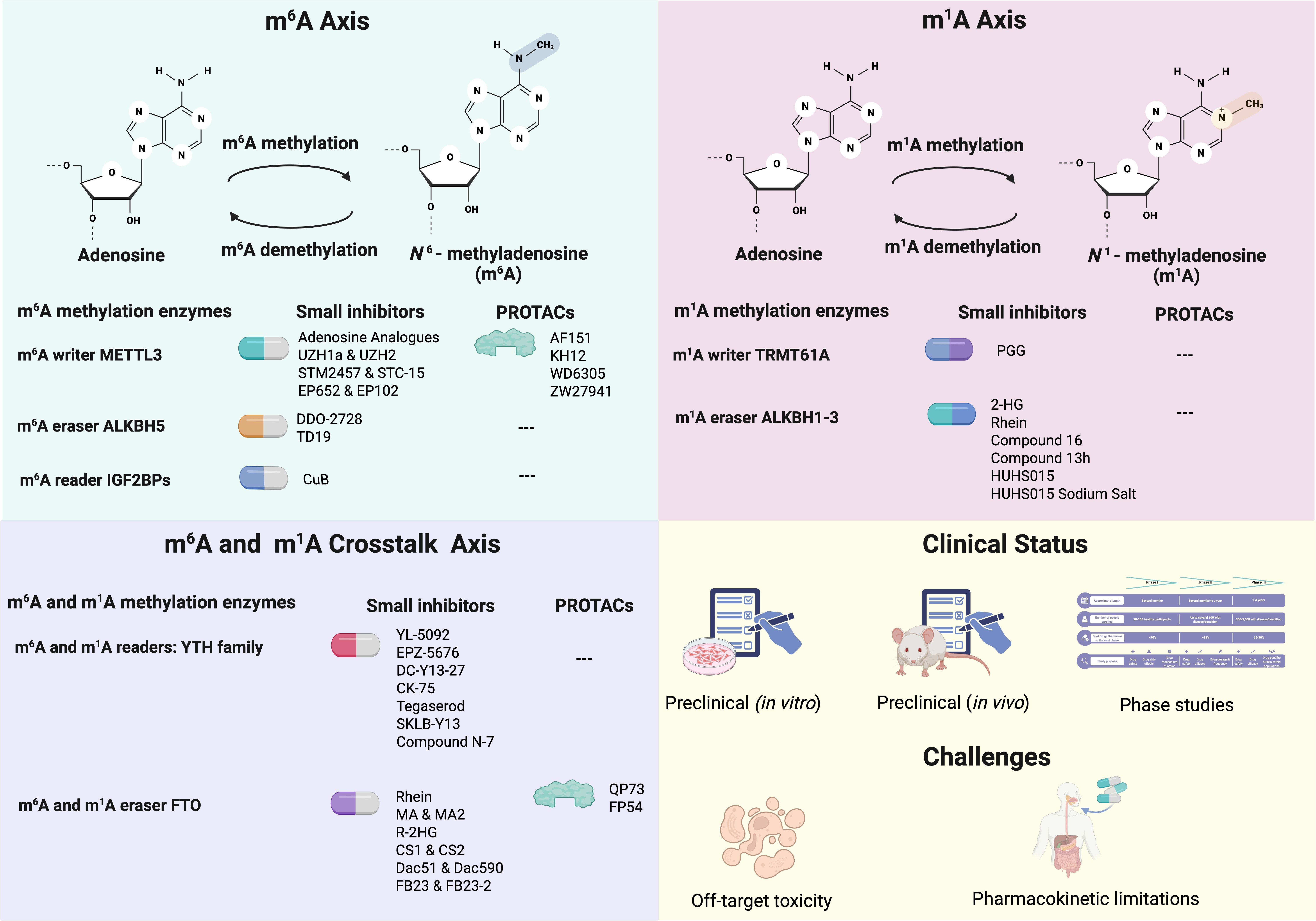
Epitranscriptomic modifications, particularly RNA methylations, have emerged as regulators of gene expression, with their dysregulation acting as a key factor in tumorigenesis and metastatic progression. This review evaluates the therapeutic landscapes of N6-methyladenosine (m6A) and N1-methyladenosine (m1A) modifications in cancer. While the m6A machinery predominantly dictates mRNA turnover and stability, the m1A network is uniquely positioned to drive translational reprogramming, allowing malignant cells to endure severe microenvironmental stress and evade cell death. Despite positional and chemical differences, these modifications exhibit profound epitranscriptomic crosstalk through shared regulatory proteins. Here, we comprehensively analyze current pharmacological strategies targeting the m6A axis, highlighting the transition from classical small-molecule inhibitors of regulatory proteins of these methylations, such as methyltransferase-like 3 (METTL3), fat mass and obesity-associated protein (FTO), and AlkB homolog 5 (ALKBH5), to the novel event-driven approach of proteolysis-targeting chimeras (PROTACs). Furthermore, we assess the emerging therapeutic potential of the m1A regulatory machinery, positioning tRNA methyltransferase 6/61A (TRMT6/61A) writers and AlkB homolog 1 to 3 (ALKBH1-3) erasers as promising therapeutic targets. Finally, we discuss clinical successes and current translational obstacles, including off-target toxicity, pharmacokinetic limitations, and epitranscriptomic escape, emphasizing that site-specific modulation and smart precision therapies will dictate the future of oncology.
Share and Cite
MDPI and ACS Style
Gazaloğlu, Y.; Sağlam-Şen, B.; Akgül, B.
m1A and m6A RNA Methylations as Druggable Targets in Cancer. Pharmaceuticals 2026, 19, 990.
https://doi.org/10.3390/ph19070990
AMA Style
Gazaloğlu Y, Sağlam-Şen B, Akgül B.
m1A and m6A RNA Methylations as Druggable Targets in Cancer. Pharmaceuticals. 2026; 19(7):990.
https://doi.org/10.3390/ph19070990
Chicago/Turabian Style
Gazaloğlu, Yasemin, Buket Sağlam-Şen, and Bünyamin Akgül.
2026. "m1A and m6A RNA Methylations as Druggable Targets in Cancer" Pharmaceuticals 19, no. 7: 990.
https://doi.org/10.3390/ph19070990
APA Style
Gazaloğlu, Y., Sağlam-Şen, B., & Akgül, B.
(2026). m1A and m6A RNA Methylations as Druggable Targets in Cancer. Pharmaceuticals, 19(7), 990.
https://doi.org/10.3390/ph19070990
Note that from the first issue of 2016, this journal uses article numbers instead of page numbers. See further details
here.
Article Metrics
Article metric data becomes available approximately 24 hours after publication online.