This is an early access version, the complete PDF, HTML, and XML versions will be available soon.
Review

Circadian Influences on Chronic Kidney Disease Progression: Molecular Signaling Pathways of Melatonin and Their Therapeutic Potential

1
Division of Nephrology, Department of Medicine, Taipei Tzu Chi Hospital, Buddhist Tzu Chi Medical Foundation, New Taipei City 23142, Taiwan
2
School of Medicine, College of Medicine, Fu Jen Catholic University, New Taipei City 24205, Taiwan
3
Division of Nephrology, Department of Internal Medicine, Fu Jen Catholic University Hospital, Fu Jen Catholic University, New Taipei City 24352, Taiwan
4
Division of Nephrology, Department of Internal Medicine, Cardinal-Tien Hospital, New Taipei City 23155, Taiwan
5
Institute of Biomedical Sciences, Academia Sinica, Taipei 115201, Taiwan
6
School of Public Health, National Defense Medical University, Taipei 114201, Taiwan
7
Division of Nephrology, Department of Internal Medicine, Shuang Ho Hospital, Taipei Medical University, New Taipei City 23561, Taiwan
8
Division of Nephrology, Department of Internal Medicine, Tri-Service General Hospital, National Defense Medical University, Taipei 11490, Taiwan
*
Author to whom correspondence should be addressed.
Pharmaceuticals 2026, 19(6), 952; https://doi.org/10.3390/ph19060952 (registering DOI)
Submission received: 19 May 2026 / Revised: 12 June 2026 / Accepted: 16 June 2026 / Published: 18 June 2026
(This article belongs to the Section Medicinal Chemistry)

Abstract

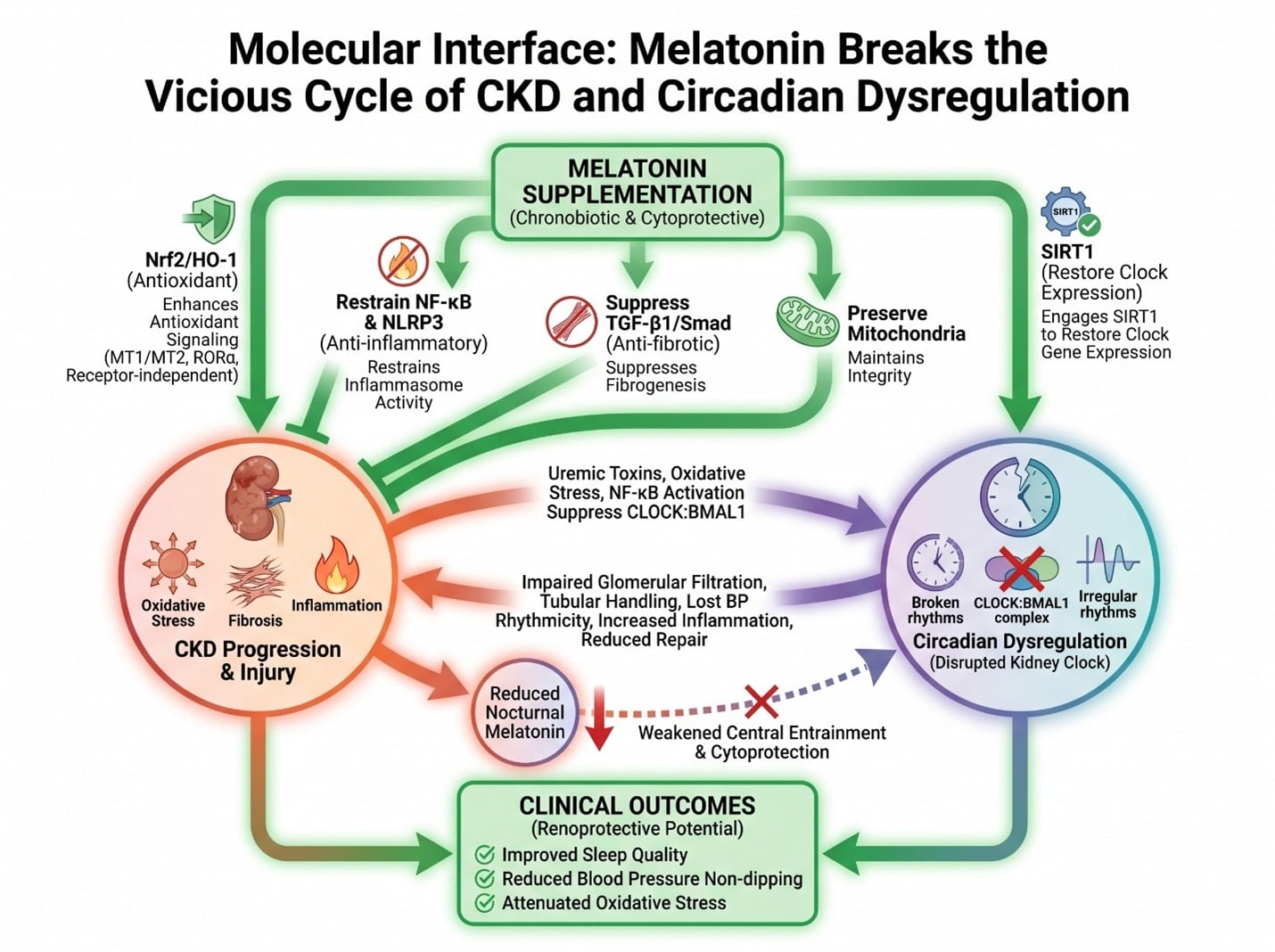
Chronic kidney disease (CKD) remains a leading cause of premature mortality and global disease burden, yet the molecular mechanisms underlying its progression are still incompletely understood. Accumulating evidence highlights circadian disruption as an underappreciated driver of CKD that warrants systematic re-examination. The kidney harbors an autonomous circadian oscillator, principally regulated by the CLOCK:BMAL1 transcription factor complex, which coordinates glomerular filtration, tubular electrolyte handling, blood pressure rhythmicity, inflammatory tone, and cellular repair. In CKD, retained uremic toxins, sustained oxidative stress, and persistent NF-κB activation collectively suppress this clock machinery, generating a self-reinforcing cycle of renal injury and circadian dysregulation. CKD is also accompanied by progressive attenuation of nocturnal melatonin secretion, weakening a central hormonal cue for peripheral clock entrainment and cytoprotection. Melatonin acts both as a chronobiotic and as a pleiotropic cytoprotective molecule. Through MT1/MT2 receptors, the nuclear receptor RORα, and receptor-independent antioxidant pathways, it may enhance Nrf2/HO-1 signaling, restrain NF-κB and NLRP3 inflammasome activity, suppress TGF-β1/Smad2/3-mediated fibrogenesis, preserve mitochondrial integrity, and engage SIRT1-linked clock regulation. Current clinical studies suggest that nightly melatonin supplementation can improve sleep quality and selected oxidative or circadian surrogate endpoints in hemodialysis patients; however, whether melatonin slows CKD progression or preserves renal function remains unproven. This review synthesizes the molecular interface between circadian dysregulation and CKD progression and articulates a rationale for adequately powered clinical trials evaluating melatonin as a candidate chronotherapeutic adjunct rather than an established renoprotective therapy.
Keywords: chronic kidney disease; circadian rhythm; melatonin; BMAL1; Nrf2; renal fibrosis; TGF-β1; NLRP3 inflammasome; SIRT1; chrono-nephrology chronic kidney disease; circadian rhythm; melatonin; BMAL1; Nrf2; renal fibrosis; TGF-β1; NLRP3 inflammasome; SIRT1; chrono-nephrology
Graphical Abstract