Synergistic Molecular Strategies for Targeting the Unfolded Protein Response in Cancer Therapy


Abstract
1. Introduction
1.1. The UPR Pathway
- (A)
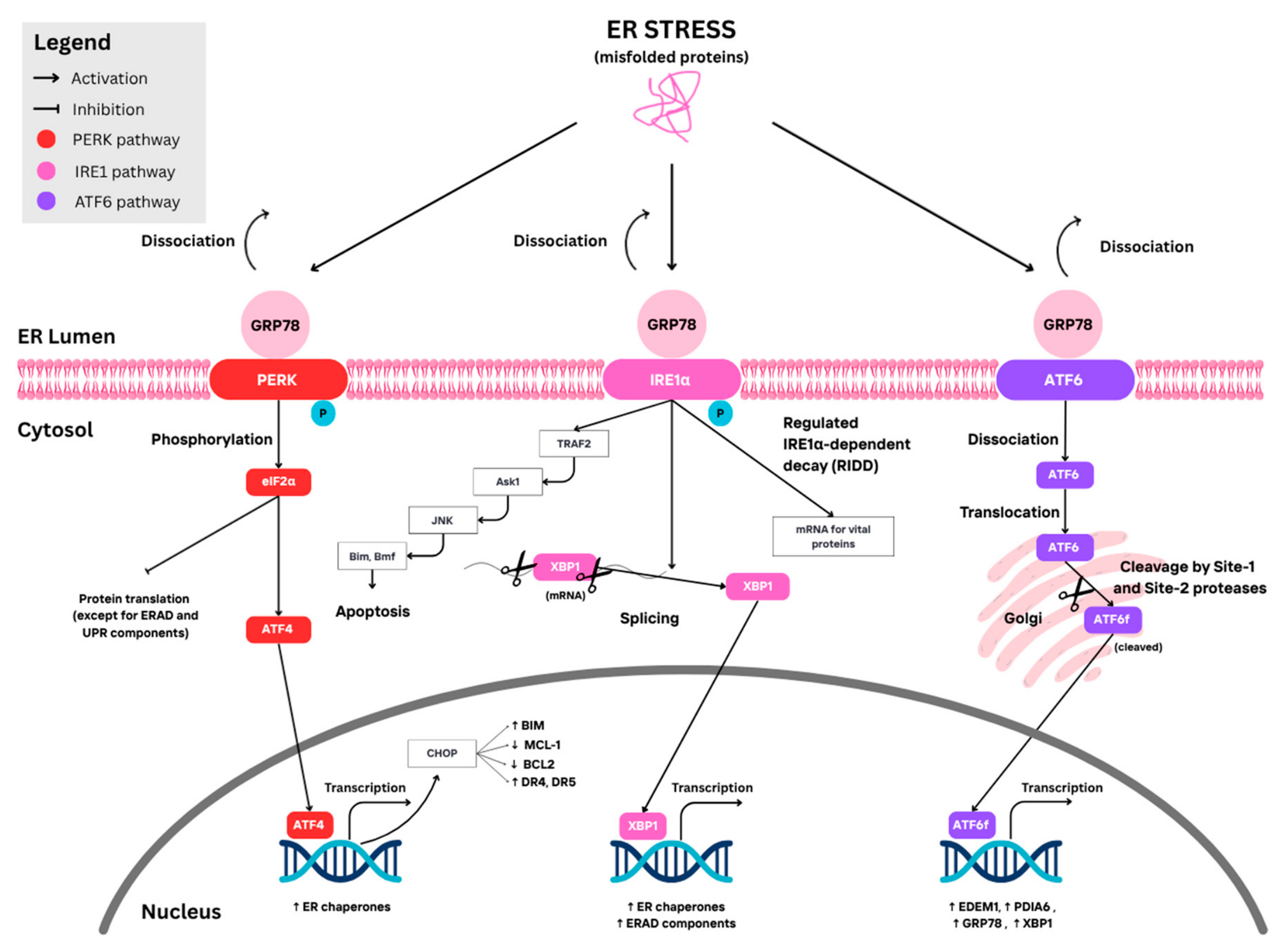
- Upon GRP78 dissociation, PERK oligomerizes and autophosphorylates. Then it proceeds to phosphorylate eukaryotic translation initiator factor 2α (eIF2α), thus inhibiting mRNA translation and protein synthesis. Exceptions to this are ERAD components, ER chaperones, UPR transcription factors, etc. [5]. Translation of mRNA for Activating Transcription Factor-4 (ATF4) is also selectively induced. In UPR stage 1, ATF4 stimulates the expression of ER chaperones and other proteins involved in the recovery of proteostasis. Additionally, ATF4 stimulates the expression of the pro-apoptotic C/EBP homologous protein (CHOP). In acute ER Stress, the elevation in CHOP levels is transient and has no significant effect. However, in chronic ER Stress, its concentration increases dramatically and facilitates the shift to UPR stage 2. Prolonged high levels of CHOP seem to have a key role in the execution of apoptosis [4,6].
- (B)
- In similar fashion to PERK, when GRP78 dissociates, IRE1α undergoes oligomerization and autophosphorylation. IRE1α then performs splicing of the mRNA coding the X-box binding protein 1 (XBP1). The activated form—spliced XBP1, is a transcription factor. It enters the nucleus and proceeds to upregulate the transcription of genes, involved in ER protein folding and ERAD [7]. The transition from stage 1 to stage 2 UPR is marked by the activation of Regulated IRE1α-dependent decay (RIDD). RIDD is responsible for the degradation of the GRP78 mRNA and the mRNA of many other proteins involved in the negative regulation of apoptosis and cell growth [4]. In this way prolonged ER Stress proves itself as the pivotal point for the switch from the pro-survival to the pro-apoptotic UPR.
- (C)
- ATF6 is the third membrane-bound ER Stress sensor. It exists as a dimer associated with GRP78. Upon GRP78 dissociation, ATF6 translocates from the ER to the Golgi apparatus where it is cleaved by Site-1 protease and Site-2 protease. Occasionally, the now active transcription factor ATF6f enters the nucleus and induces the expression of proteins, which either alleviate the ER Stress directly—degradation-enhancing α-mannosidase-like protein 1 (EDEM1), protein disulphide isomerase-associated 6 (PDIA6), or do so by influencing the UPR—expression of GRP78 and XBP1 [8].
1.2. The UPR Can Trigger Apoptosis
1.3. The UPR as a Therapeutic Target in Cancer
2. Therapeutic Approaches
3. Primary ER Stress Inducers
4. Classification of Synergistic Strategies by Mechanism of Action
4.1. Therapies Using UPR Feedback Inhibitors
4.2. Therapies Using UPR Pathway Inhibitors
4.3. Therapies Using Signal Pathway Inhibitors

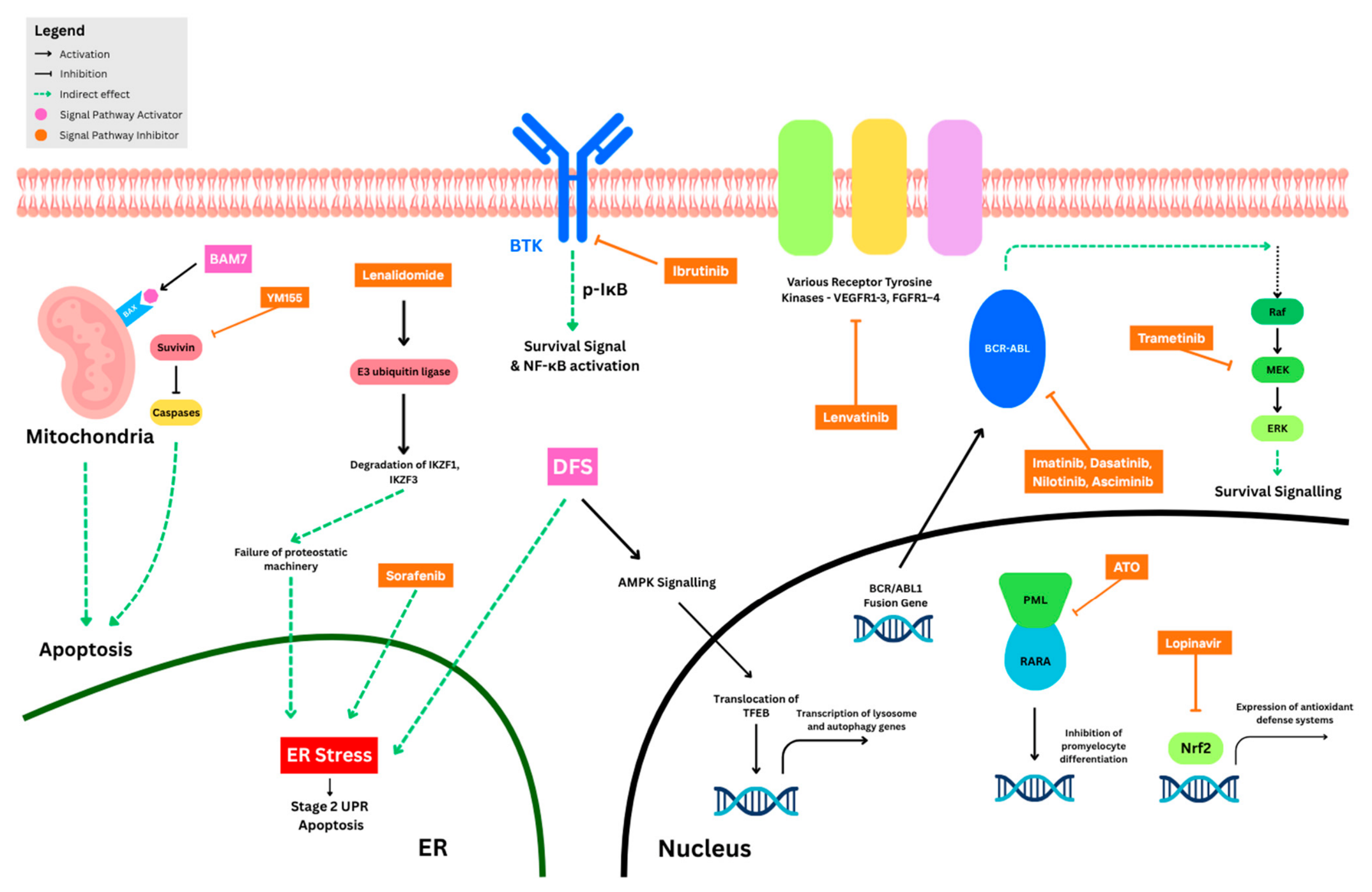
| Primary Drug (ER-Stress Inducer) | Accompanying Drug (Signal Pathway Inhibitor) | Mechanism of Action of the Accompanying Drug | Cancer Type/Cancer Cell Line | Author/Ref. No. |
|---|---|---|---|---|
| Bortezomib/Carfilzomib | Lopinavir | HIV-Protease inhibitors; inhibit Nrf2 to block the cellular antioxidant response. | Renal cell carcinoma cells | Abt. et al. [32] |
| 2-DG (Glycosylation inhibitor) | Ibrutinib | BTK inhibitor; increases transcription of UPR genes (XBP1). | Diffuse large B-cell lymphoma cell lines | Zhang et al. [37] |
| LU-102 (PI) | Ibrutinib | BTK inhibitor; decreases p-IκB levels, suppressing NF-κB activation. | MM cells | Kraus et al. [38] |
| Ironomycin | Ibrutinib | BTK inhibitor; causes downregulation of the BCR survival pathway. | Mantle cell lymphoma cell lines | Ovejero et al. [39] |
| ALLN/Epoxomicin | Sorafenib | Multi-kinase inhibitor; potent ER-stress inducer and UPR activator. | Hepatocellular carcinoma cell lines | Honma et al. [40] |
| Clofoctol | Sorafenib | Multi-kinase inhibitor; potent ER Stress inducer and UPR activator. | Prostate cancer cell lines | Fan et al. [42] |
| Thapsigargin/Oligomycin | Imatinib, Dasatinib, Nilotinib, Asciminib | BCR:ABL1 inhibitors (TKIs) that synergize with metabolic inhibitors. | Chronic myeloid leukemia cell lines | Häselbarth et al. [43] |
| Antrocinol | Lenvatinib | Downregulates the expression of ATG5—a key regulatory molecule related to autophagy | Hepatocellular carcinoma cell lines | Lai et al. [44] |
| Onalespib (HSP90i) | Trametinib/MTA (Pemetrexed) | MEK inhibitor/Antifolate; targets resistance in KRAS-mutant cells. | Lung cancer Cell lines) | Yang et al. [45] |
| Bortezomib (PI) | Arsenic trioxide (ATO) | Binds PML/PML-RARA proteins; leads to autophagy-mediated degradation. | Acute Promyelocytic Leukemia cell lines | Ganesan et al. [46] |
| Romidepsin (HDACi) | Lenalidomide | Pleiotropic; activates E3 ubiquitin ligase to degrade IKZF1/3. | T-Cell Lymphoma cell line, Anaplastic Large Cell Lymphoma cell line | Cosenza et al. [47] |
| CuET (p97 inhibitor) | YM 155 | Survivin inhibitor; prevents physical inhibition of caspases. | Prostate cancer cells | Majera et al. [48] |
4.4. Signal Pathway Activators
4.5. Therapies Using Proteostasis Inhibitors
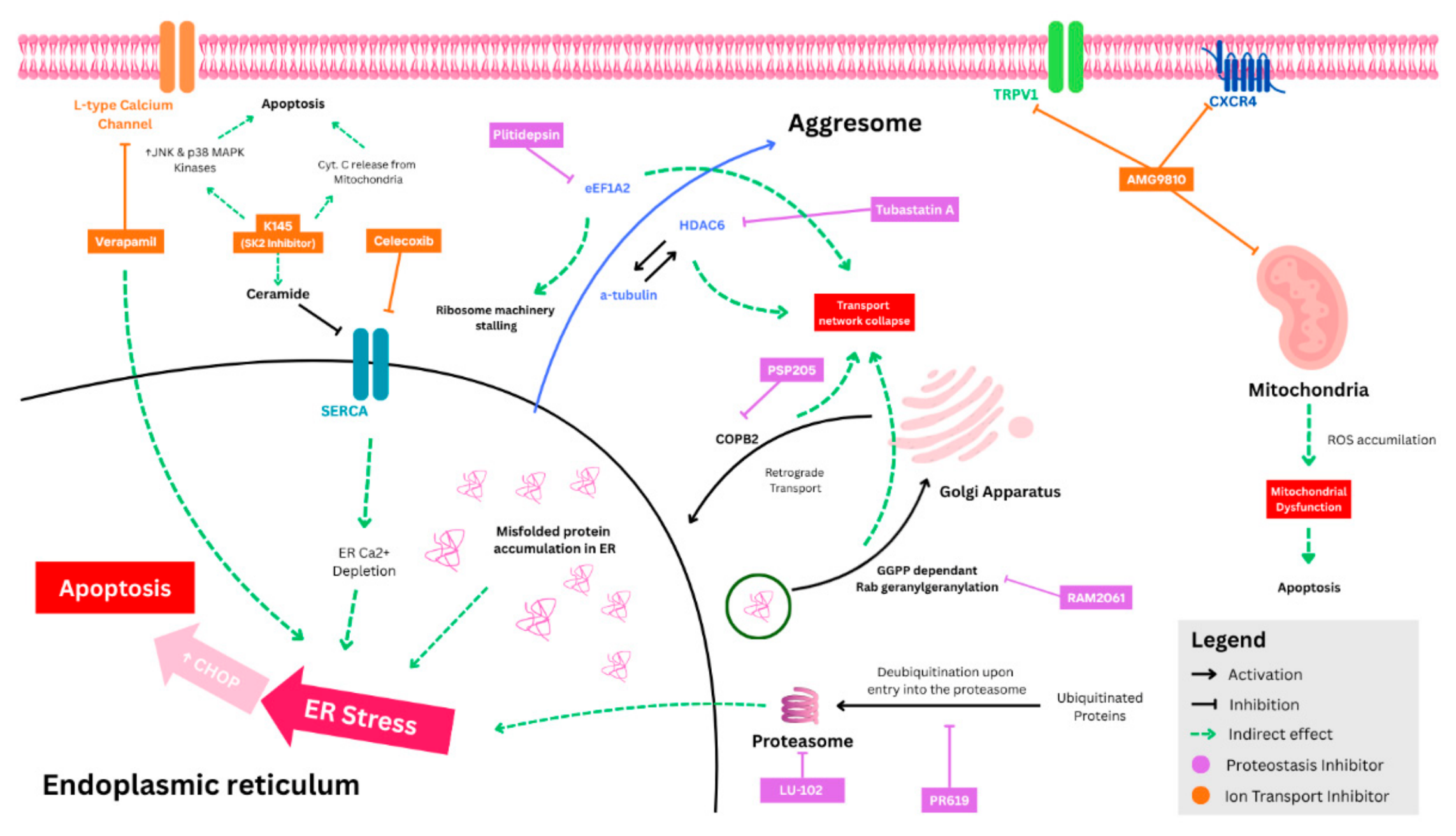
| Primary Drug (ER-Stress Inducer) | Accompanying Drug (Proteostasis Inhibitor) | Mechanism of Action of the Accompanying Drug | Cancer Type/Cancer Cell Line | Author/Ref. No. |
|---|---|---|---|---|
| Bortezomib/Carfilzomib | LU-102 | Beta2-selective proteasome inhibitor; prolongs the duration of proteasome inhibition | MM cell lines | Kraus et al. [56] |
| Fe3O2 (Nanoparticle) | PR-619 | Pan-deubiquitinating enzyme (DUB) inhibitor; inhibits ERAD by preventing ubiquitin trimming required for proteasomal entry | Renal cell adenocarcinoma and prostate cancer cell lines | Cai et al. [57] |
| Bortezomib | RAM2061 | Reduces GGPP levels, inhibits Rab GTPase geranylgeranylation. | MM cell lines | Haney et al. [58] |
| MG132 (Proteasome Inhibitor) | PSP 205 | Phenyl sulfonyl piperidine that inhibits COPB2; disrupts Golgi-to-ER retrograde transport, causing a protein “traffic jam” | Colon cancer cell lines | Samanta et al. [60] |
| Temozolomide (TMZ) | Tubastatin A | Specific HDAC6 inhibitor; disrupts the microtubule-dependent transport of misfolded proteins from the ER to the aggresome | Glioblastoma multiforme cell lines | Li et al. [61] |
| Bortezomib | Plitidepsin | Cyclic depsipeptide (protein synthesis inhibitor); causes ER Stress via ROS generation and inhibition of protein degradation/autophagy | MM cell lines, breast cancer and cervical cancer cell lines | Losada et al. [64] |
4.6. Therapies Using Ion Transport Inhibitors
| Primary Drug (ER-Stress Inducer) | Accompanying Drug (Ion Transport Inhibitor) | Mechanism of Action of the Accompanying Drug | Cancer Type/Cancer Cell Line | Author/Ref. No. |
|---|---|---|---|---|
| Bortezomib | K145 (SK2 Inhibitor) | (1) Accumulates ceramide (by lowering S1P) (2) Inhibits SERCA expression and disturbs ER calcium homeostasis. | MM cell lines | Wallington-Beddoe et al. [65] |
| MG132 | Celecoxib (COX-2 Inhibitor) | Direct inhibitor of SERCA, leading to the depletion of Ca2+ in the ER. | Human liver tumors | Cusimano et al. [67] |
| Bortezomib/Carfilzomib | AMG9810 | Inhibits TRPV1 channels, causing mitochondrial Ca2+ flux, ROS accumulation, and inhibition of the ubiquitin pathway. | Breast cancer cell lines | Beider et al. [68] |
| Bortezomib | Verapamil | Ca2+ channel inhibitor; increases expression of PERK and ATF4 to enhance UPR activation. | MM cell lines | Meister et al. [70] |
4.7. Conventional Chemotherapeutics
4.8. Others
5. Discussion
6. Materials and Methods
6.1. Study Design
6.2. Search Strategy
6.3. Inclusion Criteria
6.4. Exclusion Criteria
6.5. Analysis
7. Conclusions
Author Contributions
Funding
Institutional Review Board Statement
Informed Consent Statement
Data Availability Statement
Acknowledgments
Conflicts of Interest
Abbreviations
| 2-DG | 2-deoxy-D-glucose |
| 3-MA | 3-methyladenine |
| ABCB1 | ATP-binding cassette subfamily B member 1 |
| AMPK | Adenosine monophosphate-activated protein kinase |
| APL | Acute promyelocytic leukemia |
| ASK1 | Apoptosis signal-regulating kinase 1 |
| ATF4 | Activating transcription factor-4 |
| ATF6 | Activating transcription factor 6 |
| ATO | Arsenic trioxide |
| BiP | Binding immunoglobulin protein |
| BTK inhibitors | Bruton’s tyrosine kinase inhibitors |
| CHOP | C/EBP homologous protein |
| COMET | Combination Organelle Mitochondrial Endoplasmic Reticulum Therapy |
| CuET | Bis (diethyldithiocarbamate)-copper |
| DFS | (−)-(2R, 3R)-1,4-O-diferuloylsecoisolariciresinol |
| DON | Diazo-5-oxo-L-norleucine |
| DPAGT1 | UDP-N-acetylglucosamine–dolichol phosphate N-acetylglucosamine-1-phosphate transferase |
| DR4 | Death receptor 4 |
| DR5 | Death receptor 5 |
| EDEM1 | ER degradation-enhancing α-mannosidase-like protein 1 |
| EGCG | Epigallocatechin-3-gallate |
| eIF2α | Eukaryotic translation initiation factor 2α |
| EMT | Epithelial to mesenchymal transition |
| ER | Endoplasmic reticulum |
| ERAD | ER-associated degradation |
| FLCs | Free light chains |
| GFAT | Glutamine:fructose-6-phosphate amidotransferase |
| GRP78 | Glucose-Regulated Protein 78 |
| HDAC inhibitor | Histone deacetylase inhibitor |
| HDAC6 | Histone deacetylase 6 |
| HNK | Honokiol |
| Hsp70 | Heat Shock Protein 70 |
| HSP90 | Heat Shock Protein 90 |
| HSPA5 | Heat Shock Protein Family A (Hsp70) Member 5 gene |
| IAP | Inhibitor of Apoptosis |
| IRE1α | Inositol-requiring enzyme 1 alpha |
| ISR | Integrated Stress Response |
| JNK | c-Jun N-terminal kinase |
| MCL | Mantle cell lymphoma |
| MDR | Multidrug-resistant |
| MFN2 | Mitofusin 2 |
| MiND | Mitochondrial Network Disrupting Nanoparticles |
| MM | Multiple myeloma |
| MTA | Multitargeted antifolate |
| Nrf1/NFE2L1 | Nuclear factor erythroid 2-related factor 1 |
| OXPHOS | Oxidative phosphorylation |
| PDI inhibitors | Protein disulfide isomerase inhibitors |
| PDIA6 | Protein disulphide isomerase-associated 6 |
| PERK | Protein kinase RNA-like endoplasmic reticulum kinase |
| P-gp | P-glycoprotein |
| PI | Proteasome inhibitor |
| PML | Promyelocytic Leukemia protein |
| PRISMA | Preferred Reporting Items for Systematic Reviews and Meta-Analyses |
| RIDD | Regulated IRE1α-dependent decay |
| ROS | Reactive oxygen species |
| S2P | Site-2-protease |
| SERCA | sarcoplasmic/endoplasmic reticulum Ca2+-ATPase |
| TKI | Tyrosine kinase inhibitor |
| TME | Tumor microenvironment |
| TMZ | Temozolomide |
| TNBC | Triple Negative Breast Cancer |
| TRAF2 | TNF receptor-associated factor 2 |
| TRIB3 | Tribbles 3 |
| TRPV1 | Transient Receptor Potential Vanilloid type 1 |
| UPR | Unfolded Protein Response |
| UPS | Ubiquitin Proteasome System |
| XBP1 | X-box binding protein 1 |
| XN | Xanthohumol |
References
- Hwang, S.-M.; Chang, S.; Rodriguez, P.C.; Cubillos-Ruiz, J.R. Endoplasmic Reticulum Stress Responses in Anticancer Immunity. Nat. Rev. Cancer 2025, 25, 684–702. [Google Scholar] [CrossRef]
- Zhang, K.; Kaufman, R.J. Protein Folding in the Endoplasmic Reticulum and the Unfolded Protein Response. In Molecular Chaperones in Health and Disease; Starke, K., Gaestel, M., Eds.; Handbook of Experimental Pharmacology; Springer: Berlin/Heidelberg, Germany, 2006; Volume 172, pp. 69–91. [Google Scholar]
- Krshnan, L.; Van De Weijer, M.L.; Carvalho, P. Endoplasmic Reticulum–Associated Protein Degradation. Cold Spring Harb. Perspect. Biol. 2022, 14, a041247. [Google Scholar] [CrossRef] [PubMed]
- Ojha, R.; Amaravadi, R.K. Targeting the Unfolded Protein Response in Cancer. Pharmacol. Res. 2017, 120, 258–266. [Google Scholar] [CrossRef]
- Bell, M.C.; Meier, S.E.; Ingram, A.L.; Abisambra, J.F. PERK-Opathies: An Endoplasmic Reticulum Stress Mechanism Underlying Neurodegeneration. Curr. Alzheimer Res. 2016, 13, 150–163. [Google Scholar] [CrossRef] [PubMed]
- Schonthal, A.H. Targeting Endoplasmic Reticulum Stress for Cancer Therapy. Front. Biosci. 2012, S4, 412–431. [Google Scholar] [CrossRef]
- Park, S.-M.; Kang, T.-I.; So, J.-S. Roles of XBP1s in Transcriptional Regulation of Target Genes. Biomedicines 2021, 9, 791. [Google Scholar] [CrossRef] [PubMed]
- Hillary, R.F.; FitzGerald, U. A Lifetime of Stress: ATF6 in Development and Homeostasis. J. Biomed. Sci. 2018, 25, 48. [Google Scholar] [CrossRef]
- Iurlaro, R.; Muñoz-Pinedo, C. Cell Death Induced by Endoplasmic Reticulum Stress. FEBS J. 2016, 283, 2640–2652. [Google Scholar] [CrossRef]
- Datta, S.R.; Dudek, H.; Tao, X.; Masters, S.; Fu, H.; Gotoh, Y.; Greenberg, M.E. Akt Phosphorylation of BAD Couples Survival Signals to the Cell-Intrinsic Death Machinery. Cell 1997, 91, 231–241. [Google Scholar] [CrossRef]
- Hu, H.; Tian, M.; Ding, C.; Yu, S. The C/EBP Homologous Protein (CHOP) Transcription Factor Functions in Endoplasmic Reticulum Stress-Induced Apoptosis and Microbial Infection. Front. Immunol. 2019, 9, 3083. [Google Scholar] [CrossRef]
- Quwaider, D.; Corchete, L.A.; Martín-Izquierdo, M.; Hernández-Sánchez, J.M.; Rojas, E.A.; Cardona-Benavides, I.J.; García-Sanz, R.; Herrero, A.B.; Gutiérrez, N.C. RNA Sequencing Identifies Novel Regulated IRE1-Dependent Decay Targets That Affect Multiple Myeloma Survival and Proliferation. Exp. Hematol. Oncol. 2022, 11, 18. [Google Scholar] [CrossRef]
- Lei, K.; Davis, R.J. JNK Phosphorylation of Bim-Related Members of the Bcl2 Family Induces Bax-Dependent Apoptosis. Proc. Natl. Acad. Sci. USA 2003, 100, 2432–2437. [Google Scholar] [CrossRef] [PubMed]
- Junjappa, R.P.; Patil, P.; Bhattarai, K.R.; Kim, H.-R.; Chae, H.-J. IRE1α Implications in Endoplasmic Reticulum Stress-Mediated Development and Pathogenesis of Autoimmune Diseases. Front. Immunol. 2018, 9, 1289. [Google Scholar] [CrossRef]
- Morishima, N.; Nakanishi, K.; Nakano, A. Activating Transcription Factor-6 (ATF6) Mediates Apoptosis with Reduction of Myeloid Cell Leukemia Sequence 1 (Mcl-1) Protein via Induction of WW Domain Binding Protein 1. J. Biol. Chem. 2011, 286, 35227–35235. [Google Scholar] [CrossRef]
- Ho Zhi Guang, M.; Kavanagh, E.; Dunne, L.; Dowling, P.; Zhang, L.; Lindsay, S.; Bazou, D.; Goh, C.; Hanley, C.; Bianchi, G.; et al. Targeting Proteotoxic Stress in Cancer: A Review of the Role That Protein Quality Control Pathways Play in Oncogenesis. Cancers 2019, 11, 66. [Google Scholar] [CrossRef]
- Li, X.; Zhang, K.; Li, Z. Unfolded Protein Response in Cancer: The Physician’s Perspective. J. Hematol. Oncol. 2011, 4, 8. [Google Scholar] [CrossRef]
- Nunes, A.T.; Annunziata, C.M. Proteasome Inhibitors: Structure and Function. Semin. Oncol. 2017, 44, 377–380. [Google Scholar] [CrossRef]
- Lust, S.; Vanhoecke, B.; VAN Gele, M.; Boelens, J.; VAN Melckebeke, H.; Kaileh, M.; Vanden Berghe, W.; Haegeman, G.; Philippé, J.; Bracke, M.; et al. Xanthohumol Activates the Proapoptotic Arm of the Unfolded Protein Response in Chronic Lymphocytic Leukemia. Anticancer Res. 2009, 29, 3797–3805. [Google Scholar]
- Gsottberger, F.; Meier, C.; Ammon, A.; Parker, S.; Wendland, K.; George, R.; Petkovic, S.; Mellenthin, L.; Emmerich, C.; Lutzny-Geier, G.; et al. Targeted Inhibition of Protein Synthesis Renders Cancer Cells Vulnerable to Apoptosis by Unfolded Protein Response. Cell Death Dis. 2023, 14, 561. [Google Scholar] [CrossRef] [PubMed]
- Martin, S.; Lamb, H.K.; Brady, C.; Lefkove, B.; Bonner, M.Y.; Thompson, P.; Lovat, P.E.; Arbiser, J.L.; Hawkins, A.R.; Redfern, C.P.F. Inducing Apoptosis of Cancer Cells Using Small-Molecule Plant Compounds That Bind to GRP78. Br. J. Cancer 2013, 109, 433–443. [Google Scholar] [CrossRef] [PubMed]
- Li, M.; Wang, J.; Jing, J.; Hua, H.; Luo, T.; Xu, L.; Wang, R.; Liu, D.; Jiang, Y. Synergistic Promotion of Breast Cancer Cells Death by Targeting Molecular Chaperone GRP78 and Heat Shock Protein 70. J. Cell. Mol. Med. 2009, 13, 4540–4550. [Google Scholar] [CrossRef]
- Wang, J.; Yin, Y.; Hua, H.; Li, M.; Luo, T.; Xu, L.; Wang, R.; Liu, D.; Zhang, Y.; Jiang, Y. Blockade of GRP78 Sensitizes Breast Cancer Cells to Microtubules-interfering Agents That Induce the Unfolded Protein Response. J. Cell. Mol. Med. 2009, 13, 3888–3897. [Google Scholar] [CrossRef] [PubMed]
- Wang, R.; Liu, S.L.; Guo, Q.Q.; Shi, X.H.; Ma, M.M. Circadian Clock REV-ERBs Agonist SR9009 Induces Synergistic Antitumor Activity in Multiple Myeloma by Suppressing Glucose-Regulated Protein 78-Dependent Autophagy and Lipogenesis. World J. Oncol. 2023, 14, 464–475. [Google Scholar] [CrossRef] [PubMed]
- Buontempo, F.; Orsini, E.; Lonetti, A.; Cappellini, A.; Chiarini, F.; Evangelisti, C.; Evangelisti, C.; Melchionda, F.; Pession, A.; Bertaina, A.; et al. Synergistic Cytotoxic Effects of Bortezomib and CK2 Inhibitor CX-4945 in Acute Lymphoblastic Leukemia: Turning off the Prosurvival ER Chaperone BIP/Grp78 and Turning on the pro-Apoptotic NF-κB. Oncotarget 2016, 7, 1323–1340. [Google Scholar] [CrossRef]
- Luo, G.; Aldridge, K.; Chen, T.; Aslot, V.; Kim, B.; Han, E.H.; Singh, N.; Li, S.; Xiao, T.S.; Sporn, M.B.; et al. The Synthetic Oleanane Triterpenoid CDDO-2P-Im Binds GRP78/BiP to Induce Unfolded Protein Response-mediated Apoptosis in Myeloma. Mol. Oncol. 2023, 17, 2526–2545. [Google Scholar] [CrossRef]
- Chen, Y.; Tao, Y.; Hu, K.; Lu, J. GRP78 Inhibitor HA15 Increases the Effect of Bortezomib on Eradicating Multiple Myeloma Cells through Triggering Endoplasmic Reticulum Stress. Heliyon 2023, 9, e19806. [Google Scholar] [CrossRef]
- Samanta, S.; Yang, S.; Debnath, B.; Xue, D.; Kuang, Y.; Ramkumar, K.; Lee, A.S.; Ljungman, M.; Neamati, N. The Hydroxyquinoline Analogue YUM70 Inhibits GRP78 to Induce ER Stress–Mediated Apoptosis in Pancreatic Cancer. Cancer Res. 2021, 81, 1883–1895. [Google Scholar] [CrossRef] [PubMed]
- Vandewynckel, Y.-P.; Coucke, C.; Laukens, D.; Devisscher, L.; Paridaens, A.; Bogaerts, E.; Vandierendonck, A.; Raevens, S.; Verhelst, X.; Van Steenkiste, C.; et al. Next-Generation Proteasome Inhibitor Oprozomib Synergizes with Modulators of the Unfolded Protein Response to Suppress Hepatocellular Carcinoma. Oncotarget 2016, 7, 34988–35000. [Google Scholar] [CrossRef]
- Fujimoto, A.; Kawana, K.; Taguchi, A.; Adachi, K.; Sato, M.; Nakamura, H.; Ogishima, J.; Yoshida, M.; Inoue, T.; Nishida, H.; et al. Inhibition of Endoplasmic Reticulum (ER) Stress Sensors Sensitizes Cancer Stem-like Cells to ER Stress-Mediated Apoptosis. Oncotarget 2016, 7, 51854–51864. [Google Scholar] [CrossRef]
- Zhang, X.; Wang, X.; Zhou, Z.; Bai, H.; Shi, L.; Yang, Y.; Zhou, S.; Zhang, X. The Combination of Digoxin and GSK2606414 Exerts Synergistic Anticancer Activity against Leukemia in Vitro and in Vivo. BioFactors 2017, 43, 812–820. [Google Scholar] [CrossRef]
- Abt, D.; Besse, A.; Sedlarikova, L.; Kraus, M.; Bader, J.; Silzle, T.; Vodinska, M.; Slaby, O.; Schmid, H.; Engeler, D.S.; et al. Improving the Efficacy of Proteasome Inhibitors in the Treatment of Renal Cell Carcinoma by Combination with the Human Immunodeficiency Virus (HIV)-protease Inhibitors Lopinavir or Nelfinavir. BJU Int. 2018, 121, 600–609. [Google Scholar] [CrossRef] [PubMed]
- Sheng, X.; Nenseth, H.Z.; Qu, S.; Kuzu, O.F.; Frahnow, T.; Simon, L.; Greene, S.; Zeng, Q.; Fazli, L.; Rennie, P.S.; et al. IRE1α-XBP1s Pathway Promotes Prostate Cancer by Activating c-MYC Signaling. Nat. Commun. 2019, 10, 323. [Google Scholar] [CrossRef] [PubMed]
- Chien, W.; Ding, L.-W.; Sun, Q.-Y.; Torres-Fernandez, L.A.; Tan, S.Z.; Xiao, J.; Lim, S.L.; Garg, M.; Lee, K.L.; Kitajima, S.; et al. Selective Inhibition of Unfolded Protein Response Induces Apoptosis in Pancreatic Cancer Cells. Oncotarget 2014, 5, 4881–4894. [Google Scholar] [CrossRef]
- Saito, S.; Furuno, A.; Sakurai, J.; Park, H.-R.; Shin-ya, K.; Tomida, A. Compound C Prevents the Unfolded Protein Response during Glucose Deprivation through a Mechanism Independent of AMPK and BMP Signaling. PLoS ONE 2012, 7, e45845. [Google Scholar] [CrossRef] [PubMed]
- Huang, H.; Liu, H.; Liu, C.; Fan, L.; Zhang, X.; Gao, A.; Hu, X.; Zhang, K.; Cao, X.; Jiang, K.; et al. Disruption of the Unfolded Protein Response (UPR) by Lead Compound Selectively Suppresses Cancer Cell Growth. Cancer Lett. 2015, 360, 257–268. [Google Scholar] [CrossRef]
- Zhang, X.; Hu, X.; Wang, H.; Kan, W.; Xu, L.; Wang, Z.; Xiang, Y.; Wu, W.; Feng, B.; Li, J.; et al. Activation of Unfolded Protein Response Overcomes Ibrutinib Resistance in Diffuse Large B-Cell Lymphoma. Acta Pharmacol. Sin. 2021, 42, 814–823. [Google Scholar] [CrossRef]
- Kraus, J.; Kraus, M.; Liu, N.; Besse, L.; Bader, J.; Geurink, P.P.; De Bruin, G.; Kisselev, A.F.; Overkleeft, H.; Driessen, C. The Novel Β2-Selective Proteasome Inhibitor LU-102 Decreases Phosphorylation of I Kappa B and Induces Highly Synergistic Cytotoxicity in Combination with Ibrutinib in Multiple Myeloma Cells. Cancer Chemother. Pharmacol. 2015, 76, 383–396. [Google Scholar] [CrossRef]
- Ovejero, S.; Alibert, L.; Devin, J.; Cañeque, T.; Jacquier, V.; Romero, A.; Amar, S.; Abouladzé, M.; de Paco, E.G.; Gadacha, O.K.; et al. Ironomycin Induces Mantle Cell Lymphoma Cell Death by Targeting Iron Metabolism Addiction. Theranostics 2025, 15, 2834–2851. [Google Scholar] [CrossRef]
- Honma, Y.; Harada, M. Sorafenib Enhances Proteasome Inhibitor-Mediated Cytotoxicity via Inhibition of Unfolded Protein Response and Keratin Phosphorylation. Exp. Cell Res. 2013, 319, 2166–2178. [Google Scholar] [CrossRef] [PubMed]
- Rahmani, M.; Davis, E.M.; Crabtree, T.R.; Habibi, J.R.; Nguyen, T.K.; Dent, P.; Grant, S. The Kinase Inhibitor Sorafenib Induces Cell Death through a Process Involving Induction of Endoplasmic Reticulum Stress. Mol. Cell. Biol. 2007, 27, 5499–5513. [Google Scholar] [CrossRef]
- Fan, L.; He, Z.; Head, S.A.; Zhou, Y.; Lu, T.; Feng, X.; Zhang, X.; Zhang, M.; Dang, Y.; Jiang, X.; et al. Clofoctol and Sorafenib Inhibit Prostate Cancer Growth via Synergistic Induction of Endoplasmic Reticulum Stress and UPR Pathways. Cancer Manag. Res. 2018, 10, 4817–4829. [Google Scholar] [CrossRef] [PubMed]
- Häselbarth, L.; Gamali, S.; Saul, D.; Krumbholz, M.; Böttcher-Loschinski, R.; Böttcher, M.; Zou, D.; Metzler, M.; Karow, A.; Mougiakakos, D. Synergistic Lethality in Chronic Myeloid Leukemia—Targeting Oxidative Phosphorylation and Unfolded Protein Response Effectively Complements Tyrosine Kinase Inhibitor Treatment. BMC Cancer 2023, 23, 1153. [Google Scholar] [CrossRef] [PubMed]
- Lai, S.-W.; Cheng, Y.-C.; Hsieh, M.-S.; Kuo, K.-T.; Yadav, V.K.; Tzeng, Y.-M.; Yeh, C.-T.; Tsai, T.-Y. Antrocinol-Mediated Downregulation of ATG5 Induces Autophagy-Dependent Cell Death and Activates the Unfolded Protein Response through PERK/CHOP Signaling in Lenvatinib-Resistant Hepatocellular Carcinoma Cells. Eur. J. Pharmacol. 2025, 1006, 178115. [Google Scholar] [CrossRef] [PubMed]
- Yang, H.; Liang, S.-Q.; Xu, D.; Yang, Z.; Marti, T.M.; Gao, Y.; Kocher, G.J.; Zhao, H.; Schmid, R.A.; Peng, R.-W. HSP90/AXL/eIF4E-Regulated Unfolded Protein Response as an Acquired Vulnerability in Drug-Resistant KRAS-Mutant Lung Cancer. Oncogenesis 2019, 8, 45. [Google Scholar] [CrossRef]
- Ganesan, S.; Alex, A.A.; Chendamarai, E.; Balasundaram, N.; Palani, H.K.; David, S.; Kulkarni, U.; Aiyaz, M.; Mugasimangalam, R.; Korula, A.; et al. Rationale and Efficacy of Proteasome Inhibitor Combined with Arsenic Trioxide in the Treatment of Acute Promyelocytic Leukemia. Leukemia 2016, 30, 2169–2178. [Google Scholar] [CrossRef]
- Cosenza, M.; Civallero, M.; Fiorcari, S.; Pozzi, S.; Marcheselli, L.; Bari, A.; Ferri, P.; Sacchi, S. The Histone Deacetylase Inhibitor Romidepsin Synergizes with Lenalidomide and Enhances Tumor Cell Death in T-Cell Lymphoma Cell Lines. Cancer Biol. Ther. 2016, 17, 1094–1106. [Google Scholar] [CrossRef]
- Majera, D.; Skrott, Z.; Bouchal, J.; Bartkova, J.; Simkova, D.; Gachechiladze, M.; Steigerova, J.; Kurfurstova, D.; Gursky, J.; Korinkova, G.; et al. Targeting Genotoxic and Proteotoxic Stress-response Pathways in Human Prostate Cancer by Clinically Available PARP Inhibitors, Vorinostat and Disulfiram. Prostate 2019, 79, 352–362. [Google Scholar] [CrossRef]
- Zhou, W.; Wang, D.; Tu, J.; Li, J.; Xu, J.; Tan, W.; Mo, D.; Liang, P.; Guo, Y.; Hu, M.; et al. Lopinavir/Ritonavir Induces Hepatotoxicity in HepG2 Cells through Inhibition of the Nrf2 Pathway, Resulting in Oxidative Stress, Endoplasmic Reticulum Stress, and Cell Cycle Arrest. Toxicol. Lett. 2026, 415, 111798. [Google Scholar] [CrossRef]
- Tsitsipatis, D.; Jayavelu, A.K.; Müller, J.P.; Bauer, R.; Schmidt-Arras, D.; Mahboobi, S.; Schnöder, T.M.; Heidel, F.; Böhmer, F.-D. Synergistic Killing of FLT3ITD-Positive AML Cells by Combined Inhibition of Tyrosine-Kinase Activity and N-Glycosylation. Oncotarget 2017, 8, 26613–26624. [Google Scholar] [CrossRef]
- Kato, S.; Adashek, J.J.; Subbiah, V.; Fu, S.; Sun, M.; Nguyen, L.; Brown, E.J.; Yap, T.A.; Karp, D.D.; Piha-Paul, S.A.; et al. A Phase i Study of Ixazomib and Erlotinib in Patients with Advanced Solid Tumors. Investig. New Drugs 2022, 40, 99–105. [Google Scholar] [CrossRef]
- Piperdi, B.; Ling, Y.-H.; Perez-Soler, R. Schedule-Dependent Interaction between the Proteosome Inhibitor Bortezomib and the EGFR-TK Inhibitor Erlotinib in Human Non-Small Cell Lung Cancer Cell Lines. J. Thorac. Oncol. 2007, 2, 715–721. [Google Scholar] [CrossRef]
- Kim, B.-G.; Choi, S.H.; Nguyen, H.; Liang, F.-S.; Kim, S.-J.; Letterio, J.; Huang, A. Abstract 4554: Novel Combination Therapy for Treating Proteasome Inhibitor-Resistant Multiple Myeloma. Cancer Res. 2024, 84, 4554. [Google Scholar] [CrossRef]
- Milane, L.S.; Dolare, S.; Ren, G.; Amiji, M. Combination Organelle Mitochondrial Endoplasmic Reticulum Therapy (COMET) for Multidrug Resistant Breast Cancer. J. Control. Release 2023, 363, 435–451. [Google Scholar] [CrossRef]
- Kwon, J.; Lee, Y.; Jeong, J.H.; Ryu, J.-H.; Kim, K.I. Inhibition of Autophagy Sensitizes Lignan-Induced Endoplasmic Reticulum Stress-Mediated Cell Death. Biochem. Biophys. Res. Commun. 2020, 526, 300–305. [Google Scholar] [CrossRef]
- Kraus, M.; Bader, J.; Geurink, P.P.; Weyburne, E.S.; Mirabella, A.C.; Silzle, T.; Shabaneh, T.B.; Van Der Linden, W.A.; De Bruin, G.; Haile, S.R.; et al. The Novel 2-Selective Proteasome Inhibitor LU-102 Synergizes with Bortezomib and Carfilzomib to Overcome Proteasome Inhibitor Resistance of Myeloma Cells. Haematologica 2015, 100, 1350–1360. [Google Scholar] [CrossRef]
- Cai, B.; Hou, M.; Zhang, S.; Xin, Z.; Huang, J.; Yang, J.; Wang, Y.; Cai, X.; Xie, S.; Zhang, C.; et al. Dual Targeting of Endoplasmic Reticulum by Redox-Deubiquitination Regulation for Cancer Therapy. Int. J. Nanomed. 2021, 16, 5193–5209. [Google Scholar] [CrossRef]
- Haney, S.L.; Varney, M.L.; Williams, J.T.; Smith, L.M.; Talmon, G.; Holstein, S.A. Geranylgeranyl Diphosphate Synthase Inhibitor and Proteasome Inhibitor Combination Therapy in Multiple Myeloma. Exp. Hematol. Oncol. 2022, 11, 5. [Google Scholar] [CrossRef]
- Haney, S.L.; Varney, M.L.; Chhonker, Y.S.; Shin, S.; Mehla, K.; Crawford, A.J.; Smith, H.J.; Smith, L.M.; Murry, D.J.; Hollingsworth, M.A.; et al. Inhibition of Geranylgeranyl Diphosphate Synthase Is a Novel Therapeutic Strategy for Pancreatic Ductal Adenocarcinoma. Oncogene 2019, 38, 5308–5320. [Google Scholar] [CrossRef]
- Samanta, S.; Roy, J.; Debnath, B.; Ljungman, M.; Neamati, N. PSP205, a Novel Phenyl Sulfonyl Piperidine, Induces Apoptotic Cell Death in Colon Cancer by Modulating Coat Protein Complex-Mediated Vesicle Trafficking. ACS Pharmacol. Transl. Sci. 2025, 8, 1072–1086. [Google Scholar] [CrossRef]
- Li, Z.; Zhang, C.; Zhang, Y.; Chen, L.; Chen, B.; Li, Q.; Zhang, X.; Li, W. A Novel HDAC6 Inhibitor Tubastatin A: Controls HDAC6-P97/VCP-Mediated Ubiquitination-Autophagy Turnover and Reverses Temozolomide-Induced ER Stress-Tolerance in GBM Cells. Cancer Lett. 2017, 391, 89–99. [Google Scholar] [CrossRef] [PubMed]
- Kawaguchi, Y.; Kovacs, J.J.; McLaurin, A.; Vance, J.M.; Ito, A.; Yao, T.-P. The Deacetylase HDAC6 Regulates Aggresome Formation and Cell Viability in Response to Misfolded Protein Stress. Cell 2003, 115, 727–738. [Google Scholar] [CrossRef] [PubMed]
- Rao, R.; Fiskus, W.; Yang, Y.; Joshi, R.; Fernandez, P.; Lee, P.; Jillella, A.; Tao, J.; Atadja, P.; Sotomayor, E.; et al. Co-Treatment with Panobinostat Enhances Bortezomib-Induced Unfolded Protein Response, Endoplasmic Reticulum Stress and Apoptosis of Human Mantle Cell Lymphoma Cells. Blood 2008, 112, 887. [Google Scholar] [CrossRef]
- Losada, A.; Berlanga, J.J.; Molina-Guijarro, J.M.; Jiménez-Ruiz, A.; Gago, F.; Avilés, P.; De Haro, C.; Martínez-Leal, J.F. Generation of Endoplasmic Reticulum Stress and Inhibition of Autophagy by Plitidepsin Induces Proteotoxic Apoptosis in Cancer Cells. Biochem. Pharmacol. 2020, 172, 113744. [Google Scholar] [CrossRef]
- Wallington-Beddoe, C.T.; Bennett, M.K.; Vandyke, K.; Davies, L.; Zebol, J.R.; Moretti, P.A.B.; Pitman, M.R.; Hewett, D.R.; Zannettino, A.C.W.; Pitson, S.M. Sphingosine Kinase 2 Inhibition Synergises with Bortezomib to Target Myeloma by Enhancing Endoplasmic Reticulum Stress. Oncotarget 2017, 8, 43602–43616. [Google Scholar] [CrossRef]
- Liu, Z.; Xia, Y.; Li, B.; Xu, H.; Wang, C.; Liu, Y.; Li, Y.; Li, C.; Gao, N.; Li, L. Induction of ER Stress-Mediated Apoptosis by Ceramide via Disruption of ER Ca2+ Homeostasis in Human Adenoid Cystic Carcinoma Cells. Cell Biosci. 2014, 4, 71. [Google Scholar] [CrossRef] [PubMed]
- Cusimano, A.; Azzolina, A.; Iovanna, J.L.; Bachvarov, D.; McCubrey, J.A.; D’Alessandro, N.; Montalto, G.; Cervello, M. Novel Combination of Celecoxib and Proteasome Inhibitor MG132 Provides Synergistic Antiproliferative and Proapoptotic Effects in Human Liver Tumor Cells. Cell Cycle 2010, 9, 1399–1410. [Google Scholar] [CrossRef]
- Cho, H.-Y.; Thomas, S.; Golden, E.B.; Gaffney, K.J.; Hofman, F.M.; Chen, T.C.; Louie, S.G.; Petasis, N.A.; Schönthal, A.H. Enhanced Killing of Chemo-Resistant Breast Cancer Cells via Controlled Aggravation of ER Stress. Cancer Lett. 2009, 282, 87–97. [Google Scholar] [CrossRef]
- Beider, K.; Rosenberg, E.; Dimenshtein-Voevoda, V.; Sirovsky, Y.; Vladimirsky, J.; Magen, H.; Ostrovsky, O.; Shimoni, A.; Bromberg, Z.; Weiss, L.; et al. Blocking of Transient Receptor Potential Vanilloid 1 (TRPV1) Promotes Terminal Mitophagy in Multiple Myeloma, Disturbing Calcium Homeostasis and Targeting Ubiquitin Pathway and Bortezomib-Induced Unfolded Protein Response. J. Hematol. Oncol. 2020, 13, 158. [Google Scholar] [CrossRef] [PubMed]
- Meister, S.; Frey, B.; Lang, V.R.; Gaipl, U.S.; Schett, G.; Schlötzer-Schrehardt, U.; Voll, R.E. Calcium Channel Blocker Verapamil Enhances Reticulum Stress and Death Induced by Proteasome Inhibition in Myeloma Cells. Neoplasia 2010, 12, 550–561. [Google Scholar] [CrossRef]
- Evangelisti, C.; Evangelisti, C.; Teti, G.; Chiarini, F.; Falconi, M.; Melchionda, F.; Pession, A.; Bertaina, A.; Locatelli, F.; McCubrey, J.A.; et al. Assessment of the Effect of Sphingosine Kinase Inhibitors on Apoptosis, Unfolded Protein Response and Autophagy of T-Cell Acute Lymphoblastic Leukemia Cells; Indications for Novel Therapeutics. Oncotarget 2014, 5, 7886–7901. [Google Scholar] [CrossRef]
- Erzurumlu, Y.; Catakli, D.; Dogan, H.K. Potent Carotenoid Astaxanthin Expands the Anti-Cancer Activity of Cisplatin in Human Prostate Cancer Cells. J. Nat. Med. 2023, 77, 572–583. [Google Scholar] [CrossRef]
- Del Vecchio, V.; Sanchez-Pajares, I.R.; Panda, S.K.; Rehman, A.; De Falco, V.; Nigam, A.; Mosca, L.; Russo, D.; Arena, C.; Nicoletti, M.M.; et al. Xanthohumol Modulate Autophagy and ER Stress to Counteract Stemness and Enhance Cisplatin Efficacy in Head and Neck Squamous Cell Carcinoma. Sci. Rep. 2025, 15, 13137. [Google Scholar] [CrossRef] [PubMed]
- Chen, W.; Do, K.C.; Saxton, B.; Leng, S.; Filipczak, P.; Tessema, M.; Belinsky, S.A.; Lin, Y. Inhibition of the Hexosamine Biosynthesis Pathway Potentiates Cisplatin Cytotoxicity by Decreasing BiP Expression in Non-Small-Cell Lung Cancer Cells. Mol. Carcinog. 2019, 58, 1046–1055. [Google Scholar] [CrossRef]
- Fan, L.; Liu, C.; Gao, A.; Zhou, Y.; Li, J. Berberine Combined with 2-Deoxy-d-Glucose Synergistically Enhances Cancer Cell Proliferation Inhibition via Energy Depletion and Unfolded Protein Response Disruption. Biochim. Biophys. Acta BBA—Gen. Subj. 2013, 1830, 5175–5183. [Google Scholar] [CrossRef]
- Yang, C.; Li, F.; Ren, Y.; Zhang, Q.; Jiao, B.; Zhang, J.; Huang, J. Targeting Esophageal Squamous Cell Carcinoma by Combining Copper Ionophore Disulfiram and JMJD3/UTX Inhibitor GSK J4. Cancers 2023, 15, 5347. [Google Scholar] [CrossRef]
- Acosta, L.; Byham-Gray, L.; Kurzer, M.; Samavat, H. Hepatotoxicity with High-Dose Green Tea Extract: Effect of Catechol-O-Methyltransferase and Uridine 5′-Diphospho-Glucuronosyltransferase 1A4 Genotypes. J. Diet. Suppl. 2023, 20, 850–869. [Google Scholar] [CrossRef]
- National Institutes of Health ClinicalTrials.Gov. Available online: https://clinicaltrials.gov/ (accessed on 20 May 2026).
- Sarrica, A.; Kirika, N.; Romeo, M.; Salmona, M.; Diomede, L. Safety and Toxicology of Magnolol and Honokiol. Planta Med. 2018, 84, 1151–1164. [Google Scholar] [CrossRef]
- Bakewell, S.J.; Rangel, D.F.; Ha, D.P.; Sethuraman, J.; Crouse, R.; Hadley, E.; Costich, T.L.; Zhou, X.; Nichols, P.; Lee, A.S. Suppression of Stress Induction of the 78-Kilodalton Glucose Regulated Protein (GRP78) in Cancer by IT-139, an Anti-Tumor Ruthenium Small Molecule Inhibitor. Oncotarget 2018, 9, 29698–29714. [Google Scholar] [CrossRef] [PubMed]
- Park, B.J.; Raha, P.; Pankovich, J.; Bazett, M. Utilization of Cancer Cell Line Screening to Elucidate the Anticancer Activity and Biological Pathways Related to the Ruthenium-Based Therapeutic BOLD-100. Cancers 2022, 15, 28. [Google Scholar] [CrossRef]
- ClinicalTrials.gov. BOLD-100 Plus Doxorubicin in Advanced Soft Tissue Sarcomas. Available online: https://clinicaltrials.gov/study/NCT07027423?intr=BOLD-100&viewType=Card&rank=1&tab=study (accessed on 11 April 2026).
- ClinicalTrials.gov. BOLD-100 in Combination With FOLFOX for the Treatment of Advanced Solid Tumours. Available online: https://clinicaltrials.gov/study/NCT04421820?intr=BOLD-100&viewType=Card&rank=2 (accessed on 11 April 2026).
- Mercado, G.; Castillo, V.; Soto, P.; López, N.; Axten, J.M.; Sardi, S.P.; Hoozemans, J.J.M.; Hetz, C. Targeting PERK Signaling with the Small Molecule GSK2606414 Prevents Neurodegeneration in a Model of Parkinson’s Disease. Neurobiol. Dis. 2018, 112, 136–148. [Google Scholar] [CrossRef] [PubMed]
- Yu, Q.; Zhao, B.; Gui, J.; Katlinski, K.V.; Brice, A.; Gao, Y.; Li, C.; Kushner, J.A.; Koumenis, C.; Diehl, J.A.; et al. Type I Interferons Mediate Pancreatic Toxicities of PERK Inhibition. Proc. Natl. Acad. Sci. USA 2015, 112, 15420–15425. [Google Scholar] [CrossRef] [PubMed]
- Stokes, M.E.; Calvo, V.; Fujisawa, S.; Dudgeon, C.; Huang, S.; Ballal, N.; Shen, L.; Gasparek, J.; Betzenhauser, M.; Taylor, S.J.; et al. PERK Inhibition by HC-5404 Sensitizes Renal Cell Carcinoma Tumor Models to Antiangiogenic Tyrosine Kinase Inhibitors. Clin. Cancer Res. 2023, 29, 4870–4882. [Google Scholar] [CrossRef]
- ClinicalTrials.gov. A Study of HC-5404-FU to Establish the Maximum Tolerated Dose (MTD). Available online: https://clinicaltrials.gov/study/NCT04834778?intr=HC-5404&viewType=Card&rank=1 (accessed on 11 April 2026).
- Gallagher, C.M.; Walter, P. Ceapins Inhibit ATF6α Signaling by Selectively Preventing Transport of ATF6α to the Golgi Apparatus during ER Stress. eLife 2016, 5, e11880. [Google Scholar] [CrossRef]
- ClinicalTrials.gov. Metformin, Nelfinavir, and Bortezomib in Treating Patients with Relapsed and/or Refractory Multiple Myeloma. Available online: https://clinicaltrials.gov/study/NCT03829020?intr=Metformin,%20Nelfinavir,%20and%20Bortezomib%20in%20Treating%20Patients%20With%20Relapsed%20and%2F%E2%80%8Bor%20Refractory%20Multiple%20Myeloma&viewType=Table&rank=1 (accessed on 11 April 2026).
- ClinicalTrials.gov. Nelfinavir Mesylate and Bortezomib in Treating Patients with Relapsed or Progressive Advanced Hematologic Cancer. Available online: https://clinicaltrials.gov/study/NCT01164709?intr=Nelfinavir%20Mesylate%20and%20Bortezomib%20in%20Treating%20Patients%20With%20Relapsed%20or%20Progressive%20Advanced%20Hematologic%20Cancer&viewType=Table&rank=1 (accessed on 11 April 2026).
- ClinicalTrials.gov. Treatment of Patients with Advanced Solid Tumors with Oral Agent ORIN1001 and in Combination with Standard of Care. Available online: https://clinicaltrials.gov/study/NCT05154201?intr=ORIN1001&viewType=Card&rank=3 (accessed on 11 April 2026).
- ClinicalTrials.gov. ORIN1001 in Patients with Advanced Solid Tumors and Relapsed Refractory Metastatic Breast Cancer. Available online: https://clinicaltrials.gov/study/NCT03950570?intr=ORIN1001&viewType=Card&rank=2 (accessed on 11 April 2026).
- Qu, F.; Zhao, Q.; Jin, Y. Histone Deacetylase 6: A New Player in Oxidative Stress-associated Disorders and Cancers (Review). Int. J. Mol. Med. 2025, 56, 137. [Google Scholar] [CrossRef] [PubMed]
- Choi, J.-K.; Park, S.; Park, J.-A.; Shin, H.-E.; Choi, Y.; Lee, Y. HDAC Inhibitor and Proteasome Inhibitor Induce Cleavage and Exosome-Mediated Secretion of HSP90 in Mouse Pluripotent Stem Cells. Biochem. Biophys. Res. Commun. 2022, 620, 29–34. [Google Scholar] [CrossRef] [PubMed]
- Lee, S.W.; Yeon, S.-K.; Kim, G.W.; Lee, D.H.; Jeon, Y.H.; Yoo, J.; Kim, S.Y.; Kwon, S.H. HDAC6-Selective Inhibitor Overcomes Bortezomib Resistance in Multiple Myeloma. Int. J. Mol. Sci. 2021, 22, 1341. [Google Scholar] [CrossRef]
- ClinicalTrials.gov. Study of ACY-1215 Alone and in Combination with Bortezomib and Dexamethasone in Multiple Myeloma (ACY-1215). Available online: https://www.cancertherapyadvisor.com/uncategorized/study-of-acy-1215-alone-and-in-combination-with-bortezomib-and-dexamethasone-in-multiple-myeloma/ (accessed on 11 April 2026).
- Wright, J.J. Combination Therapy of Bortezomib with Novel Targeted Agents: An Emerging Treatment Strategy. Clin. Cancer Res. 2010, 16, 4094–4104. [Google Scholar] [CrossRef]
- Lü, S.; Wang, J. The Resistance Mechanisms of Proteasome Inhibitor Bortezomib. Biomark. Res. 2013, 1, 13. [Google Scholar] [CrossRef]
- Tyrna, P.; Procyk, G.; Szeleszczuk, Ł.; Młynarczuk-Biały, I. Different Strategies to Overcome Resistance to Proteasome Inhibitors—A Summary 20 Years after Their Introduction. Int. J. Mol. Sci. 2024, 25, 8949. [Google Scholar] [CrossRef]
- Mahadevan, N.R.; Rodvold, J.; Sepulveda, H.; Rossi, S.; Drew, A.F.; Zanetti, M. Transmission of Endoplasmic Reticulum Stress and Pro-Inflammation from Tumor Cells to Myeloid Cells. Proc. Natl. Acad. Sci. USA 2011, 108, 6561–6566. [Google Scholar] [CrossRef]
- Jiang, Z.; Zhang, G.; Huang, L.; Yuan, Y.; Wu, C.; Li, Y. Transmissible Endoplasmic Reticulum Stress: A Novel Perspective on Tumor Immunity. Front. Cell Dev. Biol. 2020, 8, 846. [Google Scholar] [CrossRef] [PubMed]
- Sprenkle, N.T.; Lahiri, A.; Simpkins, J.W.; Meares, G.P. Endoplasmic Reticulum Stress Is Transmissible in Vitro between Cells of the Central Nervous System. J. Neurochem. 2019, 148, 516–530. [Google Scholar] [CrossRef] [PubMed]
- Fu, Z.; Li, M.; Zhou, H.; Zhong, X.; Zhang, Z.; Meng, X.; Jiang, Y.; Wang, T.; Li, N. Endoplasmic Reticulum Stress Orchestrates Tumor Metabolism and Immunity: New Insights into Immunometabolic Therapeutics. Front. Immunol. 2025, 16, 1674163. [Google Scholar] [CrossRef]
- Zanetti, M.; Xian, S.; Dosset, M.; Carter, H. The Unfolded Protein Response at the Tumor-Immune Interface. Front. Immunol. 2022, 13, 823157. [Google Scholar] [CrossRef]
- Bhandary, B.; Marahatta, A.; Kim, H.-R.; Chae, H.-J. An Involvement of Oxidative Stress in Endoplasmic Reticulum Stress and Its Associated Diseases. Int. J. Mol. Sci. 2012, 14, 434–456. [Google Scholar] [CrossRef]
- Shah, J.; Devalaraju, S.; Baerman, E.; Lee, I.J.-A.; Takigawa, K.; Machado, A.P.; Catinis, C.; Shatila, M.; Varatharajalu, K.; Shafi, M.; et al. Gastrointestinal Toxicities of Proteasome Inhibitor Therapy. J. Cancer Res. Clin. Oncol. 2024, 150, 334. [Google Scholar] [CrossRef]
- Zheng, Y.; Huang, S.; Xie, B.; Zhang, N.; Liu, Z.; Tse, G.; Liu, T. Cardiovascular Toxicity of Proteasome Inhibitors in Multiple Myeloma Therapy. Curr. Probl. Cardiol. 2023, 48, 101536. [Google Scholar] [CrossRef]
- Huang, J.; Zhang, M.; Lin, J.; Yang, X.; Huang, P.; Zheng, X. Safety Assessment of Proteasome Inhibitors Real World Adverse Event Analysis from the FAERS Database. Sci. Rep. 2025, 15, 11628. [Google Scholar] [CrossRef] [PubMed]
- Page, M.J.; McKenzie, J.E.; Bossuyt, P.M.; Boutron, I.; Hoffmann, T.C.; Mulrow, C.D.; Shamseer, L.; Tetzlaff, J.M.; Akl, E.A.; Brennan, S.E.; et al. The PRISMA 2020 Statement: An Updated Guideline for Reporting Systematic Reviews. BMJ 2021, 372, 71. [Google Scholar] [CrossRef]
- Tricco, A.C.; Lillie, E.; Zarin, W.; O’Brien, K.K.; Colquhoun, H.; Levac, D.; Moher, D.; Peters, M.D.J.; Horsley, T.; Weeks, L.; et al. PRISMA Extension for Scoping Reviews (PRISMA-ScR): Checklist and Explanation. Ann. Intern. Med. 2018, 169, 467–473. [Google Scholar] [CrossRef]


| Primary Drug (ER-Stress Inducer) | Accompanying Drug (UPR Feedback Inhibitor) | Mechanism of Action of the Accompanying Drug | Cancer Type/Cancer Cell Line | Author/Ref. No. |
|---|---|---|---|---|
| 2-DG (Glycolysis/Glycosylation inhibitor) | Moxe | Prevents the upregulation of GRP78, keeping UPR sensors perpetually active. | Xenograft mouse models of mantle cell lymphoma, Burkitt’s lymphoma, patient-derived acute lymphoblastic leukemia | Gsottberger et al. [20] |
| Plant based | HNK (Honokiol) | Binds to the ATP-ase domain of GRP78; prevents sequestration of UPR sensors | Neuroectodermal tumor cell lines, melanoma and glioblastoma cells | Martin et al. [21] |
| Quercetin | EGCG | Binds to the ATP-ase domain of GRP78; prevents sequestration of UPR sensors. | Breast cancer cells | Li et al. [22] |
| Taxol or Vinblastine | EGCG | Binds to the ATP-ase domain of GRP78; inhibits chaperone function. | Breast cancer cells | Wang et al. [23] |
| Bortezomib | SR9009 | Activates REV-ERBα/β to downregulate GRP78 and reduce autophagy. | MM cell lines (RPMI8226 and U266) in vitro and in vivo nonobese diabetic/severe combined immunodeficient (NOD/SCID) murine xenograft MM model | Wang et al. [24] |
| Bortezomib | CX-4945 (CK2-inhibitor) | Inhibits Cdc37 phosphorylation, impairing the BIP/Hsp90/Cdc37 complex to downregulate GRP78. | Acute lymphoblastic leukemia patients | Buontempo et al. [25] |
| Ixazomib | 2P-Im | Directly inhibits GRP78 | MM cells and in vivo in a murine model of plasmacytoma | Luo et al. [26] |
| Bortezomib | HA15 | Binds to the ATP-ase domain of GRP78; prevents sequestration of UPR sensors. | MM cells | Chen et al. [27] |
| Topotecan or Vorinostat | YUM-70 | Binds to the ATP-ase domain of GRP78; prevents sequestration of UPR sensors. | Pancreatic cancer cell lines and in vivo in a pancreatic cancer xenograft model | Samanta et al. [28] |
| Primary Drug (ER-Stress Inducer) | Accompanying Drug (UPR Pathway Inhibitor) | Mechanism of Action of the Accompanying Drug | Cancer Type/Cancer Cell Line | Author/Ref. No. |
|---|---|---|---|---|
| Oprozomib | Salubrinal | Inhibits eIF2α dephosphorylation | Hepatocellular carcinoma cell line and in vivo orthotopic and xenograft models | Vandewynckel et al. [29] |
| Oprozomib | Nelfinavir | Inhibits Site-2-Protease (S2P), causes ATF6 accumulation | Hepatocellular carcinoma cell line and in vivo orthotopic and xenograft models | Vandewynckel et al. [29] |
| Tunicamycin/Cisplatin | GSK2606414 | First-generation PERK inhibitor | Human cervical squamous carcinoma cell line | Fujimoto et al. [30] |
| Digoxin | GSK2606414 | First-generation PERK inhibitor | Cervical cancer cell line | Zhang et al. [31] |
| Bortezomib/Carfilzomib | Nelfinavir | Inhibits Site-2-Protease (S2P) | Clear cell renal cell cancer cell lines | Abt et al. [32] |
| Cabazitaxel | MKC8866 | Inhibits IRE1alpha RNase activity | Prostate cancer cell lines | Sheng et al. [33] |
| Bortezomib | STF-083010 | Inhibits IRE1alpha RNase activity | Pancreatic cancer cells | Chien et al. [34] |
| Phenformin (under 2-DG stress) | Compound C (Dorsomorphin) | Synergistic cytotoxicity via UPR downregulation | Human fibrosarcoma, renal cell carcinoma, cervical carcinoma cell lines | Saito et al. [35] |
| 2-DG | Lead Compound #17 | Downregulates GRP78, CHOP, and ATF4 expression | Cervical adenocarcinoma, non-small cell lung cancer, colorectal carcinoma cell lines | Huang et al. [36] |
Disclaimer/Publisher’s Note: The statements, opinions and data contained in all publications are solely those of the individual author(s) and contributor(s) and not of MDPI and/or the editor(s). MDPI and/or the editor(s) disclaim responsibility for any injury to people or property resulting from any ideas, methods, instructions or products referred to in the content. |
© 2026 by the authors. Licensee MDPI, Basel, Switzerland. This article is an open access article distributed under the terms and conditions of the Creative Commons Attribution (CC BY) license.
Share and Cite
Muradyan, O.; Tahir, M.; Sarafian, V. Synergistic Molecular Strategies for Targeting the Unfolded Protein Response in Cancer Therapy. Pharmaceuticals 2026, 19, 941. https://doi.org/10.3390/ph19060941
Muradyan O, Tahir M, Sarafian V. Synergistic Molecular Strategies for Targeting the Unfolded Protein Response in Cancer Therapy. Pharmaceuticals. 2026; 19(6):941. https://doi.org/10.3390/ph19060941
Chicago/Turabian StyleMuradyan, Ovanes, Moudood Tahir, and Victoria Sarafian. 2026. "Synergistic Molecular Strategies for Targeting the Unfolded Protein Response in Cancer Therapy" Pharmaceuticals 19, no. 6: 941. https://doi.org/10.3390/ph19060941
APA StyleMuradyan, O., Tahir, M., & Sarafian, V. (2026). Synergistic Molecular Strategies for Targeting the Unfolded Protein Response in Cancer Therapy. Pharmaceuticals, 19(6), 941. https://doi.org/10.3390/ph19060941