Author Contributions
Y.A.: Conceptualization, Methodology, Formal analysis, Funding acquisition, Writing—original draft, U.H.: writing—review and editing, Investigation, N.B.: Writing—review and editing, Investigation, Writing—original draft, Project administration, K.S.M.: Writing—review and editing, Methodology, M.A.R.: Formal analysis, Validation, Funding acquisition, Writing—review and editing, S.S. and F.A.: Investigation and Formulation, U.M.R.V.: Project Administration, Writing—review and editing. All authors have read and agreed to the published version of the manuscript.
Figure 1.
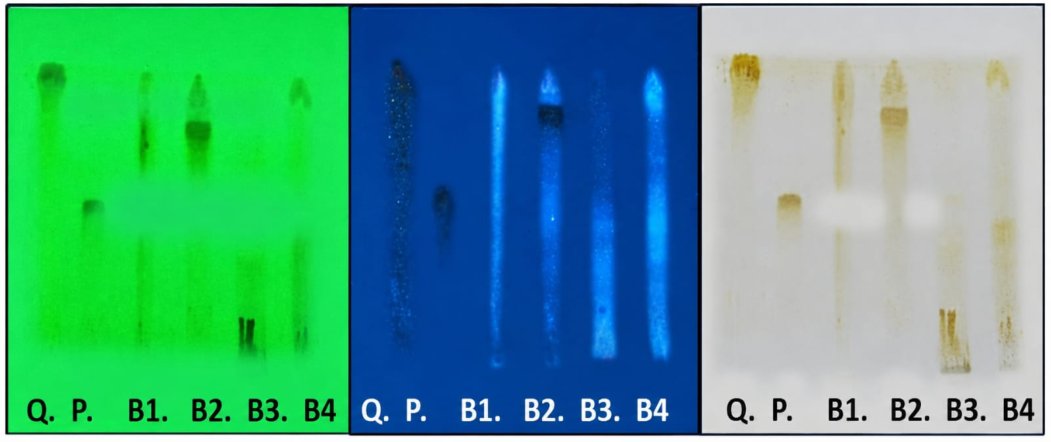
HPTLC fingerprint profile of ethanolic Bougainvillea glabra leaf extract and reference standards under three detection modes. Lanes: Q = quercetin reference standard; P = pinitol reference standard; B1–B4 = B. glabra ethanolic extract at increasing application volumes (2, 4, 6, and 8 μL). Left panel: UV 254 nm—dark quenching bands on fluorescent green background; centre panel: UV 366 nm—fluorescent bands showing characteristic quercetin fluorescence at Rf 0.52; right panel: visible light after derivatization with anisaldehyde-sulfuric acid reagent—brown bands at Rf 0.52 (quercetin) and Rf 0.35 (pinitol). Mobile phase: toluene:ethyl acetate:formic acid (5:4:1 v/v/v); stationary phase: Silica Gel 60F254 HPTLC plates.
Figure 1.
HPTLC fingerprint profile of ethanolic Bougainvillea glabra leaf extract and reference standards under three detection modes. Lanes: Q = quercetin reference standard; P = pinitol reference standard; B1–B4 = B. glabra ethanolic extract at increasing application volumes (2, 4, 6, and 8 μL). Left panel: UV 254 nm—dark quenching bands on fluorescent green background; centre panel: UV 366 nm—fluorescent bands showing characteristic quercetin fluorescence at Rf 0.52; right panel: visible light after derivatization with anisaldehyde-sulfuric acid reagent—brown bands at Rf 0.52 (quercetin) and Rf 0.35 (pinitol). Mobile phase: toluene:ethyl acetate:formic acid (5:4:1 v/v/v); stationary phase: Silica Gel 60F254 HPTLC plates.
Figure 2.
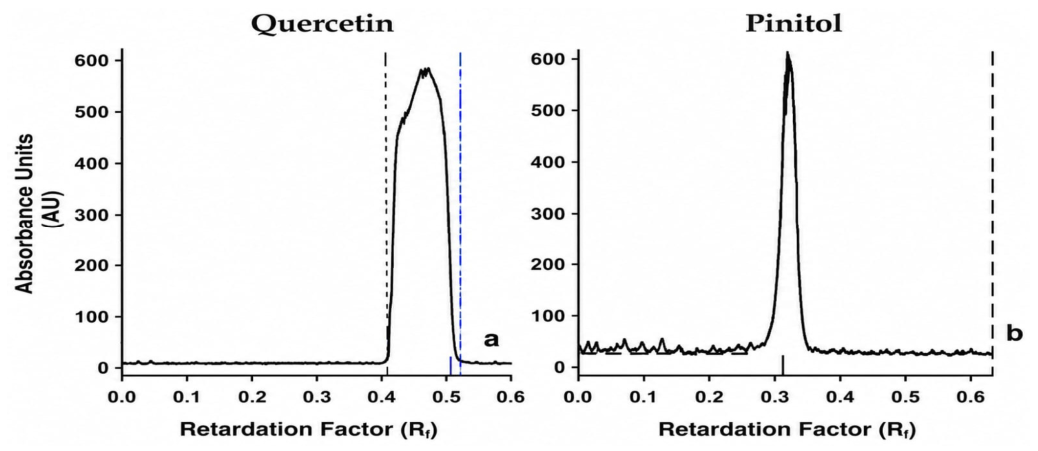
HPTLC densitogram of Bougainvillea glabra ethanolic leaf extract showing characteristic peaks for the marker compounds: (a) quercetin (Rf 0.52, peak intensity ≈ 610 AU) and (b) pinitol (Rf 0.35, peak intensity ≈ 600 AU), confirmed by co-chromatography with reference standards Q and P, The vertical dashed and dotted lines indicate the Rf positions of the respective marker peaks, and the blue line in panel (a) marks the Rf of the quercetin reference standard. Stationary phase: Silica Gel 60 F254; mobile phase: toluene:ethyl acetate:formic acid (5:4:1 v/v/v); detection: UV 366 nm.
Figure 2.
HPTLC densitogram of Bougainvillea glabra ethanolic leaf extract showing characteristic peaks for the marker compounds: (a) quercetin (Rf 0.52, peak intensity ≈ 610 AU) and (b) pinitol (Rf 0.35, peak intensity ≈ 600 AU), confirmed by co-chromatography with reference standards Q and P, The vertical dashed and dotted lines indicate the Rf positions of the respective marker peaks, and the blue line in panel (a) marks the Rf of the quercetin reference standard. Stationary phase: Silica Gel 60 F254; mobile phase: toluene:ethyl acetate:formic acid (5:4:1 v/v/v); detection: UV 366 nm.
Figure 3.
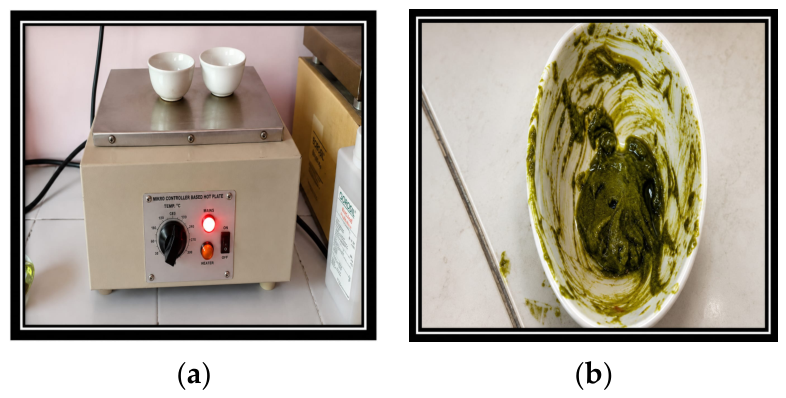
Preparation of the ethanolic extract of Bougainvillea glabra leaves by cold maceration. (a) Dried and coarsely powdered leaves were soaked in ethanol at room temperature with intermittent stirring; (b) The mixture was then filtered, and the resulting green ethanolic extract was collected and concentrated under reduced pressure.
Figure 3.
Preparation of the ethanolic extract of Bougainvillea glabra leaves by cold maceration. (a) Dried and coarsely powdered leaves were soaked in ethanol at room temperature with intermittent stirring; (b) The mixture was then filtered, and the resulting green ethanolic extract was collected and concentrated under reduced pressure.
Figure 4.
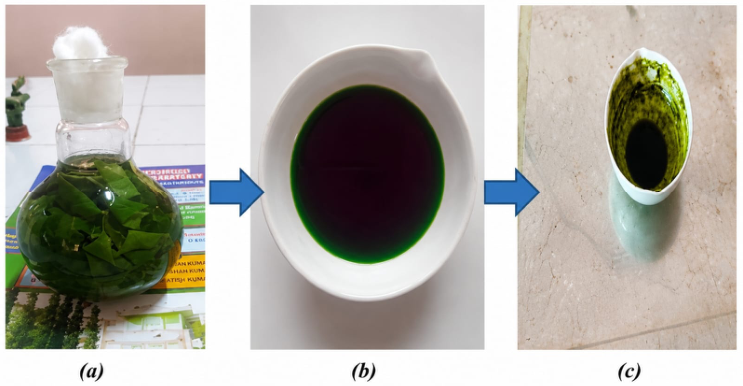
Photographs of the Bougainvillea glabra cold cream preparation: (a) maceration of leaves in ethanol; (b) filtered ethanolic leaf extract; (c) concentrated extract/final formulation.
Figure 4.
Photographs of the Bougainvillea glabra cold cream preparation: (a) maceration of leaves in ethanol; (b) filtered ethanolic leaf extract; (c) concentrated extract/final formulation.
Figure 5.
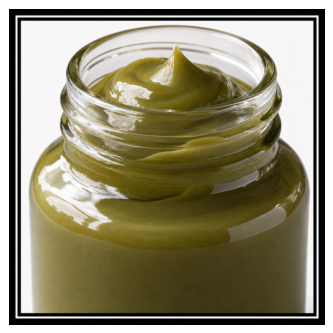
Representative photograph of the optimized Bougainvillea glabra cold cream formulation.
Figure 5.
Representative photograph of the optimized Bougainvillea glabra cold cream formulation.
Figure 6.
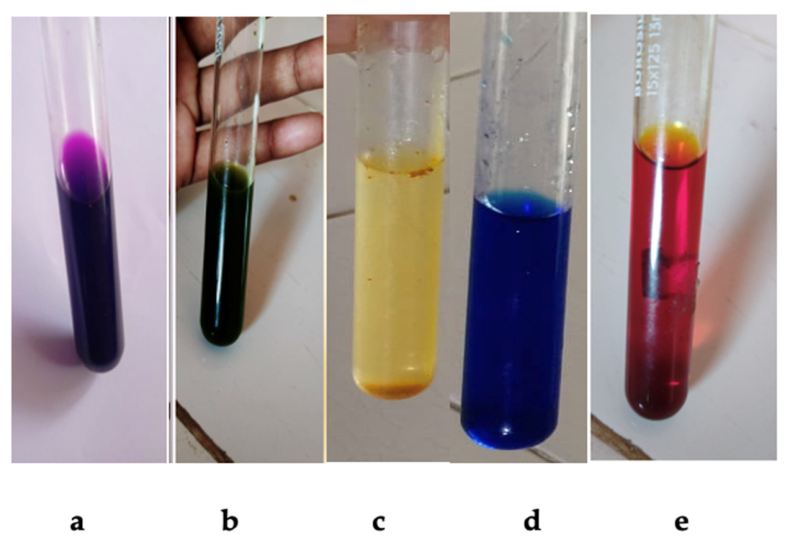
Results of the preliminary qualitative phytochemical screening of the ethanolic
Bougainvillea glabra leaf extract. Positive results are indicated by characteristic color changes: (
a) Shinoda test—purple to violet color confirming the presence of flavonoids and anthocyanins; (
b) FeCl
3 test (5%
w/
v)—blue-black to dark green precipitate confirming the presence of phenolic compounds and tannins; (
c) Dragendorff’s test—orange precipitate confirming the presence of alkaloids; (
d) Foam test—persistent stable froth observed for ≥15 min confirming the presence of saponins (the bright blue-violet color of the solution is attributable to the natural betacyanin pigments of
B. glabra extract and does not affect test interpretation); (
e) Salkowski test—reddish-brown coloration at the CHCl
3/H
2SO
4 interface confirming the presence of terpenoids. All tests were performed in triplicate. Complete results are presented in
Table 6.
Figure 6.
Results of the preliminary qualitative phytochemical screening of the ethanolic
Bougainvillea glabra leaf extract. Positive results are indicated by characteristic color changes: (
a) Shinoda test—purple to violet color confirming the presence of flavonoids and anthocyanins; (
b) FeCl
3 test (5%
w/
v)—blue-black to dark green precipitate confirming the presence of phenolic compounds and tannins; (
c) Dragendorff’s test—orange precipitate confirming the presence of alkaloids; (
d) Foam test—persistent stable froth observed for ≥15 min confirming the presence of saponins (the bright blue-violet color of the solution is attributable to the natural betacyanin pigments of
B. glabra extract and does not affect test interpretation); (
e) Salkowski test—reddish-brown coloration at the CHCl
3/H
2SO
4 interface confirming the presence of terpenoids. All tests were performed in triplicate. Complete results are presented in
Table 6.
Figure 7.
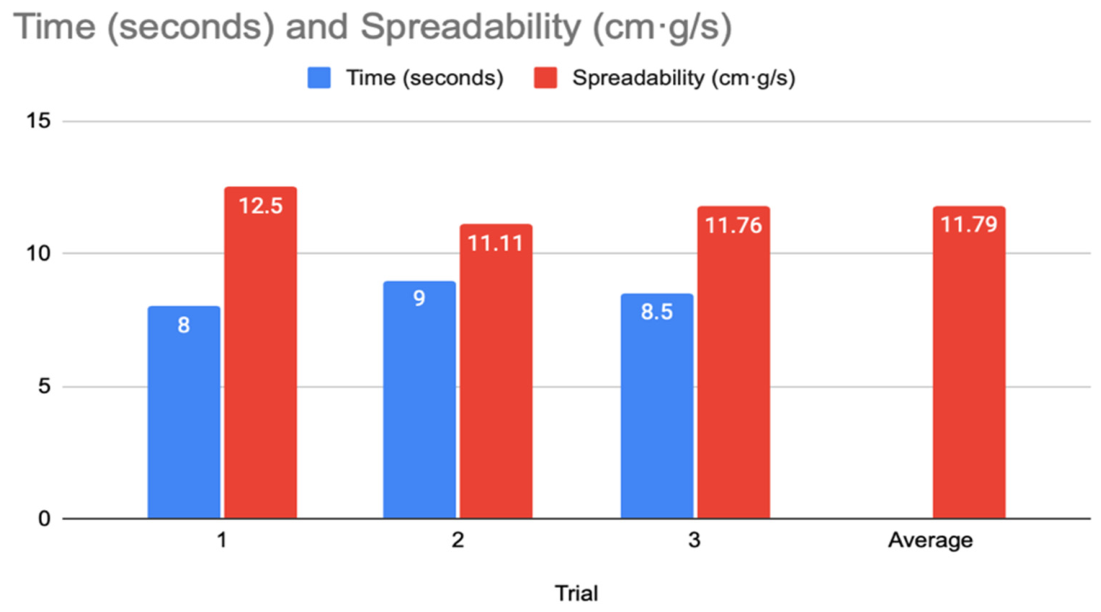
Spreadability of the cream.
Figure 7.
Spreadability of the cream.
Figure 8.
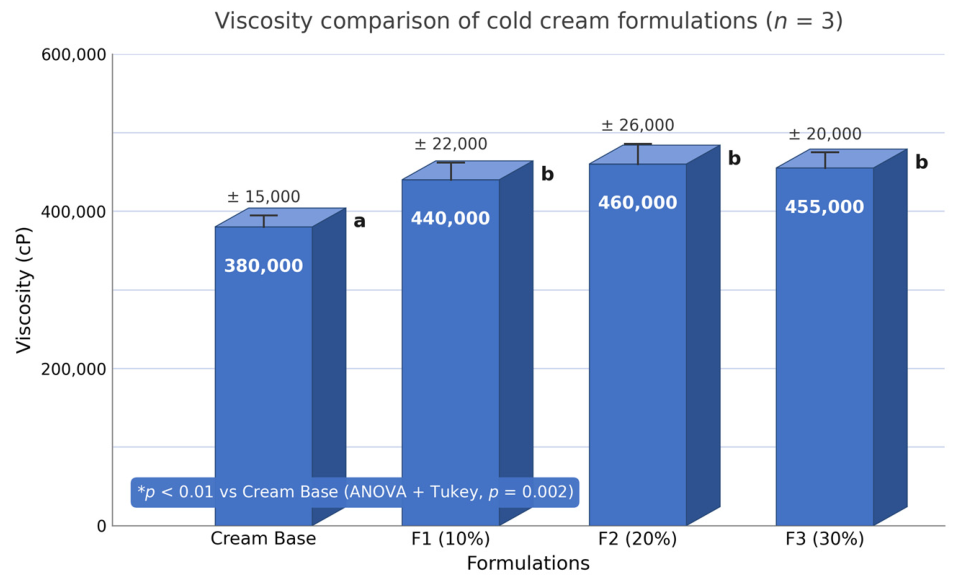
Viscosity comparison of B. glabra cold cream formulations (n = 3). Bars represent mean viscosity ± SD. Letters (a, b) indicate Tukey’s grouping (different letters = p < 0.05). Asterisks (*) = p < 0.01 vs. Cream Base (one-way ANOVA, F = 12.34, p = 0.002; Tukey’s post hoc).
Figure 8.
Viscosity comparison of B. glabra cold cream formulations (n = 3). Bars represent mean viscosity ± SD. Letters (a, b) indicate Tukey’s grouping (different letters = p < 0.05). Asterisks (*) = p < 0.01 vs. Cream Base (one-way ANOVA, F = 12.34, p = 0.002; Tukey’s post hoc).
Figure 9.
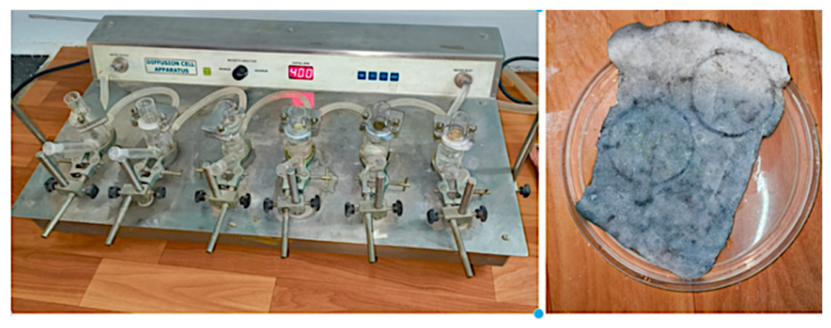
Franz diffusion cell apparatus (left) used for ex vivo quercetin permeation studies, and freshly excised goat skin membrane (right) mounted as the permeation barrier. Subcutaneous fat was removed prior to mounting; skin integrity was confirmed by TEER measurement (>1 kΩ) before each experiment.
Figure 9.
Franz diffusion cell apparatus (left) used for ex vivo quercetin permeation studies, and freshly excised goat skin membrane (right) mounted as the permeation barrier. Subcutaneous fat was removed prior to mounting; skin integrity was confirmed by TEER measurement (>1 kΩ) before each experiment.
Figure 10.
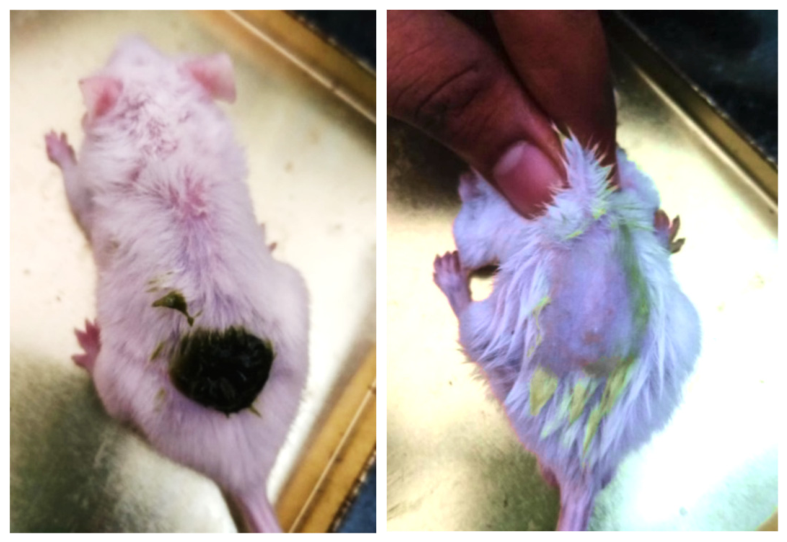
Representative photographs of rat dorsal skin 72 h post-application of F3 (30% B. glabra extract cold cream). No erythema (score = 0) or edema (score = 0) was observed in any of the five treated animals; control (sterile saline) also showed no reaction. Scoring follows the Draize primary irritation index.
Figure 10.
Representative photographs of rat dorsal skin 72 h post-application of F3 (30% B. glabra extract cold cream). No erythema (score = 0) or edema (score = 0) was observed in any of the five treated animals; control (sterile saline) also showed no reaction. Scoring follows the Draize primary irritation index.
Figure 11.
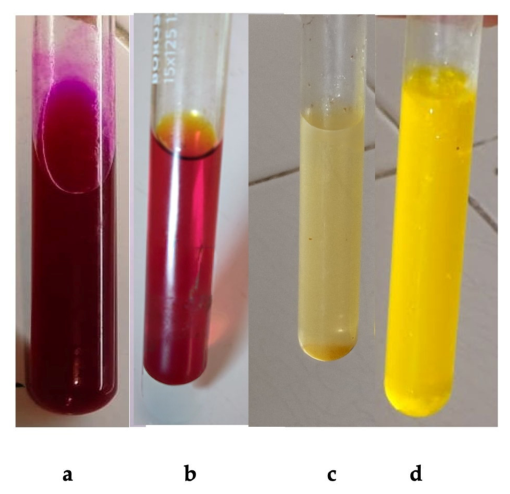
Antioxidant activity of Bougainvillea cream (KMnO4 test). Phytochemical screening of Bougainvillea glabra ethanolic leaf extract showing characteristic color reactions: (a) Light purple (b) Brownish-yellow; (c) Light yellow; (d) Yellow.
Figure 11.
Antioxidant activity of Bougainvillea cream (KMnO4 test). Phytochemical screening of Bougainvillea glabra ethanolic leaf extract showing characteristic color reactions: (a) Light purple (b) Brownish-yellow; (c) Light yellow; (d) Yellow.
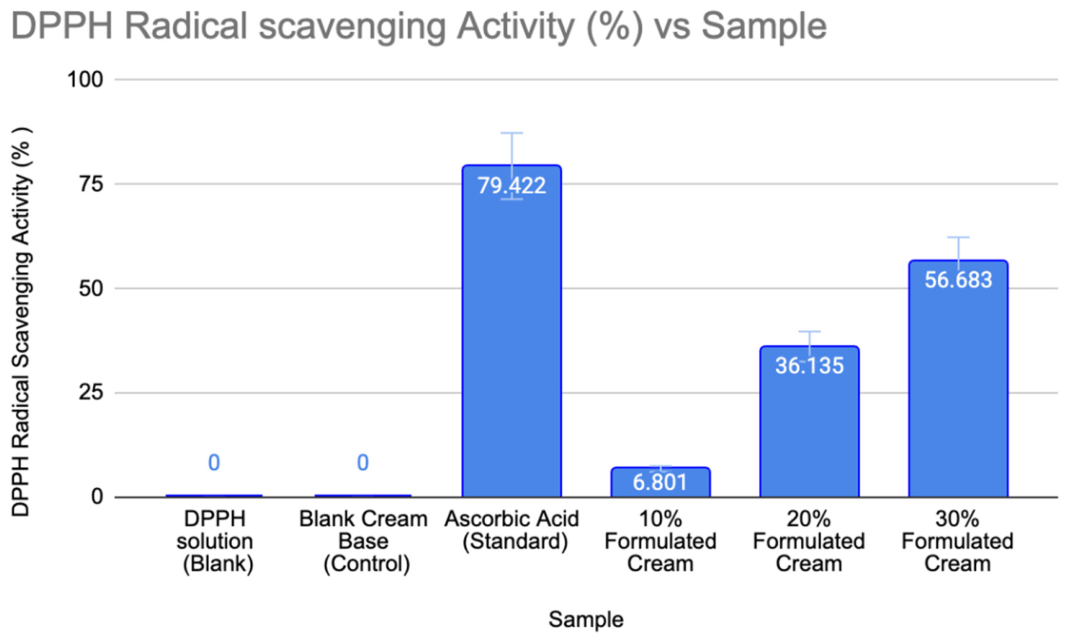
Figure 12.
Antioxidant activity of Bougainvillea cream (DPPH Assay).
Figure 12.
Antioxidant activity of Bougainvillea cream (DPPH Assay).
Figure 13.
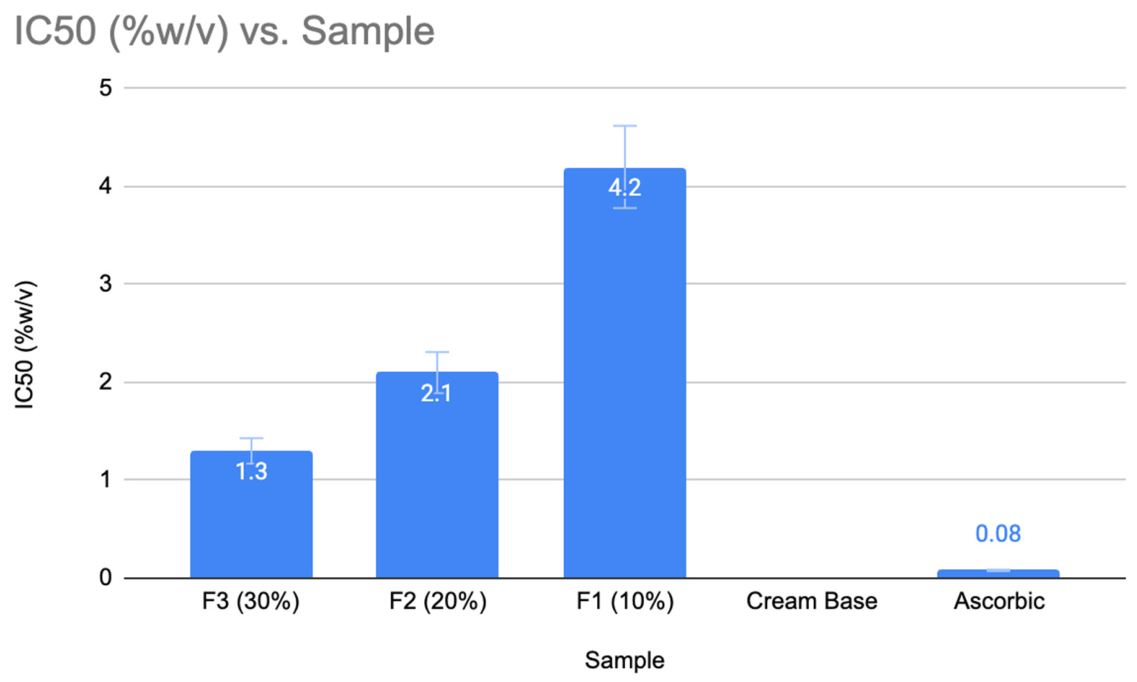
IC50 Analysis. F3 exhibited significantly lower IC50 (higher potency) than F1/F2 (one-way ANOVA F = 45.2, p < 0.0001; Tukey post hoc).
Figure 13.
IC50 Analysis. F3 exhibited significantly lower IC50 (higher potency) than F1/F2 (one-way ANOVA F = 45.2, p < 0.0001; Tukey post hoc).
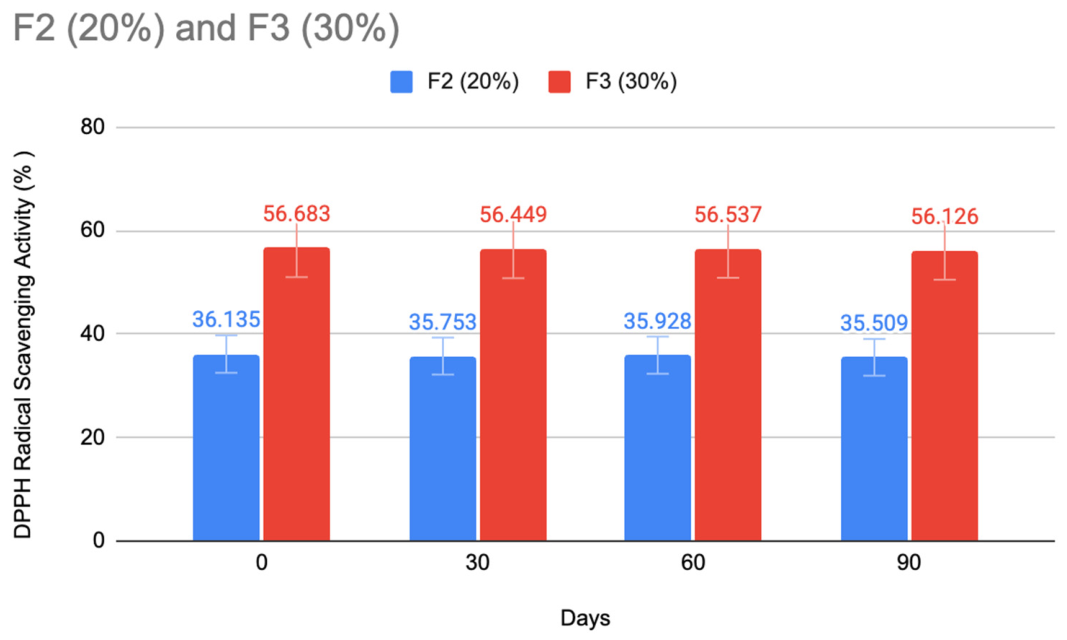
Figure 14.
Accelerated stability study (40 °C/75%RH, n = 3).
Figure 14.
Accelerated stability study (40 °C/75%RH, n = 3).
Table 1.
HPTLC Rf values and color characteristics of markers in B. glabra.
Table 1.
HPTLC Rf values and color characteristics of markers in B. glabra.
| S. No. | Compound/Sample | Rf Value | Fluorescence |
|---|
| 1 | Quercetin (Standard) | 0.52 | Yellow Fluorescence |
| 2 | Pinitol (Standard) | 0.35 | Brownish-grey |
| 3 | B. glabra Extract | 0.52 | Yellow Fluorescence |
| 4 | B. glabra Extract | 0.35 | Brownish-grey |
Table 2.
Quantitative marker content showing calibration parameters, limits of detection and quantification, and marker content in the dry extract and formulations (F1–F3).
Table 2.
Quantitative marker content showing calibration parameters, limits of detection and quantification, and marker content in the dry extract and formulations (F1–F3).
| Marker | Calibration Range (μg/Band) | R2 | LOD (μg/Band) | LOQ (μg/Band) | Content in Dry Extract (mg/g) | F1 (mg/g) | F2 (mg/g) | F3 (mg/g) |
|---|
| Quercetin | 0.1–3.0 | 0.9985 | 0.03 | 0.09 | 4.82 ± 0.14 | 0.48 ± 0.01 | 0.97 ± 0.02 | 1.45 ± 0.03 |
| Pinitol | 0.1–3.0 | 0.9978 | 0.04 | 0.12 | 2.31 ± 0.09 | 0.23 ± 0.01 | 0.46 ± 0.01 | 0.69 ± 0.02 |
Table 3.
Accuracy (Recovery %) of the HPTLC method for quercetin and pinitol.
Table 3.
Accuracy (Recovery %) of the HPTLC method for quercetin and pinitol.
| Marker | Spike Level | Initial Amount (μg/Band) | Amount Added (μg/Band) | Total Amount Found (μg/Band) | % Recovery | Mean % Recovery ± SD |
|---|
| Quercetin | 50% | 1.0 | 0.5 | 1.48 | 98.67 | |
| | 100% | 1.0 | 1.0 | 1.99 | 99.50 | 99.21 ± 0.47 |
| | 150% | 1.0 | 1.5 | 2.49 | 99.47 | |
| Pinitol | 50% | 1.0 | 0.5 | 1.47 | 98.00 | |
| | 100% | 1.0 | 1.0 | 1.98 | 99.00 | 98.60 ± 0.53 |
| | 150% | 1.0 | 1.5 | 2.47 | 98.80 | |
Table 4.
Precision of the HPTLC method for quercetin and pinitol.
Table 4.
Precision of the HPTLC method for quercetin and pinitol.
| Marker | Concentration (μg/Band) | Intraday Precision (n = 3) | Interday Precision (n = 3) |
|---|
| | | Measured Conc. ± SD | % RSD | Measured Conc. ± SD | % RSD |
|---|
| Quercetin | 0.5 | 0.49 ± 0.004 | 0.82 | 0.48 ± 0.006 | 1.25 |
| | 1.5 | 1.49 ± 0.011 | 0.74 | 1.47 ± 0.016 | 1.09 |
| | 2.5 | 2.48 ± 0.014 | 0.56 | 2.46 ± 0.023 | 0.93 |
| Pinitol | 0.5 | 0.48 ± 0.005 | 1.04 | 0.47 ± 0.008 | 1.70 |
| | 1.5 | 1.48 ± 0.013 | 0.88 | 1.46 ± 0.021 | 1.44 |
| | 2.5 | 2.47 ± 0.019 | 0.77 | 2.44 ± 0.031 | 1.27 |
Table 5.
Organoleptic properties of cream.
Table 5.
Organoleptic properties of cream.
| S. No. | Property | Result |
|---|
| 1 | Colour | Green |
| 2 | Odor | Characteristic |
| 3 | Appearance | Semi-solid |
Table 6.
Preliminary phytochemical screening results.
Table 6.
Preliminary phytochemical screening results.
| Test | Observation | Result |
|---|
| Flavonoids | Purple to violet color | + |
| Phenolics | Blue-black to dark green | + |
| Alkaloids | Orange/cream/brown ppt | +++ |
| Tannins | Blue-black | + |
| Saponins | Stable froth (≥15 min) | + |
| Terpenoids | Red-brown ring | + |
Table 7.
pH of the formulated cream.
Table 7.
pH of the formulated cream.
| S. No | Formulation | pH |
|---|
| 1 | F1 | 5.9 ± 0.1 |
| 2 | F2 | 5.8 ± 0.1 |
| 3 | F3 | 5.7 ± 0.1 |
| 4 | Cream base | 5.9 ± 0.1 |
Table 8.
Spreadability of the formulation.
Table 8.
Spreadability of the formulation.
| Trial | Time (s) | Spreadability (cm·g/s) |
|---|
| 1 | 8 | 12.5 cm·g/s |
| 2 | 9 | 11.11 cm·g/s |
| 3 | 8.5 | 11.76 cm·g/s |
| Mean ± SD | 8.5 ± 0.5 | 11.79 ± 0.70 cm·g/s |
Table 9.
Rheological characterization.
Table 9.
Rheological characterization.
| Reading | Viscosity (cP) |
|---|
| Cream Base | 380,000 ± 15,000 cP |
| F1 (10%) | 440,000 ± 22,000 cP |
| F2 (20%) | 460,000 ± 26,000 cP |
| F3 (30%) | 455,000 ± 20,000 cP |
Table 10.
Viscosity ANOVA result.
Table 10.
Viscosity ANOVA result.
| Comparison | p-Value | Significance |
|---|
| Base vs. F1 | 0.003 | p < 0.01 |
| Base vs. F2 | 0.001 | p < 0.01 |
| Base vs. F3 | 0.002 | p < 0.01 |
| F1 vs. F2 | 0.78 | ns |
| F2 vs. F3 | 0.89 | ns |
| F1 vs. F3 | 0.92 | ns |
Table 11.
Ex vivo cumulative quercetin permeation data (Franz Diffusion Cell, Goat Skin Membrane, 32 ± 0.5 °C, n = 3).
Table 11.
Ex vivo cumulative quercetin permeation data (Franz Diffusion Cell, Goat Skin Membrane, 32 ± 0.5 °C, n = 3).
| Time (h) | F1 (μg/cm2) | F2 (μg/cm2) | F3 (μg/cm2) |
|---|
| 1 | 4.5 ± 0.3 | 7.1 ± 0.5 | 9.5 ± 0.6 |
| 2 | 7.8 ± 0.5 | 13.4 ± 0.8 | 17.1 ± 1.1 |
| 4 | 11.4 ± 0.8 | 19.8 ± 1.2 | 26.3 ± 1.6 |
| 6 | 13.5 ± 1.0 | 24.9 ± 1.5 | 36.2 ± 2.0 |
| 8 | 15.7 ± 1.1 | 28.1 ± 1.8 | 45.8 ± 2.3 |
| 12 | 17.5 ± 1.2 | 32.0 ± 2.0 | 48.1 ± 2.5 |
| 24 | 18.2 ± 1.4 | 34.7 ± 2.1 | 51.3 ± 2.8 |
Table 12.
Skin Irritation Test. The erythema and edema scores are represented as “Erythema/Edema.” (0 = none, 1 = slight, 2 = moderate, 3 = severe).
Table 12.
Skin Irritation Test. The erythema and edema scores are represented as “Erythema/Edema.” (0 = none, 1 = slight, 2 = moderate, 3 = severe).
| Rat ID | Treatment | 1 h | 4 h | 24 h | 48 h | 72 h | Overall Assessment |
|---|
| 1 | Bougainvillea Cream | 0/0 | 0/0 | 0/0 | 0/0 | 0/0 | No Irritation |
| 2 | 0/0 | 0/0 | 0/0 | 0/0 | 0/0 | No Irritation |
| 3 | 0/0 | 0/0 | 0/0 | 0/0 | 0/0 | No Irritation |
| 4 | 0/0 | 0/0 | 0/0 | 0/0 | 0/0 | No Irritation |
| 5 | 0/0 | 0/0 | 0/0 | 0/0 | 0/0 | No Irritation |
6
(control) | 0/0 | 0/0 | 0/0 | 0/0 | 0/0 | No Irritation |
Table 13.
Qualitative screening data—potassium permanganate reduction test for Bougainvillea cold cream formulations.
Table 13.
Qualitative screening data—potassium permanganate reduction test for Bougainvillea cold cream formulations.
| Test Variable | Trial 1 | Trial 2 | Interpretation |
|---|
- A.
10% Formulated Cream (F1)
| Light purple (lighter than original) | Light purple (lighter than original) | Negative (but some color change) |
- B.
20% Formulated Cream (F2)
| Brownish-yellow | Brownish-yellow | Positive for antioxidant activity (decolorization) |
- C.
30% Formulated Cream (F3)
| Brownish-yellow | Light yellow | Positive for antioxidant activity (decolorization) |
- D.
Positive Control (Ascorbic Acid)
| Yellow | Yellow | Positive for antioxidant activity (decolorization) |
Table 14.
Antioxidant activity of Bougainvillea cream (DPPH assay).
Table 14.
Antioxidant activity of Bougainvillea cream (DPPH assay).
| Sample | Mean Absorbance ± SD
(517 nm) | DPPH Radical Scavenging Activity (%) | Statistical Significance |
|---|
DPPH solution
(Blank) | 3.426 ± 0.226 | -- | |
Blank Cream Base
(Control) | 3.193 ± 0.157 | 0.0 ± 0.01% | — |
Ascorbic Acid
(Standard) | 0.705 ± 0.052 | 79.422 ± 0.1% | a |
| 10% Formulated Cream | 3.193 ± 0.157 | 6.801 ± 0.2% | b |
| 20% Formulated Cream | 2.188 ± 0.509 | 36.135 ± 0.5% | c |
| 30% Formulated Cream | 1.484 ± 0.105 | 56.683 ± 1.1% | d |
Table 15.
IC50 analysis.
| Sample | IC50 (% w/v) | 95% CI | Statistical Grouping |
|---|
| Cream Base | >5.0 | 0 | 0 |
| F1 (10%) | 4.2 ± 0.4 | 3.4–5.0 | b |
| F2 (20%) | 2.1 ± 0.3 | 1.7–2.5 | b |
| F3 (30%) | 1.3 ± 0.1 | 1.1–1.5 | a |
| Ascorbic Acid | 0.08 ± 0.01 | 0.06–0.10 | a |
Table 16.
Accelerated Stability Study—DPPH antioxidant activity and HPTLC marker compound retention (40 ± 2 °C/75 ± 5% RH, n = 3).
Table 16.
Accelerated Stability Study—DPPH antioxidant activity and HPTLC marker compound retention (40 ± 2 °C/75 ± 5% RH, n = 3).
| Time (Days) | F2 DPPH Scavenging (%) | F3 DPPH Scavenging (%) | F2 Quercetin Retention (%) | F3 Quercetin Retention (%) | F2 Pinitol Retention (%) | F3 Pinitol Retention (%) |
|---|
| 0 | 36.135 ± 0.51 | 56.683 ± 1.11 | 100.0 | 100.0 | 100.0 | 100.0 |
| 30 | 35.753 ± 0.40 | 56.449 ± 1.00 | 99.4 ± 0.3 | 99.6 ± 0.2 | 99.1 ± 0.4 | 99.3 ± 0.3 |
| 60 | 35.928 ± 0.50 | 56.537 ± 0.90 | 99.0 ± 0.4 | 99.4 ± 0.3 | 98.5 ± 0.4 | 98.8 ± 0.3 |
| 90 | 35.509 ± 0.45 | 56.126 ± 0.95 | 98.6 ± 0.4 | 99.1 ± 0.3 | 97.9 ± 0.5 | 98.3 ± 0.4 |
| p-value (Day 0 vs. 90) | ns | ns | ns | ns | ns | ns |
Table 17.
Optimized formulation based on multiple factors.
Table 17.
Optimized formulation based on multiple factors.
| Parameter | F1 (10%) | F2 (20%) | F3 (30%) | Winner |
|---|
| IC50 (Potency) | 4.2 ± 0.4% | 2.1 ± 0.2% | 1.3 ± 0.1% | F3 |
| Viscosity | 440k cP | 460k ± 26k | 455k cP | F2 |
| Spreadability | Good | 11.8 ± 0.3 | Good | F2 |
| pH | 5.9 | 5.8 ± 0.1 | 5.7 | F3 |
| Stability (90d) | Stable | Stable | Stable | All |
| Safety | Non-irritant | Non-irritant | Non-irritant | All |
Table 18.
Composition of B. glabra cold cream formulations.
Table 18.
Composition of B. glabra cold cream formulations.
| Ingredient | INCI Name | Function | F1 (10%) | F2 (20%) | F3 (30%) |
|---|
| B. glabra Extract | Bougainvillea glabra Leaf Extract | Antioxidant | 10 g | 20 g | 30 g |
| Beeswax | Cera Alba | Stiffening agent | 8.0 g | 8.0 g | 8.0 g |
| Liquid Paraffin | Paraffinum Liquidum | Emollient | 12.5 mL | 12.5 mL | 12.5 mL |
| Borax | Sodium Borate | Emulsifier | 1.0 g | 1.0 g | 1.0 g |
| Methylparaben | Methylparaben | Preservative | 0.4 g | 0.4 g | 0.4 g |
| Glycerin | Glycerin | Humectant | 5 mL | 5 mL | 5 mL |
| Perfume (Rose oil) | Fragrance | Fragrance | q.s. | q.s. | q.s. |
| Purified Water | Aqua | Vehicle | q.s. to 100 g | q.s. to 100 g | q.s. to 100 g |
Table 19.
KMnO4 assay concentrations.
Table 19.
KMnO4 assay concentrations.
| Sample | Mass Taken | Final Volume | Final Conc. (% w/v) |
|---|
| F1–F3 creams | 0.5 g | 10 mL | 0.5 |
| Cream base | 0.5 g | 10 mL | 0.5 |
| Ascorbic acid | 10 mg | 10 mL | 0.1 |




 ,
,