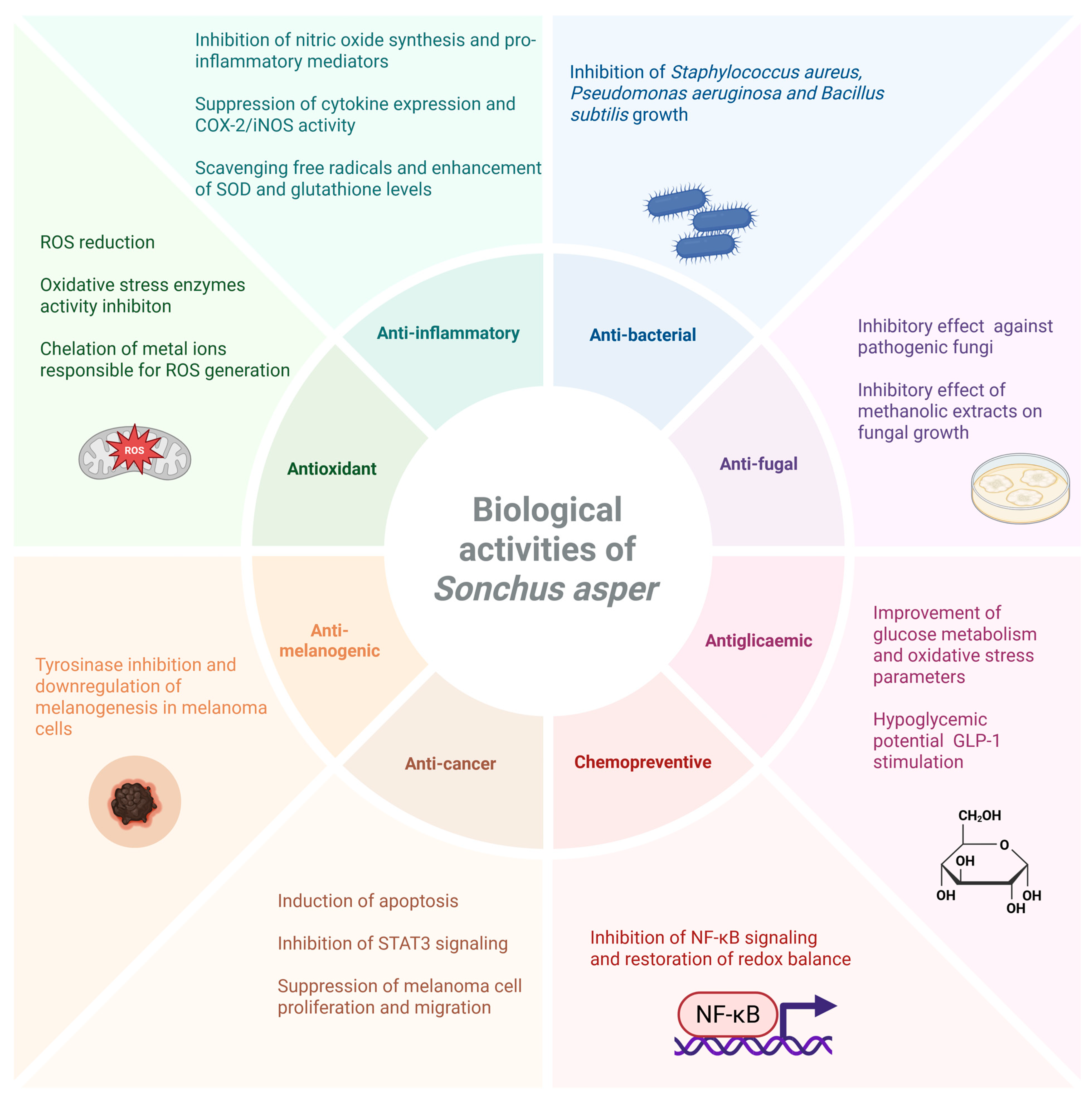
Sonchus asper and Its Potential in Cosmetics—A Review

 , , ,
, , ,  and
and
Abstract
1. Introduction
2. Prickly Sow Thistle as a Source of Diverse Metabolites
2.1. Primary Metabolites
2.2. Specialised Metabolites
3. Cosmetic Properties of Sonchus asper
3.1. Antioxidant Activity
3.2. Anti-Inflammatory Activity
3.3. Antimicrobial and Antifungal Properties of the Plant
3.3.1. Inhibition of Staphylococcus aureus
3.3.2. Inhibition of Pseudomonas aeruginosa
3.3.3. Inhibition of Bacillus subtilis
3.3.4. Antifungal Activity
3.4. Antiglycaemic Effects of S. asper
The Importance of S. asper Antidiabetic Properties in the Context of Skin Biology
3.5. The Potential of S. asper in the Treatment of Skin Cancer
3.6. Skin Barrier Suport
4. New Approach Methodologies (NAMs) as a Necessary Aim for Assessing the Safety and Permeability of Sonchus asper
5. Materials and Methods
6. Conclusions and Future Perspectives
Supplementary Materials
Author Contributions
Funding
Institutional Review Board Statement
Informed Consent Statement
Data Availability Statement
Conflicts of Interest
References
- Lindenmaier, M.P.; Stevens, J.F. Dietary Phytochemicals and Herbal Medicines Re-Program Cellular Networks by Targeting Key Transcription Factors. Mol. Nutr. Food Res. 2026, 70, e70457. [Google Scholar] [CrossRef]
- Varvaresou, A.; Papageorgiou, S.; Tsirivas, E.; Protopapa, E.; Kintziou, H.; Kefala, V.; Demetzos, C. Self-preserving Cosmetics. Int. J. Cosmet. Sci. 2009, 31, 163–175. [Google Scholar] [CrossRef]
- Bandyopadhyay, A.; Selvan, S.A.; Patial, P.K.; Pal, T. Plant-based Ingredients in Cosmetic Science: Current Applications, Limitations, and Prospects. Int. J. Cosmet. Sci. 2025, 48, 258–284. [Google Scholar] [CrossRef]
- Bussmann, R.W.; Paniagua-Zambrana, N.Y.; Khutsishvili, M.; Kikvidze, Z.; Batsatsashvili, K.; Maisaia, I.; Sikharulidze, S.; Tchelidze, D. Sonchus arvensis L. Sonchus asper (L.) Hill. Sonchus oleraceus L. Asteraceae. In Ethnobotany of the Caucasus; Bussmann, R.W., Ed.; Ethnobotany of Mountain Regions; Springer Nature: Cham, Switzerland, 2025; pp. 1–13. [Google Scholar]
- Mikropoulou, E.V.; Vougogiannopoulou, K.; Kalpoutzakis, E.; Sklirou, A.D.; Skaperda, Z.; Houriet, J.; Wolfender, J.-L.; Trougakos, I.P.; Kouretas, D.; Halabalaki, M.; et al. Phytochemical Composition of the Decoctions of Greek Edible Greens (Chórta) and Evaluation of Antioxidant and Cytotoxic Properties. Molecules 2018, 23, 1541. [Google Scholar] [CrossRef]
- Parisi, V.; Santoro, V.; Faraone, I.; Benedetto, N.; Vassallo, A.; De Tommasi, N.; Milella, L.; Nesticò, A.; Maselli, G.; Fadda, A.M.; et al. Sonchus asper (L.) Hill Extracts: Phytochemical Characterization and Exploitation of Its Biological Activities by Loading into Nanoformulation. Front. Plant Sci. 2024, 15, 1416539. [Google Scholar] [CrossRef]
- Giner, R.M.; Ubeda, A.; Just, M.J.; Serrano, A.; Máñez, S.; Ríos, J.-L. A Chemotaxonomic Survey of Sonchus Subgenus Sonchus. Biochem. Syst. Ecol. 1993, 21, 617–620. [Google Scholar] [CrossRef]
- De Paula Filho, G.X.; Barreira, T.F.; Pinheiro-Sant’Ana, H.M. Chemical Composition and Nutritional Value of Three Sonchus Species. Int. J. Food Sci. 2022, 2022, 4181656. [Google Scholar] [CrossRef] [PubMed]
- Khan, R.A.; Khan, M.R.; Sahreen, S.; Ahmed, M. Evaluation of Phenolic Contents and Antioxidant Activity of Various Solvent Extracts of Sonchus asper (L.) Hill. Chem. Cent. J. 2012, 6, 12. [Google Scholar] [CrossRef] [PubMed]
- Helal, A.M.; Nakamura, N.; El-Askary, H.; Hattori, M. Sesquiterpene Lactone Glucosides from Sonchus Asper. Phytochemistry 2000, 53, 473–477. [Google Scholar] [CrossRef]
- Liava, V.; Fernandes, Â.; Reis, F.; Finimundy, T.; Mandim, F.; Pinela, J.; Stojković, D.; Ferreira, I.C.F.R.; Barros, L.; Petropoulos, S.A. How Does Domestic Cooking Affect the Biochemical Properties of Wild Edible Greens of the Asteraceae Family? Foods 2024, 13, 2677. [Google Scholar] [CrossRef]
- Altin, G.; Bildik, F.; Kasapoğlu, K.N.; Genç, S.; Genç, M.; Özçelik, B. Identification of the Functional Food Potency of Çalkama: A Traditional Recipe with Edible Mediterranean Wild Greens from Turkish Cuisine. Mediterr. J. Nutr. Metab. 2021, 14, 207–218. [Google Scholar] [CrossRef]
- Bujor, O.-C.; Tanase, C.; Popa, M.E. Phenolic Antioxidants in Aerial Parts of Wild Vaccinium Species: Towards Pharmaceutical and Biological Properties. Antioxidants 2019, 8, 649. [Google Scholar] [CrossRef]
- Maya-Cano, D.A.; Arango-Varela, S.; Santa-Gonzalez, G.A. Phenolic Compounds of Blueberries (Vaccinium Spp.) as a Protective Strategy against Skin Cell Damage Induced by ROS: A Review of Antioxidant Potential and Antiproliferative Capacity. Heliyon 2021, 7, e06297. [Google Scholar] [CrossRef]
- Munteanu, I.G.; Apetrei, C. Analytical Methods Used in Determining Antioxidant Activity: A Review. Int. J. Mol. Sci. 2021, 22, 3380. [Google Scholar] [CrossRef]
- Koss-Mikołajczyk, I.; Baranowska, M.; Namieśnik, J.; Bartoszek, A. Determination of Antioxidantactivity of Phytochemicals in Cellular Models by Fluorescence/Luminescence Methods. Postep. Hig. Med. Dosw. 2017, 71, 602–617. [Google Scholar] [CrossRef] [PubMed]
- Jesus, A.; Silva, J.P.; Cidade, H.; Cruz, M.T.; Sousa, E.; Almeida, I.F. Human Photoaging Skin Models for the Efficacy Evaluation of Anti-Aging Ingredients: Advances on Clinical and Ex Vivo Studies. Eur. J. Pharm. Biopharm. 2026, 223, 115059. [Google Scholar] [CrossRef]
- Al-ebini, Y.; Al-Hasnaawei, S.; Rekha, M.M.; Ray, S.; Chennakesavulu, K.; Sharma, V.; Messa, S. Synergistic Essential Oil Blends: Chemical Composition, Antimicrobial Activity and Antioxidant Properties for Cosmetic Preservation. Flavour Fragr. J. 2026, 41, 535–548. [Google Scholar] [CrossRef]
- Mansoor, K.; Aburjai, T.; Al-Mamoori, F.; Schmidt, M. Plants with Cosmetic Uses. Phytother. Res. 2023, 37, 5755–5768. [Google Scholar] [CrossRef]
- Sharafan, M.; Malinowska, M.A.; Kubicz, M.; Kubica, P.; Gémin, M.-P.; Abdallah, C.; Ferrier, M.; Hano, C.; Giglioli-Guivarc’h, N.; Sikora, E.; et al. Shoot Cultures of Vitis vinifera (Vine Grape) Different Cultivars as a Promising Innovative Cosmetic Raw Material—Phytochemical Profiling, Antioxidant Potential, and Whitening Activity. Molecules 2023, 28, 6868. [Google Scholar] [CrossRef]
- Reis, R.D.; da Rosa, R.; Pessa, L.R.; Ruch Werneck Guimarães, C. Nonclinical evaluation of a Vitis vinifera extract towards a novel antiaging cosmetic ingredient. J. Cosmet. Dermatol. 2023, 22, 3445–3458. [Google Scholar] [CrossRef] [PubMed]
- Huang, Y.; Xu, H.; Ding, M.; Li, J.; Wang, D.; Li, H.; Sun, M.; Xia, F.; Bai, H.; Wang, M.; et al. Screening of Rosemary Essential Oils with Different Phytochemicals for Antioxidant Capacity, Keratinocyte Cytotoxicity, and Anti-Proliferative Activity. Molecules 2023, 28, 586. [Google Scholar] [CrossRef]
- Shin, S.; Kim, M.; Song, N.; Sun, S.; Choi, J.; Park, K. Antioxidant and Anti-Melanogenesis Effects of Colloidal Gold Camellia sinensis L. Extracts. Molecules 2022, 27, 5593. [Google Scholar] [CrossRef]
- Tsiapali, O.I.; Kontaxi, N.-I.; Pavlidis, K.; Ofrydopoulou, A.; Prokopiou, V.; Letsiou, S.; Kosheleva, R.I.; Mitropoulos, A.; Tsoupras, A. Anti-Inflammatory and Antioxidant Properties of Anti-UV Creams Enriched with Natural Extracts from Avocado, Apple, and Kiwi By-Products, with and Without Nanobubbles. Cosmetics 2025, 12, 231. [Google Scholar] [CrossRef]
- Zubair, M.; Gul, Z.; Awais, M.; Saeed, S.; Akbar, A. Nutritional and medicinal importance of Sonchus asper (L.) Hill plant-a review. Pak. Euro J. Med. Life Sci. 2023, 6, 219–224. [Google Scholar]
- Rahman, R.; Al-Qudah, T.S.; Shakoor, A.; Nisar, S.; Al-Qudah, T.S. Spiny Sowthistle Facts and Health Benefits: A Review. Int. J. Chem. Biochem. Sci. 2017, 11, 71–74. [Google Scholar]
- Tripathi, A.N.; Sati, S.C.; Kumar, P. An Invasive Plant Sonchus asper (L.) Hill: A Review of Its Ethnopharmacology, Phytochemistry, and Pharmacological Properties. Indian. J. Nat. Prod. Resour. 2022, 13, 468–473. [Google Scholar] [CrossRef]
- Zarei, M.; Mohammadi, S.; Shahidi, S.; Fallahzadeh, A.R. Effects of Sonchus Asper and Apigenin-7-Glucoside on Nociceptive Behaviors in Mice. J. Pharm. Pharmacogn. Res. 2017, 5, 227–237. [Google Scholar] [CrossRef] [PubMed][Green Version]
- Banerjee, K.; Mandal, M. Oxidative Stress Triggered by Naturally Occurring Flavone Apigenin Results in Senescence and Chemotherapeutic Effect in Human Colorectal Cancer Cells. Redox Biol. 2015, 5, 153–162. [Google Scholar] [CrossRef]
- Shimizu, S.; Miyase, T.; Ueno, A.; Usmanghani, K. Sesquiterpene Lactone Glycosides and Ionone Derivative Glycosides from Sonchus Asper. Phytochemistry 1989, 28, 3399–3402. [Google Scholar] [CrossRef]
- Wang, L.; Xu, M.L.; Liu, J.; Wang, Y.; Hu, J.H.; Wang, M.-H. Sonchus Asper. Extract Inhibits LPS-Induced Oxidative Stress and pro-Inflammatory Cytokine Production in RAW264.7 Macrophages. Nutr. Res. Pract. 2015, 9, 579. [Google Scholar] [CrossRef]
- Muvhulawa, N.; Dludla, P.V.; Ziqubu, K.; Mthembu, S.X.H.; Mthiyane, F.; Nkambule, B.B.; Mazibuko-Mbeje, S.E. Rutin Ameliorates Inflammation and Improves Metabolic Function: A Comprehensive Analysis of Scientific Literature. Pharmacol. Res. 2022, 178, 106163. [Google Scholar] [CrossRef]
- Mucha, P.; Skoczyńska, A.; Małecka, M.; Hikisz, P.; Budzisz, E. Overview of the Antioxidant and Anti-Inflammatory Activities of Selected Plant Compounds and Their Metal Ions Complexes. Molecules 2021, 26, 4886. [Google Scholar] [CrossRef] [PubMed]
- Ondusko, D.S.; Nolt, D. Staphylococcus Aureus. Pediatr. Rev. 2018, 39, 287–298. [Google Scholar] [CrossRef] [PubMed]
- Kausar, R.; Razaq, L.; Rahman, F.U.; Zafar, M.; Alsaedi, A. Detection and Extraction of Antibacterial Compounds from the Leaves of Sonchus Asper Plant. Nat. Volatiles Essent. Oils J. 2021, 8, 15032–15045. [Google Scholar]
- Xia, D.-Z.; Yu, X.-F.; Zhu, Z.-Y.; Zou, Z.-D. Antioxidant and Antibacterial Activity of Six Edible Wild Plants (Sonchus Spp.) in China. Nat. Prod. Res. 2011, 25, 1893–1901. [Google Scholar] [CrossRef]
- Mallik, P.; Mishra, S.; Satapathy, K. Studies on the Antibacterial and Antioxidant Activities of Sonchus asper (L.) Hill and seseli diffusum (Roxb. Ex Sm.) Sant. & Wagh. IOSR J. Pharm. Biol. Sci. 2014, 9, 24–27. [Google Scholar] [CrossRef]
- Jimoh, F.O.; Adedapo, A.A.; Afolayan, A.J. Comparison of the Nutritive Value, Antioxidant and Antibacterial Activities of Sonchus Asper and Sonchus Oleraceus. Rec. Nat. Prod. 2011, 51, 29–42. [Google Scholar]
- Elfadadny, A.; Ragab, R.F.; AlHarbi, M.; Badshah, F.; Ibáñez-Arancibia, E.; Farag, A.; Hendawy, A.O.; De Los Ríos-Escalante, P.R.; Aboubakr, M.; Zakai, S.A.; et al. Antimicrobial Resistance of Pseudomonas Aeruginosa: Navigating Clinical Impacts, Current Resistance Trends, and Innovations in Breaking Therapies. Front. Microbiol. 2024, 15, 1374466. [Google Scholar] [CrossRef]
- Spagnolo, A.M.; Sartini, M.; Cristina, M.L. Pseudomonas Aeruginosa in the Healthcare Facility Setting. Rev. Med. Microbiol. 2021, 32, 169–175. [Google Scholar] [CrossRef]
- Wood, S.J.; Kuzel, T.M.; Shafikhani, S.H. Pseudomonas Aeruginosa: Infections, Animal Modeling, and Therapeutics. Cells 2023, 12, 199. [Google Scholar] [CrossRef] [PubMed]
- Khan, R.A.; Khan, M.R.; Sahreen, S.; Bokhari, J. Antimicrobial and Phytotoxic Screening of Various Fractions of Sonchus Asper. Afr. J. Biotechnol. 2010, 9, 3883–3887. [Google Scholar]
- Yi, H.; Chun, J.; Cha, C.-J. Genomic Insights into the Taxonomic Status of the Three Subspecies of Bacillus Subtilis. Syst. Appl. Microbiol. 2014, 37, 95–99. [Google Scholar] [CrossRef]
- Ilinskaya, O.N.; Ulyanova, V.V.; Yarullina, D.R.; Gataullin, I.G. Secretome of Intestinal Bacilli: A Natural Guard against Pathologies. Front. Microbiol. 2017, 8, 1666. [Google Scholar] [CrossRef] [PubMed]
- Moskovicz, V.; Ben-El, R.; Horev, G.; Mizrahi, B. Skin Microbiota Dynamics Following B. Subtilis Formulation Challenge: An in Vivo Study in Mice. BMC Microbiol. 2021, 21, 231. [Google Scholar] [CrossRef]
- Gow, N.A.R.; Johnson, C.; Berman, J.; Coste, A.T.; Cuomo, C.A.; Perlin, D.S.; Bicanic, T.; Harrison, T.S.; Wiederhold, N.; Bromley, M.; et al. The Importance of Antimicrobial Resistance in Medical Mycology. Nat. Commun. 2022, 13, 5352. [Google Scholar] [CrossRef]
- Upadhyay, H.; Kumar, A.; Gupta, M.K.; Sharma, A.; Rahal, A. Validation of Medicinal Values of Traditionally Used Sonchus asper (Prickly Sow Thistle) Leaves for the Treatment of Skin Ailments. Adv. Med. Plant Res. 2013, 1, 29–35. [Google Scholar]
- Rafiq, M.; Shoaib, A.; Javaid, A. GC-MS ANALYSIS OF Sonchus asper ROOT EXTRACT FOR IDENTIFICATION OF Fungicidal Compounds against Rhizoctonia Solani. Pak. J. Weed Sci. Res. 2020, 27, 267–274. [Google Scholar] [CrossRef]
- Ejaz, T.; Jabeen, K.; Iqbal, S.; Naeem, A. Fungistatic Potential of Sonchus Asper against Botrytis Cinerea and Rhizoctonia Solani. Int. J. Biosci. 2017, 10, 327–334. [Google Scholar] [CrossRef]
- Hossain, J.; Al-Mamun, A.; Islam, R. Diabetes Mellitus, the Fastest Growing Global Public Health Concern: Early Detection Should Be Focused. Health Sci. Rep. 2024, 7, e2004. [Google Scholar] [CrossRef]
- Sok Yen, F.; Shu Qin, C.; Tan Shi Xuan, S.; Jia Ying, P.; Yi Le, H.; Darmarajan, T.; Gunasekaran, B.; Salvamani, S. Hypoglycemic Effects of Plant Flavonoids: A Review. Evid. Based Complement. Altern. Med. 2021, 2021, 2057333. [Google Scholar] [CrossRef]
- Singh, S.; Bansal, A.; Singh, V.; Chopra, T.; Poddar, J. Flavonoids, Alkaloids and Terpenoids: A New Hope for the Treatment of Diabetes Mellitus. J. Diabetes Metab. Disord. 2022, 21, 941–950. [Google Scholar] [CrossRef]
- McCarthy, T.; Green, B.D.; Calderwood, D.; Gillespie, A.; Cryan, J.F.; Giblin, L. STC-1 Cells. In The Impact of Food Bioactives on Health; Verhoeckx, K., Cotter, P., López-Expósito, I., Kleiveland, C., Lea, T., Mackie, A., Requena, T., Swiatecka, D., Wichers, H., Eds.; Springer International Publishing: Cham, Switzerland, 2015; pp. 211–220. [Google Scholar]
- Grill, H.J. A Role for GLP-1 in Treating Hyperphagia and Obesity. Endocrinology 2020, 161, bqaa093. [Google Scholar] [CrossRef]
- Nauck, M.A.; Quast, D.R.; Wefers, J.; Meier, J.J. GLP-1 Receptor Agonists in the Treatment of Type 2 Diabetes—State-of-the-Art. Mol. Metab. 2021, 46, 101102. [Google Scholar] [CrossRef] [PubMed]
- Khan, R.A. Antidiabetic, Antioxidant, and Hypolipidemic Potential of Sonchus Asper Hill. Altern. Ther. Health Med. 2017, 23, 34–40. [Google Scholar]
- Dutta, K.N.; Sahariah, B.J.; Talukdar, A.; Deka, M.K.; Lahkar, M. Phytochemical Screening and Antidiabetic Activity of Sonchus Asper Leaves. Int. J. Res. Anal. Rev. 2020, 7, 297–304. [Google Scholar]
- De Paulo Farias, D.; De Araújo, F.F.; Neri-Numa, I.A.; Pastore, G.M. Antidiabetic Potential of Dietary Polyphenols: A Mechanistic Review. Food Res. Int. 2021, 145, 110383. [Google Scholar] [CrossRef]
- Lee, J.H.; Park, J.; Shin, D.W. The Molecular Mechanism of Polyphenols with Anti-Aging Activity in Aged Human Dermal Fibroblasts. Molecules 2022, 27, 4351. [Google Scholar] [CrossRef]
- Tomas, M.; Günal-Köroğlu, D.; Kamiloglu, S.; Ozdal, T.; Capanoglu, E. The State of the Art in Anti-Aging: Plant-Based Phytochemicals for Skin Care. Immun. Ageing 2025, 22, 5. [Google Scholar] [CrossRef] [PubMed]
- Kamml, J.; Acevedo, C.; Kammer, D.S. Advanced-Glycation Endproducts: How Cross-Linking Properties Affect the Collagen Fibril Behavior. J. Mech. Behav. Biomed. Mater. 2023, 148, 106198. [Google Scholar] [CrossRef]
- Foti, M.C. Antioxidant Properties of Phenols. J. Pharm. Pharmacol. 2007, 59, 1673–1685. [Google Scholar] [CrossRef]
- Soto-Hernández, M.; García-Mateos, R.; Palma-Tenango, M. (Eds.) Plant Physiological Aspects of Phenolic Compounds; IntechOpen: London, UK, 2019. [Google Scholar]
- Zaman, W.; Amin, A. Mechanistic Insight into Phenolic Compounds in Mitigating Diabetic Complications Induced by Advanced Glycation End Products. Curr. Issues Mol. Biol. 2025, 47, 841. [Google Scholar] [CrossRef] [PubMed]
- Tak, R.D.; Patil, A.B.; Jaiwal, B.V.; Kale, Y.P. Exploring Medicinal Plants as Natural Inhibitors of Collagenase, Elastase, and Hyaluronidase: A Novel Approach for Cosmeceutical Innovation. Biomed. Pharmacol. J. 2025, 18, 2133–2149. [Google Scholar] [CrossRef]
- Devi, A.; Jain, S.; Singhal, D.; Ghosh, A.; Kumar, V.; Dwibedi, V.; George, N.; Khan, Z.A. Multiple Ligand Simultaneous Docking Analysis of Epigallocatechin-O-Gallate (Green Tea) and Withaferin A (Ashwagandha) Effects on Skin-Aging Related Enzymes. Indian J. Pharm. Sci. 2023, 85, 1045–1067. [Google Scholar] [CrossRef]
- Zhang, W.-R.; Zhang, Q.-R.; Zhou, Z.-Y.; Zhang, Y.-F.; Li, X.-W.; Shen, H.-Y.; Tang, L.-F.; Xiang, Q. Oxidative-Inflammatory Modulation of Skin Lipid Metabolism by Squalane, Oleic Acid, and Linoleic Acid. Cosmetics 2025, 12, 130. [Google Scholar] [CrossRef]
- Mustafa, Y.F. Coumarins and the Science of Timeless Beauty: A Natural Anti-Skin Aging Solution. Fitoterapia 2026, 189, 107053. [Google Scholar] [CrossRef]
- Ranđelović, S.; Bipat, R. A Review of Coumarins and Coumarin-Related Compounds for Their Potential Antidiabetic Effect. Clin. Med. Insights Endocrinol. Diabetes 2021, 14, 11795514211042023. [Google Scholar] [CrossRef]
- Lee, Y.-K.; Lee, H.; Kim, Y.N.; Kang, J.; Jeong, E.J.; Rho, J.-R. Sesquiterpene Lactones with Anti-Inflammatory Activity from the Halophyte Sonchus Brachyotus DC. Molecules 2023, 28, 1518. [Google Scholar] [CrossRef]
- Fisher, G.J.; Quan, T.; Purohit, T.; Shao, Y.; Cho, M.K.; He, T.; Varani, J.; Kang, S.; Voorhees, J.J. Collagen Fragmentation Promotes Oxidative Stress and Elevates Matrix Metalloproteinase-1 in Fibroblasts in Aged Human Skin. Am. J. Pathol. 2009, 174, 101–114. [Google Scholar] [CrossRef]
- Wang, G.; Yang, F.; Zhou, W.; Xiao, N.; Luo, M.; Tang, Z. The Initiation of Oxidative Stress and Therapeutic Strategies in Wound Healing. Biomed. Pharmacother. 2023, 157, 114004. [Google Scholar] [CrossRef]
- Michalak, M. Plant-Derived Antioxidants: Significance in Skin Health and the Ageing Process. Int. J. Mol. Sci. 2022, 23, 585. [Google Scholar] [CrossRef]
- Hata, K.; Ishikawa, K.; Hori, K.; Konishi, T. Differentiation-Inducing Activity of Lupeol, a Lupane-Type Triterpene from Chinese Dandelion Root (Hokouei-Kon), on a Mouse Melanoma Cell Line. Biol. Pharm. Bull. 2000, 23, 962–967. [Google Scholar] [CrossRef]
- Liu, H.-M.; Cheng, M.-Y.; Xun, M.-H.; Zhao, Z.-W.; Zhang, Y.; Tang, W.; Cheng, J.; Ni, J.; Wang, W. Possible Mechanisms of Oxidative Stress-Induced Skin Cellular Senescence, Inflammation, and Cancer and the Therapeutic Potential of Plant Polyphenols. Int. J. Mol. Sci. 2023, 24, 3755. [Google Scholar] [CrossRef]
- Khan, R.A.; Khan, M.R.; Sahreen, S.; Shah, N.A. Hepatoprotective Activity of Sonchus Asper against Carbon Tetrachloride-Induced Injuries in Male Rats: A Randomized Controlled Trial. BMC Complement. Altern. Med. 2012, 12, 90. [Google Scholar] [CrossRef] [PubMed]
- Khan, R.A.; Khan, M.R.; Sahreen, S. Protective Effect of Sonchus Asper Extracts against Experimentally Induced Lung Injuries in Rats: A Novel Study. Exp. Toxicol. Pathol. 2012, 64, 725–731. [Google Scholar] [CrossRef] [PubMed]
- Hussain, J.; Muhammad, Z.; Ullah, R.; Khan, F.U.; Khan, I.U.; Khan, N.; Ali, J.; Jan, S. Evaluation of the Chemical Composition of Sonchus Eruca and Sonchus Asper. J. Am. Sci. 2010, 6, 231–235. [Google Scholar]
- Tanigawa, T.; Kanazawa, S.; Ichibori, R.; Fujiwara, T.; Magome, T.; Shingaki, K.; Miyata, S.; Hata, Y.; Tomita, K.; Matsuda, K.; et al. (+)-Catechin Protects Dermal Fibroblasts against Oxidative Stress-Induced Apoptosis. BMC Complement. Altern. Med. 2014, 14, 133. [Google Scholar] [CrossRef]
- Rozenblat, S.; Grossman, S.; Bergman, M.; Gottlieb, H.; Cohen, Y.; Dovrat, S. Induction of G2/M Arrest and Apoptosis by Sesquiterpene Lactones in Human Melanoma Cell Lines. Biochem. Pharmacol. 2008, 75, 369–382. [Google Scholar] [CrossRef]
- Cao, H.-H.; Tse, A.K.-W.; Kwan, H.-Y.; Yu, H.; Cheng, C.-Y.; Su, T.; Fong, W.-F.; Yu, Z.-L. Quercetin Exerts Anti-Melanoma Activities and Inhibits STAT3 Signaling. Biochem. Pharmacol. 2014, 87, 424–434. [Google Scholar] [CrossRef]
- Kim, S.-H.; Yoo, E.-S.; Woo, J.-S.; Han, S.-H.; Lee, J.-H.; Jung, S.-H.; Kim, H.-J.; Jung, J.-Y. Antitumor and Apoptotic Effects of Quercetin on Human Melanoma Cells Involving JNK/P38 MAPK Signaling Activation. Eur. J. Pharmacol. 2019, 860, 172568. [Google Scholar] [CrossRef]
- Snyman, M.; Walsdorf, R.E.; Wix, S.N.; Gill, J.G. The Metabolism of Melanin Synthesis—From Melanocytes to Melanoma. Pigment. Cell Melanoma Res. 2024, 37, 438–452. [Google Scholar] [CrossRef]
- Ur-Rehman, E. Indigenous Knowledge on Medicinal Plants, Village Barali Kass and Its Allied Areas, District Kotli Azad Jammu & Kashmir, Pakistan. Ethnobot. Leafl. 2006, 1, 27. [Google Scholar]
- Nonato, I.D.A.; Vargas Viloria, M.I.; Carvalho, G.D.; Valente, F.L.; Salcedo, J.H.P.; Da Rosa, M.B.; De Carvalho, C.A. Healing Effects of Formulations with Extract of Sonchus Oleraceus. Acta Sci. Vet. 2018, 46, 7. [Google Scholar] [CrossRef]
- Prichoa, F.C.; Roman, S.S.; Manfredini, V. Tissue Injuries of Wistar Rats Treated with Hydroalcoholic Extract of Sonchus oleraceus L. Braz. J. Pharm. Sci. 2011, 47, 605–613. [Google Scholar] [CrossRef]
- Yu, H.; Pardoll, D.; Jove, R. STATs in Cancer Inflammation and Immunity: A Leading Role for STAT3. Nat. Rev. Cancer 2009, 9, 798–809. [Google Scholar] [CrossRef] [PubMed]
- Piskounova, E.; Agathocleous, M.; Murphy, M.M.; Hu, Z.; Huddlestun, S.E.; Zhao, Z.; Leitch, A.M.; Johnson, T.M.; DeBerardinis, R.J.; Morrison, S.J. Oxidative Stress Inhibits Distant Metastasis by Human Melanoma Cells. Nature 2015, 527, 186–191. [Google Scholar] [CrossRef] [PubMed]
- Rawlings, A.V.; Harding, C.R. Moisturization and skin barrier function. Dermatol. Ther. 2004, 17, 43–48. [Google Scholar] [CrossRef]
- Caffall, K.H.; Mohnen, D. The structure, function, and biosynthesis of plant cell wall pectic polysaccharides. Carbohydr. Res. 2009, 344, 1879–1900. [Google Scholar] [CrossRef] [PubMed]
- Fowler, J. Understanding the role of natural moisturizing factor in skin hydration. Pract. Dermatol. 2012, 9, 36–40. [Google Scholar]
- Zawawi, N.A.; Ahmad, H.; Madatheri, R.; Fadilah, N.I.M.; Maarof, M.; Fauzi, M.B. Flavonoids as Natural Anti-Inflammatory Agents in the Atopic Dermatitis Treatment. Pharmaceutics 2025, 17, 261. [Google Scholar] [CrossRef]
- Tiana, C.; Liua, X.; Changa, Y.; Wanga, R.; Lva, T.; Cuia, C.; Liua, M. Investigation of the anti-inflammatory and antioxidant activities of luteolin, kaempferol, apigenin and quercetin. South Afr. J. Bot. 2021, 137, 257–264. [Google Scholar] [CrossRef]
- Di Petrillo, A.; Orrù, G.; Fais, A.; Fantini, M.C. Quercetin and its derivates as antiviral potentials: A comprehensive review. Phytother. Res. 2022, 36, 266–278. [Google Scholar] [CrossRef]
- Aldeeb, M.M.E.; Wilar, G.; Suhandi, C.; Mohammed, A.F.A.; El-Rayyes, A.; Elamin, K.M.; Wathoni, N. Formulation and characterization of Sonchus arvensis L. Nanosuspension for enhanced antioxidant and lipid-lowering activities. Int. J. Nanomed. 2025, 20, 5457–5473. [Google Scholar] [CrossRef]
- Proksch, E.; Brandner, J.M.; Jensen, J.M. The skin: An indispensable barrier. Exp. Dermatol. 2008, 17, 1063–1072. [Google Scholar] [CrossRef] [PubMed]
- Chessa, M.; Caddeo, C.; Valenti, D.; Manconi, M.; Sinico, C.; Fadda, A.M. Effect of Penetration Enhancer Containing Vesicles on the Percutaneous Delivery of Quercetin through New Born Pig Skin. Pharmaceutics 2011, 3, 497–509. [Google Scholar] [CrossRef]
- Szulc-Musioł, B.; Siemiradzka, W.; Dolińska, B. Formulation and Evaluation of Hydrogels Based on Sodium Alginate and Cellulose Derivatives with Quercetin for Topical Application. Appl. Sci. 2023, 13, 7826. [Google Scholar] [CrossRef]
- Paleco, R.; Vucen, S.R.; Crean, A.M.; Moore, A.; Scalia, S. Enhancement of the in vitro penetration of quercetin through pig skin by combined microneedles and lipid microparticles. Int. J. Pharm. 2014, 472, 206–213. [Google Scholar] [CrossRef]
- Butkeviciute, A.; Ramanauskiene, K.; Kurapkiene, V.; Janulis, V. Dermal Penetration Studies of Potential Phenolic Compounds Ex Vivo and Their Antioxidant Activity In Vitro. Plants 2022, 11, 1901. [Google Scholar] [CrossRef]
- Marti-Mestres, G.; Mestres, J.P.; Bres, J.; Martin, S.; Ramos, J.; Vian, L. The “in vitro” percutaneous penetration of three antioxidant compounds. Int. J. Pharm. 2007, 331, 139–144. [Google Scholar] [CrossRef] [PubMed]
- Chang, Z.Y.; Chen, C.W.; Tsai, M.J.; Chen, C.C.; Alshetaili, A.; Hsiao, Y.T.; Fang, J.Y. The elucidation of structure-activity and structure-permeation relationships for the cutaneous delivery of phytosterols to attenuate psoriasiform inflammation. Int. Immunopharmacol. 2023, 119, 110202. [Google Scholar] [CrossRef] [PubMed]
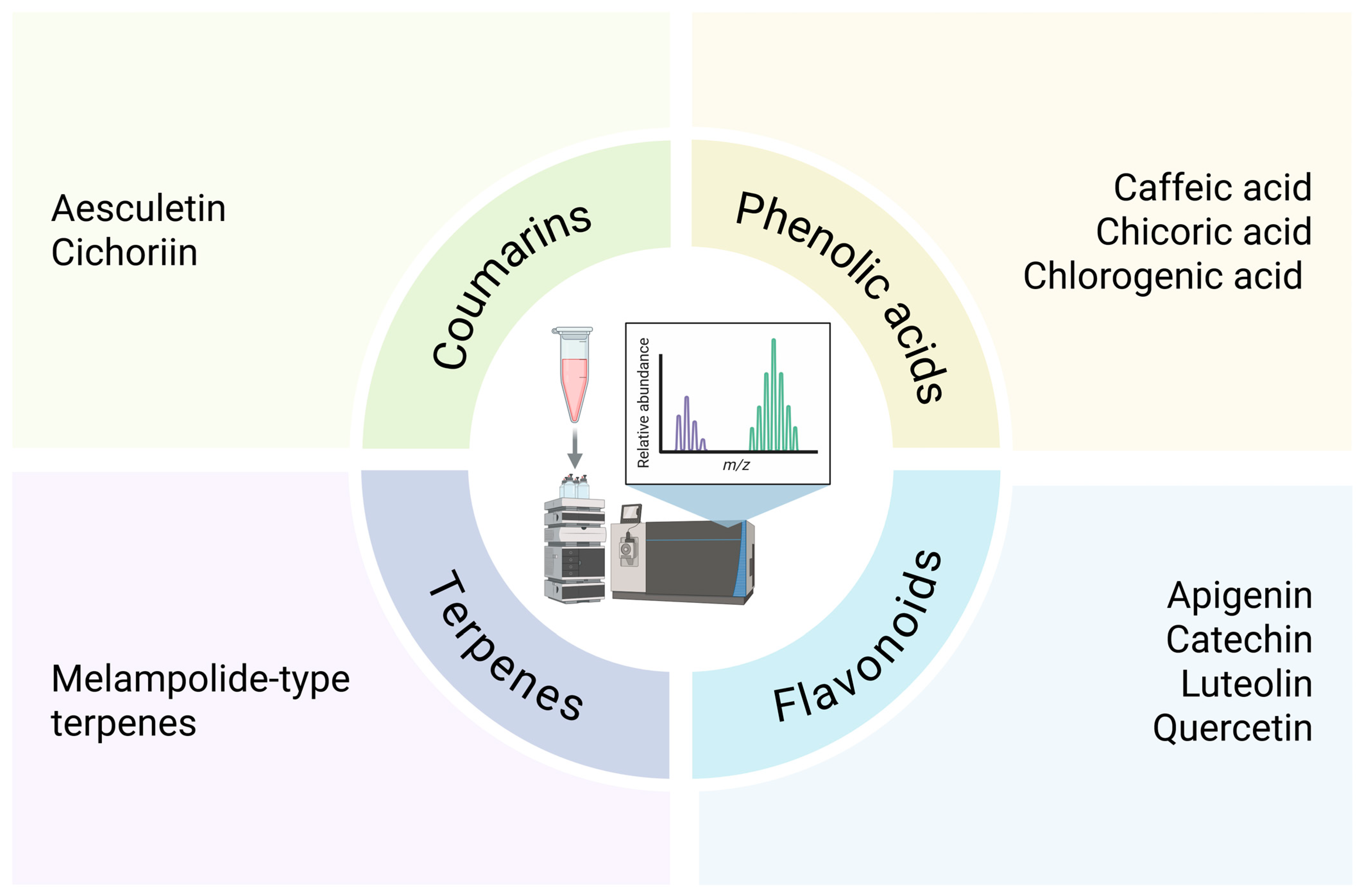


| Primary Metabolites of Sonchus asper | |
|---|---|
| Chemical compounds | Function according to CosIng |
| Ascorbic Acid | antioxidant, skin conditioning |
| Tocopherol (Vitamin E) | antioxidant, skin conditioning |
| Vitamin K | skin conditioning |
| Linoleic Acid | emollient, skin conditioning, surfactant |
| Alpha-Linolenic Acid | skin conditioning, emollient |
| L-Lysine | antistatic, hair conditioning, skin conditioning |
| L-Threonine | skin conditioning |
| L-Isoleucine | skin conditioning |
| L-Leucine | skin conditioning |
| L-Phenylalanine | skin conditioning |
| L-Tryptophan | skin conditioning |
| Secondary metabolites of Sonchus asper | |
| Phenolic compounds | Function according to CosIng |
| Caffeic Acid | antioxidant, masking |
| Chlorogenic Acid | antioxidant, skin conditioning |
| Rosmarinic Acid | antioxidant, skin conditioning |
| Gallic Acid | antioxidant, masking |
| Chicoric Acid | antioxidant, skin conditioning |
| Malic Acid | buffering, humectant, skin conditioning |
| Flavonoid compounds | |
| Quercetin | antioxidant, skin protecting |
| Quercetin-3-Glucoside | antioxidant |
| Quercetin-3-Galactoside | antioxidant |
| Luteolin | antioxidant, skin protecting |
| Luteolin-7-Glucoside | antioxidant |
| Apigenin | antioxidant, skin protecting |
| Catechin | antioxidant, skin conditioning |
| Isorhamnetin | antioxidant |
| Rhamnetin | antioxidant |
| Coumarin compounds | |
| Esculin | skin conditioning, tonic |
| Esculetin | antioxidant |
| Type of Test | |||||||||
|---|---|---|---|---|---|---|---|---|---|
| Extract Type | Extraction Characteristics | Solvent | DPPH | FRAP | TBARS (EC50 μg/mL) | OxHLIA (IC50 μg/mL) After 60 min | OxHLIA (IC50 μg/mL) After 120 min | ABTS | Reference Compound/Literature |
| Raw U leaf extract | U (320 W, 15 min); | Hydroalcoholic | 15.67 ± 1.96 mg TE/g | 9.7 ± 0.28 mg TE/g | NR | NR | NR | NR | [6] |
| Cooked U leaf extract | 2 min of cooking. U (320 W, 15 min) | Hydroalcoholic | 19.47 ± 1.56 mg TE/g | 16.34 ± 2.05 mg TE/g | NR | NR | NR | NR | |
| Raw MW leaf extract | MAE (1000 W, 5 min) | Hydroalcoholic | 17.88 ± 1.87 mg TE/g | 14.94 ± 1.85 mg TE/g | NR | NR | NR | NR | |
| Cooked MW leaf extract | 2 min of cooking. MAE (1000 W, 5 min) | Hydroalcoholic | 21.72 ± 2.49 mg TE/g | 29.63 ± 2.14 mg TE/g | NR | NR | NR | NR | |
| SAD extract | U (320 W, 15 min); maceration | Hydroalcoholic | 209.56 ± 19.14 (9.0 ± 0.94) mg TE/g | 1540.77 ± 110.28 (12.33 ± 0.88) mg TE/g | NR | NR | NR | NR | |
| SAD eu-liposomes | U (320 W, 15 min); maceration; sonification | Hydroalcoholic | 266.58 ± 23.53 (11.46 ± 1.1) mg TE/g | 2526.34 ± 151.25 (20.35 ± 2.85) mg TE/g | NR | NR | NR | NR | |
| Hydroethanol raw leaf extract | Stirring for 1 h | EtOH: H2O (80:20) | NR | NR | 144 ± 1 μg/mL | 35 ± 3 μg/mL | 112 ± 9 μg/mL | NR | Trolox/[11] |
| Decoction | Distillation for 5 min | Boiling water | NR | NR | 281 ± 4 μg/mL | 49 ± 4 μg/mL | 116 ± 9 μg/mL | NR | |
| Hydroethanol raw leaf extract from decoction | Distillation for 5 min; stirring for 1 h | Boiling water EtOH:H2O (80:20) | NR | NR | 318 ± 6 μg/mL | 62 ± 2 μg/mL | 130 ± 6 μg/mL | NR | |
| SAME | Maceration for 48 h at 25 °C; | Methanol | 2.5 ± 0.05 μg/mL | 64 ± 2.12 μg/mL | NR | NR | NR | 53.4 ± 4.2 μg/mL | Ascorbic acid/[9] |
| SACE | Liquid–liquid partitioning for 6 h | Acetone | 3.8 ± 0.2 μg/mL | 87.8 ± 2.56 μg/mL | NR | NR | NR | 74.2 ± 2.6 μg/mL | |
| SAEE | Liquid–liquid partitioning for 6 h | Ethanol | 4.1 ± 0.32 μg/mL | 100.4 ± 2.21 μg/mL | NR | NR | NR | 83.4 ± 1.5 μg/mL | |
| SAHE | Liquid–liquid partitioning for 6 h | n-Hexane | 12.2 ± 1.43 μg/mL | 110.6 ± 1.67 μg/mL | NR | NR | NR | 90.21 ± 2.8 μg/mL | |
| Ascorbic acid | - | Reference compound | 3.61 ± 23 μg/mL | 73.7 ± 3.4 μg/mL | NR | NR | NR | 76.3 ± 2.15 μg/mL | |
| Leaf extract | Extraction in room temperature for 18–24 h | Acetone | 85.6% | 158.67 ± 21.89 μmol Fe (II)/g | NR | NR | NR | 97.8% | BHT/[8] |
| Leaf extract | Extraction in room temperature for 18–24 h | Methanol | 85.3% | 298.56 ± 32.52 μmol Fe (II)/g | NR | NR | NR | 98.0% | |
| Leaf extract | Extraction in room temperature for 18–24 h | Water | 81.8% | 18.32 ± 5.79 μmol Fe (II)/g | NR | NR | NR | 99.1% | |
| Ascorbic acid | - | Reference compound | 99.8% | 1632.1 ± 16.95 μmol Fe (II)/g | NR | NR | NR | NR | |
| BHT | - | Reference compound | 100% | 63.46 ± 2.49 μmol Fe (II)/g | NR | NR | NR | 99.3% | |
| Catechin | - | Reference compound | NR | 972.02 ± 0.61 μmol Fe (II)/g | NR | NR | NR | NR | |
| Quercetin | - | Reference compound | NR | 3107.29 ± 31.28 μmol Fe (II)/g | NR | NR | NR | NR | |
| Extract Type | Solvent | Type of Test | |||
|---|---|---|---|---|---|
| TPC | TFC | TAC | Literature | ||
| Raw U | Hydroalcoholic | 20.08 ± 3.54 mg GAE/g | NR | NR | [6] |
| Cooked U | Hydroalcoholic | 20.51 ± 1.18 mg GAE/g | NR | NR | |
| Raw MW | Hydroalcoholic | 20.21 ± 2.47 mg GAE/g | NR | NR | |
| Cooked MW | Hydroalcoholic | 43.85 ± 0.43 mg GAE/g | NR | NR | |
| SAD extract | Hydroalcoholic | 63.36 ± 3.73 (1.69 ± 0.1) mg GAE/g | NR | NR | |
| SAD eu-liposomes | Hydroalcoholic | 79.17 ± 6.03 (2.02 ± 0.02) mg GAE/g | NR | NR | |
| Flavonol-3-ol extracts | Methanol | 56.54 ± 3.86 mg GAE/g | 13.16 ± 1.69 mg CA/g s.m | 216.94 ± 3.30 mg TE/g | [12] |
| Flavones/flavonols/flavanones | Methanol | 12.49 ± 1.72 mg GAE/g | 19.37 ± 1.57 mg CA/g s.m | 728.96 ± 15.30 mg TE/g | |
| SAME | Methanol | 332 ± 1.53 mg rutin/g | 11.4 ± 0.45 mg rutin/g | NR | [8] |
| SACE | Acetone | 325 ± 2.3 mg rutin/g | 8.66 ± 1.9 mg rutin/g | NR | |
| SAEE | Ethanol | 192 ± 3.0 mg rutin/g | 7.57 ± 0.09 mg rutin/g | NR | |
| SAHE | n-hexane | 325 ± 2.3 mg rutin/g | 5.16 ± 0.9 mg rutin/g | NR | |
| Leaf extract | Acetone | 10.14 ± 0.44 mg tannic acid/g | 1.04 ± 0.05 mg QC/g | NR | |
| Leaf extract | Methanol | 10.53 ± 1.29 mg tannic acid/g | 0.98 ± 0.10 mg QC/g | NR | |
| Leaf extract | Water | 5.00 ± 0.24 mg tannic acid/g | 0.63 ± 0.12 mg QC/g | NR | |
| Part of the Plant | Extract | Bacteria | Minimum Inhibitory Concentration (mg/mL) | References | |
|---|---|---|---|---|---|
| 1. | Leaves | Methanol, Ethanol, Water | S. aureus, B. spizizinii, E.coli, P. aeruginosa | 15 | [35] |
| 2. | Whole plant (leaves, stem, flowers, seeds and roots) | Methanolic, n-hexane, ethyl acetate, chloroform, butanolic, water | S. aureus, E.coli, K. pneumoniae, M. luteus, B. subtilis, P. aeruginosa | 1 | [42] |
| 3. | Leaves | Methanol, Water | S. aureus, B. cerus, K. pneumoniae, E. coli | 10 | [47] |
| 4. | The aerial parts | Methanol | E. coli S. enterica S. aureus V. parahaemolyticus | 0.04 | [36] |
| 5 | Leaves | Acetone, methanol, water | B. cereus, S. epidermidis, S. aureus, M. kristinae, S. pyogenes, E. coli, S. pooni, S. marcescens, P. aeruginosa, K. pneumonae | 2 | [38] |
| 6 | no data | n-Hexane, Chloroform, Methanol | S. flexneri, Micrococcus sp., E. coli, and S. aureus | 0.75 | [37] |
Disclaimer/Publisher’s Note: The statements, opinions and data contained in all publications are solely those of the individual author(s) and contributor(s) and not of MDPI and/or the editor(s). MDPI and/or the editor(s) disclaim responsibility for any injury to people or property resulting from any ideas, methods, instructions or products referred to in the content. |
© 2026 by the authors. Licensee MDPI, Basel, Switzerland. This article is an open access article distributed under the terms and conditions of the Creative Commons Attribution (CC BY) license.
Share and Cite
Kasprzak, D.; Dycha, N.; Michalak-Tomczyk, M.; Wawruszak, A.; Zdziebło, M.; Kukula-Koch, W.; Ginalska, G. Sonchus asper and Its Potential in Cosmetics—A Review. Pharmaceuticals 2026, 19, 890. https://doi.org/10.3390/ph19060890
Kasprzak D, Dycha N, Michalak-Tomczyk M, Wawruszak A, Zdziebło M, Kukula-Koch W, Ginalska G. Sonchus asper and Its Potential in Cosmetics—A Review. Pharmaceuticals. 2026; 19(6):890. https://doi.org/10.3390/ph19060890
Chicago/Turabian StyleKasprzak, Dorota, Natalia Dycha, Magdalena Michalak-Tomczyk, Anna Wawruszak, Magdalena Zdziebło, Wirginia Kukula-Koch, and Grazyna Ginalska. 2026. "Sonchus asper and Its Potential in Cosmetics—A Review" Pharmaceuticals 19, no. 6: 890. https://doi.org/10.3390/ph19060890
APA StyleKasprzak, D., Dycha, N., Michalak-Tomczyk, M., Wawruszak, A., Zdziebło, M., Kukula-Koch, W., & Ginalska, G. (2026). Sonchus asper and Its Potential in Cosmetics—A Review. Pharmaceuticals, 19(6), 890. https://doi.org/10.3390/ph19060890