This is an early access version, the complete PDF, HTML, and XML versions will be available soon.
Review

Biomarker Research in NSAID Hypersensitivity: A Scoping Review and Evidence Map
Division of Allergy, Department of Internal Medicine, Chungbuk National University Hospital, Cheongju-si 28644, Republic of Korea
Pharmaceuticals 2026, 19(6), 838; https://doi.org/10.3390/ph19060838
Submission received: 29 April 2026 / Revised: 23 May 2026 / Accepted: 25 May 2026 / Published: 27 May 2026
(This article belongs to the Special Issue Advances in Drug Hypersensitivity Research)

Abstract

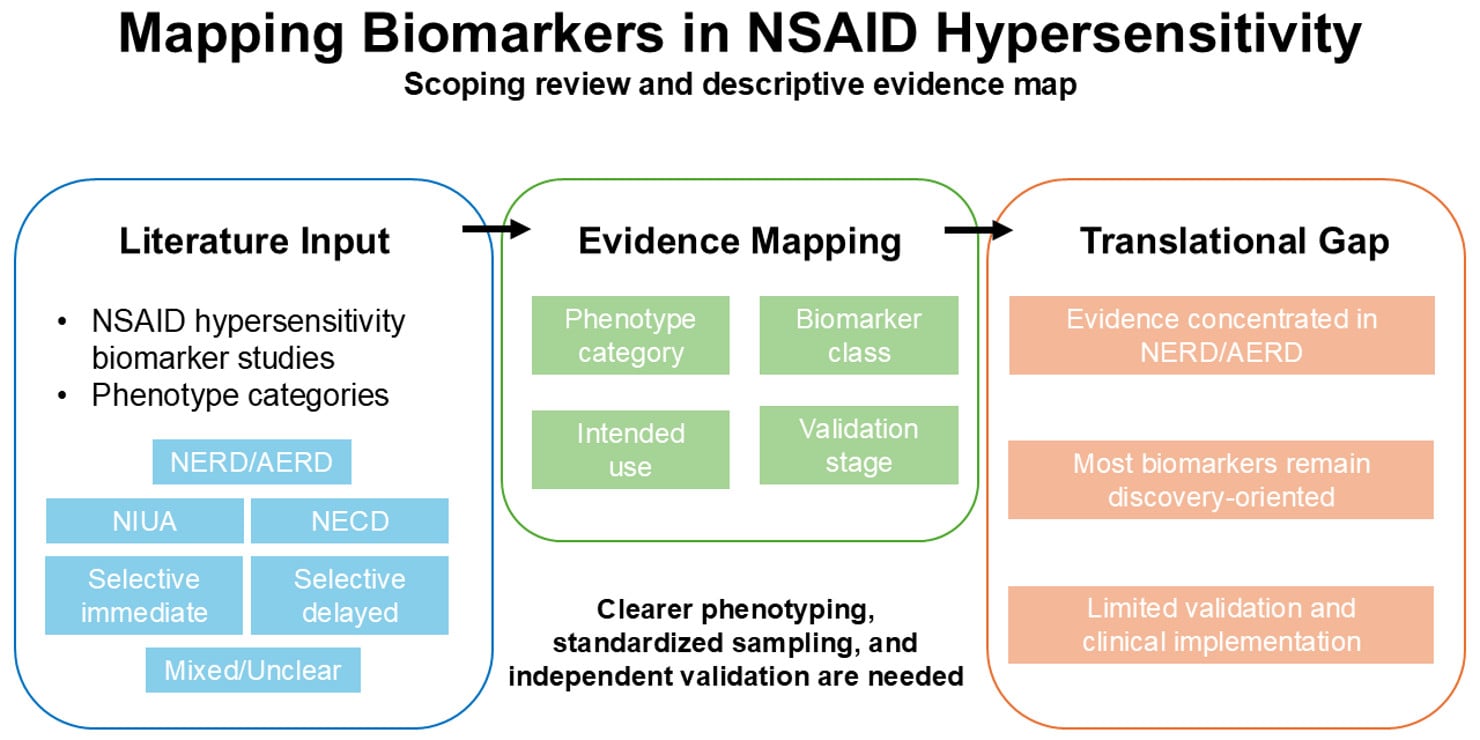
Background/Objectives: Nonsteroidal anti-inflammatory drug (NSAID) hypersensitivity comprises clinically distinct phenotypes, with different implications for diagnosis and future drug use. However, the biomarker literature in this field remains heterogeneous and difficult to interpret as a whole. We aimed to map how NSAID hypersensitivity biomarker studies are distributed across harmonized phenotype categories, biomarker classes, intended uses, and translational validation stages. Methods: We conducted a scoping review with systematic literature searching and descriptive evidence mapping. English-language records published between 1 January 2005 and 31 March 2026 were identified through PubMed and Embase. After staged screening and cross-database deduplication, eligible records were classified according to prespecified phenotype, biomarker, intended use, reference-standard, and validation-stage frameworks. Results: A total of 218 deduplicated records were retained in the master dataset. The mapped literature was heavily concentrated in NSAID-exacerbated respiratory disease/aspirin-exacerbated respiratory disease (NERD/AERD) (189/218, 86.7%). Genetic biomarkers were the most frequent class (118/218, 54.1%). The most frequent phenotype–biomarker class connection was between NERD/AERD and genetic biomarkers (n = 100). Most records were mapped to phenotype/endotype stratification (152/218, 69.7%), and most remained at Stage 0 exploratory discovery (197/218, 90.4%). Conclusions: The NSAID hypersensitivity biomarker literature is concentrated in a narrow phenotype space and remains dominated by exploratory research with limited later-stage validation. Future studies should prioritize clearer phenotype harmonization, stronger diagnostic anchoring, standardized biospecimen strategies, and independent validation to improve clinical translation.
Keywords: NSAID hypersensitivity; biomarker; scoping review; evidence mapping; NERD; aspirin-exacerbated respiratory disease; translational validation NSAID hypersensitivity; biomarker; scoping review; evidence mapping; NERD; aspirin-exacerbated respiratory disease; translational validation
Graphical Abstract