This is an early access version, the complete PDF, HTML, and XML versions will be available soon.
Open AccessArticle
Interpretable QSAR, External PubChem Validation, and Coordination-Aware Docking Enable Tiered Prioritization of Carbonic Anhydrase I Inhibitors
by
Alaa M. Elsayad
 Alaa M. Elsayad
 and
and
Khaled A. Elsayad
 Khaled A. Elsayad
1
Biomedical Group, Department of Electrical Engineering, College of Engineering, Prince Sattam Bin Abdulaziz University, Wadi Alddawasir 11991, Saudi Arabia
2
Pharmacy Department, Cairo University Hospitals, Cairo University, Cairo 11662, Egypt
*
Author to whom correspondence should be addressed.
Pharmaceuticals 2026, 19(5), 778; https://doi.org/10.3390/ph19050778 (registering DOI)
Submission received: 18 April 2026
/
Revised: 10 May 2026
/
Accepted: 12 May 2026
/
Published: 15 May 2026
Abstract
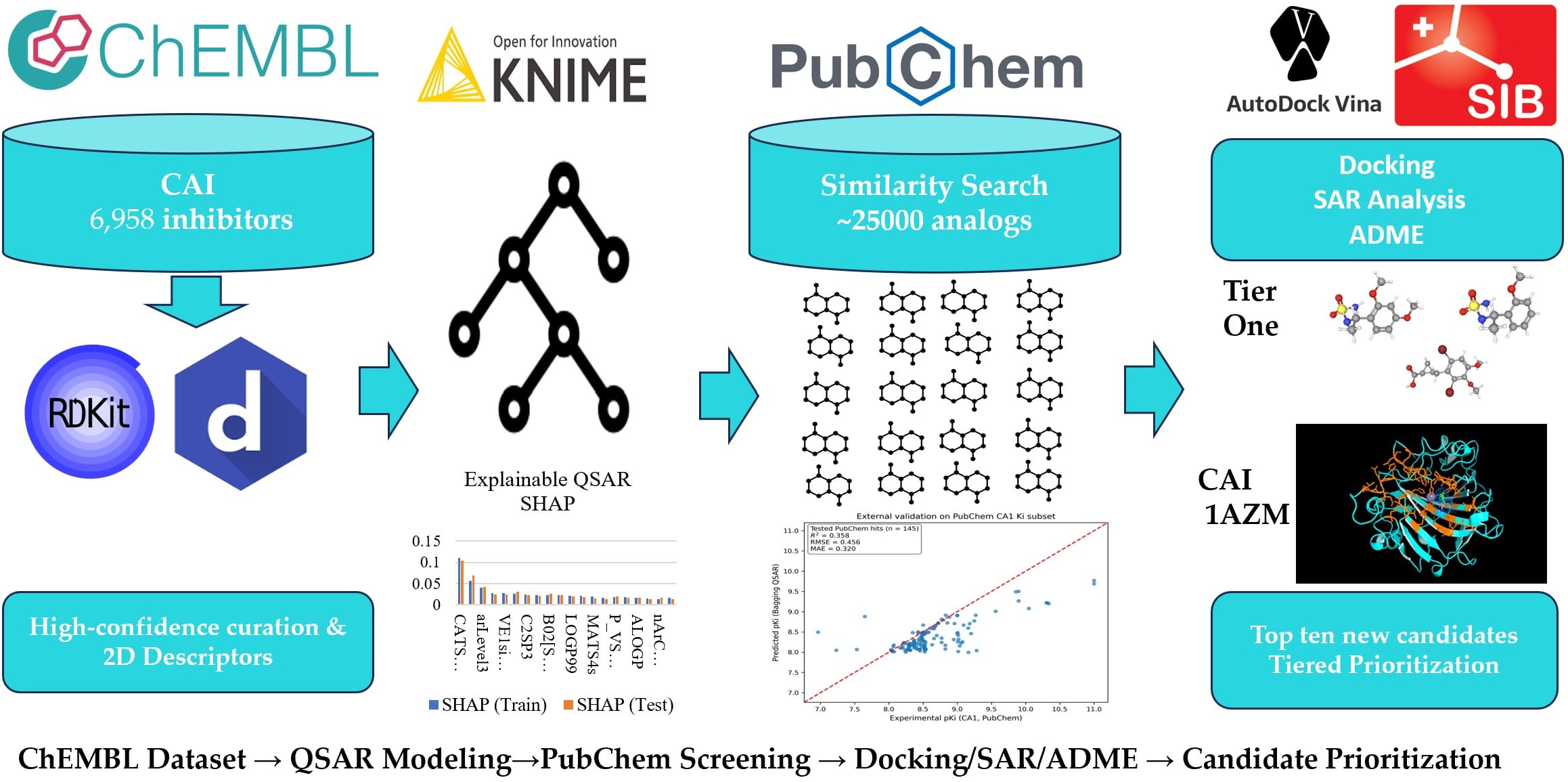
Background/Objectives: Carbonic anhydrase I (CAI) is a zinc-dependent metalloenzyme whose inhibitor discovery requires both effective navigation of chemical space and explicit evaluation of coordination-credible binding hypotheses. We aimed to develop an interpretable and reproducible QSAR-to-structure workflow for CAI inhibitor discovery. The workflow links potency prediction with zinc-site plausibility and early developability to support decision-oriented prioritization of new CAI inhibitor candidates. Methods: CAI inhibitors were retrieved from ChEMBL (CHEMBL261) and modeled as pKi = 9 – log10(Ki[nM]). AlvaDesc v3.0.8 generated 4224 2D descriptors, which were reduced using train-only preprocessing, variance filtering, correlation pruning, and bagged-tree ranking to a top-100 panel. Five regressors (elastic net, CART, bagging, GB, and XGB) were benchmarked on a held-out test set. Potent ChEMBL seeds (Ki ≤ 10 nM) were used for a 90% 2D similarity PubChem expansion. Predicted hits were then externally validated using independently available PubChem CAI Ki records. Ten novel candidates lacking CAI Ki data were docked to CAI (PDB: 1AZM) via SwissDock AutoDock Vina in neutral and relevant anionic states, with pose selection constrained by a Zn-donor filter (Zn-N/O ≤2.6 Å). SwissADME was used to profile physicochemical space, alerts, and absorption/distribution proxies. Results: The bagging model showed the best test generalization (R2 = 0.646; RMSE = 0.61; MAE = 0.45). PFI and SHAP converged on sulfur/heteroatom connectivity and polar–lipophilic organization as dominant potency drivers. PubChem expansion yielded 25,315 analogs and 233 candidates at predicted pKi ≥ 8.0; external validation on 145 CAI-measured hits gave R2 = 0.358 (RMSE = 0.456; MAE = 0.320). Across 20 ligand/protomer docking runs, 12 produced canonical Zn-anchored poses (10 Zn-N; 2 Zn-O). SwissADME indicated consensus logP values from −0.65 to 3.21, 0/10 PAINS alerts, and predominantly favorable drug-likeness (8/10 with zero Lipinski violations), supporting tiered advancement. Conclusions: Integrating interpretable QSAR, external PubChem validation, coordination-aware docking, and SwissADME yields a practical triage framework for CAI inhibitor discovery. The resulting tiered shortlist identifies two Zn-N-anchored N-alkyl sulfamides (CIDs 103935964 and 112684680) and one Zn-O-anchored carboxylate control (CID 122367674) as highest-priority computational hypotheses for staged biochemical evaluation.
Share and Cite
MDPI and ACS Style
Elsayad, A.M.; Elsayad, K.A.
Interpretable QSAR, External PubChem Validation, and Coordination-Aware Docking Enable Tiered Prioritization of Carbonic Anhydrase I Inhibitors. Pharmaceuticals 2026, 19, 778.
https://doi.org/10.3390/ph19050778
AMA Style
Elsayad AM, Elsayad KA.
Interpretable QSAR, External PubChem Validation, and Coordination-Aware Docking Enable Tiered Prioritization of Carbonic Anhydrase I Inhibitors. Pharmaceuticals. 2026; 19(5):778.
https://doi.org/10.3390/ph19050778
Chicago/Turabian Style
Elsayad, Alaa M., and Khaled A. Elsayad.
2026. "Interpretable QSAR, External PubChem Validation, and Coordination-Aware Docking Enable Tiered Prioritization of Carbonic Anhydrase I Inhibitors" Pharmaceuticals 19, no. 5: 778.
https://doi.org/10.3390/ph19050778
APA Style
Elsayad, A. M., & Elsayad, K. A.
(2026). Interpretable QSAR, External PubChem Validation, and Coordination-Aware Docking Enable Tiered Prioritization of Carbonic Anhydrase I Inhibitors. Pharmaceuticals, 19(5), 778.
https://doi.org/10.3390/ph19050778
Note that from the first issue of 2016, this journal uses article numbers instead of page numbers. See further details
here.
Article Metrics
Article Access Statistics
For more information on the journal statistics, click
here.
Multiple requests from the same IP address are counted as one view.