Hybrid SES–MEW Scaffold Strategies: A Narrative Review of Multi-Scale Fiber Architectures for Soft and Hard Tissue Engineering




Abstract
1. Introduction
2. Technical Principles of the SES–MEW Combination
3. Tissue-Specific Applications: A Critical Cross-Tissue Analysis
3.1. Skin
3.2. Vascular Tissue Engineering: Small-Diameter Grafts
3.3. Bone Tissue Engineering
3.4. Soft Connective Tissues: Heart Valve Leaflets, Pericardium, and Cartilage
3.5. Skeletal Muscle
4. Critical Cross-Tissue Analysis

| Tissue | Principal SES Contribution | Principal MEW Contribution | Key Hybrid Advantage | Critical Open Gap | In Vivo Validation | TRL |
|---|---|---|---|---|---|---|
| Skin | DEJ biomimicry; keratinocyte barrier; ECM permeability control | Open-pore dermal scaffold; fibroblast organization | Full-thickness skin equivalent in 18 days; elastin deposition from day 18 [50] | No skin appendages [52]; no perfusable vasculature [54,57]; no in vivo data | None for SES–MEW construct | 3 |
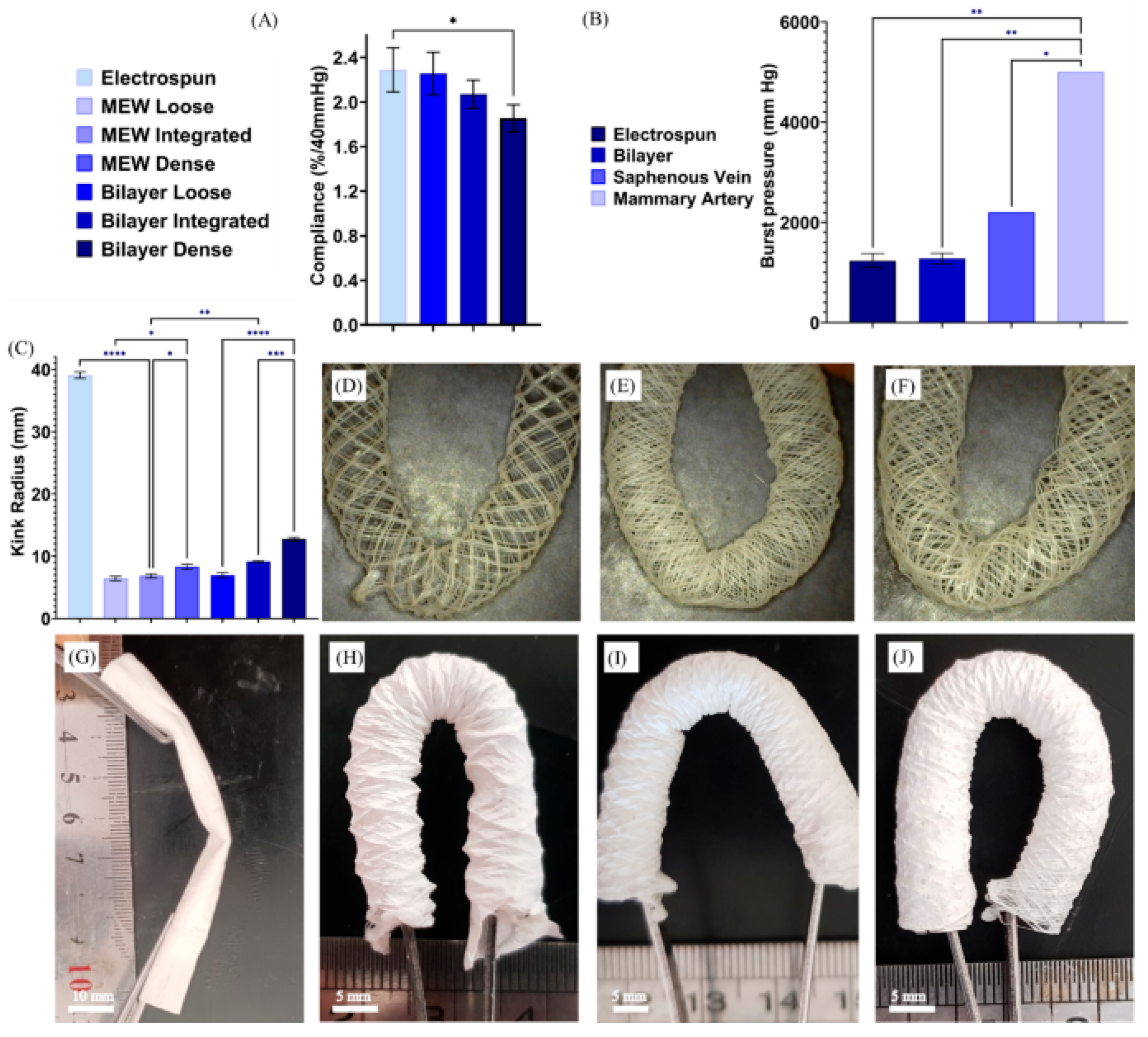
| Vasculature (SDVG) | Confluent luminal endothelium; adventitial mechanical reinforcement; ECM nanotopography | J-shaped stress-strain; circumferential MSC orientation; kink resistance | Native J-curve recapitulation; cell organization without soluble factors [62] | Suture retention below native artery [45,65]; no large animal model; compliance mismatch uncharacterized under in vivo conditions [60]; no shear-conditioned endothelial data | Rat abdominal aorta [63] | 3–4 |
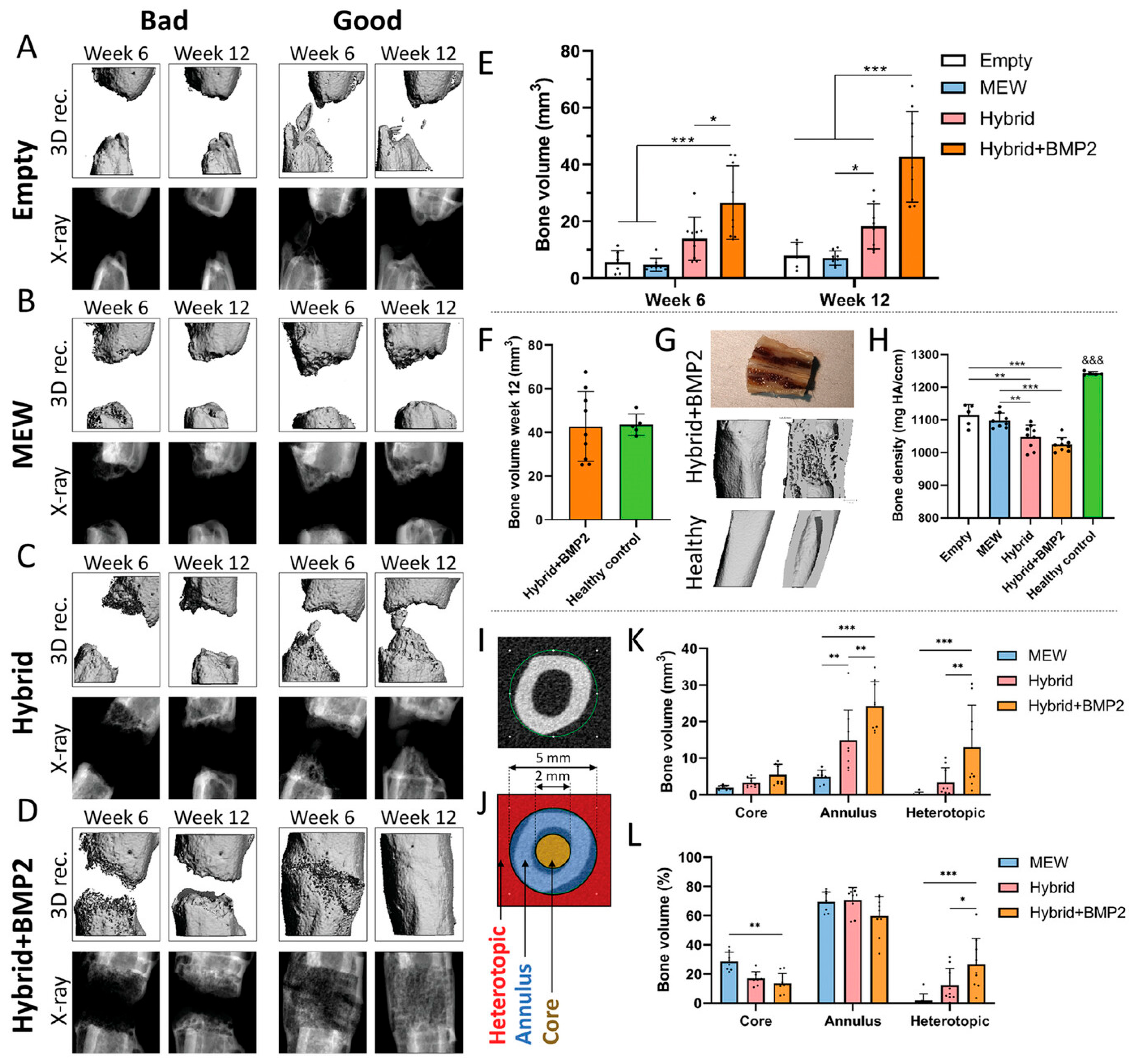
| Bone | Dual payload (HAp + ROX); osteoconductive nanofiber surface; drug delivery | Microgrid mechanical backbone; FDM shell for soft tissue exclusion; pore geometry preservation in vivo | Dual osteogenic-antibacterial function [72]; vascularization superior to MEW alone [43] | In vivo antibacterial validation absent; insufficient pore geometry optimization for vascularization [76]; compressive modulus below cortical bone [77,78]; PCL degradation mismatched to bone remodeling timeline [115] | Rat femoral critical-size defect [43] | 4 |
| Heart valve/pericardium | ECM-mimetic nanotopography for VIC/VSMC; potential growth factor delivery | Prescribed biaxial nonlinear anisotropic mechanics [86,87,88]; serpentine and sinusoidal fibers from bioinspired and FEA-DOE design framework | Biaxial mechanical target matching within 10% deviation; trileaflet valve under pulmonary pressure | No fatigue data; no aortic-pressure in vivo test; SES not yet integrated in valve constructs | Subcutaneous rat (non-hemodynamic) [96] | 3 |
| Skeletal muscle | Interstitial vascularization via endothelial cell guidance [106,107]; VEGF delivery; nano-ECM for myoblast adhesion | Directional fiber orientation guiding myoblast alignment and MHC expression [98] | Myoblast alignment and myogenic differentiation dependent on fiber aspect ratio; angiogenic co-culture synergy [107] | No integrated SES–MEW hybrid reported [98]; vascularization unresolved at the construct scale [103,104] | None for SES–MEW construct | 2 |
5. Translational Barriers
5.1. Process Standardization, Reproducibility, and the Role of Machine Learning
5.2. Regulatory Classification and Biocompatibility
5.3. Scale-Up Manufacturing
6. Future Perspectives
7. Conclusions
Author Contributions
Funding
Institutional Review Board Statement
Informed Consent Statement
Data Availability Statement
Conflicts of Interest
References
- Yang, Q.; Li, J.; Su, W.; Yu, L.; Li, T.; Wang, Y.; Zhang, K.; Wu, Y.; Wang, L. Electrospun aligned poly(ε-caprolactone) nanofiber yarns guiding 3D organization of tendon stem/progenitor cells in tenogenic differentiation and tendon repair. Front. Bioeng. Biotechnol. 2022, 10, 960694. [Google Scholar] [CrossRef] [Scilit]
- Buckley, C.; Madhavarapu, S.; Kamara, Z.; Pellegrini, M.; Perry, B.; Gatt, C.J.; Freeman, J.W. In Vivo Evaluation of the Regenerative Capacity of a Nanofibrous, Prevascularized, Load-Bearing Scaffold for Bone Tissue Engineering. Regen. Eng. Transl. Med. 2023, 10, 56–67. [Google Scholar] [CrossRef] [Scilit]
- Moody, A.; Bhattarai, N. Enhanced Cell Proliferation, Migration, and Fibroblast Differentiation with Electrospun PCL-Zinc Scaffolds Coated with Fibroblast-Derived ECM. ACS Omega 2025, 10, 4427–4441. [Google Scholar] [CrossRef] [Scilit]
- Licciardello, M.; Traldi, C.; Bortolameazzi, M.; Testore, D.; Ciardelli, G.; Tonda-Turo, C. Aligned polycaprolactone/polyaniline electrospun nanofibers for directing neural stem cell differentiation and neuron arrangement. Front. Biomater. Sci. 2024, 3, 1362599. [Google Scholar] [CrossRef] [Scilit]
- Amores de Sousa, M.C.; Rodrigues, C.A.V.; Ferreira, I.A.F.; Diogo, M.M.; Linhardt, R.J.; Cabral, J.M.S.; Ferreira, F.C. Functionalization of Electrospun Nanofibers and Fiber Alignment Enhance Neural Stem Cell Proliferation and Neuronal Differentiation. Front. Bioeng. Biotechnol. 2020, 8, 580135. [Google Scholar] [CrossRef] [Scilit]
- Hernandez, J.L.; Doan, M.-A.; Stoddard, R.; VanBenschoten, H.M.; Chien, S.-T.; Suydam, I.T.; Woodrow, K.A. Scalable Electrospinning Methods to Produce High Basis Weight and Uniform Drug Eluting Fibrous Biomaterials. Front. Biomater. Sci. 2022, 1, 928537. [Google Scholar] [CrossRef] [Scilit]
- Owida, H.A.; Al-Nabulsi, J.I.; Alnaimat, F.; Al-Ayyad, M.; Turab, N.M.; Al Sharah, A.; Shakur, M. Recent Applications of Electrospun Nanofibrous Scaffold in Tissue Engineering. Appl. Bionics Biomech. 2022, 2022, 1953861. [Google Scholar] [CrossRef] [Scilit]
- Liu, Y.X.; Chaparro, F.J.; Tian, Z.; Jia, Y.; Gosser, J.; Gaumer, J.; Ross, L.; Tafreshi, H.; Lannutti, J.J. Visualization of porosity and pore size gradients in electrospun scaffolds using laser metrology. PLoS ONE 2023, 18, e0282903. [Google Scholar] [CrossRef] [Scilit] [PubMed]
- Baker, B.M.; Gee, A.O.; Metter, R.B.; Nathan, A.S.; Marklein, R.A.; Burdick, J.A.; Mauck, R.L. The potential to improve cell infiltration in composite fiber-aligned electrospun scaffolds by the selective removal of sacrificial fibers. Biomaterials 2008, 29, 2348–2358. [Google Scholar] [CrossRef] [Scilit]
- Brown, T.D.; Slotosch, A.; Thibaudeau, L.; Taubenberger, A.; Loessner, D.; Vaquette, C.; Dalton, P.D.; Hutmacher, D.W. Design and fabrication of tubular scaffolds via direct writing in a melt electrospinning mode. Biointerphases 2012, 7, 13. [Google Scholar] [CrossRef] [Scilit] [PubMed]
- Farrugia, B.L.; Brown, T.D.; Upton, Z.; Hutmacher, D.W.; Dalton, P.D.; Dargaville, T.R. Dermal fibroblast infiltration of poly(ε-caprolactone) scaffolds fabricated by melt electrospinning in a direct writing mode. Biofabrication 2013, 5, 025001. [Google Scholar] [CrossRef] [Scilit]
- Phipps, M.C.; Clem, W.C.; Grunda, J.M.; Clines, G.A.; Bellis, S.L. Increasing the pore sizes of bone-mimetic electrospun scaffolds comprised of polycaprolactone, collagen I and hydroxyapatite to enhance cell infiltration. Biomaterials 2012, 33, 524–534. [Google Scholar] [CrossRef] [Scilit]
- Tallawi, M.; Rosellini, E.; Barbani, N.; Grazia Cascone, M.; Rai, R.; Saint-Pierre, G.; Boccaccini, A.R. Strategies for the chemical and biological functionalization of scaffolds for cardiac tissue engineering: A review. J. R. Soc. Interface 2015, 12, 20150254. [Google Scholar] [CrossRef] [Scilit]
- Roth, G.A.; Abate, D.; Abate, K.H.; Abay, S.M.; Abbafati, C.; Abbasi, N.; Abbastabar, H.; Abd-Allah, F.; Abdela, J.; Abdelalim, A.; et al. Electrospun nanofiber scaffold for vascular tissue engineering. Mater. Sci. Eng. C 2021, 129, 112373. [Google Scholar] [CrossRef] [Scilit]
- Meng, J.; Boschetto, F.; Yagi, S.; Marin, E.; Adachi, T.; Chen, X.; Pezzotti, G.; Sakurai, S.; Yamane, H.; Xu, H. Design and manufacturing of 3D high-precision micro-fibrous poly (l-lactic acid) scaffold using melt electrowriting technique for bone tissue engineering. Mater. Des. 2021, 210, 110063. [Google Scholar] [CrossRef] [Scilit]
- Loewner, S.; Heene, S.; Baroth, T.; Heymann, H.; Cholewa, F.; Blume, H.; Blume, C. Recent advances in melt electro writing for tissue engineering for 3D printing of microporous scaffolds for tissue engineering. Front. Bioeng. Biotechnol. 2022, 10, 896719. [Google Scholar] [CrossRef] [Scilit]
- Shahverdi, M.; Seifi, S.; Akbari, A.; Mohammadi, K.; Shamloo, A.; Movahhedy, M.R. Melt electrowriting of PLA, PCL, and composite PLA/PCL scaffolds for tissue engineering application. Sci. Rep. 2022, 12, 19935. [Google Scholar] [CrossRef] [Scilit] [PubMed]
- Culbreath, C.J.; McCullen, S.D.; Mefford, O.T. Controlling Mechanical Properties of Medical-Grade Scaffolds through Electrospinning Parameter Selection. ACS Omega 2024, 9, 36982–36992. [Google Scholar] [CrossRef] [Scilit] [PubMed]
- Włodarczyk-Biegun, M.K.; Villiou, M.; Koch, M.; Muth, C.; Wang, P.; Ott, J.; Del Campo, A. Melt Electrowriting of Graded Porous Scaffolds to Mimic the Matrix Structure of the Human Trabecular Meshwork. ACS Biomater. Sci. Eng. 2022, 8, 3899–3911. [Google Scholar] [CrossRef] [Scilit]
- Mueller, K.M.A.; Mansi, S.; De-Juan-Pardo, E.M.; Mela, P. Advances in melt electrowriting for cardiovascular applications. Front. Bioeng. Biotechnol. 2024, 12, 1425073. [Google Scholar] [CrossRef] [Scilit] [PubMed]
- Dalton, P.D.; Woodfield, T.B.F.; Mironov, V.; Groll, J. Advances in Hybrid Fabrication toward Hierarchical Tissue Constructs. Adv. Sci. 2020, 7, 1902953. [Google Scholar] [CrossRef] [Scilit]
- Jungst, T.; Pennings, I.; Schmitz, M.; Rosenberg, A.J.W.P.; Groll, J.; Gawlitta, D. Heterotypic Scaffold Design Orchestrates Primary Cell Organization and Phenotypes in Cocultured Small Diameter Vascular Grafts. Adv. Funct. Mater. 2019, 29, 1905987. [Google Scholar] [CrossRef] [Scilit]
- Saha, U.; Nairn, R.; Keenan, O.; Monaghan, M.G. A Deeper Insight into the Influence of the Electric Field Strength When Melt-Electrowriting on Non-Planar Surfaces. Macromol. Mater. Eng. 2021, 306, 2100496. [Google Scholar] [CrossRef] [Scilit]
- Mueller, K.M.A.; Hangleiter, A.; Burkhardt, S.; Rojas-González, D.M.; Kwade, C.; Pammer, S.T.; Leonhardt, S.; Mela, P. Filament-Based Melt Electrowriting Enables Dual-Mode Additive Manufacturing for Multiscale Constructs. Small Sci. 2023, 3, 2300021. [Google Scholar] [CrossRef] [Scilit] [PubMed]
- Brooks-Richards, T.L.; Paxton, N.C.; Allenby, M.C.; Woodruff, M.A. Dissolvable 3D printed PVA moulds for melt electrowriting tubular scaffolds with patient-specific geometry. Mater. Des. 2022, 215, 110466. [Google Scholar] [CrossRef] [Scilit]
- Böhm, C.; Tandon, B.; Hrynevich, A.; Teßmar, J.; Dalton, P.D. Processing of Poly(lactic-co-glycolic acid) Microfibers via Melt Electrowriting. Macromol. Chem. Phys. 2022, 223, 2100417. [Google Scholar] [CrossRef] [Scilit]
- Capuana, E.; Testa, M.; Di Marco, C.; Lopresti, F.; La Carrubba, V. Impact of Fiber Orientation in Electrospun PLA Scaffolds on Fluid Dynamics in a Custom Microfluidic Device. Adv. Healthc. Mater. 2025, 14, e2500378. [Google Scholar] [CrossRef] [Scilit]
- Capuana, E.; Lopresti, F.; Pavia, F.C.; Brucato, V.; Carrubba, V. La Solution-Based Processing for Scaffold Fabrication in Tissue Engineering Applications: A Brief Review. Polymers 2021, 13, 2041. [Google Scholar] [CrossRef] [Scilit]
- Ahmadi Bonakdar, M.; Rodrigue, D. Electrospinning: Processes, Structures, and Materials. Macromolecules 2024, 4, 58–103. [Google Scholar] [CrossRef] [Scilit]
- Omiyale, B.O.; Ogbeyemi, A.; Rasheed, A.A.; Adamolekun, T.M.; Zhang, W.C. Influence of electrospinning parameters on the development of high-quality electrospun nanofibers: A brief critical assessment. Next Nanotechnol. 2025, 8, 100295. [Google Scholar] [CrossRef] [Scilit]
- Bauer, M.; Lautenschlaeger, C.; Kempe, K.; Tauhardt, L.; Schubert, U.S.; Fischer, D. Poly(2-ethyl-2-oxazoline) as Alternative for the Stealth Polymer Poly(ethylene glycol): Comparison of in vitro Cytotoxicity and Hemocompatibility. Macromol. Biosci. 2012, 12, 986–998. [Google Scholar] [CrossRef] [Scilit]
- Ahmadian, A.; Shafiee, A.; Aliahmad, N.; Agarwal, M. Overview of Nano-Fiber Mats Fabrication via Electrospinning and Morphology Analysis. Textiles 2021, 1, 206–226. [Google Scholar] [CrossRef] [Scilit]
- Van Daele, L.; Braig, J.; Brancart, J.; Van Vlierberghe, S.; Jungst, T.; Dubruel, P. A Platform Material for Melt Electrowriting: Shape Memory Poly(Alkylene Terephthalate)s with Tunable Thermo-Mechanical Properties. Adv. Funct. Mater. 2026. Early View. [Google Scholar] [CrossRef] [Scilit]
- O’Neill, K.L.; Dalton, P.D. A Decade of Melt Electrowriting. Small Methods 2023, 7, e2201589. [Google Scholar] [CrossRef] [Scilit] [PubMed]
- Xie, Y.; Fang, Q.; Zhao, H.; Li, Y.; Lin, Z.; Chen, J. Effects of Six Processing Parameters on the Size of PCL Fibers Prepared by Melt Electrospinning Writing. Micromachines 2023, 14, 1437. [Google Scholar] [CrossRef] [Scilit] [PubMed]
- Liu, Y.; Deng, R.; Hao, M.; Yan, H.; Yang, W. Orthogonal design study on factors effecting on fibers diameter of melt electrospinning. Polym. Eng. Sci. 2010, 50, 2074–2078. [Google Scholar] [CrossRef] [Scilit]
- Böhm, C.; Stahlhut, P.; Weichhold, J.; Hrynevich, A.; Teßmar, J.; Dalton, P.D. The Multiweek Thermal Stability of Medical-Grade Poly(ε-caprolactone) During Melt Electrowriting. Small 2022, 18, 2104193. [Google Scholar] [CrossRef] [Scilit]
- Blum, C.; Weichhold, J.; Hochleitner, G.; Stepanenko, V.; Würthner, F.; Groll, J.; Jungst, T. Controlling Topography and Crystallinity of Melt Electrowritten Poly(ɛ-Caprolactone) Fibers. 3D Print. Addit. Manuf. 2021, 8, 315–321. [Google Scholar] [CrossRef] [Scilit]
- Xing, J.; Zhang, M.; Liu, X.; Wang, C.; Xu, N.; Xing, D. Multi-material electrospinning: From methods to biomedical applications. Mater. Today Bio 2023, 21, 100710. [Google Scholar] [CrossRef] [Scilit]
- Diloksumpan, P.; De Ruijter, M.; Castilho, M.; Gbureck, U.; Vermonden, T.; Van Weeren, P.R.; Malda, J.; Levato, R. Combining multi-scale 3D printing technologies to engineer reinforced hydrogel-ceramic interfaces. Biofabrication 2020, 12, 025014. [Google Scholar] [CrossRef] [Scilit]
- D’Amato, A.R.; Bramson, M.T.K.; Corr, D.T.; Puhl, D.L.; Gilbert, R.J.; Johnson, J. Solvent retention in electrospun fibers affects scaffold mechanical properties. Electrospinning 2018, 2, 15–28. [Google Scholar] [CrossRef] [Scilit]
- Yang, L.; Lou, Y.; Zhang, G.; Sun, Y.; Yang, Y.; Wu, J.; Ye, Y.; Chu, X.; Du, L.; Jiang, Z.; et al. Hybrid manufacturing of highly stretchable functionalized membrane for joint wound treatment. Colloids Surf. A Physicochem. Eng. Asp. 2024, 680, 132655. [Google Scholar] [CrossRef] [Scilit]
- Eichholz, K.F.; Pitacco, P.; Burdis, R.; Chariyev-Prinz, F.; Barceló, X.; Tornifoglio, B.; Paetzold, R.; Garcia, O.; Kelly, D.J. Integrating Melt Electrowriting and Fused Deposition Modeling to Fabricate Hybrid Scaffolds Supportive of Accelerated Bone Regeneration. Adv. Healthc. Mater. 2024, 13, e2302057. [Google Scholar] [CrossRef] [Scilit]
- Ozdemir, S.; Oztemur-Sezgin, J.; Tezcan-Unlu, H.; Yolgosteren, A.; Unlu, E.; Oz, A.D.; Kocaturk-Guney, M.; Cecener, G.; Satar, N.Y.G.; Sezgin, H.; et al. Prolonged In Vivo Performance of Electrospun PCL-Based Vascular Grafts in a Large Animal Model: Influence of Material Design and Systemic Drug Support. ACS Omega 2026, 11, 18356–18371. [Google Scholar] [CrossRef] [Scilit]
- Meng, X.; Wang, X.; Jiang, Y.; Zhang, B.; Li, K.; Li, Q. Suture retention strength of P(LLA-CL) tissue-engineered vascular grafts. RSC Adv. 2019, 9, 21258–21264. [Google Scholar] [CrossRef] [Scilit] [PubMed]
- Regulation (EU) 2017/745 on Medical Devices—European Sources Online. Available online: https://www.europeansources.info/record/proposal-for-a-regulation-of-the-european-parliament-and-of-the-council-on-medical-devices-and-amending-directive-2001-83-ec-regulation-ec-no-178-2002-and-regulation-ec-no-1223-2009/ (accessed on 30 March 2026).
- Aleemardani, M.; Trikić, M.Z.; Green, N.H.; Claeyssens, F. The Importance of Mimicking Dermal-Epidermal Junction for Skin Tissue Engineering: A Review. Bioengineering 2021, 8, 148. [Google Scholar] [CrossRef] [Scilit]
- Roig-Rosello, E.; Dayan, G.; Bovio, S.; Manissier, P.; Errazuriz, E.; Rousselle, P. Dermal stiffness governs the topography of the epidermis and the underlying basement membrane in young and old human skin. Aging Cell 2024, 23, e14096. [Google Scholar] [CrossRef] [Scilit]
- Yilmaz, H.; Bedir, T.; Gursoy, S.; Kaya, E.; Senel, I.; Tinaz, G.B.; Gunduz, O.; Ustundag, C.B. Development of bilayer tissue-engineered scaffolds: Combination of 3D printing and electrospinning methodologies. Biomed. Mater. 2024, 19, 045029. [Google Scholar] [CrossRef] [Scilit] [PubMed]
- Girard, F.; Lajoye, C.; Camman, M.; Tissot, N.; Berthelot Pedurand, F.; Tandon, B.; Moedder, D.; Liashenko, I.; Salameh, S.; Dalton, P.D.; et al. First Advanced Bilayer Scaffolds for Tailored Skin Tissue Engineering Produced via Electrospinning and Melt Electrowriting. Adv. Funct. Mater. 2024, 34, 2314757. [Google Scholar] [CrossRef] [Scilit]
- Larouche, D.; Cantin-Warren, L.; Desgagné, M.; Guignard, R.; Martel, I.; Ayoub, A.; Lavoie, A.; Gauvin, R.; Auger, F.A.; Moulin, V.J.; et al. Improved Methods to Produce Tissue-Engineered Skin Substitutes Suitable for the Permanent Closure of Full-Thickness Skin Injuries. BioRes. Open Access 2016, 5, 320–329. [Google Scholar] [CrossRef] [Scilit]
- Wu, X.; Zhao, F.; Wang, H.; Schirhagl, R.; Włodarczyk-Biegun, M.K. Integrating melt electrowriting (MEW) PCL scaffolds with fibroblast-laden hydrogel toward vascularized skin tissue engineering. Mater. Today Bio 2025, 31, 101593. [Google Scholar] [CrossRef] [Scilit]
- Baran, E.T.; Tahmasebifar, A.; Yilmaz, B. Co-axial electrospinning of PLLA shell, collagen core nanofibers for skin tissue engineering. J. Biomater. Appl. 2023, 37, 1645–1666. [Google Scholar] [CrossRef] [Scilit] [PubMed]
- Hendrickx, B.; Vranckx, J.J.; Luttun, A. Cell-based vascularization strategies for skin tissue engineering. Tissue Eng. Part B Rev. 2011, 17, 13–24. [Google Scholar] [CrossRef] [Scilit]
- Motter Catarino, C.; Kaiser, K.; Baltazar, T.; Motter Catarino, L.; Brewer, J.R.; Karande, P. Evaluation of native and non-native biomaterials for engineering human skin tissue. Bioeng. Transl. Med. 2022, 7, e10297. [Google Scholar] [CrossRef] [Scilit]
- Zhou, C.J.; Guo, Y. Mini review on collagens in normal skin and pathological scars: Current understanding and future perspective. Front. Med. 2024, 11, 1449597. [Google Scholar] [CrossRef] [Scilit]
- Iqbal, M.Z.; Riaz, M.; Biedermann, T.; Klar, A.S. Breathing new life into tissue engineering: Exploring cutting-edge vascularization strategies for skin substitutes. Angiogenesis 2024, 27, 587–621. [Google Scholar] [CrossRef] [Scilit]
- Emmert, M.Y.; Bonatti, J.; Caliskan, E.; Gaudino, M.; Grabenwöger, M.; Grapow, M.T.; Heinisch, P.P.; Kieser-Prieur, T.; Kim, K.B.; Kiss, A.; et al. Consensus statement—Graft treatment in cardiovascular bypass graft surgery. Front. Cardiovasc. Med. 2024, 11, 1285685. [Google Scholar] [CrossRef] [Scilit] [PubMed]
- Ozdemir, S.; Yalcin-Enis, I.; Yalcinkaya, B.; Yalcinkaya, F. An Investigation of the Constructional Design Components Affecting the Mechanical Response and Cellular Activity of Electrospun Vascular Grafts. Membranes 2022, 12, 929. [Google Scholar] [CrossRef] [Scilit] [PubMed]
- Yao, Y.; Pohan, G.; Cutiongco, M.F.A.; Jeong, Y.J.; Kunihiro, J.; Zaw, A.M.; David, D.; Shangguan, H.; Yu, A.C.H.; Yim, E.K.F. In vivo evaluation of compliance mismatch on intimal hyperplasia formation in small diameter vascular grafts. Biomater. Sci. 2023, 11, 3297–3307. [Google Scholar] [CrossRef] [Scilit]
- Ma, Y.; Feng, X.; Rogers, J.A.; Huang, Y.; Zhang, Y. Design and application of ‘J-shaped’ stress-strain behavior in stretchable electronics: A review. Lab Chip 2017, 17, 1689–1704. [Google Scholar] [CrossRef] [Scilit]
- Bartolf-Kopp, M.; de Silva, L.; Rosenberg, A.J.W.P.; Groll, J.; Gawlitta, D.; Jungst, T. Hybrid Co-Spinning and Melt Electrowriting Approach Enables Fabrication of Heterotypic Tubular Scaffolds Resembling the Non-Linear Mechanical Properties of Human Blood Vessels. Adv. Funct. Mater. 2024, 34, 2311797. [Google Scholar] [CrossRef] [Scilit]
- Federici, A.S.; Garcia, O.; Kelly, D.J.; Hoey, D.A. Muticomponent Melt-Electrowritten Vascular Graft to Mimic and Guide Regeneration of Small Diameter Blood Vessels. Adv. Funct. Mater. 2024, 34, 2409883. [Google Scholar] [CrossRef] [Scilit]
- Shahverdi, M.; Shaygani, H.; Soltani, M.; Dadkhah, K.; Rezaei Demneh, S.M.H.; Mohammadi, K.; Shamloo, A. Fabrication of a low-kink-radius bilayer vascular scaffold incorporating a TPU stent fabricated via melt electrowriting and an electrospun PCL/PU/gelatin layer. Sci. Rep. 2025, 15, 24894. [Google Scholar] [CrossRef] [Scilit]
- Konig, G.; McAllister, T.N.; Dusserre, N.; Garrido, S.A.; Iyican, C.; Marini, A.; Fiorillo, A.; Avila, H.; Wystrychowski, W.; Zagalski, K.; et al. Mechanical properties of completely autologous human tissue engineered blood vessels compared to human saphenous vein and mammary artery. Biomaterials 2009, 30, 1542–1550. [Google Scholar] [CrossRef] [Scilit]
- ANSI/AAMI/ISO 7198:2016; Cardiovascular Implants and Extracorporeal Systems—Vascular Prostheses—Tubular Vascular Grafts and Vascular Patches. Association for the Advancement of Medical Instrumentation (AAMI): Arlington, VA, USA, 2016.
- Ding, H.; Hou, X.; Gao, Z.; Guo, Y.; Liao, B.; Wan, J. Challenges and Strategies for Endothelializing Decellularized Small-Diameter Tissue-Engineered Vessel Grafts. Adv. Healthc. Mater. 2024, 13, 2304432. [Google Scholar] [CrossRef] [Scilit] [PubMed]
- Li, W.; Wu, P.; Zhang, Y.; Midgley, A.C.; Yuan, X.; Wu, Y.; Wang, L.; Wang, Z.; Zhu, M.; Kong, D. Bilayered Polymeric Micro- and Nanofiber Vascular Grafts as Abdominal Aorta Replacements: Long-Term in Vivo Studies in a Rat Model. ACS Appl. Bio Mater. 2019, 2, 4493–4502. [Google Scholar] [CrossRef] [Scilit]
- Xiang, Z.; Xiang, Y.; Li, Y.; Zhang, J.; Zhou, C.; Yan, H.; Fu, D.; Wang, Y. Hierarchical Biomimetic Electrospun Vascular Grafts for Improved Patency and Regeneration. Adv. Funct. Mater. 2025, 35, 2424981. [Google Scholar] [CrossRef] [Scilit]
- Agnes, C.J.; Willie, B.M.; Boccaccini, A.R.; Tabrizian, M. Advances in bone tissue engineering using biomaterial based scaffolds, purine crosslinking and Wnt signaling. Explor. BioMat-X 2025, 2, 101327. [Google Scholar] [CrossRef] [Scilit]
- Eichholz, K.F.; Gonçalves, I.; Barceló, X.; Federici, A.S.; Hoey, D.A.; Kelly, D.J. How to design, develop and build a fully-integrated melt electrowriting 3D printer. Addit. Manuf. 2022, 58, 102998. [Google Scholar] [CrossRef] [Scilit]
- Lai, X.; Huang, J.; Huang, S.; Wang, J.; Zheng, Y.; Luo, Y.; Tang, L.; Gao, B.; Tang, Y. Antibacterial and Osteogenic Dual-Functional Micronano Composite Scaffold Fabricated via Melt Electrowriting and Solution Electrospinning for Bone Tissue Engineering. ACS Appl. Mater. Interfaces 2024, 16, 37707–37721. [Google Scholar] [CrossRef] [Scilit]
- Golafshan, N.; Castilho, M.; Daghrery, A.; Alehosseini, M.; van de Kemp, T.; Krikonis, K.; de Ruijter, M.; Dal-Fabbro, R.; Dolatshahi-Pirouz, A.; Bhaduri, S.B.; et al. Composite Graded Melt Electrowritten Scaffolds for Regeneration of the Periodontal Ligament-to-Bone Interface. ACS Appl. Mater. Interfaces 2023, 15, 12735–12749. [Google Scholar] [CrossRef] [Scilit]
- Toosi, S.; Javid-Naderi, M.J.; Tamayol, A.; Ebrahimzadeh, M.H.; Yaghoubian, S.; Mousavi Shaegh, S.A. Additively manufactured porous scaffolds by design for treatment of bone defects. Front. Bioeng. Biotechnol. 2023, 11, 1252636. [Google Scholar] [CrossRef] [Scilit]
- Karageorgiou, V.; Kaplan, D. Porosity of 3D biomaterial scaffolds and osteogenesis. Biomaterials 2005, 26, 5474–5491. [Google Scholar] [CrossRef] [Scilit]
- Gupte, M.J.; Swanson, W.B.; Hu, J.; Jin, X.; Ma, H.; Zhang, Z.; Liu, Z.; Feng, K.; Feng, G.; Xiao, G.; et al. Pore Size Directs Bone Marrow Stromal Cell Fate and Tissue Regeneration in Nanofibrous Macroporous Scaffolds by Mediating Vascularization. Acta Biomater. 2018, 82, 1–11. [Google Scholar] [CrossRef] [Scilit]
- Beisekenov, N.; Sadenova, M.; Azamatov, B.; Syrnev, B. Analysis of Biomechanical Characteristics of Bone Tissues Using a Bayesian Neural Network: A Narrative Review. J. Funct. Biomater. 2025, 16, 168. [Google Scholar] [CrossRef] [Scilit]
- Kovács, K.; Váncsa, S.; Agócs, G.; Harnos, A.; Hegyi, P.; Weninger, V.; Baross, K.; Kovács, B.; Soós, G.; Kocsis, G. Anisotropy, Anatomical Region, and Additional Variables Influence Young’s Modulus of Bone: A Systematic Review and Meta-Analysis. JBMR Plus 2023, 7, e10835. [Google Scholar] [CrossRef] [Scilit] [PubMed]
- McLaren, J.S.; White, L.J.; Cox, H.C.; Ashraf, W.; Rahman, C.V.; Blunn, G.W.; Goodship, A.E.; Quirk, R.A.; Shakesheff, K.M.; Bayston, R.; et al. A biodegradable antibiotic-impregnated scaffold to prevent osteomyelitis in a contaminated in vivo bone defect model. Eur. Cells Mater. 2014, 27, 332–349. [Google Scholar] [CrossRef] [Scilit]
- Zimmerli, W.; Trampuz, A.; Ochsner, P.E. Prosthetic-joint infections. N. Engl. J. Med. 2004, 351, 1645–1654. [Google Scholar] [CrossRef] [Scilit] [PubMed]
- Hasan, A.; Ragaert, K.; Swieszkowski, W.; Selimović, Š.; Paul, A.; Camci-Unal, G.; Mofrad, M.R.K.; Khademhosseini, A. Biomechanical properties of native and tissue engineered heart valve constructs. J. Biomech. 2014, 47, 1949–1963. [Google Scholar] [CrossRef] [Scilit]
- Ayoub, S.; Ferrari, G.; Gorman, R.C.; Gorman, J.H.; Schoen, F.J.; Sacks, M.S. Heart Valve Biomechanics and Underlying Mechanobiology. Compr. Physiol. 2016, 6, 1743–1780. [Google Scholar] [CrossRef] [Scilit] [PubMed]
- Emmert, M.Y.; Schmitt, B.A.; Loerakker, S.; Sanders, B.; Spriestersbach, H.; Fioretta, E.S.; Bruder, L.; Brakmann, K.; Motta, S.E.; Lintas, V.; et al. Computational modeling guides tissue-engineered heart valve design for long-term in vivo performance in a translational sheep model. Sci. Transl. Med. 2018, 10, eaan4587. [Google Scholar] [CrossRef] [Scilit]
- Shih, J.Y.; Gee, T.; Scuderi, G.; Butcher, J. Biomechanical Remodeling of Aortic Valve Interstitial Cells During Calcified Lesion Formation In Vitro. Ann. Biomed. Eng. 2024, 52, 1270–1279. [Google Scholar] [CrossRef] [Scilit] [PubMed]
- Verga, A.S.; Tucker, S.J.; Gao, Y.; Plaskett, A.M.; Hollister, S.J. Nonlinear Viscoelastic Properties of 3D-Printed Tissue Mimicking Materials and Metrics to Determine the Best Printed Material Match to Tissue Mechanical Behavior. Front. Mech. Eng. 2022, 8, 862375. [Google Scholar] [CrossRef] [Scilit]
- Saidy, N.T.; Wolf, F.; Bas, O.; Keijdener, H.; Hutmacher, D.W.; Mela, P.; De-Juan-Pardo, E.M. Biologically Inspired Scaffolds for Heart Valve Tissue Engineering via Melt Electrowriting. Small 2019, 15, e1900873. [Google Scholar] [CrossRef] [Scilit]
- Vernon, M.J.; Lu, J.; Padman, B.; Lamb, C.; Kent, R.; Mela, P.; Doyle, B.; Ihdayhid, A.R.; Jansen, S.; Dilley, R.J.; et al. Engineering Heart Valve Interfaces Using Melt Electrowriting: Biomimetic Design Strategies from Multi-Modal Imaging. Adv. Healthc. Mater. 2022, 11, e2201028. [Google Scholar] [CrossRef] [Scilit]
- Mirani, B.; Mathew, S.O.; Latifi, N.; Labrosse, M.R.; Amsden, B.G.; Simmons, C.A. Programmable Melt Electrowriting to Engineer Soft Connective Tissues with Prescribed, Biomimetic, Biaxial Mechanical Properties. Adv. Funct. Mater. 2023, 34, 2302786. [Google Scholar] [CrossRef] [Scilit]
- Xu, C.; Yang, K.; Xu, Y.; Meng, X.; Zhou, Y.; Xu, Y.; Li, X.; Qiao, W.; Shi, J.; Zhang, D.; et al. Melt-electrowriting-enabled anisotropic scaffolds loaded with valve interstitial cells for heart valve tissue Engineering. J. Nanobiotechnol. 2024, 22, 378. [Google Scholar] [CrossRef] [Scilit]
- Sophia Fox, A.J.; Bedi, A.; Rodeo, S.A. The Basic Science of Articular Cartilage: Structure, Composition, and Function. Sports Health 2009, 1, 461–468. [Google Scholar] [CrossRef] [Scilit] [PubMed]
- Visser, J.; Melchels, F.P.W.; Jeon, J.E.; Van Bussel, E.M.; Kimpton, L.S.; Byrne, H.M.; Dhert, W.J.A.; Dalton, P.D.; Hutmacher, D.W.; Malda, J. Reinforcement of hydrogels using three-dimensionally printed microfibres. Nat. Commun. 2015, 6, 6933. [Google Scholar] [CrossRef] [Scilit]
- de Ruijter, M.; Ribeiro, A.; Dokter, I.; Castilho, M.; Malda, J. Simultaneous Micropatterning of Fibrous Meshes and Bioinks for the Fabrication of Living Tissue Constructs. Adv. Healthc. Mater. 2019, 8, e1800418. [Google Scholar] [CrossRef] [Scilit]
- Effanga, V.E.; Akilbekova, D.; Mukasheva, F.; Zhao, X.; Kalyon, D.M.; Erisken, C. In Vitro Investigation of 3D Printed Hydrogel Scaffolds with Electrospun Tidemark Component for Modeling Osteochondral Interface. Gels 2024, 10, 745. [Google Scholar] [CrossRef] [Scilit]
- Cordelle, M.Z.; Snelling, S.J.B.; Mouthuy, P.A. Skeletal Muscle Tissue Engineering: From Tissue Regeneration to Biorobotics. Cyborg Bionic Syst. 2025, 6, 0279. [Google Scholar] [CrossRef] [Scilit]
- Braunreiter, K.; Kempton, A.; Mejia-Guerra, M.K.; Murray, A.; Baine, S.; Adegboye, K.; Haile, A.; Ahuja, S.J.K.; Fedoce, A.; Liu, C.; et al. Characterization of a humanized mouse model of Duchenne muscular dystrophy to support the development of genetic medicines. Dis. Models Mech. 2025, 18, dmm052182. [Google Scholar] [CrossRef] [Scilit]
- Xu, Y.; Dong, S.; Zhou, Q.; Mo, X.; Song, L.; Hou, T.; Wu, J.; Li, S.; Li, Y.; Li, P.; et al. The effect of mechanical stimulation on the maturation of TDSCs-poly(L-lactide-co-e-caprolactone)/collagen scaffold constructs for tendon tissue engineering. Biomaterials 2014, 35, 2760–2772. [Google Scholar] [CrossRef] [Scilit]
- Greising, S.M.; Rivera, J.C.; Goldman, S.M.; Watts, A.; Aguilar, C.A.; Corona, B.T. Unwavering Pathobiology of Volumetric Muscle Loss Injury. Sci. Rep. 2017, 7, 13179. [Google Scholar] [CrossRef] [Scilit]
- Snow, F.; O’Connell, C.; Elbourne, A.; Kita, M.; Yang, P.; Williams, R.J.; Moulton, S.E.; Pirogova, E.; Kapsa, R.M.I.; Quigley, A. High resolution melt electro-written scaffolds promote alignment of human skeletal muscle cells. Biofabrication 2025, 17, 035013. [Google Scholar] [CrossRef] [Scilit] [PubMed]
- Cha, S.H.; Lee, H.J.; Koh, W.G. Study of myoblast differentiation using multi-dimensional scaffolds consisting of nano and micropatterns. Biomater. Res. 2017, 21, s40824-016-0087-x. [Google Scholar] [CrossRef] [Scilit]
- Huang, N.F.; Patel, S.; Thakar, R.G.; Wu, J.; Hsiao, B.S.; Chu, B.; Lee, R.J.; Li, S. Myotube Assembly on Nanofibrous and Micropatterned Polymers. Nano Lett. 2006, 6, 537–542. [Google Scholar] [CrossRef] [Scilit] [PubMed]
- Huber, A.; Pickett, A.; Shakesheff, K.M. Reconstruction of spatially orientated myotubes in vitro using electrospun, parallel microfibre arrays. Eur. Cells Mater. 2007, 14, 56–63. [Google Scholar] [CrossRef] [Scilit]
- Mueller, K.M.A.; Unterrainer, A.; Rojas-González, D.M.; De-Juan-Pardo, E.; Willner, M.S.; Herzen, J.; Mela, P. Introducing Controlled Microporosity in Melt Electrowriting. Adv. Mater. Technol. 2023, 8, 2201158. [Google Scholar] [CrossRef] [Scilit]
- Koffler, J.; Kaufman-Francis, K.; Shandalov, Y.; Egozi, D.; Amiad Pavlov, D.; Landesberg, A.; Levenberg, S. Improved vascular organization enhances functional integration of engineered skeletal muscle grafts. Proc. Natl. Acad. Sci. USA 2011, 108, 14789–14794. [Google Scholar] [CrossRef] [Scilit] [PubMed]
- Eugenis, I.; Wu, D.; Rando, T.A. Cells, scaffolds, and bioactive factors: Engineering strategies for improving regeneration following volumetric muscle loss. Biomaterials 2021, 278, 121173. [Google Scholar] [CrossRef] [Scilit] [PubMed]
- Moghadam, A.H.; Bayati, V.; Orazizadeh, M.; Rashno, M. Redesigning of 3-Dimensional Vascular-Muscle Structure Using ADSCs/HUVECs Co-Culture and VEGF on Engineered Skeletal Muscle ECM. Cell J. 2022, 24, 380–390. [Google Scholar] [CrossRef] [Scilit]
- Borisov, V.; Gili Sole, L.; Reid, G.; Milan, G.; Hutter, G.; Grapow, M.; Eckstein, F.S.; Isu, G.; Marsano, A. Upscaled Skeletal Muscle Engineered Tissue with In Vivo Vascularization and Innervation Potential. Bioengineering 2023, 10, 800. [Google Scholar] [CrossRef] [Scilit] [PubMed]
- Yeo, M.; Kim, G.H. Micro/nano-hierarchical scaffold fabricated using a cell electrospinning/3D printing process for co-culturing myoblasts and HUVECs to induce myoblast alignment and differentiation. Acta Biomater. 2020, 107, 102–114. [Google Scholar] [CrossRef] [Scilit]
- Saiz, P.G.; Reizabal, A.; Vilas-Vilela, J.L.; Dalton, P.D.; Lanceros-Mendez, S. Materials and Strategies to Enhance Melt Electrowriting Potential. Adv. Mater. 2024, 36, e2312084. [Google Scholar] [CrossRef] [Scilit]
- Matsumoto, H.; Tanioka, A. Functionality in electrospun nanofibrous membranes based on fiber’s size, surface area, and molecular orientation. Membranes 2011, 1, 249–264. [Google Scholar] [CrossRef] [Scilit]
- Moroni, L.; Burdick, J.A.; Highley, C.; Lee, S.J.; Morimoto, Y.; Takeuchi, S.; Yoo, J.J. Biofabrication strategies for 3D in vitro models and regenerative medicine. Nat. Rev. Mater. 2018, 3, 21–37. [Google Scholar] [CrossRef] [Scilit]
- Caddeo, S.; Boffito, M.; Sartori, S. Tissue engineering approaches in the design of healthy and pathological in vitro tissue models. Front. Bioeng. Biotechnol. 2017, 5, 40. [Google Scholar] [CrossRef] [Scilit]
- Vacanti, J.P.; Langer, R. Tissue engineering: The design and fabrication of living replacement devices for surgical reconstruction and transplantation. Lancet 1999, 354, 32–34. [Google Scholar] [CrossRef] [Scilit]
- Deshpande, M.V.; Girase, A.; King, M.W. Degradation of Poly(ε-caprolactone) Resorbable Multifilament Yarn under Physiological Conditions. Polymers 2023, 15, 3819. [Google Scholar] [CrossRef] [Scilit]
- Dias, J.R.; Sousa, A.; Augusto, A.; Bártolo, P.J.; Granja, P.L. Electrospun Polycaprolactone (PCL) Degradation: An In Vitro and In Vivo Study. Polymers 2022, 14, 3397. [Google Scholar] [CrossRef] [Scilit]
- Woodruff, M.A.; Hutmacher, D.W. The return of a forgotten polymer—Polycaprolactone in the 21st century. Prog. Polym. Sci. 2010, 35, 1217–1256. [Google Scholar] [CrossRef] [Scilit]
- Lam, C.X.F.; Hutmacher, D.W.; Schantz, J.T.; Woodruff, M.A.; Teoh, S.H. Evaluation of polycaprolactone scaffold degradation for 6 months in vitro and in vivo. J. Biomed. Mater. Res. A 2009, 90, 906–919. [Google Scholar] [CrossRef] [Scilit]
- Liu, J.; Li, S.; Pan, X.; Wang, J.; Xu, W.; Li, Z.; Wu, M.; Hu, N.; Luo, Y.; Ruan, C. The degradation behavior of 3D-printed polyurethane composite scaffolds regulates bone regeneration. Biofabrication 2026, 18, 015037. [Google Scholar] [CrossRef] [Scilit]
- Daskalakis, E.; Hassan, M.H.; Omar, A.M.; Acar, A.A.; Fallah, A.; Cooper, G.; Weightman, A.; Blunn, G.; Koc, B.; Bartolo, P. Accelerated Degradation of Poly-ε-caprolactone Composite Scaffolds for Large Bone Defects. Polymers 2023, 15, 670. [Google Scholar] [CrossRef] [Scilit] [PubMed]
- Fan, A.T.; Gadbois, G.E.; Huang, H.T.; Chaudhry, C.; Jiang, J.; Sigua, L.H.; Smith, E.R.; Wu, S.; Poirier, G.J.; Dunne-Dombrink, K.; et al. A Kinetic Scout Approach Accelerates Targeted Protein Degrader Development. Angew. Chem. Int. Ed. Engl. 2024, 64, e202417272. [Google Scholar] [CrossRef] [Scilit]
- Sinad, K.V.G.; Hunt, N.K.; Singh, S.; Seims, K.B.; Wu, Y.; Pashuck, E.T.; Grayson, W.L.; Chow, L.W. Design and Synthesis of Peptide-Polyester Conjugates for Cell-Mediated Scaffold Degradation. bioRxiv 2025. [Google Scholar] [CrossRef] [Scilit] [PubMed]
- Abdullah, K.K.; Molnár, K. Current Trends and Future Prospects of Integrating Electrospinning with 3D Printing Techniques for Mimicking Bone Extracellular Matrix Scaffolds. J. Polym. Sci. 2025, 63, 1481–1504. [Google Scholar] [CrossRef] [Scilit]
- Smith, J.A.; Mele, E. Electrospinning and Additive Manufacturing: Adding Three-Dimensionality to Electrospun Scaffolds for Tissue Engineering. Front. Bioeng. Biotechnol. 2021, 9, 674738. [Google Scholar] [CrossRef] [Scilit]
- Wang, Y.; Liu, M.; Zhang, W.; Liu, H.; Jin, F.; Mao, S.; Han, C.; Wang, X. Mechanical strategies to promote vascularization for tissue engineering and regenerative medicine. Burn. Trauma 2024, 12, tkae039. [Google Scholar] [CrossRef] [Scilit] [PubMed]
- Neves, S.C.; Sousa, A.; Nascimento, D.S.; Orge, I.D.; Ferreira, S.A.; Mota, C.; Moroni, L.; Barrias, C.C.; Granja, P.L. A hybrid construct with tailored 3D structure for directing pre-vascularization in engineered tissues. Mater. Today Bio 2024, 29, 101291. [Google Scholar] [CrossRef] [Scilit] [PubMed]
- Renkler, N.Z.; Scialla, S.; Russo, T.; D’Amora, U.; Cruz-Maya, I.; De Santis, R.; Guarino, V. Micro- and Nanostructured Fibrous Composites via Electro-Fluid Dynamics: Design and Applications for Brain. Pharmaceutics 2024, 16, 134. [Google Scholar] [CrossRef] [Scilit]
- Muthukrishnan, L. An overview on electrospinning and its advancement toward hard and soft tissue engineering applications. Colloid Polym. Sci. 2022, 300, 875–901. [Google Scholar] [CrossRef] [Scilit]
- Reizabal, A.; Saiz, P.G.; Luposchainsky, S.; Liashenko, I.; Chasko, D.S.; Lanceros-Méndez, S.; Lindberg, G.; Dalton, P.D. Cryo-Electrohydrodynamic Jetting of Aqueous Silk Fibroin Solutions. ACS Biomater. Sci. Eng. 2023, 10, 1843–1855. [Google Scholar] [CrossRef] [Scilit] [PubMed]
- Nunes, G.; Moreira, M.; Rodrigues, F.; Páscoa, J. Experimental Analysis of Electrohydrodynamic Jet Actuation Modes Based on the Phase Doppler Technique. Actuators 2025, 14, 141. [Google Scholar] [CrossRef] [Scilit]
- Saidy, N.T.; Shabab, T.; Bas, O.; Rojas-González, D.M.; Menne, M.; Henry, T.; Hutmacher, D.W.; Mela, P.; De-Juan-Pardo, E.M. Melt Electrowriting of Complex 3D Anatomically Relevant Scaffolds. Front. Bioeng. Biotechnol. 2020, 8, 793. [Google Scholar] [CrossRef] [Scilit]
- Sun, T.; Lu, H.; Luposchainsky, S.; Yang, L.; Zhang, X.; Hirano, A.; Nakano, Y.; Shinichi, Y.; Xu, H. Challenges of high-temperature melt electrowriting: A study of EVOH printing. Polymer 2025, 331, 128518. [Google Scholar] [CrossRef] [Scilit]
- Carotenuto, F.; Fiaschini, N.; Di Nardo, P.; Rinaldi, A. Towards a Material-by-Design Approach to Electrospun Scaffolds for Tissue Engineering Based on Statistical Design of Experiments (DOE). Materials 2023, 16, 1539. [Google Scholar] [CrossRef] [Scilit]
- Liu, J.; Dong, S.; Liu, Y.; Pan, S.; Yin, Z. Fluid and Electric Field Simulation and Optimization of the Multi-Vane and Multi-Slit Electrospinning Nozzle. Nanomaterials 2025, 15, 461. [Google Scholar] [CrossRef] [Scilit] [PubMed]
- Gupta, J.; Beryozkina, S.; Aljaidi, M.; Singla, M.K.; Safaraliev, M.; Gupta, A.; Nijhawan, P. Application of hybrid chaotic particle swarm optimization and slime mould algorithm to optimally estimate the parameter of fuel cell and solar PV system. Int. J. Hydrogen Energy 2024, 83, 1003–1023. [Google Scholar] [CrossRef] [Scilit]
- Mieszczanek, P.; Corke, P.; Mehanian, C.; Dalton, P.D.; Hutmacher, D.W. Towards industry-ready additive manufacturing: AI-enabled closed-loop control for 3D melt electrowriting. Commun. Eng. 2024, 3, 158. [Google Scholar] [CrossRef] [Scilit]
- Mieszczanek, P.; Robinson, T.M.; Dalton, P.D.; Hutmacher, D.W. Convergence of Machine Vision and Melt Electrowriting. Adv. Mater. 2021, 33, 2100519. [Google Scholar] [CrossRef] [Scilit]
- Shin, D.; Chang, J. Optimizing electrohydrodynamic direct-writing with multilayer perceptron: Accurate and efficient predictions of jet profiles. J. Intell. Manuf. 2026, 37, 647–658. [Google Scholar] [CrossRef] [Scilit]
- Oikonomou, A.; Loutas, T.; Fan, D.; Garmulewicz, A.; Nounesis, G.; Chaudhuri, S.; Tourlomousis, F. Physics-Informed Bayesian learning of electrohydrodynamic polymer jet printing dynamics. Commun. Eng. 2023, 2, 20. [Google Scholar] [CrossRef] [Scilit]
- Iglesias-Lopez, C.; Agustí, A.; Vallano, A.; Obach, M. Current landscape of clinical development and approval of advanced therapies. Mol. Ther. Methods Clin. Dev. 2021, 23, 606–618. [Google Scholar] [CrossRef] [Scilit] [PubMed]
- ISO 10993-18:2020/Amd 1:2022; Biological Evaluation of Medical Devices—Part 18: Chemical Characterization of Medical Device Materials Within a Risk Management Process—Amendment 1: Determination of the Uncertainty Factor. ISO: Geneva, Switzerland, 2022. Available online: https://www.iso.org/standard/82241.html (accessed on 30 March 2026).
- ISO 10993-17:2023; Biological Evaluation of Medical Devices—Part 17: Toxicological Risk Assessment of Medical Device Constituents. ISO: Geneva, Switzerland, 2023. Available online: https://www.iso.org/standard/75323.html (accessed on 30 March 2026).
- Eames, M.L.; Weekes, A.; Ayyachi, T.; Pepper, R.A.; Pickering, E.; Bell, S.; Wu, C.; Woodruff, M.A.; Klein, T.J. Solvent-free melt-electrowriting of polycaprolactone-bioceramic composites. Biomaterials 2026, 329, 123943. [Google Scholar] [CrossRef] [Scilit]
- Uhljar, L.É.; Ambrus, R. Electrospinning of Potential Medical Devices (Wound Dressings, Tissue Engineering Scaffolds, Face Masks) and Their Regulatory Approach. Pharmaceutics 2023, 15, 417. [Google Scholar] [CrossRef] [Scilit]
- Iglesias-López, C.; Agustí, A.; Obach, M.; Vallano, A. Regulatory Framework for Advanced Therapy Medicinal Products in Europe and United States. Front. Pharmacol. 2019, 10, 921. [Google Scholar] [CrossRef] [Scilit] [PubMed]
- Detela, G.; Lodge, A. EU Regulatory Pathways for ATMPs: Standard, Accelerated and Adaptive Pathways to Marketing Authorisation. Mol. Ther.—Methods Clin. Dev. 2019, 13, 205–232. [Google Scholar] [CrossRef] [Scilit]
- Wunner, F.M.; Wille, M.L.; Noonan, T.G.; Bas, O.; Dalton, P.D.; De-Juan-Pardo, E.M.; Hutmacher, D.W. Melt Electrospinning Writing of Highly Ordered Large Volume Scaffold Architectures. Adv. Mater. 2018, 30, 1706570. [Google Scholar] [CrossRef] [Scilit] [PubMed]
- Ashour, S.; Du, L.; Zhang, X.; Sakurai, S.; Xu, H. Unlocking the print of poly(L-lactic acid) by melt electrowriting for medical application. Eur. Polym. J. 2024, 204, 112675. [Google Scholar] [CrossRef] [Scilit]
- Kim, M.H.; Kim, J.Y.; Jung, J.; Lah, J.D.; Kim, H.; Kwon, Y.W.; Cheon, J.; Park, J.U.; Lee, J.H. Large-Scale and High-Resolution Patterning of Magnetic Liquid Metal Nanohybrid for Stretchable Circuits. ACS Nano 2026, 20, 5452–5462. [Google Scholar] [CrossRef] [Scilit] [PubMed]
- Kammerer, A.; Hartmann, F.A.; Nau, C.; Leiblein, M.; Schaible, A.; Neijhoft, J.; Henrich, D.; Verboket, R.; Janko, M. The Impact of Defect Size on Bone Healing in Critical-Size Bone Defects Investigated on a Rat Femur Defect Model Comparing Two Treatment Methods. Bioengineering 2024, 11, 287. [Google Scholar] [CrossRef] [Scilit]
- Wunner, F.M.; Eggert, S.; Maartens, J.; Bas, O.; Dalton, P.D.; De-Juan-Pardo, E.M.; Hutmacher, D.W. Design and Development of a Three-Dimensional Printing High-Throughput Melt Electrowriting Technology Platform. 3D Print. Addit. Manuf. 2019, 6, 82–90. [Google Scholar] [CrossRef] [Scilit]
- Ju, H.; Mirihanage, W.; Wang, W.; Kilic, Z.M. Review on Melt Electrowriting Modelling and Applications. Machines 2025, 13, 763. [Google Scholar] [CrossRef] [Scilit]
- Diaz, R.S.; De-Juan-Pardo, E.M.; Dalton, P.D.; Dargaville, T.R. Semi-Woven Structures via Dual Nozzle Melt Electrowriting. Macromol. Mater. Eng. 2023, 308, 2200526. [Google Scholar] [CrossRef] [Scilit]
- Khalf, A.; Madihally, S.V. Recent advances in multiaxial electrospinning for drug delivery. Eur. J. Pharm. Biopharm. 2017, 112, 1–17. [Google Scholar] [CrossRef] [Scilit]
- Huang, Y.-H.; Ono, A.; Sudo, R. Advances in In Vitro Vascularization of Engineered Tissues: From Microvessel Formation to Hepatic Tissue Integration. Regen. Ther. 2026, 32, 101086. [Google Scholar] [CrossRef] [Scilit]
- Folkman, J.; Hochberg, M. Self-Regulation of Growth in Three Dimensions. J. Exp. Med. 1973, 138, 745–753. [Google Scholar] [CrossRef] [Scilit]
- Rouwkema, J.; Rivron, N.C.; van Blitterswijk, C.A. Vascularization in tissue engineering. Trends Biotechnol. 2008, 26, 434–441. [Google Scholar] [CrossRef] [Scilit] [PubMed]
- Nazarnezhad, S.; Baino, F.; Kim, H.W.; Webster, T.J.; Kargozar, S. Electrospun Nanofibers for Improved Angiogenesis: Promises for Tissue Engineering Applications. Nanomaterials 2020, 10, 1609. [Google Scholar] [CrossRef] [Scilit]
- Jiménez-Beltrán, M.A.; Gómez-Calderón, A.J.; Quintanar-Zúñiga, R.E.; Santillán-Cortez, D.; Téllez-González, M.A.; Suárez-Cuenca, J.A.; García, S.; Mondragón-Terán, P. Electrospinning-Generated Nanofiber Scaffolds Suitable for Integration of Primary Human Circulating Endothelial Progenitor Cells. Polymers 2022, 14, 2448. [Google Scholar] [CrossRef] [Scilit]
- de Lima, G.G.; Lyons, S.; Devine, D.M.; Nugent, M.J.D. Electrospinning of Hydrogels for Biomedical Applications. In Hydrogels; Springer: Singapore, 2018; pp. 219–258. [Google Scholar] [CrossRef] [Scilit]
- Zhang, Y.; Zhao, F.; Chen, S.; Li, B.; Dong, J.; Chen, Y.; Liu, Y.; Qiao, A.; Chen, M. Melt electrowriting-enabled hybrid platforms: Toward functional biomimetic scaffolds for cellular interaction and tissue regeneration. Acta Biomater. 2026, 213, 21–61. [Google Scholar] [CrossRef] [Scilit]
- Hochleitner, G.; Fürsattel, E.; Giesa, R.; Groll, J.; Schmidt, H.W.; Dalton, P.D. Melt Electrowriting of Thermoplastic Elastomers. Macromol. Rapid Commun. 2018, 39, e1800055. [Google Scholar] [CrossRef] [Scilit] [PubMed]
- Ma, L.; Dong, W.; Lai, E.; Wang, J. Silk fibroin-based scaffolds for tissue engineering. Front. Bioeng. Biotechnol. 2024, 12, 1381838. [Google Scholar] [CrossRef] [Scilit]
- Yang, L.; Wang, X.; Xiong, M.; Liu, X.; Luo, S.; Luo, J.; Wang, Y. Electrospun silk fibroin/fibrin vascular scaffold with superior mechanical properties and biocompatibility for applications in tissue engineering. Sci. Rep. 2024, 14, 3942. [Google Scholar] [CrossRef] [Scilit] [PubMed]
- Safonova, L.; Bobrova, M.; Efimov, A.; Davydova, L.; Tenchurin, T.; Bogush, V.; Agapova, O.; Agapov, I. Silk Fibroin/Spidroin Electrospun Scaffolds for Full-Thickness Skin Wound Healing in Rats. Pharmaceutics 2021, 13, 1704. [Google Scholar] [CrossRef] [Scilit]
- Kade, J.C.; Dalton, P.D. Polymers for Melt Electrowriting. Adv. Healthc. Mater. 2021, 10, 2001232. [Google Scholar] [CrossRef] [Scilit] [PubMed]
- King, W.E.; Bowlin, G.L. Near-Field Electrospinning and Melt Electrowriting of Biomedical Polymers—Progress and Limitations. Polymers 2021, 13, 1097. [Google Scholar] [CrossRef] [Scilit]


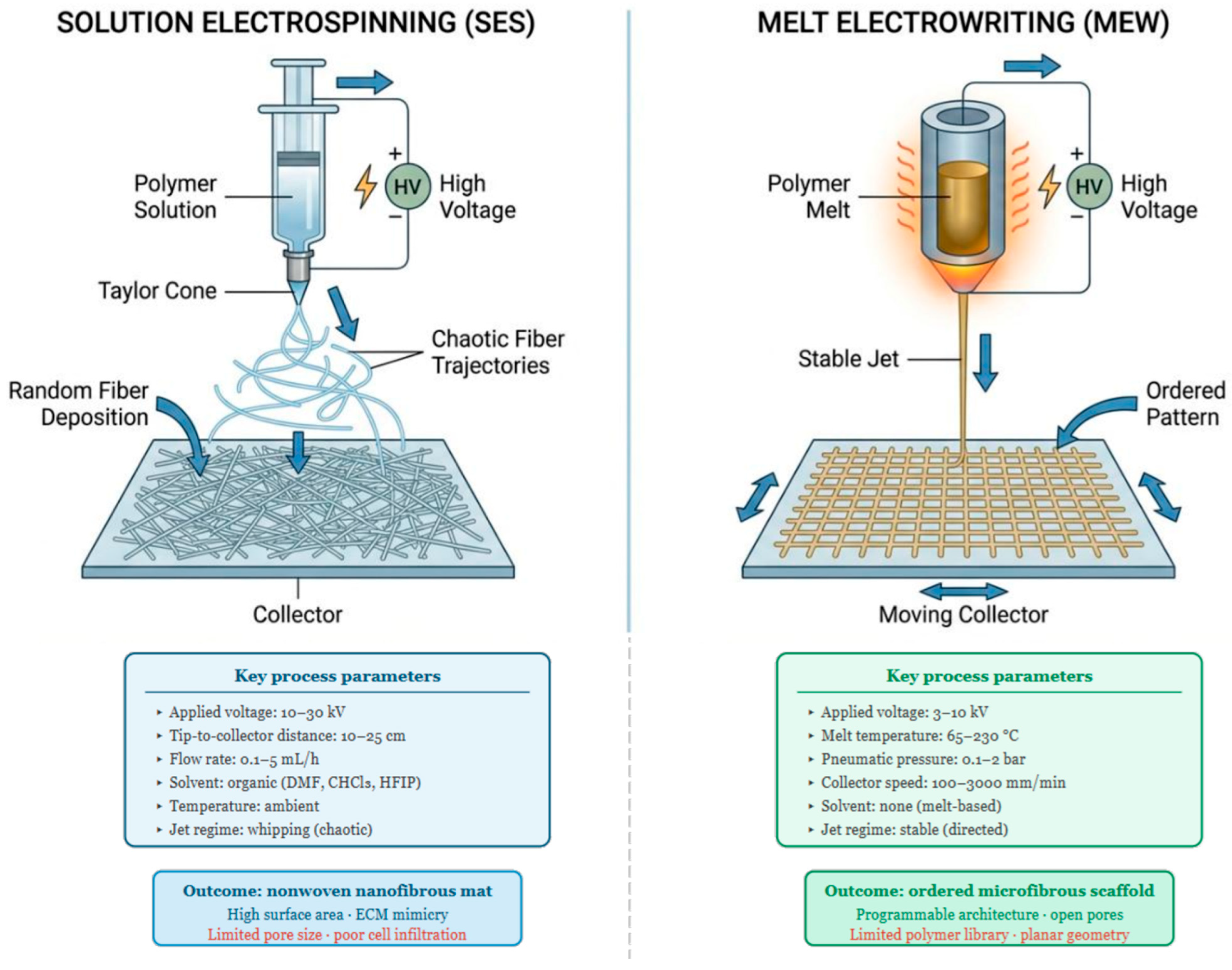
| Parameter | SES | MEW | SES + MEW |
|---|---|---|---|
| Fiber diameter | 100 nm–~10 µm | 3–100 µm | Dual-scale: nm + µm |
| Material phase | Polymer solution | Polymer melt | Both |
| Solvent required | Yes (organic) | No | Partially (SES component) |
| Process temperature | Room temperature | 65–230 °C | Both |
| Applied voltage | 10–30 kV | 3–10 kV | Independent per head |
| Fiber deposition | Random/aligned (whipping) | Programmed (stable jet) | Complementary |
| Pore size | Sub-micron to ~10 µm (small) | 50 µm–~1 mm (tunable) | Hierarchical |
| Cell infiltration | Poor (fiber density-limited) | Excellent | Layer-dependent |
| Mechanical properties | Low stiffness, anisotropic | Tunable, programmable | Enhanced, composite |
| ECM mimicry | High (nanotopography) | Low | High (via SES component) |
| Scalability | Moderate to high (multi-nozzle compatible) | Low (single nozzle) | Limited |
| Regulatory risk | Moderate (solvent residues) | Lower | Composite (solvent residues + device classification) |
Disclaimer/Publisher’s Note: The statements, opinions and data contained in all publications are solely those of the individual author(s) and contributor(s) and not of MDPI and/or the editor(s). MDPI and/or the editor(s) disclaim responsibility for any injury to people or property resulting from any ideas, methods, instructions or products referred to in the content. |
© 2026 by the authors. Licensee MDPI, Basel, Switzerland. This article is an open access article distributed under the terms and conditions of the Creative Commons Attribution (CC BY) license.
Share and Cite
Capuana, E.; Brucato, V.; La Carrubba, V. Hybrid SES–MEW Scaffold Strategies: A Narrative Review of Multi-Scale Fiber Architectures for Soft and Hard Tissue Engineering. Pharmaceuticals 2026, 19, 683. https://doi.org/10.3390/ph19050683
Capuana E, Brucato V, La Carrubba V. Hybrid SES–MEW Scaffold Strategies: A Narrative Review of Multi-Scale Fiber Architectures for Soft and Hard Tissue Engineering. Pharmaceuticals. 2026; 19(5):683. https://doi.org/10.3390/ph19050683
Chicago/Turabian StyleCapuana, Elisa, Valerio Brucato, and Vincenzo La Carrubba. 2026. "Hybrid SES–MEW Scaffold Strategies: A Narrative Review of Multi-Scale Fiber Architectures for Soft and Hard Tissue Engineering" Pharmaceuticals 19, no. 5: 683. https://doi.org/10.3390/ph19050683
APA StyleCapuana, E., Brucato, V., & La Carrubba, V. (2026). Hybrid SES–MEW Scaffold Strategies: A Narrative Review of Multi-Scale Fiber Architectures for Soft and Hard Tissue Engineering. Pharmaceuticals, 19(5), 683. https://doi.org/10.3390/ph19050683