Review

Hybrid SES–MEW Scaffold Strategies: A Narrative Review of Multi-Scale Fiber Architectures for Soft and Hard Tissue Engineering


Department of Engineering, University of Palermo, Viale Delle Scienze, Ed. 8, 90128 Palermo, Italy
*
Author to whom correspondence should be addressed.
Pharmaceuticals 2026, 19(5), 683; https://doi.org/10.3390/ph19050683
Submission received: 31 March 2026 / Revised: 17 April 2026 / Accepted: 23 April 2026 / Published: 27 April 2026
(This article belongs to the Special Issue Electrospinning for Biomedical Applications)

Abstract

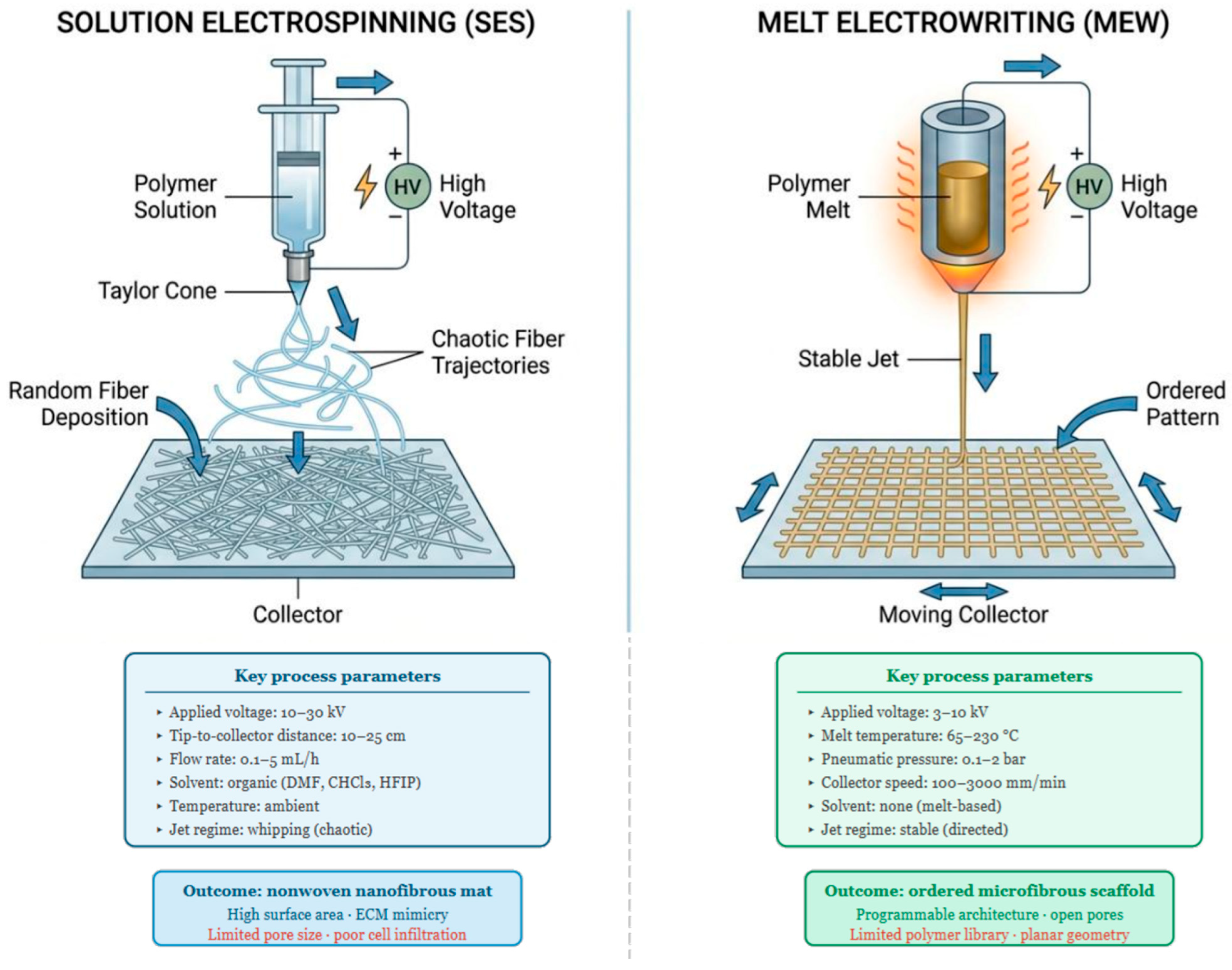
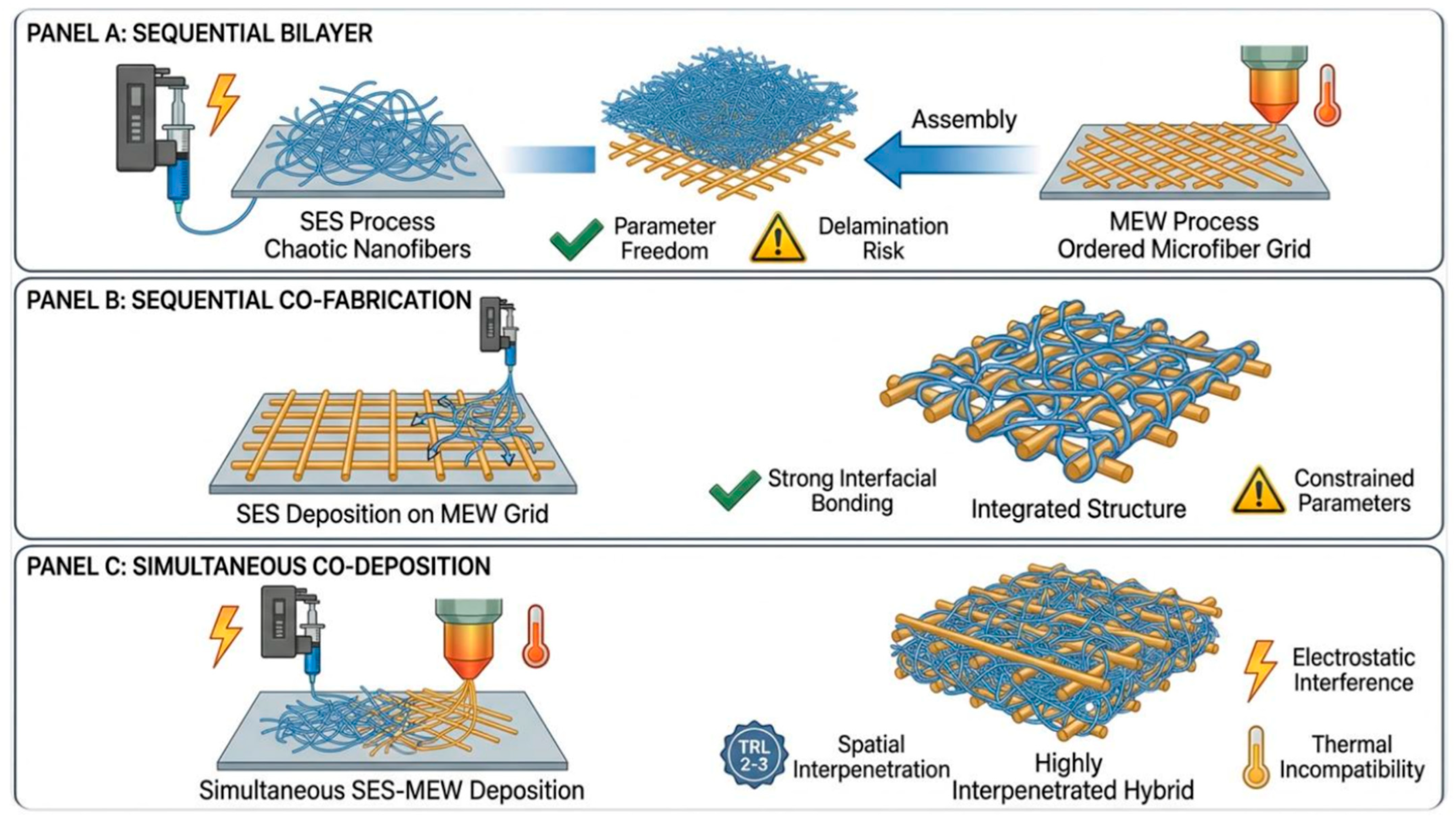
Solution electrospinning (SES) and melt electrowriting (MEW) are complementary fiber-based fabrication platforms extensively investigated in tissue engineering. SES generates fibers typically ranging from the nanometer to the low-micrometer scale, producing fibrous networks that mimic the native extracellular matrix (ECM) and support key cellular functions. MEW, by contrast, operates solvent-free and enables precise, layer-by-layer deposition of microfibers with well-controlled geometry, conferring the mechanical integrity and open-pore architecture that SES constructs inherently lack. Despite growing interest, the body of peer-reviewed literature reporting original hybrid SES–MEW fabrication and biological outcome data remains limited, with no comprehensive cross-tissue synthesis available to date. This narrative review examines the current state of SES–MEW hybrid strategies across five tissue engineering targets selected for their clinical relevance: skin, vascular grafts, bone, cartilage, cardiac valves, and skeletal muscle. For each application, the architectural rationale, the fabrication approach, and the in vitro and in vivo biological outcomes are discussed in an integrated manner, with attention to how the spatial organization of nano- and microfibers translates into tissue-specific functional responses. A comparative analysis across tissue types highlights both the versatility of hybrid constructs and their persistent limitations, including suture retention values that remain below clinically accepted thresholds in vascular applications, incomplete cellular infiltration through dense nanofibrous layers, and the absence of validated, reproducible scale-up protocols compatible with clinical-grade manufacturing. The review concludes by identifying the most critical open questions in the field, encompassing process standardization, regulatory classification, and the emerging role of machine learning in closed-loop MEW process optimization. This work aims to provide an evidence-based perspective on the current state of hybrid SES–MEW scaffold engineering and the key translational gaps limiting clinical application.
Keywords: solution electrospinning; melt electrowriting; hybrid scaffolds; tissue engineering; extracellular matrix mimicry; multi-scale fiber architecture; scaffold fabrication solution electrospinning; melt electrowriting; hybrid scaffolds; tissue engineering; extracellular matrix mimicry; multi-scale fiber architecture; scaffold fabrication