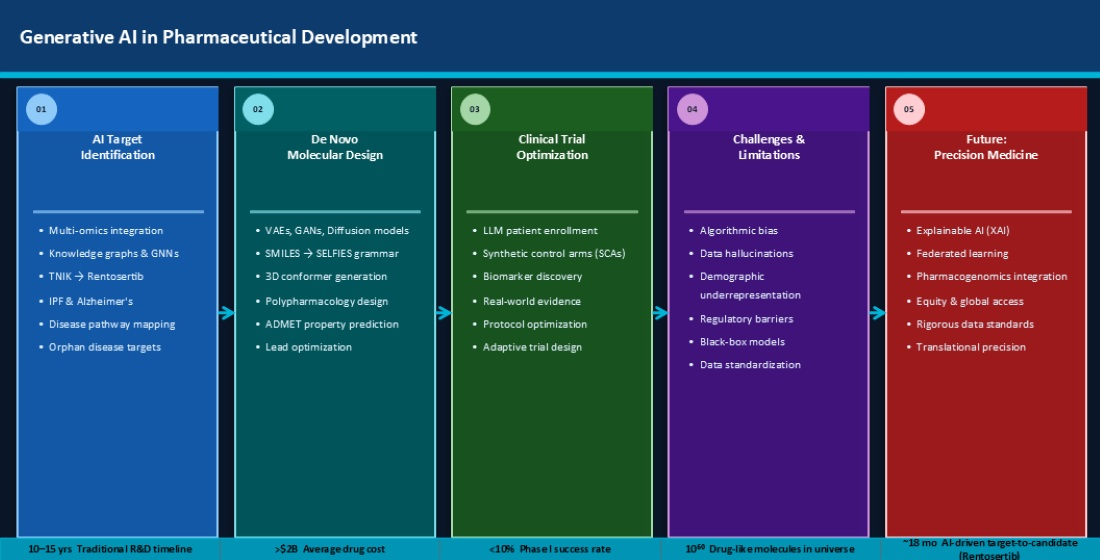
Generative Artificial Intelligence Transitions Pharmaceutical Development from Empirical Screening to Predictive Molecular Design and Clinical Trial Optimization



Abstract
1. Introduction
2. AI-Driven Target Identification and Disease Mechanism Elucidation
2.1. Multi-Omics Integration and Deep Knowledge Graphs
2.2. Clinical Validation of AI-Identified Targets
2.3. Expanding Target Discovery to Neurodegeneration
3. Generative Artificial Intelligence in De Novo Molecular Design
3.1. Evolution of Deep Generative Architectures
3.2. Molecular Representations: From Linear Strings to Geometric Graphs
3.3. Geometric Diffusion Models for 3D Conformation Generation
3.4. Polypharmacology and Multi-Target Therapeutic Design
4. Lead Optimization and Binding Affinity Prediction
Physics-Informed Deep Learning in Affinity Prediction
5. Biomarker Discovery and Multi-Modal Data Integration
5.1. Multi-Omics Frameworks for Precision Diagnostics
5.2. Generative AI Agents as Virtual Laboratories
6. Clinical Trial Optimization and Synthetic Control Arms
6.1. Large Language Models for Patient Screening and Enrollment
6.2. Data-Driven Stratification and Adaptive Trial Design
6.3. Synthetic Control Arms
7. Limitations, Ethical Considerations, and Algorithmic Bias
7.1. Data Bias and Demographic Underrepresentation
7.2. Data Silos, Hallucinations, and the Need for Explainable AI
7.3. Generalization Failure and Distribution Shift
8. Conclusions
Toward a Self-Improving Pharmaceutical Pipeline
Author Contributions
Funding
Institutional Review Board Statement
Informed Consent Statement
Data Availability Statement
Conflicts of Interest
References
- Dermawan, D.; Alotaiq, N. From Lab to Clinic: How Artificial Intelligence (AI) Is Reshaping Drug Discovery Timelines and Industry Outcomes. Pharmaceuticals 2025, 18, 981. [Google Scholar] [CrossRef] [Scilit]
- Thorlund, K.; Dron, L.; Park, J.J.H.; Mills, E.J. Synthetic and External Controls in Clinical Trials—A Primer for Researchers. Clin. Epidemiol. 2020, 12, 457–467. [Google Scholar] [CrossRef] [Scilit]
- Xie, W.; Wang, F.; Li, Y.; Lai, L.; Pei, J. Advances and Challenges in De Novo Drug Design Using Three-Dimensional Deep Generative Models. J. Chem. Inf. Model. 2022, 62, 2269–2279. [Google Scholar] [CrossRef] [Scilit]
- Martinelli, D.D. Generative Machine Learning for De Novo Drug Discovery: A Systematic Review. Comput. Biol. Med. 2022, 145, 105403. [Google Scholar] [CrossRef] [Scilit]
- Gangwal, A.; Ansari, A.; Ahmad, I.; Azad, A.K.; Kumarasamy, V.; Subramaniyan, V.; Wong, L.S. Generative Artificial Intelligence in Drug Discovery: Basic Framework, Recent Advances, Challenges, and Opportunities. Front. Pharmacol. 2024, 15, 1331062. [Google Scholar] [CrossRef] [Scilit]
- Selvaraj, C.; Chandra, I.; Singh, S.K. Artificial Intelligence and Machine Learning Approaches for Drug Design: Challenges and Opportunities for the Pharmaceutical Industries. Mol. Divers. 2022, 26, 1893–1913. [Google Scholar] [CrossRef] [Scilit]
- Harrer, S.; Shah, P.; Antony, B.; Hu, J. Artificial Intelligence for Clinical Trial Design. Trends Pharmacol. Sci. 2019, 40, 577–591. [Google Scholar] [CrossRef] [Scilit] [PubMed]
- Liu, K.; Chen, X.; Ren, Y.; Liu, C.; Lv, T.; Liu, Y.; Zhang, Y. Multi-Target-Based Polypharmacology Prediction (mTPP): An Approach Using Virtual Screening and Machine Learning for Multi-Target Drug Discovery. Chem. Biol. Interact. 2022, 368, 110239. [Google Scholar] [CrossRef] [Scilit] [PubMed]
- Pun, F.W.; Ozerov, I.V.; Zhavoronkov, A. AI-Powered Therapeutic Target Discovery. Trends Pharmacol. Sci. 2023, 44, 561–572. [Google Scholar] [CrossRef] [Scilit] [PubMed]
- Kale, M.; Wankhede, N.; Pawar, R.; Ballal, S.; Kumawat, R.; Goswami, M.; Khalid, M.; Taksande, B.; Upaganlawar, A.; Umekar, M.; et al. AI-Driven Innovations in Alzheimer’s Disease: Integrating Early Diagnosis, Personalized Treatment, and Prognostic Modelling. Ageing Res. Rev. 2024, 101, 102497. [Google Scholar] [CrossRef] [Scilit]
- Mak, K.K.; Pichika, M.R. Artificial Intelligence in Drug Development: Present Status and Future Prospects. Drug Discov. Today 2019, 24, 773–780. [Google Scholar] [CrossRef] [Scilit]
- Dey, A.; Chakraborty, M.; Maulik, U.; Bandyopadhyay, S. Network Based Approach for Drug Target Identification in Early Onset Parkinson’s Disease. Sci. Rep. 2025, 15, 10563. [Google Scholar] [CrossRef] [Scilit]
- Xu, J.; Hou, Y.; Zhou, Y.; Bekris, L.M.; Pieper, A.A.; Cummings, J.; Leverenz, J.B.; Cheng, F. A Network-Based Deep Learning Framework Translates GWAS and Multi-Omics Findings to Pathobiology and Drug Repurposing for Alzheimer’s Disease. Alzheimer’s Dement. 2022, 18, e066647. [Google Scholar] [CrossRef] [Scilit]
- Ren, F.; Ding, X.; Zheng, M.; Korzinkin, M.; Cai, X.; Zhu, W.; Mantsyzov, A.; Aliper, A.; Aladinskiy, V.; Cao, Z.; et al. AlphaFold Accelerates Artificial Intelligence Powered Drug Discovery: Efficient Discovery of a Novel CDK20 Small Molecule Inhibitor. Chem. Sci. 2023, 14, 1443–1452. [Google Scholar] [CrossRef] [Scilit] [PubMed]
- Ren, F.; Aliper, A.; Chen, J.; Zhao, H.; Rao, S.; Kuppe, C.; Ozerov, I.V.; Zhang, M.; Witte, K.; Kruse, C.; et al. A Small-Molecule TNIK Inhibitor Targets Fibrosis in Preclinical and Clinical Models. Nat. Biotechnol. 2025, 43, 63–75. [Google Scholar] [CrossRef] [Scilit] [PubMed]
- Xu, Z.; Ren, F.; Wang, P.; Cao, J.; Tan, C.; Ma, D.; Zhao, L.; Dai, J.; Ding, Y.; Fang, H.; et al. A Generative AI-Discovered TNIK Inhibitor for Idiopathic Pulmonary Fibrosis: A Randomized Phase 2a Trial. Nat. Med. 2025, 31, 2602–2610. [Google Scholar] [CrossRef] [Scilit]
- Schneuing, A.; Harris, C.; Du, Y.; Didi, K.; Jamasb, A.; Igashov, I.; Du, W.; Gomes, C.; Blundell, T.L.; Lio, P.; et al. Structure-Based Drug Design with Equivariant Diffusion Models. Nat. Comput. Sci. 2024, 4, 1157–1169. [Google Scholar] [CrossRef] [Scilit]
- Igashov, I.; Stärk, H.; Vignac, C.; Schneuing, A.; Satorras, V.G.; Frossard, P.; Welling, M.; Bronstein, M.; Correia, B. Equivariant 3D-Conditional Diffusion Model for Molecular Linker Design. Nat. Mach. Intell. 2024, 6, 417–427. [Google Scholar] [CrossRef] [Scilit]
- Guan, J.; Qian, W.W.; Peng, X.; Su, Y.; Peng, J.; Ma, J. 3D Equivariant Diffusion for Target-Aware Molecule Generation and Affinity Prediction. In Proceedings of the 11th International Conference on Learning Representations (ICLR 2023), Kigali, Rwanda, 1–5 May 2023. [Google Scholar]
- Bhadwal, A.S.; Kumari, M.; Kumar, A. PCF-VAE: Posterior Collapse Free Variational Autoencoder for De Novo Drug Design. Sci. Rep. 2025, 15, 34152. [Google Scholar] [CrossRef] [Scilit] [PubMed]
- Polykovskiy, D.; Zhebrak, A.; Sanchez-Lengeling, B.; Golovanov, S.; Tatanov, O.; Belyaev, S.; Kurbanov, R.; Artamonov, A.; Aladinskiy, V.; Veselov, M.; et al. Molecular Sets (MOSES): A Benchmarking Platform for Molecular Generation Models. Front. Pharmacol. 2020, 11, 565644. [Google Scholar] [CrossRef] [Scilit]
- de Cao, N.; Kipf, T. MolGAN: An Implicit Generative Model for Small Molecular Graphs. In Proceedings of the ICML 2018 Workshop on Theoretical Foundations and Applications of Deep Generative Models, Stockholm, Sweden, 14 July 2018. [Google Scholar]
- Xie, Y.; Shi, C.; Zhou, H.; Yang, Y.; Zhang, W.; Yu, Y.; Li, L. MARS: Markov Molecular Sampling for Multi-Objective Drug Discovery. In Proceedings of the 9th International Conference on Learning Representations (ICLR 2021), Virtual, 3–7 May 2021. [Google Scholar]
- Draxler, F.; Sorrenson, P.; Zimmermann, L.; Rousselot, A.; Köthe, U. Free-form Flows: Make Any Architecture a Normalizing Flow. arXiv 2023, arXiv:2310.16624. [Google Scholar]
- Köhler, J.; Klein, L.; Noé, F. Equivariant Flows: Exact Likelihood Generative Learning for Symmetric Densities. In Proceedings of the 37th International Conference on Machine Learning (ICML 2020), Virtual, 12–18 July 2020; pp. 5361–5370. [Google Scholar]
- Xu, M.; Yu, L.; Song, Y.; Shi, C.; Ermon, S.; Tang, J. GeoDiff: A Geometric Diffusion Model for Molecular Conformation Generation. In Proceedings of the 10th International Conference on Learning Representations (ICLR 2022), Virtual, 25–29 April 2022. [Google Scholar]
- Farah, E.; Kenney, M.; Warkentin, M.T.; Cheung, W.Y.; Brenner, D.R. Examining External Control Arms in Oncology: A Scoping Review of Applications to Date. Cancer Med. 2024, 13, e7447. [Google Scholar] [CrossRef] [Scilit]
- Ho, J.; Jain, A.; Abbeel, P. Denoising Diffusion Probabilistic Models. Adv. Neural Inf. Process. Syst. 2020, 33, 6840–6851. [Google Scholar]
- Axelrod, S.; Gomez-Bombarelli, R. GEOM, Energy-Annotated Molecular Conformations for Property Prediction and Molecular Generation. Sci. Data 2022, 9, 185. [Google Scholar] [CrossRef] [Scilit]
- Satorras, V.G.; Hoogeboom, E.; Welling, M. E(n) Equivariant Graph Neural Networks. In Proceedings of the 38th International Conference on Machine Learning (ICML 2021), Virtual, 18–24 July 2021; pp. 9323–9332. [Google Scholar]
- Ganea, O.; Pattanaik, L.; Coley, C.; Barzilay, R.; Jensen, K.F.; Green, W.H.; Jaakkola, T.S. GeoMol: Torsional Geometric Generation of Molecular 3D Conformer Ensembles. Adv. Neural Inf. Process. Syst. 2021, 34, 13757–13769. [Google Scholar]
- Jing, B.; Corso, G.; Chang, J.; Barzilay, R.; Jaakkola, T. Torsional Diffusion for Molecular Conformer Generation. Adv. Neural Inf. Process. Syst. 2022, 35, 24240–24253. [Google Scholar]
- Chaudhari, R.; Bhatt, S.; Jangid, K.; Sharma, P.; Pandey, R. AI-Driven Polypharmacology in Small-Molecule Drug Discovery. Int. J. Mol. Sci. 2025, 26, 6996. [Google Scholar] [CrossRef] [Scilit]
- Bi, X.; Wang, Y.; Wang, J.; Liu, C. Machine Learning for Multi-Target Drug Discovery: Challenges and Opportunities in Systems Pharmacology. Pharmaceutics 2025, 17, 1186. [Google Scholar] [CrossRef] [Scilit]
- Cichońska, A.; Ravikumar, B.; Rahman, R. AI for Targeted Polypharmacology: The Next Frontier in Drug Discovery. Curr. Opin. Struct. Biol. 2024, 84, 102771. [Google Scholar] [CrossRef] [Scilit]
- Munson, B.P.; Chen, M.; Bogosian, A.; Kreisberg, J.F.; Licon, K.; Abagyan, R.; Kuenzi, B.M.; Ideker, T. De Novo Generation of Multi-Target Compounds Using Deep Generative Chemistry. Nat. Commun. 2024, 15, 3636. [Google Scholar] [CrossRef] [Scilit]
- Tan, R.K.; Liu, Y.; Xie, L. Reinforcement Learning for Systems Pharmacology-Oriented and Personalized Drug Design. Expert Opin. Drug Discov. 2022, 17, 849–863. [Google Scholar] [CrossRef] [Scilit] [PubMed]
- Kang, S.I.; Shin, J.H.; Wu, B.M.; Choi, H.S. Deep Generative AI for Multi-Target Therapeutic Design: Toward Self-Improving Drug Discovery Framework. Int. J. Mol. Sci. 2025, 26, 11443. [Google Scholar] [CrossRef] [Scilit] [PubMed]
- Peng, S.; Yang, Y.; Li, W.; Lin, S.; Chu, S.; Xiong, T.; Ge, J.; Sheng, L.; Wang, J.; Xu, H. Discovery of Novel PI3K/BRD4 Dual Inhibitors for Esophageal Cancer: Rational Design, Optimization, and Senescence-Inducing Mechanisms. J. Med. Chem. 2025, 68, 23078–23102. [Google Scholar] [CrossRef] [Scilit]
- Plowright, A.T.; Johnstone, C.; Kihlberg, J.; Pettersson, J.; Robb, G.; Thompson, R.A. Hypothesis Driven Drug Design: Improving Quality and Effectiveness of the Design-Make-Test-Analyse Cycle. Drug Discov. Today 2012, 17, 56–62. [Google Scholar] [CrossRef] [Scilit]
- Wang, L.; Wu, Y.; Deng, Y.; Kim, B.; Pierce, L.; Krilov, G.; Lupyan, D.; Robinson, S.; Dahlgren, M.K.; Greenwood, J.; et al. Accurate and Reliable Prediction of Relative Ligand Binding Potency in Prospective Drug Discovery by Way of a Modern Free-Energy Calculation Protocol and Force Field. J. Am. Chem. Soc. 2015, 137, 2695–2703. [Google Scholar] [CrossRef] [Scilit]
- Kuhn, M.; Firth-Clark, S.; Tosco, P.; Mey, A.S.J.S.; Mackey, M.; Michel, J. Assessment of Binding Affinity via Alchemical Free-Energy Calculations. J. Chem. Inf. Model. 2020, 60, 3120–3130. [Google Scholar] [CrossRef] [Scilit]
- Yu, J.; Su, M.; Li, Z.; Chen, G.; Kong, X.; Hu, J.; Wang, D.; Cao, D.; Li, Y.; Huo, R.; et al. Computing the Relative Binding Affinity of Ligands Based on a Pairwise Binding Comparison Network. Nat. Comput. Sci. 2023, 3, 860–872. [Google Scholar] [CrossRef] [Scilit]
- Zhou, G.; Gao, Z.; Ding, Q.; Zheng, H.; Xu, H.; Wei, Z.; Zhang, L.; Ke, G. Uni-Mol: A Universal 3D Molecular Representation Learning Framework. In Proceedings of the 11th International Conference on Learning Representations (ICLR 2023), Kigali, Rwanda, 1–5 May 2023. [Google Scholar] [CrossRef] [Scilit]
- Imrie, F.; Hadfield, T.E.; Deane, C.M.; Morris, G.M. Narrowing the Gap Between Machine Learning Scoring Functions and Free Energy Perturbation Using Augmented Data. Commun. Chem. 2025, 8, 37. [Google Scholar] [CrossRef] [Scilit]
- Harren, T.; Matter, H.; Hessler, G.; Rarey, M.; Schöning-Stierand, K. Interpretation of Structure-Activity Relationships in Real-World Drug Design Processes Using Explainable Artificial Intelligence. J. Chem. Inf. Model. 2022, 62, 447–462. [Google Scholar] [CrossRef] [Scilit]
- Zeng, X.; Xiang, H.; Yu, L.; Wang, J.; Li, K.; Nussinov, R.; Cheng, F. Accurate Prediction of Molecular Properties and Drug Targets Using a Self-Supervised Image Representation Learning Framework. Nat. Mach. Intell. 2022, 4, 1004–1016. [Google Scholar] [CrossRef] [Scilit]
- Schneider, P.; Walters, W.P.; Plowright, A.T.; Sieroka, N.; Listgarten, J.; Goodnow, R.A.; Fisher, J.; Jansen, J.M.; Duca, J.S.; Rush, T.S.; et al. Rethinking Drug Design in the Artificial Intelligence Era. Nat. Rev. Drug Discov. 2020, 19, 353–364. [Google Scholar] [CrossRef] [Scilit]
- Hasin, Y.; Seldin, M.; Lusis, A. Multi-Omics Approaches to Disease. Genome Biol. 2017, 18, 83. [Google Scholar] [CrossRef] [Scilit]
- Strimbu, K.; Tavel, J.A. What Are Biomarkers? Curr. Opin. HIV AIDS 2010, 5, 463–466. [Google Scholar] [CrossRef] [Scilit]
- Topol, E.J. High-Performance Medicine: The Convergence of Human and Artificial Intelligence. Nat. Med. 2019, 25, 44–56. [Google Scholar] [CrossRef] [Scilit]
- Garg, M.; Karpinski, M.; Matelska, D.; Middleton, L.; Burren, O.S.; Hu, F.; Wheeler, E.; Smith, K.R.; Fabre, M.A.; Mitchell, J.; et al. Disease Prediction with Multi-Omics and Biomarkers Empowers Case-Control Genetic Discoveries in the UK Biobank. Nat. Genet. 2024, 56, 1821–1831. [Google Scholar] [CrossRef] [Scilit]
- Truong, B.; Hull, L.E.; Ruan, Y.; Huang, Q.Q.; Hornsby, W.; Martin, H.; van Heel, D.A.; Wang, Y.; Martin, A.R.; Lee, S.H.; et al. Integrative Polygenic Risk Score Improves the Prediction Accuracy of Complex Traits and Diseases. Cell Genom. 2024, 4, 100523. [Google Scholar] [CrossRef] [Scilit]
- Sadikovic, B.; Levy, M.A.; Aref-Eshghi, E. Functional Annotation of Genomic Variation: DNA Methylation Episignatures in Neurodevelopmental Mendelian Disorders. Hum. Mol. Genet. 2020, 29, R27–R32. [Google Scholar] [CrossRef] [Scilit]
- Sadikovic, B.; Levy, M.A.; Kerkhof, J.; Aref-Eshghi, E.; Schenkel, L.; Stuart, A.; McConkey, H.; Henneman, P.; Venema, A.; Schwartz, C.E.; et al. Clinical Epigenomics: Genome-Wide DNA Methylation Analysis for the Diagnosis of Mendelian Disorders. Genet. Med. 2021, 23, 1065–1074. [Google Scholar] [CrossRef] [Scilit] [PubMed]
- Kang, M.; Gulati, G.S.; Brown, E.L.; Qi, Z.; Avagyan, S.; Armenteros, J.J.A.; Gleyzer, R.; Zhang, W.; Steen, C.B.; D’Silva, J.P.; et al. Improved reconstruction of single-cell developmental potential with CytoTRACE 2. Nat. Methods 2025, 22, 2258–2263. [Google Scholar] [CrossRef] [Scilit] [PubMed]
- Muehlematter, U.J.; Daniore, P.; Vokinger, K.N. Approval of Artificial Intelligence and Machine Learning-Based Medical Devices in the USA and Europe (2015–20): A Comparative Analysis. Lancet Digit. Health 2021, 3, e195–e203. [Google Scholar] [CrossRef] [Scilit] [PubMed]
- Obermeyer, Z.; Powers, B.; Vogeli, C.; Mullainathan, S. Dissecting Racial Bias in an Algorithm Used to Manage the Health of Populations. Science 2019, 366, 447–453. [Google Scholar] [CrossRef] [Scilit]
- Jin, Q.; Wang, Z.; Floudas, C.S.; Chen, F.; Gong, C.; Bracken-Clarke, D.; Xue, E.; Yang, Y.; Sun, J.; Lu, Z. Matching Patients to Clinical Trials with Large Language Models. Nat. Commun. 2024, 15, 9074. [Google Scholar] [CrossRef] [Scilit]
- Liu, R.; Rizzo, S.; Whipple, S.; Pal, N.; Lopez Pineda, A.; Lu, M.; Arnieri, B.; Lu, Y.; Capra, W.; Copping, R.; et al. Evaluating Eligibility Criteria of Oncology Trials Using Real-World Data and AI. Nature 2021, 592, 629–633. [Google Scholar] [CrossRef] [Scilit]
- Tucker, A.; Wang, Z.; Rotalinti, Y.; Myles, P. Generating High-Fidelity Synthetic Patient Data for Assessing Machine Learning Healthcare Software. NPJ Digit. Med. 2020, 3, 147. [Google Scholar] [CrossRef] [Scilit] [PubMed]
- Fisher, C.K.; Smith, A.M.; Walsh, J.R. Machine Learning for Comprehensive Forecasting of Alzheimer’s Disease Progression. Sci. Rep. 2019, 9, 13622. [Google Scholar] [CrossRef] [Scilit]
- Beaulieu-Jones, B.K.; Wu, Z.S.; Williams, C.; Lee, R.; Bhavnani, S.P.; Byrd, J.B.; Greene, C.S. Privacy-Preserving Generative Deep Neural Networks Support Clinical Data Sharing. Circ. Cardiovasc. Qual. Outcomes 2019, 12, e005122. [Google Scholar] [CrossRef] [Scilit]
- U.S. Food and Drug Administration. Considerations for the Design and Conduct of Externally Controlled Trials for Drug and Biological Products: Guidance for Industry; FDA: Silver Spring, MD, USA, 2023. Available online: https://www.fda.gov/regulatory-information/search-fda-guidance-documents/considerations-design-and-conduct-externally-controlled-trials-drug-and-biological-products (accessed on 1 April 2026).
- Salas-Vega, S.; Mossialos, E. External Control Arms in Oncology: Current Use and Future Directions. Ann. Oncol. 2022, 33, 376–385. [Google Scholar] [CrossRef] [Scilit] [PubMed]
- King, T.E., Jr.; Bradford, W.Z.; Castro-Bernardini, S.; Fagan, E.A.; Glaspole, I.; Glassberg, M.K.; Gorina, E.; Hopkins, P.M.; Kardatzke, D.; Lancaster, L.; et al. A Phase 3 Trial of Pirfenidone in Patients with Idiopathic Pulmonary Fibrosis (ASCEND). N. Engl. J. Med. 2014, 370, 2083–2092. [Google Scholar] [CrossRef] [Scilit] [PubMed]
- Richeldi, L.; du Bois, R.M.; Raghu, G.; Azuma, A.; Brown, K.K.; Costabel, U.; Cottin, V.; Flaherty, K.R.; Hansell, D.M.; Inoue, Y.; et al. Efficacy and Safety of Nintedanib in Idiopathic Pulmonary Fibrosis (INPULSIS). N. Engl. J. Med. 2014, 370, 2071–2082. [Google Scholar] [CrossRef] [Scilit]
- Cirillo, D.; Catuara-Solarz, S.; Morey, C.; Guney, E.; Subirats, L.; Mellino, S.; Gigante, A.; Valencia, A.; Rementeria, M.J.; Chadha, A.S.; et al. Sex and Gender Differences and Biases in Artificial Intelligence for Biomedicine and Healthcare. npj Digit. Med. 2020, 3, 81. [Google Scholar] [CrossRef] [Scilit]
- Beheshti, M.; Toubal, I.E.; Alaboud, K.; Almalaysha, M.; Ogundele, O.B.; Turabieh, H.; Abdalnabi, N.; Boren, S.A.; Scott, G.J.; Dahu, B.M. Evaluating the Reliability of ChatGPT for Health-Related Questions: A Systematic Review. Informatics 2025, 12, 9. [Google Scholar] [CrossRef] [Scilit]
- Huang, X.; Estau, D.; Liu, X.; Yu, Y.; Qin, J.; Li, Z. Evaluating the Performance of ChatGPT in Clinical Pharmacy: A Comparative Study of ChatGPT and Clinical Pharmacists. Br. J. Clin. Pharmacol. 2023, 90, 232–238. [Google Scholar] [CrossRef] [Scilit] [PubMed]
- Azmakan, H.; Nabipour, A.; Ghorabi Tehrani, N.; Najari, N.; Fathi Hafshjani, P.; Falahati Marvast, A.; Mani, S.; Asemi Sichani, N.; Fallah Pakdaman, S.; Shieh, M.; et al. ChatGPT as a Digital Pharmacist: A Systematic Review and Meta-Analysis of Drug-Counselling Accuracy. medRxiv 2025. [Google Scholar] [CrossRef] [Scilit]

| Architecture Type | Mathematical Mechanism | Primary Representation | Strengths in Molecular Drug Design |
|---|---|---|---|
| Variational Autoencoders (VAEs) | Maps input data to a continuous probabilistic latent distribution via an encoder, from which new samples are decoded [4,5] | 1D Strings (SMILES, SELFIES) | Continuous property optimization, multi-parameter conditioning, and smooth interpolation between known structures [4] |
| Generative Adversarial Networks (GANs) | Employs a zero-sum game between a generator creating molecules from noise and a discriminator distinguishing real from synthetic molecules [4] | 1D Strings, 2D Graphs | Generates realistic structural distributions; useful for targeted library generation without explicit likelihood modeling [4] |
| Normalizing Flows | Learns exact, invertible transformations of simple probability distributions to model complex molecular datasets [3] | 2D Graphs, 3D Point Clouds | Provides exact likelihood estimation, improving chemical validity of generated molecules [3] |
| Geometric Diffusion Models | Destroys data through a forward Markov chain of noise injection, then trains a network to reverse this process [4] | 2D Graphs, 3D Point Clouds, Protein Sequences | State-of-the-art for generating precise 3D geometries and conditional ligand generation within protein pockets [3,8] |
| Framework | Biological Modality | Algorithmic Mechanism and Clinical Output |
|---|---|---|
| MILTON | Proteomics combined with routine clinical markers | Augments traditional diagnostic data with AI-selected proteomics biomarkers to improve predictive performance across disease states [10] |
| PRSmix | Genomics (Polygenic Risk Scores) | Uses elastic net regression to aggregate and optimize polygenic risk scores, capturing epistatic interactions to improve genomic risk biomarkers [10] |
| EpiSign | Epigenomics (DNA Methylation) | Deploys SVMs to analyze methylation data, identifying episignatures associated with Mendelian disorders and generating methylation variant pathogenicity scores [10] |
| CytoTRACE2 | Single-cell Transcriptomics | Uses interpretable deep learning based on Gene Set Binary Networks to predict responses to chemotherapy and immune checkpoint inhibitors [10] |
Disclaimer/Publisher’s Note: The statements, opinions and data contained in all publications are solely those of the individual author(s) and contributor(s) and not of MDPI and/or the editor(s). MDPI and/or the editor(s) disclaim responsibility for any injury to people or property resulting from any ideas, methods, instructions or products referred to in the content. |
© 2026 by the authors. Licensee MDPI, Basel, Switzerland. This article is an open access article distributed under the terms and conditions of the Creative Commons Attribution (CC BY) license.
Share and Cite
Mansour, G.K.; Sukkarieh, H.H. Generative Artificial Intelligence Transitions Pharmaceutical Development from Empirical Screening to Predictive Molecular Design and Clinical Trial Optimization. Pharmaceuticals 2026, 19, 614. https://doi.org/10.3390/ph19040614
Mansour GK, Sukkarieh HH. Generative Artificial Intelligence Transitions Pharmaceutical Development from Empirical Screening to Predictive Molecular Design and Clinical Trial Optimization. Pharmaceuticals. 2026; 19(4):614. https://doi.org/10.3390/ph19040614
Chicago/Turabian StyleMansour, Ghaith K., and Hatouf H. Sukkarieh. 2026. "Generative Artificial Intelligence Transitions Pharmaceutical Development from Empirical Screening to Predictive Molecular Design and Clinical Trial Optimization" Pharmaceuticals 19, no. 4: 614. https://doi.org/10.3390/ph19040614
APA StyleMansour, G. K., & Sukkarieh, H. H. (2026). Generative Artificial Intelligence Transitions Pharmaceutical Development from Empirical Screening to Predictive Molecular Design and Clinical Trial Optimization. Pharmaceuticals, 19(4), 614. https://doi.org/10.3390/ph19040614