Drug-Induced Amyloid-Related Imaging Abnormalities: A Neurovascular Perspective on Risk Assessment

 , , , , ,
Abstract
1. Introduction
2. Methods
3. Drug-Induced and Spontaneous ARIA: Differences and Similarities
4. Eligibility Criteria in AAT Clinical Trials from the Neurovascular Perspective
- (i)
- First, to exclude patients in whom a vascular component may have played a role in the etiology of the cognitive impairment;
- (ii)
- Second, since ARIA-E and brain hemorrhage are the most feared complications of AAT, RCTs attempted to exclude patients with plausible ARIA risk factors (overt cerebral SVD) or inadequately compensated hemorrhagic risk factors (e.g., hemostasis issues, uncontrolled arterial hypertension).
5. Limitations of RCTs’ Selection Criteria from a Neurovascular Perspective

6. ARIA Risk Assessment: Present and Future
6.1. Current Approach to Pre-Treatment ARIA Risk Assessment
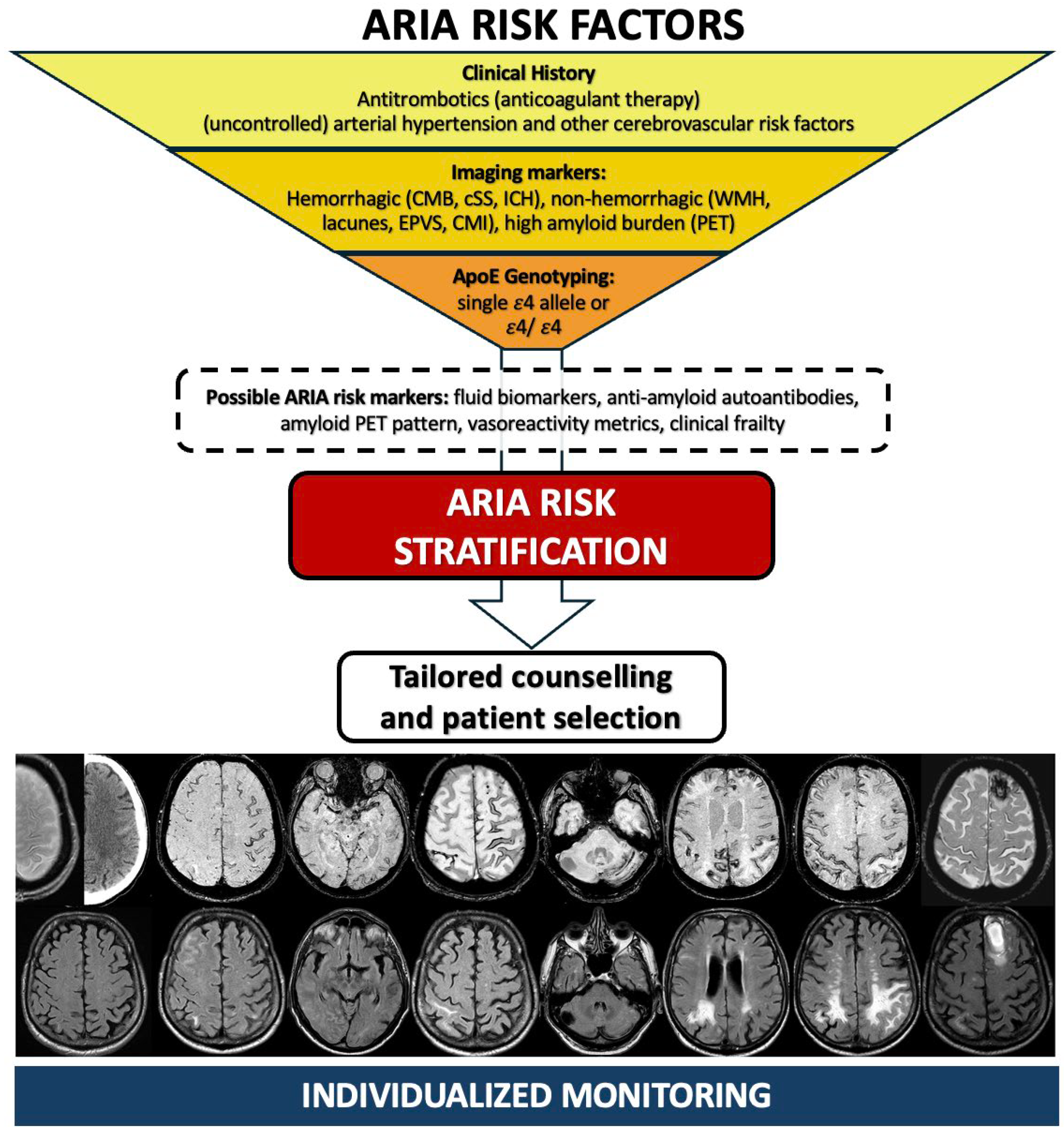
- (i)
- A clinical assessment to exclude major comorbidities (e.g., recent ischemic stroke or TIA, active cancer, systemic autoimmune disease, anticoagulant therapy, uncontrolled arterial hypertension);
- (ii)
- APOE genotyping (which is recommended by the FDA but mandatory for EMA)
- (iii)
- A pre-treatment MRI to evaluate hemorrhagic and ischemic features.
6.2. ARIA Risk Assessment: Possible Implementations from a Vascular Perspective
6.3. Future Directions
7. Conclusions
Author Contributions
Funding
Institutional Review Board Statement
Informed Consent Statement
Data Availability Statement
Conflicts of Interest
References
- Fox, N.C.; Belder, C.; Ballard, C.; Kales, H.C.; Mummery, C.; Caramelli, P.; Ciccarelli, O.; Frederiksen, K.S.; Gomez-Isla, T.; Ismail, Z.; et al. Treatment for Alzheimer’s disease. Lancet 2025, 406, 1408–1423. [Google Scholar] [CrossRef]
- Van Dyck, C.H.; Swanson, C.J.; Aisen, P.; Bateman, R.J.; Chen, C.; Gee, M.; Kanekiyo, M.; Li, D.; Reyderman, L.; Cohen, S.; et al. Lecanemab in Early Alzheimer’s Disease. N. Engl. J. Med. 2023, 388, 9–21. [Google Scholar] [CrossRef]
- Sims, J.R.; Zimmer, J.A.; Evans, C.D.; Lu, M.; Ardayfio, P.; Sparks, J.; Wessels, A.M.; Shcherbinin, S.; Wang, H.; Nery, E.S.M.; et al. Donanemab in Early Symptomatic Alzheimer Disease: The TRAILBLAZER-ALZ 2 Randomized Clinical Trial. JAMA 2023, 330, 512–527. [Google Scholar] [CrossRef] [PubMed]
- Zedde, M.; Losa, M.; Grisafi, E.; Lucia, D.D.; Gandoglia, I.; Del Sette, M.; Pardini, M.; Roccatagliata, L.; Pascarella, R.; Piazza, F. Spontaneous and Drug-Induced Amyloid-Related Imaging Abnormalities: Overlaps, Divergences, and Clinical Implications Across a Continuum Between Alzheimer’s Disease and Cerebral Amyloid Angiopathy. Biomolecules 2026, 16, 89. [Google Scholar] [CrossRef] [PubMed]
- Greenberg, S.M.; Bacskai, B.J.; Hernandez-Guillamon, M.; Pruzin, J.; Sperling, R.; van Veluw, S.J. Cerebral amyloid angiopathy and Alzheimer disease—One peptide, two pathways. Nat. Rev. Neurol. 2020, 16, 30–42. [Google Scholar] [CrossRef] [PubMed]
- Jäkel, L.; De Kort, A.M.; Klijn, C.J.M.; Schreuder, F.H.B.M.; Verbeek, M.M. Prevalence of cerebral amyloid angiopathy: A systematic review and meta-analysis. Alzheimer’s Dement. 2022, 18, 10–28. [Google Scholar] [CrossRef]
- Robinson, J.L.; Xie, S.X.; Baer, D.R.; Suh, E.; Van Deerlin, V.M.; Loh, N.J.; Irwin, D.J.; McMillan, C.T.; Wolk, D.A.; Chen-Plotkin, A.; et al. Pathological combinations in neurodegenerative disease are heterogeneous and disease-associated. Brain 2023, 146, 2557–2569. [Google Scholar] [CrossRef]
- Charidimou, A.; Boulouis, G.; Frosch, M.P.; Baron, J.C.; Pasi, M.; Albucher, J.F.; Banerjee, G.; Barbato, C.; Bonneville, F.; Brandner, S.; et al. The Boston criteria version 2.0 for cerebral amyloid angiopathy: A multicentre, retrospective, MRI-neuropathology diagnostic accuracy study. Lancet Neurol. 2022, 21, 714–725. [Google Scholar] [CrossRef]
- Cordonnier, C.; Klijn, C.; Smith, E.E.; Al-Shahi Salman, R.; Chwalisz, B.K.; van Etten, E.; Muir, R.T.; Piazza, F.; Schreiber, S.; Schreuder, F.H.; et al. Diagnosis and management of cerebral amyloid angiopathy: A scientific statement from the International CAA Association and the World Stroke Organization. Int. J. Stroke 2025, 20, 949–967. [Google Scholar] [CrossRef]
- Bilodeau, P.A.; Dickson, J.R.; Kozberg, M.G. The Impact of Anti-Amyloid Immunotherapies on Stroke Care. J. Clin. Med. 2024, 13, 1245. [Google Scholar] [CrossRef]
- Sperling, R.A.; Jack, C.R., Jr.; Black, S.E.; Frosch, M.P.; Greenberg, S.M.; Hyman, B.T.; Scheltens, P.; Carrillo, M.C.; Thies, W.; Bednar, M.M.; et al. Amyloid-related imaging abnormalities in amyloid-modifying therapeutic trials: Recommendations from the Alzheimer’s Association Research Roundtable Workgroup. Alzheimer’s Dement. 2011, 7, 367–385. [Google Scholar] [CrossRef]
- Antolini, L.; DiFrancesco, J.C.; Zedde, M.; Basso, G.; Arighi, A.; Shima, A.; Cagnin, A.; Caulo, M.; Carare, R.O.; Charidimou, A.; et al. Spontaneous ARIA-like events in cerebral amyloid angiopathy-related inflammation a multicenter prospective longitudinal cohort study. Neurology 2021, 97, E1809–E1822. [Google Scholar] [CrossRef]
- Zimmer, J.A.; Ardayfio, P.; Wang, H.; Khanna, R.; Evans, C.D.; Lu, M.; Sparks, J.; Andersen, S.; Lauzon, S.; Nery, E.S.M.; et al. Amyloid-Related Imaging Abnormalities With Donanemab in Early Symptomatic Alzheimer Disease: Secondary Analysis of the TRAILBLAZER-ALZ and ALZ 2 Randomized Clinical Trials. JAMA Neurol. 2025, 82, 461–469. [Google Scholar] [CrossRef] [PubMed]
- Auriel, E.; Charidimou, A.; Gurol, M.E.; Ni, J.; Van Etten, E.S.; Martinez-Ramirez, S.; Boulouis, G.; Piazza, F.; DiFrancesco, J.C.; Frosch, M.P.; et al. Validation of clinicoradiological criteria for the diagnosis of cerebral amyloid angiopathy-related inflammation. JAMA Neurol. 2016, 73, 197–202. [Google Scholar] [CrossRef] [PubMed]
- Zedde, M.; Pascarella, R.; Piazza, F. CAA-ri and ARIA: Two Faces of the Same Coin? AJNR Am. J. Neuroradiol. 2023, 44, E13. [Google Scholar] [CrossRef]
- Piazza, F.; Greenberg, S.M.; Savoiardo, M.; Gardinetti, M.; Chiapparini, L.; Raicher, I.; Nitrini, R.; Sakaguchi, H.; Brioschi, M.; Billo, G.; et al. Anti-amyloid β autoantibodies in cerebral amyloid angiopathy-related inflammation: Implications for amyloid-modifying therapies. Ann. Neurol. 2013, 73, 449–458. [Google Scholar] [CrossRef] [PubMed]
- Piazza, F.; Caminiti, S.P.; Zedde, M.; Presotto, L.; DiFrancesco, J.C.; Pascarella, R.; Giossi, A.; Sessa, M.; Poli, L.; Basso, G.; et al. Association of Microglial Activation With Spontaneous ARIA-E and CSF Levels of Anti-Aβ Autoantibodies. Neurology 2022, 99, E1265–E1277. [Google Scholar] [CrossRef]
- Ziliotto, N.; Bernardi, F.; Piazza, F. Hemostasis components in cerebral amyloid angiopathy and Alzheimer’s disease. Neurol. Sci. 2021, 42, 3177–3188. [Google Scholar] [CrossRef]
- van Olst, L.; Simonton, B.; Edwards, A.J.; Forsyth, A.V.; Boles, J.; Jamshidi, P.; Watson, T.; Shepard, N.; Krainc, T.; Argue, B.M.; et al. Microglial mechanisms drive amyloid-β clearance in immunized patients with Alzheimer’s disease. Nat. Med. 2025, 31, 1604–1616. [Google Scholar] [CrossRef]
- Nicolll, J.A.R.; Wilkinson, D.; Holmes, C.; Steart, P.; Markham, H.; Weller, R.O. Neuropathology of human Alzheimer disease after immunization with amyloid-beta peptide: A case report. Nat. Med. 2003, 9, 448–452. [Google Scholar] [CrossRef]
- Kozberg, M.G.; Yi, I.; Freeze, W.M.; Auger, C.A.; Scherlek, A.A.; Greenberg, S.M.; van Veluw, S.J. Blood-brain barrier leakage and perivascular inflammation in cerebral amyloid angiopathy. Brain Commun. 2022, 4, fcac245. [Google Scholar] [CrossRef] [PubMed]
- Solopova, E.; Romero-Fernandez, W.; Harmsen, H.; Ventura-Antunes, L.; Wang, E.; Shostak, A.; Maldonado, J.; Donahue, M.J.; Schultz, D.; Coyne, T.M.; et al. Fatal iatrogenic cerebral β-amyloid-related arteritis in a woman treated with lecanemab for Alzheimer’s disease. Nat. Commun. 2023, 14, 8220. [Google Scholar] [CrossRef] [PubMed]
- Reish, N.J.; Jamshidi, P.; Stamm, B.; Flanagan, M.E.; Sugg, E.; Tang, M.; Donohue, K.L.; McCord, M.; Krumpelman, C.; Mesulam, M.-M.; et al. Multiple Cerebral Hemorrhages in a Patient Receiving Lecanemab and Treated with t-PA for Stroke. N. Engl. J. Med. 2023, 388, 478–479. [Google Scholar] [CrossRef] [PubMed]
- Boon, B.D.C.; Piura, Y.D.; Moloney, C.M.; Chalk, J.L.; Lincoln, S.J.; Rutledge, M.H.; Rothberg, D.M.; Kouri, N.; Hinkle, K.M.; Roemer, S.F.; et al. Neuropathologic changes and amyloid-related imaging abnormalities in Alzheimer’s disease treated with aducanumab versus untreated: A retrospective case-control study. Lancet Neurol. 2025, 24, 931. [Google Scholar] [CrossRef]
- Available online: https://www.accessdata.fda.gov/drugsatfda_docs/label/2023/761269Orig1s001lbl.pdf (accessed on 1 February 2026).
- Available online: https://www.ema.europa.eu/en/documents/product-information/leqembi-epar-product-information_en.pdf (accessed on 1 February 2026).
- Greenberg, S.M.; Aparicio, H.J.; Furie, K.L.; Goyal, M.S.; Hinman, J.D.; Kozberg, M.; Leonard, A.; Fisher, M.J.; on behalf of the American Heart Association Stroke Council; Council on Cardiovascular and Stroke Nursing; and Council on Clinical Cardiology. Vascular Neurology Considerations for Antiamyloid Immunotherapy: A Science Advisory From the American Heart Association. Stroke 2025, 56, e30–e38. [Google Scholar] [CrossRef]
- Prabhakaran, S.; Gonzalez, N.R.; Zachrison, K.S.; Adeoye, O.; Alexandrov, A.W.; Ansari, S.A.; Chapman, S.; Czap, A.L.; Dumitrascu, O.M.; Ishida, K.; et al. 2026 Guideline for the Early Management of Patients With Acute Ischemic Stroke: A Guideline from the American Heart Association/American Stroke Association. Stroke 2026. ahead of print. [Google Scholar] [CrossRef]
- Cummings, J.; Apostolova, L.; Rabinovici, G.D.; Atri, A.; Aisen, P.; Greenberg, S.; Hendrix, S.; Selkoe, D.; Weiner, M.; Petersen, R.C.; et al. Lecanemab: Appropriate Use Recommendations. J. Prev. Alzheimer’s Dis. 2023, 10, 362–377. [Google Scholar] [CrossRef] [PubMed] [PubMed Central]
- Rabinovici, G.D.; Selkoe, D.J.; Schindler, S.E.; Aisen, P.; Apostolova, L.G.; Atri, A.; Greenberg, S.M.; Hendrix, S.B.; Petersen, R.C.; Weiner, M.; et al. Donanemab: Appropriate use recommendations. J. Prev. Alzheimer’s Dis. 2025, 12, 100150. [Google Scholar] [CrossRef]
- Pittock, R.R.; Aakre, J.A.; Castillo, A.M.; Ramanan, V.K.; Kremers, W.K.; Jack, C.R., Jr.; Vemuri, P.; Lowe, V.J.; Knopman, D.S.; Petersen, R.C.; et al. Eligibility for Anti-Amyloid Treatment in a Population-Based Study of Cognitive Aging. Neurology 2023, 101, e1837–e1849. [Google Scholar] [CrossRef]
- Claus, J.J.; Vom Hofe, I.; van Ijlzinga Veenstra, A.; Licher, S.; Seelaar, H.; de Jong, F.J.; Neitzel, J.; Vernooij, M.W.; Ikram, M.A.; Wolters, F.J. Generalizability of trial criteria on amyloid-lowering therapy against Alzheimer’s disease to individuals with mild cognitive impairment or early Alzheimer’s disease in the general population. Eur. J. Epidemiol. 2025, 40, 327–337. [Google Scholar] [CrossRef]
- Jeon, S.Y.; Byun, M.S.; Choi, H.J.; Kim, Y.H.; Gwag, C.H.; Oh, Y.; Park, J.E.; Yi, D.; Jung, G.; Ahn, H.; et al. Eligibility for lecanemab and donanemab in Korea under Appropriate Use Recommendations. Alzheimer’s Dement. 2025, 21, e70875. [Google Scholar] [CrossRef] [PubMed]
- Greenberg, S.M.; Charidimou, A. Diagnosis of Cerebral Amyloid Angiopathy: Evolution of the Boston Criteria. Stroke 2018, 49, 491–497. [Google Scholar] [CrossRef] [PubMed]
- Knudsen, K.A.; Rosand, J.; Karluk, D.; Greenberg, S.M. Clinical diagnosis of cerebral amyloid angiopathy: Validation of the Boston criteria. Neurology 2001, 56, 537–539. [Google Scholar] [CrossRef] [PubMed]
- van Rooden, S.; van der Grond, J.; van den Boom, R.; Haan, J.; Linn, J.; Greenberg, S.M.; van Buchem, M.A. Descriptive analysis of the Boston criteria applied to a Dutch-type cerebral amyloid angiopathy population. Stroke 2009, 40, 3022–3027. [Google Scholar] [CrossRef]
- Linn, J.; Halpin, A.; Demaerel, P.; Ruhland, J.; Giese, A.; Dichgans, M.; van Buchem, M.; Bruckmann, H.; Greenberg, S. Prevalence of superficial siderosis in patients with cerebral amyloid angiopathy. Neurology 2010, 74, 1346–1350. [Google Scholar] [CrossRef]
- Puy, L.; Pasi, M.; Rodrigues, M.; van Veluw, S.J.; Tsivgoulis, G.; Shoamanesh, A.; Cordonnier, C. Cerebral microbleeds: From depiction to interpretation. J. Neurol. Neurosurg. Psychiatry 2021, 92, 598–607. [Google Scholar] [CrossRef]
- Shoamanesh, A.; Kwok, C.S.; Benavente, O. Cerebral microbleeds: Histopathological correlation of neuroimaging. Cerebrovasc. Dis. 2011, 32, 528–534. [Google Scholar] [CrossRef]
- van Veluw, S.J.; Biessels, G.J.; Klijn, C.J.; Rozemuller, A.J. Heterogeneous histopathology of cortical microbleeds in cerebral amyloid angiopathy. Neurology 2016, 86, 867–871. [Google Scholar] [CrossRef]
- Charidimou, A.; Pantoni, L.; Love, S. The concept of sporadic cerebral small vessel disease: A road map on key definitions and current concepts. Int. J. Stroke 2016, 11, 6–18. [Google Scholar] [CrossRef]
- Perosa, V.; Auger, C.A.; Zanon Zotin, M.C.; Oltmer, J.; Frosch, M.P.; Viswanathan, A.; Greenberg, S.M.; van Veluw, S.J. Histopathological Correlates of Lobar Microbleeds in False-Positive Cerebral Amyloid Angiopathy Cases. Ann. Neurol. 2023, 94, 856–870. [Google Scholar] [CrossRef]
- Okine, D.N.; Knopman, D.S.; Mosley, T.H.; Wong, D.F.; Johansen, M.C.; Walker, K.A.; Jack, C.R., Jr.; Kantarci, K.; Pike, J.R.; Graff-Radford, J.; et al. Cerebral Microbleed Patterns and Cortical Amyloid-β: The ARIC-PET Study. Stroke 2023, 54, 2613–2620. [Google Scholar] [CrossRef]
- Pasi, M.; Charidimou, A.; Boulouis, G.; Auriel, E.; Ayres, A.; Schwab, K.M.; Goldstein, J.N.; Rosand, J.; Viswanathan, A.; Pantoni, L.; et al. Mixed-location cerebral hemorrhage/microbleeds: Underlying microangiopathy and recurrence risk. Neurology 2018, 90, e119–e126. [Google Scholar] [CrossRef] [PubMed]
- Martinez-Ramirez, S.; Romero, J.; Shoamanesh, A.; McKee, A.C.; Van Etten, E.; Pontes-Neto, O.; Macklin, E.A.; Ayres, A.; Auriel, E.; Himali, J.J.; et al. Diagnostic value of lobar microbleeds in individuals without intracerebral hemorrhage. Alzheimer’s Dement. 2015, 11, 1480–1488. [Google Scholar] [CrossRef] [PubMed]
- Pasi, M.; Pongpitakmetha, T.; Charidimou, A.; Singh, S.D.; Tsai, H.-H.; Xiong, L.; Boulouis, G.; Warren, A.D.; Rosand, J.; Frosch, M.P.; et al. Cerebellar microbleed distribution patterns and cerebral amyloid angiopathy. Stroke 2019, 50, 1727–1733. [Google Scholar] [CrossRef] [PubMed]
- Tsai, H.-H.; Pasi, M.; Tsai, L.-K.; Chen, Y.-F.; Chen, Y.-W.; Tang, S.-C.; Gurol, M.E.; Yen, R.-F.; Jeng, J.-S. Superficial cerebellar microbleeds and cerebral amyloid angiopathy: A magnetic resonance Imaging/Positron emission tomography study. Stroke 2020, 51, 202–208. [Google Scholar] [CrossRef]
- Sveinbjornsdottir, S.; Sigurdsson, S.; Aspelund, T.; Kjartansson, O.; Eiriksdottir, G.; Valtysdottir, B.; Lopez, O.L.; A van Buchem, M.; Jonsson, P.V.; Gudnason, V.; et al. Cerebral microbleeds in the population based AGES-Reykjavik study: Prevalence and location. J. Neurol. Neurosurg. Psychiatry 2008, 79, 1002–1006. [Google Scholar] [CrossRef]
- Romero, J.R.; Preis, S.R.; Beiser, A.; DeCarli, C.; Viswanathan, A.; Martinez-Ramirez, S.; Kase, C.S.; Wolf, P.A.; Seshadri, S. Risk factors, stroke prevention treatments, and prevalence of cerebral microbleeds in the Framingham heart study. Stroke 2014, 45, 1492–1494. [Google Scholar] [CrossRef]
- Poels, M.M.; Vernooij, M.W.; Ikram, M.A.; Hofman, A.; Krestin, G.P.; van der Lugt, A.; Breteler, M.M. Prevalence and risk factors of cerebral microbleeds: An update of the Rotterdam scan study. Stroke 2010, 41, S103–S106. [Google Scholar] [CrossRef]
- Akoudad, S.; Portegies, M.L.; Koudstaal, P.J.; Hofman, A.; van der Lugt, A.; Ikram, M.A.; Vernooij, M.W. Cerebral microbleeds are associated with an increased risk of stroke: The Rotterdam study. Circulation 2015, 132, 509–516. [Google Scholar] [CrossRef]
- Charidimou, A.; Shams, S.; Romero, J.R.; Ding, J.; Veltkamp, R.; Horstmann, S.; Eiriksdottir, G.; A van Buchem, M.; Gudnason, V.; Himali, J.J.; et al. Clinical significance of cerebral microbleeds on MRI: A comprehensive meta-analysis of risk of intracerebral hemorrhage, ischemic stroke, mortality, and dementia in cohort studies (V1). Int. J. Stroke 2018, 13, 454–468. [Google Scholar] [CrossRef]
- Charidimou, A.; Boulouis, G.; Shams, S.; Calvet, D.; Shoamanesh, A.; International META-MICROBLEEDS Initiative. Intracerebral haemorrhage risk in microbleed-positive ischaemic stroke patients with atrial fibrillation: Preliminary meta-analysis of cohorts and anticoagulation decision schema. J. Neurol. Sci. 2017, 378, 102–109. [Google Scholar] [CrossRef]
- Sima, D.M.; Phan, T.V.; Franceschi, A.M.; Gibbs, W.N.; Barkhof, F.; Scheltens, P.; Salloway, S.; Cummings, J.; Van Hecke, W.; Smeets, D. Monitoring of amyloid related imaging abnormalities: SWI vs T2*-GRE. J. Prev. Alzheimer’s Dis. 2025, 12, 100220. [Google Scholar] [CrossRef] [PubMed]
- Nandigam, R.N.; Viswanathan, A.; Delgado, P.; Skehan, M.E.; Smith, E.E.; Rosand, J.; Greenberg, S.M.; Dickerson, B.C. MR imaging detection of cerebral microbleeds: Effect of susceptibility-weighted imaging, section thickness, and field strength. AJNR Am. J. Neuroradiol. 2009, 30, 338–343. [Google Scholar] [CrossRef] [PubMed]
- Assis Lopes, P.; Raposo, N.; Charidimou, A.; Zotin, M.C.Z.; Gurol, M.E.; Greenberg, S.; Viswanathan, A. SWI versus GRE-T2*: As-sessing cortical superficial siderosis in advanced cerebral amyloid angiopathy. Rev. Neurol. 2024, 180, 532–538. [Google Scholar] [CrossRef] [PubMed]
- Shams, S.; Martola, J.; Cavallin, L.; Granberg, T.; Shams, M.; Aspelin, P.; Wahlund, L.O.; Kristoffersen-Wiberg, M. SWI or T2*: Which MRI sequence to use in the detection of cerebral microbleeds? The Karolinska Imaging Dementia Study. AJNR Am. J. Neuroradiol. 2015, 36, 1089–1095. [Google Scholar] [CrossRef]
- Cheng, A.L.; Batool, S.; McCreary, C.R.; Lauzon, M.L.; Frayne, R.; Goyal, M.; Smith, E.E. Susceptibility-weighted imaging is more re-liable than T2*-weighted gradient-recalled echo MRI for detecting microbleeds. Stroke 2013, 44, 2782–2786. [Google Scholar] [CrossRef]
- Haller, S.; Vernooij, M.W.; Kuijer, J.P.; Larsson, E.M.; Jäger, H.R.; Barkhof, F. Cerebral microbleeds: Imag-ing and clinical significance. Radiology 2018, 287, 11–28. [Google Scholar] [CrossRef]
- Wollenweber, F.A.; Opherk, C.; Zedde, M.; Catak, C.; Malik, R.; Duering, M.; Konieczny, M.J.; Pascarella, R.; Samões, R.; Correia, M.; et al. Prognostic relevance of cortical superficial siderosis in cerebral amyloid angiopathy. Neurology 2019, 92, e792–e801. [Google Scholar] [CrossRef]
- Deasy, L.; Laurent-Chabalier, S.; Wacongne, A.; Parvu, T.; Mura, T.; Thouvenot, E.; Renard, D. Diagnostic Accuracy of Posterior/Anterior Periventricular WMH Ratio to Differentiate CAA From Hypertensive Arteriopathy. Stroke 2024, 55, 2086–2093. [Google Scholar] [CrossRef]
- Thanprasertsuk, S.; Martinez-Ramirez, S.; Pontes-Neto, O.M.; Ni, J.; Ayres, A.; Reed, A.; Swords, K.; Gurol, M.E.; Greenberg, S.M.; Viswanathan, A. Posterior white matter disease distribution as a pre-dictor of amyloid angiopathy. Neurology 2014, 83, 794–800. [Google Scholar] [CrossRef]
- Weaver, N.A.; Kuijf, H.J.; Aben, H.P.; Abrigo, J.; Bae, H.J.; Barbay, M.; Best, J.G.; Bordet, R.; Chappell, F.M.; Chen, C.P.L.H.; et al. Strategic infarct locations for post-stroke cognitive impairment: A pooled analysis of individual patient data from 12 acute ischaemic stroke cohorts. Lancet Neurol. 2021, 20, 448–459, Erratum in Lancet Neurol. 2024, 23, e8. https://doi.org/10.1016/S1474-4422(24)00094-2. [Google Scholar] [CrossRef] [PubMed]
- Benjamin, P.; Lawrence, A.J.; Lambert, C.; Patel, B.; Chung, A.W.; MacKinnon, A.D.; Morris, R.G.; Barrick, T.R.; Markus, H.S. Strategic lacunes and their relationship to cognitive impairment in cerebral small vessel disease. Neuroimage Clin. 2014, 4, 828–837. [Google Scholar] [CrossRef] [PubMed]
- Gold, G.; Kövari, E.; Herrmann, F.R.; Canuto, A.; Hof, P.R.; Michel, J.P.; Bouras, C.; Giannakopoulos, P. Cognitive consequences of thalamic, basal ganglia, and deep white matter lacunes in brain aging and dementia. Stroke 2005, 36, 1184–1188. [Google Scholar] [CrossRef] [PubMed]
- Zedde, M.; Quatrale, R.; Cossu, G.; Sette, M.D.; Pascarella, R. The Role of the Claustrum in Parkinson’s Disease and Vascular Parkinsonism: A Matter of Network? Life 2025, 15, 180. [Google Scholar] [CrossRef]
- Zedde, M.; Napoli, M.; Grisendi, I.; Assenza, F.; Moratti, C.; Valzania, F.; Pascarella, R. Perfusion Status in Lacunar Stroke: A Pathophysiological Issue. Diagnostics 2023, 13, 2003. [Google Scholar] [CrossRef]
- Zedde, M.; Napoli, M.; Grisendi, I.; Assenza, F.; Moratti, C.; Valzania, F.; Pascarella, R. CT Perfusion in Lacunar Stroke: A Systematic Review. Diagnostics 2023, 13, 1564. [Google Scholar] [CrossRef]
- Mombelli, S.; Rinaldi, C.; Palumbo, V.; Poggesi, A.; Nencini, P.; Vandelli, G.; Busto, G.; Pascarella, R.; Fainardi, E.; Zedde, M.L.; et al. Imaging patterns and prognosis of proximal and distal small subcortical infarcts. Neurol. Sci. 2025, 46, 3709–3717. [Google Scholar] [CrossRef]
- Wardlaw, J.M.; Valdés Hernández, M.C.; Muñoz-Maniega, S. What are white matter hyperintensities made of? Relevance to vascular cognitive impairment. J. Am. Heart Assoc. 2015, 4, 001140, Erratum in J. Am. Heart Assoc. 2016, 5, e002006. https://doi.org/10.1161/JAHA.115.002006. [Google Scholar] [CrossRef]
- Zanon Zotin, M.C.; Makkinejad, N.; Schneider, J.A.; Arfanakis, K.; Charidimou, A.; Greenberg, S.M.; van Veluw, S.J. Sensitivity and Specificity of the Boston Criteria Version 2.0 for the Diagnosis of Cerebral Amyloid Angiopathy in a Community-Based Sample. Neurology 2024, 102, e207940. [Google Scholar] [CrossRef]
- Switzer, A.R.; Charidimou, A.; McCarter, S.; Vemuri, P.; Nguyen, A.T.; Przybelski, S.A.; Lesnick, T.G.; Rabinstein, A.A.; Brown, R.D.; Knopman, D.S.; et al. Boston Criteria v2.0 for Cerebral Amyloid Angiopathy Without Hemorrhage: An MRI-Neuropathologic Validation Study. Neurology 2024, 102, e209386. [Google Scholar] [CrossRef]
- Ortiz, A.F.H.; Suriano, E.S.; Eltawil, Y.; Sekhon, M.; Gebran, A.; Garland, M.; Cuenca, N.T.R.; Cadavid, T.; Almarie, B. Prevalence and risk factors of unruptured intracranial aneurysms in ischemic stroke patients—A global meta-analysis. Surg. Neurol. Int. 2023, 14, 222. [Google Scholar] [CrossRef] [PubMed]
- Müller, T.B.; Vik, A.; Romundstad, P.R.; Sandvei, M.S. Risk Factors for Unruptured Intracranial Aneurysms and Subarachnoid Hemorrhage in a Prospective Population-Based Study. Stroke 2019, 50, 2952. [Google Scholar] [CrossRef] [PubMed]
- Wiebers, D.O.; Whisnant, J.P.; Huston, J., 3rd; Meissner, I.; Brown, R.D., Jr.; Piepgras, D.G.; Forbes, G.S.; Thielen, K.; Nichols, D.; O’Fallon, W.M.; et al. Unruptured intracranial aneurysms: Natural history, clinical outcome, and risks of surgical and endovascular treatment. Lancet 2003, 362, 103. [Google Scholar] [CrossRef] [PubMed]
- UCAS Japan Investigators. The natural course of unruptured cerebral aneurysms in a Japanese cohort. N. Engl. J. Med. 2012, 366, 2474. [Google Scholar] [CrossRef]
- Greving, J.P.; Wermer, M.J.; Brown, R.D., Jr.; Morita, A.; Juvela, S.; Yonekura, M.; Ishibashi, T.; Torner, J.C.; Nakayama, T.; Rinkel, G.J.; et al. Development of the PHASES score for prediction of risk of rupture of intracranial aneurysms: A pooled analysis of six prospective cohort studies. Lancet Neurol. 2014, 13, 59. [Google Scholar] [CrossRef]
- Rigamonti, D.; Hadley, M.N.; Drayer, B.P.; Johnson, P.C.; Hoenig-Rigamonti, K.; Knight, J.T.; Spetzler, R.F. Cerebral cavernous malformations. Incidence and familial occurrence. N. Engl. J. Med. 1988, 319, 343–347. [Google Scholar] [CrossRef]
- Akers, A.; Al-Shahi Salman, R.; AAwad, I.; Dahlem, K.; Flemming, K.; Hart, B.; Kim, H.; Jusue-Torres, I.; Kondziolka, D.; Lee, C.; et al. Synopsis of Guide-lines for the Clinical Management of Cerebral Cavernous Malformations: Consensus Recommendations Based on Systematic Literature Review by the Angioma Alliance Scientific Advisory Board Clinical Experts Panel. Neurosurgery 2017, 80, 665–680. [Google Scholar] [CrossRef]
- Zuurbier, S.M.; Hickman, C.R.; Tolias, C.S.; Rinkel, L.A.; Leyrer, R.; Flemming, K.D.; Bervini, D.; Lanzino, G.; Wityk, R.J.; Schneble, H.M.; et al. Long-term antithrombotic therapy and risk of intracranial haemorrhage from cerebral cavernous malformations: A population-based cohort study, systematic review, and meta-analysis. Lancet Neurol. 2019, 18, 935–941. [Google Scholar] [CrossRef]
- Schwartz, N.U.; Dietz, C.D.; Prufer Araújo, I.; Villanueva-Meyer, J.E.; Chiong, W.; Lane-Donovan, C.; Vandevrede, L.; Ljubenkov, P.A.; Wang, Y.; Soleimani-Meigooni, D.N.; et al. Changes of a Cerebral Cavernous Malformation Associated With Lecanemab Therapy in a Patient With Alzheimer Disease. Neurol. Clin. Pract. 2025, 15, e200508. [Google Scholar] [CrossRef]
- Greenberg, S.M.; Vernooij, M.W.; Cordonnier, C.; Viswanathan, A.; Salman, R.A.-S.; Warach, S.; Launer, L.J.; A Van Buchem, M.; Breteler, M.M. Cerebral microbleeds: A guide to detection and interpretation. Lancet Neurol. 2009, 8, 165–174. [Google Scholar] [CrossRef]
- Charidimou, A.; Martinez-Ramirez, S.; Reijmer, Y.D.; Oliveira-Filho, J.; Lauer, A.; Roongpiboonsopit, D.; Frosch, M.; Vashkevich, A.; Ayres, A.; Rosand, J.; et al. Total Magnetic Resonance Imaging Burden of Small Vessel Disease in Cerebral Amyloid Angiopathy: An Imaging-Pathologic Study of Concept Validation. JAMA Neurol. 2016, 73, 994–1001. [Google Scholar] [CrossRef]
- Jack, C.R., Jr.; Andrews, J.S.; Beach, T.G.; Buracchio, T.; Dunn, B.; Graf, A.; Hansson, O.; Ho, C.; Jagust, W.; McDade, E.; et al. Revised criteria for diagnosis and staging of Alzheimer’s disease: Alzheimer’s Association Workgroup. Alzheimer’s Dement. 2024, 20, 5143–5169. [Google Scholar] [CrossRef]
- Dubois, B.; Villain, N.; Schneider, L.; Fox, N.; Campbell, N.; Galasko, D.; Kivipelto, M.; Jessen, F.; Hanseeuw, B.; Boada, M.; et al. Alzheimer Disease as a Clinical-Biological Construct-An International Working Group Recommendation. JAMA Neurol. 2024, 81, 1304–1311. [Google Scholar] [CrossRef]
- Duering, M.; Biessels, G.J.; Brodtmann, A.; Chen, C.; Cordonnier, C.; de Leeuw, F.-E.; Debette, S.; Frayne, R.; Jouvent, E.; Rost, N.S.; et al. Neuroimaging standards for research into small vessel disease-advances since 2013. Lancet Neurol. 2023, 22, 602–618. [Google Scholar] [CrossRef]
- van der Plas, M.C.; Koemans, E.A.; Schipper, M.R.; Voigt, S.; Rasing, I.; van der Zwet, R.G.; Kaushik, K.; van Dort, R.; Schriemer, S.; van Harten, T.W.; et al. One-Year Radiologic Progression in Sporadic and Hereditary Cerebral Amyloid Angiopathy. Neurology 2025, 104, e213546. [Google Scholar] [CrossRef] [PubMed]
- Parks, A.L.; Lykken, J.M.; Rieu-Werden, M.L.; Ko, D.; Kim, D.H.; Fang, M.C.; Greenberg, S.M.; Witt, D.M.; Supiano, M.A.; Shah, S.J. Risk of New Indications for Anticoagulants and Thrombolytics in People With Cognitive Impairment: Implications for Anti-Amyloid Therapy. Neurology 2026, 106, e214489. [Google Scholar] [CrossRef] [PubMed]
- Pyun, J.M.; Kang, M.J.; Baek, S.J.; Lee, K.; Park, Y.H.; Kim, S.Y. Magnetic Resonance Imaging-Negative Cerebral Amyloid Angiopathy: Cerebrospinal Fluid Amyloid-β42 over Amyloid Positron Emission Tomography. J. Prev. Alzheimer’s Dis. 2024, 11, 1041–1046. [Google Scholar] [CrossRef] [PubMed]
- van den Brink, H.; Kozberg, M.G.; Makkinejad, N.; Kirsch, J.E.; Thrippleton, M.J.; van Harten, T.W.; Voigt, S.; Freeze, W.M.; Van Osch, M.J.; Viswanathan, A.; et al. In Vivo Imaging of Blood-Brain Barrier Leakage Using a Contrast Agent in Patients With Cerebral Amyloid Angiopathy: An Exploratory Study. Neurology 2025, 105, e214336. [Google Scholar] [CrossRef]
- Zedde, M.; Piazza, F.; Pascarella, R. Positron Emission Tomography in Cerebral Amyloid Angiopathy: A Scoping Review. Appl. Sci. 2025, 15, 3973. [Google Scholar] [CrossRef]
- Xu, F.; Xu, J.; Wang, Q.; Gao, F.; Fu, J.; Yan, T.; Dong, Q.; Su, Y.; Cheng, X. Serum YKL-40 as a Predictive Biomarker of Cerebral Amyloid Angiopathy-Related Intracerebral Hemorrhage Recurrence. J. Alzheimer’s Dis. 2024, 99, 503–511. [Google Scholar] [CrossRef]
- Avola, G.; Bottignole, D.; Cancilla, R.; Florindo, I.; Lucia, D.D.; Grisafi, E.; Cerasti, D.; Scarlattei, M.; Piazza, F.; Menozzi, R.; et al. Iatrogenic cerebral amyloid angiopathy and cerebral amyloid angiopathy-related inflammation: Clinical, radiological and biological findings from a case. Neurol. Sci. 2025, 47, 47. [Google Scholar] [CrossRef]
- Losa, M.; Ramusino, M.C.; Cama, I.; Gualco, L.; Gandoglia, I.; Massa, F.; Donniaquio, A.; Mortola, P.; Argenti, L.; Lombardo, L.; et al. Cerebrospinal Fluid Biomarkers Profiling in Cerebral Amyloid Angiopathy and Relationship With Disease Phenotypes. J. Am. Heart Assoc. 2025, 14, e044784. [Google Scholar] [CrossRef]


| Lecanemab [2] | Donanemab [3] |
|---|---|
| Exclusion criteria (medical history) | |
|
|
| Exclusion criteria (MRI features at screening) | |
|
|
| Participants who are on anticoagulant therapy should have their anticoagulant status optimized and be on a stable dose for 4 weeks before screening | |
| Issues | Limitations |
|---|---|
| CMB number | Crude reliance on CMB counts, with a threshold of “>4 CMBs”, was decided discretionally and not based on biological evidence. While the number of CMB is a risk factor for ARIA, there are no data on the application of different thresholds as selection criteria for AAT. |
| CMB location | They do not account for the anatomical pattern of distribution, which suggests the main etiological driver of the hemorrhagic markers |
| Natural history | The dynamic changes (historical progression) of the hemorrhagic markers are not considered, which carry stronger implications for CAA evidence [87]; |
| CAA diagnostic criteria | There is limited integration in this setting of CAA-specific non-hemorrhagic imaging markers and diagnostic categories, according to Boston Criteria v2.0 [8]. |
Disclaimer/Publisher’s Note: The statements, opinions and data contained in all publications are solely those of the individual author(s) and contributor(s) and not of MDPI and/or the editor(s). MDPI and/or the editor(s) disclaim responsibility for any injury to people or property resulting from any ideas, methods, instructions or products referred to in the content. |
© 2026 by the authors. Licensee MDPI, Basel, Switzerland. This article is an open access article distributed under the terms and conditions of the Creative Commons Attribution (CC BY) license.
Share and Cite
Zedde, M.; Losa, M.; Donniaquio, A.; Gandoglia, I.; Sette, M.D.; Roccatagliata, L.; Piazza, F.; Pardini, M.; Pascarella, R. Drug-Induced Amyloid-Related Imaging Abnormalities: A Neurovascular Perspective on Risk Assessment. Pharmaceuticals 2026, 19, 579. https://doi.org/10.3390/ph19040579
Zedde M, Losa M, Donniaquio A, Gandoglia I, Sette MD, Roccatagliata L, Piazza F, Pardini M, Pascarella R. Drug-Induced Amyloid-Related Imaging Abnormalities: A Neurovascular Perspective on Risk Assessment. Pharmaceuticals. 2026; 19(4):579. https://doi.org/10.3390/ph19040579
Chicago/Turabian StyleZedde, Marialuisa, Mattia Losa, Andrea Donniaquio, Ilaria Gandoglia, Massimo Del Sette, Luca Roccatagliata, Fabrizio Piazza, Matteo Pardini, and Rosario Pascarella. 2026. "Drug-Induced Amyloid-Related Imaging Abnormalities: A Neurovascular Perspective on Risk Assessment" Pharmaceuticals 19, no. 4: 579. https://doi.org/10.3390/ph19040579
APA StyleZedde, M., Losa, M., Donniaquio, A., Gandoglia, I., Sette, M. D., Roccatagliata, L., Piazza, F., Pardini, M., & Pascarella, R. (2026). Drug-Induced Amyloid-Related Imaging Abnormalities: A Neurovascular Perspective on Risk Assessment. Pharmaceuticals, 19(4), 579. https://doi.org/10.3390/ph19040579