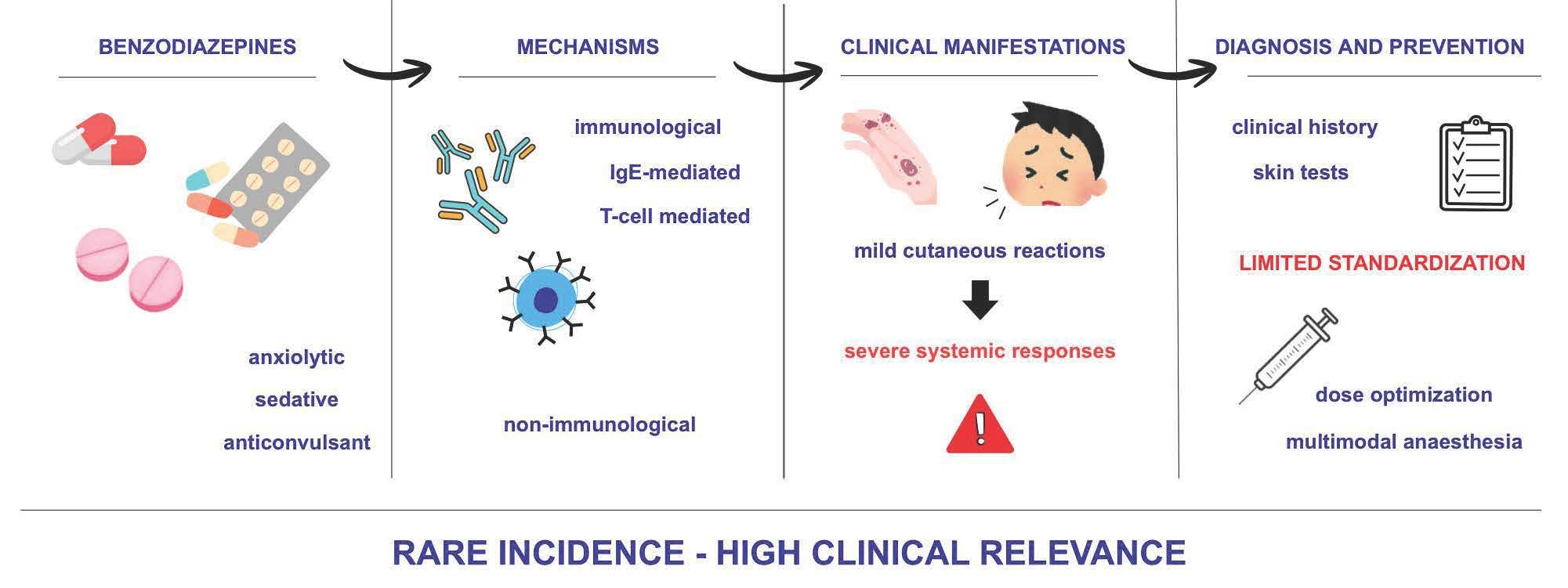
Hypersensitivity Reactions to Benzodiazepines Used for Perioperative Premedication: A Narrative Review
 , , , , and
Abstract
1. Introduction
2. Results
2.1. The Most Used Benzodiazepines in Premedication
2.1.1. Midazolam
2.1.2. Remimazolam
2.2. Hypersensitivity Mechanisms
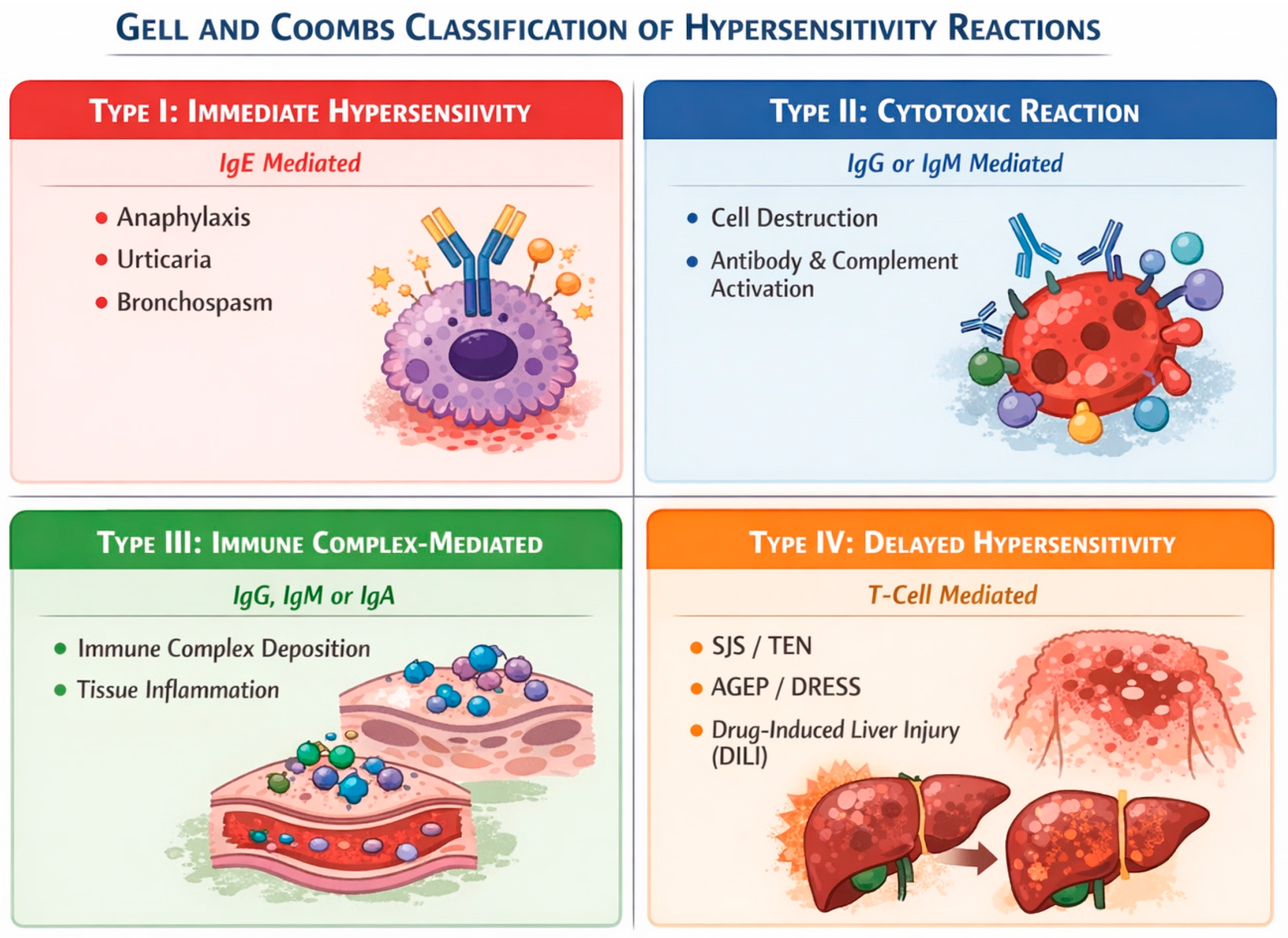
- Type I reactions (Immediate): Mediated by IgE antibodies that bind to mast cells or basophils, triggering the release of mediators that cause anaphylaxis, urticaria and bronchospasm. Notably, an IgG-mediated anaphylaxis has also been documented [16].
- Type II reactions (Cytotoxic): Mediated by drug-specific IgG or IgM antibodies. Cell destruction results from direct antibody–cell interaction or complement activation.
- Type III reactions (Immune Complex): Mediated by IgG, IgM or IgA deposition in tissue leading to organ injury.
- Type IV reactions (Delayed): These T cell-mediated reactions typically present with a delayed onset. This category includes severe cutaneous adverse reactions (SCAR), such as SJS/TEN, AGEP, and DRESS. The reaction may also manifest as single-organ involvement, most commonly drug-induced liver injury (DILI) [16,17].
- The hapten model
- The danger model
- Pharmacological interaction with immune receptors (P–I model reaction)
- Pharmacogenetic reactions
- The altered self-repertoire model
2.3. Paradoxical Reactions Occurring After the Use of Benzodiazepines
2.4. Clinical Picture
2.5. Diagnostic Strategies
2.6. Management and Prevention
3. Discussion
4. Materials and Methods
4.1. Search Strategy
4.2. Eligibility Criteria
4.3. Study Selection and Data Synthesis
5. Conclusions
Author Contributions
Funding
Institutional Review Board Statement
Informed Consent Statement
Data Availability Statement
Conflicts of Interest
References
- Simić, D.; Stanković, Z.; Stević, M.; Petrov-Bojičić, I. Oral premedication with benzodiazepines. Galen. Med. J. 2023, 2, 41–45. [Google Scholar] [CrossRef] [Scilit]
- Marsh, A.; McIndoe, A.K. Premedication. Anaesth. Intensive Care Med. 2004, 5, 250–252. [Google Scholar] [CrossRef] [Scilit]
- Salud Navarra. Available online: https://www.navarra.es/home_en/Temas/Portal+de+la+Salud/Profesionales/Documentacion+y+publicaciones/Publicaciones+tematicas/Medicamento/BIT/Vol+22/DTB+Vol+22+N+2.htm (accessed on 1 January 2026).
- Silva, A.C.D.; Boralli, C.F.; Portilho, N.C.; Garro, L.S.; Ribeiro, M.R.; De Magalhaes, M.C.; Campos, L.; Motta, A.A.; Filho, J.E.K.; Giavina-Bianchi, P.; et al. Midazolam is a major cause of intraoperative immediate hypersensitivity reactions. J. Allergy Clin. Immunol. 2018, 141, AB38. [Google Scholar] [CrossRef] [Scilit]
- Nucera, E.; Parrinello, G.; Buonomo, A.; Aruanno, A.; Rizzi, A. Allergic reactions to midazolam: A case series from an Italian allergy unit. Allergol. Immunopathol. (Madr). 2021, 49, 167–170. [Google Scholar] [CrossRef] [Scilit]
- Landsem, L.M.; Ross, F.J.; Eisses, M.J. A case of midazolam anaphylaxis during a pediatric patient’s first anesthetic. J. Clin. Anesth. 2017, 43, 75–76. [Google Scholar] [CrossRef] [Scilit] [PubMed]
- Laguna, J.; Archilla, J.; Doña, I.; Corominas, M.; Gastaminza, G.; Mayorga, C.; Berjes-Gimeno, P.; Tornero, P.; Martin, S.; Planas, A.; et al. Practical guidelines for perioperative hypersensitivity reactions. J. Investig. Allergol. Clin. Immunol. 2018, 28, 216–232. [Google Scholar] [CrossRef] [Scilit]
- Benzodiazepiny. Available online: https://www.mp.pl/interna/chapter/B16.II.20.4 (accessed on 1 January 2026).
- Haybarger, E.; Young, A.S.; Giovannitti, J.A. Benzodiazepine allergy with anesthesia administration: A review of current literature. Anesth. Prog. 2016, 63, 160–167. [Google Scholar] [CrossRef] [Scilit]
- Bieńkowski, P.; Samochowiec, J.; Sienkiewicz-Jarosz, H.; Wichniak, A.; Mastalerz-Migas, A. Bezpieczne stosowanie benzodiazepin w podstawowej opiece zdrowotnej—Rekomendacje dla lekarzy rodzinnych. Lek. POZ 2019, 5, 177–193. [Google Scholar]
- Hasushita, Y.; Nagao, M.; Miyazawa, Y.; Yunoki, K.; Mima, H. Cardiac arrest following remimazolam-induced anaphylaxis: A case report. A&A Pract. 2022, 16, e01616. [Google Scholar] [CrossRef] [Scilit]
- Winegarner, A.; Kendall, M.C.; Stephen, M.; Siddiqui, A. Delayed anaphylactic reaction to midazolam in the absence of immediate respiratory or skin manifestations. Case Rep. Anesthesiol. 2023, 2023, 3873076. [Google Scholar] [CrossRef] [Scilit] [PubMed]
- Tsurumi, K.; Takahashi, S.; Hiramoto, Y.; Nagumo, K.; Takazawa, T.; Kamiyama, Y. Remimazolam anaphylaxis during anesthesia induction. J. Anesth. 2021, 35, 571–575. [Google Scholar] [CrossRef] [Scilit] [PubMed]
- Hu, X.; Tang, Y.; Fang, X. Laryngeal edema following remimazolam-induced anaphylaxis: A rare clinical manifestation. BMC Anesthesiol. 2023, 23, 99. [Google Scholar] [CrossRef] [Scilit]
- Lee, S.; Park, J.; Kim, N.H.; Hong, H.; Sohn, K.H.; Kang, H.Y.; Kim, M.K.; You, A.H. Remimazolam anaphylaxis during induction of general anesthesia confirmed by provocation test—A case report and literature review. Medicina (Kaunas) 2023, 59, 1915. [Google Scholar] [CrossRef] [Scilit]
- Pallardy, M.; Bechara, R.; Whritenour, J.; Mitchell-Ryan, S.; Herzyk, D.; Lebrec, H.; Merk, H.; Gourley, I.; Komocsar, W.J.; Piccotti, J.R.; et al. Drug hypersensitivity reactions: Review of the state of the science for prediction and diagnosis. Toxicol. Sci. 2024, 200, 11–30. [Google Scholar] [CrossRef] [Scilit]
- Pavlos, R.; Mallal, S.; Ostrov, D.; Buus, S.; Metushi, I.; Peters, B.; Phillips, E. T-cell–mediated hypersensitivity reactions to drugs. Annu. Rev. Med. 2015, 66, 439–454. [Google Scholar] [CrossRef] [Scilit]
- Pichler, W.J. Immune pathomechanism and classification of drug hypersensitivity. Allergy 2019, 74, 1457–1471. [Google Scholar] [CrossRef] [Scilit]
- Ring, J.; Messmer, K. Incidence and severity of anaphylactoid reactions to colloid volume substitutes. Lancet 1977, 309, 466–469. [Google Scholar] [CrossRef] [Scilit]
- Gomez, A.M.; Gonzalez, M.B.; Alvarez, N.C.; Muñoz, M.G.; Sastre, V.H.; Arceo, J.P.; Induráin, B.V. Perioperative anaphylactic reactions: Review and procedure protocol in paediatrics. Allergol. Immunopathol. (Madr). 2015, 43, 203–214. [Google Scholar] [CrossRef] [Scilit]
- Liu, X.; Gong, R.; Xin, X.; Zhao, J. Clinical characteristics and allergen detection of perioperative anaphylaxis: A 12-year retrospective analysis from an anesthesia clinic in China. Perioper. Med. 2022, 11, 5. [Google Scholar] [CrossRef] [Scilit] [PubMed]
- Karaatmaca, B.; Sahiner, U.M.; Sekerel, B.E.; Soyer, O. Perioperative hypersensitivity reactions during childhood and outcomes of subsequent anesthesia. Paediatr. Anaesth. 2021, 31, 436–443. [Google Scholar] [CrossRef] [Scilit] [PubMed]
- Park, S.; Ibrahim, M.; Torres, A. Persistent paradoxical reaction to midazolam despite general anesthesia with dexmedetomidine. Case Rep. Anesthesiol. 2024, 2024, 4152422. [Google Scholar] [CrossRef] [Scilit]
- Sivakumar, S.; Mendonca, R.; Demeterio, D.; Girshin, M. Paradoxical reactions to midazolam in a term parturient after intravenous sedation during cesarean section. Cureus 2021, 13, e17792. [Google Scholar] [CrossRef] [Scilit]
- Jin, E.H.; Song, J.H.; Lee, J.; Bae, J.H.; Chung, S.J. Midazolam dose is associated with recurrence of paradoxical reactions during endoscopy. World J. Clin. Cases 2021, 9, 8763–8772. [Google Scholar] [CrossRef] [Scilit] [PubMed]
- Zhao, Z.; Liu, L.; Zhang, X. Remimazolam-induced paradoxical reaction in a bipolar patient: A case report. Clin. Case Rep. 2023, 11, e71624. [Google Scholar] [CrossRef] [Scilit]
- Nucera, E.; Aruanno, A.; Buonomo, A.; Parrinello, G.; Rizzi, A. Hypersensitivity reaction to midazolam: A case of cardiorespiratory failure. Postepy Dermatol. Alergol. 2021, 37, 1012–1013. [Google Scholar] [CrossRef] [Scilit] [PubMed]
- Nguyen, S.M.T.; Rupprecht, C.P.; Haque, A.; Pattanaik, D.; Yusin, J.; Krishnaswamy, G. Mechanisms governing anaphylaxis: Inflammatory cells, mediators, endothelial gap junctions and beyond. Int. J. Mol. Sci. 2021, 22, 7787. [Google Scholar] [CrossRef] [Scilit]
- Bernardini, R.; Bonadonna, P.; Catania, P.; Passalacqua, G. Perioperative midazolam hypersensitivity in a seven-year-old boy. Pediatr. Allergy Immunol. 2017, 28, 400–401. [Google Scholar] [CrossRef] [Scilit] [PubMed]
- Nakai, T.; Kako, E.; Ota, H.; So, M.H.; Sobue, K. Remimazolam anaphylaxis in a patient not allergic to brotizolam: A case report and literature review. BMC Anesthesiol. 2024, 24, 204. [Google Scholar] [CrossRef] [Scilit]
- Ateş, A.H.; Kul, S. Acute coronary syndrome due to midazolam use: Kounis syndrome during a transurethral prostatectomy. Turk Kardiyol. Dern. Ars. 2015, 43, 558–561. [Google Scholar]
- Ayuse, T.; Kurata, S.; Ayuse, T. Anaphylactoid-like reaction to midazolam during oral and maxillofacial surgery. Anesth. Prog 2015, 62, 64–65. [Google Scholar] [CrossRef] [Scilit]
- Ayyildiz, Z.A.; Işık, S.; Sözmen, Ş.Ç.; Tezcan, D.; Karaman, Ö.; Uzuner, N. Midazolam and ketamine hypersensitivity in a four-year-old child. Asthma Allergy Immunol. 2018, 16, 109–111. [Google Scholar]
- Çakmakcı, S.; Bayhan, T.; Cihan, M.K.; İlhan, İ.E. Anaphylaxis with midazolam in pediatric hematology-oncology unit: A case report. Turk Pediatri Ars. 2018, 53, 200–201. [Google Scholar] [CrossRef] [Scilit]
- Agulló-García, A.; Garcés Sotillos, M.; Colás Sanz, C. Fixed drug eruption due to lorazepam. J. Investig. Allergol. Clin. Immunol. 2018, 28, 185–186. [Google Scholar] [CrossRef] [Scilit]
- Jeon, Y.S.; Shim, J.; Jun, E.H.; Choi, S.T.; Jung, H.S. Midazolam anaphylaxis during general anesthesia: A case report. Medicine (Baltimore) 2019, 98, e17560. [Google Scholar] [CrossRef] [Scilit]
- Tejada, N.; Vu, A. Midazolam-induced perioperative angioedema: A case report. Ann. Allergy Asthma Immunol. 2024, 133, S142–S143. [Google Scholar] [CrossRef] [Scilit]
- Lagarteira, B.; Flor de Lima, M.; Bento, M.; Santa, C.; Rego, J. Unraveling the cause of perioperative anaphylaxis: The role of patent blue dye and midazolam. Cureus 2025, 17, e80013. [Google Scholar] [CrossRef] [Scilit]
- Hopkins, P.M.; Cooke, P.J.; Clarke, R.C.; Guttormsen, A.B.; Platt, P.R.; Dewachter, P.; Ebo, D.G.; Garcez, T.; Garvey, L.H.; Hepner, D.L.; et al. Consensus clinical scoring for suspected perioperative immediate hypersensitivity reactions. Br. J. Anaesth. 2019, 123, e29–e37. [Google Scholar] [CrossRef] [Scilit]
- Funabiki, R.; Horiuchi, T.; Shiraishi, T.; Orihara, M.; Nagumo, K.; Saito, S. Anaphylaxis due to midazolam administered before induction of general anesthesia: A case report. JA Clin. Rep. 2025, 11, 37. [Google Scholar] [CrossRef] [Scilit] [PubMed]
- Takazawa, T.; Yamaura, K.; Hara, T.; Yorozu, T.; Mitsuhata, H.; Morimatsu, H. Practical guidelines for the response to perioperative anaphylaxis. J. Anesth. 2021, 35, 778–793. [Google Scholar] [CrossRef] [Scilit] [PubMed]
- Admass, B.A.; Hassen, A.E.; Agegnehu, A.F.; Temesgen, M.M.; Gebeyehu, N.A.; Ferede, Y.A.; Tegegne, B.A. Management of perioperative anaphylaxis: Systematic review. Int. J. Surg. Open 2023, 52, 100595. [Google Scholar] [CrossRef] [Scilit]
- Di Leo, E.; Delle Donne, P.; Calogiuri, G.F.; Macchia, L.; Nettis, E. Focus on the agents most frequently responsible for perioperative anaphylaxis. Clin. Mol. Allergy 2018, 16, 16. [Google Scholar] [CrossRef] [Scilit] [PubMed]
- Harper, N.J.N.; Cook, T.M.; Garcez, T.; Farmer, L.; Floss, K.; Marinho, S.; Torevell, H.; Warner, A.; Ferguson, K.; Hitchman, J.; et al. Anaesthesia, surgery, and life-threatening allergic reactions: Epidemiology and clinical features of perioperative anaphylaxis in the 6th National Audit Project (NAP6). Br. J. Anaesth. 2018, 121, 159–171. [Google Scholar] [CrossRef] [Scilit]
- Golden, D.B.K.; Wang, J.; Waserman, S.; Akin, C.; Campbell, R.L.; Ellis, A.K.; Greenhawt, M.; Lang, D.M.; Ledford, D.K.; Lieberman, J.; et al. Anaphylaxis: A 2023 practice parameter update. Ann. Allergy Asthma Immunol. 2024, 132, 124–176. [Google Scholar] [CrossRef] [Scilit] [PubMed]
- Misbah, S.A.; Krishna, M.T. Peri-operative anaphylaxis—An investigational challenge. Front. Immunol. 2019, 10, 1117. [Google Scholar] [CrossRef] [Scilit] [PubMed]
- Fukasawa, T.; Suzuki, A.; Otani, K. Effects of genetic polymorphism of cytochrome P450 enzymes on the pharmacokinetics of benzodiazepines. J. Clin. Pharm. Ther. 2007, 32, 333–341. [Google Scholar] [CrossRef] [Scilit]
- Kosaki, Y.; Nishizawa, D.; Hasegawa, J.; Yoshida, K.; Ikeda, K.; Ichinohe, T. γ-Aminobutyric acid type A receptor β1 subunit gene polymorphisms are associated with the sedative and amnesic effects of midazolam. Mol. Brain 2024, 17, 70. [Google Scholar] [CrossRef] [Scilit]


| Clinical Signs | Grade |
|---|---|
| Skin symptoms and/or mild fever reaction | I |
| Measurable, but not life-threatening Cardiovascular reaction (tachycardia, hypotension) Gastrointestinal disturbance (nausea) Respiratory disturbance | II |
| Shock, life-threatening spasm of smooth muscles (bronchi, uterus, etc.) | III |
| Cardiac or respiratory arrest | IV |
| Investigated BDZ | Diagnostic Method | Population | Study Type | Author |
|---|---|---|---|---|
| Midazolam | SPT, ID, BAT, serological tests | 14 adults | Original research | Eberlein et al. |
| Midazolam | SPT, ID | 459 adults | Prospective study | Beyaz et al. |
| Midazolam | SPT, ID, BAT | 145 adults | Retrospective study | Liu et al. |
| Midazolam | SPT, ID, provocation tests | 101 adults | Retrospective study | D’Onofrio et al. |
| Midazolam | SPT, ID, serological tests | 50 children | Retrospective study | Karaatmaca et al. |
| Possible Mechanism | Laboratory Findings | Case Description | Age/Sex | Author (Year) |
|---|---|---|---|---|
| Anaphylactoid reaction (non IgE-mediated) to midazolam | Serum tryptase: Elevated (16.7 μg/L) Troponin: Increased (0.151 to 0.9 ng/dL) | During preoperative preparation before transurethral prostatectomy, the patient received IV midazolam (2 mg). Immediately, he developed ST depression on ECG, hypotension (80/45 mmHg), and urticaria on the legs and back. The patient’s condition progressed to angina, dyspnea, and sweating. Emergency coronary angiography revealed Kounis syndrome (allergic myocardial infarction secondary to the acute hypersensitivity to midazolam). | 70/Male | Ateş et al. (2015) [31] |
| Anaphylactoid reaction (non IgE-mediated) to midazolam probable direct histamine release | Multiple allergy tests, including skin tests, revealed no clear evidence of an allergic reaction. | Patient after the full induction dose of IV midazolam (5 mg) before mandible tumor resection developed a life-threating reaction: hypotension (systolic BP 65 mmHg), bronchospasm, ST depression in ECG, widespread flush, and edema of the eyes. She had a history of skin reactions to antibiotics and CT contrast. | 50/Female | Ayuse et al. (2015) [32] |
| IgE-dependent hypersensitivity (type I) to midazolam likely mediated by a hapten-carrier complex (positive IDT and persistence of skin reactivity) | Specific IgE 1.93% (nonspecific binding (0.7%) SPT (midazolam): Negative IDT (midazolam): Positive After 1 year: Specific IgE 0.66% (nonspecific binding 0.41%) IDT: Positive | A patient with a history of allergic asthma, rhinitis, and a family history of asthma was admitted for adenoidectomy. After premedication with oral midazolam (0.5 mg/kg), he developed dyspnea, wheezing, and prolonged expiration with SpO2 < 90%. | 7/Male | Bernardini et al. (2017) [29] |
| IgE-dependent anaphylaxis (type I hypersensitivity) to midazolam, probable hapten–carrier complex mechanism | Serum Tryptase: Elevated (31.7 μg/L) SPT and IDT (midazolam): Positive | The patient received IV midazolam (2 mg) followed by induction drugs (including vecuronium) before EP ablation. Ten minutes after re-dose of vecuronium, his BP dropped to 68/24 mmHg, HR 125 bpm and hives appeared on the chest and face. | 17/Male | Landsem et al. (2017) [6] |
| Undetermined reaction to midazolam Type 1—positive IDT Pseudoallergic—negative SPT and IgE | Specific IgE: Negative SPT (midazolam): Negative IDT (midazolam, ketamine): Positive | A patient diagnosed with nephrolithiasis developed generalized urticaria immediately after IV midazolam and other anesthetics. Similar reactions happened before. The reaction was limited to the skin (no systemic symptoms) and resolved quickly after treatment. | 4/Female | Arikan Ayyildiz et al. (2018) [33] |
| Anaphylaxis (type I hypersensitivity) to midazolam | Not mentioned | A patient with AML was scheduled for bone marrow aspiration and lumbar puncture. Despite 7 prior exposures to midazolam without incident, this time, immediately after IV midazolam (5 mg) administration, he developed dyspnea. Vomiting, chest pain, hypotension (80/40 mmHg), urticaria, and edema of face and neck. | 17/Male | Çakmakcı et al. (2018) [34] |
| Delayed hypersensitivity reaction (type IV)—fixed drug eruption to lorazepam | Patch test (lorazepam): Negative Controlled oral challenge test (lorazepam): Positive (pruritus and lesions appeared 30 min after 1 mg cumulative dose) Peripheral eosinophilia: 10% | A patient developed cutaneous pruritus and macular lesions on the trunk and limbs during hospitalization after bladder surgery (post-operative period). The reaction recurred 8 h after taking oral lorazepam. Lesions healed with residual hyperpigmentation. | 68/Male | Agulló-García et al. (2018) [35] |
| IgE-dependent hypersensitivity (type I anaphylaxis) to midazolam with possible midazolam-specific IgE antibodies | IDT (9 weeks after reaction): Positive | A patient was preparing for endoscopic discectomy under anesthesia. She had previously received midazolam without incident. This time, one minute after IV midazolam administration (1 mg), she developed BP 41/30 mmHg, HR 46 bpm, bronchospasm (wheezing, obstructive capnography), and skin erythema. | 62/Female | Jeon et al. (2019) [36] |
| IgE-dependent hypersensitivity (type I anaphylaxis) to remimazolam | After onset: Serum tryptase: Normal (5.8 μg/mL) Histamine: Elevated (1.5 ng/mL) IDT (remimazolam midazolam): Positive | A patient with no history of allergy experienced facial flushing, hypoxia, hypotension (BP 49 mmHg), and laryngeal edema 2 min after IV remimazolam administration. | 32/Male | Tsurumi et al. (2021) [13] |
| IgE-dependent anaphylaxis (type I hypersensitivity) to midazolam most likely because of likely hapten–carrier complex formation | Specific IgE: Negative SPT (midazolam): Negative IDT (midazolam): Positive | A patient was undergoing elective video laparoscopic cholecystectomy with IV midazolam (2 mg) administration as premedication. A few minutes after induction, he developed bradycardia (35 bpm). Wide QRS, ST elevation, asystole, and ventricular fibrillation. | 54/Male | Nucera et al. (2021) [27] |
| IgE-dependent anaphylaxis (type I hypersensitivity) to remimazolam with IgE mediated cross-reactivity | IDT (midazolam): Positive IDT (remimazolam): Negative | A patient with no history of allergy was premedicated by IV remimazolam (10 mg) before colonoscopy. He developed stridor, erythema of the face, neck, and chest, swelling of the eyelids and lips, hypotension (BP 77/47 mmHg), epiglottic edema, and diarrhea. | 41/Male | Hu et al. (2023) [14] |
| IgE-dependent anaphylaxis (type I hypersensitivity) to midazolam | Serum tryptase: Elevated (56.5 μg/mL) SPT (midazolam): Positive IDT (midazolam): Positive | A patient with multiple comorbidities and prior exposure to midazolam before incident was premedicated by midazolam IV (2 mg) before hydrocelectomy. Seven minutes after spinal anesthesia, he developed hypotension refractory to vasopressors (38/28 mmHg), HR 31 bpm, and Sp02 86%. | 73/Male | Winegarner et al. (2023) [12] |
| Non-immunological (pseudoallergic) reaction to remimazolam | Serum tryptase: Normal (3.9 μg/L) IDT (all drugs given including remimazolam): Negative Provocation test (remimazolam): Positive | A patient with a history of topical anesthetic allergy (presumed lidocaine) after administration IV remimazolam (10 mg) developed hypotension (32/18 mmHg), tachycardia (102 bpm), and a generalized skin rash with swelling after IV remimazolam (10 mg) administration. | 51/Female | Lee et al. (2023) [15] |
| Delayed hypersensitivity reaction (type IV) to midazolam | Latex IgE and serum complement levels: Normal SPT and IDT (midazolam): Positive | A patient underwent salpingoophorectomy. Six hours after anesthesia induction, she developed unilateral tongue swelling, which persisted for three weeks despite treatment. | 30/Female | Tejada et al. (2024) [37] |
| Undetermined reaction to midazolam and remimazolam | Acute tryptase: Elevated (9.2 μg/L) SPT and IDT (remimazolam, midazolam): Not performed, because it was considered too risky | A patient with a history of two severe reactions (during FFP and anesthesia) where midazolam was the sole drug used during both procedures. During gastrectomy, the patient developed tracheal and bronchial edema, bronchospasm, hypotension, and cardiac arrest. | 75/Male | Nakai et al. (2024) [30] |
| IgE-dependent anaphylaxis (type I hypersensitivity), with two possible causative agents—midazolam and patent blue dye | Serum tryptase: Elevated SPT (midazolam, Patent Blue Dye): Positive IDT (midazolam, Patent Blue Dye): Positive | A woman with no history of allergy was undergoing left total mastectomy. Five minutes after induction IV midazolam and other anesthetic drugs and injection of patent blue dye, she developed MAP 25–45 mmHg and bradycardia (40 bpm). The reaction was refractory to vasopressors. Twenty minutes after the collapse, a diffuse skin rash and edema appeared. | 30/Female | Lagarteira et al. (2025) [38] |
Disclaimer/Publisher’s Note: The statements, opinions and data contained in all publications are solely those of the individual author(s) and contributor(s) and not of MDPI and/or the editor(s). MDPI and/or the editor(s) disclaim responsibility for any injury to people or property resulting from any ideas, methods, instructions or products referred to in the content. |
© 2026 by the authors. Licensee MDPI, Basel, Switzerland. This article is an open access article distributed under the terms and conditions of the Creative Commons Attribution (CC BY) license.
Share and Cite
Gąsiorowska, J.; Kiełczyńska, E.; Dziamara, W.; Grundys, A.; Drozdowska, J.; Woźny, M.; Skiba, A.; Gomułka, K. Hypersensitivity Reactions to Benzodiazepines Used for Perioperative Premedication: A Narrative Review. Pharmaceuticals 2026, 19, 507. https://doi.org/10.3390/ph19030507
Gąsiorowska J, Kiełczyńska E, Dziamara W, Grundys A, Drozdowska J, Woźny M, Skiba A, Gomułka K. Hypersensitivity Reactions to Benzodiazepines Used for Perioperative Premedication: A Narrative Review. Pharmaceuticals. 2026; 19(3):507. https://doi.org/10.3390/ph19030507
Chicago/Turabian StyleGąsiorowska, Julia, Emilia Kiełczyńska, Weronika Dziamara, Amelia Grundys, Justyna Drozdowska, Monika Woźny, Aleksandra Skiba, and Krzysztof Gomułka. 2026. "Hypersensitivity Reactions to Benzodiazepines Used for Perioperative Premedication: A Narrative Review" Pharmaceuticals 19, no. 3: 507. https://doi.org/10.3390/ph19030507
APA StyleGąsiorowska, J., Kiełczyńska, E., Dziamara, W., Grundys, A., Drozdowska, J., Woźny, M., Skiba, A., & Gomułka, K. (2026). Hypersensitivity Reactions to Benzodiazepines Used for Perioperative Premedication: A Narrative Review. Pharmaceuticals, 19(3), 507. https://doi.org/10.3390/ph19030507