Incidence of Guillain–Barré Syndrome Following COVID-19 Vaccination and SARS-CoV-2 Infection: A Population-Based Cohort Study Using the Valencia Health System Integrated Database (Spain)
 , , and
Abstract
1. Introduction
2. Results
2.1. Baseline Characteristics of Patients
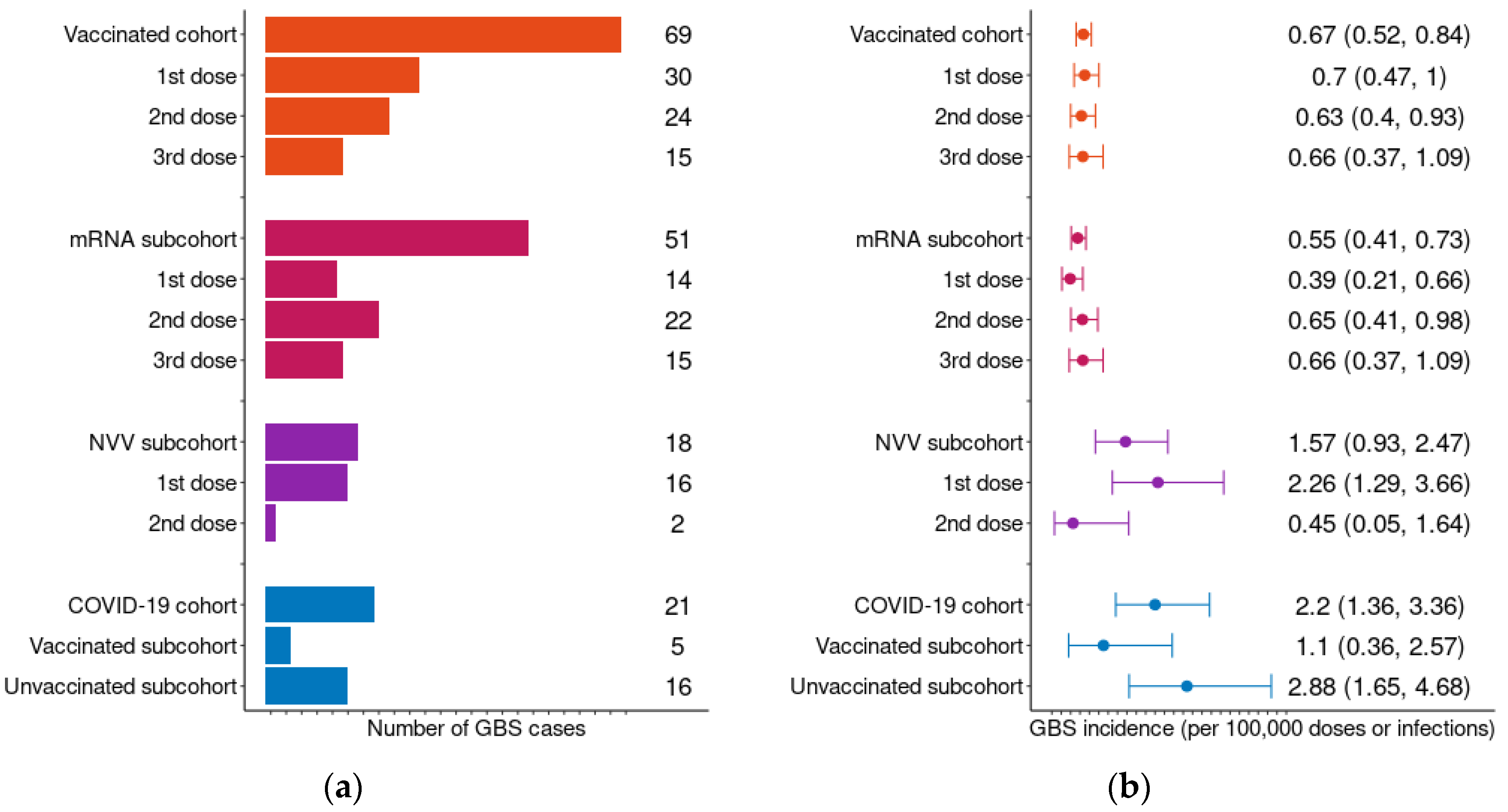
2.2. Vaccinated Cohort and GBS Incidence
2.3. COVID-19 Cohort and GBS Incidence
2.4. GBS Severity
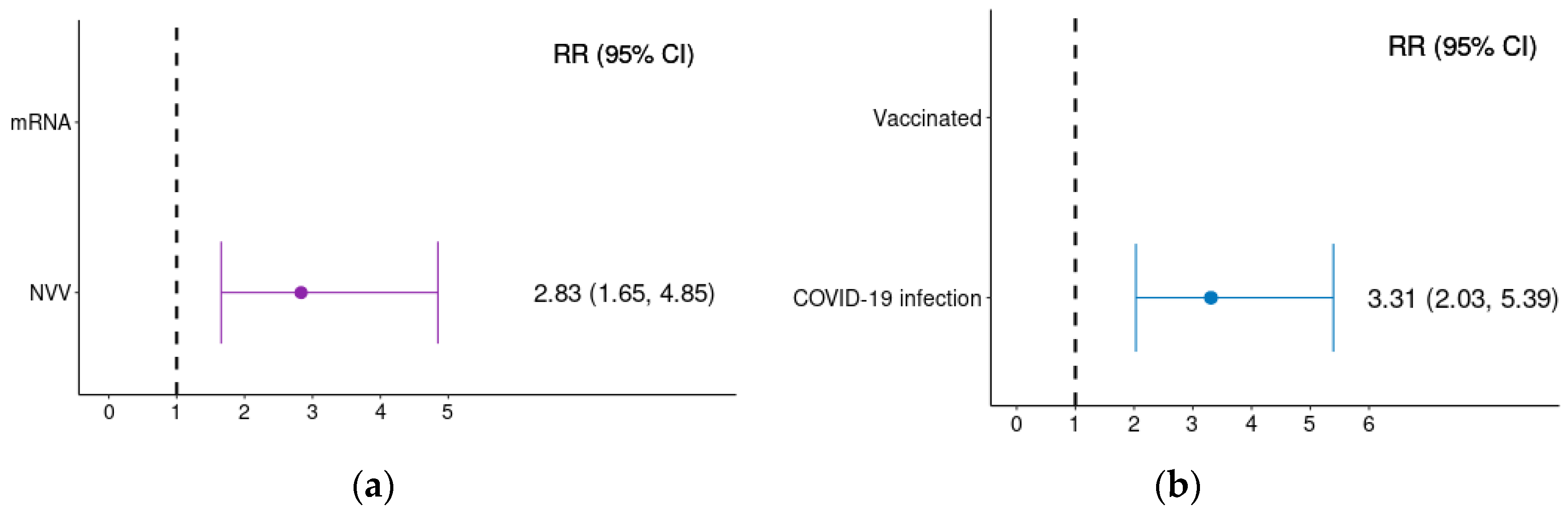
2.5. Relative Risk
2.6. GBS Cases Reported to the PAC-VR as AEFI
3. Discussion
4. Materials and Methods
4.1. Study Design, Cohort and Population
4.2. Data Source
4.3. Outcome
4.4. Exposure
4.5. Statistical Analysis
5. Conclusions
Supplementary Materials
Author Contributions
Funding
Institutional Review Board Statement
Informed Consent Statement
Data Availability Statement
Conflicts of Interest
Abbreviations
| AEFI | Adverse Event Following Immunization |
| AESI | Adverse Event of Special Interest |
| CI | Confidence Interval |
| GBS | Guillain–Barré syndrome |
| ICU | Intensive care unit |
| IQR | Interquartile range |
| NVV | Non-virus-vectored (adenoviral vector–based) COVID-19 vaccines |
| PAC-VR | Pharmacovigilance Autonomic Center of the Valencia Region |
| PCR | Polymerase Chain Reaction |
| RR | Relative Risk |
| VID | Integrated Database of the Valencian Health System |
| VIS | Vaccine Information System |
References
- Willison, H.J.; Jacobs, B.C.; van Doorn, P.A. Guillain-Barré Syndrome. Lancet 2016, 388, 717–727. [Google Scholar] [CrossRef] [Scilit]
- Sejvar, J.J.; Kohl, K.S.; Gidudu, J.; Amato, A.; Bakshi, N.; Baxter, R.; Burwen, D.R.; Cornblath, D.R.; Cleerbout, J.; Edwards, K.M.; et al. Guillain-Barré Syndrome and Fisher Syndrome: Case Definitions and Guidelines for Collection, Analysis, and Presentation of Immunization Safety Data. Vaccine 2011, 29, 599–612. [Google Scholar] [CrossRef] [Scilit]
- Yuki, N.; Hartung, H.-P. Guillain–Barré Syndrome. N. Engl. J. Med. 2012, 366, 2294–2304. [Google Scholar] [CrossRef] [Scilit] [PubMed]
- McGrogan, A.; Madle, G.C.; Seaman, H.E.; De Vries, C.S. The Epidemiology of Guillain-Barré Syndrome Worldwide. Neuroepidemiology 2009, 32, 150–163. [Google Scholar] [CrossRef] [Scilit]
- Goodfellow, J.A.; Willison, H.J. Guillain-Barré Syndrome: A Century of Progress. Nat. Rev. Neurol. 2016, 12, 723–731. [Google Scholar] [CrossRef] [Scilit]
- Esposito, S.; Longo, M.R. Guillain–Barré Syndrome. Autoimmun. Rev. 2017, 16, 96–101. [Google Scholar] [CrossRef] [Scilit] [PubMed]
- Nachamkin, I.; Allos, B.M.; Ho, T. Campylobacter Species and Guillain-Barré Syndrome. Clin. Microbiol. Rev. 1998, 11, 555–567. [Google Scholar] [CrossRef] [Scilit] [PubMed]
- Jacobs, B.C.; Rothbarth, P.H.; van der Meché, F.G.A.; Herbrink, P.; Schmitz, P.I.M.; de Klerk, M.A.; van Doorn, P.A. The Spectrum of Antecedent Infections in Guillain-Barré Syndrome. Neurology 1998, 51, 1110–1115. [Google Scholar] [CrossRef] [Scilit]
- Koike, H.; Katsuno, M. Emerging Infectious Diseases, Vaccines and Guillain–Barré Syndrome. Clin. Exp. Neuroimmunol. 2021, 12, 165–170. [Google Scholar] [CrossRef] [Scilit]
- Parra, B.; Lizarazo, J.; Jiménez-Arango, J.A.; Zea-Vera, A.F.; González-Manrique, G.; Vargas, J.; Angarita, J.A.; Zuñiga, G.; Lopez-Gonzalez, R.; Beltran, C.L.; et al. Guillain–Barré Syndrome Associated with Zika Virus Infection in Colombia. N. Engl. J. Med. 2016, 375, 1513–1523. [Google Scholar] [CrossRef] [Scilit]
- Schonberger, L.B.; Bregman, D.J.; Sullivan-Bolyai, J.Z.; Keenlyside, R.A.; Ziegler, D.W.; Retailliau, H.F.; Eddins, D.L.; Bryan, J.A. Guillain-Barre Syndrome Following Vaccination in the National Influenza Immunization Program, United States, 1976–1977. Am. J. Epidemiol. 1979, 110, 105–123. [Google Scholar] [CrossRef] [Scilit]
- Stowe, J.; Andrews, N.; Wise, L.; Miller, E. Investigation of the Temporal Association of Guillain-Barré Syndrome With Influenza Vaccine and Influenzalike Illness Using the United Kingdom General Practice Research Database. Am. J. Epidemiol. 2009, 169, 382–388. [Google Scholar] [CrossRef] [Scilit]
- World Health Organization. COVID-19 Vaccines: Safety Surveillance Manual; World Health Organization: Geneva, Switzerland, 2020. [Google Scholar]
- Filosto, M.; Cotti Piccinelli, S.; Gazzina, S.; Foresti, C.; Frigeni, B.; Servalli, M.C.; Sessa, M.; Cosentino, G.; Marchioni, E.; Ravaglia, S.; et al. Guillain-Barré Syndrome and COVID-19: An Observational Multicentre Study from Two Italian Hotspot Regions. J. Neurol. Neurosurg. Psychiatry 2021, 92, 751–756. [Google Scholar] [CrossRef] [Scilit] [PubMed]
- Ellul, M.A.; Benjamin, L.; Singh, B.; Lant, S.; Michael, B.D.; Easton, A.; Kneen, R.; Defres, S.; Sejvar, J.; Solomon, T. Neurological Associations of COVID-19. Lancet Neurol. 2020, 19, 767–783. [Google Scholar] [CrossRef] [Scilit]
- Kilinc, D.; van de Pasch, S.; Doets, A.Y.; Jacobs, B.C.; van Vliet, J.; Garssen, M.P.J. Guillain–Barré Syndrome after SARS-CoV-2 Infection. Eur. J. Neurol. 2020, 27, 1757–1758. [Google Scholar] [CrossRef] [Scilit] [PubMed]
- Toscano, G.; Palmerini, F.; Ravaglia, S.; Ruiz, L.; Invernizzi, P.; Cuzzoni, M.G.; Franciotta, D.; Baldanti, F.; Daturi, R.; Postorino, P.; et al. Guillain–Barré Syndrome Associated with SARS-CoV-2. N. Engl. J. Med. 2020, 382, 2574–2576. [Google Scholar] [CrossRef] [Scilit]
- European Medicines Agency (EMA). Vaxzevria (Previously COVID-19 Vaccine AstraZeneca). Available online: https://www.ema.europa.eu/en/medicines/human/EPAR/vaxzevria (accessed on 28 May 2025).
- European Medicines Agency (EMA). Jcovden (Previously COVID-19 Vaccine Janssen). Available online: https://www.ema.europa.eu/en/medicines/human/EPAR/jcovden (accessed on 28 May 2025).
- Hanson, K.E.; Goddard, K.; Lewis, N.; Fireman, B.; Myers, T.R.; Bakshi, N.; Weintraub, E.; Donahue, J.G.; Nelson, J.C.; Xu, S.; et al. Incidence of Guillain-Barré Syndrome After COVID-19 Vaccination in the Vaccine Safety Datalink. JAMA Netw. Open 2022, 5, e228879. [Google Scholar] [CrossRef] [Scilit] [PubMed]
- García-Sempere, A.; Orrico-Sánchez, A.; Muñoz-Quiles, C.; Hurtado, I.; Peiró, S.; Sanfélix-Gimeno, G.; Diez-Domingo, J. Data Resource Profile: The Valencia Health System Integrated Database (VID). Int. J. Epidemiol. 2020, 49, 740–741e. [Google Scholar] [CrossRef] [Scilit]
- Patone, M.; Handunnetthi, L.; Saatci, D.; Pan, J.; Katikireddi, S.V.; Razvi, S.; Hunt, D.; Mei, X.W.; Dixon, S.; Zaccardi, F.; et al. Neurological Complications after First Dose of COVID-19 Vaccines and SARS-CoV-2 Infection. Nat. Med. 2021, 27, 2144–2153. [Google Scholar] [CrossRef] [Scilit]
- Ha, J.; Park, S.; Kang, H.; Kyung, T.; Kim, N.; Kim, D.K.; Kim, H.; Bae, K.; Song, M.C.; Lee, K.J.; et al. Real-World Data on the Incidence and Risk of Guillain–Barré Syndrome Following SARS-CoV-2 Vaccination: A Prospective Surveillance Study. Sci. Rep. 2023, 13, 3773. [Google Scholar] [CrossRef] [Scilit]
- Jeong, Y.D.; Park, S.; Lee, S.; Jang, W.; Park, J.; Lee, K.; Lee, J.; Kang, J.; Udeh, R.; Rahmati, M.; et al. Global Burden of Vaccine-Associated Guillain-Barré Syndrome over 170 Countries from 1967 to 2023. Sci. Rep. 2024, 14, 24561. [Google Scholar] [CrossRef] [Scilit]
- Rzymski, P. Guillain-Barré Syndrome and COVID-19 Vaccines: Focus on Adenoviral Vectors. Front. Immunol. 2023, 14, 1183258. [Google Scholar] [CrossRef] [Scilit]
- Noh, Y.; Ko, H.Y.; Kim, J.H.; Yoon, D.; Choe, Y.J.; Choe, S.-A.; Jung, J.; Shin, J.-Y. Barriers to COVID-19 Vaccine Surveillance: The Issue of under-Reporting Adverse Events. Epidemiol. Health 2023, 45, e2023054. [Google Scholar] [CrossRef] [Scilit]
- Miller, E.R.; McNeil, M.M.; Moro, P.L.; Duffy, J.; Su, J.R. The Reporting Sensitivity of the Vaccine Adverse Event Reporting System (VAERS) for Anaphylaxis and for Guillain-Barré Syndrome. Vaccine 2020, 38, 7458–7463. [Google Scholar] [CrossRef] [Scilit]
- Faillie, J.-L.; Montastruc, F.; Montastruc, J.-L.; Pariente, A. L’apport de La Pharmaco-Épidémiologie à La Pharmacovigilance. Therapies 2016, 71, 203–209. [Google Scholar] [CrossRef] [Scilit]
- Willame, C.; Dodd, C.; Durán, C.; Elbers, R.; Gini, R.; Bartolini, C.; Paoletti, O.; Wang, L.; Ehrenstein, V.; Kahlert, J.; et al. Background Rates of 41 Adverse Events of Special Interest for COVID-19 Vaccines in 10 European Healthcare Databases—An ACCESS Cohort Study. Vaccine 2023, 41, 251–262. [Google Scholar] [CrossRef] [Scilit] [PubMed]
- Bots, S.H.; Belitser, S.; Groenwold, R.H.H.; Durán, C.E.; Riera-Arnau, J.; Schultze, A.; Messina, D.; Segundo, E.; Douglas, I.; Carreras, J.J.; et al. Applying Two Approaches to Detect Unmeasured Confounding Due to Time-Varying Variables in a Self-Controlled Risk Interval Design Evaluating COVID-19 Vaccine Safety Signals, Using Myocarditis as a Case Example. Am. J. Epidemiol. 2025, 194, 208–219. [Google Scholar] [CrossRef] [Scilit] [PubMed]
- Schultze, A.; Martin, I.; Messina, D.; Bots, S.; Belitser, S.; José Carreras-Martínez, J.; Correcher-Martinez, E.; Urchueguía-Fornes, A.; Martín-Pérez, M.; García-Poza, P.; et al. A Comparison of Four Self-Controlled Study Designs in an Analysis of COVID-19 Vaccines and Myocarditis Using Five European Databases. Vaccine 2024, 42, 3039–3048. [Google Scholar] [CrossRef] [Scilit] [PubMed]
- Correcher-Martínez, E.; López-Lacort, M.; Muñoz-Quiles, C.; Díez-Domingo, J.; Orrico-Sánchez, A. Risk of Herpes Zoster in Adults with SARS-CoV-2 Infection in Spain: A Population-Based, Retrospective Cohort Study. Int. J. Infect. Dis. 2024, 143, 107037. [Google Scholar] [CrossRef] [Scilit] [PubMed]



| Population | Total | Sex | Age at the End of Follow-Up | |||
|---|---|---|---|---|---|---|
| Males | Females | <18 Years Old | 18–64 Years Old | +65 Years Old | ||
| General population | 5,109,919 | 2,510,709 (49.13%) | 2,599,210 (50.87%) | 820,162 (16.05%) | 3,119,006 (61.04%) | 1,170,751 (22.91%) |
| Vaccinated cohort | 4,270,610 | 2,077,250 (48.64%) | 2,193,360 (51.36%) | 505,191 (11.83%) | 2,780,394 (65.11%) | 985,025 (23.07%) |
| mRNA vaccinated | 4,192,059 | 2,038,565 (48.63%) | 2,153,494 (51.37%) | 505,175 (12.05%) | 2,707,060 (64.58%) | 979,824 (23.37%) |
| NVV vaccinated | 709,564 | 332,979 (46.93%) | 376,585 (53.07%) | 89 (0.01%) | 622,786 (87.77%) | 86,689 (12.22%) |
| COVID-19 infection cohort | 920,643 | 436,356 (47.40%) | 484,287 (52.60%) | 175,386 (19.05%) | 629,491 (68.38%) | 115,766 (12.57%) |
| Vaccinated | 451,477 | 206,249 (45.68%) | 245,228 (54.32%) | 52,311 (11.59%) | 348,204 (77.13%) | 50,962 (11.29%) |
| Unvaccinated | 545,535 | 263,672 (48.33%) | 281,863 (51.67%) | 126,068 (23.11%) | 341,947 (62.68%) | 77,520 (14.21%) |
| Hospitalized | 33,162 | 18,745 (56.53%) | 14,417 (43.47%) | 490 (1.48%) | 13,816 (41.66%) | 18,856 (56.86%) |
| Non-hospitalized | 888,859 | 418,283 (47.06%) | 470,576 (52.94%) | 174,928 (19.68%) | 616,446 (69.35%) | 97,485 (10.97%) |
| Vaccine Platform | Dose | GBS Cases (n) | Doses Administered (n) | Incidence per 100,000 Doses | 95% CI |
|---|---|---|---|---|---|
| mRNA | Dose 1 | 14 | 3,561,591 | 0.39 | (0.21–0.66) |
| mRNA | Dose 2 | 22 | 3,398,817 | 0.65 | (0.41–0.98) |
| mRNA | Dose 3 | 15 | 2,265,251 | 0.66 | (0.37–1.09) |
| NVV | Dose 1 | 16 | 709,019 | 2.26 | (1.29–3.66) |
| NVV | Dose 2 | 2 | 440,730 | 0.45 | (0.05–1.64) |
| Overall vaccinated | All doses | 69 | 10,375,408 | 0.67 | (0.52–0.84) |
| Vaccinated Cohort | COVID-19 Infected Cohort | |||||
|---|---|---|---|---|---|---|
| Total, N = 69 | RNA Subcohort, N = 51 | NVV Subcohort, N = 18 | Total, N = 21 | Vaccinated Subcohort, N = 5 | Not Vaccinated Subcohort, N = 16 | |
| Hospitalizations, n (%) | 35 (50.72%) | 23 (45.09%) | 12 (66.67%) | 12 (66.67%) | 1 (20.00%) | 11 (68.75%) |
| ICU admission, n (%) | 5 (7.25%) | 4 (7.84%) | 1 (5.56%) | 2 (9.52%) | 0 (0.00%) | 2 (12.50%) |
| Length of stay, Median (IQR) | 9.0 (4.2–19.0) | 8.5 (4.0–15.5) | 10.5 (7.0–21.8) | 15.0 (6.5–22.0) | 9.0 (9.0–9.0) | 21.0 (6.0–22.0) |
Disclaimer/Publisher’s Note: The statements, opinions and data contained in all publications are solely those of the individual author(s) and contributor(s) and not of MDPI and/or the editor(s). MDPI and/or the editor(s) disclaim responsibility for any injury to people or property resulting from any ideas, methods, instructions or products referred to in the content. |
© 2026 by the authors. Licensee MDPI, Basel, Switzerland. This article is an open access article distributed under the terms and conditions of the Creative Commons Attribution (CC BY) license.
Share and Cite
Correcher-Martínez, E.; Viciedo-Mata, S.P.; Urchueguía-Fornes, A.; Carreras, J.J. Incidence of Guillain–Barré Syndrome Following COVID-19 Vaccination and SARS-CoV-2 Infection: A Population-Based Cohort Study Using the Valencia Health System Integrated Database (Spain). Pharmaceuticals 2026, 19, 477. https://doi.org/10.3390/ph19030477
Correcher-Martínez E, Viciedo-Mata SP, Urchueguía-Fornes A, Carreras JJ. Incidence of Guillain–Barré Syndrome Following COVID-19 Vaccination and SARS-CoV-2 Infection: A Population-Based Cohort Study Using the Valencia Health System Integrated Database (Spain). Pharmaceuticals. 2026; 19(3):477. https://doi.org/10.3390/ph19030477
Chicago/Turabian StyleCorrecher-Martínez, Elisa, Sergio Pascual Viciedo-Mata, Arantxa Urchueguía-Fornes, and Juan José Carreras. 2026. "Incidence of Guillain–Barré Syndrome Following COVID-19 Vaccination and SARS-CoV-2 Infection: A Population-Based Cohort Study Using the Valencia Health System Integrated Database (Spain)" Pharmaceuticals 19, no. 3: 477. https://doi.org/10.3390/ph19030477
APA StyleCorrecher-Martínez, E., Viciedo-Mata, S. P., Urchueguía-Fornes, A., & Carreras, J. J. (2026). Incidence of Guillain–Barré Syndrome Following COVID-19 Vaccination and SARS-CoV-2 Infection: A Population-Based Cohort Study Using the Valencia Health System Integrated Database (Spain). Pharmaceuticals, 19(3), 477. https://doi.org/10.3390/ph19030477