Physiologically-Based Pharmacokinetics of Ribociclib Drug–Drug Interactions and Organ Impairment Pharmacokinetics in Early Breast Cancer

 , , ,
, , ,  ,
,
Abstract
1. Introduction
2. Results
2.1. PBPK Model Selection
2.2. Effects of Concomitant Medications on Ribociclib PK
2.3. Effect of Ribociclib on the PK of Concomitant Medications
2.4. Effect of Hepatic Function on Ribociclib PK
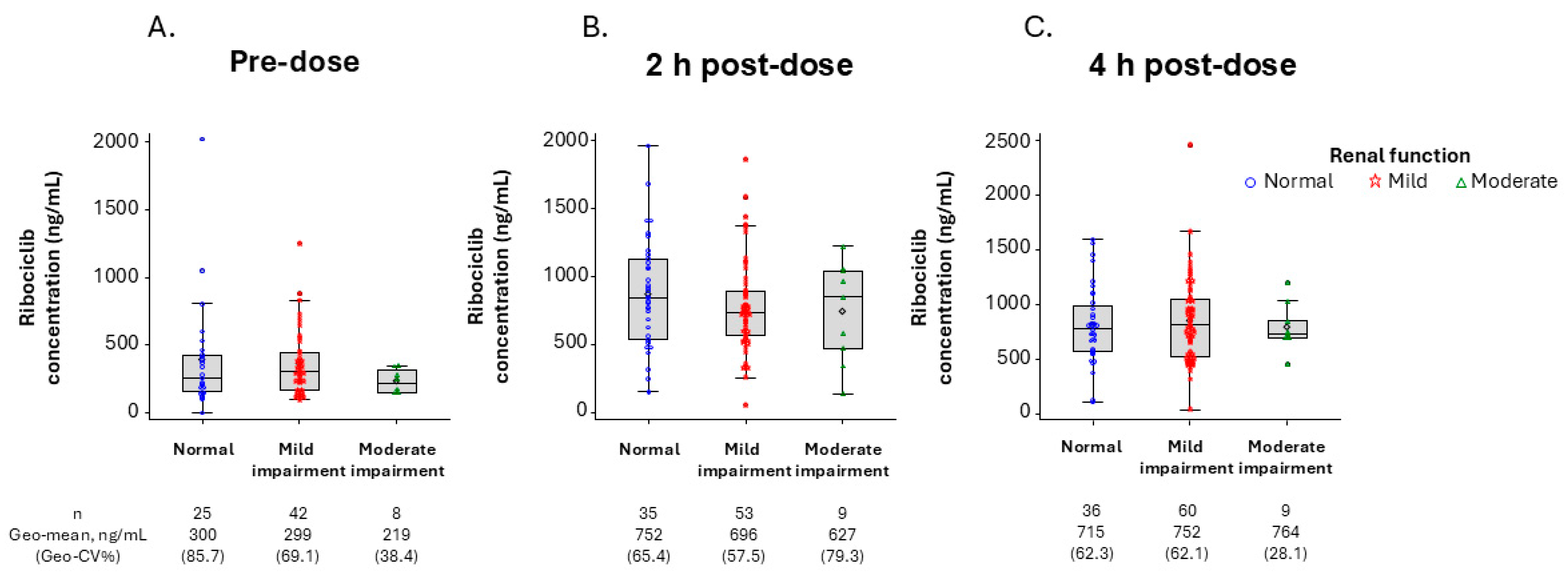
2.5. Effect of Renal Function on Ribociclib PK
3. Discussion
4. Methods
4.1. NATALEE Study Design
4.2. PBPK Modeling and Simulation to Assess DDIs
4.3. Hepatic Impairment Assessment
4.4. Renal Impairment Assessment
5. Conclusions
Supplementary Materials
Author Contributions
Funding
Data Availability Statement
Acknowledgments
Conflicts of Interest
References
- Bray, F.; Laversanne, M.; Sung, H.; Ferlay, J.; Siegel, R.L.; Soerjomataram, I.; Jemal, A. Global cancer statistics 2022: GLOBOCAN estimates of incidence and mortality worldwide for 36 cancers in 185 countries. CA Cancer J. Clin. 2024, 74, 229–263. [Google Scholar] [CrossRef] [PubMed]
- Waks, A.G.; Winer, E.P. Breast Cancer Treatment: A Review. JAMA 2019, 321, 288–300. [Google Scholar] [CrossRef]
- Huppert, L.A.; Gumusay, O.; Idossa, D.; Rugo, H.S. Systemic therapy for hormone receptor-positive/human epidermal growth factor receptor 2-negative early stage and metastatic breast cancer. CA Cancer J. Clin. 2023, 73, 480–515. [Google Scholar] [CrossRef]
- Jhaveri, K.; Pegram, M.; Neven, P.; Curigliano, G.; Spring, L.M.; Gligorov, J.; Schlam, I.; Harbeck, N.; Juric, D.; Lim, E.; et al. 292P Real-world evidence on risk of recurrence in patients with node-negative and node-positive HR+/HER2- early breast cancer from US electronic health records. Ann. Oncol. 2024, 35, S337–S338. [Google Scholar] [CrossRef]
- Pedersen, R.N.; Esen, B.Ö.; Mellemkjær, L.; Christiansen, P.; Ejlertsen, B.; Lash, T.L.; Nørgaard, M.; Cronin-Fenton, D. The Incidence of Breast Cancer Recurrence 10–32 Years After Primary Diagnosis. J. Natl. Cancer Inst. 2022, 114, 391–399. [Google Scholar] [CrossRef] [PubMed]
- Pan, H.; Gray, R.; Braybrooke, J.; Davies, C.; Taylor, C.; McGale, P.; Peto, R.; Pritchard, K.I.; Bergh, J.; Dowsett, M.; et al. 20-Year Risks of Breast-Cancer Recurrence after Stopping Endocrine Therapy at 5 Years. N. Engl. J. Med. 2017, 377, 1836–1846. [Google Scholar]
- Murphy, C.G.; Dickler, M.N. The Role of CDK4/6 Inhibition in Breast Cancer. Oncologist 2015, 20, 483–490. [Google Scholar] [CrossRef]
- Im, S.A.; Lu, Y.S.; Bardia, A.; Harbeck, N.; Colleoni, M.; Franke, F.; Chow, L.; Sohn, J.; Lee, K.S.; Campos-Gomez, S.; et al. Overall Survival with Ribociclib plus Endocrine Therapy in Breast Cancer. N. Engl. J. Med. 2019, 381, 307–316. [Google Scholar] [CrossRef]
- Hortobagyi, G.N.; Stemmer, S.M.; Burris, H.A.; Yap, Y.S.; Sonke, G.S.; Hart, L.; Campone, M.; Petrakova, K.; Winer, E.P.; Janni, W.; et al. Overall Survival with Ribociclib plus Letrozole in Advanced Breast Cancer. N. Engl. J. Med. 2022, 386, 942–950. [Google Scholar] [CrossRef]
- Slamon, D.J.; Neven, P.; Chia, S.; Fasching, P.A.; De Laurentiis, M.; Im, S.A.; Petrakova, K.; Bianchi, G.V.; Esteva, F.J.; Martin, M.; et al. Overall Survival with Ribociclib plus Fulvestrant in Advanced Breast Cancer. N. Engl. J. Med. 2020, 382, 514–524. [Google Scholar] [CrossRef] [PubMed]
- Kisqali Prescribing Information. 2024. Available online: https://www.novartis.com/us-en/sites/novartis_us/files/kisqali.pdf (accessed on 10 January 2026).
- Kisqali. 2025. Available online: https://www.ema.europa.eu/en/medicines/human/EPAR/kisqali (accessed on 20 May 2025).
- Slamon, D.; Lipatov, O.; Nowecki, Z.; McAndrew, N.; Kukielka-Budny, B.; Stroyakovskiy, D.; Yardley, D.A.; Huang, C.S.; Fasching, P.A.; Crown, J.; et al. Ribociclib plus Endocrine Therapy in Early Breast Cancer. N. Engl. J. Med. 2024, 390, 1080–1091. [Google Scholar] [CrossRef]
- Fasching, P.A.; Stroyakovskiy, D.; Yardley, D.A.; Huang, C.S.; Crown, J.; Bardia, A.; Chia, S.; Im, S.A.; Martin, M.; Xu, B.; et al. Ribociclib Plus Endocrine Therapy in Hormone Receptor-Positive/ERBB2-Negative Early Breast Cancer: 4-Year Outcomes From the NATALEE Randomized Clinical Trial. JAMA Oncol. 2025, 11, 1364–1372. [Google Scholar] [CrossRef]
- James, A.D.; Schiller, H.; Marvalin, C.; Jin, Y.; Borell, H.; Roffel, A.F.; Glaenzel, U.; Ji, Y.; Camenisch, G. An integrated assessment of the ADME properties of the CDK4/6 Inhibitor ribociclib utilizing preclinical in vitro, in vivo, and human ADME data. Pharmacol. Res. Perspect. 2020, 8, e00599. [Google Scholar] [CrossRef] [PubMed]
- Ji, Y.; Yartsev, V.; Quinlan, M.; Serra, P.; Wang, Y.; Chakraborty, A.; Miller, M. Justifying Ribociclib Dose in Patients with Advanced Breast Cancer with Renal Impairment Based on PK, Safety, and Efficacy Data: An Innovative Approach Integrating Data from a Dedicated Renal Impairment Study and Oncology Clinical Trials. Clin. Pharmacokinet. 2023, 62, 493–504. [Google Scholar] [CrossRef] [PubMed]
- Samant, T.S.; Huth, F.; Umehara, K.; Schiller, H.; Dhuria, S.V.; Elmeliegy, M.; Miller, M.; Chakraborty, A.; Heimbach, T.; He, H.; et al. Ribociclib Drug-Drug Interactions: Clinical Evaluations and Physiologically-Based Pharmacokinetic Modeling to Guide Drug Labeling. Clin. Pharmacol. Ther. 2020, 108, 575–585. [Google Scholar] [CrossRef]
- Samant, T.S.; Yang, S.; Miller, M.; Ji, Y. Pharmacokinetics of Ribociclib in Subjects With Hepatic Impairment. J. Clin. Pharmacol. 2021, 61, 1001–1009. [Google Scholar] [CrossRef]
- Ji, Y.; Schiller, H.; Yang, S.; Quinlan, M.; Darstein, C.; Huth, F.; Winter, S.; Chakraborty, A. Use of Pharmacokinetic and Pharmacodynamic Data to Develop the CDK4/6 Inhibitor Ribociclib for Patients with Advanced Breast Cancer. Clin. Pharmacokinet. 2024, 63, 155–170. [Google Scholar] [CrossRef]
- Abdel-Razeq, H.; Iweir, S.; Abdel-Razeq, R.; Rahman, F.A.; Almasri, H.; Bater, R.; Taqash, A.; Abdelkhaleq, H. Differences in clinicopathological characteristics, treatment, and survival outcomes between older and younger breast cancer patients. Sci. Rep. 2021, 11, 14340. [Google Scholar] [CrossRef] [PubMed]
- Tang, D.D.; Ye, Z.J.; Liu, W.W.; Wu, J.; Tan, J.Y.; Zhang, Y.; Xu, Q.; Xiang, Y.B. Survival feature and trend of female breast cancer: A comprehensive review of survival analysis from cancer registration data. Breast 2025, 79, 103862. [Google Scholar] [CrossRef]
- Fietz, T.; Zahn, M.O.; Köhler, A.; Engel, E.; Frank, M.; Kruggel, L.; Jänicke, M.; Marschner, N. Routine treatment and outcome of breast cancer in younger versus elderly patients: Results from the SENORA project of the prospective German TMK cohort study. Breast Cancer Res. Treat. 2018, 167, 567–578. [Google Scholar] [CrossRef]
- Crown, J.P.; Wang, C.; Combes, F.P.; Ho, Y.Y.; Fasching, P.A.; Untch, M.; Zarate, J.P.; Ji, Y. 228P Ribociclib (RIB) in early breast cancer (eBC): Pharmacokinetic (PK) assessment and exposure-response analysis. ESMO Open 2025, 10, 104782. [Google Scholar] [CrossRef]
- NDA/BLA Multi-Disciplinary Review and Evaluation. Available online: https://www.accessdata.fda.gov/drugsatfda_docs/nda/2024/209092s018,209935s027MultidisciplineR.pdf (accessed on 30 October 2025).
- Hortobagyi, G.N.; Lacko, A.; Sohn, J.; Cruz, F.; Ruiz Borrego, M.; Manikhas, A.; Hee Park, Y.; Stroyakovskiy, D.; Yardley, D.A.; Huang, C.S.; et al. A phase III trial of adjuvant ribociclib plus endocrine therapy versus endocrine therapy alone in patients with HR-positive/HER2-negative early breast cancer: Final invasive disease-free survival results from the NATALEE trial. Ann. Oncol. 2025, 36, 149–157. [Google Scholar] [CrossRef]
- Chirgwin, J.H.; Giobbie-Hurder, A.; Coates, A.S.; Price, K.N.; Ejlertsen, B.; Debled, M.; Gelber, R.D.; Goldhirsch, A.; Smith, I.; Rabaglio, M.; et al. Treatment Adherence and Its Impact on Disease-Free Survival in the Breast International Group 1-98 Trial of Tamoxifen and Letrozole, Alone and in Sequence. J. Clin. Oncol. 2016, 34, 2452–2459. [Google Scholar] [CrossRef]
- Peddie, N.; Agnew, S.; Crawford, M.; Dixon, D.; MacPherson, I.; Fleming, L. The impact of medication side effects on adherence and persistence to hormone therapy in breast cancer survivors: A qualitative systematic review and thematic synthesis. Breast 2021, 58, 147–159. [Google Scholar] [CrossRef]
- Wagner, L.I.; Zhao, F.; Goss, P.E.; Chapman, J.W.; Shepherd, L.E.; Whelan, T.J.; Mattar, B.I.; Bufill, J.A.; Schultz, W.C.; LaFrancis, I.E.; et al. Patient-reported predictors of early treatment discontinuation: Treatment-related symptoms and health-related quality of life among postmenopausal women with primary breast cancer randomized to anastrozole or exemestane on NCIC Clinical Trials Group (CCTG) MA.27 (E1Z03). Breast Cancer Res. Treat. 2018, 169, 537–548. [Google Scholar] [PubMed]
- Lu, Y.; Yang, S.; Ho, Y.Y.; Ji, Y. Ribociclib Population Pharmacokinetics and Pharmacokinetic/Pharmacodynamic Analysis of Neutrophils in Cancer Patients. J. Clin. Pharmacol. 2021, 61, 1054–1068. [Google Scholar] [CrossRef]
- Slamon, D.J.; Fasching, P.A.; Hurvitz, S.; Chia, S.; Crown, J.; Martín, M.; Barrios, C.H.; Bardia, A.; Im, S.A.; Yardley, D.A.; et al. Rationale and trial design of NATALEE: A Phase III trial of adjuvant ribociclib + endocrine therapy versus endocrine therapy alone in patients with HR+/HER2- early breast cancer. Ther. Adv. Med. Oncol. 2023, 15, 17588359231178125. [Google Scholar] [CrossRef]
- Ji, Y.; Abdelhady, A.M.; Samant, T.S.; Yang, S.; Rodriguez Lorenc, K. Evaluation of Absolute Oral Bioavailability and Bioequivalence of Ribociclib, a Cyclin-Dependent Kinase 4/6 Inhibitor, in Healthy Subjects. Clin. Pharmacol. Drug Dev. 2020, 9, 855–866. [Google Scholar] [CrossRef]
- Patel, H.; Egorin, M.J.; Remick, S.C.; Mulkerin, D.; Takimoto, C.H.M.; Doroshow, J.H.; Potter, D.; Ivy, S.P.; Murgo, A.J.; Ramanathan, R.K. Comparison of Child-Pugh (CP) criteria and NCI organ dysfunction working group (NCI-ODWG) criteria for hepatic dysfunction (HD): Implications for chemotherapy dosing. J. Clin. Oncol. 2004, 22, 6051. [Google Scholar] [CrossRef]
- KDIGO 2012 Clinical Practice Guideline for the Evaluation and Management of Chronic Kidney Disease. Available online: https://kdigo.org/wp-content/uploads/2017/02/KDIGO_2012_CKD_GL.pdf (accessed on 10 January 2026).



| Precipitant | RIB Dose Regimen | Precipitant Status | Geometric Mean Cmax, ng/mL (%CV) | Geometric Mean AUC, ng•h/mL (%CV) | Geometric Mean Cmax Ratio (90% CI) | Geometric Mean AUC Ratio (90% CI) |
|---|---|---|---|---|---|---|
| Ritonavir 100 mg BID for 8 days | 400 mg QD for 8 days | Without inhibitor | 900 (35.5) | 10,523 (47.1) | 1.47 (1.43, 1.51) | 1.84 (1.76, 1.93) |
| With inhibitor | 1322 (28.9) | 19,401 (35.5) | ||||
| Ritonavir 100 mg BID for 8 days | 200 mg QD for 8 days | Without inhibitor | 375 (33.5) | 3855 (42.5) | 1.76 (1.72, 1.82) | 2.51 (2.40, 2.63) |
| With inhibitor | 661 (28.9) | 9696 (35.5) | ||||
| Erythromycin 500 mg BID for 8 days | 400 mg QD for 8 days | Without inhibitor | 900 (35.5) | 10,523 (47.1) | 1.13 (1.12, 1.14) | 1.23 (1.21, 1.24) |
| With inhibitor | 1021 (33.7) | 12,912 (44.0) | ||||
| Rifampicin 600 mg QD for 14 days | 400 mg QD for 14 days | Without inducer | 518 (28.6) | 5753 (33.5) | 0.342 (0.318, 0.367) | 0.171 (0.155, 0.188) |
| With inducer | 206 (53.6) | 1149 (59.2) | ||||
| Efavirenz 600 mg QD for 14 days | 400 mg QD for 14 days | Without inducer | 521 (29.1) | 5866 (34.4) | 0.449 (0.424, 0.477) | 0.260 (0.236, 0.286) |
| With inducer | 286 (36.2) | 1842 (43.1) |
| Precipitant Dose Regimen | Object Dose Regimen | Source | Object Drug Geometric Mean Cmax Ratio (90% CI) | Object Drug Geometric Mean AUC Ratio (90% CI) |
|---|---|---|---|---|
| RIB 400 mg QD for 8 days | Midazolam 2 mg SD on day 8 | Observed | 2.05 (1.88, 2.23) | 3.75 (3.41, 4.11) |
| Predicted | 2.28 (2.18, 2.38) | 4.18 (3.84, 4.55) |
| Model-Predicted PK Parameter | Cohort | n | Adjusted Geometric Mean | Cohort Comparison | |||
|---|---|---|---|---|---|---|---|
| Comparison | Geometric Mean Ratio | 90% Lower CI | 90% Upper CI | ||||
| Cmax, ng/mL | Normal | 45 | 1050 | Mild impairment/normal | 0.939 | 0.853 | 1.03 |
| Mild impairment | 69 | 991 | |||||
| AUC0–24, ng•h/mL | Normal | 45 | 10,500 | Mild impairment/normal | 0.994 | 0.895 | 1.10 |
| Mild impairment | 69 | 10,400 | |||||
| Tmax, h | Normal | 45 | 3.63 | Mild impairment/normal | 1.020 | 0.988 | 1.05 |
| Mild impairment | 69 | 3.70 | |||||
Disclaimer/Publisher’s Note: The statements, opinions and data contained in all publications are solely those of the individual author(s) and contributor(s) and not of MDPI and/or the editor(s). MDPI and/or the editor(s) disclaim responsibility for any injury to people or property resulting from any ideas, methods, instructions or products referred to in the content. |
© 2026 by the authors. Licensee MDPI, Basel, Switzerland. This article is an open access article distributed under the terms and conditions of the Creative Commons Attribution (CC BY) license.
Share and Cite
Ji, Y.; Huth, F.; Wang, C.; Schiller, H.; Combes, F.P.; Crown, J.; Fasching, P.A.; Zarate, J.P.; Untch, M. Physiologically-Based Pharmacokinetics of Ribociclib Drug–Drug Interactions and Organ Impairment Pharmacokinetics in Early Breast Cancer. Pharmaceuticals 2026, 19, 461. https://doi.org/10.3390/ph19030461
Ji Y, Huth F, Wang C, Schiller H, Combes FP, Crown J, Fasching PA, Zarate JP, Untch M. Physiologically-Based Pharmacokinetics of Ribociclib Drug–Drug Interactions and Organ Impairment Pharmacokinetics in Early Breast Cancer. Pharmaceuticals. 2026; 19(3):461. https://doi.org/10.3390/ph19030461
Chicago/Turabian StyleJi, Yan, Felix Huth, Craig Wang, Hilmar Schiller, Francois Pierre Combes, John Crown, Peter A. Fasching, Juan Pablo Zarate, and Michael Untch. 2026. "Physiologically-Based Pharmacokinetics of Ribociclib Drug–Drug Interactions and Organ Impairment Pharmacokinetics in Early Breast Cancer" Pharmaceuticals 19, no. 3: 461. https://doi.org/10.3390/ph19030461
APA StyleJi, Y., Huth, F., Wang, C., Schiller, H., Combes, F. P., Crown, J., Fasching, P. A., Zarate, J. P., & Untch, M. (2026). Physiologically-Based Pharmacokinetics of Ribociclib Drug–Drug Interactions and Organ Impairment Pharmacokinetics in Early Breast Cancer. Pharmaceuticals, 19(3), 461. https://doi.org/10.3390/ph19030461